engine AUDI A5 COUPE 2014 Service Manual
[x] Cancel search | Manufacturer: AUDI, Model Year: 2014, Model line: A5 COUPE, Model: AUDI A5 COUPE 2014Pages: 286, PDF Size: 70.99 MB
Page 119 of 286
Programming the transmitter (version B)
Applies to vehicles: with Horne link
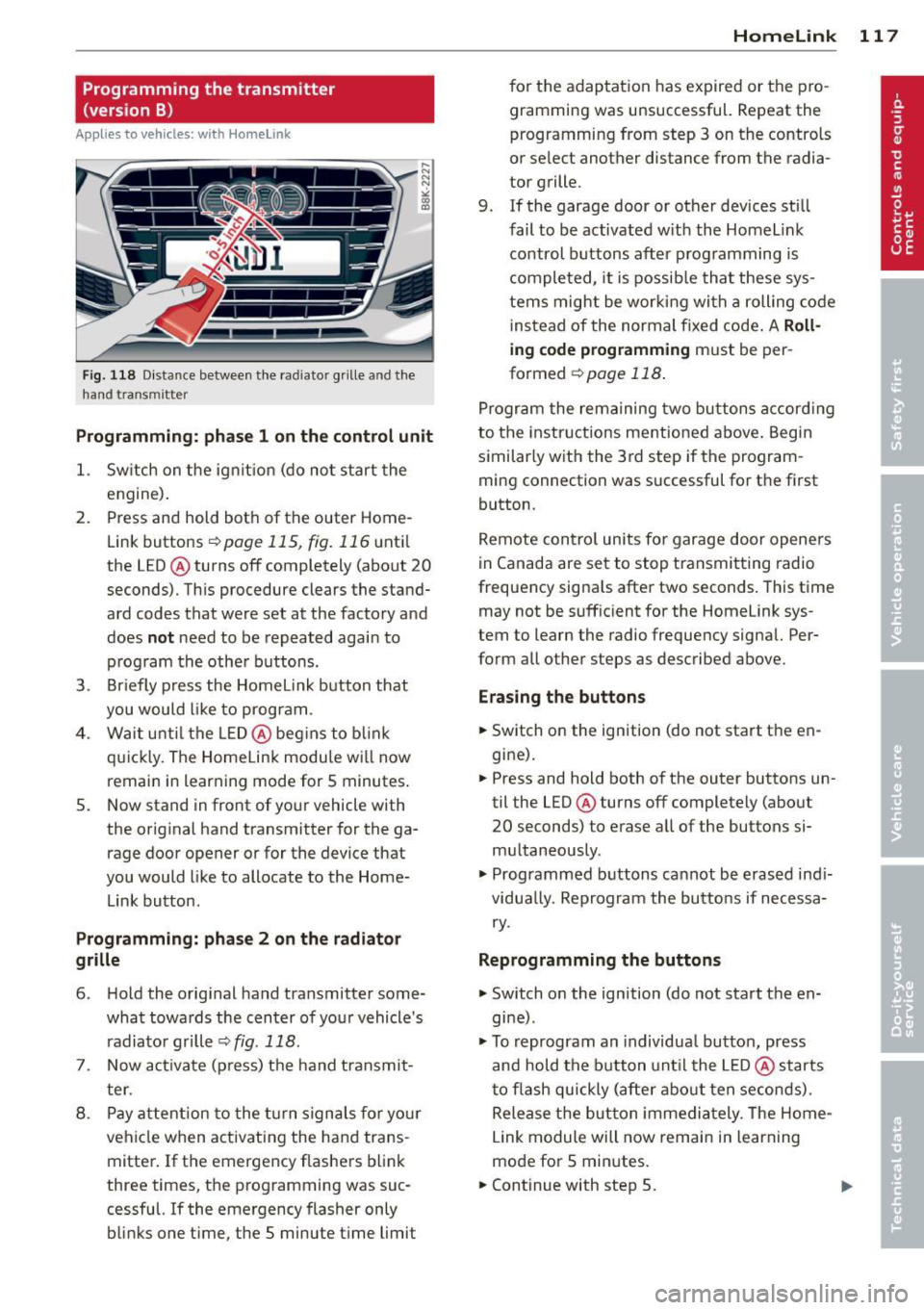
Fig. 118 D istance between t he rad ia to r gr ille a nd the
h and trans mitter
Programming: phase 1 on the control unit
1. Sw itch on the ig nit io n (do no t start the
engine ).
2. Press and hold bot h of the outer Home
Link buttons
r=> page 115, fig. 116 until
the LED @ turns off completely (about
20
seconds). Th is procedure clears the stand
ard codes that were set at the factory and
does
not need to be repeated agai n to
p rog ram the othe r buttons.
3 . Briefly press the Homelink button that
you would like to prog ram .
4 . Wai t unti l the LED @ beg ins to blink
q ui ckly . The Home Lin k modu le wi ll now
remai n in learning mode for
5 minutes .
5. Now stand in front of your vehicle with
the original hand transmitter for the ga rage door opener or for the device that
you would like to allocate to the Home
Link button.
Programming: pha se 2 on the radiator
grille
6 . Hold the orig inal hand t ransmitter some
what towa rds the center o f you r vehicle 's
radiato r gr ille
r=> fig . 118 .
7. Now activate (p ress) t he hand transmit
ter.
8 . Pay a ttention to the t urn sign als for yo ur
vehicle when activating the ha nd trans
mitter . If t he emergency flashers b link
three times, the programming was suc
cessful. If the emergency flasher only bli nks one t ime, the 5 minute t ime limit
Homelink 11 7
for the adaptat ion has expired or the pro
gram ming was unsuccessful. Repeat the
programming from step 3 on the controls
o r se lect another distance from the radia
tor grille.
9. If the garage door or other devices sti ll
fail to be activated w it h the Homelin k
control buttons after p rogramming is
comple ted, it is possib le tha t these sys
tems might be w ork ing wi th a roll ing co de
ins tead of the normal fixed co de.
A Roll
ing code programming must be per
formed
r=> page 118 .
Program the rema ining tw o butt ons accor ding
to the instructions mentioned above . Beg in
similar ly w ith the 3rd step if the program
m ing connection was successful for t he fi rst
button .
Remote con trol units fo r garage door opene rs
in Canada are set to stop tra nsmitting radio
frequency signa ls after two seconds . This t ime
may not be suffic ient for the Homelink sys
tem to learn the radio frequency signa l. Per
form all other steps as described above.
Erasing the buttons
.,. Switch on the ignition (do not sta rt the en
gi ne).
.,. Press and hold both o f the outer buttons un
til the LED@ turns off completely (abo ut
20 seconds) to e rase a ll of the buttons si
m ultaneously .
.,. Programmed b uttons ca nnot be erased ind i
vidua lly. Reprogram the butto ns if necessa
ry .
Reprogramming the buttons
.,. Switch o n the ignition (do not start t he en
gine) .
.,. To reprogram an individua l bu tto n, press
and hold the button unt il the LED @ starts
t o f lash quickly (a fter ab out ten seconds) .
Release t he bu tton imme dia tely. The Home
L ink module will now remai n in learning
mo de for 5 min utes.
.,. Continue with step 5.
Page 132 of 286
130 Safety belts
Why safety belts?
Frontal collisions and the law of physics
Frontal crashes create very strong forces for
people riding in vehicles .
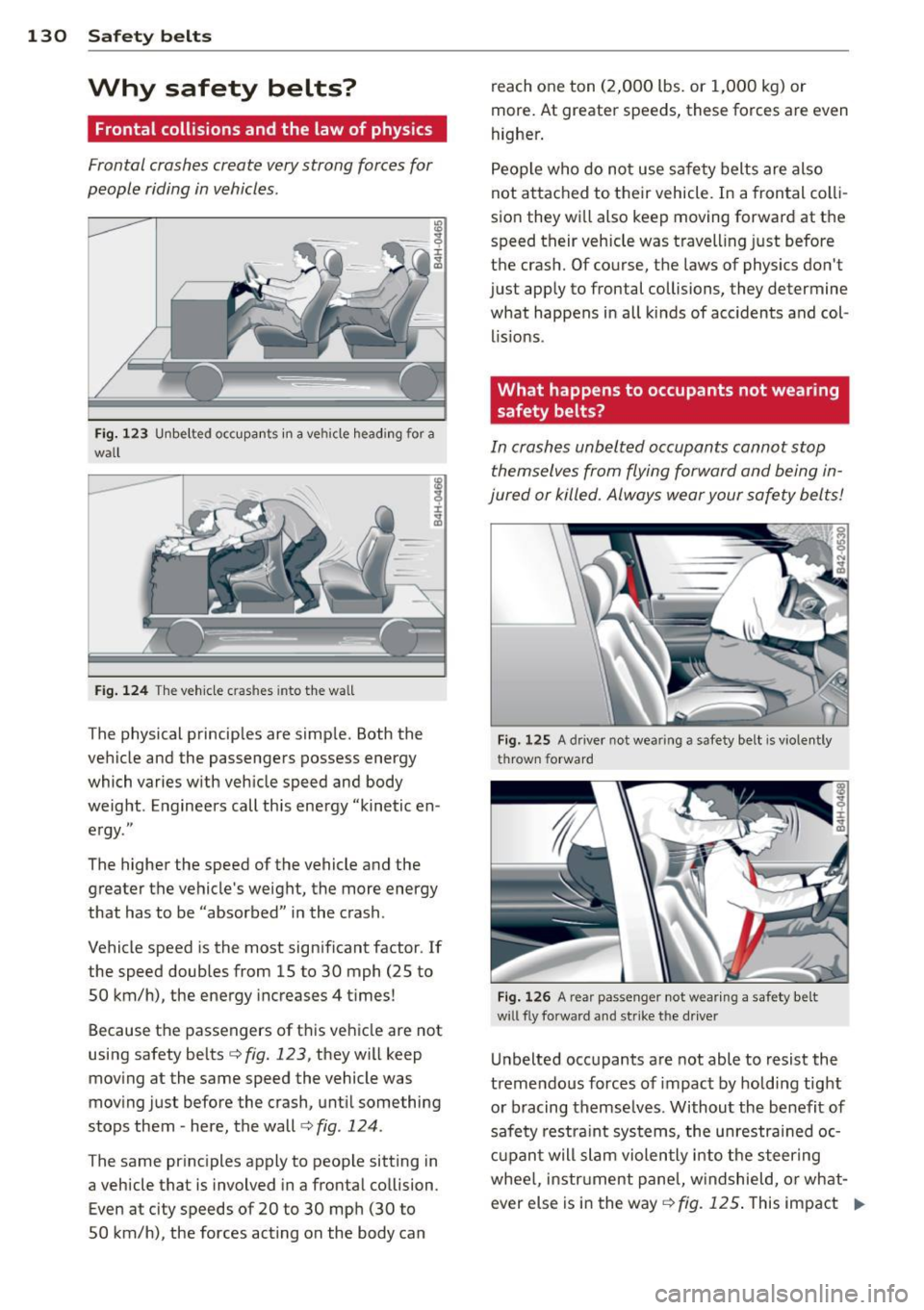
Fig. 123 Unbelted occupants in a ve hicle heading for a
wall
Fig. 124 The vehicle c ras hes into the wall
The physical principles are simple. Both the
vehicle and the passengers possess energy
which varies with vehicle speed and body
weight . Engineers call this energy ''kinetic en
ergy ."
The higher the speed of the vehicle and the
greater the vehicle's weight, the more energy
that has to be "absorbed" in the crash .
Vehicle speed is the most significant factor . If
the speed doubles from 15 to 30 mph (25 to
50 km/h), the energy increases 4 times!
Because the passengers of this vehicle are not
using safety belts¢
fig. 123, they will keep
moving at the same speed the vehicle was
moving just before the crash, until something
stops them -here, the wall¢
fig. 124 .
The same principles apply to people sitting in
a vehicle that is involved in a frontal collision .
Even at city speeds of 20 to 30 mph (30 to
50 km/h), the forces acting on the body can reach
one ton (2,000 lbs. or 1,000 kg) or
more. At greater speeds, these forces are
even
higher.
People who do not use safety belts are also
not attached to their vehicle. In a frontal colli
sion they wi ll also keep moving forward at the
speed their vehicle was travell ing just before
the crash. Of course, the laws of physics don't
just apply to frontal collisions, they determine what happens in all kinds of accidents and col
lisions .
What happens to occupants not wearing
safety belts?
In crashes unbelted occupants cannot stop
themselves from flying forward and being in
jured or killed . Always wear your safety belts!
Fig. 12S A driver not wea ring a safety belt is vio len tly
t hrown forward
Fig. 126 A re ar passe nger not wearing a safety belt
w ill fl y forw ard and strike t he drive r
Unbelted occupants are not able to resist the
tremendous forces of impact by holding tight
or bracing themselves . Without the benefit of
safety restraint systems, the unrestrained oc
cupant will slam violently into the steering
whee l, instr ument panel, windshield, or what
ever else is in the way r:!>fig . 125 . This impact II>-
Page 133 of 286
with the vehicle interior has all the energy
they had just before the crash.
Never rely on air bags a lone for protec tion.
E ven when they deploy, airbags provide only
additional protection . Ai rbags are not sup
posed to deploy in all kinds of accidents. Al
though your Audi is equipped with a irbags, all
veh icle occupants, including the driver , must
wear safety belts correctly in order to min i
mize t he risk of severe injury or death in a
crash .
Remember too, that airbags wi ll deploy on ly
once and that your safety belts are always
there to offer protection in those accidents in
which airbags are not supposed to deploy or
when they have a lready deployed . U nbelted
occupants ca n also be thrown out of the vehi
cle whe re even mo re severe o r fa tal in ju ries
can occur .
It is also impo rtant fo r the rear passenge rs to
wear safety belts co rrec tly. Unbe lted passen
ge rs i n the rea r seats endanger no t on ly them
se lves bu t also the driver a nd o ther passen
gers
¢ fig. 126 . In a frontal collision they will
be thrown forward vio lent ly, where they can
h it and injure the dr iver and/or front seat pas
senger .
Safety belts protect
People think it 's possible to use the hands to
brace the body in a minor collision. It 's simply
not true!
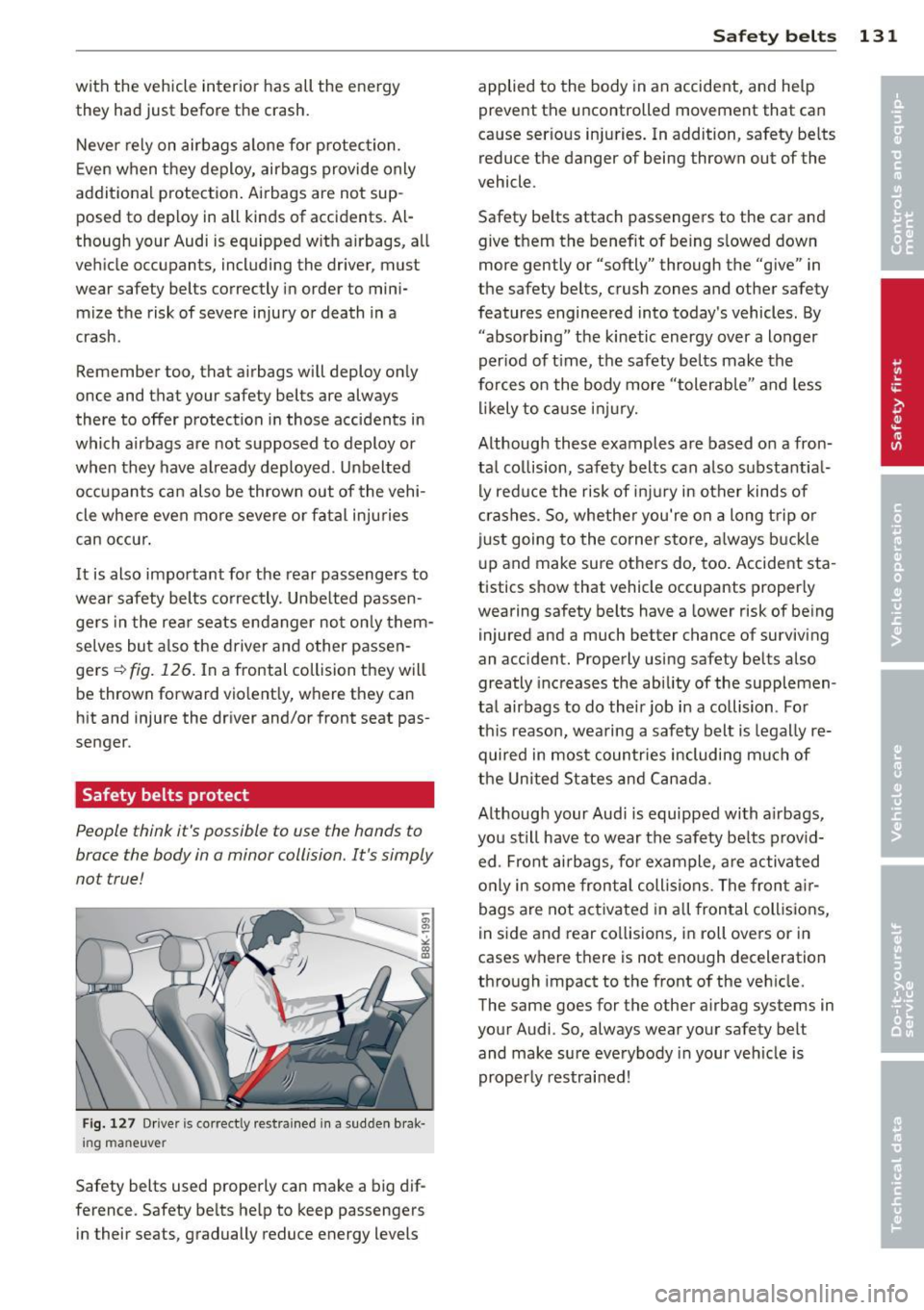
F ig . 127 D river is correctly restra ined in a sud den bral<·
ing maneuve r
Safety belts used properly can make a big dif
ference . Safety be lts he lp to keep passengers
in their seats, gradually reduce energy levels
Safety belts 131
applied to the body in an accident, and he lp
prevent the uncontrolled movement that can
ca use serio us injuries . In addition, safety be lts
reduce the danger of being thrown out of the
vehicle.
Safety be lts attach passengers to the car and
give t hem the benefit of being s lowed down
more gently or "softly" through the "give" in
the safety belts, crush zones and other safety
features enginee red into today's vehicles. By
"absorbing" t he kinetic energy over a longer
per iod of t ime, the safety be lts make the
fo rces on the body more "tolerable" and less
li kely to ca use inju ry.
Althoug h these examples a re based o n a fron
ta l co llision, safety belts can a lso substantia l
l y red uce the risk of in jur y in other kinds of
cr ashes. So, whethe r you're on a long trip o r
just going to the co rner store, a lways buckle
u p and make sure others do, too . Accident sta
tistics show that vehicle occupants properly
wearing safety belts have a lower risk of be ing
i njured and a much better chance of surviving
an accident. Properly using safety belts also
greatly increases the ability of the supplemen
ta l airbags to do the ir job in a collision . Fo r
th is reason, wearing a safety belt is legally re
quired in mos t coun tries including much of
t he United States and Canada.
Althoug h your Aud i is equipped wi th a irbags,
you st ill have to wear the safety be lts p rov id
ed . Front airbags, fo r example, a re activa ted
o nly in some frontal collisions. The fron t air
bags are not act ivated in a ll fron tal coll isions,
in s ide and rear co llisions, in roll ove rs or in
cases where t here is not eno ugh deceleration
through impact to the front of the veh icle.
The same goes for the other a irbag systems in
your Audi . So, always wear your safety belt
and make su re everybody in your veh icle is
properly restrai ned!
Page 182 of 286
180 Intellige nt tec hno logy
Intelligent technology
Notice about data
recorded by veh ic le
control modules
Your vehicle is not equipped with an Event Da
ta Recorder (EDR), installed by some manu
facturers fo r the express purpose of capturing
data for retrieval after an accident or crash
event . EDR's are sometimes called "crash re
corders".
Some state laws restrict the retrieval or down
loading of data stored by EDR's that were in
stalled in a vehicle for the express purpose of
retrieving data after an accident or crash
event without the owner's consent.
A lthough your vehicle is not equipped with an
EDR, it is equipped with a number of electron
ic control modules for various vehicle systems
such as, for example, engine function, emis
sion control, as well as for the airbags and
safety belts.
These electronic control modules also record
vehicle-related data during normal vehicle op
eration for diagnostic and repair purposes.
The recording capacity of the electronic con
trol modules is limited to data (no sound is re
corded) and only a small amount of data is ac
tually recorded over a very limited period of
time and stored when a system fault or other
condition is sensed by a control unit. Some of
the data then stored may relate to vehicle
speed, direction, braking as well as restraint
system use and performance in the event of a
crash or other condition. Stored data can only
be read and downloaded with special equip
ment.
Electronic Stab ilization
Control (ESC)
Description
ESC helps to improve road holding and vehicle
dynamics to help reduce the probability of
skidding and loss of vehicle control. It works
only when the engine is running. ESC detects certain difficult driving situations, including
when the vehicle is beginning to spin (yaw)
out of control and helps you to get the vehicle back under control by selectively braking the
wheels, and/or reducing engine power and
providing steering assistance to help hold the
vehicle on the driver's intended course. The in
dicator light
J.i) in the instrument cluster
blinks when ESC is taking action to help you
control the vehicle.
ESC has limitations.
It is important to remem
ber that ESC cannot overcome the laws of
physics. It will not always be able to help out
under a ll cond itions you may come up against.
For example, ESC may not always be able to
help you master situations where there is a
sudden change in the coefficient of friction of
the road surface. When there is a section of dry road that is suddenly covered with water,
slush or snow, ESC cannot perform the same
way it would on the dry surface . If the vehicle
hydroplanes (rides on a cushion of water in
stead of the road surface), ESC will not be
able to help you steer the vehicle because con
tact with the pavement has been interrupted
and the vehicle cannot be braked or steered.
During fast cornering, particularly on winding
roads, ESC cannot always deal as effectively
with difficult driving situations than at lower
speeds. When towing a trailer, ESC is not able
to help you regain control as it would if you
were not towing a trailer.
Always adjust your speed and driving style to road, traffic and weather conditions. ESC can
not override the vehicle's physical limits, in
crease the available traction, or keep a vehicle
on the road if road departure is a result of
driver inattent ion. Instead, ESC improves the
possibility of keeping the vehicle under con
trol and on the road during extreme maneu
vers by using the driver's steering inputs to
help keep the vehicle going in the intended di
rection . If you are traveling at a speed that
causes you to run off the road before ESC can
provide any assistance, you may not experi
ence the benefits of ESC.
Page 183 of 286
ESC includes and/or works together with the
anti-lock brake system (ABS), brake assist sys
tem, anti -slip regulation (ASR) , e lectronic dif
ferential lock (EDL), dynamic steering* and electronic i nteraxle differential lock* /selective
wheel torque control* . ESC is switched on all
the t ime. I n certain s ituations when you need
less traction, you can switch
off ASR by press
i ng the button~~
page 182, fig. 153 or
~ page 182, fig. 154. Be sure to sw itch ASR
on again when you no longer need less trac
tion.
Anti-lock b ra king s ystem (ABS)
ABS prevents the wheels from locking up
when braking. The vehicle can still be steered
even d uring hard brak ing . Apply ste ady p res
sure to the brake pedal. Do not pump the ped
a l. A pulsing in the brake peda l indicates t hat
the system is he lping you to brake the vehicle.
Brake assist system
The brake assist system can decrease bra king
d istance. It increases braking power when the
d river presses the brake pedal quick ly in emer
gency situations . You must press and hold the
brake peda l until the situation is over. In
veh icles w ith adaptive cru ise contro l*, the
brake assist system is more sensit ive if the
d istance detected to the veh icle ahead is too
small.
Anti- slip regulati on (ASR)
ASR reduces engine power when the drive
wheels begin to spin and adapts the force to
the road condit ions. This makes it eas ier to
start, accelerate and drive up hills.
Elect ronic diffe renti al lo ck (EDL )
The ED L brakes wheels that are spinning and
transfers the drive power to the other drive
wheel or wheels if the vehicle is equipped with
all-wheel drive*. This function is available up
to about 60 mph (100 km/h) .
In extreme cases, EDL automatica lly switches
off to help keep the brake on the braked whee l
from overheating. EDL w ill switch on again au-
Intellig ent technolog y 181
tomat ica lly when conditions have returned to
norma l.
Dynamic steering*
On vehicles with dynam ic steering*, ESC helps
stab il ize the s teer ing in crit ica l sit uat io ns.
Electronic interaxle differential lock* /
selective wheel torque control*
T he electronic i nteraxle differential lock (front
whee l dr ive) or the se lective whee l to rque
control (all-wheel dr ive) opera tes when dr iv
ing thro ugh curves. The front wheel on the in
side of the c urve or both whee ls on the inside
of the curve are braked selectively as needed .
This min imizes sliding in the front wheels and
allows for more precise driving through
cu rves . The applicable system may not acti
vate when dr iv ing in wet or snowy conditions.
A WARNING
- ESC, ABS , ASR, EDL dynam ic steering*
a nd the elect ronic interaxle differential
loc k* /se lective wheel torque control*
cannot overcome the laws of physics .
This is especially important on slippery
or wet roads. If the systems begin acting
to stabilize your veh icle, yo u should im
mediately change your speed to match
the road and traff ic conditions. Do not
let the increased safety provided by
these systems tempt you to take r isks.
Doing so will increase the risk of a loss of
veh icle contro l, col lision and ser ious per
sonal injuries.
- Always adapt your speed to road, traffi c
and wea ther conditions. The risk of los
ing contro l of the vehicle increases when
driving too fast, espec ially through
curves and on slippery or wet roads, and
when dr iv ing too close to vehicles up
ahead. ESC, ABS, the brake ass ist sys
tem, ASR, EDL dynam ic steering* and the
electronic interaxle differentia l lock*/se
lective whee l torque control* cannot p re-
vent co llisions . ..,.
•
•
Page 184 of 286
182 Intelligent technology
-Always accelerate with specia l care on
even, smooth surfaces s uch as those that
are wet or covered with ice and snow.
The drive whee ls can spin even with
these ass istance systems that canno t al
ways help to reduce the risk of loss of ve hicle control.
(i_) Tips
-ABS and ASR on ly wor k correctly when
all four wheels a re eq uipped w ith ident i-
Switching on/off
cal tires. Diffe ren t tire sizes can lead to a
reduction in engine power.
- Yo u may hear noises when the systems
descri bed are worki ng.
- If the in dicator ligh t
bl or t!lJ (USA
models)/ [IJ (Ca nada models) ap pears,
there may be a malfunction
¢page 18,
¢page 19.
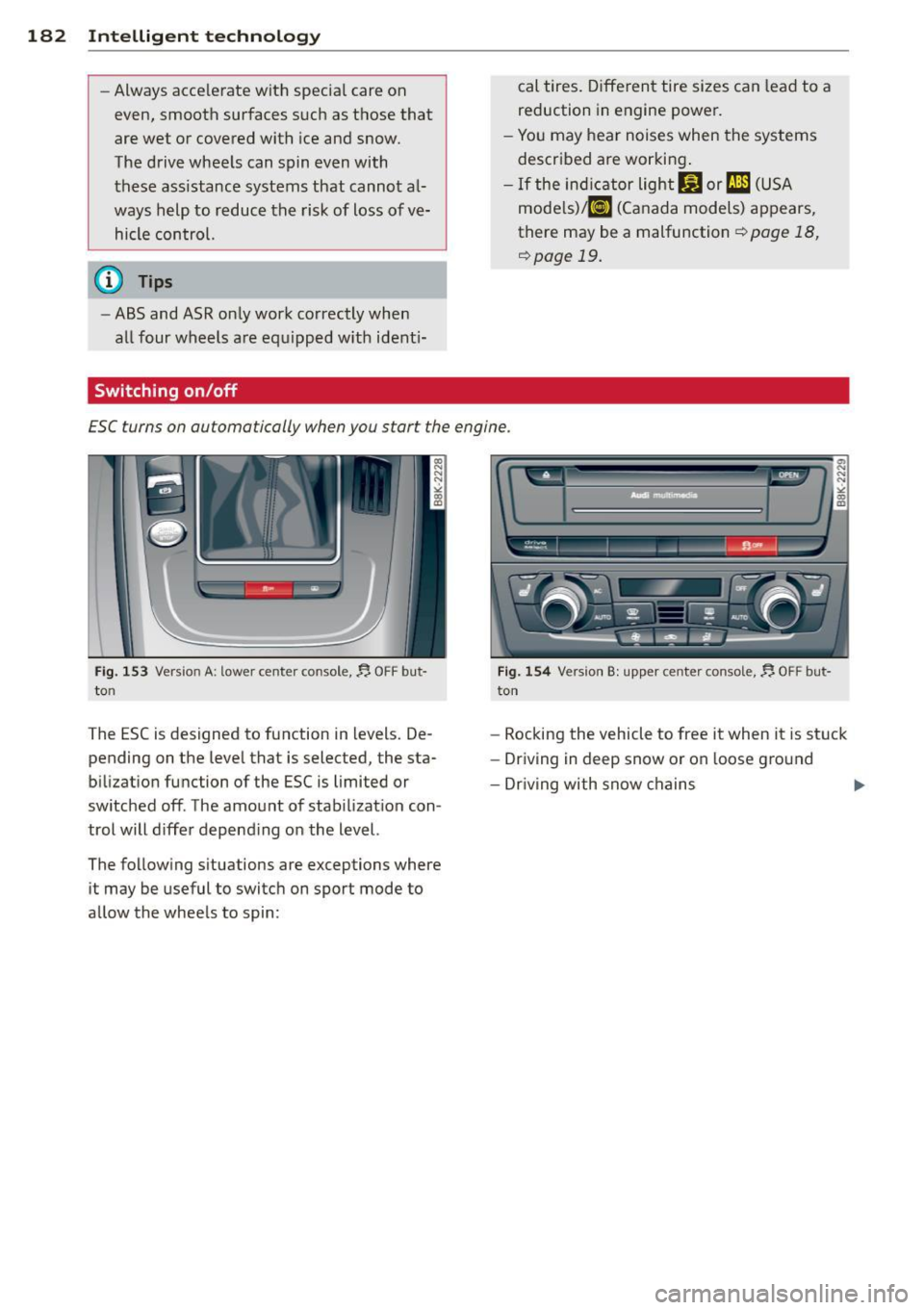
ESC turns on automatically when you start the engine.
Fig . 15 3 Version A: lower center console,~ OFF but·
ton
The ESC is designed to function in levels . De
pending on the leve l that is selected, the sta
b ili zat io n function of the ESC is limited or
switched off. The amount of stabilizat ion con
trol will d iffe r depend ing on the level.
The following situations are exceptions where
it may be useful to switch on sport mode to
allow the whee ls to spin:
Fig. 154 Versio n B: uppe r ce nter console,~ OFF but·
to n
-Rocking the vehicle to free it when it is st uck
- Driving in deep snow or on loose g round
- Dr iving with snow c hains
Page 187 of 286
overhea t red ucin g the e ffec tiveness of
t h e ent ire brake system.
- Failure of one brake circuit will impair
the bra king capability resulting in an in
creased stopp ing distance. Avoid driv ing
the vehicle and have it towed to the near est author ized Audi dealer or qualified
wor kshop .
- Never let the vehicle roll to a stop w ith
the engine shut off.
- If the brake booster is not work ing, the
brake pedal must be pressed considera
bly harder to make up for the lac k of
booster assistance.
Electro-mechanical
power assist, dynamic
steering
The electro-mechanical power assist helps
the driver when steering.
Power steering adapts electronically based on
the vehicle speed.
Indicator light s and messages
• Steering defecti ve! Do not drive vehicle!
If th is ind icator light tu rns on and stays on
and th is message appears, t he power s teeri ng
may have f ailed.
Do
not co ntin u e d riving . See yo ur autho rized
Aud i dea ler o r a qua lifi ed r epai r fac ility for as
sis tance .
':rj Dynam ic steering: Sy stem fault! You can
continue driving
If the indicator light t urns on and the mes
sage appears, the steer ing may be more diffi
cult to move or more sensitive than usual. The
steer ing wheel may also be at an angle whe n
d riving st raight .
Drive s low ly to your au thor ized Audi dealer or
qua lified workshop to have the malfunction
corrected.
'y.ij Dynam ic steering : initializing
Int ellig ent technolog y 185
If this drive r message appea rs and the indica
tor lig ht is f lashing on the instrument panel,
dynamic steer ing * is being rein itia lized. After
starting the engine, the steering wheel will move s light ly. Re- initiali zation might be nec
essary if the steering wheel was moved hard
to the left and right wh ile the vehicle was not
moving . Th e display goes out as soo n as ini ti
ali zation is comple te .
A WARNING
H ave the dy namic s tee ring * system mal
f u nction repa ired as soon as possible by an
authorized Audi dealer or qualified work
shop - risk of acc ident !
(D Tips
- If the . or l;rj indic ator l ight only st ays
on fo r a short time, you may continue
dr iving.
- T he dynamic s teering* s tabilit y systems
are not availab le in the even t of a system
ma lfunction.
- F or ad ditiona l information on dynamic
steering *, refer to ¢page 104 .
-
Driving with your
quattro
Applies to vehicles: with all-wheel drive
With all-wheel drive, all four wheels are driv
en .
General informati on
With a ll-wheel d rive, power is distrib uted to
all four wheels. This happens automatically depending on your driving style and the road
cond it ions at the time. See also¢ page 180 .
A center d ifferential distributes the driving
power variably to the front and rear ax le. It
wor ks together with selective wheel torque
control, wh ich activates when dr iv ing t hrough
curves Qpage 181. With the sport differen
t ia l*, power d istr ibut io n to the rea r wheels is
var iable a nd can be adjusted w ith dr ive se lect
¢ page 10 4.
IJII>
•
•
Page 188 of 286
186 Intelligent technology
The all-wheel drive concept is designed fo r
high engine power. Yo ur vehicle is exception
ally powerful and has exce llent dr iving charac
te ristics both under normal driving conditions
and on snow and ice . Always read and follow
safety precautions
c:> ,&. .
Winter t ires
When driving in the winte r, your ve hic le with
a ll-whee l drive has an advantage, even with
regular t ires. In winter road conditions it may
be adv isable to mount winter tires (or all-sea
son t ires) for improved dr iveability a nd brak
ing: these t ires must be mounted on
all four
wheels . See also i=>page 237, Winter tires.
Tire chain s
Where tire cha ins are mandatory on certain
roads, th is normally a lso applies to vehicles
with a ll-wheel drive
c:> page 238, Snow
chains.
Replacing wheels /ti res
Vehicles w ith all -wheel drive must a lways
have tires o f the same size. Also avoid t ires
with d iffe rent tread depths . For details see
page
c:;> page 2 33, New tires and replacing
tires and wheels .
Off-Road driving?
Your Audi does not have enough ground clear
ance to be used as an off-road veh icle.
It is
therefore best to avoid rough t racks and un
even terrain as much as possible . Also refe r to
<=;> page 188.
A WARNING
Always adjus t you r d rivi ng to roa d and tr af
fic co ndition s. Do no t let the e xt ra s afety
a ff orde d by all -whee l dr ive tem pt you in to
taking extra risks .
- Alt hough the all-whee l dr ive is very e f
f ec tive, a lways remember tha t br aking
ca pacity is limited by t ire traction . Yo u
sho uld the refore not dr ive at excessive
speeds on icy or s lippery road surfaces.
- On wet road s urfaces, be careful not to
dr ive too fast because the front wheels co
uld begin to slide o n top of the water
(aquaplaning). If t his should occur, you
will have no warn ing fr om a s udden in
crease in eng ine speed as w ith a front
wh eel drive veh icle . Always dr ive at
speeds wh ich are su ited to the road co n
di tions -risk of crash.
Energy management
Starting ability is optimized
Energy management controls the distribution
of electrical energy and thus optimizes the
availability of electrical energy for starting the engine.
If a vehicle wi th a conventiona l ener gy sys tem
is not driven for a long per io d of time, the bat
te ry is discharged by idling current consumers
(e .g. immobilize r). In certain circumstances it
can res ult in there being insufficient energy
available to start the eng ine .
Intelligent energy management in your vehi
cle hand les the dist ribution o f electr ica l ener
gy. Start ing ability is markedly improved and
t h e life of the battery is extended .
Bas ica lly, energy management consists of
battery diagnosis , idling current manage
ment
and dynamic energy management .
Battery diagnosis
Battery diagnosis contin uously de termines
t h e state of the battery . Sensors determine
batte ry voltage, battery current and battery
temperature. This determines the current
state of charge and t he power of t he battery .
Idling current management
Idling current management reduces energy
consumption while t he vehi cle is standing.
With the ign ition sw itched off, it controls the
energy supply to the various electrica l compo
nen ts. Data from battery diagnos is is cons id
ered .
Depend ing on the battery's state of charge,
individ ual consumers are gradually turned off ..,.
Page 189 of 286
to prevent excessive discha rge of the battery
and thus maintain starting capability .
Dynam ic energy man agement
W hile the vehicle is being driven , dynamic en
e rgy management distributes the energy gen
erated according to the needs of the individu
a l components . It regu lates consumption, so
that more electrical energy is not being used
than is being generated and ensures an opti mal state of charge for the battery.
(D Tips
- But even energy management cannot
negate the limits of physics. Consider
that the power and life of a battery are
limited.
- If starting ab ility is threatened, the indi
cator light (•) appears
¢ page 17.
What you should know
The highest priority is given to maintaining
starting capabili ty.
The battery is severely taxed in short-distance
driving, in city traffic and d uring the co ld time
of year. Abundant electrical energy is re
qu ired, but only a little is generated. It is also
cr itical if the engine is not run ning and electri
cal components are turned on . In th is in
stance energy is being consumed but none is
be ing generated.
It is in precisely these situations that you w ill
notice energy management actively regulat
i ng the distribution of energy.
Vehicle stands for an extended period
If you do not drive your vehicle over a period
of several days or weeks, electrical compo
nents are gradually cut back o r switched off .
This reduces energy consumption and main
tains starting capab ility over a longer per iod .
Some of the conven ience fun ctions may not
ope rate, such as the in ter ior lig hts o r th e
power seat adj ustment. The conven ience
functions will be available again when you
switch on the ignitio n and start the engine .
Intellig ent technolog y 187
With the eng ine turned off
If you listen to the radio, for examp le, w ith
the engine turned off or use other MMI func
tions, the battery is being discharged .
If starting capab il ity is jeopardized d ue to en
ergy consump tion, the following warning ap
pears in the MM I display:
Pl ea se start the en gin e s oon or the sy ste m
will be turn ed off .
The warning indicates that the system w ill be
turned off automatically after 3 minutes . If
you w ish to continue using the funct io ns, yo u
have to sta rt the eng ine .
With the engine running
Although electrical energy is generated when
the vehicle is being driven, the battery can be
come d ischa rged . This happe ns mostly when
li ttle energy is being gene rated and a g reat
deal consumed and t he battery's state of
charge is not opt imal.
To b ring the energy ba lance back into equili
brium , consume rs which requ ire espec ially
la rge amounts of ene rgy are temporar ily cu t
ba ck or sw itched o ff. Hea ting systems in p ar
ticu lar require a great deal of energy . If yo u
notice, for examp le, that the heated seats * or
the heated rear window are not heating, they
have been temporarily cut back or switched
off . These systems w ill be available again as
soon as the ene rgy balance has been restored .
You wi ll also notice that engine id le speed has
been increased slightly . T hi s is normal and not
a cause for concern. By increasing engine id le
speed the additional energy required is gene r
ated and the battery is charged .
•
•
Page 190 of 286
188 Driving and environment
Driving and
environment
The first 1,000 miles
(1,500 km) and
afterwards
New engine
The engine needs to be run-in during the first
1,000 miles (1,500 km).
For the fir st 600 miles (1,000
kilometers ):
.,. Do not use full throttle.
... Do not d rive at engine speeds that are more
than 2/3 of the max imum permitted RPM.
From 600 to 1,000 miles (1 ,000 to
1,500 kilometers):
.,. Speeds can gradually be increased to the
max imum pe rm iss ible road or eng ine speed .
During and after break-in period
... Do not rev the eng ine up to high speeds
when it is cold. Th is app lies whether the
transmission is in N (Neutra l) or in gear.
After the break- in period
... Do not exceed max imum engine speed un
der any circumstances .
... Upshift into the next higher gear before
reaching the red area at the end of the tach
ometer scale¢ page 10.
During the first few hours of driving, the en
g ine's inter na l friction is higher than later
when all the moving parts have been broken
i n. How well this break- in process is done de
pends to a conside rable extent on the way the
ve hicl e is driven du ring the first 1,000 miles
(1, 500 kilome ters).
(D Note
E xtremely high engi ne speeds are auto
mat ica lly r educ ed. However, t hese rpm
lim its are programme d for a n engine well
r u n- in, not a new eng ine.
{® For the sake of the environment
Do not d rive with unnecessarily high en
g ine speeds - upshifting ear ly saves fuel,
reduces no ise and protects the environ
ment.
, New tires
If your vehicle is runni ng on new tires, drive
very carefully for the first 350 miles (500 ki lo
meters) after fitting.
_& WARNING
N ew tires tend to be slip pery a nd mus t al
so be "b roken -in" . Be s ure to remembe r
this dur ing the fi rst 350 mi les ( 500 kilo
meters) . Brake gently . Avoid fo llow ing
closely behind other vehicles or other sit
uations that m ight require sudden, hard
braking.
Avoid damaging the
vehicle
When you a re d rivi ng on poo r roads, or over
cu rbs, ste ep ramps, etc., ma ke certai n that
low- ly ing parts s uch as spoile rs and ex ha ust
s ystem parts do not bot tom o ut and get dam
aged.
T his is espec ially true for veh icles with low
s lu ng chassis (s por ts chassis)* and fully load
ed vehicles.
Driving through water
on roads
Note th e following to avoi d ve hicle damage
whe n driving through water, for examp le on
flooded roads:
- The wa ter must not be any hig he r th an the
bottom of the vehicle bo dy.
- Do not dr ive faste r than wal king speed.