warning AUDI A5 COUPE 2016 Owners Manual
[x] Cancel search | Manufacturer: AUDI, Model Year: 2016, Model line: A5 COUPE, Model: AUDI A5 COUPE 2016Pages: 264, PDF Size: 66.92 MB
Page 204 of 264
Checking and Filling
-If you get batt ery acid in your eyes or on
your skin, immediately rinse with cold wa
ter for several minutes and get medical at
tention .
- If you should ingest any battery acid, seek
medical attention immediately.
- Do not expose the battery to an open flame, electric sparks or an open light .
- Do not smoke.
- Do not interchange the positive and nega-
tive cables.
- When working on the battery, be sure not to short-circuit the terminals with tools or oth
er metal objects. This would cause the bat
tery to heat up very quickly, which could lead to damage or explosion and personal
injury.
- When a battery is charged, it produces hy
drogen gas which is explosive and could
cause personal injury.
- Always keep the battery well out of the
reach of children.
- Before work is done on the electrical sys
tem, disconnect the nega tive ground cable .
- Before performing any work on the electri cal system, switch off the engine and igni
tion as well as any electrical equipment. The negative cable on the battery must be dis
connected. If you are just going to replace a
light bulb, then it is enough to switch off
the lights.
- Before disconnecting the battery, sw itch off
the anti-theft alarm system! Otherwise you
will set off the alarm.
- When disconnecting the battery, first dis
connect the negative cable and then the
positive cable.
- Before reconnecting the battery, make sure
all electrical consumers are switched off.
Reconnect the positive cable first and then
the negative cable. Never interchange the
cabl es - this could start a fire!
- Never charge a frozen or a thawed-out bat
tery . It could explode! If a battery has fro
zen, then it must be replaced. A discharged
battery can freeze over at 32°F (0°C).
- Make sure the vent hose is always attached
to the opening on the side of the battery.
202
- Never use batteries which are damaged .
There is the danger of an explosion! Always
replace a damaged battery.
A WARNING
California Proposition 65 Warning:
- Battery posts, terminals and related acces
sories contain lead and lead compounds,
chemicals known to the State of California
to cause cancer and reproductive problems.
Wash hands after handling .
(D Note
- Do not disconnect the vehicle battery when
the ignition is switched on or when the en
gine is running, otherwise, you will damage
electronic components in the electrical sys
tem .
-If your vehicle is going to stand for a long
period of time without being driven, protect
the battery from "freezing" , otherwise it
will be damaged and will then have to be re
placed.
Battery charging
Starting the engine requires a well charged bat tery .
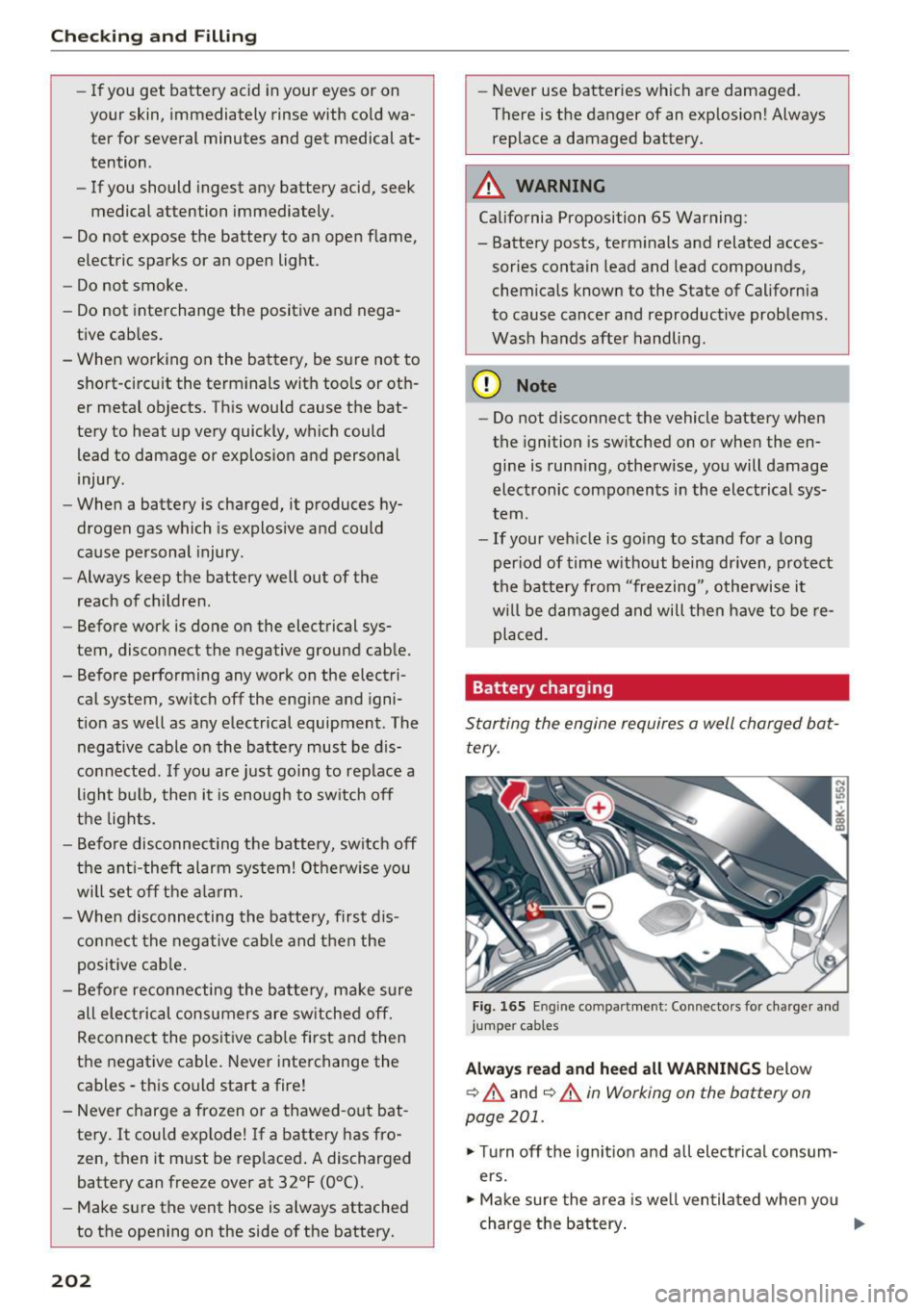
Fig. 165 En g in e compar tment : Co nnectors for charger and
jumper cab les
Always read and heed all WARNINGS below
9 A and ¢ A in Working on the battery on
page 201.
.,. Turn off the ignition and all electrical consum
ers.
.,. Make sure the area is well ventilated when you
charge the battery.
Iii>-
Page 205 of 264
.... N
0 Ico ....
~ Open the cover on the positive pole ~ fig. 165.
~ Connect the charger connectors accord ing to
the instructions to the
jump start bolts. (Bolts
under the cover= "positive", Bo lts with hex
head = "negative") .
~ Only now plug the mains lead for the charging
equipment into the wall outlet and turn it on
~ & -
~ Make sure the charging rate is not over
30 amps/14.8 Volt.
~ When the battery is fully charged: Turn the
charging equipment off and remove the mains
lead from the wall outlet.
~ Now remove the clamps for the charging equip-
ment.
~ Close the cover on the posit ive pole .
~ Close the hood ~ page 191.
A discharged battery can freeze at temperatures
of only 32 °F (0 °C) . Allow a frozen battery to
thaw completely before attempt ing to charge it
~ & . However, we recommend not using a
thawed batte ry again because the battery casing
can be cracked due to ice formation and can leak
battery acid.
Battery charging (Maximum charging rate of
30 amps/14.8 Volt)
When charging at low voltages (e .g . with a trick
le charger),
the battery cables do not have to be
disconnected first. The battery caps should
not
be opened when charging a battery.
It is not necessary to remove the battery from
the luggage compartme nt.
Fast charging the battery (charging rate
above 14.8 Volts)
Fo r techn ical reasons do not use a battery charg
e r that uses voltage greate r than 14.8 Volts to
charge your vehicle 's battery.
A WARNING
Charging a battery can be dangerous.
- Always follow the operating instructions
provided by the battery charger manufactur
er when charging your battery .
Checking and Filling
-Never charge a frozen battery . It may ex
plode because of gas trapped in the ice. Al
low a frozen battery to thaw out first.
- Do not reuse batteries which were frozen.
The battery housing may have cracked and
weakened when the battery froze.
- Charge the battery in a well ventilated area.
Keep away from open flame or electrical
spark. Do not smoke . Hydrogen gas generat
ed by the battery is explosive.
- To reduce the danger of explosion, never
connect or disconnect charger cables while
the charger is operating .
- Fast charg ing a battery is dangerous and
should only be attempted by a competent
technician with the proper equipment.
- Battery acid that may spill during charging should be washed off w ith a solution of
warm water and baking soda to neutralize
the acid .
@ Note
Never use a fast charger as a booster to start
the engine . This will seriously damage sensi
tive electronic components, such as control
units, relays, radio, etc., as well as the battery
cha rge r.
Battery replacement
The new battery must have the same specifica
tions and dimensions as the original equipment
battery.
Intelligent energy management in your vehicle is
r esponsib le for distr ibut ing the electrical energy
throughout your vehicle ~
page 175. The intelli
gent energy management system will keep the
engine battery charged better then vehicles with
out this system. To make sure the additional
electrical energy is available once again after you
have changed the battery, we recommend that
you install batteries of the same type and manu
facture only (the same as those installed at the
t ime your vehicle was delivered) . Specifications
are listed on the battery housing . Your author
ized Audi dealer must code the battery in the en-
ergy managemen t system to enable you to use
ll>
203
Page 212 of 264
Wheels
"XL" "xl" "EXTRA LOAD" or "RF" I I I
on the sidewall.
Rim
means a metal support for a tire
or a tire and tube assembly upon
which the tire beads are seated.
Rim diameter
means nominal diameter of the
bead seat . If you change your
wheel size, you w ill have to p ur
chase new tires to match the new rim diameter .
Rim size designation
means rim diameter and width.
Rim width
means nomina l distance between
rim flanges.
S idewall
means that portion of a tire be
tween the tread and bead .
Speed rating (letter code)
means the speed at which a tire is
designed to be driven for extend
ed periods of time. The rat ings
range from 93 mph (150 km/h)
to 186 mph (298 km/h)
¢ table
on page 206 .
You may not find
this information on all tires be
cause it is not requ ired by law.
2 10
The speed rating letter code,
where applicable, is molded on
the tire sidewall and ind icates the
maximum permissible road
speeds
¢ .&. in Winter tires on
page 220.
Tire pressure monitoring system*
means a system that detects
when one or mo re of a vehicle's
tires are underinflated and illum i
na tes a low tire pressure warning
te lltale .
Tread
means that portion of a tire that
comes into contact w ith the road .
Tread separation
means pulling away o f the tread
from the t ire carcass .
Treadwear indicators (TWI)
means the projections within the
principal grooves designed to give
a visua l indication of the deg rees
of wear of the tread. Se e
¢ page 214, Treadwear indicator
for more information on measur-
ing tire wear. .,.
Page 215 of 264
different tire speeds. For this reason, in case of emergency, only
use a spare tire* that is the same
circumference as the regular
tires.
&_ WARNING -
-Only use tire/rim combina tions and suitable wheel bolts
that have been approved by
Audi. Otherwise, damage to
the vehicle and an accident could result.
-For technical reasons, it is not possible to use tires from oth
er vehicles - in some cases,
you cannot even use tires from
the same vehicle model.
-Make sure that the tires you
select have enough clearance
to the vehicle . Replacement
tires should not be chosen
simply based on the nominal
size, because tires with a dif
ferent construction can differ
greatly even if they are the
same size. If there is not
enough clearance, the tires or
the vehicle can be damaged and this can reduce driving
safety and increase the risk of
an accident.
Wheels
-Only use tires that are more
than 6 years old when abso lutely necessary and drive
carefully when doing so.
-If you install wheel covers on
the vehicle, make sure they al
low enough air circulation to
cool the brake system. If they
do not, this could increase the
risk of an accident.
Tire wear/damage
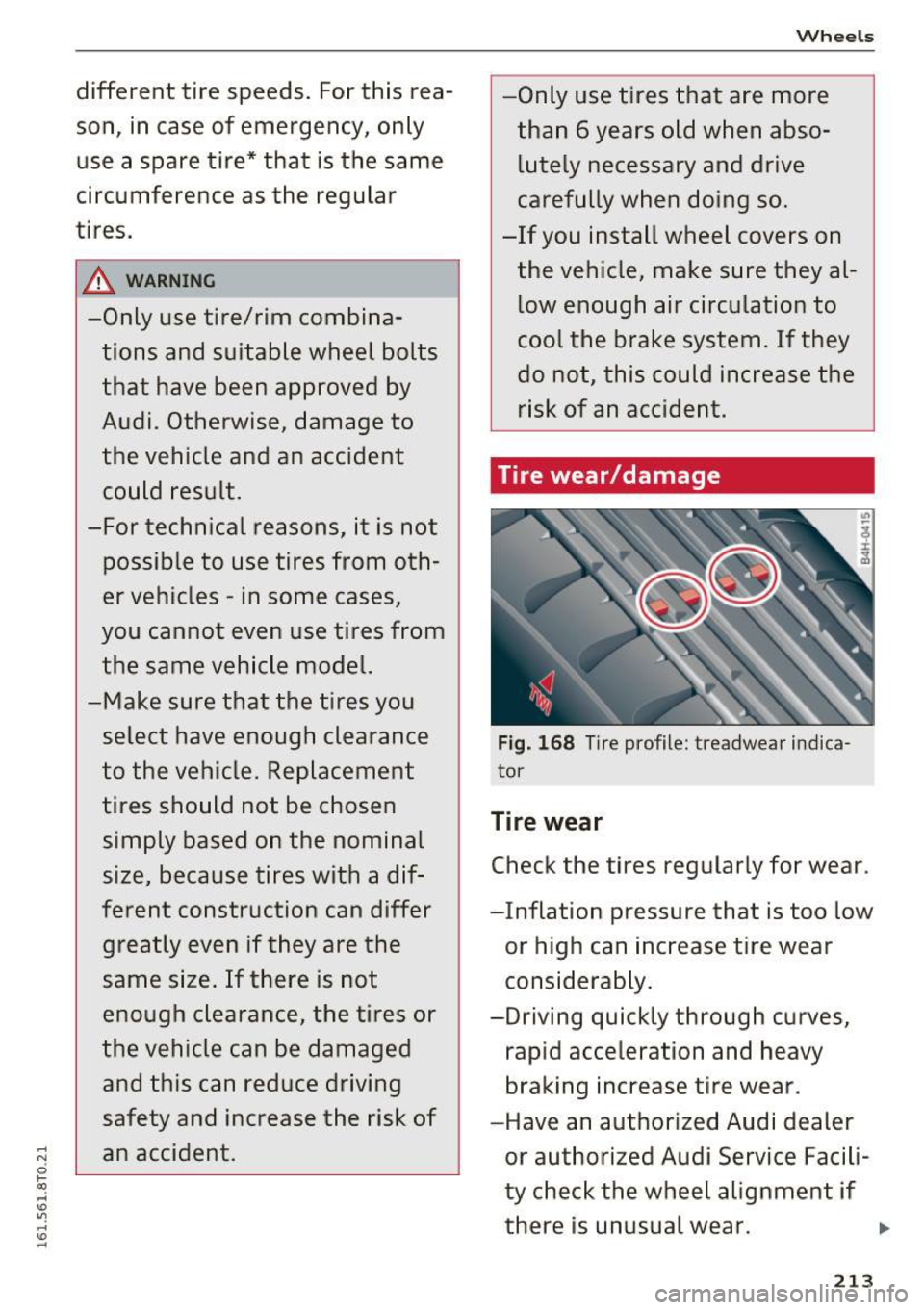
Fig. 168 Tire profile : treadwear indica
tor
Tire wear
Check the tires regularly for wear .
-Inflation pressure that is too low
or high can increase tire wear
considerably.
-Driving quickly through curves, rapid acceleration and heavy
braking increase tire wear .
-Have an authorized Audi dealer
or authorized Audi Service Facili
ty check the wheel alignment if
there is unusual wear. ..
213
Page 216 of 264
Wheels
-Have the wheels rebalanced if an imbalance is causing noticeable
vibration in the steering wheel.
If you do not, the tires and other
vehicle components could wear
more quickly.
Treadwear indicator
Original equipment tires contain
treadwear indicators in the tread
pattern, which are bars that are
1/16 inch (1.6 mm) high and are
spaced evenly around the tire per pendicular to the running direc
tion
¢ fig . 168 . The letters "TWI"
or triangles on the tire sidewall indicate the location of the tread
wear indicators.
The tires have reached the mini mum tread depth
l) when they
have worn down to the treadwear
indicators . Replace the tires with
new ones
¢ A.
Wheel rotation
Rotating the wheels regularly is
recommended to ensure the tires
wear evenly. To rotate wheels, in
stall the wheels from the rear
axle on the front axle and vice
versa. This will allow the tires to
1> Obey any applicable regulations in your
country.
214
have approximately the same
length of service life.
For unidirect ional tires, make
sure the tires are installed accord
ing to the running direction indi
cated on the tire sidewall
¢page 231.
Hidden damage
Damage to tires and rims can of
ten occur in locations that are hidden. Unusual vibrations in the
vehicle or pulling to one side may indicate that there is tire damage.
Reduce your speed immediately.
Check the tires for damage . If no
damage is visible from the out
side, drive slowly and carefully to
the nearest authorized Audi deal er or authorized Audi Service Fa
cility to have the vehicle inspect
ed.
8_ WARNING
Tread that has worn too low or different tread depths on the
tires can reduce driving safety.
This can especially have a nega
tive effect on handling, on the risk aquaplaning when driving
through water, when driving ,..
Page 217 of 264
_,
through curves and when braking, which increases the risk of
an accident.
Tire pressure
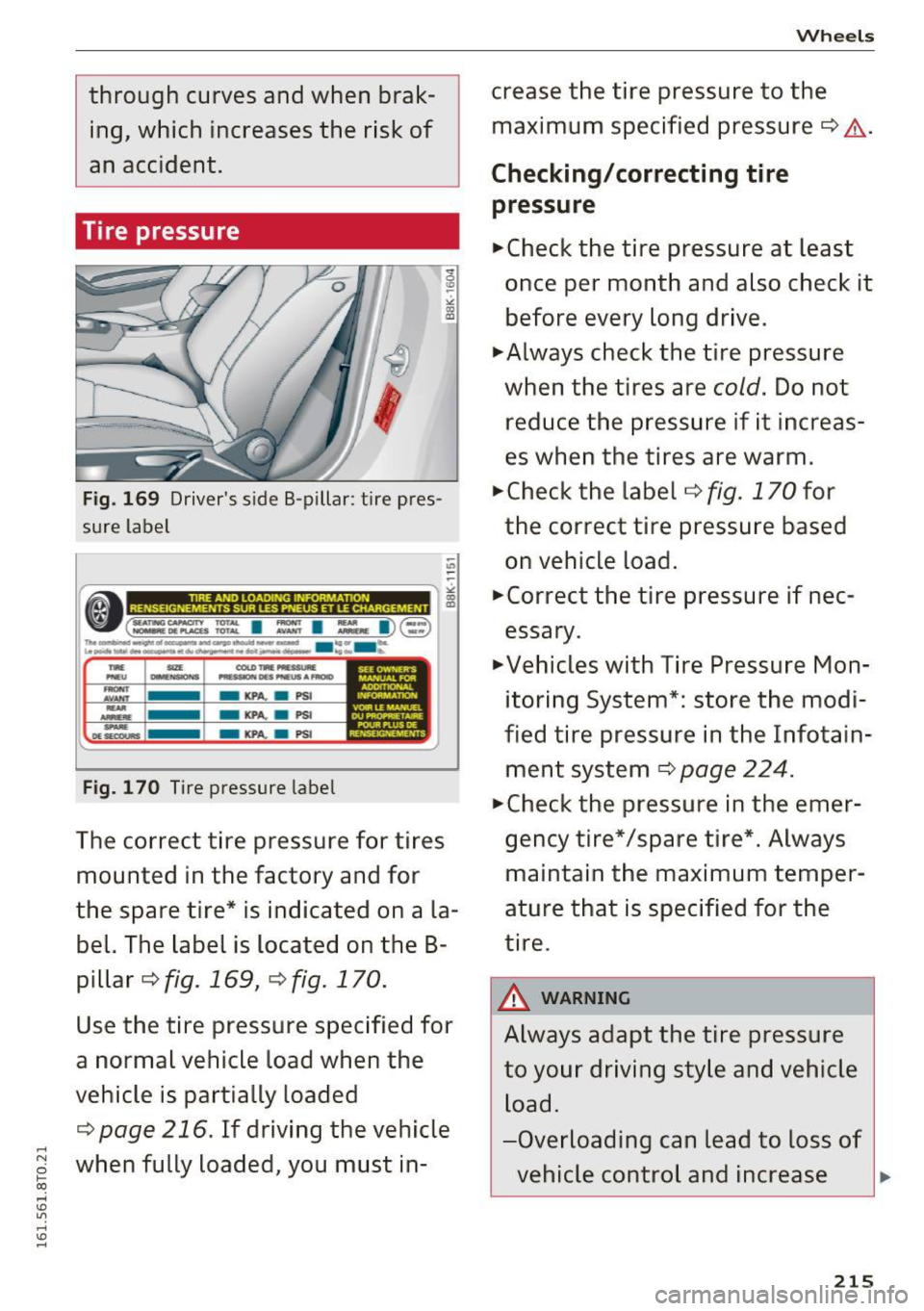
Fig. 169 Driver 's sid e B-pillar : tir e pres
sure label
"' -
-~-------------------,£
tM£. IIZl COLO tlllf fllllESSt.lW. PNfU Nl:4fN$IOM$ "IIISaoN OE$ PMEU$ A FROID
-AYIJff -KPA, a PSI
Fig. 170 Tire pressure label
The correct tire pressure for tires
mounted in the factory and for
the spare t ire* is indicated on a la
bel. The label is located on the B
pillar
¢ fig . 169, ¢ fig. 170.
Use the tire pressure specified for
a normal vehicle load when the
vehicle is partially loaded
¢
page 216. If driving the vehicle
ci when fully loaded, you must in-,_ CX) ... \D Ln _, \D _,
Wheels
crease the tire pressure to the
maximum specified pressure¢&.-
Checking/correcting tire
pressure
.,,.Check the tire pressure at least
once per month and also check it before every long drive .
.,,.Always check the tire pressure
when the tires are
cold. Do not
reduce the pressure if it increas
es when the tires are warm .
... check the label ¢
fig. 170 for
the correct tire pressure based on vehicle load.
.,,.Correct the tire pressure if nec
essary.
... vehicles with Tire Pressure Mon
itoring System*: store the modi
fied tire pressure in the Infotain
ment system
¢ page 224.
.,,.Check the pressure in the emer
gency tire*/spare t ire*. Always
maintain the maximum temper
ature that is specified for the
tire .
_& WARNING
Always adapt the tire pressure
to your driving style and vehicle
load.
-Overloading can lead to loss of vehicle control and increase ...
215
Page 219 of 264
.... N
0 Ico ....
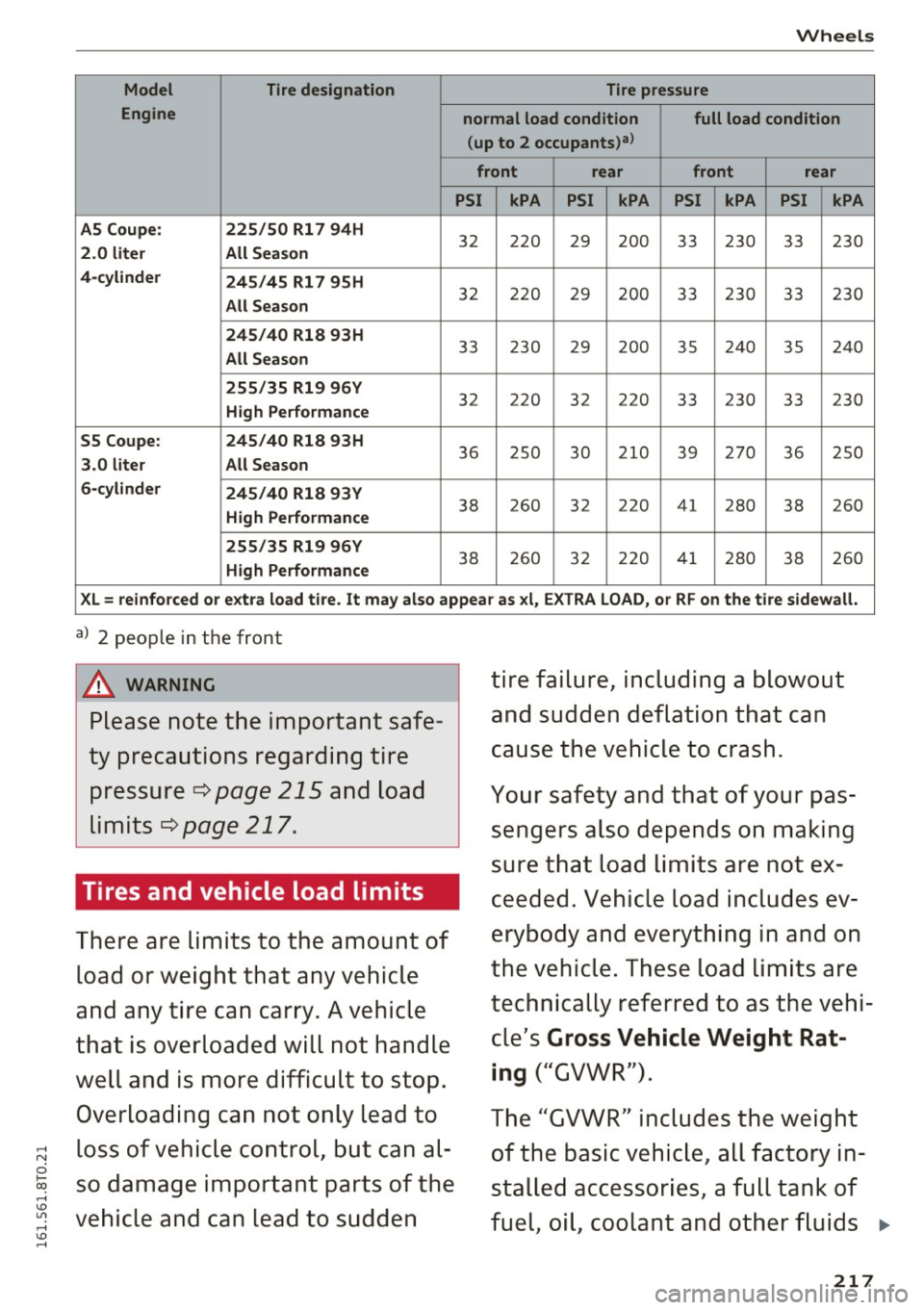
Model Tire designation Tire pressure
Engine normal load condition full load condition
(up to 2 occupants)a)
front rear front rear
PSI kPA PSI kPA PSI kPA PSI kPA
AS Coupe: 225/50 Rl
7 94H
32 220 29 200 33 230 33 230 2.0 liter All Season
4-cylinder 245/45 Rl
7 95H
All Season
32 220 29 200 33 230 33 230
245/40 Rl8 93H 33 230 29 200 35 240 35 240
All Season
255/35 Rl9 96Y
3 2 22 0 32 22 0 33 230 33 230 High Performance
55 Coupe: 245/40 Rl8 93H
36
250 30 210 39 270 36 250 3.0 liter All Season
6-cylinder
245/40 Rl8 93Y
High Performance
38 2
60 3 2 22 0 41 280
38 2
60
255/35 Rl9 96Y
38 260 32 220 41
280 38 260 High Performance
XL= reinforced or extra load tire. It may also appear as xl, EXTRA LOAD, or RF on the tire sidewall.
a) 2 people in the front
_& WARNING
Please note the important safe
ty precautions regarding tire pressure
¢page 215 and load
limits¢
page 217.
Tires and vehicle load limits
There are limits to the amount of
load or weight that any vehicle
and any tire can carry. A vehicle
that is overloaded will not handle
well and is more difficult to stop.
Overloading can not only lead to
loss of vehicle control, but can al
so damage important parts of the
vehicle and can lead to sudden tire failure, including a blowout
and sudden deflation that can
cause the vehicle to crash.
Your safety and that of your pas
sengers also depends on making
sure that load limits are not ex
ceeded. Vehicle load includes ev
erybody and everything in and on
the vehicle. These load limits are
technically referred to as the vehi cle's
Gross Vehicle Weight Rat
ing
("GVWR").
The "GVWR" includes the weight
of the basic vehicle, all factory in
stalled accessories, a full tank of
fuel, oil, coolant and other fluids ..,
217
Page 220 of 264
Wheels
plus maximum load . The maxi
mum load includes the number of
passengers that the vehicle is in
tended to carry ("seat ing capaci
ty") with an assumed weight of
150 lbs. (68 kg) for each passen
ger at a designated seating posi
tion and the total weight of any luggage in the vehicle. If you tow
a trailer , the weight of the trailer
hitch and the tongue weight of
the loaded trailer must be includ
ed as part of the vehicle load .
The
Gross Axle Weight Rating
( " GAWR") is the maximum load
that can be applied at each of the
vehicle 's two axles.
The fact that there is an upper limit to your vehicle's Gross Vehi
cle Weight Rating means that the
total weight of whatever is being
carried in the vehicle (including
the weight of a trailer hitch and
the tongue weight of the loaded
trailer) is limited . The more pas
sengers in the vehicle or passen
gers who are heavier than the
standard weights assumed mean
that less weight can be carried as
luggage.
The Gross Vehicle Weight Rating and the Gross Axle Weight Rating
218
are listed on the safety compli
ance sticker label located on the
driver's side B-pillar
~ page 215,
fig . 169 .
& WARNING ~ -
Overloading a vehicle can cause
loss of vehicle control, a crash
or other accident, serious per
sonal injury, and even death.
-Carrying more weight than your vehicle was designed to
carry will prevent the vehicle
from handling properly and increase the risk of the loss of
vehicle control.
-The brakes on a vehicle that
has been overloaded may not
be able to stop the vehicle
within a safe distance .
-Tires on a vehicle that has been overloaded can fail sud
denly, including a blowout and
sudden deflation, causing loss
of control and a crash .
-Always make sure that the to tal load being transported -
including the weight of a trail
er hitch and the tongue
weight of a loaded trailer -
does not make the vehicle
heavier than the vehicle 's
Gross Vehicle Weight Rating.
Page 222 of 264
Wheels
and a special procedure. You must not repair or
disassemble them¢&. .
A WARNING
Wheel bolts that are tightened or repaired in
correctly can become loose and result in loss
of vehicle control, which increases the risk of
an accident. For the correct t ightening specifi
cation, refer to ¢
page 22 7, After changing a
wheel .
-Always keep the wheel bolts and the
threads in the wheel hub clean and free of
grease.
- Only use wheel bolts that fit the rim .
- Always have damaged rims repaired by an
authorized Audi dealer or authorized Aud i
Service Facility . Never repair or disassemble
rims yourself, because this inc reases the risk
of an accident.
Winter tires
Winter tires s ignificantly improve the vehicle's
handling when driving in winter conditions . Be
cause of their construction (width, compound,
tread pattern), summer tires provide l ess trac
tion on ice and snow.
.,. Use winter tires on all four wheels.
.,. Only use winter tires that are approved for your
vehicle.
.,. Please note that the maximum permitted
speed may be lower with winter tires
q .&,. . An
authori zed Audi dealer or authori zed Audi Serv
ice Facility can inform you about the maximum
permitted speed for your tires .
.,. Check the tire pressure after install ing wheels
q page 215.
The effectiveness of winter tires is reduced great
ly when the tread is worn down to a depth of
0 .157 in (4 mm). The characteristics of winter
tires also decrease greatly as the tire ages, re
gardless of the remaining tread.
A WARNING
- Never drive faster than the maximum per
mitted speed for your tires. This could cause
the tires to heat up too much. This increases
220
-
the risk of an accident because it can cause
the tire to burst.
- Always adapt your driving to the road and
traffic conditions . Drive carefully and reduce
your speed on icy or slippery roads . Even
winter tires can lose traction on black ice .
@ For the sake of the environment
Reinstall summer tires at the appropriate
time, because they prov ide better handling
when roads are free of snow and ice. Summer
tires cause less road noise, tire wear and fuel
consumpt ion .
(D Tips
You can also use all season tires instead of
winter tires. Please note that in some coun
tries where winter tires are required, only
winter tires w ith the ~ symbol may be per
mitted.
Snow chains
Snow chains improve traction in the snow .
.,. Only install snow chains on the front wheels.
This applies also to vehicles with all wheel
drive* .
.,. Check and correct the seating of the snow
chains if necessary after driving a few feet. Fol
low the instructions from the manufacturer.
.,. Note the maximum permitted speed when dr iv
ing with snow chains. Do not exceed 30 mph (SO km/h).
Snow cha ins not only improve the
driving in win
ter road conditions, but also the
braking .
Use of snow chains is only permitted with certain
rim/tire combinat ions due to technical reasons .
Check with an author ized Audi dealer or author
ized Audi Service Facility to see if you may use
snow chains.
Use
fine-mesh snow chains. They must not add
more than 0.53 inch (13.5 mm) in height, includ
ing the chain lock.
You must remove the chains when driving on
roads that are
free of snow . When roads are free ..,.
Page 223 of 264
.... N
0 Ico ....
damage the t ires, and t he chains will quickly b e
destroyed.
A WARNING
Using incorrect snow chains or installing snow
chains incorrect ly can result in loss of vehicle
co ntrol, which increases the risk of an acc i
dent .
Snow chains can damage the r ims/wheel cov
ers* if the chains come into d irect contact
w ith them . Remove the wheel covers* first.
Use coated snow chains .
@ Tips
When driving with snow cha ins, it may help to
switch on sport mode¢
page 171.
Low aspect ratio tires
Your Aud i is factory-equipped with low aspect ra
t io ti res. These t ires have been tho rough ly tested
a n d been se lected specifically fo r yo ur model for
t he ir superb performance, road feel and handling
under a variety o f driving conditions. Ask your au
thor ized Audi dealer for more details .
The low aspect ratio of these t ires is indicated by
a numera l of
55 or l ess in the tire 's size designa
tion . The numera l represents the rat io o f the
tire's sidewall height in relat ion to its tread width
expressed in pe rc e ntage. Conventional t ir e s hav e
a height/w idth rat io of 60 or more.
The performan ce of low- aspect- ratio tire s is par
ticularl y sensiti ve to imp roper inflat ion pres
sure . It is therefore import ant that low a spect
ratio tires are infl ated to the specified pressure
and that the inflation pre ssure is regularl y
checked and mainta ined . Tire pre ssure s shoul d
be checked at least once a month and alwa ys
befor e a long t rip
¢ page 215.
What you can do to avoid tire and rim
damag e
Low aspect rat io tires can be damaged more easi
ly by impact with potho les, curbs, gull ies or
Wh eel s
ridges on the road, particular ly if the tire is un
deri nflated.
In orde r to min imi ze the occurrence of imp act
damage to the tires of yo ur vehicle , we recom
mend that you observe the following preca u
tions:
- Always ma intain recommended inflat io n pres
sures. Check yo ur ti re pressure every 2,000
miles (3,000 km) and add air if necessary .
- Dr ive ca refully on roads w ith po tholes, deep
gullies or ridges . The impac t from dr iving
through or over such obstacles can damage
your tires. Impact with a curb may a lso cause
damage to your tires.
- After any impact, immediate ly inspect your
tires or have th em inspected by th e nearest au
thorized Audi dealer. Replace a damaged tire as
soon as possible.
- Inspect you r tires every 2,000 m iles (3,000 km)
for damage and wear. Damage is not a lways
easy to see . Damage can lead to loss of air and
underinflation, wh ic h could eventually cause
tire fa ilure. If you believe that a tire may have
been damaged , replace the tire as soon as pos
sib le.
- These tires may wear more quickly than others .
- Please also remember that, while these tires
delive r responsive ha ndling, they may ride less
comfortably a nd make more noise than other
choi ces.
Reduced perfo rmance in winter /cold se ason
conditions
All tires are des igned for certai n purposes. The
low aspect ratio, ultra high performance tires
o rigi na lly installed o n your veh icle are intended
f or maximum dry and wet road per formance and
handling . They are not suitable for co ld, snowy or
icy weather conditions . If you drive under those
c ircumstances, you should equip your vehicle
with all-season or winter tires, which offer better
tract ion under those condi tions. We suggest you
use the recommended snow or all-season tires
spec ified for your veh icle, or their equiva lent .
Refer to¢
page 220 for more detailed informa
t ion regarding winter tires .
221