radio AUDI A5 COUPE 2016 Owner's Manual
[x] Cancel search | Manufacturer: AUDI, Model Year: 2016, Model line: A5 COUPE, Model: AUDI A5 COUPE 2016Pages: 264, PDF Size: 66.92 MB
Page 108 of 264

Parking System
_& WARNING
-Sensors have dead spaces in which ob jects
cannot be detected. Be especially alert for
small chi ldren and animals, since they are
not always detected by the sensors.
- The acoustic parking system is not a substi
tute for the driver's own caution and alert
ness. Ultimate responsibility always remains
with the driver during parking and simi lar
maneuvers . Always watch where you are
dr iv ing .
- Yo u should always adjust the volume and
frequency of the warning tones so that you
can eas ily hea r the acoustic distance warn
ing
even if the radio is p lay ing, the air-cond i
t ioner blower is on High or there is a high
level of outs ide noise .
- Chec k the settings whenever anyone e lse
has driven t he veh icle before you.
(D Note
- Remember that low obstacles for which a
warning has already been issued may "dive"
below the system 's sens ing zone if the vehi
cle is being backed up closer. In this case,
the warn ing sound shutting off does
not in
dicate that you have cleared the obstacle .
Ins tead, impact is imm inent.
- Objects such as tra ile r hitches , cha ins, nar
r ow posts or fences
cove red by a th in layer
of pa int may no t always be dete cte d by the
system. T hey can still damage your vehicle
wi tho ut warn ing.
@ Tips
Keep the senso rs in the rea r bumpe r clean
an d free of snow a nd ice so that the ac ous tic
parking assi st system can f unction properly .
Adjusting the warning tones
Applies to vehicles: with parking system (rear)
The warning tones can be adjusted in the MMI*.
• Select : ICARlfunct ion button> Parking syst em .
Or
• Se lect : ICARI funct ion button >
Car system s*
control bu tton > Driver assist > Parking aid .
106
-Rear volume -rear sensor volume
-Rear fr equen cy -rear sensor freque ncy
- Music volume whi le parking -when the pa rk-
ing sys tem is switched on, the vo lume of the
ac tive audio source is lowered.
The newly ad justed va lue is briefly heard from
the sig nal generator. The set tings are automati
ca lly stored and ass igned to the mas ter key with
remote cont rol.
Rear parking system
with rearview camera
Introduction
App lies to vehicles: with parking system (rear, with rear view
camera)
F ig. 1 10 Park in g m ode 1: reverse parking
Fi g. 111 Park in g m ode 2: p arallel p ark in g
.... .... 0
-
"' :8
Vehicles with the park ing system are equipped
with a
rear view camera in addition to the a cous
tic parking system.
You can choose between two modes to assist you
with parking. For example, you can use "parking mode
l" when parking in a parking spa ce or ga
rage
c;, fig. 110 . When you want to park paralle l
to t he edge of the street, se lect "parking mode
2 "
c::;;, fig . 111 . ...
Page 113 of 264

.... N
0 Ico ....
tain plenty of distance from an obstacle so
that your outside mirror or a co rner of your
veh icle does not collide w ith any obstacles -
danger of accident!
The left or right or ientation lines and surfaces
w ill be displayed, depending on the turn sig
na l being used.
Adjusting the display and warning tones
Applies to vehicles: with parking system (rear, with rear view
camera)
The display and warning tones are adjusted in
the radio or MMI*.
~ Select: ICARI f u nct ion button> Parking syst em .
Or
~ Se lect: I CARI function button > Ca r sy stem s*
contro l button > Dri ver a ssis t> Pa rkin g aid .
Display
- Off -when the parki ng system is switched on,
only aud ible signals are g iven.
- On -when the pa rking system is switched on,
the p icture from the rear v iew camera is dis
played.
Warning tones
- Rea r v olum e -
rear sensor volume
- Rea r frequency -rear sensor frequency
-Music volume whil e par king -when the park-
ing system is sw itched on, the volume of the
active aud io source is lowered.
The new ly adjusted value is briefly heard from
the signa l generator. The settings are automat i
cally stored and assigned to the remote contro l
key.
A WARNING
- Always make sure that the volume and fre quency of the wa rning tones is adj usted so
that you can eas ily hea r the acoust ic dis
tance signal even if the radio is playing, the air-conditioner b lower is on H igh or the re is
a high level of outside noise .
Parking Sys tem
-Check the settings whenever someone e lse
has driven the vehicle before you.
(D Tips
- The warn ing tones can also be adjus ted di
rectly from the rea r view camera image .
Simp ly press the Settings* control button.
- Changed settings are activated when park
ing assist is switched on again.
Error messages
Applies to vehicles: with parking system (rear, with rear view
camera)
If a warning tone is aud ible for about five sec
onds when you turn on the ignition, there is a
malfunction in the system. Have the prob lem
corrected by your authorized Audi dea ler.
Keep the sensors in the rear bumper clean and
free from ice so that the acoustic park assist sys
tem can function properly.
111
Page 144 of 264
Airbag system
(D Tips
If the weight-sensing mat in the front passen
ger seat detects an empty seat, the front air
bag on the passenger side will be turned off,
and
PASSENGER AIR BAG OFF will stay on.
Repair , care and disposal of the airbags
Parts of the airbag system are installed at many
different places on your Audi. Installing , remov
ing, servicing or repairing a part in an area of the
vehicle can damage a part of an airbag system and prevent that system from working properly in a collision.
There are some important things you have to
know to make sure that the effectiveness of the
system will not be impaired and that discarded
components do not cause injury or pollute the
environment.
A WARNING
Improper care, servicing and repair proce
dures can increase the risk of personal injury
and death by preventing an airbag from de
ploying when needed or deploying an airbag
unexpectedly:
-
- Never cover, obstruct, or change the steer
ing wheel horn pad or airbag cover or the in
strument panel or modify them in any way .
- Never attach any objects such as cupholders
or telephone mountings to the surfaces cov
ering the airbag units.
- For cleaning the horn pad or instrument panel, use only a soft, dry cloth or one mois
tened with plain water. Solvents or cleaners could damage the airbag cover or change
the stiffness or strength of the material so
that the airbag cannot deploy and protect properly.
- Never repair, adjust , or change any parts of
the airbag system.
- All work on the steering wheel, instrument
panel, front seats or electrical system (in
cluding the installation of audio equipment,
cellular telephones and CB radios, etc.)
must be performed by a qualified technician
142
who has the training and special equipment necessary.
- For any work on the airbag system, we
strongly recommend that you see your au
thorized Audi dealer or qualified workshop .
- Never modify the front bumper or parts of
the vehicle body.
- Always make sure that the side airbag can
inflate without interference:
- Never install seat covers or replacement
upholstery over the front seatbacks that
have not been specifically approved by
Audi .
- Never use additional seat cushions that
cover the areas where the side airbags in
flate.
- Damage to the original seat covers or to
the seam in the area of the side airbag
module must always be repaired immedi
ately by an authorized Audi dealer .
- The airbag system can be activated only
once . After an airbag has inflated, it must
be replaced by an authorized Audi dealer or
qualified technician who has the technical
information, training and special equipment
necessary.
- The airbag system can be deployed only
once . After an airbag has been deployed, it
must be replaced with new replacement
parts designed and approved especially for
your Audi model version. Replacement of complete airbag systems or airbag compo
nents must be performed by qualified work
shops only. Make sure that any airbag serv
ice action is entered in your Audi Warranty
& Maintenance booklet under AIRBAG RE
PLACEMENT RECORD.
- In accidents when an airbag is deployed, the
vehicle battery separates the alternator and
the starter from the vehicle electrical sys
tem for safety reasons with a pyrotechnic
circuit interrupter.
- Work on the pyrotechnic circuit interrupt
er must only be performed by a qualified
dealer - risk of an accident!
- If the vehicle or the circuit interrupter is
scrapped, all applicable safety precautions
must be followed.
llll-
Page 178 of 264
Intelligent Technology
according to t he needs of the individua l compo
nents. It regu lates consumption , so that more
e lectr ical energy is not being used than is being
generated and ensures an optimal state of
charge for the battery.
(D Tips
- But even energy management cannot neg
ate the limits of physics . Cons ider that the
power and life of a battery are limited.
- If starting ability is threatened, the indica
tor light (•) appears ¢
page 16.
What you should know
The highest priority is given to maintaining start
ing capability.
The batte ry is severely taxed in short-distance
driving, in c ity traffic and d uring the co ld time of
year. Abundant electrical energy is req uired, but
only a little is generated . It is also c rit ica l if the
engine is not runn ing and electrical components
are turned on . In this instance energy is be ing
consumed but none is be ing generated .
It is in precisely t hese situations that you will no
tice energy management active ly regulat ing the
d istr ibut ion of energy .
Vehicle stands fo r an e xtended period
If you do not drive your vehicle over a period of
several days or weeks, electrical components are
gradually cut back or sw itched off. T his reduces
energy consumption and ma inta ins starting ca
pab ility over a longer period . Some of the con
ve nience funct ions may not ope rate, such as the
i n terio r lights or the powe r seat adjustment. The
conven ience f unc tions w ill be available again
when yo u switch on the ign it io n and s tart the en
g ine.
With the engine turned off
I f you listen to t he radio, fo r example , with the
engine tu rned off o r use other MMI functions,
the batte ry is being discharged.
If start ing capabili ty is jeopardized due to energy
consumpt ion, a message appears in t he M MI dis
p lay. The message indicates that the system wi ll
176 b
e switched off a utomat ica lly in a moment . If
you wish to continue using the functions, you have to sta rt the eng ine.
With the engine running
Althoug h elec trica l energy is gene rated w hen t he
vehicle is bei ng drive n, the batte ry can become
discharged. This happens mostly when little en
ergy is being generated and a great dea l con
s u med and the battery 's state of charge is not
optimal.
To bring the energy balance back into equilibri
u m, consumers whic h require espec ia lly large
amounts of energy are temporar ily cut back or
switched off. Heating systems in particular re
quire a great dea l of energy. If you notice, for ex
ample, that the heated seats* o r the heated rear
window are not heati ng, they have bee n tempo
r arily cut back o r switched off . These systems will
be available again as soon as the ene rgy balance
has been res tored.
You w ill also no tice that eng ine idle speed has
been increased slig htly . T his is no rma l and not a
ca use for concer n. By in cr easi ng engine idle
speed t he ad ditional energy required is gene rat
ed and the battery is charged.
Page 205 of 264
.... N
0 Ico ....
~ Open the cover on the positive pole ~ fig. 165.
~ Connect the charger connectors accord ing to
the instructions to the
jump start bolts. (Bolts
under the cover= "positive", Bo lts with hex
head = "negative") .
~ Only now plug the mains lead for the charging
equipment into the wall outlet and turn it on
~ & -
~ Make sure the charging rate is not over
30 amps/14.8 Volt.
~ When the battery is fully charged: Turn the
charging equipment off and remove the mains
lead from the wall outlet.
~ Now remove the clamps for the charging equip-
ment.
~ Close the cover on the posit ive pole .
~ Close the hood ~ page 191.
A discharged battery can freeze at temperatures
of only 32 °F (0 °C) . Allow a frozen battery to
thaw completely before attempt ing to charge it
~ & . However, we recommend not using a
thawed batte ry again because the battery casing
can be cracked due to ice formation and can leak
battery acid.
Battery charging (Maximum charging rate of
30 amps/14.8 Volt)
When charging at low voltages (e .g . with a trick
le charger),
the battery cables do not have to be
disconnected first. The battery caps should
not
be opened when charging a battery.
It is not necessary to remove the battery from
the luggage compartme nt.
Fast charging the battery (charging rate
above 14.8 Volts)
Fo r techn ical reasons do not use a battery charg
e r that uses voltage greate r than 14.8 Volts to
charge your vehicle 's battery.
A WARNING
Charging a battery can be dangerous.
- Always follow the operating instructions
provided by the battery charger manufactur
er when charging your battery .
Checking and Filling
-Never charge a frozen battery . It may ex
plode because of gas trapped in the ice. Al
low a frozen battery to thaw out first.
- Do not reuse batteries which were frozen.
The battery housing may have cracked and
weakened when the battery froze.
- Charge the battery in a well ventilated area.
Keep away from open flame or electrical
spark. Do not smoke . Hydrogen gas generat
ed by the battery is explosive.
- To reduce the danger of explosion, never
connect or disconnect charger cables while
the charger is operating .
- Fast charg ing a battery is dangerous and
should only be attempted by a competent
technician with the proper equipment.
- Battery acid that may spill during charging should be washed off w ith a solution of
warm water and baking soda to neutralize
the acid .
@ Note
Never use a fast charger as a booster to start
the engine . This will seriously damage sensi
tive electronic components, such as control
units, relays, radio, etc., as well as the battery
cha rge r.
Battery replacement
The new battery must have the same specifica
tions and dimensions as the original equipment
battery.
Intelligent energy management in your vehicle is
r esponsib le for distr ibut ing the electrical energy
throughout your vehicle ~
page 175. The intelli
gent energy management system will keep the
engine battery charged better then vehicles with
out this system. To make sure the additional
electrical energy is available once again after you
have changed the battery, we recommend that
you install batteries of the same type and manu
facture only (the same as those installed at the
t ime your vehicle was delivered) . Specifications
are listed on the battery housing . Your author
ized Audi dealer must code the battery in the en-
ergy managemen t system to enable you to use
ll>
203
Page 209 of 264

be happy to provide more infor
mation.
® Mud and snow capability
"M/5 " or "M+S" indicates the tire
has character istics that make it
suitable for driving on mud and
snow .
& indicates a winter tire .
@Composition of the tire cord
and materials
The number of plies indicates the
number of rubberized fabric lay
ers in the tire. In general: the
more layers , the more weight a
tire can carry . Tire manufacturers
must also specify the materials
used in the tire. These inc lude
steel, nylon, polyester and other
materials.
@ Maximum permitted load
This number indicates the max i
mum load in kilograms and
pounds that the tire can carry.
@ Uniform tire quality grade
standards for treadwear,
traction and temperature resistance
Treadwear, traction and tempera
ture ranges ¢
page 222.
;:::: @ Running direction
~ ~ ...
'° V, ....
'° ....
The arrows indicate the running
direction of unidirectional tires .
Wheels
You must always follow the speci
fied runn ing d irect ion
¢ page 231 .
@ Maximum permitted
inflation pressure
This number ind icates the maxi
mum pressure to which a tire can
be inflated unde r normal operat
ing condit ions.
Glossary of tire and loading
terminology
Accessory weight
means the comb ined weigh t (in
excess of those standard items
which may be replaced) of auto
matic transm ission, power steer
ing , power brakes, power win
dows, power seats, radio, and
heater, to the extent that these
items are available as facto ry-in
stalled equipment (whether in
stalled or not) .
Aspect ratio
means the ratio of the heigh t to
the width of the tire in percent .
Numbers of 55 or lowe r indicate a
low sidewa ll for improved steer
ing response and better overall
handling on dry pavement. .,.
207
Page 236 of 264
Fuses and bulbs
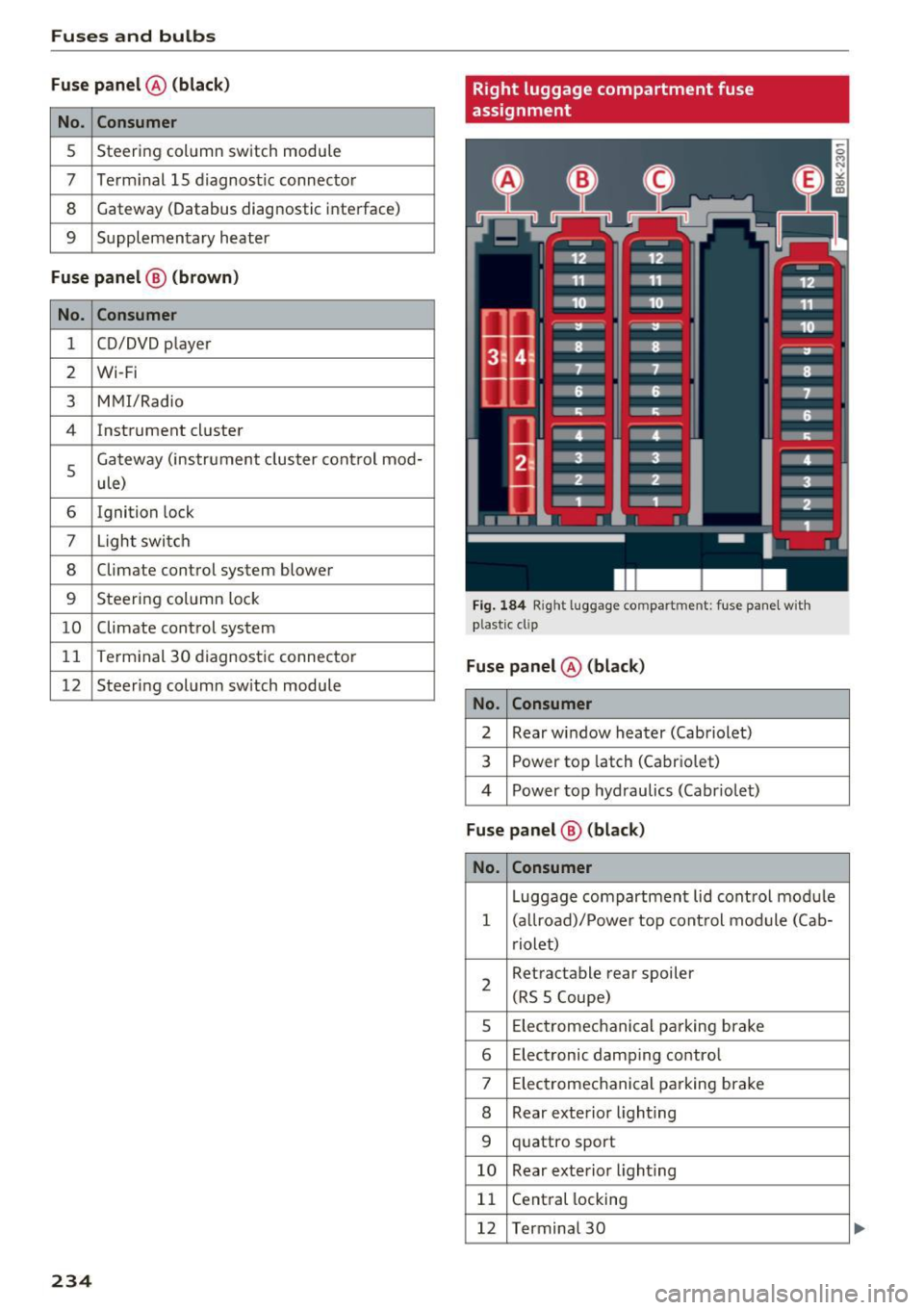
Fuse panel @ (black )
No. Consume r
5 Steering column switch module
7 Term inal 15 diagnostic connec to r
8 Gateway (Databus diagnostic interface)
9 S upplementary heater
Fuse panel @ (brown)
No. Consumer
1 C D/D VD p laye r
2 Wi-Fi
3 M MI/Radio
4 Instrument cluster
5
Ga teway (instrument cluster cont rol mod -
ule)
6 Ignition lock
7 Ligh t swi tch
8 Climate control system blower
9 Steering col umn lock
10 Climate control system
1 1 Te
rm inal 30 diagnos tic connec to r
12 Steer ing column sw itch module
234
Right luggage compartment fuse
assignment
Fig. 184 Right lu ggage compartment: fuse panel wit h
plast ic cl ip
Fuse panel @ (black)
No . Consumer
2 Rear wi ndow heater (Cabriolet)
3 Power top latch (Cabr io let)
4 P ower top hyd raulics (Cabr io let)
Fuse panel @ (black)
No . Consumer
Luggage compartment lid cont rol mo dule
1 (all road)/ Power top cont rol mod ule (Ca b-
r iolet)
2 Retractable rear
spoiler
(RS 5 Coupe)
5 E
lec tromec hanical p arking brake
6 Electronic damping contro l
7 Elec tromec hanical pa rking brake
8 Rear exte rior light ing
9 q uattro sport
10 Rear exterior lighting
1 1 Cent
ral locking
12 Terminal 30
...
Page 237 of 264
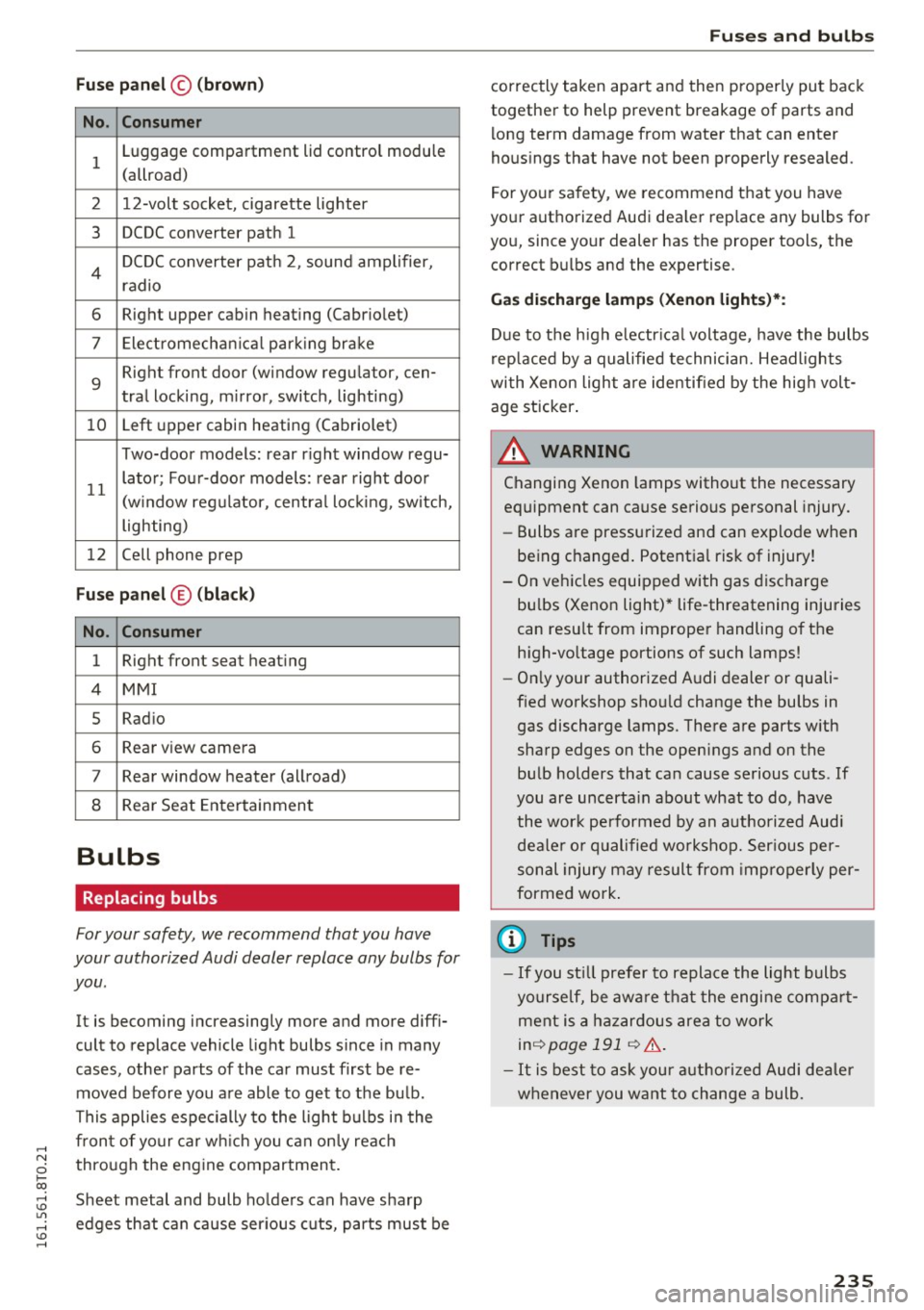
.... N
0 Ico ....
No . Consumer
1 Luggage compartment lid control module
(allroad)
2 12-volt socket, cigarette lighter
3 DCDC converter path 1
4 DCDC converter path 2, sound amplifier,
radio
6 Right upper cabin heating (Cabriolet)
7 Elect romechan ical park ing brake
9
Right front door (window regulator, cen-
tral locking, m irror, switch, lighting)
10 Left
upper cabin heating (Cabriolet)
Two-door models: rear r ight window regu-
11 lator; Four-door models:
rear right door
(w indow regulator, central locking, switch,
lighting)
12 Cell phone prep
Fuse panel ® (black )
No . Consumer
1 Right front seat
heating
4 MMI
5 Radio
6 Rear view camera
7 Rear window heater (allroad)
8 Rear Seat Entertainment
Bulbs
Replacing bulbs
For your safety, we recommend that you have
your authorized Audi dealer replace any bulbs for
you .
It is becoming increasingly more and more diffi
cult to replace vehicle light bulbs since in many
cases, other parts of the car must first be re
moved before you are able to get to the bu lb.
This applies especially to the light bulbs in the
front of your car which you can only reach
through the eng ine compartment.
Sheet metal and bulb ho lders can have sharp
edges that can cause serious cuts, parts must be
Fuses and bulbs
correctly taken apart and then properly put back
together to help prevent breakage of parts and
long term damage from water that can enter
hous ings that have not been properly resealed.
For your sa fety, we recommend that you have
your authorized Audi dea ler replace any bulbs for
you, since your dealer has the proper tools, the
correct bulbs and the expertise.
Gas discharge lamps (Xenon lights)*:
Due to the high e lectr ica l voltage, have the bulbs
replaced by a qualified technician. Headlights
with Xenon light are identified by the high volt
age sticker .
A WARNING
Changing Xenon lamps without the necessary
equipment can cause serious personal injury.
- Bulbs are pressurized and can explode when
being changed . Potential risk of injury!
- On vehicles equipped with gas discharge
bu lbs (Xenon light)* life-threatening injuries
can resu lt from improper handling of the
high -vo ltage portions of such lamps!
- Only your authorized Audi dealer or quali
fied workshop shou ld change the bulbs in
gas discharge lamps. There are parts w ith
sharp edges on the openings and on the bulb holders that can cause serious cuts . If
you are uncerta in about what to do, have
the wor k performed by an authorized Audi
dealer or qualified workshop. Serious per
sonal injury may result from improperly per
formed work.
(D Tips
- If you st ill prefer to replace the light bulbs
yourself, be awa re that the engine compa rt
ment is a hazardous area to work
inq page191 q &_ .
-It is best to ask your authorized Audi dealer
whenever you want to change a bulb.
235
Page 238 of 264
Emergency situations
Emergency situations
General
This chapter is intended for trained emergency crews and working personnel who have the nec
essary tools and equipment to perform these
operations.
Starting by pushing or
towing
CD Note
Vehicles with an automatic transmission
cannot be started by pushing or towing.
Starting with jumper
cables
If necessary, the engine con be started by con
necting it to the battery of another vehicle.
If the engine should fail to start because of a dis
charged or weak battery, the battery can be con
nected to the battery of
another vehicle, using a
pair of jumper cables to start the engine.
Jumper cables
Use only jumper cables of sufficiently largecross
section
to carry the starter current safely. Refer
to the manufacturer's specifications.
Use only jumper cables with
insulated terminal
clamps which are distinctly marked :
plus(+) cable in most cases colored red
minus(-) cable
in most cases colored black.
A WARNING
Batteries contain electricity, acid, and gas.
Any of these can cause very serious or fatal in
jury. Follow the instructions below for
safe
handling of your vehicle's battery.
-Always shield your eyes and avoid leaning
over the battery whenever possible.
-A discharged battery can freeze at tempera
tures just below 32 °F (0 °C). Before con
necting a jumper cable, you must thaw the
236
frozen battery completely, otherwise it could explode.
- Do not allow battery acid to contact eyes or
skin. Flush any contacted area with water immediately.
- Improper use of a booster battery to start a
vehicle may cause an explosion.
- Vehicle batteries generate explosive gases.
Keep sparks, flame and lighted cigarettes
away from batteries.
- Do not try to jump start any vehicle with a
low acid level in the battery.
- The voltage of the booster battery must also
have a 12-Volt rating. The capacity (Ah) of
the booster battery should not be lower
than that of the discharged battery. Use of
batteries of different voltage or substantial
ly different "Ah" rating may cause an explo
sion and personal injury.
- Never charge a frozen battery. Gas trapped in the ice may cause an explosion.
- Never charge or use a battery that has been
frozen . The battery
case may have be weak
ened .
- Use of batteries of different voltage or sub
stantially different capacity (Ah) rating may
cause an explosion and injury. The capacity
(Ah) of the booster battery should not be
lower than that of the discharged battery.
- Before you check anything in the engine
compartment, always read and heed all
WARNINGS
~page 191.
CD Note
-Applying a higher voltage booster battery
will cause expensive damage to sensitive
electronic components, such as control
units, relays, radio, etc.
- There must be no electrical contact between
the vehicles as otherwise current could al
ready start to flow as soon as the positive
(+) terminals are connected.
@ Tips
The discharged battery must be properly con-
nected to the vehicle's electrical system. .,..
Page 243 of 264
.... N
0 1-CX)
.... I.Cl U"I
.... I.Cl ....
Technical data
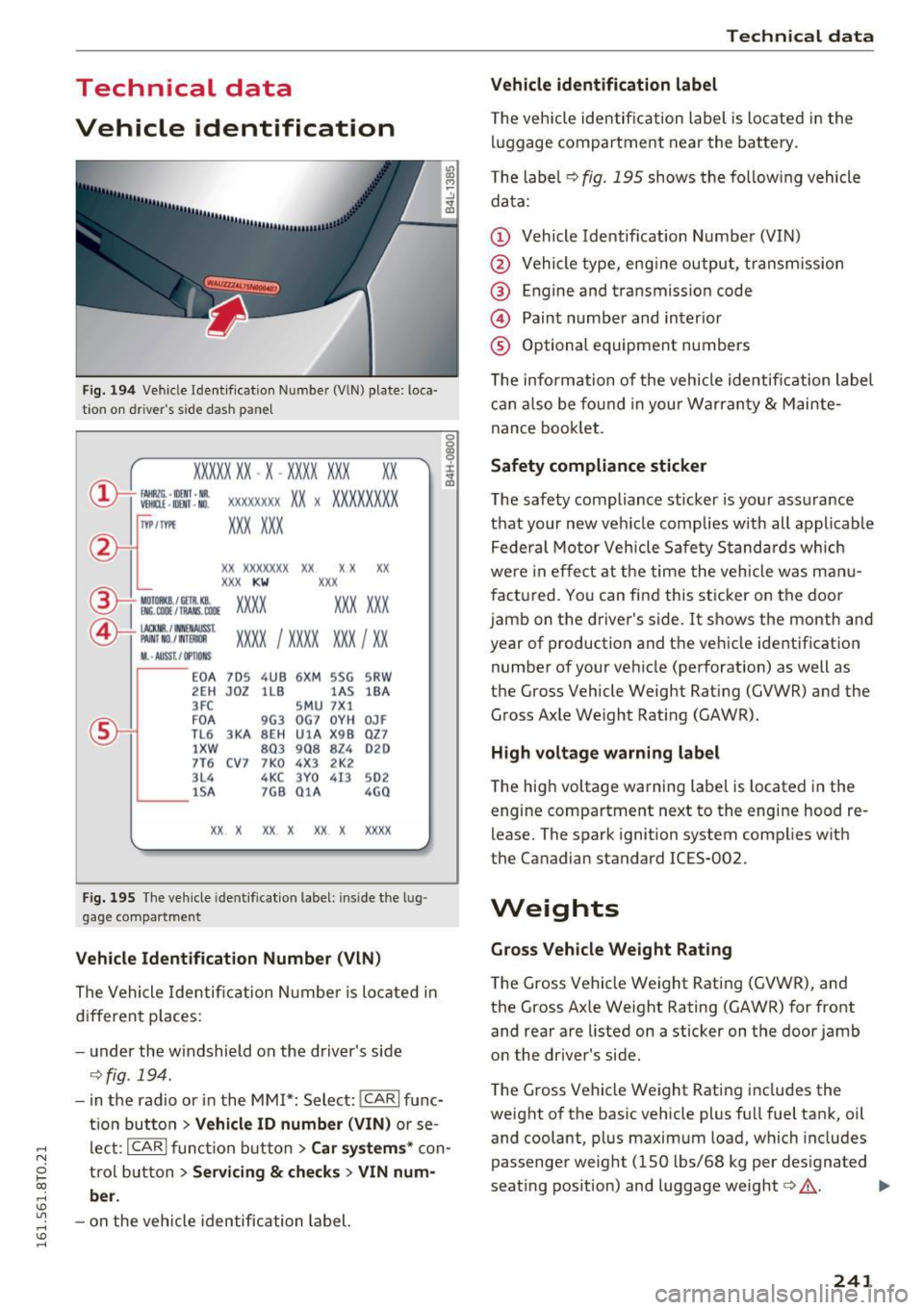
Vehicle identification
F ig. 194 Vehi cle Ident if ication Number (VlN) plate : loca·
tion on dr iver 's side dash panel
XXXXX XX -X -XXXX XXX XX
CD+ ~t :1:: xxxxxxxx xx x xxxxxxxx
TVP/fffl XXX XXX
XX XXXXXXX XX X X xx
XXX KW XXX
®i ~:J·f lfils~~ XXXX XXX XXX
®-+ ~ N:a=i~l xxxx ; xxxx xxx ; xx
II.· AUSS, I OPTIONS
,__ __
EOA 7D5
2EH JOZ
3FC
FOA
TL6 3KA
lXW
7T6 CV7
3L4 lSA 4UB
6XM 5SG
llB l AS
SMU 7Xl
9G3 OG7 0YH
8EH UlA X98
803 908 824
7K0 4X3 2K2
4KC 3Y0 413
7GB
01A
5RW
18A
OJF QZ7
020
502
4G0
XX . X XX X XX X XXXX
Fig. 195 The vehicle identificat ion label: inside the l ug·
gage compartment
Veh icle Identification Number (VlN )
The Vehicle Identification Number is located in
different p laces:
- under the windshield on the driver's side
~fig. 194.
-in the radio or in the MMI*: Select: !CAR! func
t ion button
> Vehicle ID number (VIN) or se
lect :
I CAR ! funct ion button > Car systems* con
t rol button
> Servicing & checks > VIN num
ber .
-on the vehicle identification label.
Technical data
Vehicle identification label
The vehicle identification label is located in the
luggage compartment near the battery.
The label
~ fig. 195 shows the follow ing vehicle
data:
(D Vehicle Identification Number (VIN)
@ Vehicle type, eng ine output, transm ission
@ Engine and transmission code
@ Paint number and interior
® Optional equipment numbers
T he information of the vehicle identification label
can also be found in your Warranty
& Mainte
nance booklet.
Safety compliance sticker
The safety compliance sticker is your assurance
that your new vehicle complies w ith all applicable
Federal Motor Vehicle Safety Standards which
were in effect at the time the vehicle was ma nu
factured. You can find this sticker on the door
jamb on the driver's side. It shows the month and
year of production and the vehicle identification number of your vehicle (perforation) as well as
the Gross Vehicle Weight Rat ing (GVWR) and the
Gross Axle Weight Rating (GAWR).
H igh voltage warning label
The high voltage warning label is located in the
engine compartment next to the engine hood re
lease. The spark ignition system complies with
the Canadian standard ICES-002.
Weights
Gross Vehicle W eight Rating
The Gross Vehicle Weight Rating (GVWR), and
the Gross Axle Weight Rating (GAWR) for front
and rear are listed on a sticker on the door jamb
on the driver 's side.
T he Gross Vehicle Weight Rating includes the
weight of the basic vehicle plus full fuel tank, oil
and coolant, plus maximum load, which includes
passenger weight (150 lbs/68 kg per designated
seating position) and luggage weight
c:> .&, . .,.
241