seats AUDI A5 COUPE 2016 Service Manual
[x] Cancel search | Manufacturer: AUDI, Model Year: 2016, Model line: A5 COUPE, Model: AUDI A5 COUPE 2016Pages: 264, PDF Size: 66.92 MB
Page 163 of 264
.... N
0 I-co ....
Improperly installed child safety seats in
crease the risk of serious personal injury and
death in a collision.
- Always make sure that the safety belt re
tractor is locked when installing a child
safety seat. An unlocked safety belt retrac
tor cannot hold the child safety seat in place
during no rma l driving or in a crash.
- Always buckle the child safety seat firmly in
place even if a child is not sitting in it. A
loose child safety seat can fly around d uring
a sudden stop or in a collision .
- If the backrest is not securely latched, the
child and the child restrain t will be thrown
forward together with the backrest and will strike parts of the vehicle interior. The ch ild
can be seriously injured or killed.
- Never install rearward -facing child safety
seats or infant carriers on the front passen ger seat. A child will be seriously injured and
can be killed when the passenger airbag in
flates.
- The inflating a irbag will hit the child safety
seat or infant carrier with great force and
will smash the ch ild safety seat and child
against the backrest, center armrest, door or roof .
- Always install rearward-fac ing ch ild safety
seats or infant carriers on the rear seat .
- Forward-fac ing ch ild safety seats or infant
carriers installed on the front passenger's
seat may inte rfere with the deployment of
the a irbag and cause serious injury to the
c hild.
- It is safe r to install a forward-fac ing ch ild
safety seat on the rear seat.
- Always read and heed all WARNINGS when
ever using a child restrained in a veh icle is
being used
¢page 151. Specia l pre caut ions
apply when installing a child safety seat on
the front passenger seat¢
page 130, Child
restraints on the front seat -some impor
tant things to know.
Ch ild safety
A WARNING
Always take special precautions if you must
i nstall a forward or rearward-facing child re
stra int on the front passenger's seat in excep
tional s ituations:
- Whenever a forward or rearward-fac ing
child restraint is installed on the front pas
senger seat, the
PASSENGER AIR BAG OFF
lig ht must come on and stay on w henever
the ignition is switched on.
- If the PASSENGER AIR BAG OFF li ght does
not come on and stay on, perform the
checks desc ribed¢
page 139, Monitoring
the Advanced Airbag System.
- Take the child restr aint off t he front passen
ger seat and install it properly at one of the
rear seat positions if the
PASSENGER AIR
BAG OFF
light does not stay on whenever
the ignition is switched on.
- Improper installation of child restraints can
reduce their effectiveness or even prevent
them from providing any protect ion.
- An imprope rly installed child restraint can
interfere with the airbag as it deploys and
serious ly injure or even kill the chi ld.
- Always care fully follow the manufacturer's
instr uctions provided with the child safety
seat or carr ier.
- Never p lace add itiona l items on the seat
that can increase the total weight registered
by the weight-sensing mat and can cause in
jury in a crash.
A WARNING
-Forward-facing child restra ints:
- Always make sure the forward-facing seat
has been des igned and certified by its man
ufacturer for use on a front seat with a pas
senger front and side airbag .
- Never put the forward-facing child restraint up, against or very nea r the instrument pan
el.
- Always move the passenger seat into its
rearmost posit ion in the seat's fore and aft
-
161
Page 165 of 264
.... N
0 Ico ....
the child restraint is installed is in an up
right position and securely latched into
place and cannot fold forward. Otherwise,
the seatback with the child safety seat at
tached to it could f ly forward in the event of
an accident or other emergency situation.
- Always read and heed all WARNINGS when
ever using a child restrained in a veh icle is
being used
r=;,page 151. Spec ia l precaut ions
apply when installing a child safety seat on
the front passenger seat¢
page 130, Child
restraints on the front seat -some impor
tant things to know.
Deactivating the convertible locking
retractor
The convertible locking retractor for child re
straints will be deactivated automatically when
the belt is wound all the way back into the re
tractor .
~ Press the red button on the safety belt buckle.
The belt tongue will pop out of the buckle.
~ Guide the safety belt all the way back into its
stowed position .
Always let the safety belt retract complete ly into
its stowed position. The safety belt can now be
used as an ordinary safety belt without the con
vertible locking retractor for child restraints.
If the convert ible locking retractor should be ac
tivated inadvertently, the safety belt must be un
fastened and guided completely back into its
stowed position to deact ivate this feature. If the
convert ible lock ing retractor is not deactivated,
the safety belt w ill gradually become tighte r and
uncomfo rtable to wea r.
_& WARNING
-
Improperly installed chi ld safety seats in
crease the risk of serious personal injury and
death in a collision.
- Never unfasten the safety belt to deactivate
the convertible locking retractor for child re
straints while the vehicle is moving . You
Child safety
wou ld not be restrained and could be seri
ously injured in an accident.
- Always read and heed all WARNINGS when
ever using a child restrained in a vehicle is
be ing used ¢
page 151. Special precautions
apply when installing a child safety seat on
the front passenger seat
¢ page 130, Child
restraints on the front seat -some impor
tant things to know.
163
Page 166 of 264
Child safety
LATCH system (Lower
anchorages and tethers
for children)
Child Restraint System anchors and how
are they related to child safety
To prov ide a simpler and more practicable way to
attach the child restra int on the vehicle seat,
Federal regulations require special lower ancho
rages in vehicles and devices on new child re
straints to attach to the vehicle anchorages.
I n the United States, the combination of the
tether anchorages and the lower anchorages is
now generally called the LATCH system for
"Lower Anchorages and Tethers for Children". In
Canada, the terms "top tether" with "lower uni
versal anchorages" (o r "lowe r universal anchor
age bars") are used to describe the system.
In othe r countries the term "ISO FIX" is used to
describe the lower anchorages .
F orward-facing child restraints manufactured af
ter September 1, 1999, are required by U.S. fed
eral regulations to comply with new child head
movement performance requirements. These
new performance requirements make a tether
necessary on most new child seats.
Installing a child restraint that requires a top
tether without one can seriously impair the per
formance of the child restraint and its ability to
protect the child in a collision . Installing a chi ld
restraint that requires a top tether without the
top tether may be a violation of state law.
Child restraint manufacturers offer LA TCH lower
anchorages on their child seats with hook-on or
push-on connectors attached to adjustable
straps .
In addition to the LA TCH lower anchorages, these
child restraint systems usually require the use of
tether straps to help keep the child restraint
firmly in place.
A WARNING
Improper installation of ch ild restraints will
increase the r isk of injury and death in a
crash.
164
- Always follow the instructions provided by
the manufacturer of the child restraint you
intend to install in your vehicle.
- Never install a child restraint without a
properly attached top tether strap if the
child restraint manufacturer's instructions
require the top tether strap to be used.
- Improper use of child restraint LATCH lower
anchorage points can lead to injury in a colli
sion. The LATCH lower anchorage points are
designed to withstand only those loads im
posed by correctly fitted child restraints.
- Never mount two child restraint systems on
one LATCH lower anchorage point.
- Never secure or attach any luggage or other
item to the LATCH lower anchorages.
Location
Fig. 146 Schema tic ove rview : LATCH anchorage poi nt loc a
t ion s
The illustration shows the seating locations in
your vehicle which are equ ipped with the lower
anchorages system.
Page 167 of 264
,-1 N
0 1-CX)
,-1 I.Cl U"I
,-1 I.Cl ......
Description
The lower anchorage positions are marked for
quick locating .
Fig. 147 Lower anchorages, covers marked
Fig. 148 Rea r seats : lower ancho rage bracke t locatio ns
Lower anchorages
The lower anchorage attachment points are lo
cated on the rear end of the rear seatback.
Remove the covers
ca:> fig. 147 to access the lower
anchorage attachment points.
The lower anchorage attachment points are visi ble
ca:> fig. 148 .
Lower anchorages secure the child restraint in
the seat without using the vehicle's safety belts.
Anchorages provide a secure and easy -to -use at
tachment and minim ize the possibility of improp
er ch ild restraint installation .
All ch ild restraints manufactured after Septem
ber 1, 2002, must have lower anchorage attach
ments for the
LATCH system .
Remember that the lower anchorage points are
only intended for installation and attachment of
child restraints specifically certified for use with
LATCH lower anchorages. Child restraints that
are not equipped with the lowe r anchorage at-
Child safety
tachments can still be installed in compliance
with the child restraint manufacturer 's instruc
tions on using vehicle safety belts.
A WARNING
-Improper use of LATCH lower anchorages can
cause serious personal injury in an accident.
- Always carefully follow the child restraints
manufacturer's instructions for proper in
stallat ion of the child restraint and proper
use of the lower anchorages or safety belts
in your vehicle .
- Never secure or attach any luggage or other
items to the
LATCH lower anchorages.
- Always read and heed the important infor
mat ion about ch ild restraints in this chapter
and WARNINGS
~page 151, Child safety.
Installing a child restraint with LATCH
lower anchorages
Whenever you install a child restraint always fol
low the child restraint manufacturer's instruc
tions.
Fi g. 149 Lower ancho rages : prope r mount ing
Mounting
.,. Make sure the seatback of the rear seat bench
is in the upright position and secure ly latched
in place .
.,. Attach both hook-on connectors with the spring
catch release on the child safety seat onto the LATC H lower anchorage so that the con nectars
lock into place~
fig. 149 .
.,. Pull on the connector attachments to make
sure they are properly attached to the LATCH
lower anchorage.
165
Page 168 of 264
Child safety
• Pull straps tight fo llowing the child restraint
manufacturer's instructions.
Relea sing
• Loosen the tension on the straps following the
child restraint manufacturer's instruct ions .
• Depress the spring catches to release the an
chorage hooks from the lower anchorages.
Remember: Use tether straps to he lp keep the
child restraint f irmly in place .
8_ WARNING
Improper use of the LATCH system can in
crease the risk of serious personal injury and
death in an accident.
- These anchors were deve loped only for child
safety seats using the "LA TCH" system.
- Never attach other child safety seats, belts or othe r objects to these anchors.
- Always make sure that you hear a click when
latching the seat in place . If you do not hear
a click the seat is not secure and could fly
forward and hit the interior of the vehicle, or be ejected from the vehicle.
8_ WARNING
Improper installation of ch ild restraints will
increase the r isk of injury in an acc ident.
-Always follow the child restra int system
manufacturer's instructions for proper in
stallation of the child restra int system and
proper use of tether straps as well as the
lower anchorages or safety be lts in your ve
hicle.
- Always read and heed the important infor
mation and WARNINGS abo ut child safety
and the installation of child restrain t sys
tems
r=> page 151, Child safety.
166
Tether anchors and tether straps
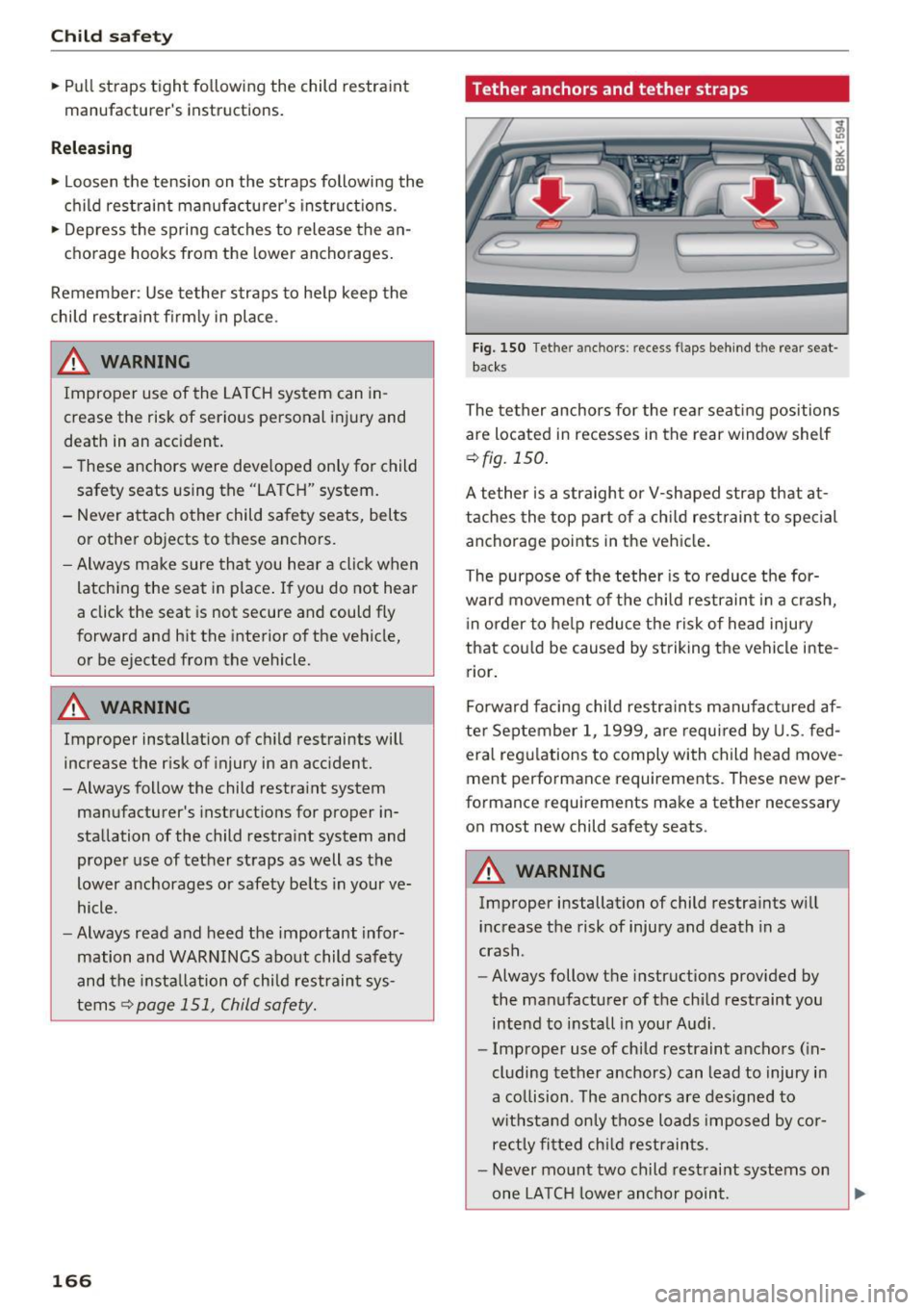
Fig. 150 Tet her an ch ors : recess flap s behind the re ar s eat
back s
The tether anchors for the rear seat ing positions
are located in recesses in the rear window shelf
r=> fig. 150.
A tether is a straight or V-shaped strap that at
taches the top part of a chi ld restraint to special
anchorage points in the vehicle.
The purpose of the tether is to reduce the for
ward movement of the child restrain t in a crash,
i n order to help reduce the risk of head injury
that cou ld be caused by striking the vehicle inte
rior.
Forward facing child restra ints manufactured af
te r September 1, 1999 , are requi red by U.S . fed
era l reg ulations to comply with child head move
ment performance requirements . T hese new per
formance requirements make a tether necessary
on most new child safety seats.
8_ WARNING
Improper installation of child restra ints w ill
increase the risk of injury and death in a
crash .
- Always follow the instructions provided by
the manufacturer of the child restraint you
intend to install in your Audi .
- Improper use of child restraint anchors ( in
cluding tether anchors) can lead to injury in
a co llision . The anchors are des igned to
w ithstand only those loads imposed by cor
re ctly fi tted ch ild restraints.
- Never mount two ch ild rest raint systems on
one LA TC H l owe r anchor point. ..,.
Page 169 of 264
,-1 N
0 1-CX)
,-1 I.Cl U"I
,-1 I.Cl ......
-Never attach two child restraint systems to
one tether strap or tether anchorage.
- Never attach a tether strap to a tie-down
hook in the luggage compartment.
- Never use child restraint tether anchorages
to secure safety belts or other kinds of occu
pant restraints.
- Never secure or attach any luggage or other
items to the LA TCH lower anchorages or to
the tether anchors.
- If a tether or other strap is used to attach a
child restraint to the front passenger seat,
make sure that it is not so tight, that it
causes the weight-sens ing mat to measure
more weight than is actually on the seat .
- The heavier weight registered can make the
Advanced Airbag System work as though an
adult were on the seat and dep loy the Ad
vanced Airbag when it must be supp ressed
ca using se rious o r even fatal injur y to the
c hild.
- If you must install a re arward fac ing ch ild
safety seat on the front passenger seat be
cause of except io na l circumstances and the
PASSENGER AIR BAG O FF light does not
come on and stay on, immediate ly install
the rear-fac ing child safety seat in a rear
seating position and have the airbag system
inspected by your authorized Audi dea ler.
Installing the upper tether strap on the
anchorage
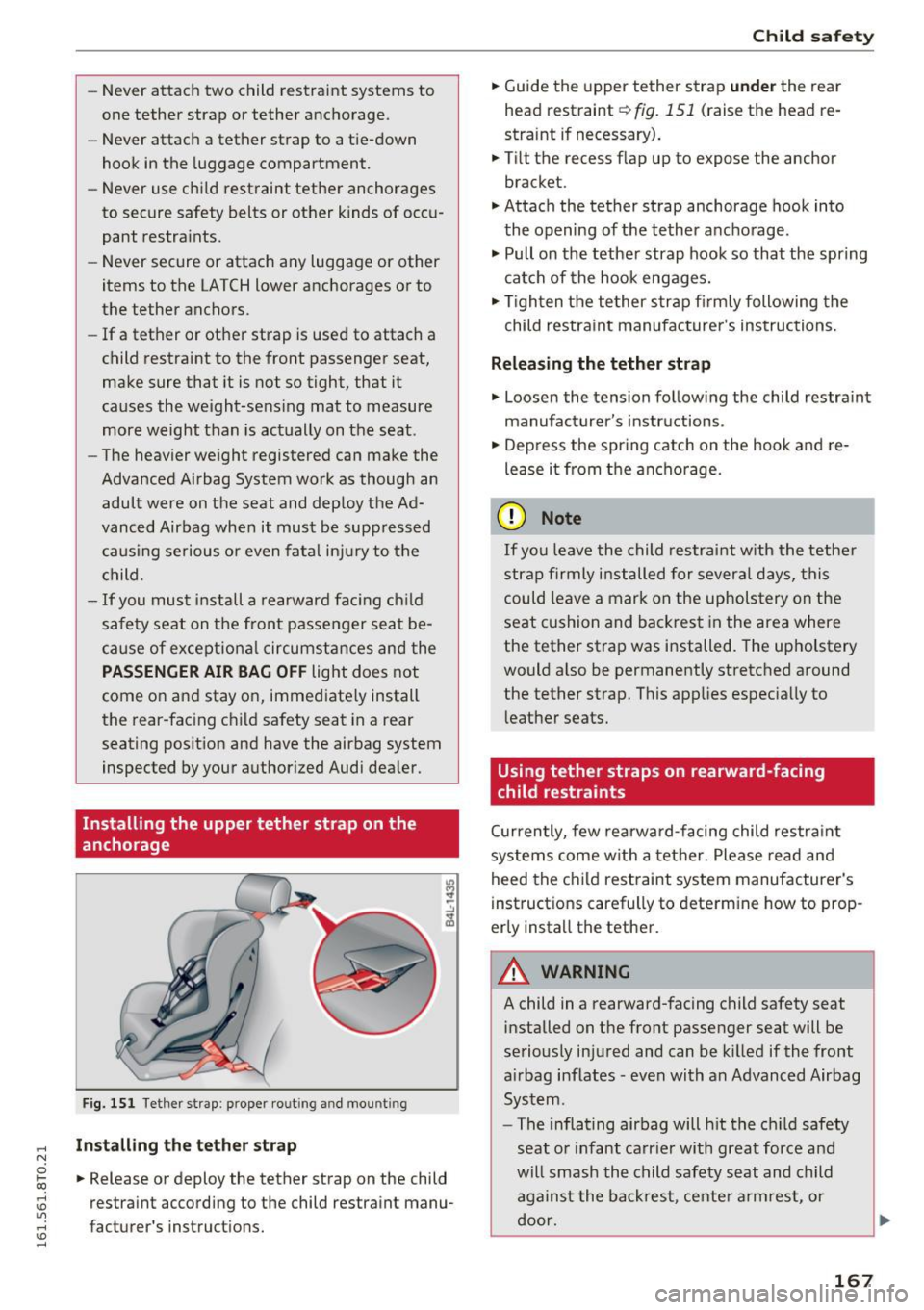
F ig. 151 Tethe r str ap : pro pe r ro uting an d mountin g
Installing th e teth er strap
.,. Release or deploy the tether strap on the child
restra int according to the child restraint manu
fac turer's in struc tions.
Ch ild sa fety
.,. Guide the upper tether strap unde r the rear
head restraint ~
fig. 151 (rais e the head r e
straint if necessary) .
.,. Tilt the recess f lap up to expose the ancho r
bracket .
.,. Attach the tether strap anchorage hook into
the opening of the tether anchorage.
.,. Pull on the tether strap hook so that the spring
catch of the hook engages.
.,. Tighten the te ther s trap fi rm ly following the
child restraint manufacturer 's ins truc tions.
Releasing the tether strap
.,. Loosen the tension follow ing the child restra int
manufact urer 's instr uctions .
.,. Dep ress the spr ing catch on the hook and re
lease it from t he ancho rage.
(D Note
If you leave the child restrai nt w ith the tethe r
stra p firmly i nstalled for several days, this
could leave a mark on the uphols tery on the
seat cushion and back rest in the area where
the tether strap was installed. The upholstery
would a lso be permanently stretched around
the tether strap. This app lies espec ia lly to
l eather seats.
Using tether straps on rearward-facing
child restraints
C urren tly, few rearwa rd-facing child restra int
systems come w ith a tether. Please read and
heed the child restra int system manufacturer's
instructions carefully to dete rm ine how to prop
erly install the tether .
A WARNING
A child in a rearward-facing child safety seat
i nstalled on the front passenger seat will be
seriously inju red and can be k illed if the front
a irbag inflates -even with an Advanced Airbag
System.
- The inflating airbag will h it the c hild safety
seat o r infant ca rr ier with great force and
will smash the child safety seat and child against the back rest , cente r a rm rest, or
door.
167
Page 178 of 264
Intelligent Technology
according to t he needs of the individua l compo
nents. It regu lates consumption , so that more
e lectr ical energy is not being used than is being
generated and ensures an optimal state of
charge for the battery.
(D Tips
- But even energy management cannot neg
ate the limits of physics . Cons ider that the
power and life of a battery are limited.
- If starting ability is threatened, the indica
tor light (•) appears ¢
page 16.
What you should know
The highest priority is given to maintaining start
ing capability.
The batte ry is severely taxed in short-distance
driving, in c ity traffic and d uring the co ld time of
year. Abundant electrical energy is req uired, but
only a little is generated . It is also c rit ica l if the
engine is not runn ing and electrical components
are turned on . In this instance energy is be ing
consumed but none is be ing generated .
It is in precisely t hese situations that you will no
tice energy management active ly regulat ing the
d istr ibut ion of energy .
Vehicle stands fo r an e xtended period
If you do not drive your vehicle over a period of
several days or weeks, electrical components are
gradually cut back or sw itched off. T his reduces
energy consumption and ma inta ins starting ca
pab ility over a longer period . Some of the con
ve nience funct ions may not ope rate, such as the
i n terio r lights or the powe r seat adjustment. The
conven ience f unc tions w ill be available again
when yo u switch on the ign it io n and s tart the en
g ine.
With the engine turned off
I f you listen to t he radio, fo r example , with the
engine tu rned off o r use other MMI functions,
the batte ry is being discharged.
If start ing capabili ty is jeopardized due to energy
consumpt ion, a message appears in t he M MI dis
p lay. The message indicates that the system wi ll
176 b
e switched off a utomat ica lly in a moment . If
you wish to continue using the functions, you have to sta rt the eng ine.
With the engine running
Althoug h elec trica l energy is gene rated w hen t he
vehicle is bei ng drive n, the batte ry can become
discharged. This happens mostly when little en
ergy is being generated and a great dea l con
s u med and the battery 's state of charge is not
optimal.
To bring the energy balance back into equilibri
u m, consumers whic h require espec ia lly large
amounts of energy are temporar ily cut back or
switched off. Heating systems in particular re
quire a great dea l of energy. If you notice, for ex
ample, that the heated seats* o r the heated rear
window are not heati ng, they have bee n tempo
r arily cut back o r switched off . These systems will
be available again as soon as the ene rgy balance
has been res tored.
You w ill also no tice that eng ine idle speed has
been increased slig htly . T his is no rma l and not a
ca use for concer n. By in cr easi ng engine idle
speed t he ad ditional energy required is gene rat
ed and the battery is charged.
Page 209 of 264

be happy to provide more infor
mation.
® Mud and snow capability
"M/5 " or "M+S" indicates the tire
has character istics that make it
suitable for driving on mud and
snow .
& indicates a winter tire .
@Composition of the tire cord
and materials
The number of plies indicates the
number of rubberized fabric lay
ers in the tire. In general: the
more layers , the more weight a
tire can carry . Tire manufacturers
must also specify the materials
used in the tire. These inc lude
steel, nylon, polyester and other
materials.
@ Maximum permitted load
This number indicates the max i
mum load in kilograms and
pounds that the tire can carry.
@ Uniform tire quality grade
standards for treadwear,
traction and temperature resistance
Treadwear, traction and tempera
ture ranges ¢
page 222.
;:::: @ Running direction
~ ~ ...
'° V, ....
'° ....
The arrows indicate the running
direction of unidirectional tires .
Wheels
You must always follow the speci
fied runn ing d irect ion
¢ page 231 .
@ Maximum permitted
inflation pressure
This number ind icates the maxi
mum pressure to which a tire can
be inflated unde r normal operat
ing condit ions.
Glossary of tire and loading
terminology
Accessory weight
means the comb ined weigh t (in
excess of those standard items
which may be replaced) of auto
matic transm ission, power steer
ing , power brakes, power win
dows, power seats, radio, and
heater, to the extent that these
items are available as facto ry-in
stalled equipment (whether in
stalled or not) .
Aspect ratio
means the ratio of the heigh t to
the width of the tire in percent .
Numbers of 55 or lowe r indicate a
low sidewa ll for improved steer
ing response and better overall
handling on dry pavement. .,.
207
Page 251 of 264
....
Emergency release . . . . . . . . . . . . . . . . . . . . 88
Kick -down . . . . . . . . . . . . . . . . . . . . . . . . . . . 87
Manual shift program . . . . . . . . . . . . . . . . . 86
Removal lock (igni tion key) . . . . . . . . . . . . . 72
Selector lever . . . . . . . . . . . . . . . . . . . . . . . . 83
Automatic wipers . . . . . . . . . . . . . . . . . . . . . . 50
Auto Safety Hotline . . . . . . . . . . . . . . . . . . . 119
Average speed . . . . . . . . . . . . . . . . . . . . . . . . 24
Avoid damaging the vehicle . . . . . . . . . . . . . 177
B
Battery . . . . . . . . . . . . . . . . . . . . . . . . . . . . . . 16
Battery location inside the luggage compart-
ment .. .. .. .. .... . .......... .. .. .. . 201
Charge level . . . . . . . . . . . . . . . . . . . . . . . . 175
Charging . . . . . . . . . . . . . . . . . . . . . . . . . . . 202
Energy manag ement . . . . . . . . . . . . . . . . . 17 5
Important w arnings when working on the
batte ry . . . . . . . . . . . . . . . . . . . . . . . . . . . . 201
Jump starting . . . . . . . . . . . . . . . . . . . . . . . 236
Replacing the battery . . . . . . . . . . . . . . . . 203
Work ing on the battery . . . . . . . . . . . . . . . 201
Befo re driving . . . . . . . . . . . . . . . . . . . . . . . . 112
Belt tensioners . . . . . . . . . . . . . . . . . . . . . . . 127
Bio -ethanol (Fuel) . . . . . . . . . . . . . . . . . . . . . 187
Blended gasoline . . . . . . . . . . . . . . . . . . . . . 186
Blower (automatic climate control) . . . . . . . . 70
Booster seats . . . . . . . . . . . . . . . . . . . . . . . . 159
Brake fluid
Changing the brake fluid . . . . . . . . . . . . . . 200
Checking the brak e fluid level . . . . . . . . . . 199
Brake system
Anti-lock braking system . . . . . . . . . . . . . . . 19
Brake fluid specifications for refill and re
p lacement . . . . . . . . . . . . . . . . . . . . . . . . . 200
Brake light defective . . . . . . . . . . . . . . . . . . 21
B rake power assist unit . . . . . . . . . . . . . . . 17 2
Br akes. .. .. .. .... ........... .. .. .. . 172
Ceramic brakes . . . . . . . . . . . . . . . . . . . . . . 172
E lectromechanical parking brake . . . . . . . . 77
Warning/indicator lights . . . . . . . . . . . . . . . 15
Worn brake pads symbol . . . . . . . . . . . . . . . 20
Braking
"' Brake assist . . . . . . . . . . . . . . . . . . . . . . . . 170
0
~ Emergency braking function . . . . . . . . . . . . 79 ....
braking guard . . . . . . . . . . . . . . . . . . . . . . . . . 89
Messages . . . . . . . . . . . . . . . . . . . . . . . . . . . 96
Settings . . . . . . . . . . . . . . . . . . . . . . . . . . . . 96
Break-in period
Brake pads . . . . . . . . . . . . . . . . . . . . . . . . . 172
T ires . . . . . . . . . . . . . . . . . . . . . . . . . . . . . . 177
Breaking in . . . . . . . . . . . . . . . . . . . . . . . . . . 177
New t ires . .. .. .. .. ............. .. .. 212
Bulbs . . . . . . . . . . . . . . . . . . . . . . . . . . . . . . . 235
C
California Proposition 65 Warning . . . . . . . 192
Battery specific . . . . . . . . . . . . . . . . . . . . . 202
Capacities . . . . . . . . . . . . . . . . . . . . . . . . . . . 242
Engine oil . . . . . . . . . . . . . . . . . . . . . . . . . . 193
Care . . . . . . . . . . . . . . . . . . . . . . . . . . . . . . . . 184
Cargo a rea
refer to Luggage compartment ...... 64, 118
Catalytic converter . . . . . . . . . . . . . . . . . . . . 178
Center armrest . . . . . . . . . . . . . . . . . . . . . . . . 5 7
C entral locking . . . . . . . . . . . . . . . . . . . . . . . . 31
Central locking switch . . . . . . . . . . . . . . . . . 35
Convenien ce key . . . . . . . . . . . . . . . . . . . . . . 34
Remote control key . . . . . . . . . . . . . . . . . . . 34
Ceramic brake rotors New brake pads . . . . . . . . . . . . . . . . . . . . . 172
Certification . . . . . . . . . . . . . . . . . . . . . . . . . 247
Changing engine oil . . . . . . . . . . . . . . . . . . . 196
Checking Engine coolant level . . . . . . . . . . . . . . . . . . 197
Child restra ints
Danger of using child restraints in the front
seat.. .... .. .. .. .. ............... .. 130
Where can I get additional information
about child restraints and their use? . . . . 168
Child restra int system anchors . . . . . . . . . . 164
Child safety . .. .. .. .. ...... ......... .. 151
I mpor tan t safety ins truc tions for using child
safety seats . . . . . . . . . . . . . . . . . . . . . . . . 154
Installing a child restraint using the LATCH
system . . . . . . . . . . . . . . . . . . . . . . . . . . . . 165
Lower anchorages . . . . . . . . . . . . . . . . . . . 165
Mounting and releas ing the anchorage
hook . . . . . . . . . . . . . . . . . . . . . . . . . . . . . . 165
Tether anchors . . . . . . . . . . . . . . . . . . . . . . 166
Tether straps . . . . . . . . . . . . . . . . . . . . . . . 166
249
Page 252 of 264
Index
Child safety seats
Booster seats . . . . . . . . . . . . . . . . . . . . . . . 15 9
Conve rt ible ch ild seats . . . . . . . . . . . . . . . 157
Danger of using ch ild restraints in the front
sea t . . . . . . . . . . . . . . . . . . . . . . . . . . . . . . . 130
H ow do I properly install a child safety seat
i n my ve hicle? ... ... ... ... .. .. .. .. .. . 154
I nfant seats . . . . . . . . . . . . . . . . . . . . . . . . 156
L A TCH system . . . . . . . . . . . . . . . . . . . . . . 165
Safety ins tructions . . . . . . . . . . . . . . . . . . . 154
Unused safety belts on the rear seat . . . . 156
C hi ld seats . . . . . . . . . . . . . . . . . . . . . . . . . . 156
Secur ing . . . . . . . . . . . . . . . . . . . . . . . . . . . 160
Cigarette lighter . . . . . . . . . . . . . . . . . . . . . . . 60
C le ani ng . . . . . . . . . . . . . . . . . . . . . . . . . . . . 184
Climate control system . . . . . . . . . . . . . . . . . 68
Automatic recircu lation . . . . . . . . . . . . . . . . 7 1
Supp lementary heater . . . . . . . . . . . . . . . . . 7 1
synchronizing . . . . . . . . . . . . . . . . . . . . . . . . 7 1
Clock . . . . . . . . . . . . . . . . . . . . . . . . . . . . . . . . 12
C losing
Sun blind . . . . . . . . . . . . . . . . . . . . . . . . . . . 40
Closing/opening at t he lo ck cylinde r. . . . . . . . . . . . . . . . . . . . 3 6
by remo te con trol . . . . . . . . . . . . . . . . . . . . 34
with the cen tra l locking switch . . . . . . . . . . 35
with the convenience key . . . . . . . . . . . . . . . 34
Com ing home . . . . . . . . . . . . . . . . . . . . . . . . . 45
Compact spare tire . . . . . . . . . . . . . . . . . . . . 225
also refer to Spare tire . . . . . . . . . . . . . . . 225
Compartments . . . . . . . . . . . . . . . . . . . . . . . . 61
Compass in the mirror . . . . . . . . . . . . . . . . . . 52
Compliance . . . . . . . . . . . . . . . . . . . . . . . . . . 247
Consumer informa tion . . . . . . . . . . . . . . . . . 2 44
Consumer I nformat ion . . . . . . . . . . . . . . . . . 119
Contacting NH TSA . . . . . . . . . . . . . . . . . . . . 119
Convenience key
I ndicator l igh ts . . . . . . . . . . . . . . . . . . . . . . 76
S tarting eng ine (STAR T ENG INE S TOP but -
ton) . . . . . . . . . . . . . . . . . . . . . . . . . . . . . . . . 75
Stopping the engine (START ENGI NE STOP
button) . . . . . . . . . . . . . . . . . . . . . . . . . . . . . 76
Sw itching on ignition . . . . . . . . . . . . . . . . . . 75
un locking/ locking . . . . . . . . . . . . . . . . . . . . 34
Convenience opening/closing . . . . . . . . . . . . 39
Conve rt ible ch ild safety seats . . . . . . . . . . . 157
250
Convertib le locking retracto r
Activating . . . . . . . . . . . . . . . . . . . . . . . . . . 162
Deact ivat ing . . . . . . . . . . . . . . . . . . . . . . . . 163
U sing to secure a child safety seat . . . . . . 162
C oo lant system . . . . . . . . . . . . . . . . . . . . . . . 196
Cooling mode (automatic cl imate control) . . 69
Cooling System Expansion tank. .. .. .. ............. .. 197
Co rnering light . . . . . . . . . . . . . . . . . . . . . . . . 44
Cruise control Changi ng speed . . . . . . . . . . . . . . . . . . . . . . 81
P resetting yo ur speed . . . . . . . . . . . . . . . . . 81
Switc hing off . . . . . . . . . . . . . . . . . . . . . . . . 81
Swi tc hin g on . . . . . . . . . . . . . . . . . . . . . . . . . 80
Cruising range . . . . . . . . . . . . . . . . . . . . . . . . . 24
( u pholder . . . . . . . . . . . . . . . . . . . . . . . . . . . . 60
D
Data re corder . . . . . . . . . . . . . . . . . . . . . . . . 169
Date disp lay . . . . . . . . . . . . . . . . . . . . . . . . . . 12
Daytime run ning lights . . . . . . . . . . . . . . 44 , 45
De clara tion of compli ance
Adap tive cruise contro l . . . . . . . . . . . . . . . 247
Audi s ide ass ist . . . . . . . . . . . . . . . . . . . . . 24 7
Cell phone package . . . . . . . . . . . . . . . . . . 247
Convenience key . . . . . . . . . . . . . . . . . . . . . 247
E lectronic immobili zer. . . . . . . . . . . . . . . . 247
Homelink universal remote contro l . . . . . 247
Remote control key . . . . . . . . . . . . . . . . . . 247
Defect ive light bu lb wa rning . . . . . . . . . . . . . 21
Defrosting (windows) . . . . . . . . . . . . . . . . . . . 70
Dete rm ining co rrect load lim it ........ .. 219
D igi tal cloc k . . . . . . . . . . . . . . . . . . . . . . . . . . 12
D igital compass . . . . . . . . . . . . . . . . . . . . . . . 52
Dimensions . . . . . . . . . . . . . . . . . . . . . . . . . . 242
D imm ing t he rearv iew m irror . . . . . . . . . . . . 48
Doors emergency locking . . . . . . . . . . . . . . . . . . . . 36
Driver informat ion system . . . . . . . . . . . . . . . 23
En hanced shift indicato r . . . . . . . . . . . . . . . 27
Open door or front lid warning . . . . . . . . . . 23
Outs ide temperature display. . . . . . . . . . . . 23
Sound system display . . . . . . . . . . . . . . . . . 23
D river seat
refer to Seating position . . . . . . . . . . . . . . 113
D rivi ng econom ica lly . . . . . . . . . . . . . . . . . . 179