warning AUDI A5 COUPE 2018 Owners Manual
[x] Cancel search | Manufacturer: AUDI, Model Year: 2018, Model line: A5 COUPE, Model: AUDI A5 COUPE 2018Pages: 409, PDF Size: 67.63 MB
Page 335 of 409
Check ing and F illing
CJ) Note
Driving with an insufficient oil level is likely to
cause severe damage to the engine .
@ Tips
-The oil pressure warn ing display. i s not
an ind icato r of the oil l evel. Do not rel y on
it. In stead , che ck th e oil le vel in your e n
gi ne a t regul ar int ervals, prefe rably e ach
t ime you re fuel , and al ways befo re go ing
on a long trip .
-If you have the impression your engine con
sumes excessive amounts of oil, we recom
mend that you consult an authorized Aud i
dealer to have the cause of your concern properly d iagnosed . Keep in mind that the
accurate measurement of oil consumpt ion
r equi res great ca re and may take some
time. An authorized Audi dealer has instruc
tions about how to measure oil consump
tion accurately.
Checking the engine oil level and adding
engine oil
The engine oil level can be checked in the Info
t ainmen t sys tem
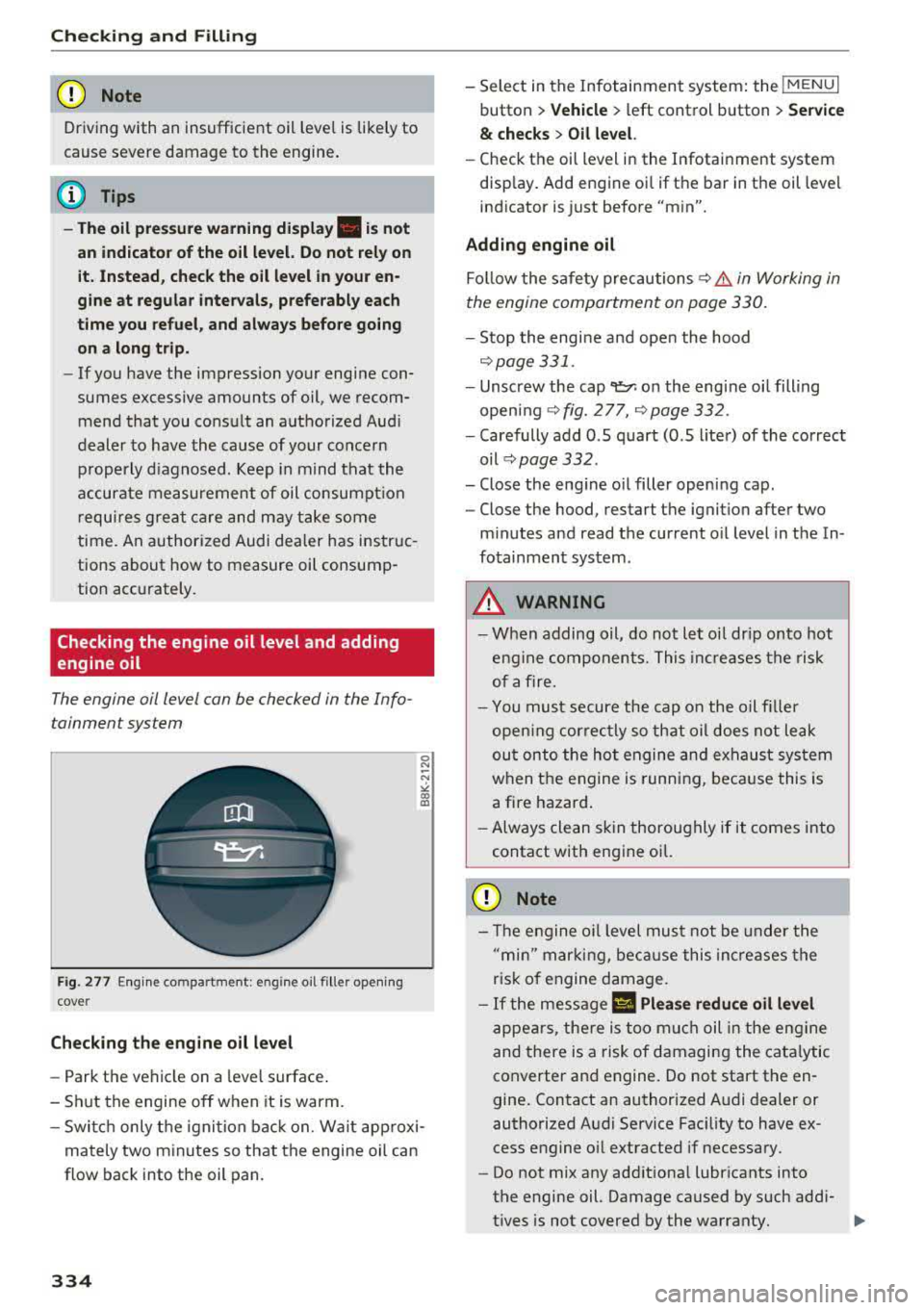
F ig . 277 Engin e co mpartme nt: e ngine o il fille r ope ning
c ove r
Checking th e engine oil l evel
-Park t he vehicle on a leve l surface .
-Sh ut the engine off when it is warm.
0 N
-N
>< (X) IX)
-Switc h only the ignition back on. Wa it approxi-
mately two minutes so that the engine oil can
flow back into the oil pan.
334
-Select in the Infotainment system: the ! MENUI
button > V ehicle > l eft control button > Se rvice
& ch ec ks > Oil level.
-Check the oil level in the Infotainment system
disp lay . Add engine oi l if the bar in the oil level
indicator is just before
"m in".
Adding engine oil
Fo llow the safety precautions r:';> Li::. in Working in
the engine compartment on page 330.
-Stop the engine and open the hood
<:';> page 331 .
-Unscrew the cap 9=;,1 on the engine oi l filling
open ing
r:';> fig. 277, <:';>page 332.
-Carefully add 0.5 quart (0.5 liter) of the correct
oil
r:';> page 332 .
-Close the eng ine oil filler opening cap.
-Close the hood, restart the ignit ion after two
m inutes and read the current o il level in the In
fotainment system.
&_ WARNING
-When adding oil, do not let oil dr ip onto hot
engine components.
This i nc reases the risk
of afire.
-You must secure the cap on the oil fi ller
open ing correctly so that oil does not leak
ou t onto the ho t engine and exhaust system
when the engine is running, beca use this is
a fire hazard .
- Always clean skin thoroughly if it comes into
contact with engine oil.
(D Note
-The engine o il level must not be under the
" min" marking, because this incre ases the
risk of engine damage.
-If the message II Pl ea se redu ce oil lev el
appears, there is too much oil in the eng ine
and there is a risk of damaging the cata lytic
converter and engine. Do not start the en
gine . Contact an authorized A udi dealer or
authorized Audi Service Fac ility to have ex
cess engine o il extracted if necessary .
- Do not mix any add it iona l lubricants into
the engine oil. Damage caused by such add i
t ives is not covered by the warranty.
...
Page 336 of 409
<( a, .... N ..... N .... 0 \0
3 a,
@ For the sa ke of the env ironment
- Oil should never enter the sewer system or
come into contact with the ground.
- Pay attention to legal requirements when
disposing of empty oil containers.
(D Tips
- The oil level indicator in the display is only
an informational disp lay. If the oil leve l is
too low, a minimum oil warning appears in
the instrument cluster. Add oil and close
the hood. The current oil level is displayed in the instrument cluster the next time the
ignition is switched on .
- The engine oil consumption may be up to
0.5 quart/600 miles (0.5 liter/1,000 km),
depend ing o n driving style and operating
cond itions. Consumption may be higher
during the first 3,000 miles (5,000 km). Be
ca use of th is, the engine oil level m ust be
checked regularly.
It would be best to check
each time you ref uel your vehicle and before
l ong drives.
Changing the engine oil
We recommend that hove your oil changed by an
authorized Audi dealer or a qualified service sta tion .
Before you check anyth ing in the engine compart
ment,
al ways r ead and h eed all WARNIN GS~ &
in Working in the engine compartment on
page 330.
The engine oil must be changed according to the
intervals specified in your Warranty
& Mainte
nance booklet . This is very important because the
lubricating properties of oil diminish gradually
during normal vehicle use.
Under some circumstances the engine oi l should
be changed more frequently. Change oil more of
ten if yo u drive mostly short distances, operate
the vehicle in dusty areas or under predominant ly
stop-and-go traffic condit ions, or have your vehi
cle where temperatures remain below freezing
for extended periods .
Check ing and Filling
Detergent additives in the oi l will make fresh oil
look dark after the engine has been running for a
short time . This is normal and is not a reason to
change the oi l more often than recommended.
Because of the problem of proper disposal, along
with the specia l tools and necessary expertise re
quired, we strongly recommend that you have
your o il changed by an authorized
Audi de aler or
a qual ified service stat ion.
If yo u choo se to ch ange your oil yo urself , please
note the following important information:
A WARNING "--
To reduce the risk of persona l injury if you
must change the eng ine oil in your vehicle
yourself:
- Wear eye protection.
-
-To reduce the r isk of burns from hot engine
oil, let the engine cool down to the touch.
- When removing the oil drain plug w ith your
f ingers, stay as far away as possible. Always
keep your forearm parallel to the ground to
help prevent hot oil from running down your
arm.
- Drain the oil into a container designed for
this purpose, one large enough to hold at least the tota l amount of oil in your engine.
- Engine oil is poisonous. Keep it well out of
the reach of children.
- Continuous contact with used engine o il is
harmful to your skin. Always protect your
skin by washing oil off thoroughly with soap
and water .
«I) Note
Never mix oil additives with your engine oil.
These additives can damage your engine and
adversely affect yo ur Audi limited New Vehi
cle Warranty .
@ For the sake of the environment
-Before chang ing your oil, first make sure
you know where you can properly d ispose of
the used oil.
- Always dispose of used engine o il properly .
Do not dump it on garden soil, wooded
3 35
Page 338 of 409
.. Place a cloth over the coolant expansion tank
cap .
.. Push the release button ¢ fig. 2 78 and careful
ly unscrew the cap to the left until you feel re
sistance¢ &_ .
.. Push the release button again and remove the
cap completely .
.. Make sure that the fluid level remains stable .
Add more coolant if necessary .
.,. Turn the cap to the right to secure it until yo u
feel resistance a second time.
Coolant loss usually indicates there is a leak . Im
mediately drive your vehicle to an authorized
Audi dealer or authorized Aud i Serv ice Facility
and have the cooling system inspected. If the
cooling system is not leaking, a loss can come
from the coolant boiling through overheating
and being pushed out of the cooling system.
A WARNING
- The cooling system is under pressure. Do
not open the coolant expansion tank cap
when the engine is hot. This increases the
risk of burns .
-The coolant additive and the coolant can be
dangerous to your health . For this reason,
keep the coolant in the original container
and away from children. There is a risk of
poisoning.
-When working in the engine compartment,
remember that the radiator fan can switch
on even if the ignition is switched off, which
increases the risk of injury.
CD Note
Do not add coolant if the expansion tank is
empty. There may be air i n the cooling sys
tem, which increases the risk of engine dam
age . If this is the case, do not continue driv
ing . See an authorized Audi dea ler or author
ized Aud i Service Facility for assistance.
Checking and Filling
Brake fluid
Fig. 279 E ng in e compartment : cap on brake fluid reservo ir
Observe the safety precautions ¢&. in Working
in the engine compartment on page 330 .
Checking the brake fluid level
... Read the brake fluid level on the brake fluid
reservoir¢ page 332, fig . 276 . The brake fluid
level must be between the MIN and MAX mark
ings¢_.&. .
The brake fluid level is monitored automatically.
Changing the brake fluid
Have the brake fluid changed regularly by an au
thorized Audi dealer or authorized Audi Service Facility.
A WARNING
- If the brake flu id level is below the MIN
marking, it can impair the brak ing effect
and driving safety, wh ich increase the risk of
an accident. Do not continue dr iving . See an
authorized Audi dealer or authorized Audi
Serv ice Facility for assistance.
-If the brake fluid is old, bubbles may form
in the brake system dur ing heavy braking.
This would impair braking performance and
driving safety, which increases the risk of an
accident.
-To ensure the brake system functions cor
rectly, only use brake fluids that comp ly
with VW standard 501 14 or FMVSS-116 DOT 4.
CD Note
-If the brake flu id l eve l is above the MAX
marking, brake fluid may leak out over the
337
Page 339 of 409
Check ing and F illing
edge of the reservoir and result in damage
to the vehicle .
- Do not get any bra ke fluid on the ve hicle
paint, beca use it will cor rode t he pa int .
Battery
General warnings about batteries
Because of the complex power s upply, a ll wor k
on batte ries such as disconnecting, rep laci ng,
etc. s hou ld
onl y be per formed by an auth or ized
Aud i dea ler o r autho rized Aud i Serv ice Facility
c;> .&. .
The te rm "vehicle battery " refers to the 12 Vo lt
b at tery i n your veh icle.
Detailed warnings for the vehicle battery:
®
Wear eye protection .
A
Battery acid is highly corrosive. Wear p ro-
tective gloves and eye p rotection.
@
F ire, sp arks , open flame and smo king a re
forbidden.
A
A highly explosive mixtu re of gases can
form when charging ba tte ries.
®
Keep c hildren away from battery acid and
batteries.
A WARNING
All work on the batte ry o r electrical system in
your vehicle can result in injuries, chemical
burns, accide nts o r burns. Because of this, a ll
wor k mu st be perf ormed
only by an au thor
ize d Aud i de aler o r authorized Aud i Se rv ice
Facility .
A WARNING
California Proposit io n 65 Warning:
- B attery posts, termin als and re late d a cces
so ries contai n lead and lead compounds,
chem ica ls known to the State of California
to cause cance r and rep roduct ive p roblems.
Wash hands after handling.
338
(D Note
P rotect the vehicle battery aga inst freezing if
the ve hicle wi ll be par ked for long periods of
time so t hat it is not destroyed by "freezing"
c;> page339.
@ For the sake of the environment
'8 Batteries conta in polluting s ubstances such
as sulfur ic acid and lead. Contact an aut ho r
i zed Audi dealer or authorized A udi Service
Fac ility for more informat io n.
· Vehicle battery
The term "vehicle battery" refers to the 12 Volt
battery in your vehicle.
Not running the v ehicl e for long period s of
time
If you do not d rive your vehicle for severa l days o r
weeks, electrical equ ipment is gradually sca led
back or sw itched off . Th is reduces energy use and
ensures the vehicle will be ab le to s tart after long
per iods o f time
9 page 155. Some co nvenience
funct io ns, such as interio r lighting o r power seat
adjus tment, may not be av ail abl e un de r c ertain
c irc umstances. These convenience functions will
be available again once you switch the ignition on
and sta rt the engine .
E ven when ele ctrical eq uipment is swi tched off,
t h e eq uipment can still dra in the vehicle ba tte ry
i f the ve hicle is not driven for long periods of
time. Deep drai ning results in a chemica l reaction
that destroys the ins ide of the vehicle batte ry.
The vehicle battery must be cha rged every month
to reduce the risk of this happening
c;> page 339.
Contact an authorized Aud i dea ler or authorized
Audi Se rvice Fac il ity for more information.
Winter operation
Co ld weather places higher demands on the vehi
cle battery. T his resu lts in reduced starting abili
ty. Have the vehicle battery chec ked by an au
thorized Aud i dea ler or authorized Audi Service
Fac ility befo re t he cold ti me of year.
Page 340 of 409
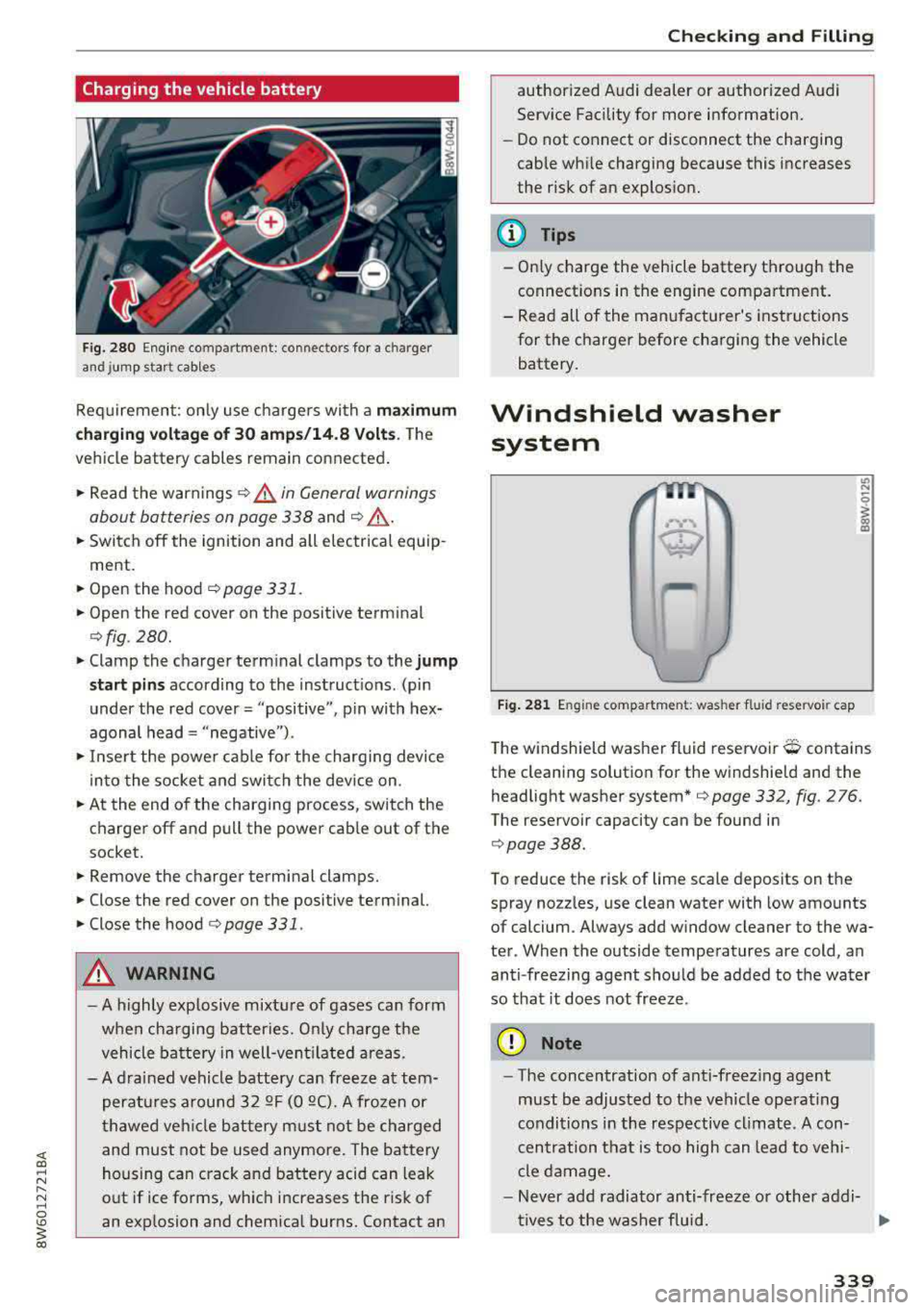
Charging the vehicle battery
Fig. 280 Engine compartment : connectors for a charger
and jump start cables
Requirement: only use chargers with a maximum
charging voltage of 30 amps/14.8 Volts.
The
vehicle battery cables remain connected .
.,. Read the warnings¢ & in General warnings
about batteries on page 338
and ¢ ,& .
.,. Switch off the ignition and all electrical equip
ment .
.,. Open the hood ¢ page 331 .
.,. Open the red cover on the positive terminal
¢ fig. 280 .
.,. Clamp the charger terminal clamps to the jump
start pins
according to the instructions . (pin
under the red cover= "positive", pin with hex
agonal head= "negative").
.,. Insert the power cable for the charging device
into the socket and switch the device on.
.,. At the end of the charging process, switch the
charger off and pull the power cable out of the
socket .
.,. Remove the charger terminal clamps.
.,. Close the red cover on the positive terminal.
.,. Close the hood ¢ page 331 .
A WARNING
-A highly explosive mixture of gases can form
when charging batteries. Only charge the
vehicle battery in well-vent ilated areas.
-A drained vehicle battery can freeze at tem
peratures around 32
QF (0 QC). A frozen or
thawed vehicle battery must not be charged
and must not be used anymore. The battery
housing can crack and battery acid can leak
out if ice forms, which increases the risk of
an explosion and chemical burns. Contact an
Checking and Filling
authorized Audi dealer or authorized Audi
Service Facility for more information.
- Do not connect or disconnect the charging
cable while charging because this increases
the risk of an explosion.
@ Tips
- Only charge the vehicle battery through the
connections in the engine compartment.
- Read all of the manufacturer's instructions
for the charger before charging the vehicle
battery.
Windshield washer system
Fig. 281 E ngine compartmen t: was her fluid reservoi r cap
The windshield washer fluid reservoir O contains
the cleaning solution for the windshield and the
headlight washer
system*¢ page 332, fig. 276 .
The reservoir capacity can be found in
¢ page 388.
To reduce the risk of lime scale deposits on the
spray nozzles, use clean water with low amounts
of calcium. Always add window cleaner to the wa
ter . When the outside temperatures are cold, an
anti -freezing agent should be added to the water
so that it does not freeze.
(D Note
-The concentration of ant i-freezing agent
must be adjusted to the vehicle operating
conditions in the respective climate . A con
centration that is too high can lead to vehi-
cle damage.
- Never add radiator anti-freeze or other addi-
tives to the washer fluid.
.,..
339
Page 350 of 409
&_ WARNING
"
-Do not use steel rims that are
17 inches or larger. Other
wise, damage to the vehicle
and an accident could result.
-For technical reasons, it is not
possible to use tires from oth
er vehicles - in some cases,
you cannot even use tires from
the same vehicle model.
-Make sure that the tires you
select have enough clearance
to the vehicle. Replacement
tires should not be chosen
simply based on the nominal
size, because tires with a dif
ferent construction can differ
greatly even if they are the
same size. If there is not
enough clearance, the tires or
the vehicle can be damaged and this can reduce driving
safety and increase the risk of
an accident.
-Only use tires that are more
than six years old when abso
lutely necessary and drive
carefully when doing so.
-Do not use run-flat tires on
your vehicle. Using them when
not permitted can lead to ve
hicle damage or accidents.
Wheels
-If you install wheel covers on
the vehicle, make sure they al
low enough air circulation to
cool the brake system. If they
do not, this could increase the
risk of an accident.
Tire wear/damage
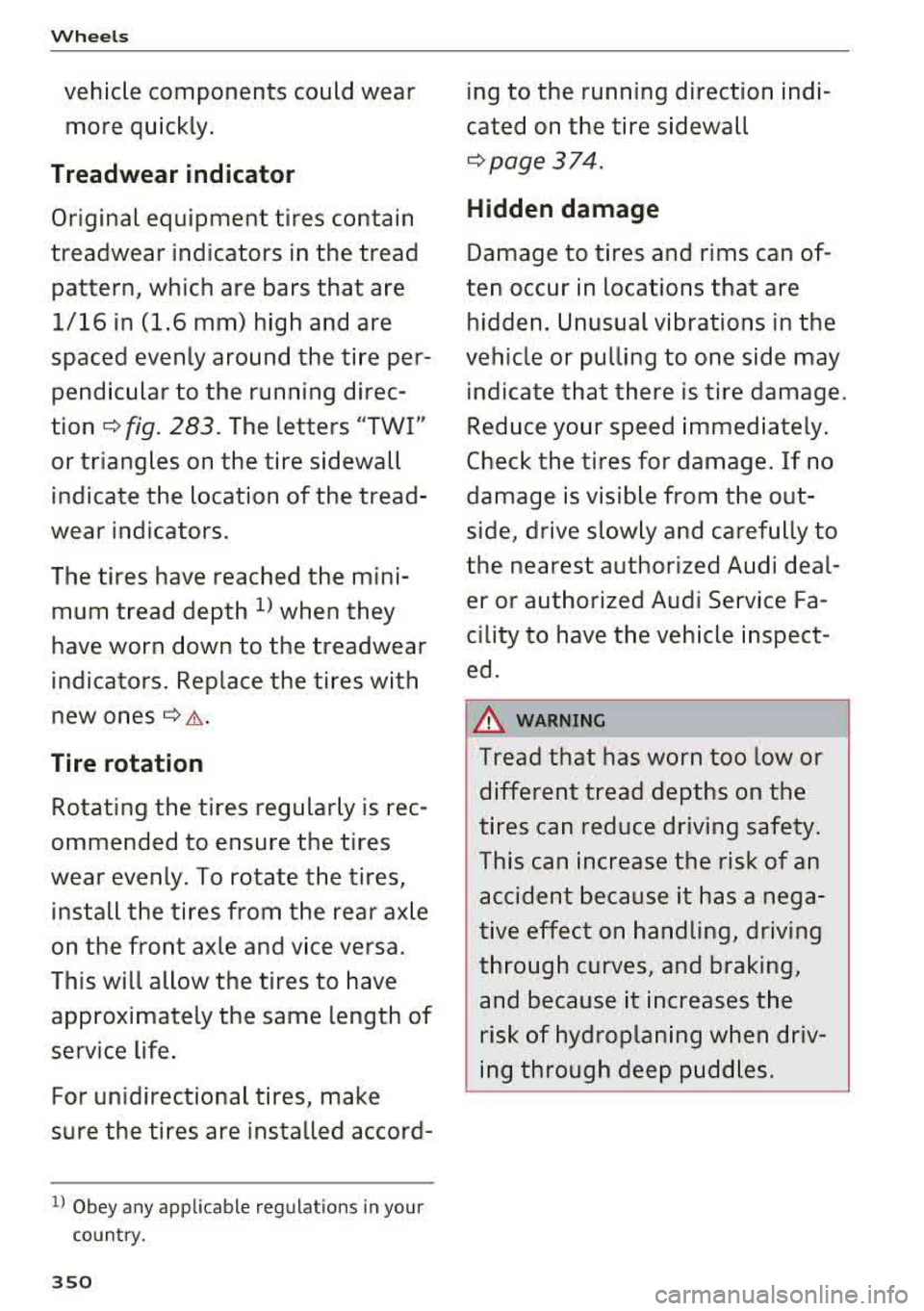
Fig. 283 T ire profile: treadwear indica
tor
Tire wear
Check the tires regularly for wear.
-Inflat ion pressure that is too low
or high can increase tire wear
considerably.
-Driving quickly through curves,
rapid acceleration and heavy
braking increase tire wear.
-Have an authorized Audi dealer
or authorized Audi Service Facili
ty check the wheel alignment if
there is unusual wear.
-Have the wheels rebalanced if an
imbalance is causing noticeable
vibration in the steering wheel. If you do not, the tires and other
..
349
Page 351 of 409
Wheels
vehicle components could wear more quickly.
Treadwear indicator
Original equipment tires contain
treadwear indicators in the tread
pattern, which are bars that are
1/16 in (1.6 mm) high and are
spaced evenly around the tire per
pendicular to the running direc
tion
¢ fig. 283. The letters "TWI"
or triangles on the tire sidewall
indicate the location of the tread
wear indicators.
The tires have reached the mini mum tread depth
l) when they
have worn down to the treadwear
indicators . Replace the tires with
new ones
c;, .&..
Tire rotation
Rotating the tires regularly is rec
ommended to ensure the tires
wear evenly. To rotate the tires,
install the tires from the rear axle
on the front axle and vice versa.
This will allow the tires to have approximately the same length of
service life.
For unidirectional tires, make
sure the tires are installed accord-
1> Obey any applicable regulations in your
country.
350
ing to the running direction indi
cated on the tire sidewall
c;, page 374.
Hidden damage
Damage to tires and rims can of
ten occur in locations that are hidden. Unusual vibrations in the
vehicle or pulling to one side may indica te that there is tire damage .
Reduce your speed immediately.
Check the tires for damage. If no
damage is visible from the out
side, drive slowly and carefully to
the nearest authorized Audi deal er or authorized Audi Service Fa
cility to have the vehicle inspect
ed.
&_ WARNING ~
Tread that has worn too low or different tread depths on the
tires can reduce driving safety.
This can increase the risk of an
accident because it has a nega
tive effect on handling, driving
through curves, and braking,
and because it increases the
risk of hydroplaning when driv
ing through deep puddles.
Page 352 of 409
~ .... N ,-.. N .... 0 I!)
5 (X)
Tire pressure
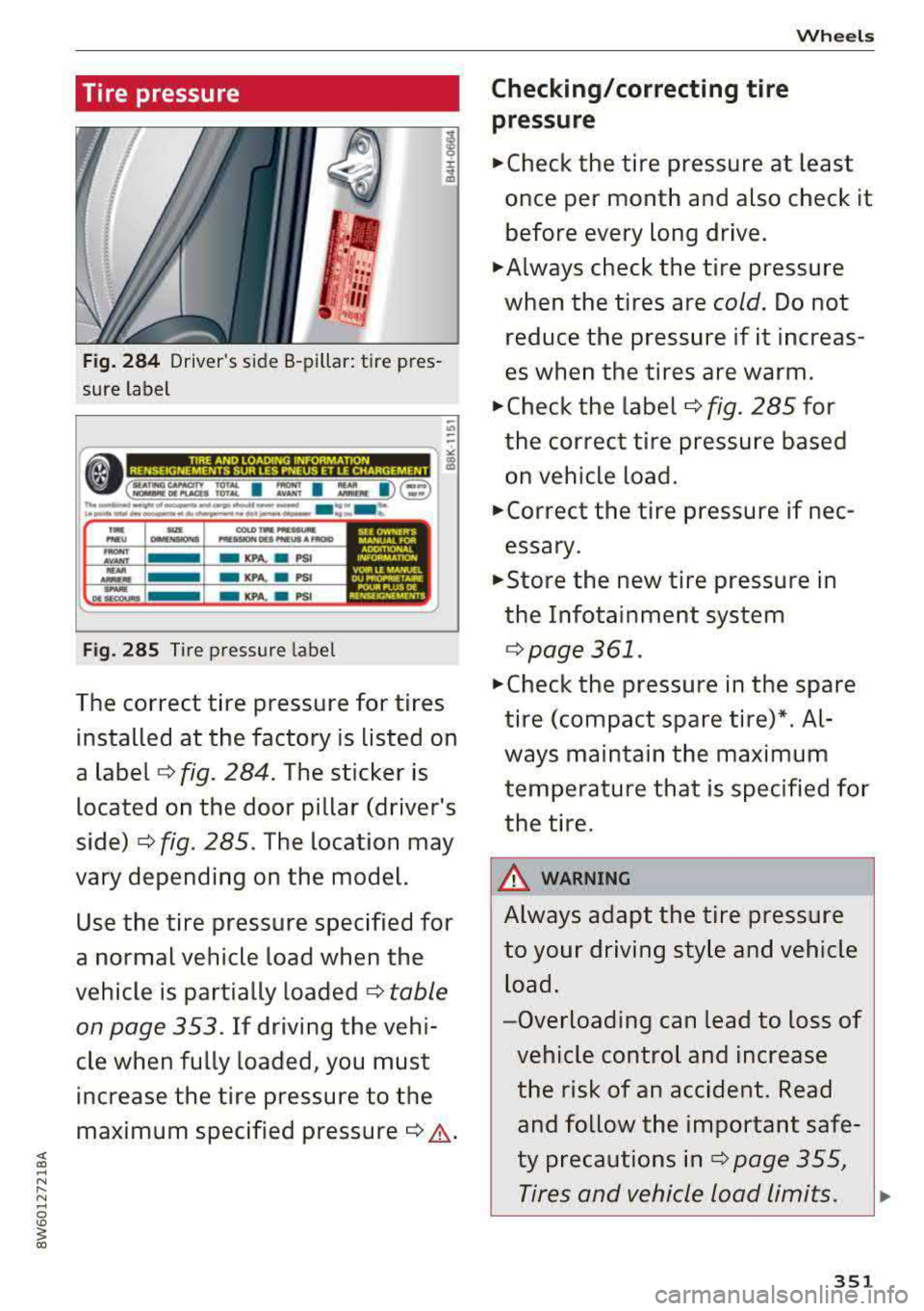
Fig. 284 Driver 's side B -pillar : tire pres
sure label
-KPA. . PSI
Fig. 285 Tir e pressur e label
"' -
The correct tire pressure for tires
installed at the factory is listed on
a
label ¢ fig. 284. The sticker is
located on the door pillar (driver's
side)¢ fig. 285. The location may
vary depending on the model.
Use the tire pressure specified for
a normal vehicle load when the
vehicle is partially loaded
¢ table
on page 353.
If driving the vehi
cle when fully loaded, you must increase the tire pressure to the
maximum specified
pressure ¢,&. .
Checking/correcting tire
pressure
Wheels
.. Check the tire pressure at least
once per month and also check it before every long drive .
.. Always check the tire pressure
when the tires are
cold. Do not
reduce the pressure if it increas
es when the tires are warm.
.. Check the label¢ fig. 285 for
the correct tire pressure based on vehicle load .
.. correct the tire pressure if nec
essary .
.. store the new tire pressure in
the Infotainment system
¢ page 361 .
.. Check the pressure in the spare
tire (compact spare tire)*. Al
ways maintain the maximum
temperature that is specified for
the tire.
A WARNING
Always adapt the tire pressure
to your driving style and vehicle load.
-Overloading can lead to loss of vehicle control and increase
the risk of an accident. Read and follow the important safe
ty precautions
in¢ page 355,
Tires and vehicle load limits.
351
Page 355 of 409
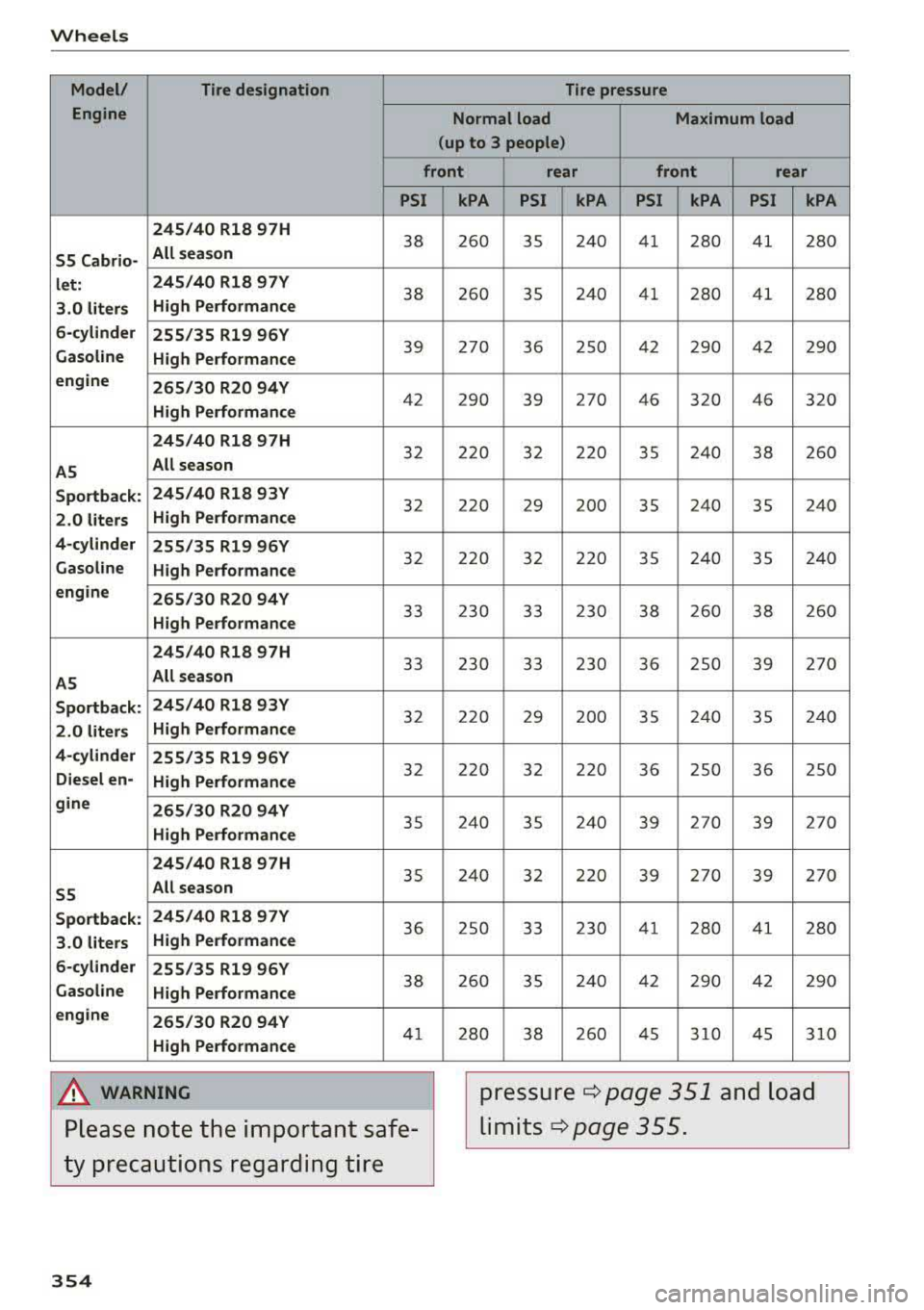
Wheels
Model/ Tire designation Tire pressure
Engine Normal load Maximum load
(up to 3 people )
front
rear front rear
PSI
245 /40 R18 97H
38
SS Cabrio- All season
let: 245
/40 R18 97Y
38
3 .0 liters High Performance
6 -cylinder
255/35 R19 96Y
39
Gasoline High Performance
engine 265/30 R20 94Y
42
High Performan ce
245 /40 R18 97H
32
AS All season
Sportback: 245/40 R18 93Y
32
2 .0 liters High Performance
4 -cylinder
255/35 R19 96Y
32
Gasoline High Performance
engine 265/30 R20 94Y
33
High Performance
245/40 R18 97H 33
AS All season
Sportback: 245
/40 R18 93Y
32
2.0 liters High Performance
4 -cylinder
255/35 R19 96Y
32
Die sel en-
High Performance
gine 265/30 R20 94Y
35
High Performan ce
245 /40 R18 97H
35
55 All season
Sportback: 245/40 R18 97Y
36
3.0 liters High Performance
6-cylinder 255/35 R19 96Y
38
Gasoline High Performance
engine 265/30 R20 94Y
41
High Performance
A WARNING
Please note the important safe
ty precautions regarding tire
354
kPA PSI kPA
PSI kPA PSI kPA
260 35 240 41
280 41
280
26 0 35 240 41 280 41
280
270 36 250 42 290 42 290
290 39 270 46
320 46
320
220 32 220 35 240 38 260
220 29 200 35 240
35 240
220 32 220 35 240 35 240
2 30 33 230 38 26 0 38 260
230 33 230 36 250 39 270
2 20 2 9 200 3 5 240
35 24
0
220 32 220 36 250 36 250
240 35 240
39 270
39 270
2 40 32 220 39 270 39 270
250 33 230
41 280 41
280
26 0 35 24
0
42 290 42 290
2 80 38 260 45 310 45 3 10
pressure ¢ page 351 and load
limits ¢ page 355.
Page 357 of 409
Wheels
A WARNING
Overloading a vehicle can cause
loss of vehicle control, a crash
or other accident, serious per
sonal injury, and even death.
-Carrying more weight than your vehicle was designed to carry will prevent the vehicle
from handling properly and
increase the risk of the loss of
vehicle control.
-The brakes on a vehicle that
has been overloaded may not
be able to stop the vehicle
within a safe distance.
-Tires on a vehicle that has
been overloaded can fail sud
denly, including a blowout and
sudden deflation, causing loss
of control and a crash.
-Always make sure that the to
tal load being transported
-
includ ing the weight of a trail
er hitch and the tongue
weight of a loaded trailer
-
does not make the vehicle
heavier than the vehicle's
Gross Vehicle Weight Rating.
Determining correct load
limit
Use the example below to calcu
late the total weight of the pas -
356
sengers and luggage or other
things that you plan to transport so that you can make sure that
your vehicle will not be overload
ed.
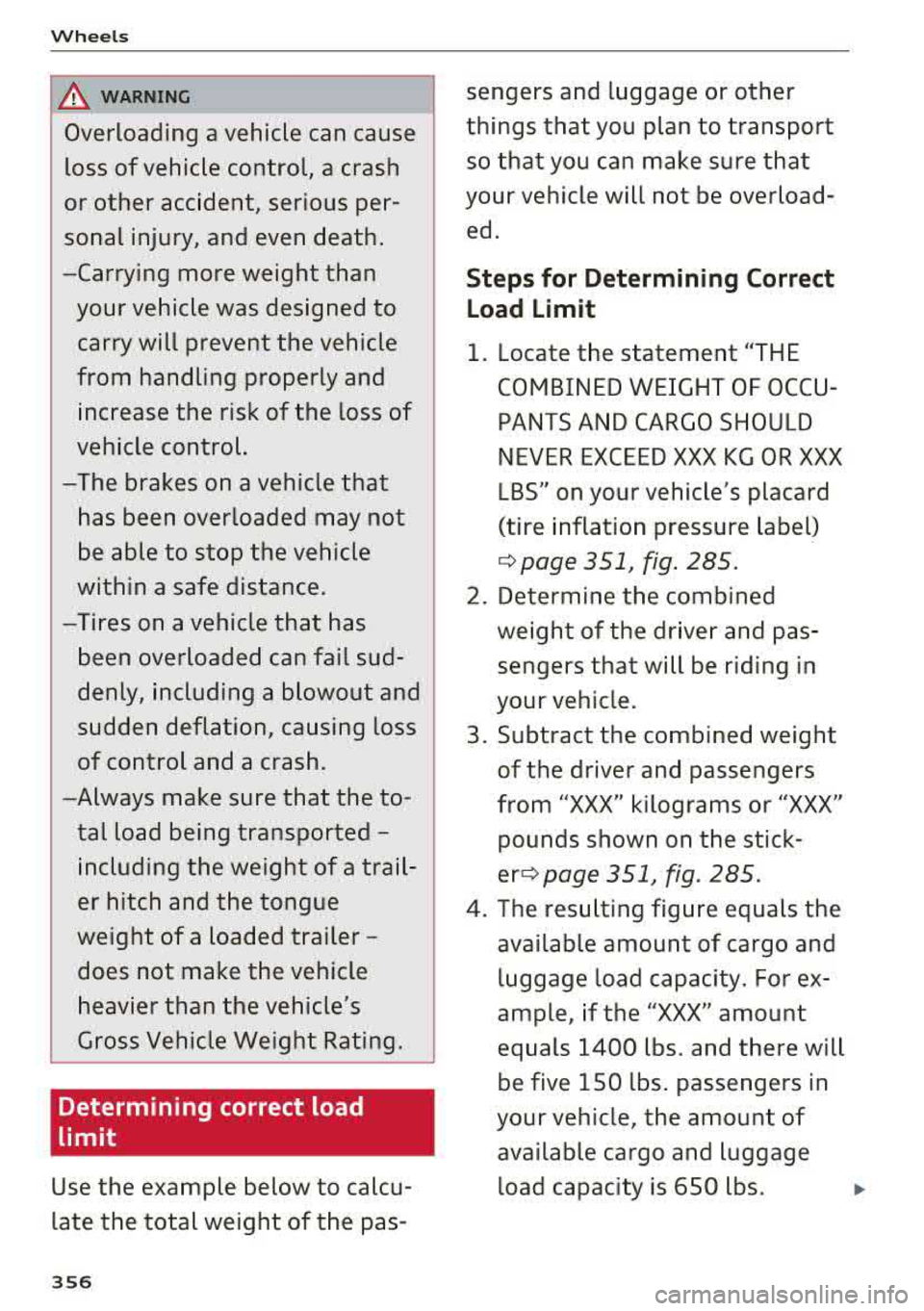
Steps for Determining Correct Load Limit
1. Locat e the statement "THE
COMBINED WEIGHT OF OCCU
PANTS AND CARGO SHOULD
NEVER EXCEED XXX KG OR XXX
LBS" on your vehicle's placard
(tire inflation pressure label)
Q page 351, fig. 285.
2.
Determine the combined
weight of the driver and pas
sengers that will be riding in
your vehicle.
3. Subtract the combined weight
of the driver and passengers
from
"XXX" kilograms or "XXX"
pounds shown on the stick
erQ page 351, fig. 285.
4. The resulting figure equals the
available amount of cargo and luggage load capacity. For ex
ample, if the "XXX" amount
equals 1400 lbs . and there will
be five 150 lbs. passengers in
your vehicle, the amount of
available cargo and luggage load capacity is 650 lbs.
.,.