warning AUDI A5 COUPE 2018 Owners Manual
[x] Cancel search | Manufacturer: AUDI, Model Year: 2018, Model line: A5 COUPE, Model: AUDI A5 COUPE 2018Pages: 409, PDF Size: 67.63 MB
Page 372 of 409
-If the t ire is too severely damaged , see an
authorized Aud i dealer or authorized Aud i
Service Facility for assistance .
@ For the sake of the environment
You can give the used tire sealant bottle to an
author ized Audi dealer or authorized A udi
Serv ice Facility for disposal.
@ Tips
Remember to obtain a new bottle of sea lant
from an authorized Audi dea ler or authorized
Audi Service Facility after repair ing a tire.
Replacing a wheel
Preparation
You must complete the preparation before
changing a tire .
.,. Read and follow the important safety precau
tions ~ page 368 .
.,. Set the parking brake .
Applies to: ve hicles with man ua l transmiss ion
.,. Shift in to 1st gear.
Applies to: ve hicles with automat ic t ra n smi ssio ns
.,. Select the P selector leve r pos ition .
.,. When towing a trailer: disconnect the tra iler
from your veh icle .
.,. Lay out the veh icle tool kit 9 page 368 and the
spare tire
~ page 375 .
.,. Switch the ignition off .
A WARNING
When using the vehicle jack* on a road with a
steep hill or offroad, you must take extra pre
cautions to prevent the vehicle from rolling .
Use suitab le objects to b lock the front and
back of the wheel that is diagonal from the
wheel with the flat tire.
A WARNING
You or your passengers could be in ju red wh ile
chang ing a wheel if you do not follow these
safety precautions :
Emergen cy a ssis tanc e
-If you have a flat tire, move a safe distance
off the road. Turn off the eng ine, turn the
emergency flashers on and use other warn
ing dev ices to alert other motorists .
- Make sure that passengers wait in a safe
place away from the vehicle and well away
from the road and traff ic .
- To help prevent the veh icle from moving
suddenly a nd possib ly slipping off the jack*,
always fully set the park ing brake and block
the front and back of the wheel diagonally opposite the wheel being changed. When
one front wheel is lif ted off the gro und,
p la cing the Automa tic Transmission in P
(Park) will
not prevent the vehicle from
moving.
- Before you change a wheel, be sure the
g ro und is leve l and firm. If necessary, use a
sturdy board under the jack *.
- Always store the vehicle tool kit, the jack *
a nd the replaced tire in the luggage com
partment
~ page 263 .
(D Tips
Obey all laws .
Removing the caps
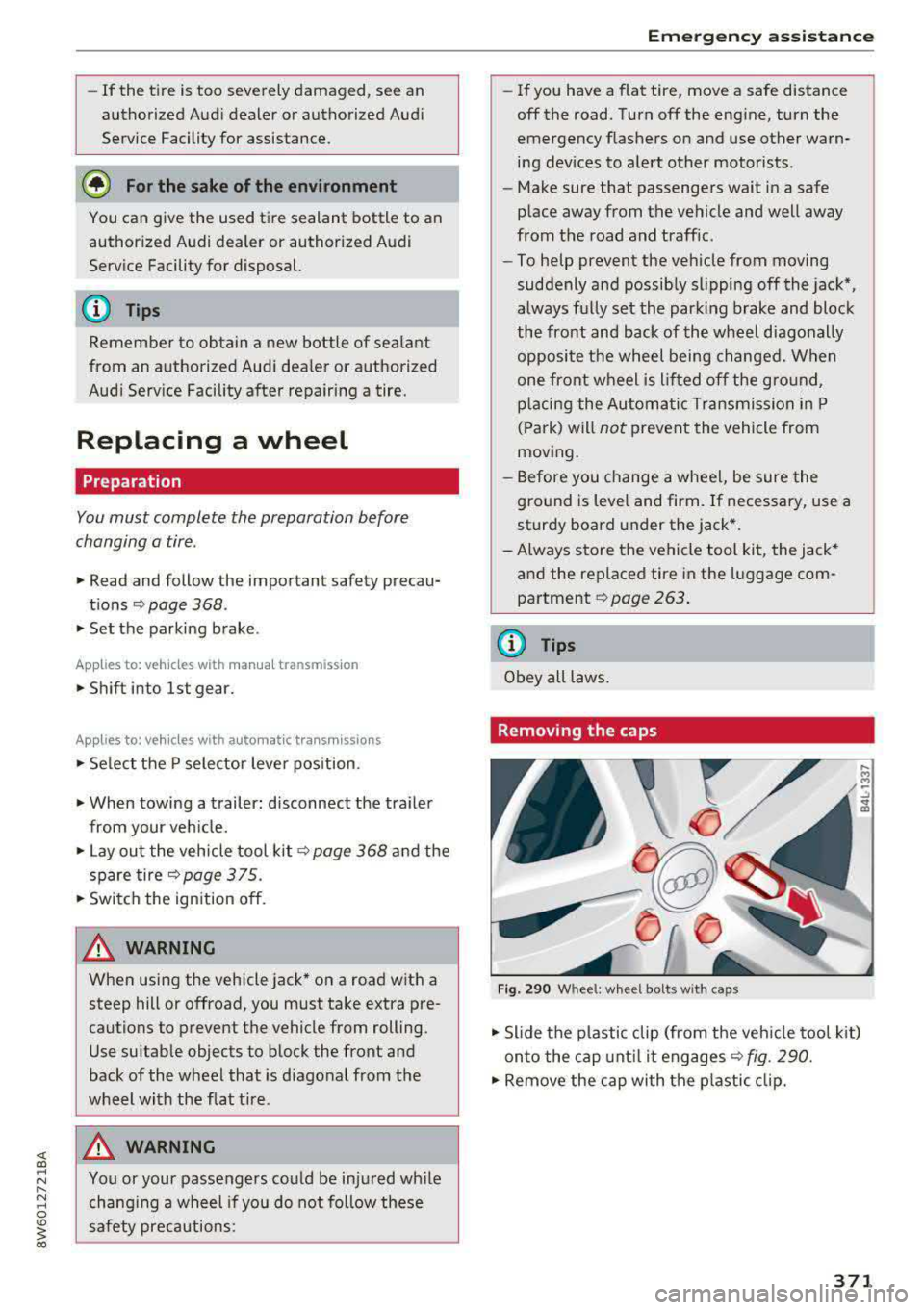
Fig. 290 W hee l: whee l bolt s w ith ca ps
.,. Slide the p lastic clip (from the veh icle tool k it)
on to the cap unt il it
engages ~ fig. 290.
.,. Remove the cap with the p lastic clip.
371
Page 373 of 409
Emergency assistance
Loosening the wheel bolts
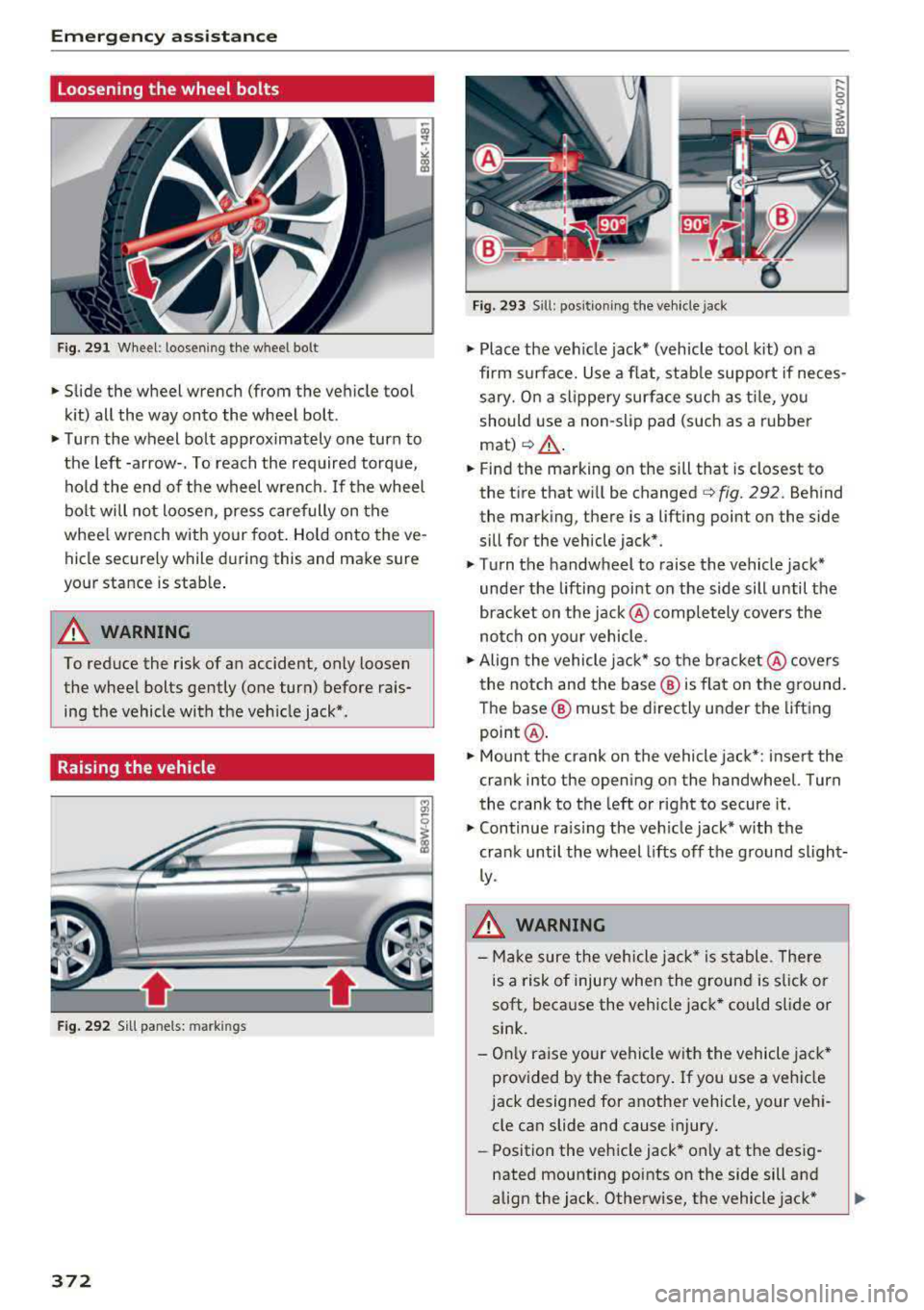
Fig. 291 Wheel: loosening the wheel bolt
• Slide the wheel wrench (from the vehicle tool
kit) all the way onto the wheel bolt.
• Turn the wheel bolt approximately one turn to
the left -arrow-. To reach the required torque,
hold the end of the wheel wrench. If the wheel
bolt will not loosen, press carefully on the
whee l wrench with your foot. Hold onto the ve
hicle securely while during this and make sure
your stance is stable .
A WARNING
To reduce the risk of an accident, only loosen
the wheel bolts gently (one turn) before rais
ing the vehicle with the veh icle jack*.
Raising the vehicle
Fig . 292 Sill panels: markings
372
Fig. 293 Sill: positio ning the vehicle jack
• Place the veh icle jack* (vehicle tool kit) on a
firm s urface. Use a flat, stable support if neces
sary. On a slippery surface such as tile, you
should use a non-slip pad (such as a rubber
mat)¢ &.
• Find the marking on the sill that is closest to
the tire that will be changed
¢fig. 292. Behind
the marking, there is a lifting point on the side
sill for the vehicle jack*.
• Turn the handwheel to raise the vehicle jack*
under the lifting point on the side sill until the
bracket on the jack @ completely covers the
notch on your vehicle.
• Align the vehicle jack* so the bracket @covers
the notch and the base ® is flat on the ground.
The base ® must be directly under the lifting
point @.
• Mount the crank on the vehicle jac k*: insert the
crank into the opening on the handwheel. Turn
the crank to the left or right to secure it.
• Continue ra is in g the veh icle jack* with the
crank until the wheel lifts off the ground slight
ly.
A WARNING
- Ma ke sure the vehicle jack* is stable. Th ere
is a risk of injury when the ground is slick or
soft, because the vehicle jack* could slide or
sink.
- Only raise your vehicle with the vehicle jack*
provided by the factory . If you use a vehicle
jack designed for another vehicle, your vehi
cle can slide and cause injury.
- Position the vehicle jack* only at the desig
nated mounting points on the side sill and
align the jack. Otherwise, the vehicle jack*
Page 374 of 409
could slip and cause an injury if it does not
have sufficient hold on the vehicle.
- To reduce the risk of an accident, never start
the engine when the vehicle is raised.
- To reduce the risk of injury, support the ve
hicle securely with suitable stands if work is
to be performed underneath the vehicle.
- To help prevent injury to yourself and your
passengers:
- Do not raise the vehicle until you are sure the jack* is securely engaged.
- Passengers must not remain in the vehicle when it is jacked up.
- Make sure that passengers wait in a safe
place away from the vehicle and well away
from the road and traffic.
- Make sure jack position is correct, adjust as necessary and then continue to raise
the jack*.
- If work has to be done under the vehicle, ensure that it is safely supported on suita
ble stands
-risk of injury!
- Never start the engine when the vehicle is on the jack*
-risk of accident!
(D Note
Do not lift the vehicle by the sill. Position the
vehicle jack* only at the designated mounting points on the side sill. Otherwise, your vehicle
will be damaged.
Removing and installing a wheel
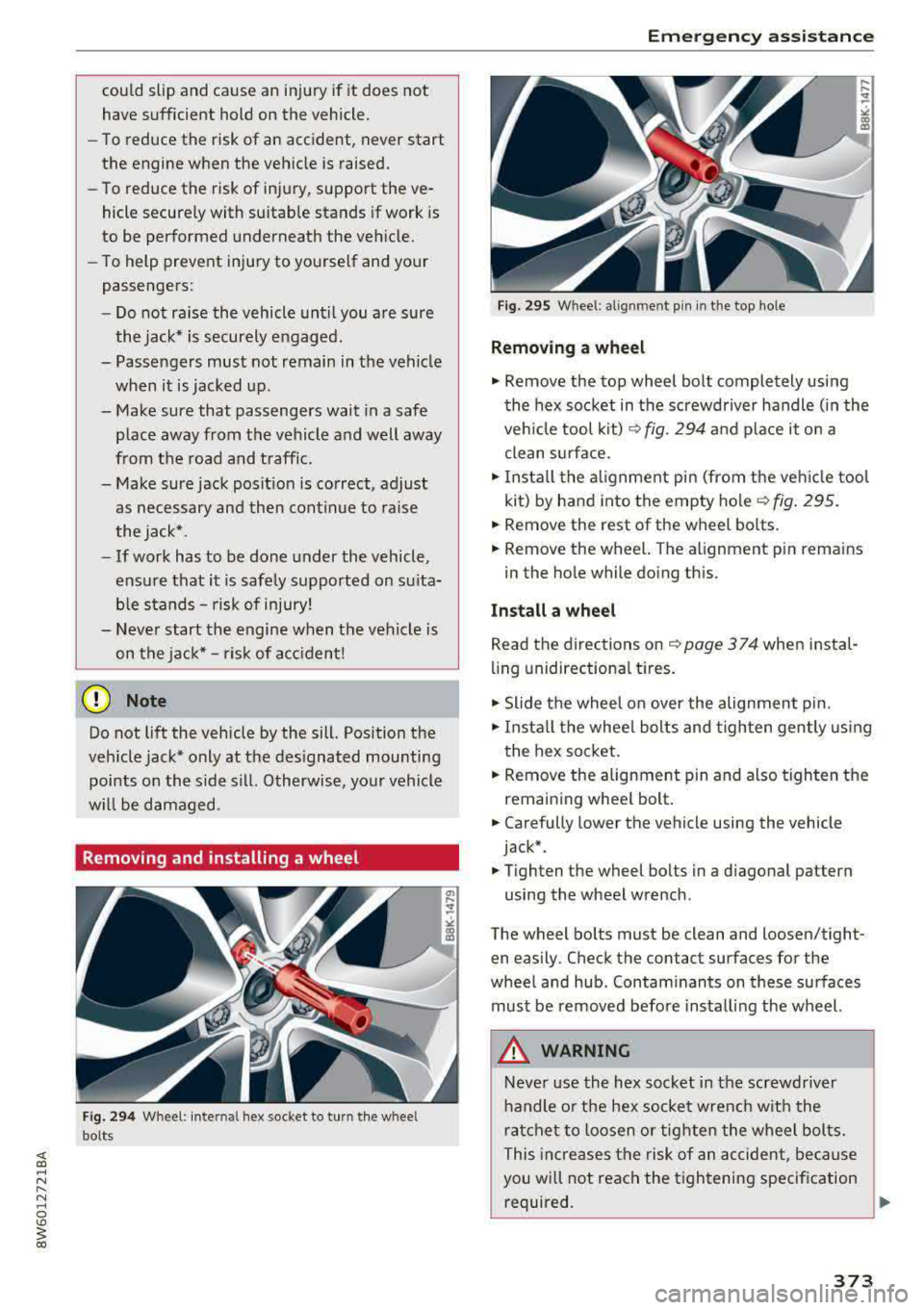
Fig. 294 Wheel: inte rnal hex socket to turn the whee l
bolts
Emergency assistance
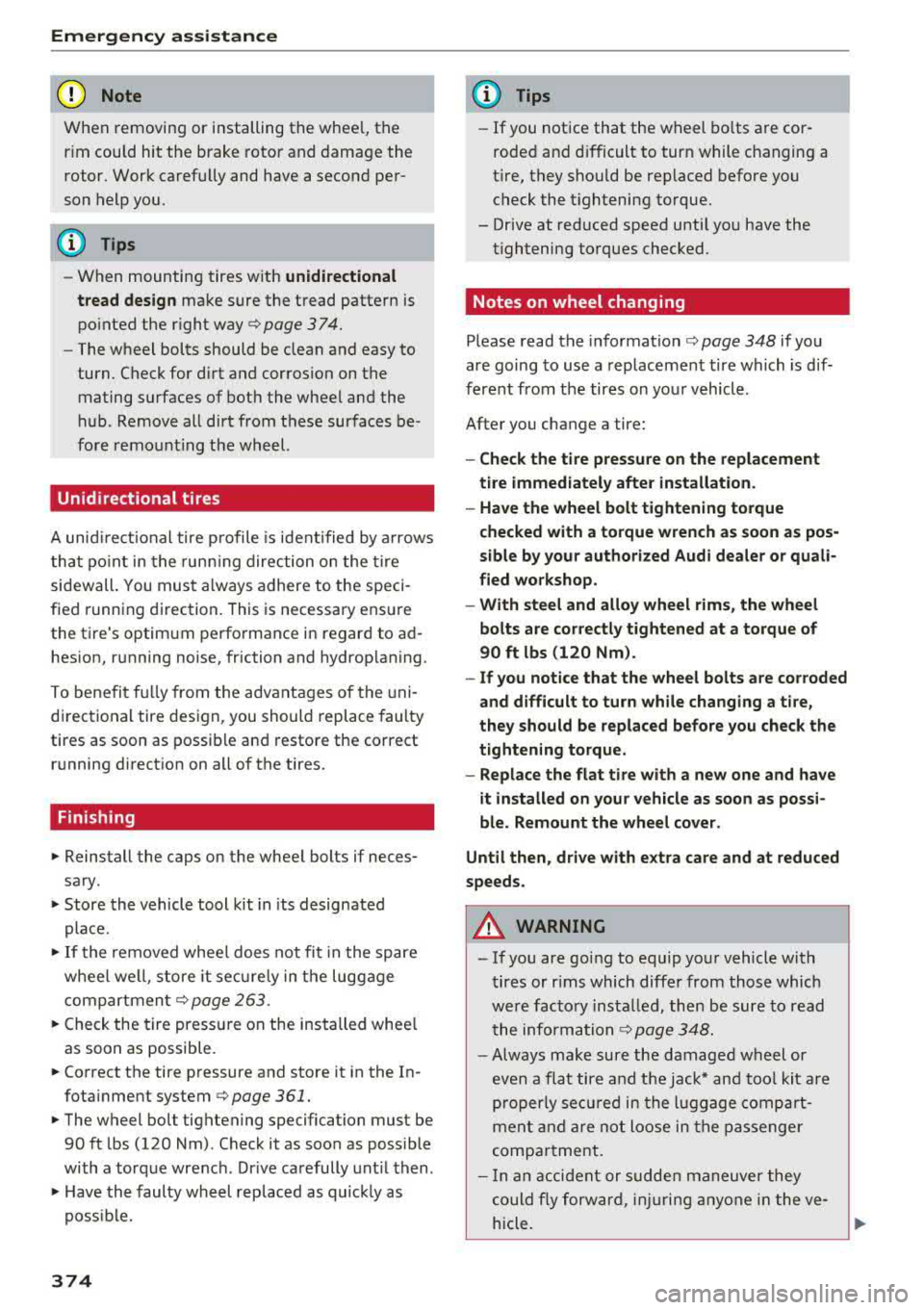
Fig. 295 Whee l: alignment pin in the top ho le
Removing a wheel
.,. Remove the top wheel bolt completely using
the hex socket in the screwdriver handle (in the
vehicle tool kit)
~fig. 294 and place it on a
clean surface.
.,. Install the alignment pin (from the vehicle tool
kit) by hand into the empty
hole ~ fig. 295.
.,. Remove the rest of the wheel bolts.
.,. Remove the wheel. The alignment p in remains
in the hole while doing this.
Install a wheel
Read the directions on ~page 374 when instal
ling unidirectional tires.
.,. Slide the wheel on over the alignment pin .
.,. Install the wheel bolts and tighten gently using
th e hex socket.
.,. Remove the alignment pin and also tighten the
remai ning wheel bolt.
.,. Carefully lower the vehicle using the vehicle
jack*.
.,. Tighten the wheel bolts in a diagonal pattern
using the wheel wrench .
The wheel bolts must be clean and loosen/tight
en easily. Check the contact surfaces for the
wheel and hub. Contaminants on these surfaces
must be removed before installing the wheel.
A WARNING
Never use the hex socket in the screwdriver
handle or the hex socket wrench with the
ratchet to loosen or tighten the wheel bolts.
This increases the risk of an accident, because
you will not reach the tightening specification
required.
~
373
Page 375 of 409
Emergency assistance
CJ) Note
When removing or installing the whee l, the
r im could hit the brake rotor and damage the
rotor. Work ca ref ull y and have a second pe r
son help you.
@ Tips
- When mounting tires w ith unidirectional
tread design
ma ke s ure the t read pattern is
po inted the r ight way
¢ page 374 .
-The wheel bolts should be clean and easy to
turn. Check for d irt and cor ros ion on the
mating s urfaces of both the wheel and the
h ub. Remove all dirt from t hese surfaces be
fo re re mount ing th e wheel.
Unidirectional tires
A unid irec tional tire p rofile is ident ified by a rrows
th at poin t in the run nin g dir e cti on o n the tire
sidewall. You mus t always a dhere to the speci
fied running d irec tion. This is necessary ens ure
the t ire's optim um perfo rmance in regar d to a d
hes ion, r unning noise, fr iction and hydrop la ning.
T o be nefi t fu lly fro m the adv ant ages of the uni
d irect ional tire des ign, you sho uld replace faulty
tires as soon as possi ble an d restore the correct
r u nning di rect io n on all of the tires.
Finishing
.,. Reinstall the caps on the whee l bolts if neces
sary .
.,. Store the vehicle tool kit in its designated
place .
.,. If the re m oved whee l does not fi t in the spa re
whee l we ll, store it se cur ely in t he luggage
com partmen t¢ page 2 63.
.,. Check the tire press ure on the ins talled whee l
as soon as possible.
.,. Co rrect the tire p ressure and store it in the I n
fota inment system
¢ page 361.
.,. The wheel bo lt tightening specification must be
90 ft lbs (120 Nm) . Check it as soon as poss ible
with a torq ue wrenc h. Dr ive ca refully unt il t hen .
.,. Have th e faulty wheel rep laced as quic kly as
poss ible.
374
(D Tips
-If you not ice that t he w heel bo lts a re cor
rode d and difficult to tur n while changing a
t ir e, t hey s hou ld be replaced befo re yo u
check the t ightening torque.
- Drive at red uce d speed unti l yo u have the
t ightening to rques checked.
· Notes on wheel changing
Please read t he informat ion¢ page 348 if yo u
are going to use a replacemen t tire which is d if
ferent from the tires on yo ur vehicle .
After you change a tire:
- Check the tire pressure on the replacement
tire immediately after installation.
- Have the wheel bolt tightening torque
checked with a torque wrench as soon as pos
sible by your authorized Audi dealer or quali
fied workshop.
- With steel and alloy wheel rims, the wheel
bolts are cor rectly tightened at a torque of
90
ft lbs (120 Nm) .
- If you notice that the wheel bolts are corroded
and difficult to turn while changing a tire,
they should be replaced before you check the
tightening torque .
- Replace the flat tire with a new one and have
it installed on your vehicle as soon as possi
ble. Remount the wheel cover .
Until then, dr ive with e xtra care and at reduced
speeds.
A WARNING
- If you are going to equip yo ur vehicle wi th
t ires or r ims which diffe r from those which
we re fac to ry insta lled , th en be su re to read
t he
informa tion ¢ page 348.
- Always make sure the damage d w heel or
ev en a fla t tire and the jack* an d tool kit are
p ro p erl y se cured in t he lug gage co mpart
me nt an d ar e no t lo o se in the pas senge r
c o mp artme nt.
- I n an ac cident or su dde n man euver they
co uld fl y forw ard , injur ing an yone i n t he ve
hicle.
Page 376 of 409
<( a, .... N ,....
N .... 0 \0
3 a,
-Always store damaged wheel, jack* and
tools securely in the luggage compartment.
Otherwise, in an accident or sudden maneu
ver they could fly forward, causing injury to
passengers in the vehicle.
Space-saving spare tire
App lies to: ve hicles with space-saving spare t ire (co mpact
spare tire)
The spare tire is intended for short-term use on
ly. Have the damaged tire checked and replaced,
if necessary, by an authorized Audi dealer or au
thori zed Audi Service Facility as soon as possible.
There are some restrictions on the use of the
compact spare tire . The compact spare tire has
been designed specifically for your type of vehi
cle . Do not replace it with the spare tire from an
other type of vehicle.
The compact spare tire is located in the luggage
compartment under the cargo f loor cover
c::>page368.
The tire pressure must be 61 PSI (420 kPA).
Snow chains
For technical reasons, the use of snow chains on
the compact spare tire is not permitted.
If you have to drive with snow chains and a front
tire fails, mount the spare t ire in place of a rear
tire. Install the snow chains on the rear tire that
you removed, and insta ll that in place of the
front tire that failed.
A WARNING
-After installing a spare tire, the tire pres
sure must be checked as soon as possible .
-Do not drive faster than 50 mph (80 km/h)
with a compact spare tire. Driving faster
than that increases the risk of an accident.
-T o reduce the risk of an accident, avoid full
thrott le acceleration, heavy braking, and
fast cornering with the compact spare tire.
-To reduce the risk of an accident, never drive
with more than one compact spare tire.
-Normal summer or winte r tires must not be
mounted on the compact spare wheel rim.
Emergency assistance
375
Page 378 of 409
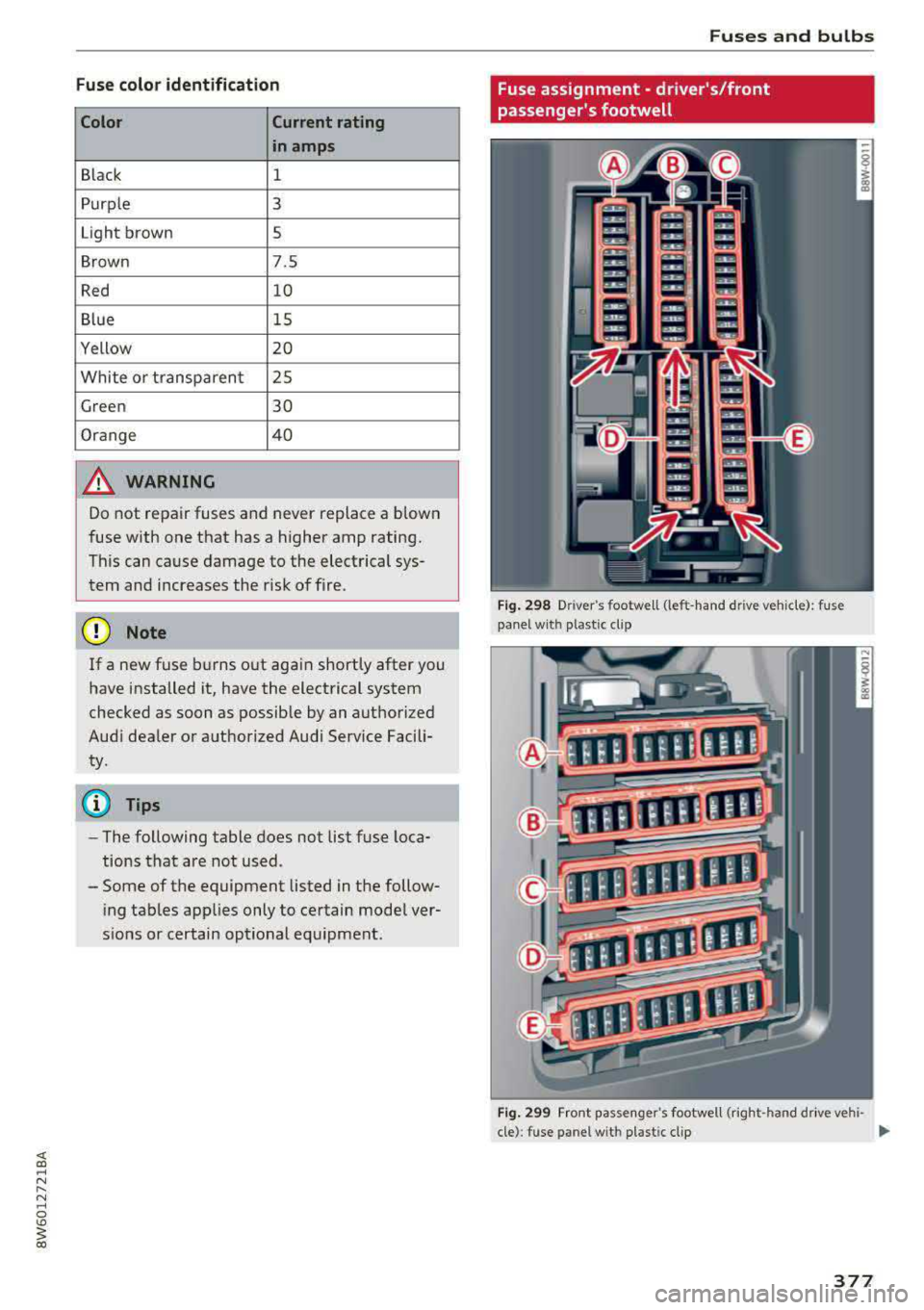
Fuse colo r identification
Color Current rating
in amps
Black 1
Purp le 3
Light brown 5
Brown 7 .5
Red 10
Blue 15
Yellow 20
White or transpa ren t 25
Green 30
Orange 40
A WARNING 1=
Do not repair fuses and never replace a blown
fuse with one that has a higher amp rating.
Th is can cause damage to the electrical sys
tem and increases the r isk of fire.
(D Note
If a new fuse b urns o ut again short ly after you
have installed it, have the electrical system
checked as soon as possible by an authorized
Aud i dea le r or a uthorized Audi Service Facili
ty.
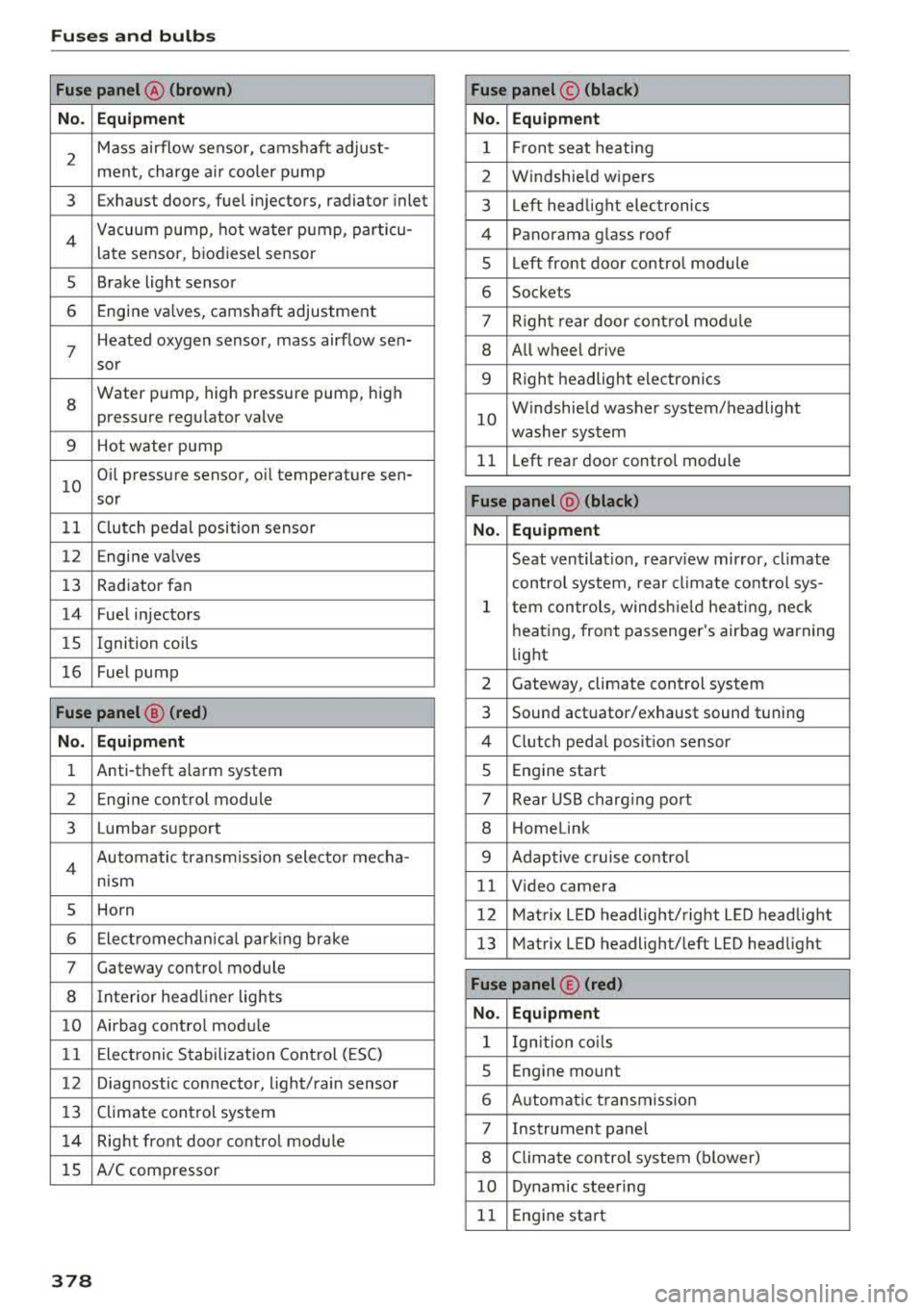
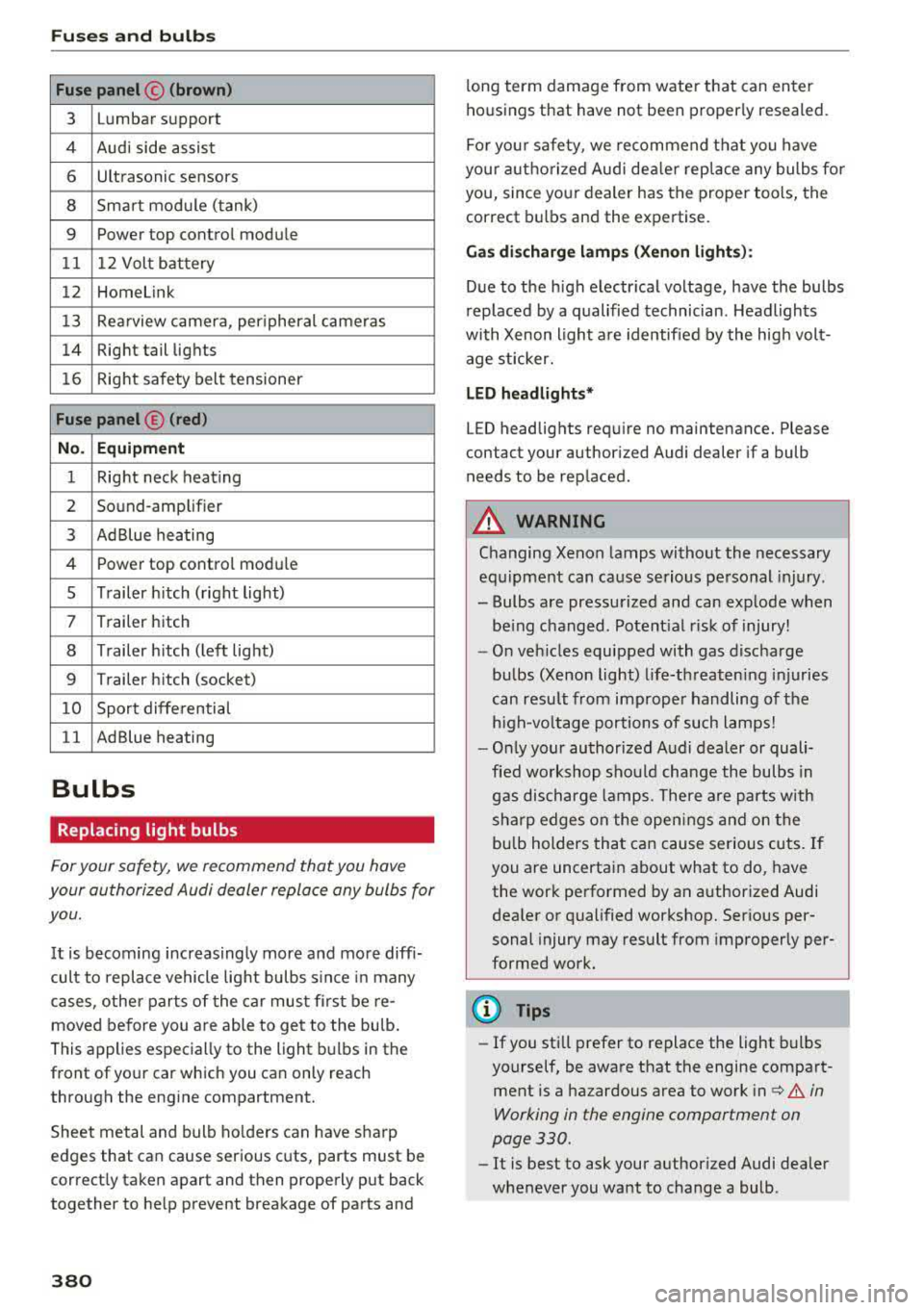
{!) Tips
- The following table does not list fuse loca
tions that are not used.
- Some of the equipment listed in the follow
i ng tables applies only to certain model ver
s ions or certain optional eq uipment.
Fuses and bulbs
Fuse assignment - driver's/front
passenger's footwell
F ig. 298 Drive r's footwe ll (left -hand dr ive vehicle): fuse
pa nel with plas tic clip
Fig . 2 99 Front passe nge r's footwell (rig ht-h and d rive vehi -
cle): fuse panel with plastic clip
II>
377
Page 379 of 409
Fuses a nd bul bs
Fuse panel @ (brown) Fuse panel© (blac k)
No. Equip ment No. Equipm ent
2
Mass airflow sensor, camshaft adjust-
ment, charge air cooler pump 1 F ront seat heating
2 Windshield wipers
3 Exhaust doors, fuel injectors, radiator inlet 3 Left head light electronics
4 Vacuum pump , hot water pump, particu-
late sensor, biodiesel sensor 4 Panorama glass roof
s Left front door contro l module
5 Brake light sensor 6 Sockets
6 Engine valves, camshaft adjustment 7 Right rear door control mod ule
7
Heated oxygen sensor, mass airflow sen-8 All wheel drive
sor
8
Water pump, high pressure pump, high
pressure regulator valve
9 Hot water pump
9 Right headlight electronics
10
Windshield washer system/headlight
washer system
11 L eft rear door control module
10
Oil pressure sensor, oil temperature sen-
sor
Fu se panel @ (blac k)
11 Clutch pedal position sensor No. Equipmen t
12 Engine valves
Seat ventilation, rearv iew mirror, climate
13 Rad iator fan control system, rear climate control sys-
14 Fuel injectors
15 Ignition
coils
16 Fuel pump
1 tern controls , windsh ie ld heat ing , neck
heating, front passenger 's airbag warning
light
2 Gateway, climate control system
Fuse panel@ (red ) 3 Sound actuator/exhaust sound tuning
No. Equ ip me nt 4 Clutch pedal posit ion sensor
1 Anti-theft alarm system 5 Engine start
2 Engine control module 7 Rear USB charg ing port
3 Lumbar support 8 Homelink
4 Automatic transmission selector mecha-
nism 9 Adaptive cruise contro l
11 Video camera
5 Horn 12 Matrix LED headlight/right L ED headlight
6 Electromechan ica l park ing brake 13 Matrix LED headlight/left LED headlight
7 Gateway control module
8 Interior headl iner lights
10 Airbag control module
11 Electronic Stabilization Control (ESC)
Fuse panel © (red )
N o. Equ ipmen t
1 Ign ition co ils
12 Diagnostic connector, light/rain sensor
13 Climate control system
14 Right front door control module
lS A/C compressor
5 Engine mount
6 Automatic transmission
7 Instrument panel
8 Climate control system (blower)
10 Dynamic steering
11 Engine start
378
Page 381 of 409
Fuses a nd bul bs
Fuse panel © (brown)
3 Lumbar support
4 Audi side assist 6 Ultrasonic sensors
8 Smart module (tank)
9 Power top control modu
le
11 12 Volt battery
12 Homelink
13 Rea rview camera, per ipheral cameras
14 Right tail lights
16 Right safety belt tensioner
Fu se panel © (red )
N o. Equipm ent
1 Right neck heating
2 Sound-amplifier
3 AdBlue heating
4 Power top control modu
le
5 Trailer h itch (right light)
7 Trailer hitch
8 Trailer h itch (left light)
9 Trailer hitch (socket)
10 Sport differential
11 AdBlue heating
Bulbs
Replacing light bulbs
For your safety, we recommend that you have
your authorized Audi dealer replace any bulbs for
you.
It is becoming increasing ly more and more diff i
cult to replace vehicle light bulbs s ince in many
cases, othe r parts of the car must fi rst be re
moved before you are able to get to the bu lb .
This applies especially to the light bulbs in the
front of your car which you can only reach
through the engine compartment.
Sheet metal and bulb ho lders can have sharp
edges that can cause serious cuts, parts must be
correct ly taken apart and then properly put back
together to he lp prevent breakage of parts and
380
long term damage from water that can enter
housings that have not been properly resealed.
Fo r you r safety, we recommend that you have
you r autho rized Audi dea ler replace any bulbs for
you, since your dealer has the proper tools, the
correct bu lbs and the expertise.
Ga s di sc harg e la mp s (Xe non ligh ts):
Due to the h igh electr ical voltage, have the bulbs
rep laced by a qualified technician . Headlights
with Xenon light a re identified by the high volt
age sticker.
L ED headlight s*
LED headlights require no maintenance. Please
contact your authorized Audi dealer if a bulb
needs to be replaced.
A WARNING
Changing Xenon lamps without the necessary
equipment can cause serious personal injury.
-Bulbs are pressurized and can explode when
be ing changed. Potent ial r isk of injury!
- On veh icles equipped with gas discharge
bulbs (Xenon light) life-threatening injuries
can result from improper handling of the
high-vo ltage portions of such lamps!
-Only your authorized Audi dealer or quali
fied workshop shou ld change the bulbs in
gas discharge lamps . There are parts with
sharp edges on the openings and on the bulb holders that can cause serious cuts. If
you are uncerta in about what to do, have
the work performed by an authorized Audi
dea ler or qualified workshop. Serious per
sonal injury may result from improperly per
formed work.
(D Tips
-If you still prefer to replace the light bulbs
yourself, be aware that the engine compart
ment is a hazardous area to work
i n c:> & in
Working in the engine compartment on
page 330 .
-It is best to ask your authorized Audi dealer
whenever you want to change a bulb .
Page 382 of 409
<( a, .... N ,....
N .... 0 \0
3 a,
Emergency situations
General
This chapter is intended for trained emergency
crews and working personnel who have the nec
essary tools and equipment to perform these
operations.
Starting by pushing or
towing
CD Note
Vehicles with an automatic transmission
cannot be started by pushing or towing.
Starting with jumper
cables
If necessary, the engine can be started by con
necting it to the battery of another vehicle.
If the engine should fail to start because of a dis
charged or weak battery, the battery can be con
nected to the battery of
another vehicle, using a
pair of jumper cables to start the engine.
Jumper cables
Use only jumper cables of sufficiently large cross
section
to carry the starter current safely. Refer
to the manufacturer's specifications.
Use only jumper cables with
insulated terminal
clamps which are distinctly marked:
plus(+) cable in most cases colored red
minus(·) cable
in most cases colored black.
A WARNING
Batteries contain electricity, acid, and gas.
Any of these can cause very serious or fatal in
jury. Follow the instructions below for safe
handling of your vehicle's battery.
-Always shield your eyes and avoid leaning
over the battery whenever possible.
-A dead battery can freeze at temperatures
around 32 °F (0 °C). If the vehicle battery is
frozen, you must thaw it before connecting
the jump start cables. If you do not, this in-
Emergency situations
creases the risk of an explosion and chemi
cal burns. After jump starting the vehicle,
drive to an authorized Audi dealer or author ized Audi Service Facility immediately to
have the vehicle battery checked.
- Do not allow battery acid to contact eyes or
skin . Flush any contacted area with water
immediately.
- Improper use of a booster battery to start a
vehicle may cause an explosion .
- Vehicle batteries generate explosive gases.
Keep sparks, flame and lighted cigarettes
away from batteries.
- Do not try to jump start any vehicle with a
low acid level in the battery .
- The voltage of the booster battery must also
have a 12-Volt rating. The capacity (Ah) of
the booster battery should not be lower
than that of the discharged battery. Use of
batteries of different voltage or substantial
ly different
"A h" rating may cause an explo
sion and personal injury.
- Never charge a frozen battery. Gas trapped
in the ice may cause an explosion.
- Never charge or use a battery that has been
frozen . The battery case may have be weak
ened.
- Use of batteries of different voltage or sub
stantially different capacity (Ah) rating may
cause an explosion and injury. The capacity (Ah) of the booster battery should not be
lower than that of the discharged battery.
- Before you check anything in the engine
compartment, always read and heed all
WARNINGS
qpage 330.
CD Note
- Applying a higher voltage booster battery
will cause expensive damage to sensitive electronic components, such as control
units, relays, radio, etc.
- There must be no electrical contact between
the vehicles as otherwise current could al
ready start to flow as soon as the positive
(+) terminals are connected.
381
Page 383 of 409
Emergency situations
@ Tips
The discharged battery must be properly con
nected to the vehicle's electrical system .
When jump starting or charging the battery,
never connect the negative ground cable to
the battery negative post because the battery
manager system must be able to detect the
battery's state of charge. Always connect the
negat ive ground cable to the negative ground
pos t of the battery manager control unit.
Using the jump start
cable
Both jump start cables must be connected in the
correct order!
Fig. 302 Engin e compartme nt: co nn ectors for jump start
cables and a charger
Fig. 303 Jump starting using a battery in anot her vehicle:
@-pro vidi ng current, @-drained
The procedure desc ribed be low for connecting
jumper cables is intended to provide a jump start
for your vehicle.
Vehicle with discharged battery
... Turn off lights and accessories, move the auto
matic transmission* selector lever to N (Neu
tral) or P (Park), and set the park ing brake.
382
Connecting the positive cable (red) to the
positive terminal
... Open the red cover on the positive terminal
¢fig. 302.
1. Secure one end of the positive cable (red) to
t he jump start
pin¢ fig. 303 CD (pin under
the red cover = "pos itive") on the vehicle that
needs to be started @.
2. Secure the other end of the positive cable
(red) to the positive terminal @on the bat
tery provid ing the cur rent @.
Connecting the negative cable (black) to the
negative terminal
3. Secure one end of the negative cable (black)
to the negative terminal @ on the battery
that is providing the current @.
4. Secure the other end of the negative cable
(black) to the jump start
pin @ (hex head pin
= "negative") on the vehicle that needs to be
started @.
Starting the engine
... Start the eng ine on the vehicle providing the
jump start @and let it run at idle .
... Now start the engine on the vehicle with the
drained battery @.
... If the engine does not start, stop the starting
procedure after 10 seconds and then repeat it
after approximately 30 seconds .
... Remove the cables when the engi nes are run
ning. Remove them in reverse order from the
way they were installed.
" Close the red cover on the positive terminal.
The battery is vented to the outside to prevent
gases from enter ing the vehicle interior. Make
sure that the jumper clamps are well connected
with their
metal parts in full contact with the
battery terminals .
A WARNING
To avoid serious personal injury and damage
to the vehicle, heed all warnings and instruc
tions of the jumper cable manufacturer. If in
doubt, call for road service .
- Jumper cables must be long enough so that
the vehicles do not touch.
"'