change wheel AUDI A5 COUPE 2018 Owner's Manual
[x] Cancel search | Manufacturer: AUDI, Model Year: 2018, Model line: A5 COUPE, Model: AUDI A5 COUPE 2018Pages: 409, PDF Size: 67.63 MB
Page 353 of 409
Wheels
-The tire must flex more if the tire pressure is too low or if
the vehicle speed or load are
too high . This heats the tire up
too much. This increases the
risk of an accident because it
can cause the tire to burst and
result in loss of vehicle con
trol.
-Incorrect tire pressure in creases tire wear and has a
negative effect on driving and
braking behavior, which in
creases the risk of an accident.
(D Note
Replace lost valve caps to re
duce the risk of damage to the
tire valves.
Tire pressure table
Please note that the information
contained in the following table
was correct at the time of print
ing, and the information is sub
ject to change. If there are differ
ences between this information
and the tire pressures specified
on the label on the driver's side 8-
pillar, always follow the specifica
tion on the 8-pillar label
¢ page 351, fig. 284.
352
(i} For the sake of the environment
-Tire pressure that is too low
increases fuel consumption.
-Fuel consumption may also in
crease when driving with the
comfort tire pressure is se
lected .
(D Tips
Audi recommends using the
tire pressure specified for a
normal load
¢ table on
page 353
or for a full load
when the vehicle is partially loaded.
Make sure that the tire designa
tion on your tire matches the des ignation on the tire pressure label
and the tire pressure table.
The following table lists recom mended tire pressures in cold
tires according to the load and
the size of the tires installed.
Page 361 of 409
Wheels
check you r tires as soon as possible, and inflate
them to the proper pressure. Driving on a signifi
cantly under-inflated tire causes the tire to over
heat and can lead to t ire failure. Under-inflation
also reduces fuel efficiency and t ire tread life,
a nd may affect the veh icle's handling and stop
p ing ability .
Please note that the TPMS is not a substit ute for
proper tire maintenance, and it is the driver's re
sponsib ility to ma inta in correct tire pressure,
even if under-inflation has not reached the level
to tr igger illum inat io n of the TPMS low tire p res
sure tellta le.
Your veh icle has also bee n eq uipped w ith a TPMS
malfunct ion i nd icator to indicate when the sys
t e m is not operat ing properly. The TPMS ma l
f u nction indicator is comb ined w ith the low tire
p ress ure tellt ale. Whe n the system dete cts a
malfunct ion, the te lltale will flash for approxi
mate ly one min ute and then remain continuo usly
i l luminated. This sequence will continue upon
subseq uent veh icle start- ups as long as the ma l
function ex ists .
When the malf unctio n indicator is ill uminated,
the system may not be able to detect or signa l
low tire pressure as intended . TPMS ma lf u nctions
may occur for a variety of reasons, including the
installation of replacement or alternate t ires or
wheels on the vehicle that prevent the TPMS from functioning prope rly . Always c heck the
TPMS malfunct ion tellta le afte r replacing one o r
mo re t ires o r whee ls on your ve hicle to e nsu re
t hat the repla cement or altern ate t ires and
wheels a llow the TPM S to con tinue to function
p roperly.
If the tire pressure monitoring indicator
appears
The tire pressure indicator in the instrument
cluster informs you if the tire pressure is too low
or if there is a system malfunction .
Using the ABS sensors, the tire pressure mon itor
ing system compares the tire tread circ umfer
ence and vibration cha racteristics of the individu
a l tires. If the pressure changes in one or more
tires, this is ind icated i n the instrument cluste r
360
display with an indicato r light RE and a message .
If only one tire is affected, the location of that
t ir e will be indicated.
The tire press ures mus t be sto red in the Infotain
ment system again each time the p ress ures
c h ange (switching between partia l and full load
pressure) or afte r changing or replac ing a tire on
yo ur vehicle
c:> page 361. The tire p ressure mon i
tor ing system on ly monitors the tire pressure you
have stored . Refer to the t ire pressure label for
t h e recommended t ire pressu re for you r vehicle
<=:> page 351, fig . 285.
Tire tread circumference and vibrat ion characte r
i stics can change and ca use a tire press ure warn
i ng if:
-the t ire pressure in one or more tires is too low
-the t ires have structural damage
-t he t ire was rep laced or the t ire pressu re was
changed and it was not stored
c:> page 361
-tires tha t are o nly p artially used are replaced
with new tires
Indicator lights
RE -Loss of pressure in at least one tire c:> &. .
Check the tir es and rep lace or repair if necessary.
Ch eck/correct the pres sures of all fou r tires and
store the press ure again in the Infotainmen t sys
tem
c:> page 361 .
mm (T ire Pressure Mon itor ing Sys tem) Tire
pressure: malfunction! See owner' s manual.
If
mm appea rs a fter switching the ignition on or
whi le dr iving and the
RE indicator light in the in
strument cl uster bli nks for approximate ly one
minute and then stays on, the re is system ma l
funct ion. T ry to store the correct t ire pressures
c:> page 361. In some cases, you m ust dr ive for
severa l m in utes after sto ring the pressures unt il
the ind icator lig ht turns off . If the indica to r li gh t
does tur n off or turns on again af ter a s hort peri
o d of t ime, dr ive to an author ized Audi dealer or
a uth o riz e d Aud i Serv ice Facili ty immedia tely to
have the mal function cor rected.
IJ,,
Page 362 of 409
<( a, .... N ,....
N .... 0 \0
3 a,
A WARNING ,~
- If the tire pressure indicator appears in the
display, reduce your speed immediately and
avoid any hard steering or braking maneu
vers. Stop as soon as possible and check the
tires and their pressure.
- The driver is responsible for maintaining the
correct tire pressure. You must check the
tire pressure regularly.
- Under certain conditions (such as a sporty
driving style, winter conditions or unpaved
roads), the tire pressure monitoring system
indicator may be delayed.
@ Tips
- The tire pressure monitoring system can al
so stop working when there is an ESC mal
function.
- Using snow chains may result in a system
malfunction.
- The tire pressure monitoring system in your
Audi was calibrated with "Audi Original
Tires"
¢page 348. Using these tires is rec
ommended.
Storing tire pressures
If the tire pressure changes or a tire is replaced,
it must be confirmed in the Infotainment sys tem.
"'Make sure before storing that the tire pressures
of all four tires meet the specified values and
are adapted to the load ¢
page 351.
"'Switch the ignition on.
"'Select in the Infotainment system: !MENUI but
ton
> Vehicle > Service & checks > Tire pres
sure monitoring
> Store tire pressure > Yes,
store now .
Do not store the tire pressures if snow chains
are installed.
Wheels
361
Page 372 of 409
-If the t ire is too severely damaged , see an
authorized Aud i dealer or authorized Aud i
Service Facility for assistance .
@ For the sake of the environment
You can give the used tire sealant bottle to an
author ized Audi dealer or authorized A udi
Serv ice Facility for disposal.
@ Tips
Remember to obtain a new bottle of sea lant
from an authorized Audi dea ler or authorized
Audi Service Facility after repair ing a tire.
Replacing a wheel
Preparation
You must complete the preparation before
changing a tire .
.,. Read and follow the important safety precau
tions ~ page 368 .
.,. Set the parking brake .
Applies to: ve hicles with man ua l transmiss ion
.,. Shift in to 1st gear.
Applies to: ve hicles with automat ic t ra n smi ssio ns
.,. Select the P selector leve r pos ition .
.,. When towing a trailer: disconnect the tra iler
from your veh icle .
.,. Lay out the veh icle tool kit 9 page 368 and the
spare tire
~ page 375 .
.,. Switch the ignition off .
A WARNING
When using the vehicle jack* on a road with a
steep hill or offroad, you must take extra pre
cautions to prevent the vehicle from rolling .
Use suitab le objects to b lock the front and
back of the wheel that is diagonal from the
wheel with the flat tire.
A WARNING
You or your passengers could be in ju red wh ile
chang ing a wheel if you do not follow these
safety precautions :
Emergen cy a ssis tanc e
-If you have a flat tire, move a safe distance
off the road. Turn off the eng ine, turn the
emergency flashers on and use other warn
ing dev ices to alert other motorists .
- Make sure that passengers wait in a safe
place away from the vehicle and well away
from the road and traff ic .
- To help prevent the veh icle from moving
suddenly a nd possib ly slipping off the jack*,
always fully set the park ing brake and block
the front and back of the wheel diagonally opposite the wheel being changed. When
one front wheel is lif ted off the gro und,
p la cing the Automa tic Transmission in P
(Park) will
not prevent the vehicle from
moving.
- Before you change a wheel, be sure the
g ro und is leve l and firm. If necessary, use a
sturdy board under the jack *.
- Always store the vehicle tool kit, the jack *
a nd the replaced tire in the luggage com
partment
~ page 263 .
(D Tips
Obey all laws .
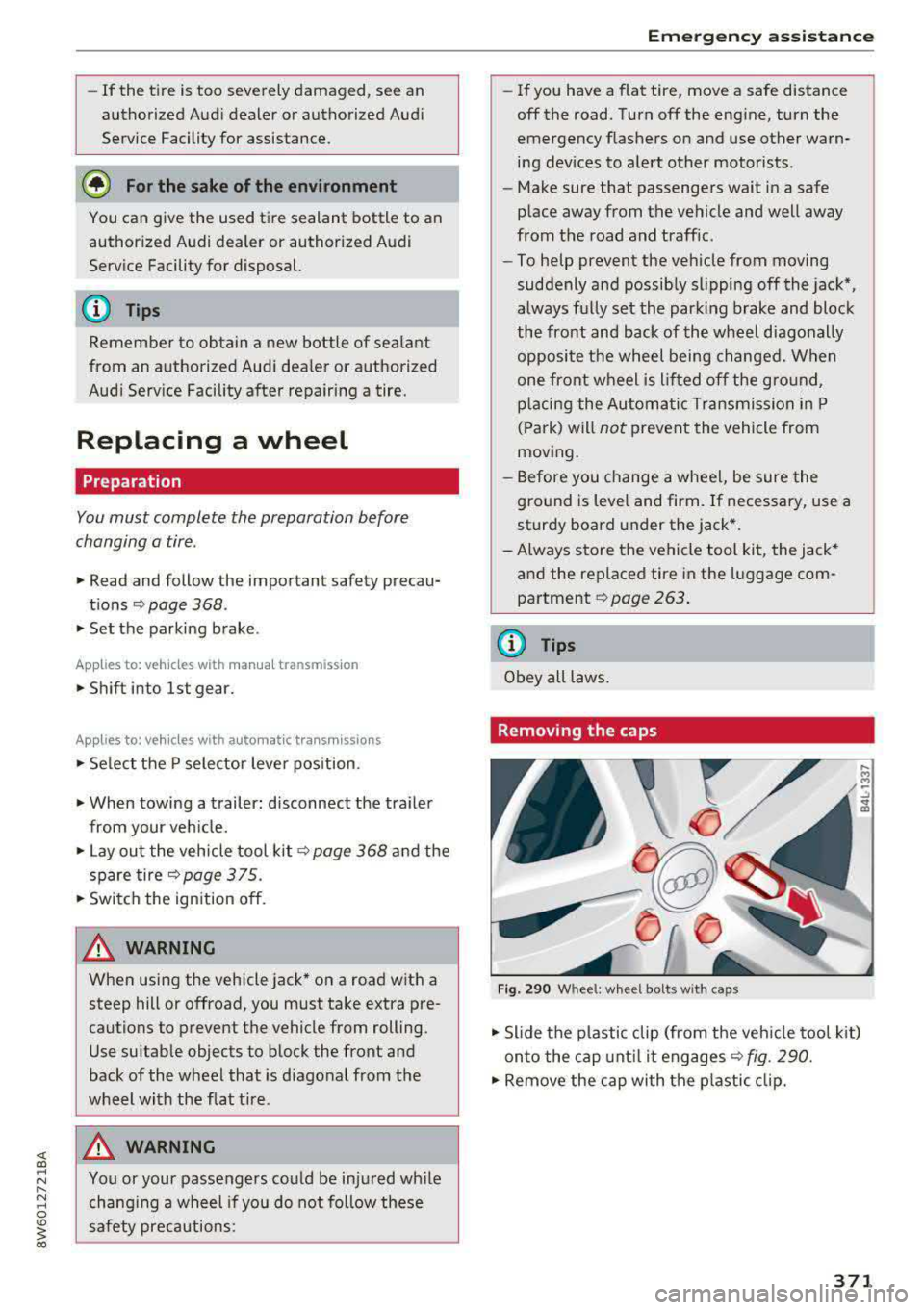
Removing the caps
Fig. 290 W hee l: whee l bolt s w ith ca ps
.,. Slide the p lastic clip (from the veh icle tool k it)
on to the cap unt il it
engages ~ fig. 290.
.,. Remove the cap with the p lastic clip.
371
Page 373 of 409
Emergency assistance
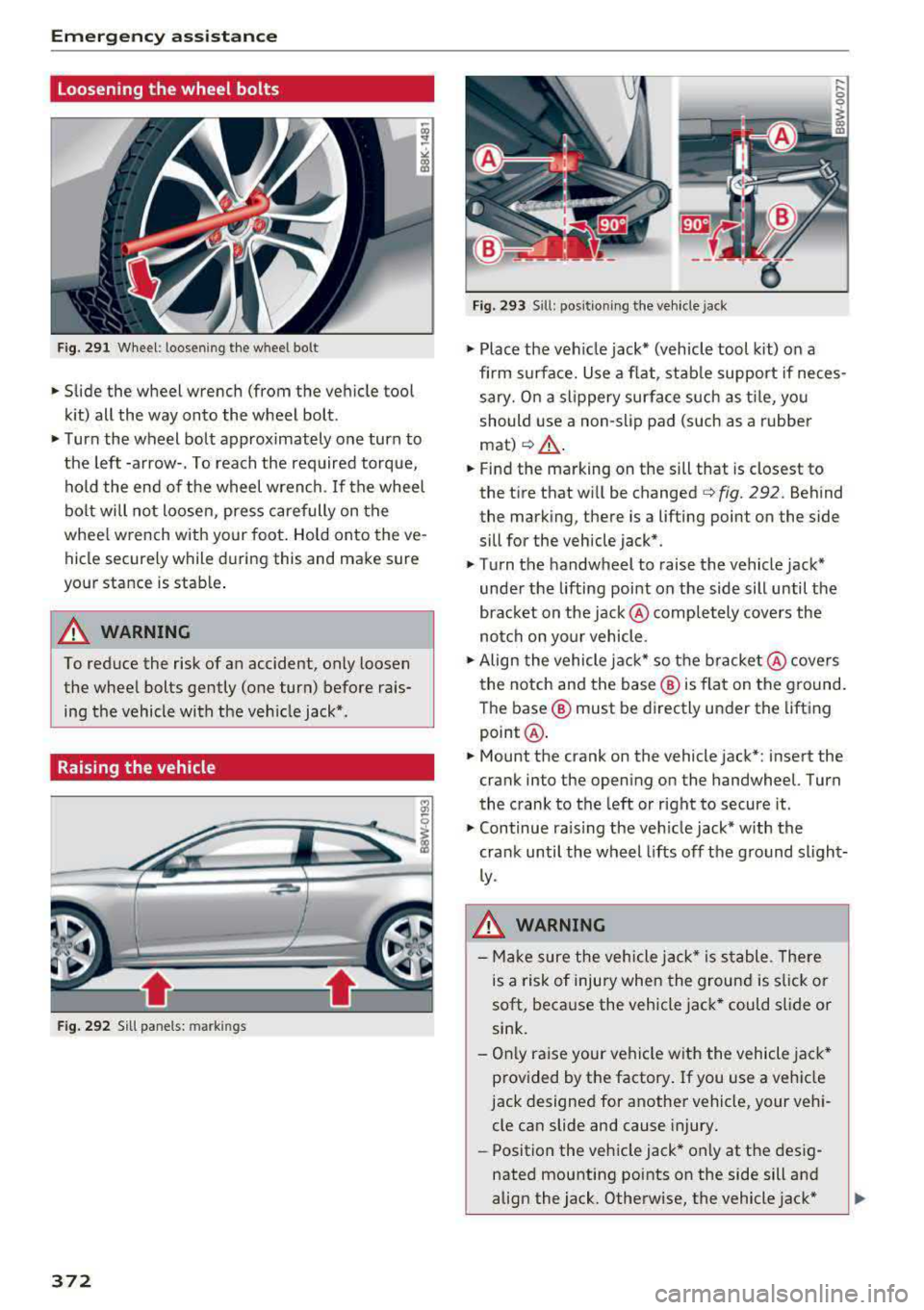
Loosening the wheel bolts
Fig. 291 Wheel: loosening the wheel bolt
• Slide the wheel wrench (from the vehicle tool
kit) all the way onto the wheel bolt.
• Turn the wheel bolt approximately one turn to
the left -arrow-. To reach the required torque,
hold the end of the wheel wrench. If the wheel
bolt will not loosen, press carefully on the
whee l wrench with your foot. Hold onto the ve
hicle securely while during this and make sure
your stance is stable .
A WARNING
To reduce the risk of an accident, only loosen
the wheel bolts gently (one turn) before rais
ing the vehicle with the veh icle jack*.
Raising the vehicle
Fig . 292 Sill panels: markings
372
Fig. 293 Sill: positio ning the vehicle jack
• Place the veh icle jack* (vehicle tool kit) on a
firm s urface. Use a flat, stable support if neces
sary. On a slippery surface such as tile, you
should use a non-slip pad (such as a rubber
mat)¢ &.
• Find the marking on the sill that is closest to
the tire that will be changed
¢fig. 292. Behind
the marking, there is a lifting point on the side
sill for the vehicle jack*.
• Turn the handwheel to raise the vehicle jack*
under the lifting point on the side sill until the
bracket on the jack @ completely covers the
notch on your vehicle.
• Align the vehicle jack* so the bracket @covers
the notch and the base ® is flat on the ground.
The base ® must be directly under the lifting
point @.
• Mount the crank on the vehicle jac k*: insert the
crank into the opening on the handwheel. Turn
the crank to the left or right to secure it.
• Continue ra is in g the veh icle jack* with the
crank until the wheel lifts off the ground slight
ly.
A WARNING
- Ma ke sure the vehicle jack* is stable. Th ere
is a risk of injury when the ground is slick or
soft, because the vehicle jack* could slide or
sink.
- Only raise your vehicle with the vehicle jack*
provided by the factory . If you use a vehicle
jack designed for another vehicle, your vehi
cle can slide and cause injury.
- Position the vehicle jack* only at the desig
nated mounting points on the side sill and
align the jack. Otherwise, the vehicle jack*
Page 375 of 409
Emergency assistance
CJ) Note
When removing or installing the whee l, the
r im could hit the brake rotor and damage the
rotor. Work ca ref ull y and have a second pe r
son help you.
@ Tips
- When mounting tires w ith unidirectional
tread design
ma ke s ure the t read pattern is
po inted the r ight way
¢ page 374 .
-The wheel bolts should be clean and easy to
turn. Check for d irt and cor ros ion on the
mating s urfaces of both the wheel and the
h ub. Remove all dirt from t hese surfaces be
fo re re mount ing th e wheel.
Unidirectional tires
A unid irec tional tire p rofile is ident ified by a rrows
th at poin t in the run nin g dir e cti on o n the tire
sidewall. You mus t always a dhere to the speci
fied running d irec tion. This is necessary ens ure
the t ire's optim um perfo rmance in regar d to a d
hes ion, r unning noise, fr iction and hydrop la ning.
T o be nefi t fu lly fro m the adv ant ages of the uni
d irect ional tire des ign, you sho uld replace faulty
tires as soon as possi ble an d restore the correct
r u nning di rect io n on all of the tires.
Finishing
.,. Reinstall the caps on the whee l bolts if neces
sary .
.,. Store the vehicle tool kit in its designated
place .
.,. If the re m oved whee l does not fi t in the spa re
whee l we ll, store it se cur ely in t he luggage
com partmen t¢ page 2 63.
.,. Check the tire press ure on the ins talled whee l
as soon as possible.
.,. Co rrect the tire p ressure and store it in the I n
fota inment system
¢ page 361.
.,. The wheel bo lt tightening specification must be
90 ft lbs (120 Nm) . Check it as soon as poss ible
with a torq ue wrenc h. Dr ive ca refully unt il t hen .
.,. Have th e faulty wheel rep laced as quic kly as
poss ible.
374
(D Tips
-If you not ice that t he w heel bo lts a re cor
rode d and difficult to tur n while changing a
t ir e, t hey s hou ld be replaced befo re yo u
check the t ightening torque.
- Drive at red uce d speed unti l yo u have the
t ightening to rques checked.
· Notes on wheel changing
Please read t he informat ion¢ page 348 if yo u
are going to use a replacemen t tire which is d if
ferent from the tires on yo ur vehicle .
After you change a tire:
- Check the tire pressure on the replacement
tire immediately after installation.
- Have the wheel bolt tightening torque
checked with a torque wrench as soon as pos
sible by your authorized Audi dealer or quali
fied workshop.
- With steel and alloy wheel rims, the wheel
bolts are cor rectly tightened at a torque of
90
ft lbs (120 Nm) .
- If you notice that the wheel bolts are corroded
and difficult to turn while changing a tire,
they should be replaced before you check the
tightening torque .
- Replace the flat tire with a new one and have
it installed on your vehicle as soon as possi
ble. Remount the wheel cover .
Until then, dr ive with e xtra care and at reduced
speeds.
A WARNING
- If you are going to equip yo ur vehicle wi th
t ires or r ims which diffe r from those which
we re fac to ry insta lled , th en be su re to read
t he
informa tion ¢ page 348.
- Always make sure the damage d w heel or
ev en a fla t tire and the jack* an d tool kit are
p ro p erl y se cured in t he lug gage co mpart
me nt an d ar e no t lo o se in the pas senge r
c o mp artme nt.
- I n an ac cident or su dde n man euver they
co uld fl y forw ard , injur ing an yone i n t he ve
hicle.