door lock AUDI A5 COUPE 2018 Owner's Guide
[x] Cancel search | Manufacturer: AUDI, Model Year: 2018, Model line: A5 COUPE, Model: AUDI A5 COUPE 2018Pages: 409, PDF Size: 67.63 MB
Page 101 of 409
too much stress from being placed on the locking
mechanism .
A WARNING
-The vehicle can roll even when the engine is
switched off.
-U nintended vehicle movement can lead to
serious injuries.
-To reduce the risk of an accident, do not press the acce lerator pedal when changing
the selector lever position while the vehicle
is stationary and the engine is running.
-To reduce the risk of an accident, never se
lect the R or P posit ions while driving.
-Do not inadvertent ly press the acce le rator
peda l when the veh icle is stationary. Other
wise the risk of an accident increases be
cause the vehicle will start to move immed i
ately, eve n if the par king brake is set.
@ Tips
For safety reasons , the parking b rake on ly re
leases automatically when the driver's door is
closed.
Hill descent control
A ppl ies to: ve hicles with a utomat ic t ra nsmi ssio ns
The hill descent control system assists the driver
when driving down hills.
Hill descent control act ivates when the transmis
sion is in the Dor S posit ion and you press the
brake pedal. The t ransmission automat ically se
lects a gear that is suitab le for the hill . H ill de
scent contro l tries to ma inta in the speed ach
i eved at the time of braking, withi n phys ica l and
techn ica l limita tions. If may st ill be necessary to
a dj ust the speed wi th t he b rake pedal.
H ill descent control switches off once the hill lev
e ls out o r yo u press the accelerator pedal.
W hen operating the c ruise contro l system*
¢ page 10 7, hill descent contro l is also act ivated
when the speed is set .
Drivi ng
A WARNING
-Hill descent control cannot overcome physical
limitat io ns, so it may not be able to ma intain
a constant speed under all conditions. Always
b e ready to app ly the brakes.
Shifting manually (tiptronic mode)
A pp lies to : vehicles wi th automatic transmiss ions
The tiptronic mode allows the driver to shift the
gears manually .
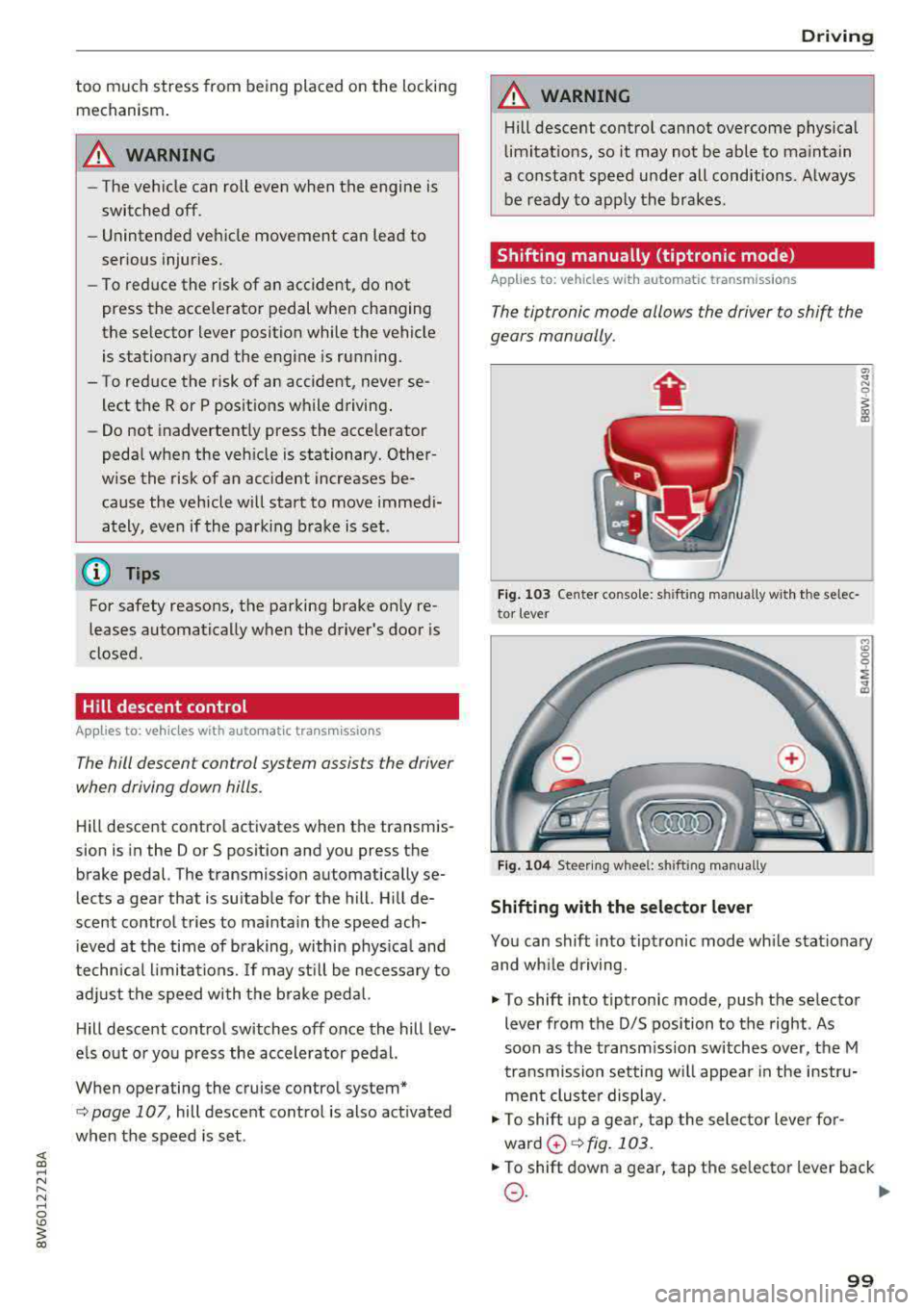
Fig. 103 Center console: s hiftin g man ually w it h th e se lec
to r lever
Fig. 1 04 Stee ring w hee l: sh ift ing man ually
Shifting with the selector lever
9 ~ ... CD
You can shift into tip tronic mode wh ile stat iona ry
and wh ile driving.
.,. To shift into tiptronic mode, push the selector
lever from the D/S position to the right . As
soon as the transm ission switches over, the M
tra nsmission setting w ill appear in the instr u
men t cluste r display .
.,. To shift up a gea r, t ap the sele ctor leve r fo r
ward
0 ¢ fig . 103 .
.,. To shift down a gear, tap the se lector lever back
0 -~
99
Page 204 of 409
Audi connect vehicle control
-Pay attention to upper- and lower-case let
ters when entering the vehicle code.
-If you do not have the 10-digit vehicle code,
contact an authorized Audi dealer or author
ized Audi Service Facility.
Additional options
Applies to vehicles with Audi connect vehicle control
License subscription
The validity and expirat ion date of you r subscrip
tions are displayed. When
Warning before sub
scription expires
is activated, a message wi ll be
d isp layed warning you that your license is about
to expire.
Select:
! MENU ! button> Audi connect > Display
available functions >
right control button> Li
cense subscription.
Resetting the primary user
F or examp le, you ca n reset the key user when
selling your vehicle in order to deactivate these
services .
Requirement: the ignition must be switched on.
Select :
!MENU ! button> Audi connect > right
control button
> Audi connect user management
> Key user> Reset key user .
Warning levels
Requirement: the primary user must have set one
or more warning levels. Secondary users can only
see if a warning level is act ive or not .
Select:
! MENU ! button> Audi connect > right
control button
> Alerts.
Remote locking and
unlocking
Applies to vehicles with Audi connect vehicle control
You can lock and unlock your veh icle using this
service.
Requirement
-This requires the 4-dig it PIN that you specified
during the verification on www.audiusa.com/
myaudi.
-The vehicle must be stationary.
202
-T he ignition must be switched off.
Vehicle status report
Applies to vehicles w ith Audi connect vehicle control
The Driver Information System collects data un
der certain conditions and sends it to a server.
When data is stored, yo u can access va lues such
as these using the service:
-Remaining range
-Fue l tank level
-Oil level
-Vehicle doors are open/closed or locked/un-
locked
-Mi leage
-Next oil change
-Next inspection
-Warning messages
-Side marker lights/parking lights on/off
For additional information on the Driver Informa
tion System, refer to
c:> page 17, Driver informa
tion system.
A WARNING
Do not ignore messages and warning or ind i
cator lights that turn on in the vehicle be
cause of the information in the status report .
This could lead to break downs in on the road,
accidents and serious injuries.
Parking location
Applies to vehicles with Audi connect vehicle control
The vehicle collects data under certain cond it ions
and sends it to a serve r.
When data is stored, you can access values such
as these using the service :
-Vehicle location display,
-Display of one's own location,
-Route to you r vehicle .
If your mobile device also has a navigation func
tion, you ca n navigate to your last kno wn parking
lo ca tion .
Page 265 of 409
Driving sa fe ty
Loose items in the luggage compartment can
shift s udden ly, changing vehicle handling charac
ter istics . Loose items can also increase the risk of
serious personal in jury in a sudden vehicle
ma
neuver or in a coll is ion.
.,. Distribute the load evenly in the luggage com
partment .
.,. Always place and properly secure heavy items in
the luggage compartment as low and as far for
ward as possible
c> fig . 230 .
.,. Secure luggage us ing the tie-downs provided
¢ page 79 .
.,. Make su re that the rea r seatbac k is securely
latched in place .
A WARNING
Improperly stored luggage or othe r items can
fly through the vehicle causing serious per
sonal injury in the event of hard braking or an
accident . To help reduce the risk of serious
personal injury :
- Always put objects, for example, luggage or
other heavy items in the luggage compart
ment.
- Always sec ure objects in the luggage com
partment using the tie-down eyelets and
s u itable straps.
A WARNING
Heavy loads will influence the way your vehi
cle handles . To he lp reduce the r isk of a loss
of contro l leading to serious pe rsonal i njury:
- Always keep in mind when transporting heavy objects, that a change i n the center of
grav ity can also cause changes in vehicle
hand ling:
- Always distr ibute the load as even ly as
possible.
- Place heavy objects as far forward in the
luggage compartment as poss ible.
- Never exceed the Gross Axle Weight Rating
o r the Gross Vehicle Weight Rating specified
on the safety compliance sticker on the
front end of the driver's door. Exceeding permissible weight standards can cause the
vehicle to s lide and handle diffe rently .
264
-Please observe info rmation on safe driving
¢page 258 .
A WARNING
To he lp prevent po isonous exhaust gas from
being drawn into the vehicle, always keep the
rear lid closed while driving.
- Never transport objects larger than those
fitting completely into the luggage area be
cause the rear lid cannot be fully closed .
- If you absolutely must dr ive with the rear lid
open, observe the following notes to reduce
the risk of poisoning :
- C lose all windows,
- Close the s unroof*,
- Close the power top*,
- Open all a ir outlets in the instrument pan -
el,
- Switch off the air reci rculat ion,
- Set the fresh air fan to the highest speed.
A WARNING
-
Always make sure that the doors, all win
dows, the sunroof*, the power top * and the
rear lid are securely closed and locked to re
duce the risk of in jury when the veh icle is not
being used.
-After clos ing the rear lid, always make sure
that it is properly closed and locked .
- Never leave your veh icle unattended espe
cially wi th the rear lid left ope n. A child
could crawl into th e vehicle th rough the lug
gage compa rtment and close the rea r lid be
comi ng trapped and u nable to ge t out. Be
ing trapped in a vehicle can lead to ser ious
pe rsonal inj ury.
- Never let c hild ren p lay in o r around the vehi
cle.
- Never let passenge rs ride in the luggage
comp artment. Vehicle occu pants mus t
al
ways be proper ly restrained in one of the ve
hicle's seat ing pos itions.
(D Tips
- Air circu lation helps t o reduce w indow fog
ging . Stale air escapes to the o uts ide
Page 273 of 409
Safety belts
-Always keep the belts clean. Dirty belts may not work properly and can impa ir the func
t ion of the inertia reel
¢ table Interior
cleaning on page 364 .
Safety belts
Belt positioner
Applies to: vehicles with belt positioners
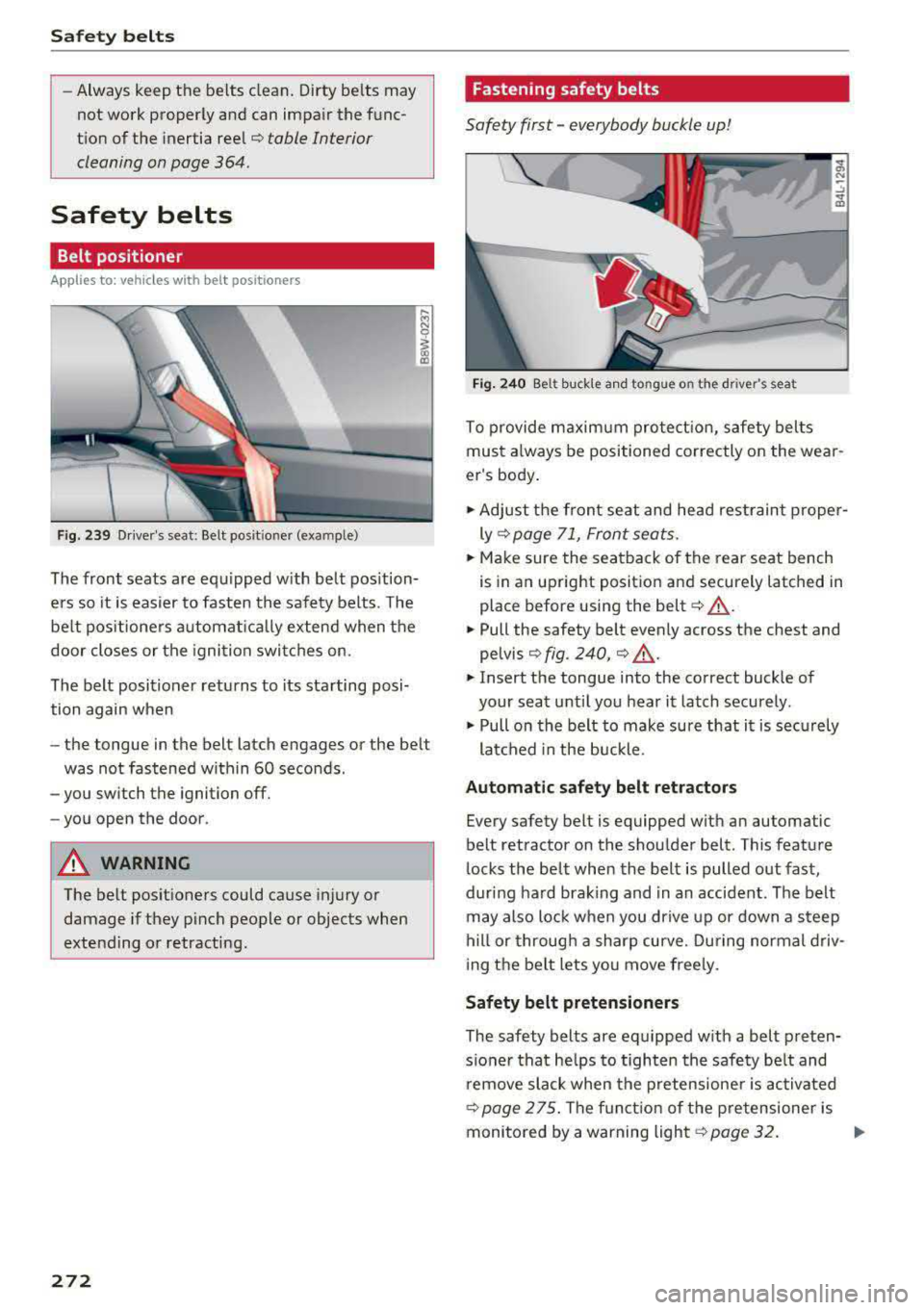
Fig. 239 Driver 's seat: Belt pos it ione r (exa mple)
The front seats are equ ipped w ith belt pos ition
ers so it is easier to fasten the safety belts . The
belt positioners automatically extend when the
door closes or the igni tion switches on.
The belt positioner returns to its starting posi
tion again when
-the tongue in the belt la tch engages or the belt
was not fastened within 60 seconds .
- you switch the ignition off.
-you open the door .
A WARNING
The belt positioners could cause injury or
damage if they p inch people or objects when
extend ing or retracting.
272
Fastening safety belts
Safety first -everybody buckle up!
Fig. 240 Belt buckle and tongue on the driver's seat
To provide maximum protection, safety belts
must always be positioned correctly on the wear
er 's body .
.. Adjust the front seat and head restraint proper
ly¢ page 71, Front seats.
.. Make sure the seatback of the rear seat bench
is in an upright position and securely latched in
place before using the
belt ¢ _A.
.. Pull the safety belt evenly across the chest and
pelvis ¢ fig. 240, ¢ _A .
.. Insert the tongue into the correct buckle of
your seat until you hear it latch securely .
.. Pull on the belt to make sure that it is sec urely
latched in the buckle .
Automatic safety belt retractors
Every safety belt is equipped with an automatic
belt retractor on the shoulder belt . This feature
locks the belt when the belt is pulled out fast,
during hard brak ing and in an accident. The belt
may also lock when you drive up or down a steep
hill or through a sharp curve. During normal driv
ing the belt lets you move free ly.
Safety belt pretensioners
The safety belts are equipped w ith a belt preten
sioner that helps to tighten the safety belt and
remove slack when the pretensioner is activated
¢ page 2 75. The function of the pretensioner is
monitored by a warning
light ¢ page 32 . Iii>
Page 283 of 409
Airbag system
-Never hold the steering wheel at the 12
o'clock position or with your hands any
where inside the steering wheel or on the
steering wheel hub. Holding the steering
wheel the wrong way increases the risk of
severe injury to the arms, hands, and head if
the driver airbag deploys.
,& WARNING
Objects between you and the airbag will in
crease the risk of injury in a crash by interfer
ing with the way the airbag unfolds and/or by
being pushed into you as the airbag inflates.
- Always make sure nothing is in the front air-
bag deployment zone that could be struck
by the airbag when it inflates.
-
- Objects in the zone of a deploying airbag
can become projectiles when the airbag de
ploys and cause serious personal injury.
- Never hold things in your hands or on your
lap when the vehicle is in use.
- Never place accessories or other objects
(such as cup holders, telephone brackets,
note pads, navigation systems, or things
that are large, heavy, or bulky) on the doors;
never attach then to the doors or the wind
shield; never place them over or near or at
tach them to the area marked ,,AIRBAG" on
the steering wheel, instrument panel or the
seat backrests; never place them between
these areas and you or any other person in
the vehicle.
- Never attach objects to the windshield
above the passenger front airbag, such as
accessory GPS navigation units or music
players. Such objects could cause serious in
jury in a collision, especially when the air bags inflate.
- Never recline the front passenger seat to transport objects. Items can also move into
the deployment area of the side airbags or
the front airbag during breaking or in a sud
den maneuver. Objects near the airbags can
fly dangerously through the passenger com partment and cause injury, particularly
when the seat is reclined and the airbags in
flate.
282
,& WARNING
, -
A person on the front passenger seat, espe
cially infants and small children, will receive
serious injuries and can even be killed by be ing too close to the airbag when it inflates .
- Although the Advanced Airbag System in your vehicle is designed to turn off the front passenger airbag if an infant or a small child
is on the front passenger seat, nobody can
absolutely guarantee that deployment un
der these special conditions is impossible in
all conceivable situations that may happen
during the useful life of your vehicle.
- The Advanced Airbag System can deploy in accordance with the
,.low risk" option for 3-
and 6-year-old children under the U.S. Fed
eral Standard if a child with electrical capac
itance greater than the combined capaci
tance of a typical one-year old infant re
strained in one of the forward facing or rear
ward-facing child seats with which your ve hicle was certified is on the front passenger
seat and the other conditions for airbag de
ployment are met.
- Accident statistics have shown that children
are generally safer in the rear seat area than
in the front seating position.
- For their own safety, all children, especially
12 years and younger, should always ride in
the back properly restrained for their age
and size.
Advanced front airbag system
Your vehicle is equipped with a front Advanced
Airbag System in compliance with United States
Federal Motor Vehicle Safety Standard (FMVSS)
208, as well as Canada Motor Vehicle Safety
Standard (CMVSS) 208 as applicable at the time
your vehicle was manufactured .
-
The front Advanced Airbag System supplements
the safety belts to provide additional protection
for the driver's and front passenger's heads and upper bodies in frontal crashes. The airbags in
flate only in frontal impacts when the vehicle de-
celeration is high enough.
ll>
Page 311 of 409
Child safety
Convertible child safety seats
Properly used convertible child safety seats can
help protect toddlers and children over age one
who weigh between 20 and 40 lbs. (9 and 18 kg)
in a crash.
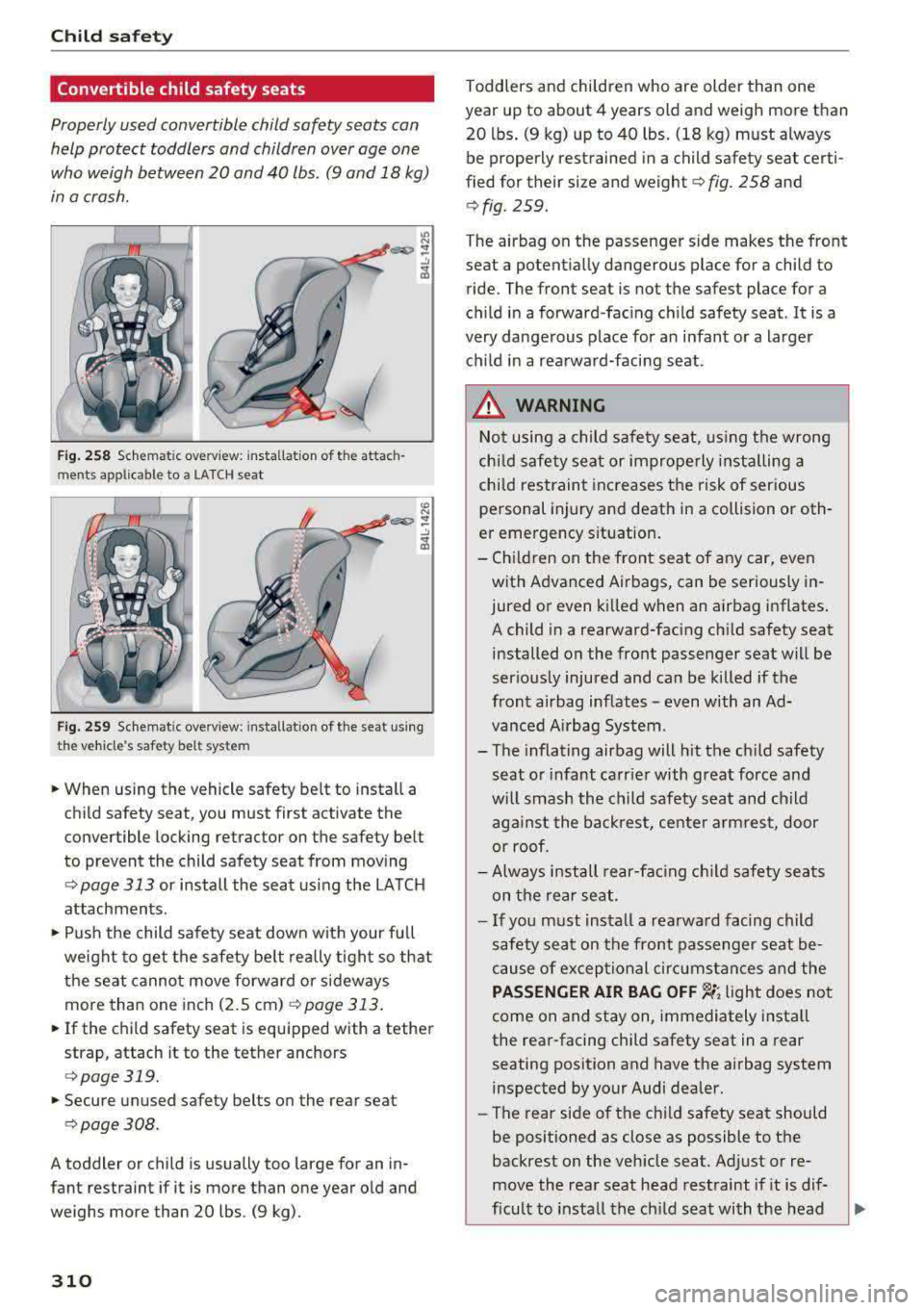
Fig. 258 Schematic overv iew: installat ion of the attach
ments app licable to a LATCH seat
Fig. 259 Schemat ic overview: installat ion of the seat using
the vehicle 's safety belt system
.. When using the vehicle safety be lt to install a
child safety seat, you must first activate the
convertible locking retractor on the safety belt
to prevent the child safety seat from mov ing
¢ page 313 or install the seat using the LATCH
attachments .
.. Push the child safety seat down with your full
weight to get the safety be lt really tight so that
the seat cannot move forward or sideways more than one inch (2.5 cm)
¢ page 313.
.. If the child safety seat is equipped with a tether
strap, attach it to the tether anchors
¢page 319.
.. Secure unused safety belts on the rear seat
¢page 308 .
A toddler or child is usually too large for an in
fant restraint if it is more than one year old and
weighs more than 20 lbs . (9 kg).
310
Toddlers and children who are older than one
year up to about 4 years old and weigh more than
20 lbs . (9 kg) up to 40 lbs. (18 kg) must always
be properly restrained in a child safety seat certi
fied for their size and
weight ¢ fig. 258 and
¢fig. 259.
The airbag on the passenger side makes the front
seat a potentially dangerous place for a child to
ride. The front seat is not the safest place for a
child in a forward-fac ing child safety seat .
It is a
very dangerous place for an infant or a larger
ch ild in a rearward-facing seat .
.&_ WARNING
Not using a child safety seat, us ing the wrong
ch ild safety seat or imprope rly i nstalling a
chi ld restraint increases the risk of serious
personal injury and death in a collision or oth
er emergency situation.
-Ch ildren on the front seat of any car, even
w ith Advanced Airbags, can be seriously in
jured or even killed when an
airbag inflates .
A child in a rearward-fac ing ch ild safety seat
installed on the front passenger seat will be
serious ly injured and can be killed if the
front airbag inflates -even with an Ad
vanced Airbag System .
-The inflating airbag will h it the chi ld safety
seat or infant carr ier with great force and
w ill smash the child safety seat and child
aga inst the backrest, center a rm rest, door
or roof.
-Always i nstall rear-fac ing ch ild safety seats
on the rear seat.
-I f you must install a rearwa rd facing child
safety seat on the front passenger seat be
cause of exceptional circ umstan ces a nd the
PASSENGER AIR BAG OFF ~; light does not
come on and stay on, immediately install
the rea r-facing child safety seat in a rear
seating position and have the airbag system
inspected by your Audi dealer .
-The rear side of the ch ild safety seat should
be positioned as close as possible to the
backrest on the veh icle seat. Ad just or re
move the rear seat head restraint if it is dif-
ficult to install the ch ild seat with the head
"'
Page 315 of 409
Child safet y
A WARNING
-
Improperly installed child safety seats in
crease the risk of ser ious personal injury and
death in a collision .
- Always make sure that the safety belt re
tractor is locked when installing a child safety seat. An unlocked safety belt retrac
tor cannot hold the child safety seat in place dur ing normal driving or in a crash.
- Always buckle the child safety seat firmly in
place even if a child is not s itting in it. A
loose child safety seat can fly around during
a sudden stop or in a coll is ion .
- Always make sure that the rear seat back
rest to which the center rear safety belt* is
attached is securely latched whenever the
rear cente r safety belt is being used to se
cu re a ch ild restraint.
- If the backrest is not securely latched, the
child and the child restraint will be thrown
forward together w ith the backrest and will
strike parts of the vehicle interior. The chi ld
can be se riously injured or killed .
- Never ins tall rear-facing chi ld safety seats
or infant carriers on the front passenger
seat . A child will be serious ly inju red and
can be killed when the passenger airbag in
flates.
- The inflating airbag will hit the child safety
seat or infant carrier with great force and
will smash the chi ld safety seat and child
against the backrest, center armrest, door
or roof .
- Always install rear-facing child safety seats
or infant carr iers on the rear seat.
- Forward-facing ch ild safety seats or infant
carr iers installed on the front passenger's
seat may interfere with the deployment of
the a irbag and cause serious injury to the
child .
- It is safer to install a forward -facing ch ild
safety seat on the rear seat .
- Always read and heed all WARNINGS when
ever using a child restrained in a veh icle is
being used
~ page 302 . Specia l precaut ions
apply when installing a child safety seat on
the fron t passenger seat
~ page 2 78, Child
314
restraints on the front seat -some impor
tant things to know.
A WARNING
A lways take special precautions if you must
install a forward or rearward-facing child re
stra int on the front passenger's seat in excep
tional s ituations:
- Whenever a forward or rearward-fac ing
child restraint is installed on the front pas
senger seat, the
PASSENGER AIR BAG OFF
~; light must come on and stay on whenev
er the ign ition is switched on.
- If the
PASSENGER AIR BAG OFF ~; light
does not come on and stay on , perform the
checks desc ribed
~ page 289, Monitoring
the Advanced Airbag System.
- Take the child restra int off the front passen
ger seat and install it prope rly at one of the
rear seat positions if the
PA SSENGER AIR
BAG
OFF ~. light does not stay on whenever
the ignition is switched on .
- Improper installation of child restraints can
reduce their effectiveness or even prevent
them from providing any protect ion .
- An improperly installed child restraint can
interfere with the airbag as it deploys and
serious ly injure or even kill the child.
- Always carefully follow the manufacturer's
instructions provided with the child safety
seat or carrier.
- After checking to make sure that the child
restraint is properly installed, make certain
that the child restraint is correctly recog nized by the capacitive passenger detection
system in the front passenger seat and that
the
PASSENGE R AIR B AG OFF ~; light sig
na ls the correct front passenger fronta l air
bag stat us.
A WARNING
Forward-facing child restra ints:
- Always make sure the forward-facing seat
has been des igned and certified by its man
ufacturer for use on a front seat with a pas
senger front and side airbag.
-
Page 316 of 409
<( a, .... N ,....
N .... 0 \0
3 a,
-Never put the forward-facing child restraint
up, against or very near the instrument pan
el.
-Always move the front passenger seat to
the highest position in the up and down
ad
justment range and move it back to the
rearmost position in the seat's fore and aft
adjustment range, as far away from the air
bag as possib le, before insta lling the
for
ward-facing child restra int.
- Always make sure that the safety belt upper
anchorage is beh ind the child restraint and
not next to or in front of the chi ld restraint
so that the safety belt will be properly pos i
tioned.
-Make sure that the PASSENGER AIR BAG
OFF ~; light comes on and stays on a ll the
time whenever the ignition is switched on.
,&. WARNING t-==
Rearward-facing child restraints:
-A ch ild in a rearward-facing child safety seat
installed on the front passenger seat wi ll be
seriously injured and can be killed if the
front airbag inflates
-even with an Ad
vanced Airbag System.
-The inflating airbag will hit the child safety
seat or infant carrier with great force and
will smash the chi ld safety seat and child
against the backrest, center armrest, door
or roof .
-Always be especially careful if you must in
stall a rearward facing child safety seat on
the front passenger seat in exceptional c ir
cumstances .
-Make sure that the PASSENGER AIR BAG
OFF ~; light comes on and stays on a ll the
t ime whenever the ignition is switched on.
-If the PASSENGE R AIR BAG OFF ~; light
does not come on and stay on, immed iate ly
install the rea r-facing child safety seat in a
rea r seat ing pos ition and have the airbag
system inspected by your Aud i dealer.
Ch ild safety
Activating the convertible locking retractor
Use the convertible locking retractor to secure a
child restraint .
Always heed the child safety seat manufacturer's
instructions when installing a child restraint in
your vehicle. To activate the convertible locking retractor:
.. Place the child restraint on a seat, preferably
on the rear seat .
.. Slowly pull the belt all the w ay out .
.. Route it around or through the child restra int
be lt
path ¢&. -
.. Push the ch ild safety seat down with you r full
weight to get the safety belt really tight.
.. Insert the belt tongue into the buckle for that
seating position.
.. Guide the safety belt back into the retractor un
til the belt lies flat and snug on the child safety
seat .
.. You should hear a ''cl icking" noise as the belt
w inds back into the inertia reel. Test the con
vert ible lock ing retractor by pulling on the belt .
You shou ld no longer be able to pull the belt
out of the retractor. The convertib le loc king re
t ractor is now activated.
.. Make sure that the red release button is facing
away from the child restraint so that it can be
unbuckled quickly .
.. Pull on the belt to make sure the safety belt is
properly tight and fastened so that the seat
cannot move forward or sideways more than
one inch (2 .5 cm) .
,&. WARNING
Using the wrong ch ild rest raint or an improp
e rly installed child restra int can cause se rious
personal injury or death in a crash.
-Always make sure that the safety be lt re
tr actor is locked when installing a child
safety seat . An un locked safety be lt retrac
tor cannot hold the chi ld safety seat in p lace
during normal driving or in a crash.
-Always buckle the child safety seat firm ly in
p lace even if a child is not sitting in it. A
loose child safety seat can fly around during
a sudden stop or in a crash.
.,.
315
Page 321 of 409
Child safety
Installing the upper tether strap on the
anchorage
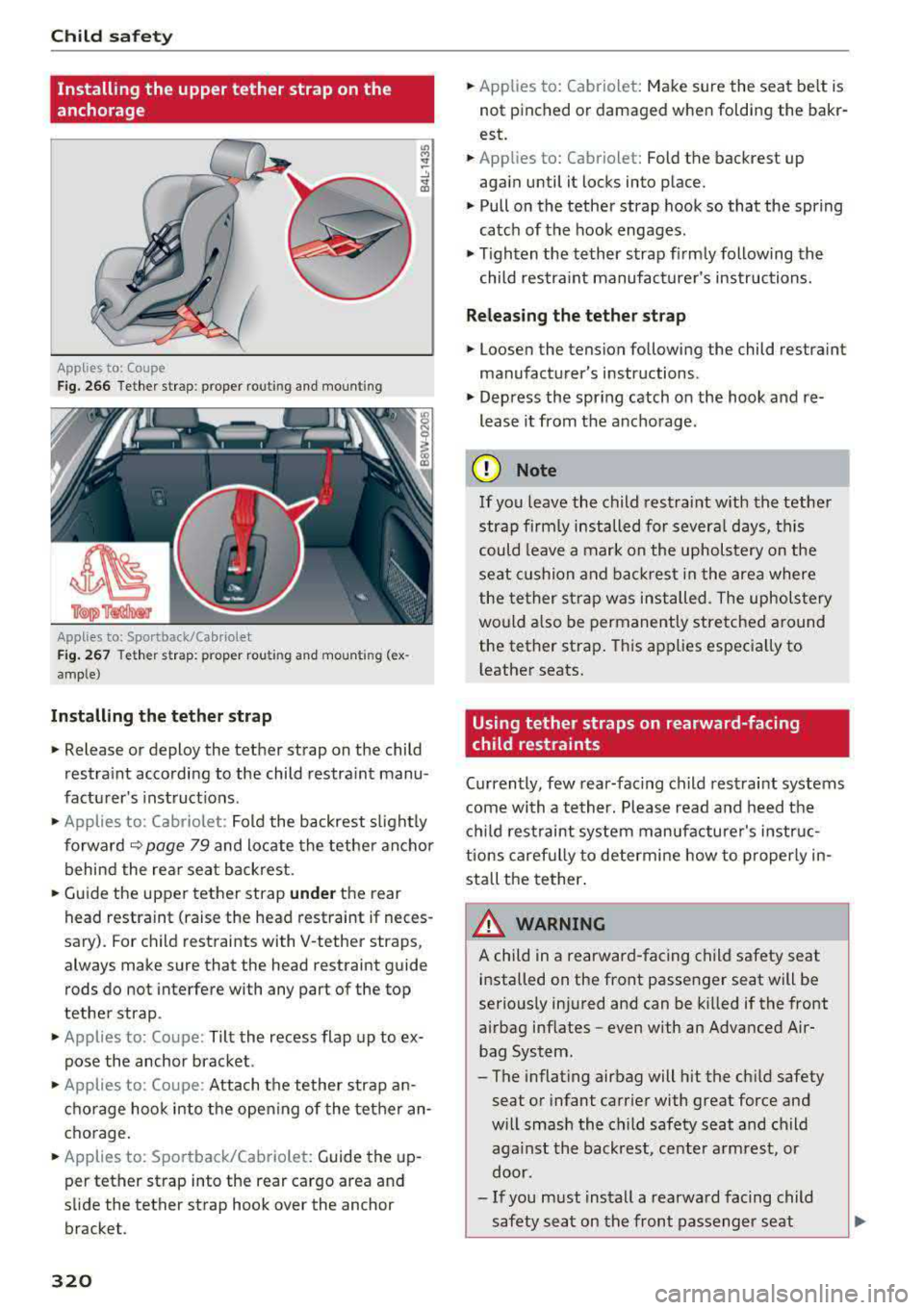
App lies to: Coupe
F ig. 266 Te ther s trap : proper ro utin g an d mo untin g
~
,r~~
Applies to: Sportback/Cabriolet
Fig. 267 Tet her st rap : proper rou ting and moun ting (ex
amp le)
In sta lling th e te th er strap
• Release or deploy the tether strap on the child
restraint according to the child restra int manu
facturer's instructions .
• Applies to: Cabrio let: Fold the backrest s light ly
forward
~ page 79 and locate the tethe r anchor
behind the rear seat backrest .
• Guide the upper tether strap under the rear
head restraint (raise the head restraint if neces
sary) . For child restraints with V -tether straps ,
always make sure that the head restraint guide rods do no t interfere with any part of the top
tether strap .
• Applies to: Coupe: Tilt the recess flap up to ex
pose the anchor bracket .
• Applies to: Coupe: Attach the tether strap an
cho rage hook into the open ing of the tether an
c h orage.
• Applies to: Sportback/Cabriolet: Guide the up
per tether strap into the rear cargo area and
slide the tether strap hook over the anchor bracket.
320
• Applies to: Cabriolet: Make sure the seat belt is
not pinched or damaged when folding the bakr
est.
• Applies to: Cabriolet: Fold the backrest up
again until it locks into place.
• Pull on the tether strap hook so that the spring
catc h of the hook engages.
• Tighten the tether strap firm ly following the
child restra int manufacturer's ins truc tions.
Releasing the tether strap
• Loosen the tension follow ing the child restra int
manufacturer's instructions .
• Depress the spring catch on the hook and re
lease it from the anchorage.
(D Note
If you leave the child restraint with the tether
strap firmly installed for severa l days, this
could leave a mark on the upholstery on the
seat cushion and ba ckrest in the area where
the te ther s trap was installed . The upholstery
would a lso be permanently stretched around
the tether strap . Th is app lies especia lly to
l eather seats.
Using tether straps on rearward -facing
child restraints
Currently, few rear-facing child restraint systems
come wi th a tether. Please read and heed the
c hi ld rest raint system manufacture r's instr uc
tions caref ully to determine how to properly in
stall the tether.
A WARNING
A child in a rearward-facing child safety seat
installed on the front passenger seat will be
seriously injured and can be k illed if the front
a irbag inflates
-even with an Advanced Air
bag System .
- The inflating airbag will h it the chi ld safety
seat or infant carrier with great force and
will smas h the child safety seat and child
aga inst the backrest, ce nter armrest, or
door.
- If you must install a rearward facing child
safety seat on the front passenger seat
Page 325 of 409
Checking and Filling
any circ umstances. Immediately contact the
nearest author ized Audi dealer or author
i zed Audi Service Facility for assistance .
These fuels contain substances that can se
verely damage the fue l system and the en
gine if the engine is started .
Refueling
Fuel filler neck
The fuel fille r neck is located on the right rear
s ide pan el behind the fu el filler flap .
I f the power locking system should fail, you can
still open the flap manua lly
-for detai led instruc
tions see
c::> page 326.
You can find the fuel tank capac ity of you r vehicle
in
c::> page 388 .
The label on the inside of the fuel filler flap tells
you the correct fue l for your vehicle . For more in
formation about fue l specifications , see
c::> page 322 .
Your veh icle fuel tank has an onboard refuelling
vapor recovery system . This feature he lps to pre
ve nt fuel vapors from escap ing from the tank and
pollut ing the e nvironment while yo u re fuel your
veh icle. In order to fi ll the tank properly while
protecting the environment, please fo llow this
r e fu eling procedure carefu lly.
& WARNING
Under normal operating conditions, never car
ry additiona l fuel containers in yo ur car. Gas
canisters and other conta iners used to trans
port fuel can be dangerous . S uch containers,
full or empty , may lea k and could cause a fire
in a collision. If yo u m ust t ransport fue l to
use for yo ur lawn mower, snow blower, etc.,
be very careful and a lways obse rve loca l and
state laws regard ing the use, t ransportation
and sto rage of such fue l conta iners. Make cer
tain the container meets industry standards
(ANSI/ASTM F852
-86).
(D Note
Never drive your vehicle unt il the fuel tan k is
comp letely empty . The irregular supply of
324
fu el can cause misfiring. Gasoline could ente r
the exhaust system and damage the catalytic
converter.
Fueling procedure
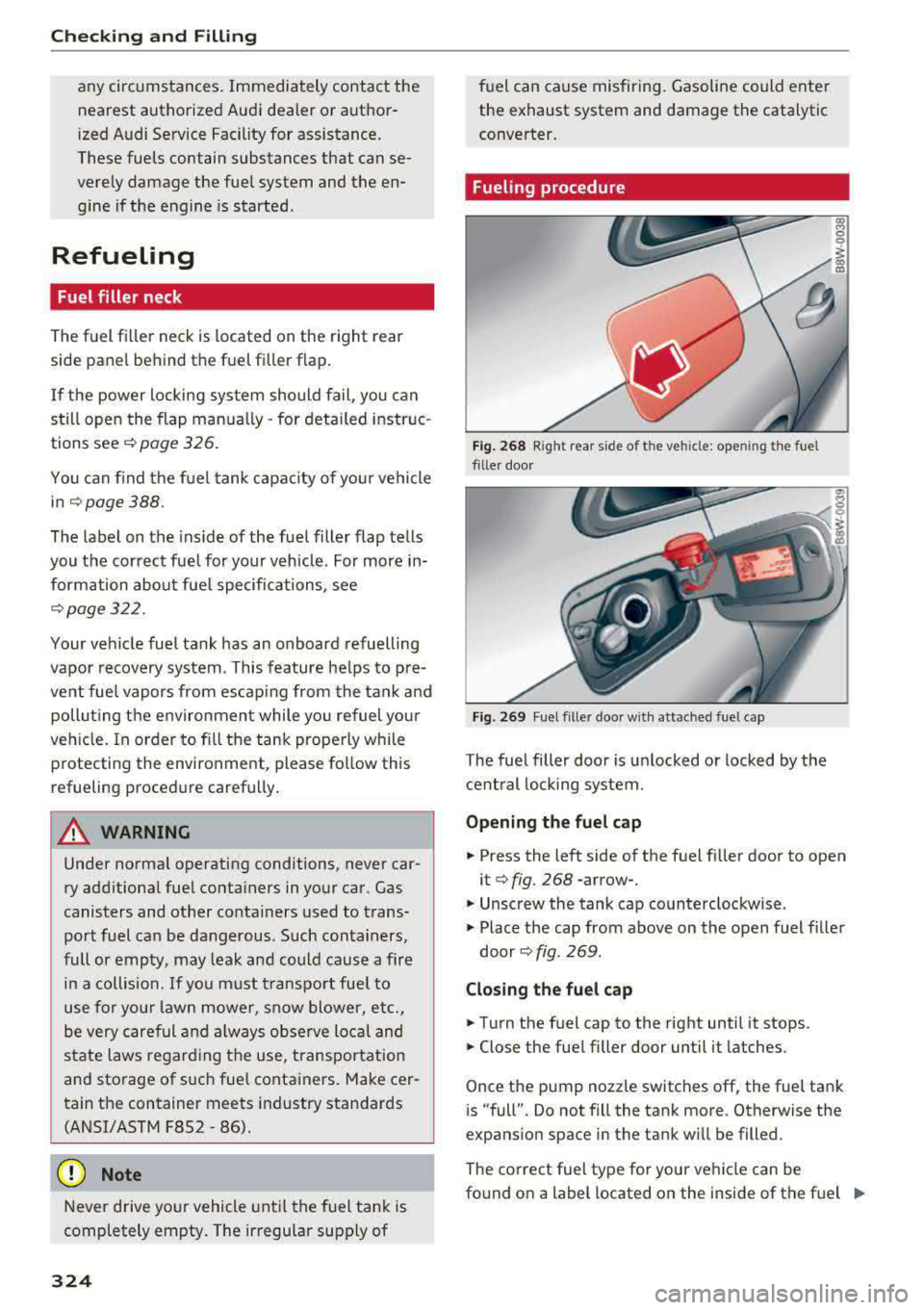
F ig . 2 6 8 Righ t rea r side of th e vehicl e: op enin g the fue l
fi ller door
Fig. 269 Fuel fille r doo r wit h attached fuel c ap
The fuel filler doo r is unlocked or locked by the
cent ral lock ing system .
Opening the fuel cap
.. Press the left side of the fuel f iller doo r to open
i t
c::> fig. 268 -arrow-.
.. Unscrew the tank cap counterclockwise .
.,.. Place the cap from above on the open fuel filler
door
c::> fig . 269 .
Closing the fuel cap
.. Turn the fuel cap to the right until it stops.
.. Close the fuel filler door until i t latches.
Onc e the pump noz zle sw itches
off, the fuel tank
is "full ". Do not fill the tank more . Otherwise the
expans ion space in the tank w ill be filled.
The correct fuel type fo r your ve hicle can be
fo und o n a label located on the inside of the f uel
IJJ,