engine AUDI A5 COUPE 2018 Service Manual
[x] Cancel search | Manufacturer: AUDI, Model Year: 2018, Model line: A5 COUPE, Model: AUDI A5 COUPE 2018Pages: 409, PDF Size: 67.63 MB
Page 107 of 409
<( a, .... N ,....
N .... 0 \0
3 a,
tires to trailer and tire manufacturers' specifica
tions.
Lights
The headlight settings should be checked with
the trailer attached before driving off. Check to
make sure both vehicle and trailer lights are
working properly.
Safety chains
Be sure trailer safety chains are properly connect
ed from the trailer to the hitch on the vehicle.
L eave enough slack in the chains to permit turn
ing corners . When you install safety chains, make
sure they will not drag on the road when you are
driving .
The cha ins shou ld cross under the trailer tongue
to prevent it from dropping in case of separat ion
from the hitch.
Driver messages
Driving with a trailer requires extra caution.
Weight distribution
Towing a loaded trailer with an empty car results
in a high ly unstable distribution of weight .
If this
cannot be avo ided, drive at very low speeds only
to avoid the risk of losing steering control.
A "balanced" rig is easier to operate and control.
This means that the tow vehicle should be loaded to the extent possible and permissible, whi le
keep ing the trailer as light as possible under the
circumstances . Whenever possible, transfer
some cargo to the luggage compartment of the
tow vehicle whi le observ ing tongue load require
ments and vehicle loading considerations.
Speed
The highe r the speed, the more difficult it be
comes for the driver to control the rig. Do not
drive at the maximum permissible speed. Reduce
your speed even more if load, weather or wind conditions are unfavorable
-particularly when
going downhill.
Tra iler towing
Reduce vehicle speed immediately if the trailer
shows the slightest sign of swaying.
Do not try
to stop the swaying by accelerating.
Observe speed limits. In some areas, speeds for
vehicles towing trailers are lower than for regular
vehicles .
Always apply brakes early. When driving down
hill, shift into a lower gear to use the engine
braking effect to slow the vehicle . Use of the
brakes alone can cause them to overheat and fail.
Coolant temperature
T he coo lant temperature gauge ~ page 11 must
be observed carefully. The coolant temperature
can increase if you drive on long inclines in a low
gear at high engine speeds . Reduce your speed
immediately if the LEDs in the top part of the dis
play turn on.
For more information about indicator lights, re
fer
to . ~page 30 .
A WARNING
=
Anyone not properly restrained in a moving
vehicle is at a much greater risk in an acci
dent. Never let anyone ride in your car who is
not properly wearing the restraints provided
by Aud i.
Trailer towing
information
Important to know
-
Your vehicle handles differently when towing a
trailer because of the addit ional weight and dif
ferent weight distribution . Safety, performance
and economy will greatly depend on how careful
ly you load your trailer and operate you r rig.
Before you actually tow your trailer, pract ice
turning, stopping and backing up in an area away
from traffic . Keep pract ic ing until you have be
come complete ly familiar w ith the way your vehi
cle-trailer combination behaves and responds.
105
Page 108 of 409
Trailer towing
Backing up is difficult and requires practice .
Backing up with a trailer generally requires steer
ing action oppos ite to that when backing up your
veh icle w ithout a trailer.
Maintain a greater distance between your vehicle
and the one in front of you. You w ill need more
room to stop. To compensate for the tra iler, you
will need a larger than normal turn ing radius.
When passing, remember that you cannot accel
erate as fast as you norma lly would because of
the added load. Make sure you have enough room
to pass. After passing, allow plenty of room for
your tra iler before chang ing lanes again.
Avoid jerky starts, sharp turns or rapid lane
changes .
@ Tips
- Do not tow a trailer during the break -in per i
od of your vehicle.
- If you tow a trailer, your Audi may require
more frequent maintenance d ue to the ex
tra load
~ page 389.
Parking on a slope
Do not pork on a slope with a trailer. If it cannot
be avoided, do so only
o~er doing the following:
When parking:
.,. Apply t he foo t brake .
.,. Have someone place chocks under both t he ve
hicle and the tra ile r whee ls .
.. With chocks in p lace, slowly release t he brakes
u ntil the whee l chocks absorb the load .
.. Turn the wheels towards the curb .
.. Apply the parking brake .
.. Move the selector lever to P (automat ic trans
mission) respectively select first gear (manual
transm iss ion).
When restarting after parking:
.. Apply the foot brake .
.. Start the engine .
.. Applies to: vehicles with automatic transmis
sion: Move the selector lever to D/S .
.,. Release the parking brake a nd slowly pull out
and away from the wheel chocks.
106
.. Stop and have someone retrieve the whee l
chocks.
Page 109 of 409
Assistance systems Electronic speed limiter
Your vehicle may be factory equipped with t ires
that are rated for a maximum speed of 130 mph (210 km/h). This is less than the maximum speed
of your vehicle. To reduce the risk of sudden tire
failure and loss of control if the vehicle is operat
ed at excessive speeds, your vehicle also has an
electronic speed limiter . The electronic speed
limiter prevents your vehicle from going faster
than the t ire speed rating. For mo re information
~page 341.
If the engine control unit receives faulty vehicle
road speed s ignals, the Malfunction Indicator
L amp
(MIL) ¢..ij will illuminate. If this occurs,
contact the nearest autho rized Audi dealer for
assistance.
_& WARNING
Always observe the posted speed limits and
adjust your speed to suit prevailing road, traf
fic and weather conditions. Never drive your
vehicle faster than the max imum speed rating
of the tires installed.
Speed warning system
Introduction
Applies to: vehicles with speed warning system
The speed warning system helps you to stay be
low a specified maximum speed that can be set,
changed or deleted in the Infotainment system.
-
The speed warning system warns you if you are
exceeding the maximum speed that you have set .
A wa rning tone will sound as soo n as yo ur speed
exceeds the s tored value sligh tly. The
[01 (USA
models)/
[01 (Canada models) indicator light
and a message appear in the instrument cluster
display at the same time. The
HI] / [0] indicator
light and the message turn off if the speed falls
back below the stored maximum speed.
Setting a threshold is recommended if you would l ike to be reminded when yo u reach a certain
maximum speed. Situations where you may want
to do so include driving in a country with a gen er-
Ass is ta nce syst ems
al speed limit or if there is a specified maximum
speed for winter tires.
Setting the warning threshold
Se lect in the Infotainment system: !MENU I b ut
ton
> Vehi cle > left contro l button > Driver a ss is
tance > S peed w arning > Manual.
(j) Tips
Regardless of t he speed warning system, you
shou ld always mon itor your speed using the
speedometer and make s ure yo u are fo llow ing
the lega l speed limit .
Cruise control system
Switching on
Applies to: vehicles with cruise control system
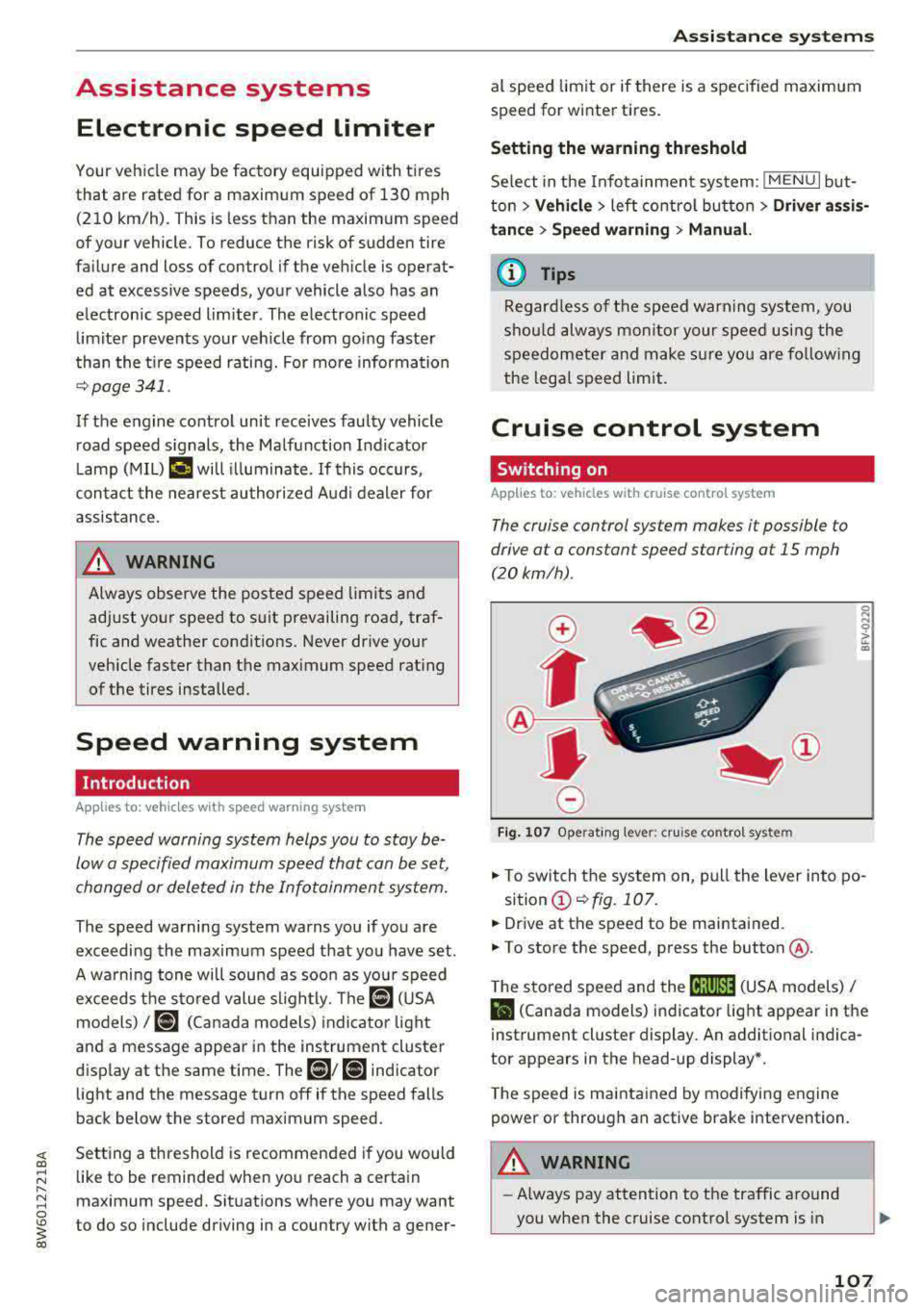
The cruise control system makes it possible to
drive at a constant speed starting at
15 mph
(20 km/h) .
0
f
~
0
Fig . 1 07 Operat ing lever: cruise control system
~
"' 0 > u. m
.. To switch the system on, pull the lever into po-
sition
(D ~ fig. 107 .
.. Dr ive at the speed to be maintained.
.. To store the speed, press the button @.
T he stored speed and the
cij;jl)~14 (USA models) /
Bl (Canada models) indicator light appear in the
instrument cluster display . An additional ind ica
tor appears in the head-up display *.
T he speed is maintained by modifying engine
power or through an active brake intervention.
A WARNING
-~
- Always pay attention to the traffic around
you when the cruise control system is in
107
Page 125 of 409
Distance indicator and
distance warning
Description
Applies to: vehicles with Audi adaptive cruise control
Fig. 125 I n st ru ment cl uste r: d istance ind ica tor /wa rnin g
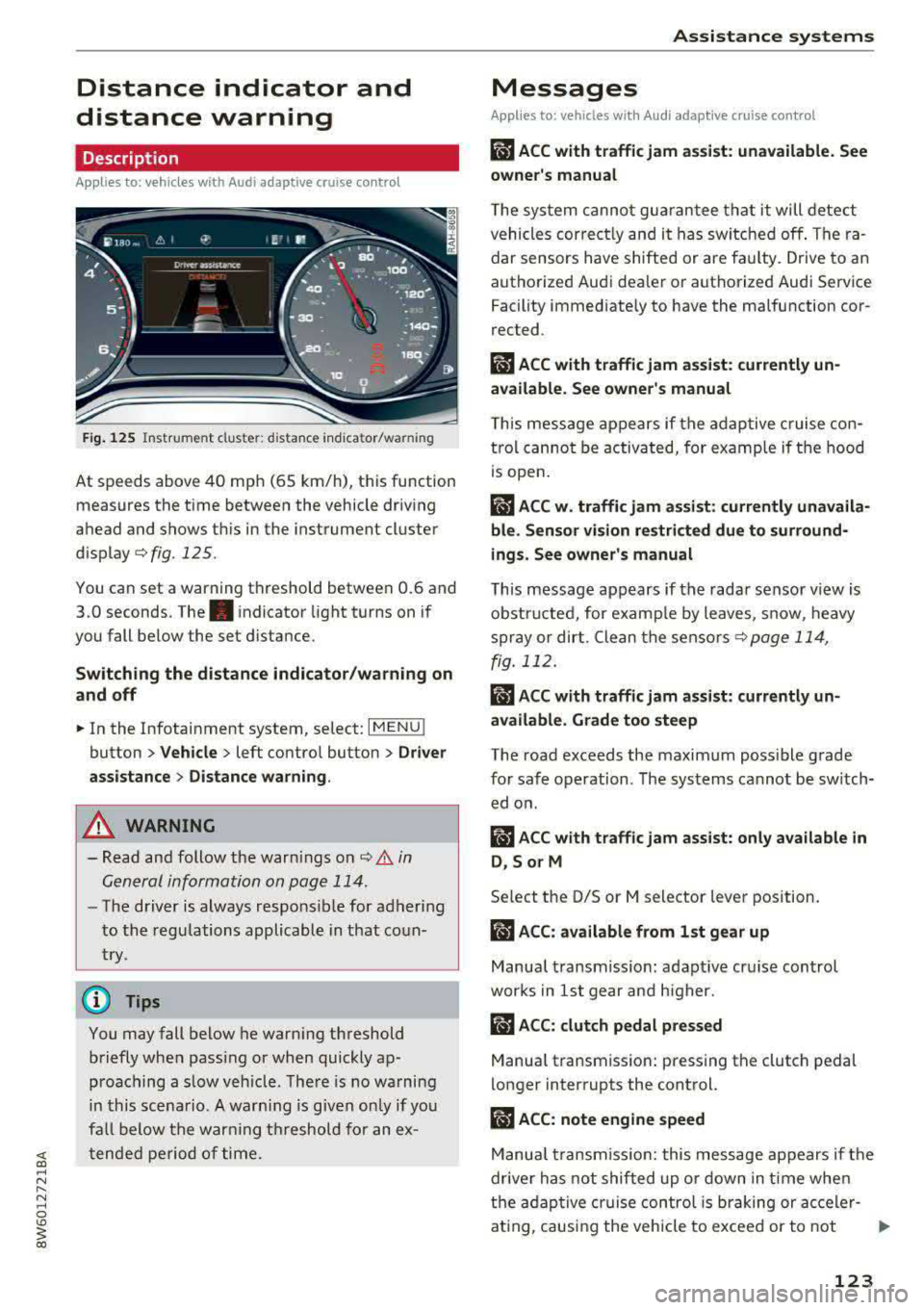
At speeds above 40 mph (65 km/h), t his function
measures the time betwee n the vehicle driving
ahead and shows th is in the inst rument cluster
d isplay ¢ f1g. 125.
You can set a warning th reshold between 0.6 and
3 .0 seconds. The . indicator light turns on if
you fall below the set d is tance .
Switching the distance indicator /warning on
and off
.. In the Infotainment system, se lect: IM ENU I
button > Vehicle > left contro l button > Driver
assistance
> Distance warning .
A WARNING
- Read and follow the war nings on ¢ A in
General info rmation on page
114 .
-
-The driver is always respo nsib le for adher ing
to the regulations applicable in that co un
tr y.
@ Tips
You may fall below he war ning th reshold
b riefly whe n passing or when quickly ap
proach ing a slow veh icle . T he re is no wa rning
in this sce na rio . A war ning is given only if yo u
fa ll b elow the war ning thresh o ld fo r an ex
t en ded p erio d o f tim e.
Assistance systems
Messages
Applies to: vehicles with Aud i adapt ive c ru ise control
111 ACC with traffic jam ass ist: unavailable. See
owne r's manual
The system cannot gu arantee t hat it will dete ct
vehicles cor rec tly an d it has sw itche d off . The ra
dar sensors have shifted or are fa ulty . Drive to an
a u tho rized Audi dea le r o r a uth orized Aud i Service
Facility immed iate ly to have the malfunction cor
rected .
111 ACC with traffic jam ass ist: currently un
available. See owner 's manual
Th is mess age appears if the adap tive cruise co n
t ro l cannot be activ ated, for examp le if t he hood
is ope n.
fl ACC w. traffic jam assist : currently unavaila
ble . Sensor vision restricted due to surround
ings. See owner's manual
This message appears if the rada r senso r view is
obst ructed, for e xam ple by leaves, s now , h eavy
s p ra y or dirt . Cle an the
sensors ¢ page 114,
fig. 112 .
ill ACC with traffic jam assist: currently un
available. Grade too steep
The road exceed s the maxim um poss ible g rade
f or safe operation . T he systems cannot be sw itch
ed o n.
ill ACC with traffic jam assist : only available in
D, Sor M
Se lect t he D/S or M s ele ctor leve r position.
r,J ACC: available from 1st gear up
Manua l t ransmiss io n: ada ptive cr uise control
wor ks in 1st gear an d higher.
IIJ ACC: clutch pedal press ed
Manua l transmiss io n: pr essing th e clutch p edal
longer inter rupts the control.
IIJ ACC: note engine speed
M anua l t ra nsmiss io n: this message appears if t he
drive r has not shifted up o r down in t ime whe n
t he adapti ve c ruise contro l is br aking or a ccele r-
a ti ng , causin g the veh icle to exceed or to not
..,..
123
Page 141 of 409
<( a, .... N ,....
N .... 0 \0
3 a,
Description
Applies to: vehicles with Audi drive select
The following systems, among other things, are
influenced by drive select:
Engine and automatic transmission*
Depending on the mode, the engine and auto
mat ic transmission* respond more quickly or in a
more balanced manner to accelerator pedal
movements. In the sporty
Dynamic mode, the
transmission shifts at highe r speed ranges.
Suspension control*
The suspension control* uses sensors to record
information regarding steering movements,
braking and acceleration operations by the driv
e r, road sur face, dr iv ing speed, and load. This
makes it possible to adapt damping to the driv
ing situation nearly in rea l time. With drive se
lect, you can adjust the suspension control to be
sporty
( Dynamic ), comfortab le ( Comfort ) or bal
anced
( Auto ).
Steering
The power steering adapts. Indirect steer ing that
moves easi ly as in
Comfort mode is especia lly
suited to long drives on highways. The
Dynamic
mode provides sporty, direct steering.
The following applies to vehicles with dynamic
steering*: the steering ratio changes based on
vehicle speed in order to maintain optimum
steering effort for the driver at all times. This
sets the steer ing to be less sensitive at higher
speeds in order to provide improved vehicle con
trol. At reduced speeds, steering is more direct in
order to keep the steering effort as min imal as
possible w hen the driver is maneuvering the vehi
cle . At low and average speeds, dynam ic steer
in g* add itionally provides more responsive steer
ing performance.
Sport differential*
As a component of the all wheel drive system
(quattro)
~ page 154, the sport differential dis
tr ibu tes the dr iv in g power to the rear ax le de
pending on the situation. The distribution of
power varies depending on the selected mode
Assistance systems
from moderate (Comfort ) to sporty (Dynamic ).
The goal is a high level of agility and ability to ac
ce lerate on curves . T he vehicle is very responsive
to steering.
Adaptive cruise control (ACC)*
The behavior when accelerating can be adjusted
from comfortable to sporty, depending on the
drive select mode. Adaptive cruise control also
responds to the driving behavior of the vehicle
ahead in a more conservative or sporty manner.
Engine sound*
The engine sound adapts to the current mode
and can be subtle to sporty.
(D Tips
The S selecto r lever position automatically en
gages when the
Dynamic mode is selected .
Selecting the driving mode
Applies to: vehicles with Aud i drive select
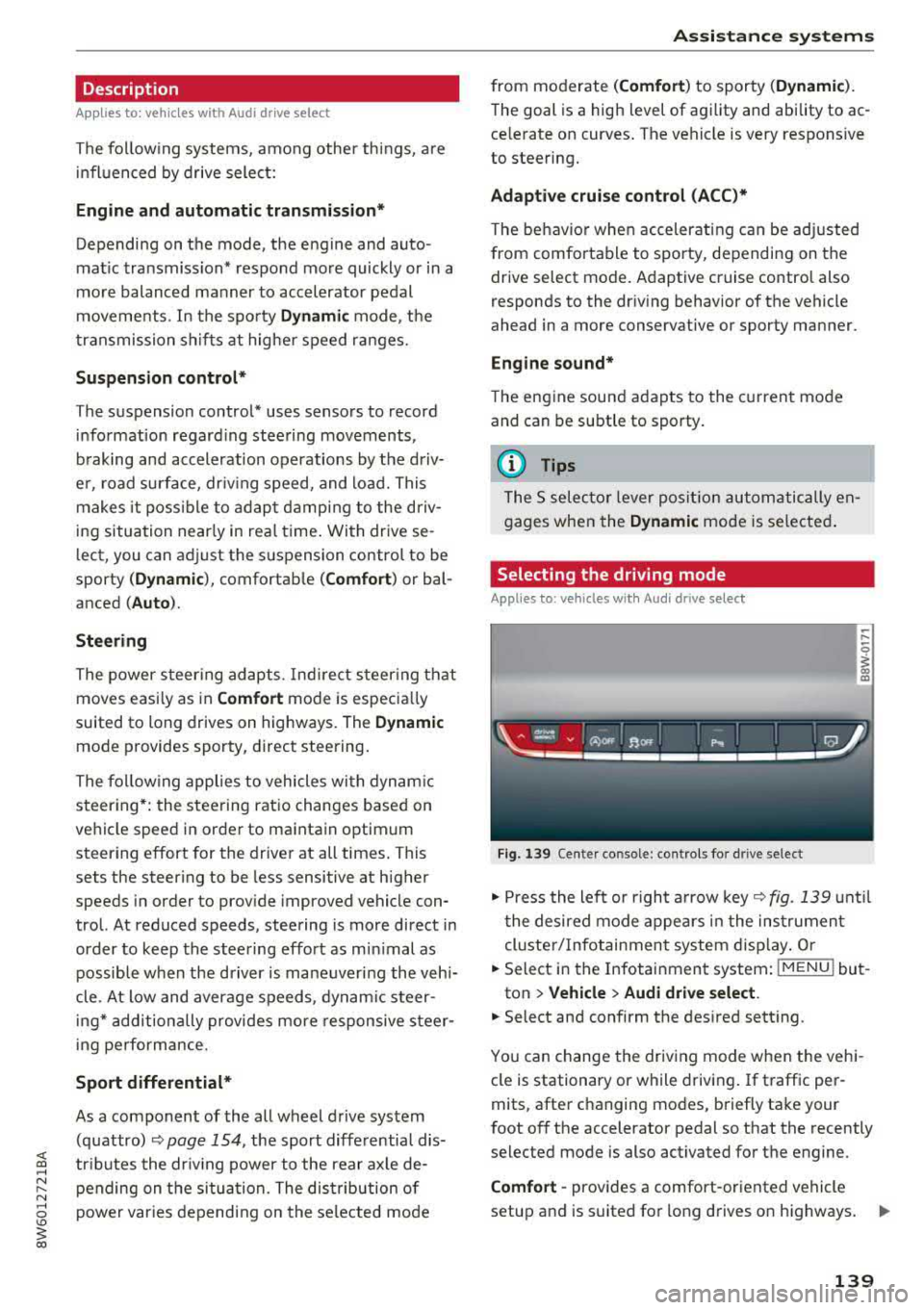
Fig . 139 Cen ter co nsole: con trols for d rive se lect
.. Press the left or right a rrow key ~fig. 139 until
t he desired mode appears in the instrumen t
cluster/ Infotainment system display. Or
.. Select in the Infotainment system: I MENU ! but-
ton
> Vehicle > Audi drive select.
.. Select and confirm the desired setting .
You can change the driving mode when the vehi-
cle is stationary or while driving. If traffic per-
mits, after changing modes, briefly take your
foot
off the accelerator pedal so that the recently
selected mode is also activated for the engine.
Comfort -provides a comfort-oriented vehicle
setup and is suit ed for long drives on highways.
..,.
139
Page 142 of 409
Assistance systems
Auto -provides an overall comfortable yet dy
namic drivi ng feel and is suited fo r every day use .
Dynami c -gives the d river a sporty d riving feel
a nd i s s uited to a spor ty d riving sty le.
Individual -~ page 140 .
Adjusting the Individual mode
Applies to: veh icles w ith Audi drive select
A WARNING
-
Pay attention to traffic when ope rating the
d rive select to reduce the r is k of an accident .
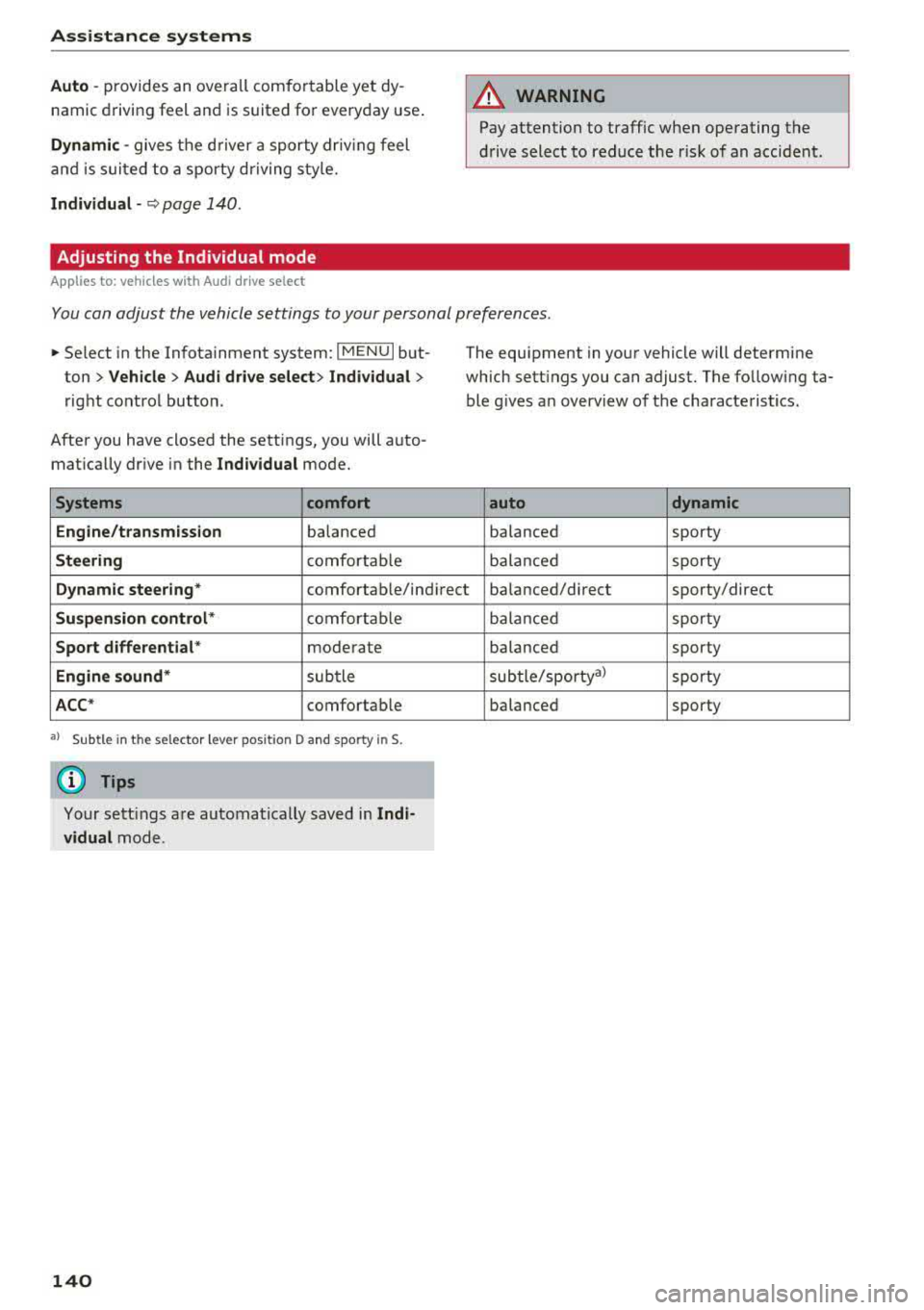
You can adjust the vehicle settings to your personal preferences .
.. Select in the Infotainment system: IMEN UI but
ton >
Vehicle > Aud i drive select > Individual >
right cont ro l button.
Afte r you have closed the settings, you will a uto
mat ically dr ive in the
Individual mode.
Systems comfort
Engine/t ransmission
ba lanced
Steering c o m for ta bl e The equipment in your vehicle will determine
which sett ings you can adjust. The fo llowing ta
ble g ives a n overview of t he characte ristics.
auto dynamic
balanced sporty
ba la nced sporty
Dynamic steering* comfortable/ind i recil: ba lanced/d irect sporty/direct
Suspen sion control * co m fort able
Sport differential * moder ate
Engine sound* sub tle
ACC * comfortab le
• > Sub tle in the se lecto r lever pos it ion D and spo rty in S.
(D Tips
Your sett ings a re automatically saved in Indi
vidual
mode .
140
balanc ed sporty
ba lance d sporty
sub tle/sportya)
sporty
ba lanced sporty
Page 154 of 409
Intelligent Technology
its integra ted systems cannot always pre
vent collisions
-there is still a risk of acci
dents!
- Press the accelerator pedal carefully when
acce lerating on smooth, slippery surfaces
such as ice and snow. The dr ive wheels can
spin even when these control systems are
Switching on and off
installed and this can affect dr iv ing stab ility
and increase the risk of a collision.
@ Tips
- The ABS and ASR only funct ion correctly
when a ll four wheels have a simi lar wear
condition . Different tire sizes can lead to a
red uction in engine power.
- You may hear noises when the systems de
scribed are working.
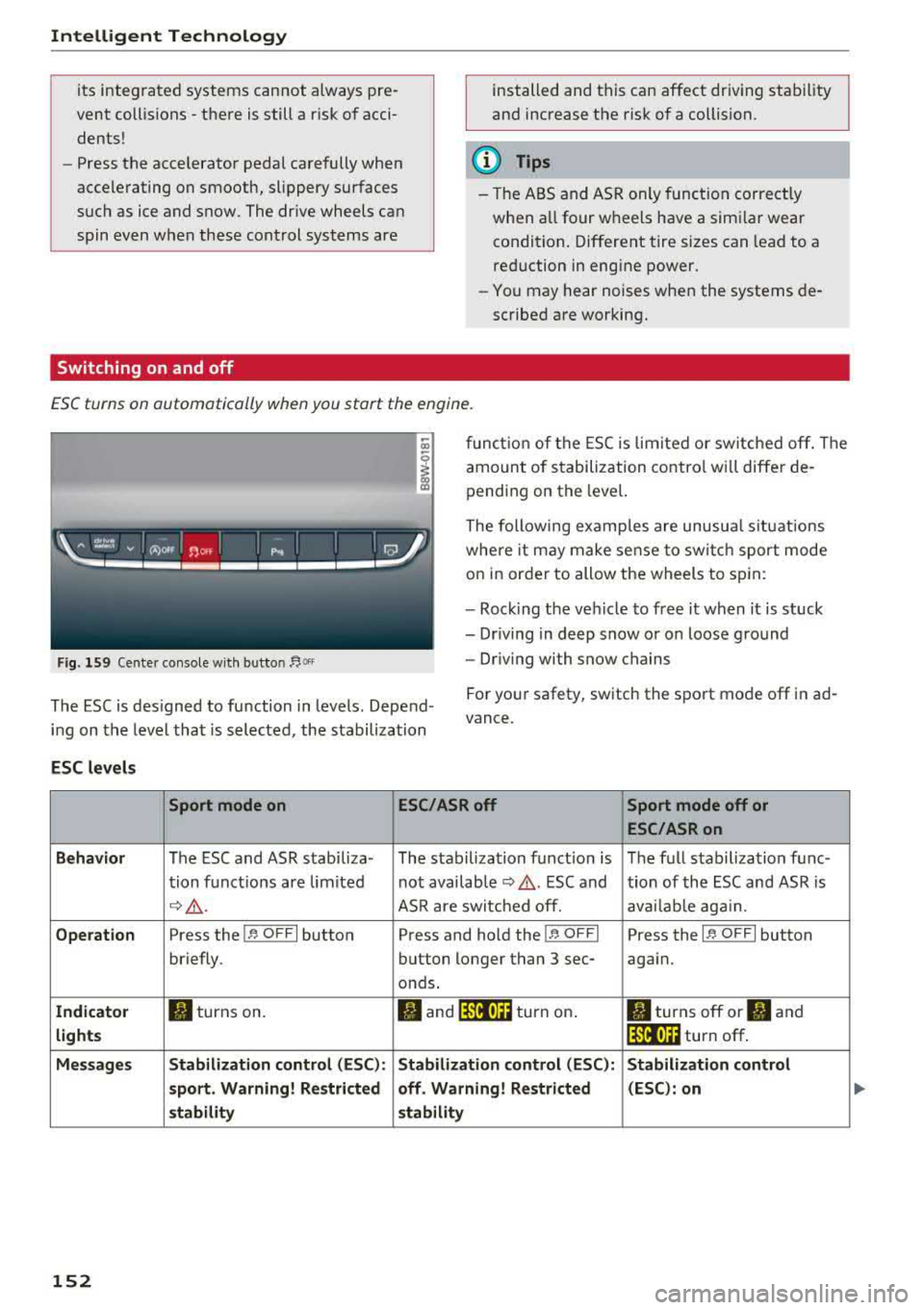
ESC turns on automatically when you start the engine.
Fig . 159 Cente r co nso le w it h button ~Of'
fun ct io n of the ESC is lim ited or switc hed off. The
amount of s tabilization contro l w ill differ de
pending on the leve l.
The following examp les are unusua l situat ions
whe re it may make se nse to sw itch sport mode
on in order to allow the wheels to sp in:
- Roc king the veh icle to free it when it is stuck
- Dr iving in deep snow or on loose g round
- Dr iving with snow chains
The ESC is des igned to function in levels . Depend
i n g on the level that is selected, the stabilization For you
r safety, switch the sport mode
off in ad
vance.
ESC levels
Sport mode on ESC/ASRoff Sport mode off or
ESC /ASRon
Behavior
The ESC and ASR stabiliza- The stabilization funct ion is The f ull s tabilization func-
t ion funct ions are lim ited not availab le
¢ .&. . ESC and tion of the ESC and ASR is
c;> .&. . ASR are switc hed off. ava ilab le aga in.
Operation Press the 11' OFF I button Press and hold the !1' O FFI Press the 11' OFFI button
briefly. button longer than 3 sec- aga in.
onds.
Indicator II turns on. fl and 14'tl•)H turn on . II turns off or II and
lights lf'tl•)H turn off .
Message s Stabilization control (ESC ): Stabilization control (ESC ): Stabilization control
sport . Warning! Restricted off . Warning! Restricted (ESC) : on
s tability stability
152
Page 155 of 409
<( a, .... N ,....
N .... 0 \0
3 a,
A WARNING
You should only switch sport mode on or switch ESC/ASR off if your driving abilities
and road conditions permit .
- The stabilization function is limited when
sport mode is sw itched on . T he driving
wheels co uld spin and the vehicle cou ld
swerve, espec ially on s lick o r sli ppery roa d
surf aces.
- T here is no vehicle stabilization when ESC/
ASR a re swi tched off .
Brakes
New brake pads
New brake pads do not ac hieve the ir full b raking
effect during the first 250 mi (400 km) . They
must be "broken
in " fi rst . However, you can com
pensate for the slightly reduced bra king fo rce by
pr ess ing firmly o n the bra ke pe dal. Avoid heavy
b ra king dur ing t he b reak -in per io d .
Wear
Brake pad wear depends largely o n the way the
ve hicl e is driven and on operat ing cond it ions .
This is especially t rue if you are d riving freque ntly
in t he c ity and on curves o r wi th a sporty driving
s tyle.
Operating noise
Noises may occur when braking depend ing o n the
speed , braking force and ou ts ide cond it ions such
as te m pe ra ture and humi dity .
Wet conditions or road salt
In certain situations, for example after driving
through water, in heavy ra in or after washing
your car, the braking ef fect may be reduced due
to mo isture or ice on the b rake roto rs and b rake
pads. The b rakes mus t be
"dried" firs t wi th a few
care ful bra ke app lic at ions.
At higher speeds and with t he windsh ie ld wipers
turned o n, the brake pads press against the bra ke
rotors for a s ho rt amoun t of time. This ac tion,
whi ch is not felt by the driver , happens at regul ar
i nte rvals an d ens ures a better reac tion time fo r
the brakes in wet weat her.
Intellig ent Technology
The brak ing effec t can a lso be reduced if yo u are
driving on salted roads and yo u do not app ly the
bra kes for long per iods o f time. The layer of sa lt
on the brake rotors and pads m ust be worn off
first whe n the brakes are applied .
Corrosion
Leaving t he vehi cle pa rked for long periods o f
time, low mileage and avoiding heavy b raking
can contrib ute to corros ion on the b rake roto rs
and to dirty brake pads.
If you usu a lly avoid heavy bra king or if there is
cor rosion prese nt, occasiona l heavy braking at
high speeds is recommended to clean the brake
roto rs and pads
c> ,& .
Brake system malfunction
If you notice that the bra ke pedal trave l has sud
denly in crease d, then a brake circuit in the dua l
circuit b rake system may have malfunctioned.
Drive to an authorized A udi dealer or authorized
Audi Se rvice Facility immed iate ly to have the
problem corrected. On the way there, d rive w ith
reduced speed and keep in mind that you will
need a longer distance to stop and you will need
to press the bra ke ped al ha rder.
Low brake fluid level
When the bra ke fluid level is low, malfu nctions in
the b rake system may occur . T h e brake fluid level
is e lec tron ically moni tored.
Brake booster
The brake booster ampli fies t he p ressure you ap
ply to the brake pedal.
A WARNING
- On ly app ly the brakes for the purpose of
cleaning the brake system when road and
traffic cond itions permi t. You must not en
da nger other road users. This inc reases the
ris k of an a ccid en t.
- Never let the vehicle roll while the engine is
sto pped bec ause t his increases the risk of an
a ccident.
153
Page 156 of 409
Intelligent Technology
CJ) Note
- Neve r let the brakes "rub" by pressing the
pedal light ly when bra king is not actually
necessary. This causes the brakes to over
heat and increases braking d istance and
causes wear .
- Before driv ing downhill a long distance on a
steep hi ll, decrease your speed and select a
l ower gear. This makes use of the engine
b raking effect and re lieves the brakes . If
you need to b rake additionally , brake in in
te rvals and n ot co nti nu ously .
(J) Tips
-If the b rake booster is no t wo rking, you
must press the brake pedal with much more
fo rce th an norma l.
- If you re trofit you r vehicle with a fron t spoil
e r, whee l cove rs o r similar items, ma ke sure
th at t he ai r flow to the fron t wheels is not
i nte rr upt ed . Ot he rw ise the bra ke sys tem
ca n become too hot.
Electromechanical
steering, Dynamic
steering
The elec trome chanical steering supp orts the
driver 's steering movemen ts.
P owe r stee ring adapts electronically based on
t he vehicle speed.
Indicator lights and messages
• Steering: malfunction! Please stop vehicle
If th is indicator light t urns o n and stays on and
this message appears, the power steer ing may
have fa iled.
Stop the vehicle in a safe location as soon as pos
sib le. Do
not continue driving. See an author ized
Aud i dea ler or a uthori zed Aud i Serv ice Facility fo r
assistance .
E£4 Steering: malfunction! You may continue
dri ving
If t he i nd ic ator lig ht tur ns on and the message
a ppears, the stee ring wheel may be more diff i-
154 cu
lt to move o r mo re sensitive than usu a l. The
steering wheel may also be at an ang le when
driv ing straight.
Drive slowly to an au thorized Audi de aler or au
thorized Audi Service Facili ty to have t he mal
funct ion correcte d.
f:$JI Dynamic steering: correcting steering wheel
po sition
If the indica tor ligh t turns on and this message
appears, the dynamic steering* is re in it ia liz ing.
The steer ing whee l will be easy to move afte r
sta rt ing t he engine . Reinitiali zation might be
necessary if the steering wheel was moved while
the engine was switched off. The disp lay turns
off if the initialization was successf ul.
(D Tips
-If the . or ':r,y indica to r light only stays on
for a sho rt time, you may cont inue driving .
- T he dynamic steering s tability sys tems
q page 151 are not ava ila bl e in the event of
a system malfunction .
- For add itio na l information o n dynamic
steeri ng, see
c:;, page 138.
ALL-wheel drive (quattro)
General information
In all whee l drive, the dr iv ing power is dis trib ut
ed betwee n all fou r whee ls w hen needed . This
happe ns automatically depending on your driving
behavior as we ll as the c urrent road con ditions.
A lso see
c:;, page 151, Electronic stabili zation
control (ESC) .
The all-whee l dr ive system distr ibutes the dr iving
power va riably to the front and rear axle. It works
together with selective wheel torq ue control,
which act ivates when dr iv ing through c urves
q page 151. With the sport d ifferent ial*, power
distribution to the rear wheels is var iable and can
be adjusted using the drive select
q pag e 139 .
The all wheel drive concept is designed for high
engine power . Your vehicle is except iona lly pow
erfu l and has excellent driving characteristics
bot h unde r normal d riving conditions and on
IJII>
Page 157 of 409
<( a, .... N ,....
N .... 0 \0
3 a,
snow and ice. Always read and follow safety
precautions¢.&. .
Winter tires
By using all wheel drive, your vehicle has good
forward motion with standard tires in winter con
ditions. However, using winter or all season tires
on
all four wheels in the winter is recommended,
because this will improve the
braking effect.
Snow chains
If there are snow chain laws, snow chains must
also be used on vehicles with all wheel drive
¢ page 358, Snow chains.
Replacing tires
For vehicles with all wheel drive, only wheels with
the same rolling circumference should be used.
Avoid using tires with different tread depths
¢ page 348, New tires or wheels.
Offroad vehicle?
Your Audi is not an offroad vehicle -there is not
enough ground clearance. For this reason, avoid
difficult terrain .
A WARNING
-Also, in vehicles with all wheel drive, adapt
your driving style to the current road and
traffic conditions. Do not let the increased
safety provided tempt you into taking risks,
because this increases the risk of an acci
dent .
- The braking ability of your vehicle is limited
to the traction of the wheels. In this way, it
is not different from a two wheel drive vehi
cle. Do not be tempted to accelerate to a
high speed when the road is slippery, be
cause this increases the risk of an accident .
- Note that on wet streets, the front wheels
can "hydroplane" if driving at speeds that
are too high. Unlike front wheel drive
vehicles, the engine does not rev higher sud
denly when the vehicle begins hydroplaning.
For this reason, adapt your speed to the
road conditions to reduce the risk of an acci
dent.
Intelligent Technology
Energy management
The starting ability is optimized
T he energy management system manages the
electrical energy distribution and optimizes the
availability of electrical energy for starting the
engtne.
When a vehicle with a conventional energy sys
tem is not driven for a long time, the vehicle bat
tery is drained by equipment (for example, the
immobilizer). In certain circumstances , there
could may not be enough energy to start the en
gine.
Your vehicle is equipped with an intelligent ener
gy management system for distributing electrici
ty. This significantly improves the starting ability
and increases the vehicle battery life.
The energy management system Is made up of
battery diagnosis, idling current management,
and dynamic energy management.
Battery diagnosis
The battery diagnosis determines the vehicle bat
tery charge level. The sensors determine the bat
tery voltage, the battery current, and the battery
temperature. The current charge level and the
performance of the vehicle battery are deter
mined based on this.
Idling current management
The idling current management decreases the
energy used while parked. With the engine
switched off, it manages the energy distribution
to the different electrical components . Data from
the battery diagnosis is taken into account for
this.
Depending on the vehicle battery charge level,
electrical equipment is switched off one item af
ter the other to prevent the vehicle battery from draining and to maintain the starting ability.
Dynamic energy management
While driving, dynamic energy management dis
tributes the appropriate amount of energy to the
electrical equipment.
It controls the battery
charge level so that the amount of energy is not
..,.
155