roof AUDI A6 2005 C5 / 2.G Electrics System Training Manual
[x] Cancel search | Manufacturer: AUDI, Model Year: 2005, Model line: A6, Model: AUDI A6 2005 C5 / 2.GPages: 92, PDF Size: 4.42 MB
Page 50 of 92
Downloaded from www.Manualslib.com manuals search engine 52
An additional on-board power supply control unit is
needed in the Audi A6 ´05 because of the huge
range of functions it offers.
Functions
Control unit 2 for on-board power supply J520
includes the following functions:
– Activate the solenoid valve for Servotronic N119
– Sliding roof convenience opening/closing
– Speed signal for sliding roof
– Tilt sensor for anti-theft warning system
– Glove compartment release
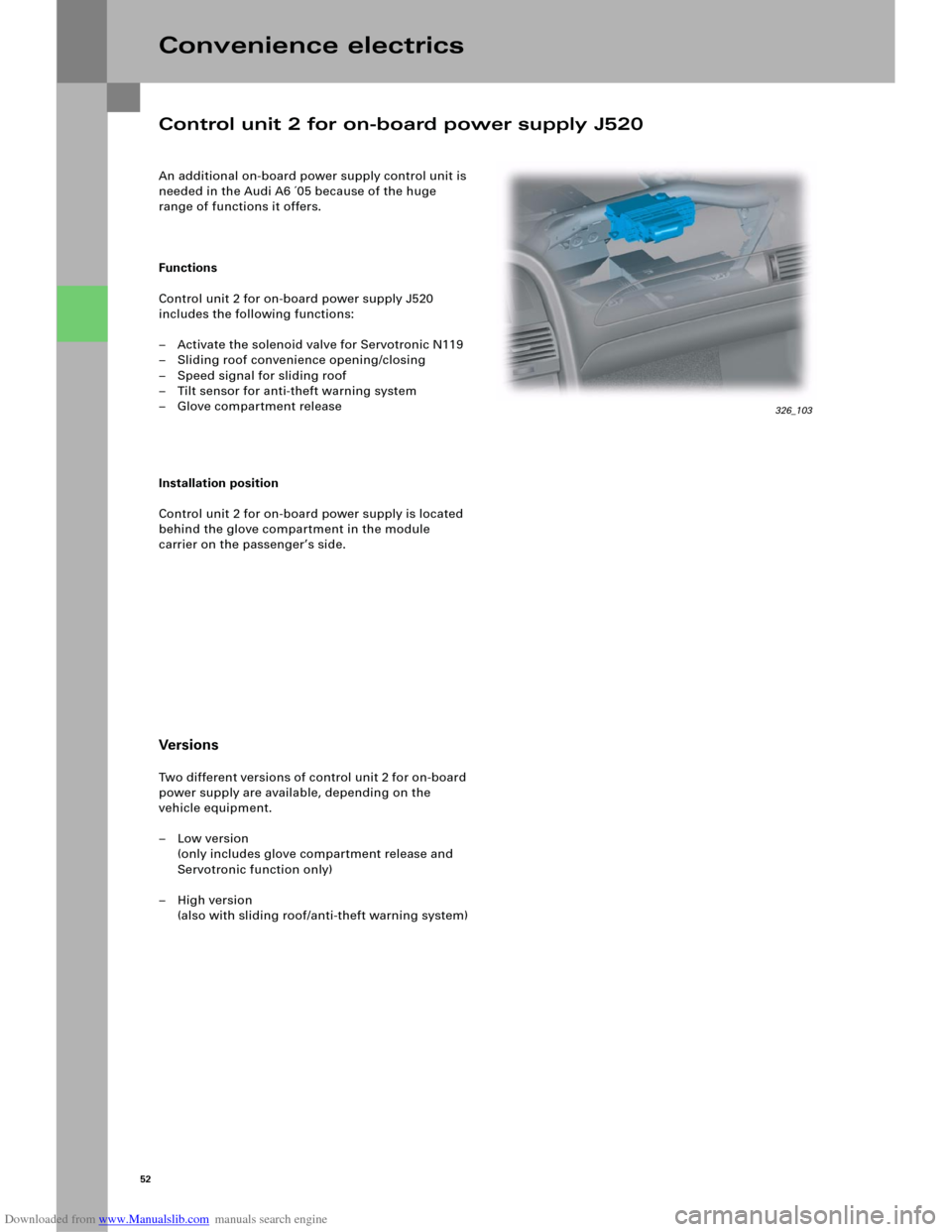
Installation position
Control unit 2 for on-board power supply is located
behind the glove compartment in the module
carrier on the passenger’s side.
Versi on s
Two different versions of control unit 2 for on-board
power supply are available, depending on the
vehicle equipment.
–Low version
(only includes glove compartment release and
Servotronic function only)
–High version
(also with sliding roof/anti-theft warning system)
Convenience electrics
Control unit 2 for on-board power supply J520
326_103
Page 51 of 92
Downloaded from www.Manualslib.com manuals search engine 53
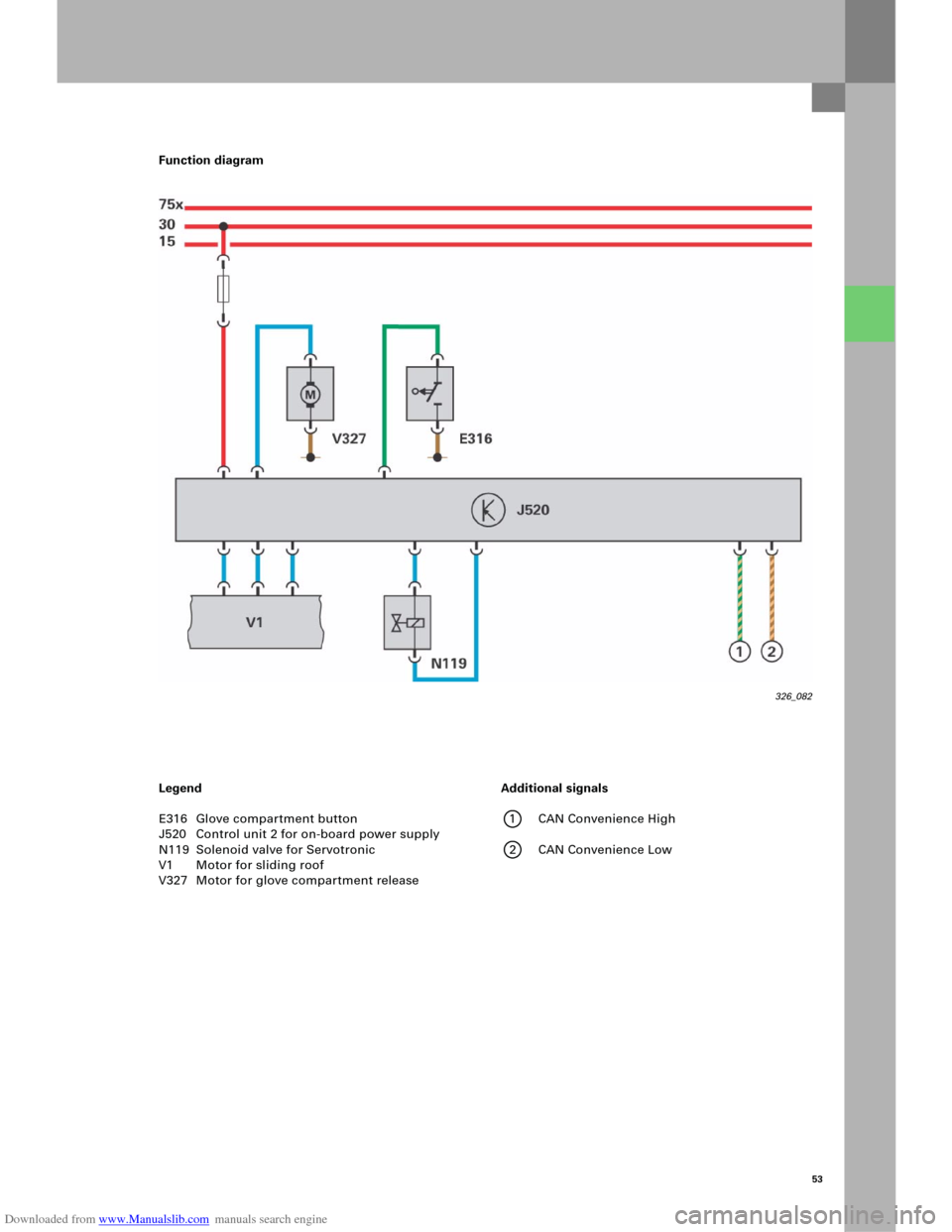
Function diagram
326_082
Legend
E316 Glove compartment button
J520 Control unit 2 for on-board power supply
N119 Solenoid valve for Servotronic
V1 Motor for sliding roof
V327 Motor for glove compartment releaseAdditional signals
1CAN Convenience High
2CAN Convenience Low
Page 52 of 92
Downloaded from www.Manualslib.com manuals search engine 54
The tilt sensor for the anti-theft warning system is
integrated directly in control unit 2 for on-board
power supply J520 in the new Audi A6 ‘05.
The fluid-filled sensor registers changes in the
vehicle tilt both transversely and longitudinally,
thereby preventing incorrect triggering as a result of
shaking through viscous fluid and electronic delay.
The current tilt values can be read out using
measured-value blocks.
Diagnosis
– Measured-value blocks
Measured-value blocks are available for the
following functions:
– Servotronic
– Sliding roof
– Tilt angle
–Actuator test
Checks can be carried out for the following
functions, depending on the version:
– Glove compartment release
– Servotronic valve
– Sliding roof activation (can be measured
using a multimeter on the on-board power
supply control unit, sliding roof does not
open, however, if it is not released by the
central control unit for the convenience
system)
–Coding
The High-Line version of control unit 2 for
on-board power supply J520 must be coded for
the following functions:
– Tilt sensor (with or without)
– Sliding roof (with or without)
Convenience electrics
Note
The tilt sensor function can be switched off
using a button in the driver’s door panel.
Reference
For further information on the tilt sensor
function, please refer to the SSP 254,
Audi A4 ‘01 – Technology.
Tilt sensor for anti-theft warning system
Page 54 of 92
Downloaded from www.Manualslib.com manuals search engine 56
326_121
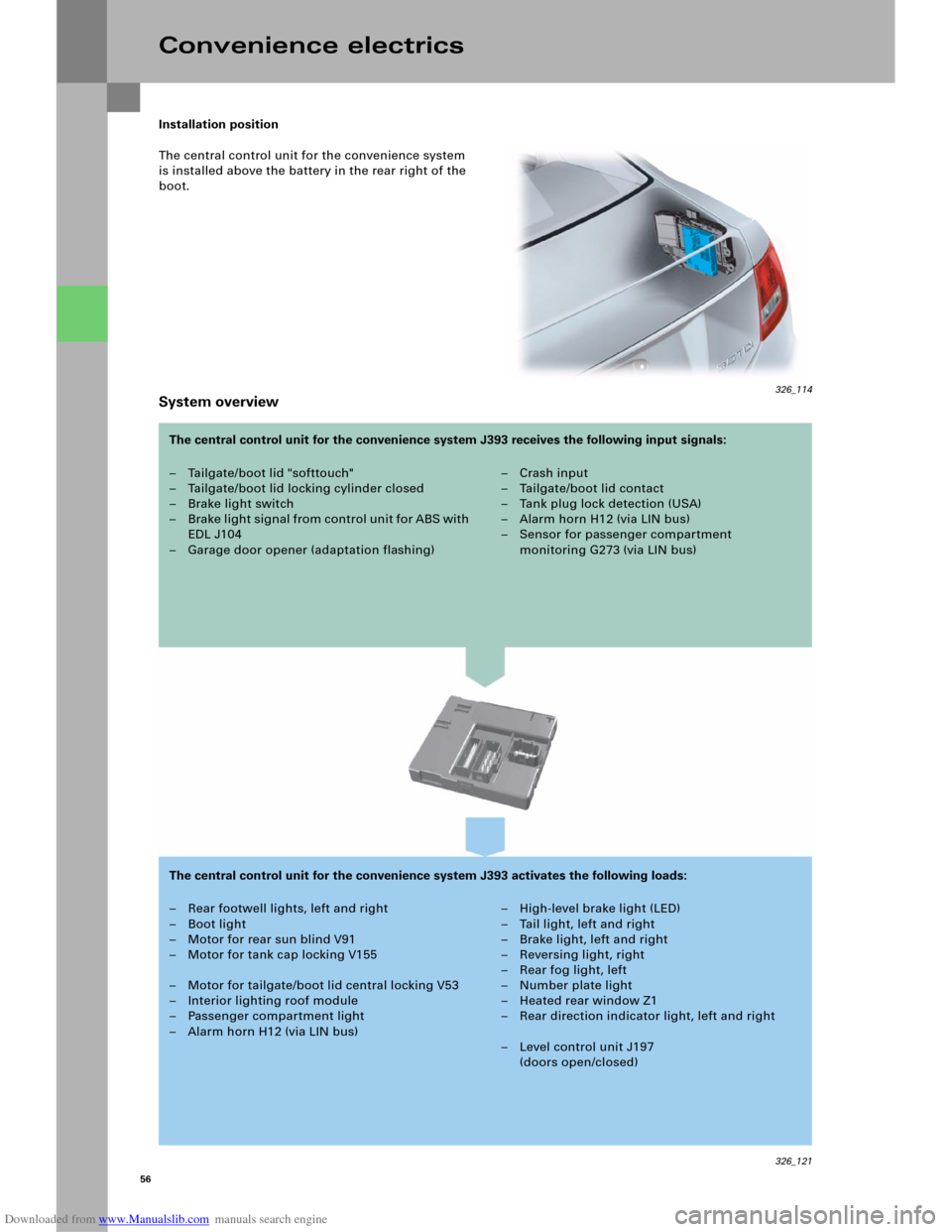
Installation position
The central control unit for the convenience system
is installed above the battery in the rear right of the
boot.
System overview
Convenience electrics
– Tailgate/boot lid "softtouch"
– Tailgate/boot lid locking cylinder closed
– Brake light switch
– B rake li ght signal from control u ni t fo r ABS with
EDL J104
– Garage door opener (adaptation flashing)– Crash input
– Tailgate/boot lid contact
–Tank plug lock detection (USA)
– Alarm horn H12 (via LIN bus)
– Sensor for passenger compartment
monitoring G273 (via LIN bus)
– Rear footwell lights, left and right
– Boot light
– Motor for rear sun blind V91
– Motor for tank cap locking V155
– Motor for tailgate/boot lid central locking V53
– Interior lighting roof module
– Passenger compartment light
– Alarm horn H12 (via LIN bus)– High-level brake light (LED)
– Tail light, left and right
–Brake light, left and right
– Reversing light, right
–Rear fog light, left
– Number plate light
– Heated rear window Z1
– Rear direction indicator light, left and right
– Level control unit J197
(doors open/closed) The central control unit for the convenience system J393 receives the following input signals:
The central control unit for the convenience system J393 activates the following loads:
326_114
Page 55 of 92

Downloaded from www.Manualslib.com manuals search engine 57
Interior lighting control
Standard equipment function
The standard function includes activating the inside
light in the roof lining, the front footwell lights, the
glove compartment light and the boot light.
The central control unit for the convenience
system J393 activates the inside light in the roof
lining, the boot light and the glove compartment
light directly via its own outputs and inputs. The
control unit for on-board power supply J519
activates the front footwell lights via CAN messages
from the central control unit for the convenience
system J393.
Additional equipment function (light package)
The light package additional equipment also
includes a door contour light in every door as well
as footwell lights (front and rear), which are based
on LED technology. The door contour lighting is
activated by the door control unit, which receives
the CAN messages for this from the central control
unit for the convenience system J393.
Page 57 of 92
Downloaded from www.Manualslib.com manuals search engine 59
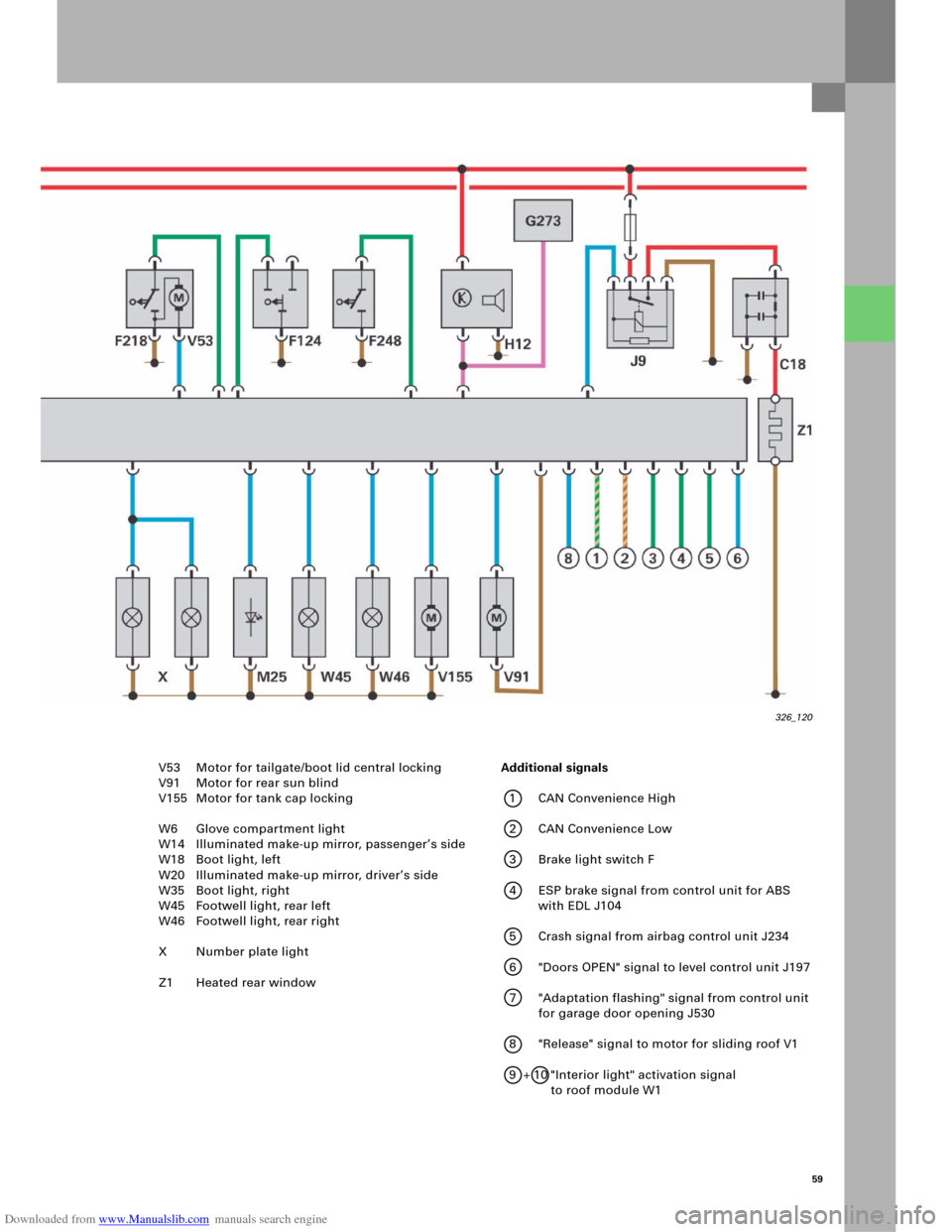
326_120
V53 Motor for tailgate/boot lid central locking
V91 Motor for rear sun blind
V155 Motor for tank cap locking
W6 Glove compartment light
W14 Illuminated make-up mirror, passenger’s side
W18 Boot light, left
W20 Illuminated make-up mirror, driver’s side
W35 Boot light, right
W45 Footwell light, rear left
W46 Footwell light, rear right
X Number plate light
Z1 Heated rear window Additional signals
1CAN Convenience High
2CAN Convenience Low
3 Brake light switch F
4 ESP brake signal from control unit for ABS
with EDL J104
5 Crash signal from airbag control unit J234
6 "Doors OPEN" signal to level control unit J197
7 "Adaptation flashing" signal from control unit
for garage door opening J530
8 "Release" signal to motor for sliding roof V1
9 + 10 "Interior light" activation signal
to roof module W1
Page 58 of 92
Downloaded from www.Manualslib.com manuals search engine 60
Diagnosis
The central control unit for convenience
system, J393, has the usual diagnostic functions,
such as read fault memory, read measured value
blocks, adaptation, coding, as well as selective and
sequential actuator test at its disposal.
Actuator test
The selective actuator test initiated by the diagnosis
tester can be used to check the following actuators:
– Indicator light for safe central locking K133
(in door rim)
– Lock central locking signal (once)
– Activate safe locking for doors (once)
– Unlock central locking signal
– Lock filler flap
– Unlock filler flap
– Lamp for left brake light M9
– Lamp for right brake light M10
– Lamp for high-level brake light M25
– Lamps for tail light, left
– Lamp for parking light, left M43
– Lamps for tail light, right
– Lamp for parking light, right M44
– Lamp for reversing light, left M16
– Lamp for reversing light, right M17
– Lamp for direction indicator light, rear left M6
– Lamp for direction indicator light, rear right M8
– Lamp for rear fog light, left L46
– Lamp for rear fog light, right L47
Coding
This diagnostic option can be used to perform
coding, for example, for these functions:
– Anti-theft warning system
– Central locking (normal/selective)
–Tilt sensor
– Passenger compartment sensor
– Convenience function via radio
–Right-hand traffic
–Avant detection
–Rear sun blind
Convenience electrics
Note
In addition to the selective actuator test,
the diagnosis software also includes the option
of a sequential actuator test.
– Number plate light X
– Boot light W3
– Footwell light, rear left W45
– Footwell light, rear right W46
– Activation of rear lid remote unlocking
(rotary latch opens, closing aid moves up)
– Motor for rear sun blind (rear sun blind moves in
both directions)
– Signal for rear window heater activation
–Interior lighting
– Acknowledgement of anti-theft warning system
horn
–RoW/USA
–Light package
– Tank cap lock detection
– Equipment (Basic/High-Line)
–Sliding roof
– Multi-function control unit (taxi/emergency
doctor/fire brigade, installed/not installed)
Page 73 of 92

Downloaded from www.Manualslib.com manuals search engine 75
Antenna systems
The antenna system in the new Audi A6 ´05 is
integrated as a module in the top area of the rear
window, to the left and next to the third brake light,
on the right.
The modules are responsible for the various
s y s t e m s, e . g . re m o t e c e n t ral lo ck i n g , rad i o , T V o r t h e
radio receiver for the auxiliary heater.
Only the modules that are required for the
requested optional extras are installed.The table shows the relevant modules for the
available vehicle equipment. These are indicated for
the various, worldwide country versions.
The modules "DAB" and "SDARS" relate to the digital
radio systems, which will be available later and are
based on either a satellite-controlled system
(SDARS) or a terrestrial system (DAB).
ModuleDesignationAvailable in market version
1
1
1
1
2
4
2
2
2
3
4
5
5
5
5
7
8Radio AM/FM
Radio AM/FM-Diversity
Radio AM/FM-Div/TV
Radio AM/FM-Div/TV
Remote central locking
Remote control for auxiliary heater
Remote locking/TV
Remote locking/TV/DAB
Remote central locking/TV
Navigation
Mobile phone-US
Te l e p h o n e E C E
Telephone (fixed or mobile)/Navigation
Telephone/Navigation
Satellite radio
Block circuit
Te l e p a s sECE
ECE/US
ECE/US
Japan
ECE/US
ECE
ECE/US
ECE
Japan
RoW
US
ECE
ECE
US
US
Italy
Installed antenna modules for possible vehicle equipment
Module 1
Module 3 Module 4Module 2 Module 5
Module 7Module 6
A
M
/F
M
-Di
v/
TV
1-2Third brake lightT
V3-
4
/R
emot
e
c
ent
ra
l
locking/R
C
/DA
B
326_125
Module 1: Radio/antenna amplifier R24
Module 2: Remote central locking/antenna amplifier 2 R111
Module 3: GPS/antenna for GPS navigation R50
Module 4: Mobile phone antenna USA/Antenna for telephone,
navigation, auxiliary heater R66Module 5: Roof antenna/antenna for radio, telephone,
navigation R52
Module 6: Block circuit
Module 7: Telepass antenna
Page 75 of 92

Downloaded from www.Manualslib.com manuals search engine 77
The control unit for front information J523 includes
an enhanced TP recording system in the Standard
Plus and Standard Navigation versions. This is a
programmable traffic programme recording
function, which is possible via the MMI operating
system.
Two different start times can be set. The traffic
broadcasts that are received are recorded for a
duration of 2 hours from the relevant start time.
This setting remains unchanged until the timer
function is switched off or the programmed times
are changed. A memory with a recording capacity of
8 minutes is available for the recording. When the
memory is full, the oldest messages are overwritten.
The CD-based navigation function is integrated as
an optional module in the display and operating
unit for front information J523.
If this equipment is installed, the vehicle comes with
the antenna module R50, the antenna for
GPS navigation in the top area of the rear window
(see Chapter Antenna systems). This antenna
delivers the GPS signal. If the mobile baseplate was
also requested, the vehicle has a roof antenna
(antena for radio, telephone, navigation R52), which
supplies the GSM and GPS signal. All other input
signals are only supplied by networking the relevant
control units. Playback of the stored messages can
also be controlled via the MMI. It is possible to
select here whether you want to play the entire
sequence or only one particular message.Functional features of the standard navigation
function:
– Position-finding through interactive destination
entry/selection
– Interactive journey planner/management with
stop-off destinations
– Selection of route options
– Route guidance (acoustic and optical via arrows
in display on dash panel insert J285)
– Dynamic route guidance via RDS TMC and online
data
– Audible navigation directions via digital sound
package control unit J525
– Storage and management of destinations
– Output of position data to the CAN bus
(e.g. for Audi telematics)
– Search for imported destinations from the
address book
Navigation input signals from the vehicle network:
Distance signal from control unit for ABS with
EDL J104, signal from reversing light switch
Output signals to the vehicle network:
GPS time including date, voice output to the
digital sound system control unit J525
Page 82 of 92
Downloaded from www.Manualslib.com manuals search engine 84
BOSE sound system
The new Audi A6 ´05 comes with a BOSE sound
system, which mainly comprises components from
the current Audi A8 ‘03. The division of the
subwoofer function into two individual subwoofers
integrated into the front doors means that the
well-known 7-channel DSP BOSE amplifier must
provide an additional output for the second
subwoofer driver in the front right-hand door. The
line-out output of the amplifier is used for this
purpose. This output signal feeds an external 100-
watt driver, which is integrated into the subwoofer
in the front right-hand door.
The current BOSE amplifier is replaced by a new
development with the launch of the Avant.
All eight drivers for the BOSE sound system are
then integrated into this new Avant amplifier.
Given this, it will be impor tant to note the exact par t
numbers and the related model year when replacing
components of the BOSE sound system in the
future, so that the functionality of the BOSE sound
system is not lost!
BOSE sound system diagnosis
Diagnosis of the BOSE sound system is also
performed using the address word 47 in the
VAS tester.
A basic setting is not required.
The available actuator tests can be performed either
selectively or sequentially.
The AudioPilot microphone, which is integrated into
the BOSE sound system, can be used to absorb
the acoustic pressure produced during the
loudspeaker actuator tests and output this on the
VAS diagnosis tester as a voltage signal.
If a voice operating system is installed, the
microphone for this is also included in the test.
The technician must then compare this voltage
reading with a default reading set at the factory and
evaluate the completed test as either OK or Not OK.
Infotainment
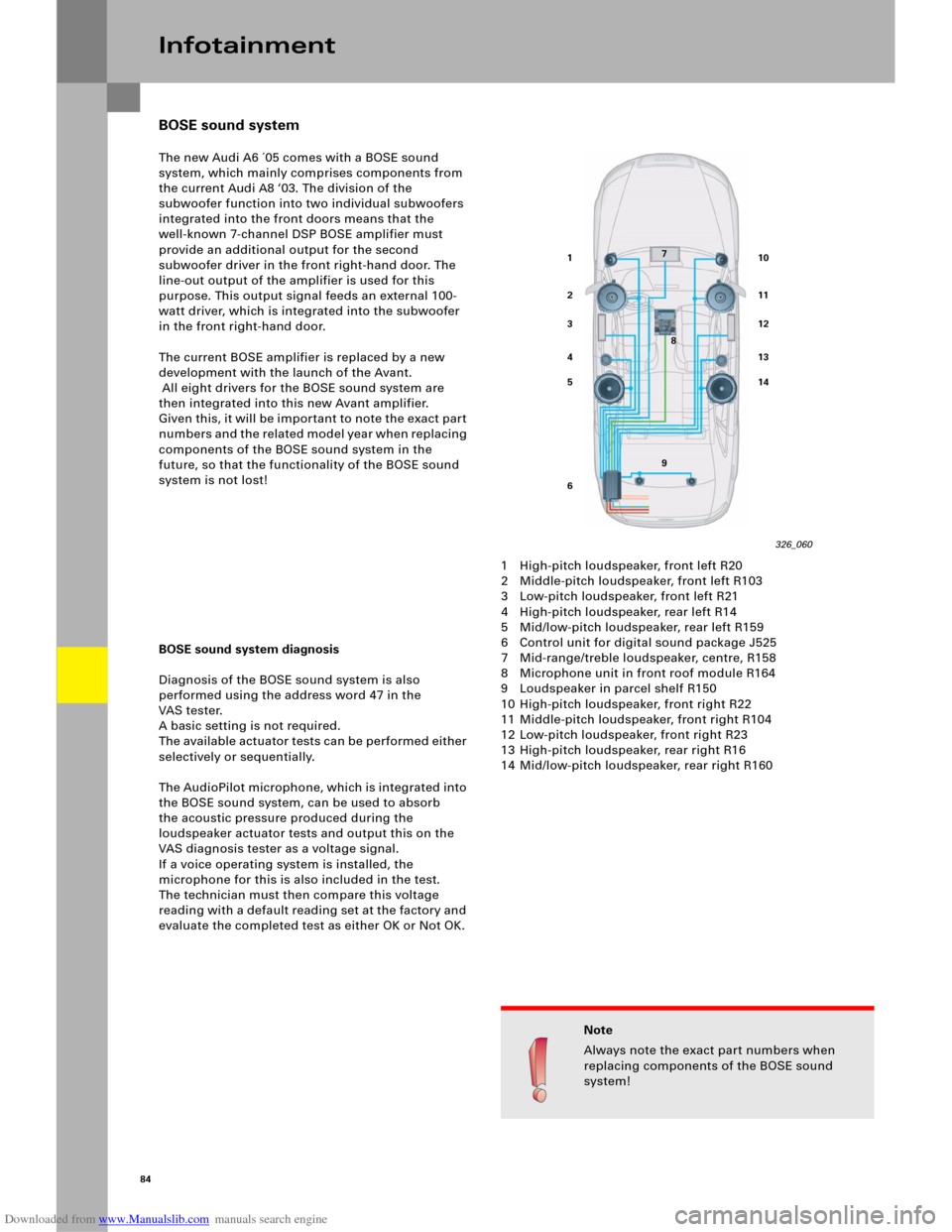
326_060
1 High-pitch loudspeaker, front left R20
2 Middle-pitch loudspeaker, front left R103
3 Low-pitch loudspeaker, front left R21
4 High-pitch loudspeaker, rear left R14
5 Mid/low-pitch loudspeaker, rear left R159
6 Control unit for digital sound package J525
7 Mid-range/treble loudspeaker, centre, R158
8 Microphone unit in front roof module R164
9 Loudspeaker in parcel shelf R150
10 High-pitch loudspeaker, front right R22
11 Middle-pitch loudspeaker, front right R104
12 Low-pitch loudspeaker, front right R23
13 High-pitch loudspeaker, rear right R16
14 Mid/low-pitch loudspeaker, rear right R160
5 4 3 17
2
98
614 13 12 10
11
Note
Always note the exact part numbers when
replacing components of the BOSE sound
system!