engine AUDI A6 2011 Owners Manual
[x] Cancel search | Manufacturer: AUDI, Model Year: 2011, Model line: A6, Model: AUDI A6 2011Pages: 370, PDF Size: 87.15 MB
Page 288 of 370
lffll __ C_h_ e_c _k _i_n -=g ,.,__ a_n_ d_ f_ i_ l _li _n _,g:,_ __________________________________________ _
Engine cooling system
Coolant
The engine coolant performs two functions: it keeps the
engine from o ve rheat ing and it prote cts the engine from
free zing in the winter .
The cooling system is sealed and genera lly requ ires little attention .
Th e cooling system has been fi lled a t the factory w it h a permanent
coo lant which does not need to be changed. The coolant consists of a
mixture of water and the man ufacturer's glycol-basedcoo lant add i
tive Gl2++ a ntifreeze with ant i corrosion additives (50% for USA
mode ls; 60% for Canadian mode ls). This mixture bot h assures the
necessary frost protec tion and p rotects metal components i n the
engine's cooling system from corrosion and scaling . It a lso ra ises the
boiling point of the coolant.
Do not reduce the concentration of the coolant in the summer by
adding p lai n water . The proport ion of coolant additive must be at
least 50 % but not more than 60 % to maintain ant ifreeze protection
and coo ling efficiency. If the coolant frost protect ion is too low, the
coo lant co uld freeze and damage the veh icle heating and eng ine
cooling system .
For year-ro und d riving, antifreeze is added at t he factory for temper
atures down to:
• - 31°F( -35°C)USA
• - 40 °F ( -40 °C) Canada .
You can mix the G12 ++ coo lant additive with other add it ives (G12 + or
G 12) . Always check with yo ur a utho rized Aud i dea ler .
& WARNING
Before you check anything in the engine compartment, always
read and heed all WARNINGS=>
& in "Working in the engine
compartment " on
page 279.
0 Note
• Before winter sets in, have the coolant checked to see if the
coo lant additive in you r vehicle is s ufficient to meet the climate
condi tions. This is especially important if you live in a region where
the winter is extreme ly cold. If necessary, increase the proport ion of
c oo lan t add it ive to 60%.
• When adding coolant additive to your cooling system, remember:
- We recommend using only coo lant add it ive G 12++ (check the
label) for your vehicle . This coolant additive is available at autho
r ized A ud i deale rs. Othe r ty pes of antifreeze can s ignifica ntly
reduce corrosion protection. The resulting corrosion can cause a
loss o f coolant and serious engine damage .
• Do not add any type of radiator leak sealant to you r vehicle's
eng ine coolant. Adding rad iator repair fl uid may adversely affect the
function and performa nce of your coo ling system and could resu lt in
d a mage not covered by your New Vehicle Limi ted W arranty. •
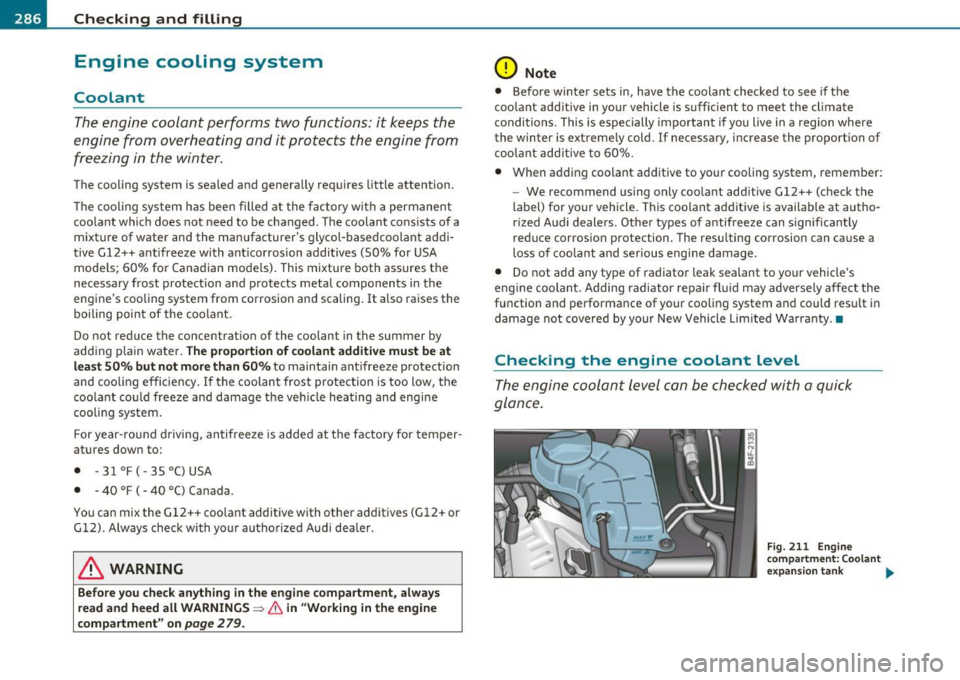
Checking the engine coolant level
The engine coolant level can be checked with a quick
glance .
Fig. 211 En gine
compa rtm ent : C oolant
ex pa nsio n tank ..
Page 289 of 370
___________________________________________ C_ h_e _c_ k_ i_ n -=g=-- a_ n_ d_ f_ i_ll _i_n -=g "-- _lffllll
Before you c hec k anythi ng in the engine compartment,
alwa ys r ead and heed all WARNINGS==> & in "Working in
the engine compartment" on
page 279.
- Turn off the ignition.
- Read the engine coolant level from the coolant expansion
tank==>
page 286, fig. 211. With a cold engine, the
coolant level should be between the "min" and "max"
markings . When the engine is wa rm, the level may be
sligh tly above the "max" marking .
The locat io n of the coolant expansion tank can be seen in the engine
compartment ill ustration ~
page 280.
To obta in an accurate reading, the engine must be sw itched off.
The expans ion tank in your vehicle is equ ipped with an electric coolant
level sensor .
When the coolan t level
is too low, the warn ing light i n th e Au to-Che ck
System ~
page 2 7 will blink until you add coo lant and the level has
bee n restored to normal. Even though the re is an elect ric coolan t
level sensor, we still recommend you check the coolant leve l from
time to time .
Coolant loss
Coolant loss may ind icate a leak in the cooling system. I n the even t of
coo lant loss, the cooling system should be inspected immed iately by
yo ur au tho rized A ud i dea le r.
It is not enough mere ly to add coolant.
In a
s ealed system, losses can occur only if the bo iling point of the
coo lant is exceeded as a resu lt of overheating .
0 Note
Do not add any type of radiator leak sealant to your vehicle's engine
coo lant. Add ing radiator repa ir fluid may adverse ly affect the func
tion and performance of your cooling system and could result in
damage not covered by your New Vehicle Limited Warra nty. •
Safety first
Adding coolant
Be very careful when adding engine coolant.
B efore you check a nything in t he engine compartment,
always read and heed all WARNINGS==> & in "Working in
the engine compartment" on
page 279.
- Turn off the engine.
- Let the engine cool down .
- Place a th ick rag over the coolant expansion tank
==>
page 286 , fig. 2 11 and carefully twist t he cap counter
clockw ise ==>& .
- Add coolant .
- Twist the cap on again
tightly .
Replacement eng ine coolant must conform to exact spec ifications
~ page 286, "Coolant". Even in an emergency, if coolant additive
G 12++, G12+ or G12 is not available, do
not use a different addi tive .
Use plain water instead until you can get the correct additive and can
restore the correc t ratio. This should be done as soon as possible.
If you have lost a considerable amount of coolant, then you should
add co ld antifreeze and cold water only when the eng ine is co ld .
Always use
new engine coo lant w hen refilling.
Do not fill coolant above the "MAX" mark. Excess coolant will be
forced ou t th rough the p ress ure relief v alve in the cap when the
engine becomes hot .
& WARNING
• The cooling sy stem i s under pres su re and can get very hot.
Reduc e the ri sk of scalding from hot coolant by following the se
steps.
-Tu rn off the engine and allow it to co ol down . _,.
Vehicle care Technical data
Page 290 of 370
___ C_ h_ e_c _k _i _ n _g ~ a_n _d_ f_il _l_in _ g _________________________________________ _
& WARNING (conti nu ed )
- Prote ct your face , hand s and arms from escaping fluid and
steam by covering the cap with a larg e, thick rag .
- Turn the cap slowly and ver y carefully in a counter-clockwise
direction while applying l ight, downward pre ssure on the top
of the cap.
- To avoid being burned, do not spill ant ifreeze or coolant on
the e xhaust system or hot engine parts. Under certain condi
tions, the ethylene glycol in engine coolant can catch fire .
• Antifreeze is poisonous. Always store antifreeze in its original
container and well out of the reach of children .
• If you drain the coolant, it mu st be caught and safely stored in
a proper container clearly marked "poison ".
0 Note
• Coolant pollutes the environme nt and could cause an eng ine fire.
Excess coo lant w ill be forced o ut throug h the pressure re lie f va lve in
the cap when the eng ine becomes hot .
• If , in an emergency, only wate r can be ad ded, the co rrect ratio
between water and antifreeze=.-
page 286 must be restored as soon
as possib le .
~ For the sake of the environment
Dra ined coolan t should no t be reused. A lways dispose of used coolant
w hile observ ing a ll enviro nmental regula tions .•
Radiator fan
The radiat or fa n sw itches on aut oma ticall y by itself .
The radiato r fa n is d rive n by t he eng ine v ia the V-bel t. T he viscous
cl utch regu lates the speed of t he fan according to the tempe rature of
the coolant . An auxiliary e
lectric rad iator fan* sw itches on and off depend ing o n
c oo lant tempe rature and other vehicle o per at ing condi tions.
After you sw itch the eng ine off, the aux iliary fa n can con tinue running
for up to 10 m inutes -even w it h the ignition off. It ca n even switch on
agai n later by itse lf ::::.- & , if
• the tempera ture of the engine coolant rises due to the heat build
up fro m the eng ine in the eng ine comp artme nt, or
• the engine compartment heats up because the vehicle is par ked in
in tense s unligh t.
& WARNING
• To reduce the risk of personal injury never touch the radiator
fan .
• The auxiliary electric fan is temperature controlled and can
switch on suddenly even when the engine is not running .
• The auxiliary radiator fan switches on automatically when the
engine coolant reaches a certain temperature and will continue to
run until the coolant temperature drops .•
Page 291 of 370

___________________________________________ C_ h _ e_c _k _ i_n -=g .._ a_n _ d_ f_i _ll _i _ n -=g '-- ........
Brake fluid
Checking brake fluid level
The b rake f lu id l eve l can be checke d wit h a qui ck g lanc e.
Fig . 212 E ngine
compartment : Br ake
fluid re se rv o ir
Before you c heck a nythi ng in the eng ine compartment ,
always read and heed all WARNINGS~ & in "Working in
the e ngi ne comp art ment" on
page 279.
- Read t he bra ke flu id level from the bra ke fluid reservoir
~ page 289, fig . 212. The brake flu id level must be
between the " MIN" and " MAX" mar kings.
The brake fluid reservoir is locate d at the rear pa rtition of the engine
compartmen t on the left s ide=>
page 280 .
The f luid leve l may drop slightly after some time d ue to the auto
m atic a dju stment of t he b rake pads. This is not c ause for ala rm.
If the brake flu id level falls
considerably be low the "M IN" mark, the
brake warni ng/ind icator light (U .S. models :
BRAKE, Canadia n mo dels:
(0) ) will come on=> page 18 and=> page 26. Do not continue to
operate t he vehicle. The complete brake system sho uld be thoroug hly
chec ked by an au thor ized A ud i d eale r or othe r qualified fac ility and
the cause corrected.
If the brake fluid level is too low, the brake
Vehicle OP-eration
warning/ind icator light will illum inate . Contact an au thoriz ed Aud i
de aler
immediately .•
Changing brake fluid
H av e the b rake fluid chang ed by an expe rie nc ed t echni
CJ an.
B ra ke flui d abso rb s moi stur e from the air. If the wa te r c on ten t in t he
brake fl uid is too high, corros ion in the b rake system may res ult after
a pe riod of time. The boili ng po int of the brak e flu id will also decrea se
co nsiderab ly and decrease brak ing perfo rmance.
Th erefore, the brake f lui d m ust be c hanged
every two years . Always
use new brake fluid w hich conforms to Fede ral Motor Veh icle Stan
dard "F MVSS 1 16 DOT 4" .
Th e br ake f luid reserv oir can be diffi cult to rea ch, there fore, we
recommend that you have the brake fluid changed by your authori zed
Audi dealer . Your deal er h as th e correc t tools, the rig ht bra ke flui d
and the know-how to do th is for you.
& WARNING
• Brake fluid is poisonous. It must be stored only in the closed
original container out of the rea ch of children!
• Brake
failure can result from old or inappropriate brake fluid .
Observe these precaution s:
- Use only b rake fluid that meets SAE specification
J 1703 and
conforms to Federa l Motor Vehicle Standard 116. Alway s check
with you r authorized Audi dealer to make sure you are using
the correct brake fluid. The corre ct type of brake fluid is also
indicated on the brake fluid rese rvoir.
- The brake fluid must be new . Heavy use of the brakes can
c ause a vapor lo ck if the brake fluid is left in the system too
long . Thi s can seriously affect the efficiency of the brakes as
well as your safety. This could result in an accident .
~
Vehicle care Do-it-yourselt service Technical data
Page 292 of 370
-L~C~ h~ e~c ~k :..!_i ~ n ~g ~ a~n ~d~ f~il ~l~in ~ g[_ ________________________________________ _
0 Note
Brake fluid will damage the paint of your vehicle.
the special tools required and the necessary expertise, we recom
mend that you have the brake fluid changed by your authorized Audi
dealer. •
Battery
General information
Under normal operating condit ions, the battery in your Aud i does not
need any maintenance. With
high outside temperatures or long daily
drives we recommend that you have the electrolyte level checked by
a service facility. The electrolyte level should also be checked each
time the battery is charged~
page 292.
Have the battery checked when you take your vehicle in for service.
You are well advised to replace a battery that is older than 5 years.
With certain types of a irbag deployment, the battery is disconnected
from the vehicle electrical system for safety reasons=>
& in "Repair,
care and disposal of the airbags" on
page 211.
Disconnecting the battery terminals
Some vehicle functions (power window regulators, for example) are
lost if the battery terminals are disconnected. These functions have
to be relearned after the battery terminals are connected aga in. To
prevent this, the battery should only be disconnected from the
vehicle electrical system when absolutely necessary for repairs.
Vehicles not driven for long periods
If you do not drive your veh icle over a period of severa l days or weeks,
electrical components are gradually cut back or switched off. This
reduces energy consumption and maintains starting capability over a
longer period~
page 249.
Take into consideration that when you unlock your vehicle, some
convenience functions, such as the master key remote function or
power seat adjustment, may not be available. The convenience func
tions will be available again when you turn on the ign ition and start
the engine.
Winter operation
During the winter months, battery capacity tends to decrease as
temperatures drop. This is because more power is also consumed
while starting, and the headlights, rear window defogger, etc., are used more often .
Avoid unnecessary power consumpt ion, particu larly in city traffic or
when traveling only short distances. Let your authorized Audi dealer
check the capacity of the vehicle battery before w inter sets in
=> page 292. A well charged battery will not only prevent starting
problems when the weather is cold, but will also last longe r.
(I] Tips
If your veh icle is left standing for several weeks at extreme ly low
temperatures, the vehicle battery should be removed and stored
where it will not freeze. This will prevent it from being damaged and
having to be replaced.•
Page 294 of 370
--~C:!h ~e~ c~ k~ i~ n ~g~ a~n~ d~ f~il ~l~in ~ g ~ ----------------------------------------
& WARN ING (con tinu ed)
• When working on the batter y, be su re not to short-ci rcuit the
terminal s with tools or other metal object s. This would cau se the
battery to heat up very quickly , which could lead to damage or
e xplo sion and per sonal injury .
• When a battery is charged , it produces hydrogen gas which i s
explo sive and could cau se p ersonal injury .
• Alway s keep the battery well out of the reach of children .
• Before work is done on the electric al system, di sconnect the
negative ground cable.
• Before perfo rming any work on the electrical system , switch
off the engine and ignition a s well as any electrical equipment .
The negative cable on the battery mu st be disconnected. If you are
just g oing to replace a light bulb, then it is enough to switch off
the l ights.
• Before dis conne cting the battery, swit ch off the anti -theft
ala rm system! Otherwise you w ill set off the alarm .
• When d is connecting the battery, first di sconnect the negative
cable and then the positive cable .
• Before reconnecting the battery, make sure all electrical
consumers are switched off. Reconnect the positive cable first and
then the negative cabl e. Never interchange th e cables· this could
start a fire!
• Never charge a frozen or a thawed-out battery . It could
e xplode! If a battery has frozen , then it must be replaced. A
dis charged battery can freeze over at 32 °F (0 °C ).
• Make sure the vent ho se is always atta ched to the opening on
the side of the battery .
• Never use batteries which are damaged. There is the danger of
an e xplosion! Always replace a damaged battery.
& WARNING
California Proposition 65 Warning:
• Battery posts , terminal s and r elated ac cessorie s cont ain lead
and lead compounds, chemi cals known to the State of Cal ifornia
to cause cancer and reproductive problem s. Wash hands after
handling.
0 Note
• Do not disco nnect the vehicle battery when the ign ition is
switched on or whe n the engine is runni ng, otherwise, you wi ll
damage electronic compone nts in the electr ical system .
• If you r ve hicl e is go ing to s ta nd for a long pe riod of time wit ho ut
being driven, protect the battery from "freezi ng", ot herwise it w ill be
damaged and will then have to be replaced .•
Battery charging
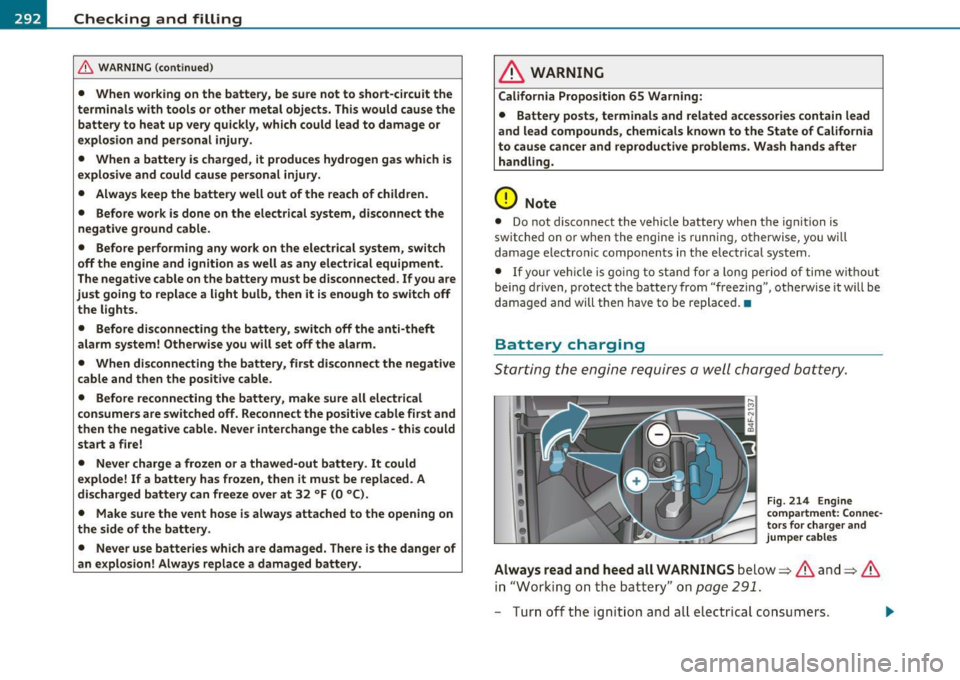
Starting the engine requires a well charged battery.
Fi g. 2 14 Engin e
c omp artm ent : Connec
to rs for charger an d
jumper cables
Always read and heed all WARNINGS be lo w => & and => &
in "Work ing o n the bat tery" on pag e 291.
- Turn o ff the ign it ion and all electrical consumers. ~
Page 295 of 370

___________________________________________ C_ h_e _c _k_ i_n ~g_ a_n_ d_ f_ i_ll _i_n _g __ _
- Mak e su re the a rea is w ell ventilated when you charge the
battery .
- Open the hood~
page 2 78.
- Open the red cover on the positive pole~ fig. 214.
- Connect the charger connectors according to the instruc- tions to the
jump start bolts . (Bolts under the red cover =
"positive", Bolts wit h hex head = "negative").
- Only now p lug the ma ins lead for the charging equipment
into the wall outlet and turn it on
~ &,. .
- Make sure the charging rate is not over 30 amps /14.8
Volt.
- When the batte ry is fully charged : Turn the charging
equipment off and remov e the ma ins lead from the wall
ou tlet.
- Now remove the clamps for the charging equipment .
- Close the red cover on the posit ive pole .
- Clos e the hood ~
page 279.
A discharged battery can freeze at tempe rat ures of only O 0C. Allow a
frozen battery to thaw completely before attemp ting to charge it
~ ,&. . However, we recommend not using a thawed battery again
because the battery casing can be cracked due to ice formation and
can leak battery acid.
B atter y charging (Ma ximum charging rate of 30
amps /14.8 Volt )
When charging at low voltages (e.g. w ith a trickle charger ), the
ba ttery cab les do not have to be disconnec ted first. The battery caps
should
not be opened when charging a battery .
It is not necessary to remove the battery from the luggage compart
ment.
Safety first
Fa st charging the b atter y (charging rat e above 14 .8
Volts)
For technical reasons do not use a batte ry c ha rger that uses voltage
greater t han 14.8 Volts to charge your veh icle's battery .
& WARNING
Charging a batter y can be dange rou s.
• Always follow the ope rating instruct ions p ro vi ded by the
batt ery c harger manufa cturer when charging your battery .
• Never cha rge a frozen battery. It ma y explode be cause of gas
trapped in the i ce. Allow a frozen battery to thaw out first.
• Do not reu se batter ies which were frozen. The battery housing
may have cracked and weakened when the batt ery froze.
• Charge the battery in a well ventilated are a. Keep a way from
open flame or el ectr ica l spark. Do not sm oke. Hydrogen gas gener
ated by the battery i s ex plosive.
• To r educ e th e danger of e xplosion , nev er conn ect or dis conne ct
c harger cable s while the charger i s operating.
• Batt ery acid that may spill during charging should b e washed
off with a solution of warm water and bakin g soda to neutralize
the acid .
0 Note
Never use a fast charger as a booster to start the engine . This will seri
ous ly damage sensitive electronic components , such as control units,
re lays, rad io, etc., as well as the battery charger. •
Vehicle care Technical data
Page 296 of 370
___ C_h_ e_c _k _i_n -=g :a,__ a_n_ d_ f_ i_ l _li _n _,g;._ __________________________________________ _
Battery replacement
The new battery must have the same specifications and
dimensions as the original equipment battery.
Inte lligent energy management in your veh icle is responsible for
dis trib uti ng the elect ric al ene rgy throughout yo ur vehi cle
::} page 249. The intelligent energy management system will keep
t he e ngine battery charged be tter then vehicles withou t this system.
To make sure the additional e lectrical energy is available once again
after you have changed the ba tte ry, we recom mend that you in sta ll
batter ies of the same type and manufacture only (the same as those
installed at the t ime your vehicle was delivered). Specifications are
listed on the battery hous ing. You r authorized dealer must code the
battery in t he energy ma nageme nt system to enab le yo u to use the
energy management functions corre ct ly aft er replac ing the battery.
If it is not poss ible to use a battery of this type, the new battery must
have the same capacity, vo ltage ( 12 volts), ampe rage, co nstr uction
and plug sea ling.
When install ing the battery, make sure the ign it ion and a ll electrica l
c ons umers are tur ned off.
0 Note
Make s ure the ventilation hose on the sid e of the battery is
connected, otherwise fumes or battery acid ca n leak o ut.
<£> For the sake of the environment
Beca use of the problem of proper disposal of a battery, we recom
me nd your authorized Audi de aler change the ba ttery for you.
Batte ries contain sulfuric acid and lead and must always be d isposed
o f prope rly in com pliance wi th all environmen tal regula tions.
Disposing of vehicle batteries imprope rly is very dangerous to the
envi ro n ment .•
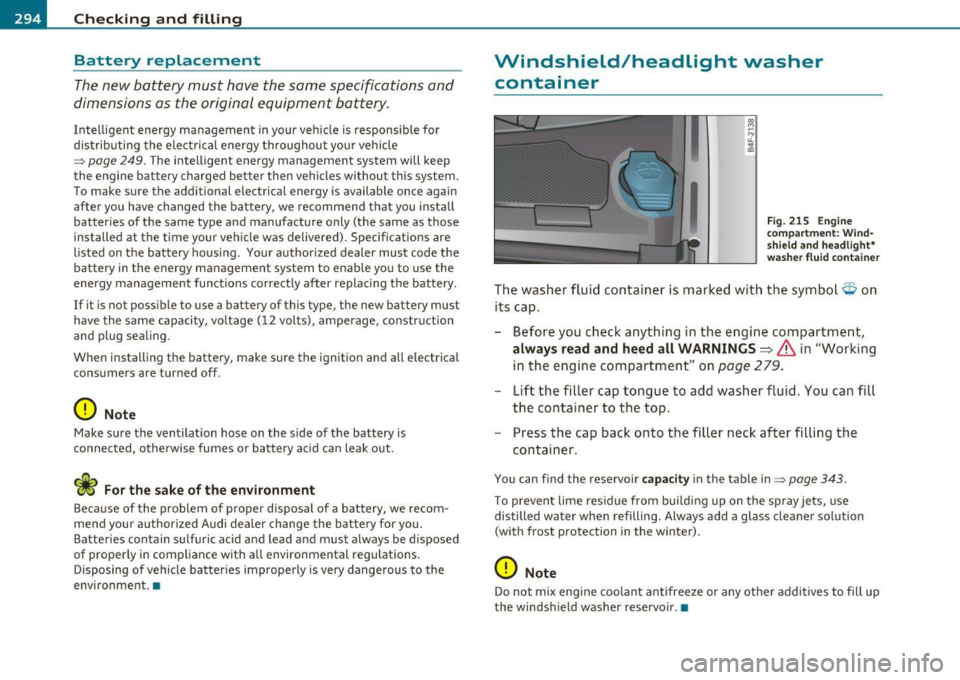
Windshield/headlight washer
container
Fig. 215 En gine
compartm ent: Wind
s hie ld and head lig ht *
w as her flu id co ntainer
Th e washe r fluid contain er is mark ed with the symb ol O on
its cap .
- Bef ore you check anything i n th e engin e compartm ent,
always read and heed all WARNINGS~ & in "Working
in th e e ngine com partme nt" on
page 279 .
-Lift t he filler cap tongue to add washe r fluid. You can fill
the conta iner to the top.
- Press the cap bac k onto the f iller neck af ter filling the
container .
You can find the reservoir capacity in the table in::} page 343.
To preven t lime res idue from bui ldi ng up on t he spray jets, use
distilled water when refilling. Always add a glass cleane r so lution
(with frost protection in t he winter).
0 Note
Do not mix engine coo lant antifreeze or any othe r additives to fi ll up
the windsh ield washe r rese rvo ir .•
Page 302 of 370
-~_T_ i_ re _ s_ a_n _ d_ w_ h _e_ e_ ls _________________________________________________ _
If you wish to improve comfort when operating the vehicle at
normal load (up to 3 o ccupants ), you can adjust tire pre ssures to
those specified for normal vehicle load . Before operating the
vehicle at maximum load, you must inc rease the tire pressures to
those specified for maximum vehicle load
=> & .
Bear in mind that the tire press ure monitoring system* can on ly
m oni tor the tire pressu res you have sto red . The system does no t
recogn ize the load condit ion of your vehicle.
T he effectiveness of the tire pressure monitoring system * w ill be
impaired if you store norma l load p ressu res b ut the n operate th e
vehicle at its maxim um loa d=> & .
Tire designation
See the illustration=> fig. 216 for the locat ion of the labe l on dr iver's
side B-p illar (colo r of the actu al labe l and ex act loc ation o n the
veh icle will vary slight ly) .
N ote that the following tab le is accurate at the time of going to press
and i s su bje ct to change. I n the even t of discrepancie s, t he tire pres
sure label is located on the driver's side B-pillar always takes prece
de nce.
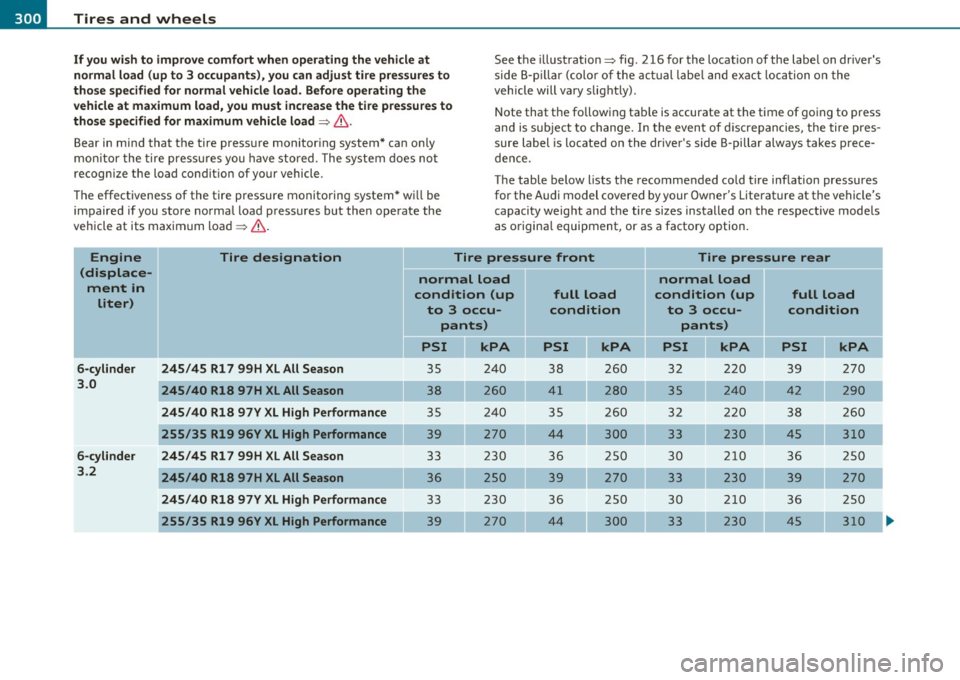
The table below lists the recommended co ld tire inf lation pressures
fo r the Audi mode l covered by your Owner 's Literat ure at the vehicle's
capacity weight and t he tire sizes installed on the respective mode ls
as o rigina l equipment, or as a factory option.
Tire pressure front Tire pressure rear
Engine
(displace
ment in liter) normal load
normal load
6-cylinder
3.0
6-cylinder
3 .2
245 /45 Rl 7 99H XL All Season
245 /40 R18 97H XL All Season
245/40 R18 97Y XL High Performance
255 /35 R19 96Y XL High Performance
245/ 45 Rl 7 99 H XL All Season
245 /40 R18 97H XL All Season
245 /40 R18 97Y XL High Performance
255 /35 R19 96Y XL High Performance
condition (up
to 3 occu- pants)
PSI
35
38
3 5 24 0
39 270
33 230
36
33
39
full load
condition
PSI kPA
38 260
41 280
3 5 260
44 300
36 250
39 270
36 250
44 300
condition (up
full load
to 3 occu- condition
pants)
PSI kPA kPA
32 220 270
35 240 42
290
3 2 220 38 260
33 230 45 310
30 210 36 250
33 230 39 270
30 210 36 250
33 230 45
310
Page 303 of 370

__________________________________________________ T_i_ r _e _s_ a_ n_ d_ w_ h_e_ e _ l_s __ _
Engine Tire designation Tire pressure front II Tire pressure rear
(displace- normal load normal load
ment
in
liter) condition (up full load condition (up full load
to 3 occu-condition to 3 occu- condition
pants) pants)
PSI II kPA PSI II kPA II PSI ll kPA PSI II kPA
a-cylinder 245/45 Rl 7 99H X L All Season 36 250 39 270 33 230 39 270
4
.2
245/40 R18 97H XL All Season 39 270 42 29 0 35 2 40 42 290
245 /40 R18 97Y XL High Performance 36 250
39 270
33 230
39 270
255
/35 R19 96Y XL High Performance 39 4 4 300 33 230 45 310
XL = reinf orced or extr a load t ire. It m ay a lso ap pear a s xl, EXTRA LOAD , or RF on the tire sidewa ll.
The correct tir e press ure for th e
spare wh eel is l ocat ed on a labe l on
the driver 's s ide B-pillar.
B eca u se technical c hanges may be ma de to vehicle e quipment dur ing
the model year, always compare the tire s ize des ignation on the tire
pressu re la b el on yo ur vehicle with the t ires on your veh icle. Make
sure that the tire size in forma tion on the vehicle labe l is the same as
the s ize of the t ires on the vehicle. This is especially important i f the
vehicle belongs to someone else or you bought the vehicle with
different r ims/tires or you bought the vehicle as a previously owned
vehicle. that the vehicle can carry.
For the loc atio n of t he ti re p ressure label
~ page 299, fig. 216 .
_& WARNING
Overloading a vehicle can cause loss of vehicle control , a cra sh or
other accident, serious personal injury, and even death .
• Carrying more weight than your vehicle wa s de signed to carr y
will prevent the veh icle from handling properly and increase the
risk of a los s of vehicle control.
• The brakes on a vehicle that has been overloaded may not be
able to stop the vehicle within a safe di stan ce.
• Tires on a vehicle that has been overloaded can fail suddenly
c ausing lo ss of control and a crash .
• Always make sure that the total load being transported -
including the weight of a trailer hitch and the tongue weight of a
loaded trailer -does not make the vehicle heavier than the
I
I
Remember, your safety and that of your passengers also depends on
m aki ng sure th at lo ad lim its are no t ex ceeded. Vehicle lo ad includes
everybody and everything in and on the veh icle. These load limits are
t echnically re fer red to as t he ve hicle's G ross Vehicle Weig ht Ra ting
("GVWR") . The Gross Axle Weight Rat ing ("GA WR") is the max imum
load that can be applied at each of the veh icle's two ax les. The Gross
Vehicle Weight Rat ing and the G ross Ax le We ight Ra ting are listed on
the safety comp liance sticke r label located on the driver's side B
pillar. The tire p re ssur e label on your Audi lists the maxim um
combined weight of a ll of th e occ upants and luggage or other cargo
vehicle 's Gros s Vehicle Weight Rating. ._
Safety first Vehicle care Technical data