ignition AUDI A6 2011 Owners Manual
[x] Cancel search | Manufacturer: AUDI, Model Year: 2011, Model line: A6, Model: AUDI A6 2011Pages: 370, PDF Size: 87.15 MB
Page 278 of 370
Fuel supply and filling your fuel tank
in. WARNING
Improper refu eling or handling of fuel can cause fire , explosion
and sev ere burns .
• Fuel is highly flammable and can cause seve re burns and other
injuries .
• Failure to shut the engine off while refueling and /or to inse rt
the pump nozzle fully into the fuel fill er n eck could cau se fuel to
spray out of filler neck or to overflow. Fuel sp ray and overflowing
fue l can cau se a fire.
• Never u se a cellula r telephone while refueling. The electromag
netic radiation can cau se spark s that can ign ite fuel vapor s and
cause a fire.
• Never get back into your vehicle while refue ling . If in ex cep
tional circumstances you must get back in your veh icle while refu
eling , make certain that you clo se th e door and touch metal to
discharge static electricity before touching the filler nozzle again .
Static electricity can cause sparks that can ignite fuel vapors
released during refueling.
• N ever smoke or have an open flame anywhere in or near your
vehicle when refueling or filling a portable fuel containe r.
• For your safety, we strongly recommend that you do not travel
with a portable fuel container in your vehicle. The containe r, full
or empty may leak and could cau se a fire, especially in a crash .
• If, under except ional circumstances , you must t ranspo rt a
portable fuel container, please ob serve the following:
- Never fill a portable fuel container while it is anywhere in or
on the vehicle (for example, in the luggage compartment, or
on the trunk ). Static electricity can bu ild up while filling and
can ignite fuel vapors causing a fire .
- Alway s place a portable fuel container on the ground before
fill ing.
- Alway s keep the filler nozzle completely inside the portable
container before and during fill ing.
& WARNING (c on tinued )
-If filling a portable container made of metal , the filler nozzle
must alway s be in contact with the container. This will help
prevent static electricity from dis charging and cause a fire .
- Never spill fuel inside the vehicle or luggage compartment .
Fuel vapor s are highly flammable.
- Always observe local and state /provincial laws regarding the
use , storage and transportation of fuel containers .
-Make certain the fuel container meets industry standards
(ANSI / ASTM F852-86).
0 Note
If any fuel has spilled onto the ca r, it should be remove d immed iate ly
t o prevent damage to t he pa int.
For the sake of the environment
As soo n as t he correct ly operated nozz le switches off automatically
for the first time, the tank is full. Do not try to add more fue l because
fue l may spill out . In addition, the expansion s pace in the fuel tank
w ill b e filled -causing the fue l to overflow when it becomes warm an d
poll ute the e nvironment .
(I] Tips
• Runn ing your e ngine while ref uellin g may cause vapo rs to escape
or even cause fuel to spill out of the tank . This wou ld then shut off the
fue l nozzle before the tank is f ull.
• Do not refuel your vehicle with the ignition turned on. The fuel
gauge may o therwise not ind icate the correc t fu el leve l after
refuell ing .•
Page 281 of 370

___________________________________________ C..:...._ h:....:e :....:c:..:. k.::..: i..:.. n .:..:g:!:....:: a....:. n..:.. d~ f:....:. i.:..ll :.:.i:....:n :.:g !....- __
Closing the engine hood
- Pull the hood down until the pressure from the struts is
reduced.
- Let the hood
drop down and latch in place. Do not try to
push it shut;
it may fail to engage=:> &.
& WARNING
A hood that is not completely latched could fly up and block your
view while driving.
• When you close the engine hood, check it to make sure the
safety catch has properly engaged. The hood should be flush with
the surrounding vehicle body parts.
• If you notice while driving that the hood is not secured prop
erly, stop at once and close it. •
Working in the engine compartment
Be especially careful whenever you work in the engine
compartment.
Whenever you must perform any work in the engine compartment,
for example checking and filling different fluids, there is a risk of injury, burns and accidents. To prevent personal injury always
observe the following WARNINGS. The engine compartment of any
vehicle is a hazardous area=>& .
& WARNING
To help avoid injury, before you check anything under the hood:
• Turn off the engine.
• Remove the ignition key.
• Apply the parking brake.
Safety first
& WARNING (continued)
• Move selector lever to "P" (Park).
• Always let the engine cool down. Hot components will burn
skin on contact.
• To reduce the risk of being burned, never open the hood if you
see or hear steam or coolant escaping from the engine compart
ment. Wait until no steam or coolant can be seen or heard before
carefully opening the hood.
• Keep children away from the engine compartment.
• Never spill fluids on hot engine components. They can cause a
fire. • Never touch the radiator fan. The auxiliary electric fan is
temperature controlled and can switch on suddenly.
• Never open the coolant reservoir cap when the engine is still
warm. The coolant system is pressurized and hot coolant could
spray out.
• Protect your face, hands and arm from steam or hot engine
coolant by placing a thick rag over the cap when you open the
coolant reservoir.
• If work on the fuel system or the electrical system is necessary:
- Always disconnect the battery.
- Never smoke or work near heaters or open flames. Fluids in
the engine compartment could start a fire.
- Keep an approved fire extinguisher immediately available.
• To avoid electrical shock and personal injury while the engine is
running or being started, never touch:
-Ignition cables
- Other components of the high voltage electronic ignition
system.
• If you must perform a check or repair with the engine running:
- First, fully apply the parking brake, move selector lever to
"P" (Park). .,
Vehicle care Technical data
Page 289 of 370
___________________________________________ C_ h_e _c_ k_ i_ n -=g=-- a_ n_ d_ f_ i_ll _i_n -=g "-- _lffllll
Before you c hec k anythi ng in the engine compartment,
alwa ys r ead and heed all WARNINGS==> & in "Working in
the engine compartment" on
page 279.
- Turn off the ignition.
- Read the engine coolant level from the coolant expansion
tank==>
page 286, fig. 211. With a cold engine, the
coolant level should be between the "min" and "max"
markings . When the engine is wa rm, the level may be
sligh tly above the "max" marking .
The locat io n of the coolant expansion tank can be seen in the engine
compartment ill ustration ~
page 280.
To obta in an accurate reading, the engine must be sw itched off.
The expans ion tank in your vehicle is equ ipped with an electric coolant
level sensor .
When the coolan t level
is too low, the warn ing light i n th e Au to-Che ck
System ~
page 2 7 will blink until you add coo lant and the level has
bee n restored to normal. Even though the re is an elect ric coolan t
level sensor, we still recommend you check the coolant leve l from
time to time .
Coolant loss
Coolant loss may ind icate a leak in the cooling system. I n the even t of
coo lant loss, the cooling system should be inspected immed iately by
yo ur au tho rized A ud i dea le r.
It is not enough mere ly to add coolant.
In a
s ealed system, losses can occur only if the bo iling point of the
coo lant is exceeded as a resu lt of overheating .
0 Note
Do not add any type of radiator leak sealant to your vehicle's engine
coo lant. Add ing radiator repa ir fluid may adverse ly affect the func
tion and performance of your cooling system and could result in
damage not covered by your New Vehicle Limited Warra nty. •
Safety first
Adding coolant
Be very careful when adding engine coolant.
B efore you check a nything in t he engine compartment,
always read and heed all WARNINGS==> & in "Working in
the engine compartment" on
page 279.
- Turn off the engine.
- Let the engine cool down .
- Place a th ick rag over the coolant expansion tank
==>
page 286 , fig. 2 11 and carefully twist t he cap counter
clockw ise ==>& .
- Add coolant .
- Twist the cap on again
tightly .
Replacement eng ine coolant must conform to exact spec ifications
~ page 286, "Coolant". Even in an emergency, if coolant additive
G 12++, G12+ or G12 is not available, do
not use a different addi tive .
Use plain water instead until you can get the correct additive and can
restore the correc t ratio. This should be done as soon as possible.
If you have lost a considerable amount of coolant, then you should
add co ld antifreeze and cold water only when the eng ine is co ld .
Always use
new engine coo lant w hen refilling.
Do not fill coolant above the "MAX" mark. Excess coolant will be
forced ou t th rough the p ress ure relief v alve in the cap when the
engine becomes hot .
& WARNING
• The cooling sy stem i s under pres su re and can get very hot.
Reduc e the ri sk of scalding from hot coolant by following the se
steps.
-Tu rn off the engine and allow it to co ol down . _,.
Vehicle care Technical data
Page 290 of 370
___ C_ h_ e_c _k _i _ n _g ~ a_n _d_ f_il _l_in _ g _________________________________________ _
& WARNING (conti nu ed )
- Prote ct your face , hand s and arms from escaping fluid and
steam by covering the cap with a larg e, thick rag .
- Turn the cap slowly and ver y carefully in a counter-clockwise
direction while applying l ight, downward pre ssure on the top
of the cap.
- To avoid being burned, do not spill ant ifreeze or coolant on
the e xhaust system or hot engine parts. Under certain condi
tions, the ethylene glycol in engine coolant can catch fire .
• Antifreeze is poisonous. Always store antifreeze in its original
container and well out of the reach of children .
• If you drain the coolant, it mu st be caught and safely stored in
a proper container clearly marked "poison ".
0 Note
• Coolant pollutes the environme nt and could cause an eng ine fire.
Excess coo lant w ill be forced o ut throug h the pressure re lie f va lve in
the cap when the eng ine becomes hot .
• If , in an emergency, only wate r can be ad ded, the co rrect ratio
between water and antifreeze=.-
page 286 must be restored as soon
as possib le .
~ For the sake of the environment
Dra ined coolan t should no t be reused. A lways dispose of used coolant
w hile observ ing a ll enviro nmental regula tions .•
Radiator fan
The radiat or fa n sw itches on aut oma ticall y by itself .
The radiato r fa n is d rive n by t he eng ine v ia the V-bel t. T he viscous
cl utch regu lates the speed of t he fan according to the tempe rature of
the coolant . An auxiliary e
lectric rad iator fan* sw itches on and off depend ing o n
c oo lant tempe rature and other vehicle o per at ing condi tions.
After you sw itch the eng ine off, the aux iliary fa n can con tinue running
for up to 10 m inutes -even w it h the ignition off. It ca n even switch on
agai n later by itse lf ::::.- & , if
• the tempera ture of the engine coolant rises due to the heat build
up fro m the eng ine in the eng ine comp artme nt, or
• the engine compartment heats up because the vehicle is par ked in
in tense s unligh t.
& WARNING
• To reduce the risk of personal injury never touch the radiator
fan .
• The auxiliary electric fan is temperature controlled and can
switch on suddenly even when the engine is not running .
• The auxiliary radiator fan switches on automatically when the
engine coolant reaches a certain temperature and will continue to
run until the coolant temperature drops .•
Page 294 of 370
--~C:!h ~e~ c~ k~ i~ n ~g~ a~n~ d~ f~il ~l~in ~ g ~ ----------------------------------------
& WARN ING (con tinu ed)
• When working on the batter y, be su re not to short-ci rcuit the
terminal s with tools or other metal object s. This would cau se the
battery to heat up very quickly , which could lead to damage or
e xplo sion and per sonal injury .
• When a battery is charged , it produces hydrogen gas which i s
explo sive and could cau se p ersonal injury .
• Alway s keep the battery well out of the reach of children .
• Before work is done on the electric al system, di sconnect the
negative ground cable.
• Before perfo rming any work on the electrical system , switch
off the engine and ignition a s well as any electrical equipment .
The negative cable on the battery mu st be disconnected. If you are
just g oing to replace a light bulb, then it is enough to switch off
the l ights.
• Before dis conne cting the battery, swit ch off the anti -theft
ala rm system! Otherwise you w ill set off the alarm .
• When d is connecting the battery, first di sconnect the negative
cable and then the positive cable .
• Before reconnecting the battery, make sure all electrical
consumers are switched off. Reconnect the positive cable first and
then the negative cabl e. Never interchange th e cables· this could
start a fire!
• Never charge a frozen or a thawed-out battery . It could
e xplode! If a battery has frozen , then it must be replaced. A
dis charged battery can freeze over at 32 °F (0 °C ).
• Make sure the vent ho se is always atta ched to the opening on
the side of the battery .
• Never use batteries which are damaged. There is the danger of
an e xplosion! Always replace a damaged battery.
& WARNING
California Proposition 65 Warning:
• Battery posts , terminal s and r elated ac cessorie s cont ain lead
and lead compounds, chemi cals known to the State of Cal ifornia
to cause cancer and reproductive problem s. Wash hands after
handling.
0 Note
• Do not disco nnect the vehicle battery when the ign ition is
switched on or whe n the engine is runni ng, otherwise, you wi ll
damage electronic compone nts in the electr ical system .
• If you r ve hicl e is go ing to s ta nd for a long pe riod of time wit ho ut
being driven, protect the battery from "freezi ng", ot herwise it w ill be
damaged and will then have to be replaced .•
Battery charging
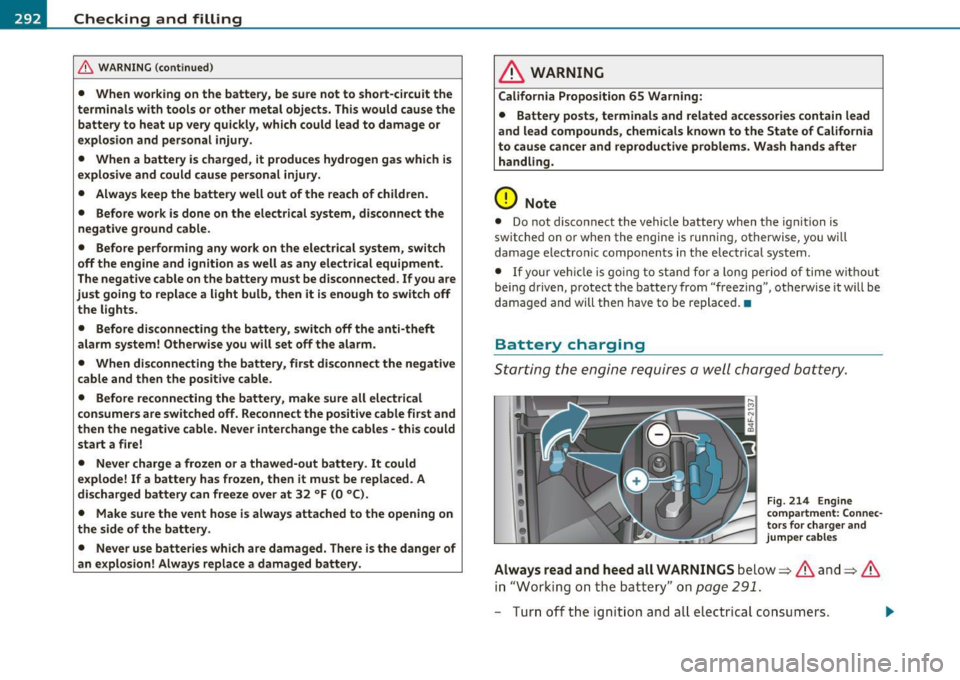
Starting the engine requires a well charged battery.
Fi g. 2 14 Engin e
c omp artm ent : Connec
to rs for charger an d
jumper cables
Always read and heed all WARNINGS be lo w => & and => &
in "Work ing o n the bat tery" on pag e 291.
- Turn o ff the ign it ion and all electrical consumers. ~
Page 318 of 370
IIIIL_T.:...:..: i r~ e:.: s~ a:::. n:..:..:: d:.....: w..:...:. h::e:.: e::.:: ls::::._ ______________________________________________ _
The tire pressure monitoring must be reset via MMI each t ime the
pressures are adjus ted (e.g. w hen swi tching between p art ial an d full
load pressure) or after chang ing o r replacing a tire o n your veh icle
~ page 31 6. Yo u can fi nd the recommended tire press ures for yo ur
veh icle on the label on the driver 's door pillar~ page
299 .
Tire tread circ umference and vibrat ion characteristics can change and
c a u se a tir e pressure war ning if:
• the t ire pressure in one o r more tires is too low,
• t he tire ha s structur al dam age,
• the tire press ure was changed, wheels rotated or rep laced but the
TPM S was no t reset~ page
316.
Warning symbols
1..1' Loss of press ure in at least one tire~ &. Check the tire or tires
and replace or repair if necessary. The indicator light (• in the instru
me nt clust er also illuminates~ page
12. Check/correct th e p res
sures o f all four tires and reset TPMS via MMI.
rr :; (T ire Pressu re M on itor ing System) Tire pres sure! System
malfunction.
If T ,.;> appears a fter switching the ignition on or w hile
dr iv ing ~ page
315, fig . 2 22 a nd t he indica to r lig ht 'in th e instr u
me nt clus ter b links for approx ima tely one m inute and the n stays on,
there is a system ma lf u nct io n. See your authorized Audi dealer as
soon as poss ible.
& WARNING
• If the tir e pres sure indicator appears in the instrument cluster
display, one or more of your tires i s significantly under-inflated.
Reduce your speed immediately and avoid any hard steering or
braking maneuvers. Stop as soon a s possible and check the tires
and their pressures . Inflate the tire pressure to the proper pres
sure as indicated on the vehicle 's tire pressure label~
page 299.
Driving on a significantly under -inflated tire causes the tire to
overheat and can lead to tire failure. Under -inflation also is likely
to impair the vehicle's handling and stopping ability.
& WARNING (co ntinued )
• The driver is re sponsible for maintaining the correct tire pres
sures . You must check the tire pres sures regularly .
• Under certain conditions (such as a sporty driving style , winter
conditions or unpaved roads) , the pressure monitor indicator may
be delayed.
• Ask your authorized Audi dealer if run-flat tires may be used on
your vehicle . Your vehicle registration becomes invalid if you u se
the se tires when not permitted. Damage to your vehicle or acci
dents could also result.
[ i ] Tips
• T he tire pressure monito ring system stops wor king when there is
an ES P/ABS malf u nctio n.
• Using snow cha ins may res ult in a system ma lf u n ct ion .
• The tire pressure mon itor ing system on your Au di was calibrated
using t ires with the "AO" or "RO " id ent ificat ion . We re comme nd
using these tires. •
Applies to vehicles: with tire p ressure monito ring system
Reset tire pressure monitoring system
I f the tire pressure is adjus ted, wheels are rotated or
changed, th e TPfvf S must b e re set via
fv1fv1 I.
-Turn on the ign it ion .
- Sele ct : Fu nct ion butt on
[C AR ]> Systems* > Tire pressure
monitoring
> Store now.
[ i ] Tips
Before resett ing the TPMS, the current pressures of all four t ires
mus t co rrespo nd to the specifie d val ues. A djust the tire pre ssure and
~
Page 329 of 370

______________________________________________ F _u_s _e_ s_ a_ n_ d _ b _u_l_b _ s _ ___.9I
Fuses and bulbs
Electrical fuses
Replacing fuses
Fuses that have blown will have metal strips that have
burned through .
Fig. 233 Left cockpi t:
f use panel cover
The fuses are located at the front left and right of the cockpit
and behind the trim on the right side of the luggage compart
ment .
- Turn off the ignition and the affected electr ical
consumers.
- Check the following table to see which fuse belongs to the
consumer.
- Remove the appropriate cover.
- To remove the purple plastic clip if necessary
4
), hold onto
it at the small side and pull it out of the fuse panel.
4J You can dispose of the p last ic cli p after remov ing it .
Vehicle OP-eration
- Remove the clamp from the rear side of the fuse cover
=> fig. 233.
-Remove the fuse using the clamp and replace the blown
fuse with an identical new one.
& WARNING
Do not repair fuses and never replace a blown fuse with one that
has a higher amp rating. This can cause damage to the electrical
system and a fire.
0 Note
If a new fuse burns out again after shortly have you have installed it,
have the electrical system checked by your authorized Aud i dea ler.
[I) Tips
• The follow ing tab le does not list fuse locations that are not used .
• Th e crank in the cover is used for emergency operation of the
power roof*.•
Vehicle care Do-it-yourself service iTechnical data
Page 330 of 370

-L_!F~U:!_:S~ e~ s ~ a~ n~ d~b~ u~l~b ~s ~-------------------------------------------
Fuse assignment, cockpit driver's side
Fig. 234 Cockpit
driver's side: fuse
panel layout
No. Consume r
3 Engine management
4
5
6
7
8
9
10
12
13
Oil level sensor
Climate control, tire pressure monitoring sys
tem Electronic Stabilization Program (ESP), clutch
sensor
Diagnostic connector
Homelink control unit
Automatic dimming interior mirror
Adaptive Cruise Control Diagnostic connector
Switch module steering column
15 Instrument cluster, control module Gateway
16 Telephone, cell phone
17 Electronic Stabili zation Program (ESP)
18 Headlight electronics, left-side
Amps
5
5
5
5
5
5
s
5
10
10
10
5
10
5
No. Con sum er
19 Rain sensor
20 Heated washer nozzles
21 Seat adjustment (driver)
22 MMI display
23 Electromechanical park ing brake
31
32
33
34
36
37
38
39
40
41
42
43
Back-up light switch, transmission, engine com
ponents
I ntelligent power module driver (footwell light
and front headlights , horn, wiper system, elec
trically adjustable steering wheel)
Intelligent power module driver (lights left-side)
I ntelligent power module driver
(lights right-side)
Headlight washer system
Electronic Stabilization Program (ESP)
Wiper system Door control module left-side
Horn
Heater fan
Control module electronic ignition lock/elec tri
cally adjustable steering wheel
Rear windshield wiper (Avant)
44 Power window opener (left-side)
Amps
5
5
10
5
5
15
30
25
25
30
25
30
15
25
40
30
15
35
-
•
Page 343 of 370
________________________________________________ G_e_ n_e_ r _a_ l_i_n _f_ o_ r_m _ a_t_ i_ o _ n __ _
The safety compliance sticker
is your assurance that yo ur new vehicle complies with all applicable
Fede ral Motor Veh icle Safe ty Standards which were i n effect at the
time the vehicle was manufact ured . Yo u can fi nd this sticker on the
left doo r jamb.
It shows the mont h and year of prod uct io n and the
vehicle identification number of your veh icle (perforation) as well as
the Gross Vehicle Weight Rating (GV WR) and the Gross Axle Weight
Rating (GAWR).
The high voltage warning label
is located o n the loc k carrier.
The spark ignition system complies with the
Canadian standard ICES-002. •
Weights
Gross Vehicle Weight Rating
The Gross Vehicle Weight Rating (GVWR), and the Gross Axle Weight
Rating (GAWR) for front and rear are listed on a sticker on the left
door jamb.
T he Gross Vehicle Weight Rating includes the weight of the basic
vehicle pl us f ull f uel tank, oil and coo la nt, plus max im um load, whi ch
includes passenger we ight (150 lbs/68 kg per des ignated seating
position) and luggage weight.
Gross Axle Weight Rating
Th e Gross Axle Weight Ra ting is the maximum lo ad that can be
applied at each axle of the vehicle~&.
Vehicle capacity weight
The vehicle capacity weight (max. load) is listed on the dr iver's side B
pillar.
Safety first
Roof weight
Th e maxim um permiss ib le roof weight is 220 lb (100 kg ). T he roof
we ight is made up of the weight of the roof rac k system and t he
we ight of the object being transported~
page 88, "Loading the roof
rack".
& WARNING
• The actual Gross A xle Weight Rating at the front and rear a xles
s hould not exceed the permis sible weights , and their combination
must not exceed the Gros s Vehicl e Weight Rat ing .
• Exceeding permi ssible weight ratings can result in vehicle
damage, accidents and personal injury.
0 Note
• T he vehicle capac ity we ight figures apply when the load is distrib
uted evenly i n the vehicle (passengers and lug gage). When trans
porting a heavy load i n the luggage compartment, ca rry the load as
near to the rear axle as possible so that the ve hicle's handling is not
impa ired.
• Do not exceed the max imum permissible axle loads o r the
maximum gross veh icle weight. Always remember that the vehicle's
handling will be affecte d by the extra load. Therefore, adjust your
speed according ly .
• Always observe loca l reg ulat ions. •
Dimensions
The specifications refe r to the basic mode l. Differences may occur
depe nd ing on the mode l type a nd options ordered, for exam ple, t ire
sizes. .,_,
Do-it,yourself service Technical data
Page 349 of 370

_____________________________________________ C_o_ n_s _u_ m __ e_r _ I_ n_ f_o _r_ m_ a_ t_ i _o_ n __ __
• oil cha nges, and
• cl ea ning or re placing th e air fi lter.
W For the sake of the environment
By regu larly ma intaini ng yo ur vehicl e, y ou h elp m ake su re th at em is
sion standards a re mainta ined, t hus mi nimizing adverse effects o n
t he enviro nmen t. •
Important considerations for you and your
vehicle
Th e increas ing use of elect ronics, s ophistica ted fuel inje ct io n and
em ission cont rol systems, and t he generally increasing tec hnical
c omplex ity o f today' s automobile s, have s tea dil y re duced t he s cope
of maintena nce and repairs w hic h can be carr ied out by ve hicle
ow ners.
Also, safety and environmental c o nce rn s plac e very s trict
limits o n the nature of repa irs and adjustments to engine an d tra ns
mission parts w hich an owner can pe rform .
M ain te nance, ad justm ents and r epairs us ua lly re quir e spec ia l t ools,
test ing devices an d other e quipment availab le to s pecia lly trained
wo rksh op pe rsonnel in order to assure pro per perfor mance, re li
ability and safety of the vehicle and its many systems.
Impro per ma inte nance, adjustments and rep airs can im pa ir the ope r
ation and reliability of your ve hicle and even void your veh icle
wa rranty . Therefo re, p ro of of se rvicing in a ccordance wi th t he ma in
t enance sch edul e may be a co nd it io n fo r u phold ing a possib le
wa rranty claim made w it h in the wa rranty pe riod.
Above all, operat io nal safety ca n be adve rsely affec ted, c reat ing
unnecessary r is ks for you and your passe ngers.
If in doubt abou t any serv ic ing, have it done by your authorized Audi
dealer or a ny o ther pro perly equipped a nd qualified workshop . W e
st rong ly ur ge you to give yo ur auth oriz e d Aud i dea ler the opportu nity
t o pe rform all sc heduled mainte na nce and necessary repairs. Yo ur
Safety first
dealer has the facilities, o rigina l parts and trained spec ia lists to keep
your vehi cle runni ng properly.
Performing limited maintenance yourself
The foll ow ing page s descr ibe a lim ite d num ber of proced ures whi ch
can be perfo rmed on your vehicle w it h ordina ry tools, shou ld the need
ar ise and tr ained pe rsonnel be u navailabl e. Befo re pe rforming any of
t hese p rocedures, always t horoughly read all of the applicable text
and ca ref ull y follow the ins tru ction s given . Alw ays rigoro usly o bserve
t he
WARNINGS prov ided .
Before you check anything in the engine compartment, always read
and heed all WARNINGS=>
& and=> & in "W orking in the engine
compartment" on
page 279.
& WARNING
• Serious personal injury may occur as a result of improperly
performed maintenance, adjustments or repairs.
• Always be extremely careful when working on the vehicle.
Always follow commonly accepted safety practices and general
common sense . Never risk personal injury .
• Do not attempt any of the maintenance, checks or repairs
described on the following pages if you are not fully familiar with
these or other procedures with respect to the vehicle, or are uncer
tain how to proceed.
• Do not do any work without the proper tools and equipment .
Have the necessary work done by your authorized Audi dealer or
another properly equipped and qualified workshop .
• The engine compartment of any motor vehicle is a potentially
hazardous area. Never reach into the area around or touch the
radiator fan. It is temperature controlled and can switch on
suddenly -even when the engine is off and the ignition key has
been removed. The radiator fan switches on automatically when
the coolant reaches a certain temperature and will continue to run until the coolant temperature drops. ..
Do-it,yourself service Technical data