warning light AUDI A6 2011 Owners Manual
[x] Cancel search | Manufacturer: AUDI, Model Year: 2011, Model line: A6, Model: AUDI A6 2011Pages: 370, PDF Size: 87.15 MB
Page 232 of 370
• .___C_ h_ il_d _ S_a _ f_ e _ t--= y '------------------------------------------------
& WARNING (cont inued)
• If the backrest is not securely latched, the child and the child
restraint will be thrown forward together with the backrest and
will strike parts of the vehicle interior. The child can be seriously
injured or killed.
• Never install rear-facing child safety seats or infant carriers on
the front passenger seat. A child will be seriously injured and can be killed when the passenger airbag inflates.
• The inflating airbag will hit the child safety seat or infant
carrier with great force and will smash the child safety seat and
child against the backrest, center armrest, door or roof .
• Always install rear-facing child safety seats or infant carriers
on the rear seat.
• Forward-facing child safety seats or infant carriers installed on
the front passenger's seat may interfere with the deployment of
the airbag and cause serious injury to the child.
• It is safer to install a forward -facing child safety seat on the
rear seat.
• Always read and heed all WARNINGS whenever using a child
restrained in a vehicle is being used~
page 219. Special precau
tions apply when installing a child safety seat on the front
passenger seat~
page 199, "Child restraints on the front seat -
some important things to know".
L1}. WARNING
Always take special precautions if you must install a forward or
rearward -facing child restraint on the front passenger's seat in
exceptional situations:
• Whenever a forward or rearward-facing child restraint is
installed on the front passenger seat, the PASSENGER AIR BAG
OFF light must come on and stay on whenever the ignition is
switched on.
& WARNING (co ntinued )
• If the PASSENGER AIR BAG OFF light does not come on and
stay on, perform the checks described
~ page 208, "Monitoring
the Advanced Airbag System".
• Take the child restraint off the front passenger seat and install
it properly at one of the rear seat positions if the PASSENGER AIR
BAG OFF light does not stay on whenever the ignition is switched
on.
• Improper installation of child restraints can reduce their effec
tiveness or even prevent them from providing any protection.
• An improperly installed child restraint can interfere with the
airbag as it deploys and seriously injure or even kill the child.
• Always carefully follow the manufacturer's instructions
provided with the child safety seat or carrier.
• Never place additional items on the seat that can increase the
total weight registered by the weight-sensing mat and can cause injury in a crash.
L1}. WARNING
Forward-facing child restraints:
• Always make sure the forward-facing seat has been designed
and certified by its manufacturer for use on a front seat with a
passenger front and side airbag .
• Never put the forward-facing child restraint up, against or very
near the instrument panel.
• Always move the passenger seat into its rearmost position in
the seat's fore and aft adjustment range, as far away from the airbag as possible before installing the forward-facing child
restraint . The backrest must be adjusted to an upright position.
• Make sure that the PASSENGER AIR BAG OFF light comes on
and stays on all the time whenever the ignition is switched on . _.
Page 233 of 370

Child Safety -
-------------------"'---
& WARNING
Rearward-facing child restraints:
• A child in a rearward-facing child safety seat installed on the
front passenger seat will be seriously injured and can be killed if
the front airbag inflates -even with an Advanced Airbag System.
• The inflating airbag will hit the child safety seat or infant
carrier with great force and will smash the child safety seat and
child against the backrest, center armrest, door or roof.
• Always be especially careful if you must install a rearward
facing child safety seat on the front passenger seat in exceptional
circumstances.
• A tight tether strap on a rearward-facing child restraint
attached to the front passenger seat can put too much pressure on
the weight-mat in the seat and register a heavier weight in the
Advanced Airbag System. The heavier weight registered can make
the system work as though an adult were on the seat and deploy
the Advanced Airbag when it must be suppressed causing serious
or even fatal injury to the child.
• Make sure that the PASSENGER AIR BAG OFF light comes on
and stays on all the time whenever the ignition is switched on.
• If the PASSENGER AIR BAG OFF light does not come on and
stay on, immediately install the rear-facing child safety seat in a
rear seating position and have the airbag system inspected by
your Audi dealer. •
Activating the convertible Locking retractor
Use the convertible locking retractor to secure a child
restraint.
Always heed the child safety seat manufacturer's instruc
tions when installing a child restraint in your vehicle. To acti
vate the convertible locking retractor:
Controls and equip
ment Safety first Vehicle operation
-
Place the child restraint on a seat, preferably on the rear
seat.
- Slowly pull the belt
all the way out.
- Route it around or through the child restraint belt path
=>& .
- Push the child safety seat down with your full weight to
get the safety belt really tight.
- Insert the belt tongue into the buckle for that seating
position.
- Guide the safety belt back into the retractor until the belt
lies flat and snug on the child safety seat.
- You should hear a "clicking" noise as the belt winds back
i nto the inertia reel. Test the convertible locking retractor
by pulling on the belt. You should no longer be able to pull
the belt out of the retractor. The convertible locking
retractor is now activated.
- Make sure that the red release button is facing away from
the child restraint so that it can be unbuckled quickly.
- Pull on the belt to make sure the safety belt is properly
tight and fastened so that the seat cannot
move forward
or sideways more than one inch (2.S cm).
& WARNING
Using the wrong child restraint or an improperly installed child
restraint can cause serious personal injury or death in a crash.
• Always make sure that the safety belt retractor is locked when
installing a child safety seat. An unlocked safety belt retractor
cannot hold the child safety seat in place during normal driving or
in a crash. ._
Vehicle care Do-it-yourself service Technical data
Page 240 of 370
___ C_h _i_ld _ S_ a_ f_ e_ t_,, y'-----------------------------------------------
& WARNING (cont inued )
to withstand only those loads imposed by correctly fitted child
restraints.
• Never mount two child restraint systems on one LATCH lower
anchor point .
• Never attach two child restraint system s to one tether strap or
tether anchorage.
• Never attach a tether strap to a tie-down hook in the luggage
compartment.
• Never u se child restraint tether anchorages to secure safety
belts or other kinds of occupant restraints .
• Never se cure or attach any luggage or other items to the LATCH
lower anchorages or to the tether anchors.
• If a tether or other strap i s used to attach a child restraint to
the front passenger seat, make sure that it is not so tight, that it
c auses the weight -sensing mat to mea sure more weight than is
actually on the seat .
• The heavier weight regi stered can make the Advan ced Airbag
System work as though an adult were on the seat and deploy the
Advanced Airbag when it must be suppre ssed causing serious or
e ven fatal injury to the child.
• If you must install a rearward facing child safety seat on the
front passenger seat because of e xceptional circumstances and
the PASSENGER AIR BAG OFF light does not come on and stay on,
immediately install the rear-facing child safety seat in a rear
seating position and have the airbag system inspected by your
Audi dealer. •
Installing the upper tether strap on the
anchorage
Installing the tether strap
Fig. 2 00 Tet her s tra p :
prop er rou ting and
mounting
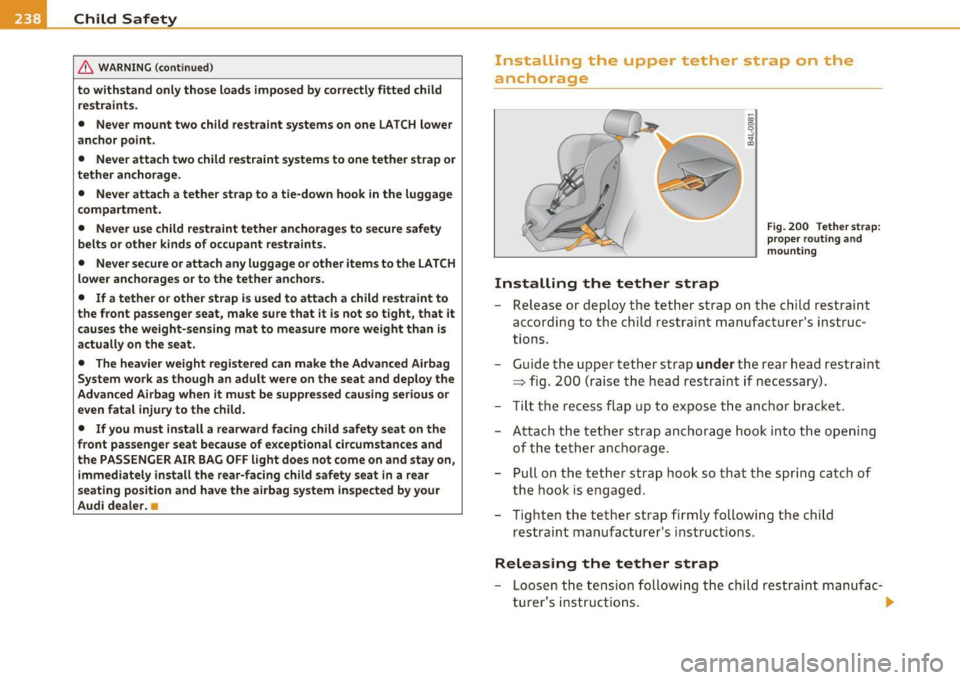
- Release or deploy the tet her strap on the ch ild restrai nt
according to the c hild restrain t manufac ture r's instruc
tions .
- Guide t he u pper tet her strap
under th e rear head rest raint
=> fi g. 20 0 (raise t he head restraint if necessary).
- T ilt the recess fla p up to ex pose t he anc hor brac ke t.
- Attach the teth er st ra p anchora ge hoo k in to the openi ng
of t he t eth er anchora ge.
- Pu ll on the tet her s trap hoo k so that the s pri ng catch of
th e h ook is e ngag ed .
- Tighte n the te ther s trap firm ly followi ng the chi ld
res traint manufactu re r's i nstruc tio ns.
Releasing the tether strap
- Loos en the ten sion follow ing th e ch ild restr aint man ufac -
t u re r's instru ctio ns.
~
Page 241 of 370

_____________________________________________ C _h_i_ld _ S_ a_ f_ e_ t ... Y'--- __
- Depress the spring catch on the hook and re lease it from
the anchorage .
0 Note
If you leave the child restra int with the tether strap firmly insta lled
for several days, th is could leave a mark on the upho lstery on the seat
cus hion and backrest in the area where the tether strap was insta lled.
Th e upho lstery wou ld also be perma nent ly stretched a round the
tether strap. This applies espec ially to leather seats .•
Using tether straps on rearward-facing
child restraints
Currently, few rear-fac ing c hild restrai nt systems come w it h a t ether.
Please read and heed the c hild restraint system manufacturer's
instructions carefully to determine how to proper ly install the tether .
& WARNING
A child in a rearward-facing child safety seat installed on the front
pa ssenger s eat w ill be seriously injured and can be killed if the
front airbag inflates· even with an Advanced Airbag System.
• The inflat ing airbag w ill hit the child safety seat or infant
c arrier with great for ce and will sma sh the child safety seat and
c hild against the backrest, center armrest , or door.
• A tight tether
or other strap on a rearward -facing child
restraint attached to the front passenger seat can put too much
pre ssure on the weight-mat in the sea t and regi ster a heavier
weight
in the Advan ced Airbag System. The heavier weight regis
tered can make the sy stem work as though an adult were on the
seat and deploy the Advan ced A irbag when it mu st be suppressed
causing ser ious or even fatal injury to the child.
• If you must install a rearward facing child safety seat on the
front passenger seat becau se of exceptional circum stances and
Controls and equip ment Safety first Vehicle operation
& WARNING
(co ntinued )
the PASSENGER AIR BAG OFF light does not come on and stay on,
imm ediately install the rear -facing child safety s eat in a rear
seating position and have the airbag system inspected by your
Audi dealer. •
Additional Information
Sources of information about child
restraints and their use
Th ere are a numbe r of sources o f addi tional in forma tion abo ut child
restra int select ion, installation and use:
N HTSA adv ises that the best chi ld safety seat is the one that f its your
child and fits in your vehicle, a nd that you w ill use cor rectly and
cons istent ly .
Tr y before you buy!
U.S National H ighway Traffic Safety Administration
Tel. : 1-888-3 27- 4236 (T TY: 1-800- 424-91S3)
www.nhtsa.gov
Nat ional SAFE KIDS Campaign
Tel. : (20 2) 662 -060 0
www.safekids .org
Safety BeltSafe U .S.A
Tel. : (800) 745 -SAF E (English)
T el. : (80 0) 74 7-SA NO (Sp anish)
www.carseat.org
Transport Canada Information Centre
T el. : 1 ( 80 0) 333 -037 1 or ca ll 1 (613 ) 99 8-86 16 if you are i n the
O ttawa area
www.tc .gc .ca/roadsafety
Vehicle care Do-it-yourself service Technical data
Page 245 of 370
Intelligent technology
--------------------------------------------------' '----'----
fore-and-aft and lateral directions, the brake pressure and the
steering angle are all measured.
The direction in which the driver wishes to travel is determined with
the aid of the steering angle and vehicle speed and is continually
compared with the actual behavior of the vehicle. If the two do not
match, for example , when the vehicle starts hydroplaning on a wet
road, ESP will automatically brake the appropriate wheel to correct
the problem.
The vehicle is then stabilized by the forces acting on the wheel during
braking. If the vehicle is
oversteering (rear tends to skid out of the
turn), the brakes are mainly applied on the wheel that is on the
outside of the curve. In the case of a vehicle that is
understeering
(tendency to slide out of the curve), the brakes are applied at the rear
wheel that is on the inside of the curve. An acoustic signal indicates
when ESP brake application cuts in =>
&.
The system operates across the entire speed range in combination
with the ABS system=>
page 246. If the Anti-Lock Brake System
(ABS) malfunctions, the ESP will be out of action as well.
Activating
When you turn on the engine, ESP will automatically be activated and
will perform a self-test . As soon as the test is completed, the system
is in normal operating mode.
You can activate a deactivated ESP or deactivated ESP/ ASR if required
by pressing the=>
page 242, fig. 201 button. When they are acti
vated, the message
ESP/ASR on appears briefly in the display .
Deactivating
The ESP should normally be activated all the time. If necessary , you
can deactivate Anti-Slip Regulation (ASR) or the Electronic Stabiliza
tion Program (ESP) by pressing the button =>
page 242, fig. 201.
• Deactivating ASR: Tap the but ton . In certain excep tional situa
tions (e.g. driving with tire chains) , the Anti-Slip Regulation (ASR) can
be deactivated=>
page 244 . The message ASR off appears in the
display as well.
Controls and equip ment Safety first Vehicle operation •
Deactivating ESP/ASR
Press the button for more than 3 seconds .
With the ESP/ASR deactivated, the ESP check light comes on, see
=>
page 14. The message ESP switched off appears in the display as
well.
& WARNING
The Electronic Stabilization Program is nevertheless subject to the laws of physics. It is particularly important to pay attention to
this fact on wet and slippery roads. It is therefore important that
you always adapt your driving to the condition of the road and traffic conditions. Do not allow the increased safety provided by
the Electronic Stabilization Program system to lull you into
accepting additional safety risks. •
Electronic differential lock (EDL)
The electronic differential lock monitors the rotational
speed of the drive wheels.
General notes
The electronic differential lock (EDL) helps the car to start moving,
accelerate and climb a gradient on surfaces providing poor or almost
no grip . Without EDL, this would be difficult, if not impossible .
How the system works
The EDL operates automatically . It monitors the rotational speed of
the drive wheels on an axle with the help of the ABS sensors
=>
page 246 . If a noticeable difference in rotational speed between
the drive wheels on one axle is detected (e.g. on slippery ground
on
one side),
the spinning wheel is braked, thereby transferring power to
the othe r drive wheel or wheels (all-wheel drive). This is done up to a
speed of about 60 mph (100 km/h) . Noises from the brake system
signal that wheel spin is being controlled.
Vehicle care Do-it-yourself service Technical data
Page 246 of 370
Intelligent technology
'-----------------------------------------------
Driv ing off
When driving off, always be sure to keep road conditions in mind as
you acce lerate. If one d rive w heel spins because it is on a surface with
less grip, gradua lly inc rease the press ure on the accelerator pedal
un til the car sta rts to move .
Overheating of brakes
To prevent the disc brake of the braked wheel from overheating if
subjected to excessive loads o n this whee l, t he EDL cuts out tem po
ra rily. The vehicle rema ins operat iona l a nd be haves in the same way
as a ve hicle wit hout EDL.
As soon as the bra ke has coo le d down , ED L swit ches on again au to
matically.
& WARNING
• When accelerating on slippery surfaces , such as on i ce or snow ,
alway s be careful when depre ssing the accelerator pedal. Even
with the EDL work ing , the drive wheels can spin and reduce your
ability to control your car. Risk of crash!
• The increased safety afforded by EDL does not mean that you
can take safety ri sks . Always adapt your driving style to the road
conditions and traffic situation.
(I) Tips
If a fa ult occurs i n the ABS, the EDL is also not f unct io ni ng . This is
indic ated by t he A BS war ning ligh t=>
page 17.
Anti-Slip Regulation System (ASR)
The Anti- S lip Re gula tio n Sy stem preven ts the dr iven
w heels from spin ning w hen t he car is accelerating .
General notes
The Anti-S lip Reg ulation Sys tem (AS R) is in tegr ate d in the ele ctroni c
stabilization program (ESP) . When the ve hicle starts up and acceler
at es, the whee ls are p reven ted from sp inning by adjust ing t he engine
power to match the amount of grip avai lable from the road surface.
How the system works
ASR performs automatically, i.e. witho ut the driver 's intervent ion.
W ith the a id of t he ABS sensors=>
page 246, ASR moni to rs the speed
of the dr iven wheels. If the wheels start to spin , th e engine torque is
redu ced a utomatically unti l the t ires find enou gh gr ip to lock onto
the road surface. T he system is active across the entire speed range .
Th e ASR works in conjunction with the ABS. If a malfunction sho uld
occ ur in th e ABS, th e AS R w ill also be out of action.
Activating
The ESP is automatically activated whe n the engine is started and it
performs a se lf-test. You can act ivate a deact ivate d ASR if required by
press ing the=>
pag e 242, fig. 201 button. Whe n it is act ivated, t he
message
ESP/ASR on appears briefly in t he disp lay. Vehicles with
front-wheel d rive a dea ct iva te d ASR a uto mat icall y re-ac tiva tes i tself
at a speed of 40 mp h (70 km/h) .
Deactivating
You can deact ivate t he ASR if required by pressing t he button (for less
t han 3 se conds) =>
page 242, fig . 2 0 1. Wi th the ASR dea ct ivated, the
ESP check light comes on, see=>
page 14. The message ASR off
appe ars i n the di sp la y as wel l. On vehicles wi th fro nt-whee l dr ive:
deactivation is possible only up to 30 mph (SO km/h) for safety
reas ons. Vehi cles w ith all -wheel drive: the AS R can be deac tivated at
any speed. ..
Page 249 of 370

Intelligent technology
--------------------------------------------------' '----'----
these circ umstances, it is especially importa nt that you dr ive slowly
a nd wi th grea t ca re .
How the ABS system works
An au tom ati c c heck is m ade w hen a speed of about 4 mp h (6 km /h) is
reac hed. When th is happens, a pump ing no ise can be heard.
If an indivi dual w heel beg ins to rot ate too s low ly in relat ion to vehi cle
speed and tends to lock, t he A BS a utomat ically reduces brake pres
sure to prevent that w heel from loc king .
Thi s au tom atic adju stm ent pr oces s w ill c au se a
slight vibration of
the brake pedal and some noises to alert you that vehicle speed must
be ad apted to exis tin g road and traff ic c ondi tio ns.
& WARNING
Although the ABS is very effective, always remember that braking
capability is limited by tire traction. Always adjust your driving
speed according to the road and traffic conditions. Do not let the
extra safety afforded by the ABS tempt you into taking extra risks.
The ABS cannot overcome the laws of physics.
[ i J Tips
• If A BS is no t fu nct ion ing prope rly, a w arn ing ligh t will come on .
See
~ page 17 .
• If a f ault o ccur s in the A BS, the EDL is also not func tio ning. T his is
ind icated by the ABS war ning light.
Brake assistant
--
The brake assis tan t is d esign ed to achie ve the opt imum
b raki ng eff ect.
The b rake ass istant he lps to increase the effective braking power and
t hu s to ac hi eve a shorter stopping dis tance . If t he dr iver p re sse s t he
brake peda l ve ry qu ickly, the b rake assistant automatica lly boosts the
Controls and equip
ment Safety first Vehicle operation
brak
ing fo rce to t he maximum level , up to the point where the anti
l ock brak e fu nction (A BS) in terve nes to stop the whee ls fr om l ocking.
Yo u should t hen kee p the brake pedal pressed unti l the ve hicle has
bra ked to the required speed. The bra ke ass istant switches itself off
as soon as you re lease the brake pedal.
The brake assistant will not be operative i f th ere is a ma lf u nction in
t he A BS.
& WARNING
Please remember that the accident risk always increases if you
drive too fast, especially in corners or on a slippery road , or if you
follow the vehicle ahead of you too clo sely. Increa sed risk of an
accident cannot be compensated for even by the brake assistant ,
so always maintain a safe speed .•
Servotronic® - advanced power
steering system
The po wer s teerin g sys tems uses the power of the
runnin g engine to a llow p re cis e st ee rin g with little effort.
The adva nced Servotronic ® power stee ring syste m senses the road
speed and elect ronically adjusts power assistance to p rovide
c omfortab le and saf e steer ing response exa ctly match ed to th e
vehicle speed.
P owe r steer ing will not wor k if the engine is o ff. As a resul t, the
steeri ng wheel will be hard to tu rn .
The power steering fluid level is checke d dur ing the sched uled main
tenance se rvices .
0 Note
If the re is a n ele ct ronic mal func tion, s ervo tr onic will s till f unction
like a conventional power steering system, provid ing a constant
~
Vehicle care Do-it-yourself service Technical data
Page 252 of 370
Intelligent technology
'-------------------------------------------------
It is in precisely these situations that you will notice energy manage
ment actively regulating the distribution of energy.
Vehicle stands for an extended period
If you do not drive your vehicle over a period of several days or weeks,
electrical components are gradually cut back or switched off. This
red uces energy consumption and maintains starting capability over a
longer period.
Take into consideration that when you unlock your vehicle, some
convenience functions, such as the remote key or power seat adjust
ment, may not be avai lab le. The convenience functions wi ll be ava il
able again when you turn on the ignition and start the engine.
With the engine turned off
If you listen to the radio, for example, with the engine turned off o r
use other MMI functions, the battery is being discharged.
If starting capability is jeopard ized due to energy consumption, the
following warning appears in the MMI display:
Please start engine, otherwise system will switch off in
3 minutes .
The warning indicates that the system will be turned off automati
cally after 3 minutes. If you wis h to continue using the funct ions, you
have to start the engine.
With the engine running
Although electrica l energy is generated when the vehicle is being
dr iven, the battery can become discharged. This happens mostly
when little energy is being generated and a great deal consumed and
the battery's state of charge is not optimal.
To bring the energy balance back into equilibrium, consumers which
req uire especially large amounts of energy are temporarily cut back
or switched off . H eating systems in particular require a great deal of
energy. If you notice, for example, that the heated seats* or the
heated rear window are not heating, they have been temporarily cut
back or switched off. These systems will be ava ilable again as soon as
the energy ba lance has been restored. You will also
notice that engine idle speed has been increased
slightly. This is normal and not a cause for concern. By increasing
engine idle speed the addit ional energy required is generated and the
battery is charged. •
Driver notification in the instrument
cluster display
If battery powe r drops into the range where it can limit the ability of
the engine to start, this is shown in the instrument cluster display
w ith the following driver message:
1 Low battery charge: battery will be charged while driving
This notification reminds you that the starting capability of the
eng ine may be limited. As soon as you start driving again, the battery
will be recharged and the notification will go out.
Driver notification appears and goes out again
If this driver notification appears after the ignition is turned on or
wh ile driving and it goes out again after a while, the battery has been
adequately recharged.
Driver notification appears and does not go out
again
If this dr iver not ificat ion appears after the ign it ion is turned on or
whi le driving and does not go out again, the battery's state of charge
is not in the optimal range. Starting ability is restricted . Have the
battery checked as soon as possible at a dealership.
Page 256 of 370
![AUDI A6 2011 Owners Manual Driving and environment
(I] Tip s
The consumption estimates as pub lished by ENV IRONMENTAL
PROTECTION AGENCY (EPA) and Transport Canada may not corre
spond to your actual consump](/img/6/57593/w960_57593-255.png "AUDI A6 2011 Owners Manual Driving and environment
(I] Tip s
The consumption estimates as pub lished by ENV IRONMENTAL
PROTECTION AGENCY (EPA) and Transport Canada may not corre
spond to your actual consump")
Driving and environment
(I] Tip s
The consumption estimates as pub lished by ENV IRONMENTAL
PROTECTION AGENCY (EPA) and Transport Canada may not corre
spond to your actual consumption on the road, which will vary
depending upon vehicle load and speed, road and weather conditions,
trip length, etc. •
Drive smoothly and keep a lookout ahead
Vehicles use the most fuel when they are accelerating .
-Avo id unnecessary accelerating and braking.
Vehicles use the most fue l when they a re accele rating. If you antici
pate what is going to happen next, you will need to brake less and,
thus, accelerate less. Let the vehicle coast whenever possible -for
example when you see that the next traffic l ight is red. •
Avoid full throttle
Driving at moderate speeds saves fuel and improves your
mileage.
- Try and keep well below your car's maximum speed .
Accelerating gently reduces fuel consumption, engine wear, and does
not disturb the environment.
Fuel consumption, exhaust emissions and engine noise increase
disproportionately at high speeds . If you drive at approx imately three
qua rters of top speed, fuel consumption will be reduced by one half.
Never drive faster than the posted speed limit and weather condi
tions permit.
a Reducing unnecessary idling
Even when your car is just idling it burns up fuel.
-
Shut the engine off when yo u are not driving the vehicle.
- Do not warm up the vehic le by letting the eng ine run at
idle.
It makes sense to shut off the engine in traffic jams, when waiting for
trains to pass at rai lroad crossings, o r at traffic lights that have long
wa its on red . Turn ing the eng ine off for just 30-40 seconds saves
more fuel than is burned starting the engine again.
It takes a long t ime for the engine to warm up fully when it is running
at idle. Howeve r, wear and noxious emissions are espec ially high
when the eng ine is wa rm ing up. So you sho uld d rive away as soon as
you start the engine and avoid running at hig h rpms while the eng ine
is still warming up.
0 Note
Do not leave engine idling unattended after starting . If warning
lights should come on to indicate improper operation, they would go
unheeded. Extended idling also produces heat, which cou ld result in
overheat ing o r othe r damage to the vehicle or other p roperty. •
Regular maintenanc_e ____________ _
A badly tuned engine unnecessarily wastes a lot of fuel .
- Have your vehicle serviced at regular intervals .
By having yo ur vehicle regularly se rviced by an Audi dealer helps to
ensure that it runs properly and economically . T he condition of your
vehicle not only a ffects its safety and ability to ho ld its va lue, it a lso
affects
fu el con sumption .
Check your o il e ach tim e you fill you r tank.
~
Page 258 of 370
Trailer towing
"---------------------------------------------------
Trailer towing
Driving with a trailer
General information
Your Audi was designed primarily for passenger transpor
tation .
If you p lan to tow a t railer, p lease remember that the additional load
w ill affect durability, economy and performance.
Tr ailer towing not on ly p laces mo re s tress on the vehicle, it also calls
for more concentration from the driver.
For this reason, a lways follow the operating and dr iv ing inst ructions
prov ided and use common sense .
0 Note
If you are going to tow a trailer, you must activate the tra iler ope ra
tion mode =>
page 170, "Towing a tra iler". •
Technical requirements
Trailer hitch
Use a we igh t-car rying h itch co nform ing to the gross tra iler we ig ht.
The h itch must be suitab le for your vehicle and trailer and must be
mou nted securely o n th e vehi cle's ch assi s at a
techni cally sound loc a
tion . Use only a trailer hitch with a removab le ball mount. Always
check wit h the t railer h itch manufactu rer to make sure that yo u are
using the correct h itch .
Do not use a bumper hitch.
The h itch mus t be installed in such a way t hat it does not in terfe re
w ith t he impact-absorb ing bumper system. No modifications shou ld be made to t
he veh icle exha ust and bra ke systems. From t ime to
time, check that a ll hitch mounting bo lts rema in securely fastened.
W hen you are no t tow in g a tra ile r, remove the t railer hit ch ball
mount. This prevents the hitc h from caus ing damage should your
vehicle be str uck from behind=>& .
Trailer brakes
If your trail er is e quipped w ith a b raking system, che ck to be s ure t hat
it conforms to all regulations.
T he tra ile r hydrau lic brake system m ust not be directly connected to
t he vehicle's hyd raulic b rake sys tem .
Safety chains
Always use safety chains between your veh icle and t he tra ile r.
Trailer lights
Trailer lights must meet all regulations. Be sure to check w ith your
Audi de aler fo r corr ec t wir ing , sw itches and re lays.
Mirrors
If you are unab le to see t he t raff ic be hind you using t he regular
outs ide mirrors, then you
must install extended mi rrors. It is impor
t an t th at yo u
always ha ve clear vi sion to the re ar.
& WARNING
After removing the trailer hitch, do not store it in your vehicle. In
case of sudden braking , the hitch could fly forward and inju re you
or your passengers. •