brake fluid AUDI A6 2011 User Guide
[x] Cancel search | Manufacturer: AUDI, Model Year: 2011, Model line: A6, Model: AUDI A6 2011Pages: 370, PDF Size: 87.15 MB
Page 262 of 370

-~_C_ le_ a_n_ i_ n_ g=- a_ n_d___. p_ ro_ t_e _c_ t_ i_o _n ___________________________________________ _
Cleaning and protection
General information
Regular care preserves vehicl e val ue.
Any automobile is exposed to industria l fumes, co rrosive road salt,
e tc. A well ca red for Audi c an look lik e new many ye ars after pur cha se.
Regu lar and correct care w ill contribute to mai nta in ing t he bea uty
a nd valu e of your Au di.
Furthermore, good care may be a condition for substantiating a
warranty claim should corrosion damage or paint defects occur.
Yo ur au thori zed Audi d eale r h as a var iety of dedicated vehicle-care
products
and can advise w hich ones to use for clea ning the exterior
a n d inter io r of your ve hicle.
W het her you use products recommended by Aud i or other comme r
cia lly availab le cleaning agents , please make sure yo u appl y them
co rrectly .
& WARNING
• Cleaning agents may be poisonous . Keep them out of the reach
of children.
• Heed all caution labels .
• Always read directions on the container before using any
product. Follow the directions carefully.
• Most chemical cleaners are concentrated and have to be
diluted .
• Use spot removing fluids only in well ventilated areas.
• Do not use gasoline, kero sene , diesel fuel , nail polish remover
or other volatile fluids . They may be toxic, flammable or
hazardous in other ways. Do not wash, wax or dry the vehicle with
the ign ition on or the engine running .
& WARNING (continued )
• Do not clean the under sides of chassi s, fenders , wheel covers,
etc. without protecting your hands and arms. You may cut your
self on sharp-edged metal parts.
• Moisture and ice on brakes may impair braking efficiency
~ page 245, "General information ". Test the brakes carefully
each time you wash the vehicle .
'£> For the sake of the environment
Select only envir onmenta lly fr iendly clea ning produc ts . Leftover
cleaning pro ducts sho uld not dis posed of i n the household waste .•
Care of exterior
Washing
F re quent w ashin g protec ts th e vehicle.
T he best protection aga inst env ironmental influences is frequent
w ashi ng and w ax ing. How oft en thi s is requ ired depen ds on :
• How m uch the vehicle is used
• Whe re the ve hicle is parke d (gar age, in the o pen un der tr ees, etc.)
• The seasona l and weather conditions
• Environ mental influences
T he longer bird droppings , insects , tree resin, road and industria l
gr ime, t ar, soo t, road sa lt and o ther ma ter ia ls remain on t he veh icle
body, the more lasti ng their destructive effects w ill be. H igh temper
atu res cause d by ex pos ure to intense s unlight int ensify the co rrosive
effect, part icu larly when humid ity is high as we ll.
~
Page 281 of 370

___________________________________________ C..:...._ h:....:e :....:c:..:. k.::..: i..:.. n .:..:g:!:....:: a....:. n..:.. d~ f:....:. i.:..ll :.:.i:....:n :.:g !....- __
Closing the engine hood
- Pull the hood down until the pressure from the struts is
reduced.
- Let the hood
drop down and latch in place. Do not try to
push it shut;
it may fail to engage=:> &.
& WARNING
A hood that is not completely latched could fly up and block your
view while driving.
• When you close the engine hood, check it to make sure the
safety catch has properly engaged. The hood should be flush with
the surrounding vehicle body parts.
• If you notice while driving that the hood is not secured prop
erly, stop at once and close it. •
Working in the engine compartment
Be especially careful whenever you work in the engine
compartment.
Whenever you must perform any work in the engine compartment,
for example checking and filling different fluids, there is a risk of injury, burns and accidents. To prevent personal injury always
observe the following WARNINGS. The engine compartment of any
vehicle is a hazardous area=>& .
& WARNING
To help avoid injury, before you check anything under the hood:
• Turn off the engine.
• Remove the ignition key.
• Apply the parking brake.
Safety first
& WARNING (continued)
• Move selector lever to "P" (Park).
• Always let the engine cool down. Hot components will burn
skin on contact.
• To reduce the risk of being burned, never open the hood if you
see or hear steam or coolant escaping from the engine compart
ment. Wait until no steam or coolant can be seen or heard before
carefully opening the hood.
• Keep children away from the engine compartment.
• Never spill fluids on hot engine components. They can cause a
fire. • Never touch the radiator fan. The auxiliary electric fan is
temperature controlled and can switch on suddenly.
• Never open the coolant reservoir cap when the engine is still
warm. The coolant system is pressurized and hot coolant could
spray out.
• Protect your face, hands and arm from steam or hot engine
coolant by placing a thick rag over the cap when you open the
coolant reservoir.
• If work on the fuel system or the electrical system is necessary:
- Always disconnect the battery.
- Never smoke or work near heaters or open flames. Fluids in
the engine compartment could start a fire.
- Keep an approved fire extinguisher immediately available.
• To avoid electrical shock and personal injury while the engine is
running or being started, never touch:
-Ignition cables
- Other components of the high voltage electronic ignition
system.
• If you must perform a check or repair with the engine running:
- First, fully apply the parking brake, move selector lever to
"P" (Park). .,
Vehicle care Technical data
Page 291 of 370

___________________________________________ C_ h _ e_c _k _ i_n -=g .._ a_n _ d_ f_i _ll _i _ n -=g '-- ........
Brake fluid
Checking brake fluid level
The b rake f lu id l eve l can be checke d wit h a qui ck g lanc e.
Fig . 212 E ngine
compartment : Br ake
fluid re se rv o ir
Before you c heck a nythi ng in the eng ine compartment ,
always read and heed all WARNINGS~ & in "Working in
the e ngi ne comp art ment" on
page 279.
- Read t he bra ke flu id level from the bra ke fluid reservoir
~ page 289, fig . 212. The brake flu id level must be
between the " MIN" and " MAX" mar kings.
The brake fluid reservoir is locate d at the rear pa rtition of the engine
compartmen t on the left s ide=>
page 280 .
The f luid leve l may drop slightly after some time d ue to the auto
m atic a dju stment of t he b rake pads. This is not c ause for ala rm.
If the brake flu id level falls
considerably be low the "M IN" mark, the
brake warni ng/ind icator light (U .S. models :
BRAKE, Canadia n mo dels:
(0) ) will come on=> page 18 and=> page 26. Do not continue to
operate t he vehicle. The complete brake system sho uld be thoroug hly
chec ked by an au thor ized A ud i d eale r or othe r qualified fac ility and
the cause corrected.
If the brake fluid level is too low, the brake
Vehicle OP-eration
warning/ind icator light will illum inate . Contact an au thoriz ed Aud i
de aler
immediately .•
Changing brake fluid
H av e the b rake fluid chang ed by an expe rie nc ed t echni
CJ an.
B ra ke flui d abso rb s moi stur e from the air. If the wa te r c on ten t in t he
brake fl uid is too high, corros ion in the b rake system may res ult after
a pe riod of time. The boili ng po int of the brak e flu id will also decrea se
co nsiderab ly and decrease brak ing perfo rmance.
Th erefore, the brake f lui d m ust be c hanged
every two years . Always
use new brake fluid w hich conforms to Fede ral Motor Veh icle Stan
dard "F MVSS 1 16 DOT 4" .
Th e br ake f luid reserv oir can be diffi cult to rea ch, there fore, we
recommend that you have the brake fluid changed by your authori zed
Audi dealer . Your deal er h as th e correc t tools, the rig ht bra ke flui d
and the know-how to do th is for you.
& WARNING
• Brake fluid is poisonous. It must be stored only in the closed
original container out of the rea ch of children!
• Brake
failure can result from old or inappropriate brake fluid .
Observe these precaution s:
- Use only b rake fluid that meets SAE specification
J 1703 and
conforms to Federa l Motor Vehicle Standard 116. Alway s check
with you r authorized Audi dealer to make sure you are using
the correct brake fluid. The corre ct type of brake fluid is also
indicated on the brake fluid rese rvoir.
- The brake fluid must be new . Heavy use of the brakes can
c ause a vapor lo ck if the brake fluid is left in the system too
long . Thi s can seriously affect the efficiency of the brakes as
well as your safety. This could result in an accident .
~
Vehicle care Do-it-yourselt service Technical data
Page 292 of 370
-L~C~ h~ e~c ~k :..!_i ~ n ~g ~ a~n ~d~ f~il ~l~in ~ g[_ ________________________________________ _
0 Note
Brake fluid will damage the paint of your vehicle.
the special tools required and the necessary expertise, we recom
mend that you have the brake fluid changed by your authorized Audi
dealer. •
Battery
General information
Under normal operating condit ions, the battery in your Aud i does not
need any maintenance. With
high outside temperatures or long daily
drives we recommend that you have the electrolyte level checked by
a service facility. The electrolyte level should also be checked each
time the battery is charged~
page 292.
Have the battery checked when you take your vehicle in for service.
You are well advised to replace a battery that is older than 5 years.
With certain types of a irbag deployment, the battery is disconnected
from the vehicle electrical system for safety reasons=>
& in "Repair,
care and disposal of the airbags" on
page 211.
Disconnecting the battery terminals
Some vehicle functions (power window regulators, for example) are
lost if the battery terminals are disconnected. These functions have
to be relearned after the battery terminals are connected aga in. To
prevent this, the battery should only be disconnected from the
vehicle electrical system when absolutely necessary for repairs.
Vehicles not driven for long periods
If you do not drive your veh icle over a period of severa l days or weeks,
electrical components are gradually cut back or switched off. This
reduces energy consumption and maintains starting capability over a
longer period~
page 249.
Take into consideration that when you unlock your vehicle, some
convenience functions, such as the master key remote function or
power seat adjustment, may not be available. The convenience func
tions will be available again when you turn on the ign ition and start
the engine.
Winter operation
During the winter months, battery capacity tends to decrease as
temperatures drop. This is because more power is also consumed
while starting, and the headlights, rear window defogger, etc., are used more often .
Avoid unnecessary power consumpt ion, particu larly in city traffic or
when traveling only short distances. Let your authorized Audi dealer
check the capacity of the vehicle battery before w inter sets in
=> page 292. A well charged battery will not only prevent starting
problems when the weather is cold, but will also last longe r.
(I] Tips
If your veh icle is left standing for several weeks at extreme ly low
temperatures, the vehicle battery should be removed and stored
where it will not freeze. This will prevent it from being damaged and
having to be replaced.•
Page 306 of 370
lffllL-_T.:..:..: ir:....:e~ s=---= a~ n:..:..: d:......: w..:....:.. h:....:e~ e= ls=--------------------------------------------------
Yo ur sa fety and that of your passengers also depends o n mak ing s ure
t h at loa d limits are no t ex ceede d. Vehicle lo ad incl udes eve rybody
and everyth ing in and on the vehicle. These load limits are tech nica lly
referred to as the ve hicle 's
Gross Vehicle Weight Rating ("G VW R").
T he "G VWR" includes the we igh t of the b asic ve hicl e, all fa ctory
installe d accesso ries, a fu ll tank of fue l, o il, coo lant and other fluids
p lu s m aximu m lo ad. Th e maxi mum lo ad include s th e num ber of
passengers that the vehicle is intended to carry ("seating capacity")
w ith a n assu med we ight of 150 l bs (6 8 kg) for e ach p assenger at a
designated seating position and the tota l weight of any luggage in
t he vehicle . If you tow a trai le r, t he weight o f the t railer hitch and t he
tongue we ig ht of the loaded trailer must be included as pa rt of the
veh icle load .
T he
Gross Axle Weight Rating ("GAWR") is the m aximum load tha t
can be applied at each of the vehicle's two ax les.
Th e Gross Vehi cle We ight Ratin g a nd the Gross Axle Weigh t Ra ting
are listed o n the safety compliance sticker label located on the
dr ive r's side B-pillar. You r A udi has 5 sea ting positions, 2 in the fron t
and 3 in the rear fo r tota l seati ng ca pac ity of 5 . Eac h seat ing position
has a safety belt ~
page 18 7, "Safety belts".
T he fa ct t hat t here is an upper lim it to your ve hicle's G ross Veh icle
We ight Rating means that t he total weight of whatever is being
c arried in t he ve hicle (includi ng the wei ght of a tra ile r hit ch an d the
tongue weig ht of the loaded tra iler) is limited. The more passengers
i n th e ve hicl e or p assenge rs who are heavier th an the stan dard
we igh ts assumed mean that less we igh t can be ca rried as luggage.
The tire pressure label on yo ur A udi a lso lists the max imum combined
w eight of all of th e occ upants and luggag e or o ther cargo that th e
vehicle ca n car ry. Fo r the location o f the labe l~
page 299, fig . 216.
& WARNING
Overloading a vehicle can cause loss of vehicle control , a crash or
other accident, serious personal injury, and even death.
& WARNING (co ntinued )
• Carrying more weight than your vehicle was de signed to carry
will prevent the vehicle from handling properly and increase the risk of the loss of vehicle control.
• The brakes on a vehicle that has been overloaded may not be
able to stop the vehicle within a safe di stance.
• Tires on a vehicle that has been overloaded can fail suddenly,
including a blowout and sudden deflation, causing loss of control
and a crash .
• Always make sure that the total load being transported -
including the weight of a trailer hitch and the tongue weight of a
loaded trailer -does not make the vehicle heavier than the
vehicle's Gros s Vehicle Weight Rating. •
Determining correct load limit
Use the example below to calculate the
total weight of the passengers and luggage or other things that you plan to transport so
that you can make sure that your vehicle
will not be overloaded. .-.
Page 309 of 370
________________________________________________ T_ i_ re _ s_ a_ n_d_ w_ h_ e_ e_l _s _ ....... JIII
Incorrect wheel alignment
In correct whee l al ignme nt can ca use excessive tir e wea r, impairing
th e sa fety o f the vehicl e. If t ires show excessive w ear, hav e the w heel
alignment checked by a n authorized A udi dea ler or qualifie d work
shop.
All Wheel Drive
Vehicles wi th quattro® must always have tires of the same size ,
con st ruct ion an d tread type . For details see~
page 248.
& WARNING
Sudden tire failure can lead to los s of control, a cra sh and serious
personal injury!
• Never drive a vehicle when the tread on any tire is worn down
to the wear indicators.
• Worn tires are a safety hazard, they do not grip well on wet
roads and increase your risk of "hydroplaning" and loss of control.
• Always keep chemicals that can cause t ire damage, such as
grease , oil, gasoline and brake fluid away from tires.
• Tires age even if they are not being used and can fail suddenly,
especially at high speeds. Tires that are more than 6 years old can
only be used in an emergency and then with special care and at
lower speeds.
• Never mount used tires on your vehicle if you are not sure of
their "previous history. " Old used tires may have been damaged
even though the damage cannot be seen that can lead to sudden
tire failu re and loss of vehicle control. •
Vehicle OP-eration
New tires and replacing tires and whee ls
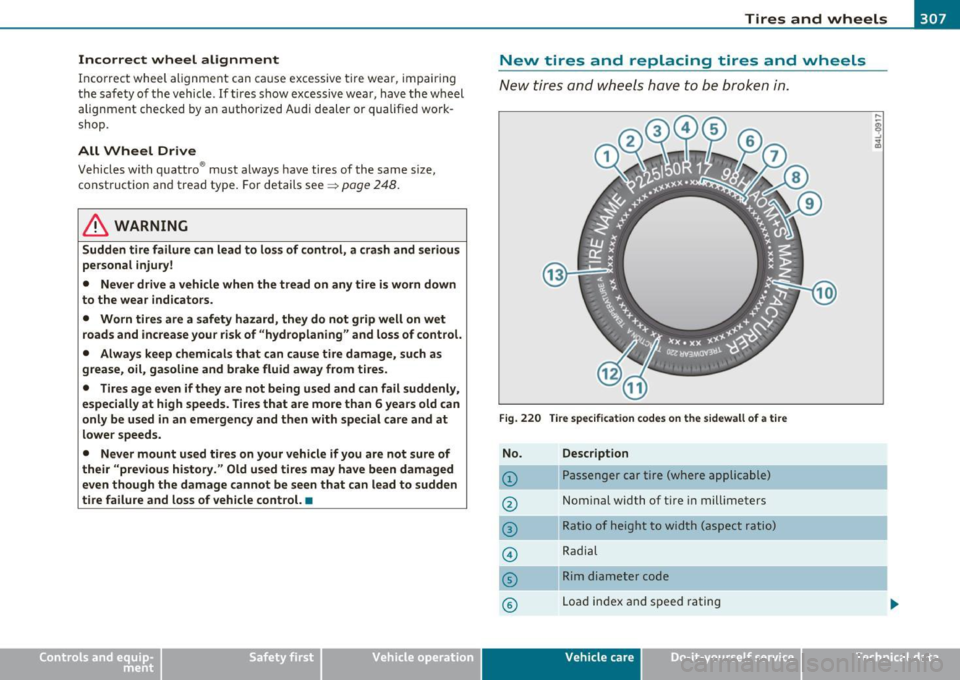
N ew t ires an d w hee ls have to be brok en in .
Fig. 220 Tire specificat ion codes on th e sidewall of a tire
No.
©
®
®
©
©
©
Description
Passenger car tire (where applicable)
Nom inal wid th of ti re in mil limeters
Ratio of hei9ht to width (aspect ratio)
Radial
jj Rim diameter code
L oa d index and speed rating
Vehicle care Do-it-yourselt service iTechnical data
Page 354 of 370
___ A_l_,_ p _ h_ a _ b_e _ t_ i_c __ a _l _i_n :...::d __ e::..: x:...::...,_ _________________________________________ _
A Temporarily turning off .......... . 124
warning/indicator lights .... ...... . 127
Danger of fitting a child safety seat on the
front passenge r seat ............
199
Accessories ..... ................... 348 Adaptive Light ......... ....... .. .. .. 61 Disposal .................. .. .... 211
Adapter for cupholder ................ 89 defective ........................ 32 Front airbags ......... ... .... 201, 202
Adaptive Air Suspension ............. 168
Automatic mode .. .. ... .... ...... 169
Comfort mode ................... 169
Description ..................... 168
Dynamic mode ... .. ... ...... .... 169
Jacking mode when changing a flat tire ...
170
Lift mode ....................... 169
Setting the driving modes ......... 169
Trailer towing mode .............. 170
Warning/indicator lights .... ....... 16
Adaptive Cruise Control ......... ... .. 119
Changing speed ....... ........... 123
Driver information .............. .
Driver intervention prompt ...... . . Adding
Engine coolant ........... ...... .
287
Engine oil ............ ...... ..... 284
Windshield washer fluid ........... 294
Additional accessories ............... 348
Additives
Engine oil ............ .. .........
284
Adjusting
Instrument cluster illum ination .....
11
Steering column electrically ........ 107
Steering column manually .. .. .. .. . 106
Adjus ting front seats ................. 75
Air conditioning
See Climate controls ...............
96
Air distribution How do the front airbags work?
.....
206
How many airbags does my vehicle have? .
204
How the Advanced Airbag System compo-
nents work together ............
205
Important things to know ... .. .. .. 197
Indicator light ................... 208
Monitoring ... .................. 208
PASSENGER AIR BAG OFF light ..... 209
Repairs ............ .. .. .. ...... 211
Safety instructions ............... 210
Side airbags .... .... ............. 213
Side curtain airbags .............. 216
Weight-sensing mat ..............
220
When must the system be inspected? 208
All Wheel Drive ... ... ............... 248 Dr iv ing in traffic ................ .
Driving program .. ...... ........ .
127
130
120
131
Climate controls 100 Alloy wheels ................. .... .. 265
Error messages . .. .. .... ........ .
Open road ... .. .. .. .. ....... ... . 129 Air pollutants filter
120 Climate controls .................. 96
All-wheel drive
Winter tire s .....................
311
Override ...................... .. 120 Airbag
Alternator
Request for driver to assume control
120 Warning/indicator lights ..... ...... 14 Malfunction ........ .............. 26
Save speed . ...... .. .. ........... 122 Airbag system .................. 197,214 Ambience lighting
Setting distance .. ...... ...... .. .
125 Advanced Airbag System .......... 201 Lighting profiles .. .. .............. 64
Setting time interval .............. 125 Advanced Airbag System components 204 Anti-freeze
Settings ...................... ..
131 Care ... .. .......... ....... .. .. . 211 See Engine coolant system ......... 286
Special driving situations .......... 131
Status messages ................. 129
Switching on and off .............. 122
System limits ................... 131
Child restraints .................. 221
Children ........................ 220
Components (front airbags) ... ..... 204
Anti-glare inside day-night mirror .... 69, 70
Anti-lock brake system
How the ABS system works ...... ..
246
Warning/indicator lights ........... 17
Page 355 of 370

Alphabetical index -________________ fWI
Anti-Slip Regulation System (ASR)
How the system works ....... .. .. . 244
Anti-theft systems Anti-theft alarm system ....... ... .. 49
Electronic immobilizer ............. 40
Ashtray Front .............. ...... .. .. .. .. 91
Rea r ........ .... .. .. ... ......... 91
ASR How the Anti-Slip Regulation System works . ...... .. ... .. .. ......... 244
Asterisk What does it mean when something is
marked with an asterisk? ........... S
Audi Service Repair Manuals and Literature
346
AUTO mode AC climate controls ...... .... .. .. .. 99
Auto Safety Hotline .... .. .. .. ....... 185
Auto-Check Control .. ........ .... ... .. 24
Automatic belt retractor ............. 191
Automatic car wash
See Washing ....... .. .... .. .. .. . 261
Automatic Shift Lock (ASL) ..... .. 148, 155
Automatic transmission 6-speed automatic transmission ... . 146
Automatic Shift Lock (ASL) .... 148, 155 Driving ............ .. .. .. .. .... . 146
Dynamic shift program ... .. .. .. .. . 149
Emergency release for selector lever . 152
Emergency release for selector lever
(mu ltitron ic®) .............. .... 159
Fail-safe mode .............. 151, 158
Controls and equip
ment Safety first
Ignition key safety lock
.... ... .. .. . 109
Kick -down . .. .. .... .. .. .. ....... 149
Manual shift program .. ... ... .... . 150
multitronic ® ....... ... ... .. .. ... 152
Selector lever .... .. .. .. .. .. . 147, 154
Shift buttons . ........... ... 151, 158
Steering wheel with tiptron ic® . 151, 158
Average speed .. ... .... .. .. .. .... .... 34
Avoid damaging the vehicle ........... 252
B
Battery ... ..... .................... 290
Battery location ins.ide the luggage
compartment . ........ ......... 291
Charging ................ .... .. .. 292
Important warnings when wo rk ing on the
battery . .. .. ..... ....... ... .. .. 291
Jump starting ..... ...... ..... .. .. 332
Low ..... .. ... ..... .. ....... .... 249
Replacing the battery .. .. ... ...... 294
State of charge .... ... ........... 249
Voltage ................. .. .. .. .. . 31
Winter operation ...... .. .. .. ..... 290
Working on the battery .... ... .. .. . 291
Before driving .. ... ... .. ... .. .. .. .. . 177
Blended gasoline ................... 273
Body cavity seal ing . ...... .. ......... 266
Booster seats . .. .. ........ ......... 227
Brake assistant ...... ............... 247
Brake booster . ........ ... ... .. .. ... 246 Brake fluid
Changing the brake fluid ....... .... 289
Checking the brake fluid level ....... 289
Reservoir . .... .. .. ... .... ... ... . 289
What is the correct brake fluid level? . 289
What should I do if the brake fluid warning
light comes on? . ................ 289
Brake light Defective ... .. ................... 21
Brake system . .. .. .. .. .. ... ..... .. .. 289
Anti-lock brake system ............. 17
Brake fluid ........ ............. . 289
Brake fluid spec ificat ions for refil l and
replacement . .... ....... ... ... . 289
Brake pads .. .. .. .. ...... .. .. .. .. 252
Electromechanical parking brake ... . 113
General informat ion ..... ...... .. . 245
How does moisture or road salt affect the
brakes? ... .................. .. 245
Malfunction ...................... 26
Warning/indicator lights ... .. .. .. .. 18
Worn brake pads symbol ........... 31
Break -in period ... .. .. .............. 251
Brake pads . ... ................ .. 252
Tires ... .... .................... 251
Bulbs .................. .. .. .. .. ... 330
Bumper cover Caution when parking near a parking barri-er or curb . ................... .. 114
C
California Proposition 65 Warning ..... 280
Battery specific .... .............. 292
Vehicle operation Vehicle care Do-it-yourself service Technical data
Page 358 of 370

ffl Alphabetical index ------',.__ ___________________________________ _
Driv ing messages ...... ...... .. .. .. .. 24
Dr iv ing safely ..... .. .. .. .. ...... ... 176
Dr iving through water ... ... ... .. .. .. 252
Dr iv ing time .. ............ .......... 34
Duplica te key . .... .... .. .. .. ........ 3 7
Dust fi lter
Climate controls .. .. .. .... .. .. . ...
96
DVD player for navigation system . .. . .. . 86
Dynam ic shift program ............ .. 1 56
E
Easy entry feature . .. .. .. .. .... ..... 1 08
Electric seat adjustment
See Power seat ................... 76
Electromechanical parking brake
Emergency braking . ... .. .. .... .. .
11 5
Ma lf u nct ion . . . . . . . . . . . . . . . . . . . . . 115
Operation . . . . . . . . . . . . . . . . . . . . . . 113
Park ing .................... .. .. 114
Releasing and app ly ing ... .. ... .. .. 113
Starting off w ith a t railer ......... . 115
Warning/ind icator lights . .......... 17
Electronic differential lock (EDL)
How the system works ... .........
243
Warning/ind icator lights . .......... 17
Electroni c immobili ze r ... .... .. .. .. .. . 4 0
Electronic powe r control
(EPC) war ning/ indicato r light .. .. ... .
14
Electronic speed limiter ........ .... .. . 23
Ele ctro nic s tabiliza tion p rogram ( ESP)
How t he system wor ks ... .........
2 4 2
W arning/ind icator lights . .......... 14
Emergency braking ..... .. .. .. .. .. .. 115
Emergency closing
Power su nroof ... ... .. .. . ... ...
55, 56
Eme rgency flasher ................ ... 61
Wa rning/ind icator l ights . .. .. .. .. .. 15
Emergency locking of doors . .. .. .. .. .. 45
E mergency sta rt ing .... ..... ... .. .. . 332
Emergency towing .................. 335
Energy management ................ 249
Battery power .. .. .. .. .. .... ..... 250
Dr iver not ification ............... . 250
Engine
Compartment . ... .. .. .. .. .. .. ...
280
Coolant .. ... .. .. .. .. .... .. .. .. . 286
Hood . ... .. .. .. .... ... .. .. .. .. . 278
Starting ....... .. .. ........ . 108, 109
Starting with jumpe r cab les . .. .... . 332
Stopping ...... .............. ...
110
Engine compa rtment
Sa fety instructions . .... ... .. .. .. .
2 79
Working the eng ine compartment .. 2 79
En gine coolant system ........ .. .. .. . 286
Add ing coolant ................. . 287
Checking coo la nt level . ..... .. .. .. 286
Checking the engine coo lant level . .. 286
Ma lfu nction ... .. ..... ..... .... .. . 27
Radiator fan ....... .. ... . .. .. ... 288
E ngine coo lant tempe rature
T emperat ure gauge ............. .. . 8
Engine data ....... ...... .... .. .....
343
Engine hood
Closing .... ..... ..... .... .. .. .. .
2 79
How to re lease the hood ..... .. ... . 278
Engine oil .. ... .... ... .. . ... ... .. .. 281
Add ing .............. .... ... .. .. 284
Add itives .................. .... . 284
Changing .. ..... .......... .. .. .. 285
Checking the engine oil leve l ..... .. 2 83
Indi cat io ns and conditions requiring extr a
check ing . .. .. .. .. .............
283
Oil consumption .... ............. 282
Oil grades . .. .. .... ..... ....... . 281
Recommended oil check intervals ... 283
Specification and viscosity ..... .. .. 28 1
Engine oil leve l .... .. .. ............. . 31
Engine oil p ress ure
Mal fu nct ion .. .. .. .. .... ..........
28
Engine oil sensor defect ive . ...... ... .. 31
Engine speed limitation ....... ... .. .. . 32
Environmen t
Bre ak-in per iod ...... ...... .. .. ..
2 51
Ca taly tic converte r .. .... ......... 2 52
Disposing o f you r vehi cle bat tery .... 29 4
Driving at hig h speeds ..... ... . ... 254
Driving to minimize poll ution and noise . .
253
Fuel .. .. .... ....... ...... .... .. 27 5
Fue l economy .. .. .. ....... .. .. .. 2 53
Leaks unde r yo ur vehicle ... .. .. .. . 2 79
Lett ing the vehicle stand and warm up .. .
254
Proper disposa l of dra ined brake fluid 289
Prope r disposal of dra ined engine coo la nt
287
Proper disposal of drained engine oil 284,
285
Recy cling used e ng ine o il .......... 2 8 4