parking brake AUDI A6 2011 User Guide
[x] Cancel search | Manufacturer: AUDI, Model Year: 2011, Model line: A6, Model: AUDI A6 2011Pages: 370, PDF Size: 87.15 MB
Page 118 of 370

lffllL--_O=-:.. n.:.....: t;,:.h .:...:e~ r...::o =-- a=-.:. d;__ ________________________________________________ _
Press brake pedal to release parking brake
This driver message appears when the switch to release the parking
brake was pressed . The parking brake can only be released if you press
the brake or accelerator pedal and press the switch at the same time.
Parking brake malfunction !
This driver message appears together with the yellow symbol
when there is a parking brake malfunction .
0 Note
If the warning/indicator light (U.S . models: BRAKE , Canadian models:
«D>) flashes in the instrument cluster, there is a brake system
malfunction . By pressing the [
CHECK I button, you can bring up a
d river message which explains the malfunction in more detail. If the
message
Parking brake! Please contact workshop appears, there is a
parking brake malfunction which you should have repaired immedi
ately by an authorized dealership~
page 26. •
Cruise control
Applies to veh icles: wit h cruise co ntro l
Switching the system on
The cruise control system makes it possible to drive at a
constant speed starting at 20 mph (30 km/h) .
-"' M
-w ., a,
Fig. 105 Control lever
with set button
Fig. 106 Display:
Selected speed
-Pull the lever to position (D => fig. 105 to switch the
system on .
- Drive at the speed you wish to set.
- Press button
© to set that speed .
Page 132 of 370

ffl..__A_ d_a_ p,__ t_iv _ e_ C_r _u _ i_ s _e _ C_ o_ n_t _ r_ o _ L ___________________________________________ _
to the traffic situation is absolutely necessary. The following may be
reasons why the message
ACC functionality limited appears:
• The ACC sensor is dirty . The ACC system is not reacting, or is not
reacting correctly, to moving vehicles up ahead in your lane of travel.
• There may be very light traffic on and there is nothing that marks
the side of the road (for example, guard rails, traffic signs, trees) . As
soon as a moving vehicle up ahead is detected aga in, ACC becomes
active again and the message disappears.
Th e ACC sensor is located in the area under the front license plate.
If
the ACC sensor is dirty or blocked, clean the area to restore system
operat ion.
ACC not available
The text message ACC not available appears, for example, if the
temperature of the brakes is excessive. Adaptive Cruise Control is
temporarily not available. A warning tone sounds as a reminder.
ACC not available!
The text message ACC not available! appears in the event of a
malfunction. Adaptive Cruise Control is turned off. A warn ing tone
so unds as a reminder. Have the system inspected by a qualified deal
ership.
ACC sensor blocked !
The text message ACC sensor blocked! appears when the ACC System
can no longer accurately detect vehicles moving up ahead in your lane
of travel. Adaptive Cruise Control is turned off. A warning tone also
so unds as a reminder.
To decide whether it is necessary to switch off the ACC (ACC sensor
blocked
!) or if it is only a temporary condition (ACC Functiona lly
limited), the system w ill also takes into consideration the outside
temperature and/or the windshield wiper operation .
Th e ACC sensor is dirty or blocked (e.g. leaves, snow) . The ACC sensor is located in the area under the front
license plate. If
the ACC sensor is dirty or bloc ked, clean the area to restore system
operation .
EPB activation
The text message EPB activation appears if emergency braking was
man ua lly initiated with the Electromechanical Parking Brake (EPB).
The Adaptive Cruise Control is turned off . Th is is accompanied by a
wa rning tone.
Speed
The set speed in mph (Canada km/h) always appears when saving or
changing the speed in Adaptive Cruise Control=:>
page 122, "How is
the speed stored?" and=:>
page 123, "Changing stored speed".
Selector lever position!
The text message Selector lever position! appears when the selecto r
lever is moved to position
N . In this position, Adaptive Cruise Control
is not available. •
Applies to vehicles: wit h Adapt ive Cruise Contro l
Driver intervention prompt
The driver intervention prompt calls on the driver to take
over the situation.
Fig. 118 I nstrument
cluster: Dr iver inter -
v ent ion prompt
~
Page 148 of 370
llffl..__A_ u_t_ o_ m_ a_t _i _c _t_ r_ a_ n_s _m _ i_ s _s _ i_o _n ___________________________________________ _
Automatic transmission
tiptronic® (6-speed automatic
transmission)
Ap plies to veh icle s: with 6-spe ed a uto mat ic trans missi on
General information
Your v ehicle is equipp ed with an ele ctronically con trolled automat ic
transmiss ion. Upshifti ng and downshifting takes place
automati
c ally.
The transm ission is also equipped with tiptronic ®. It allows the driver
t o shift gears
manually if desired=> page 150 . •
App lies to vehicl es: w ith 6 -s pee d automat ic transmiss ion
Driving the automatic transmission
St arting the engine
- The selector lever must be in N or P.
Starting off
- Press and hold the brake pedal.
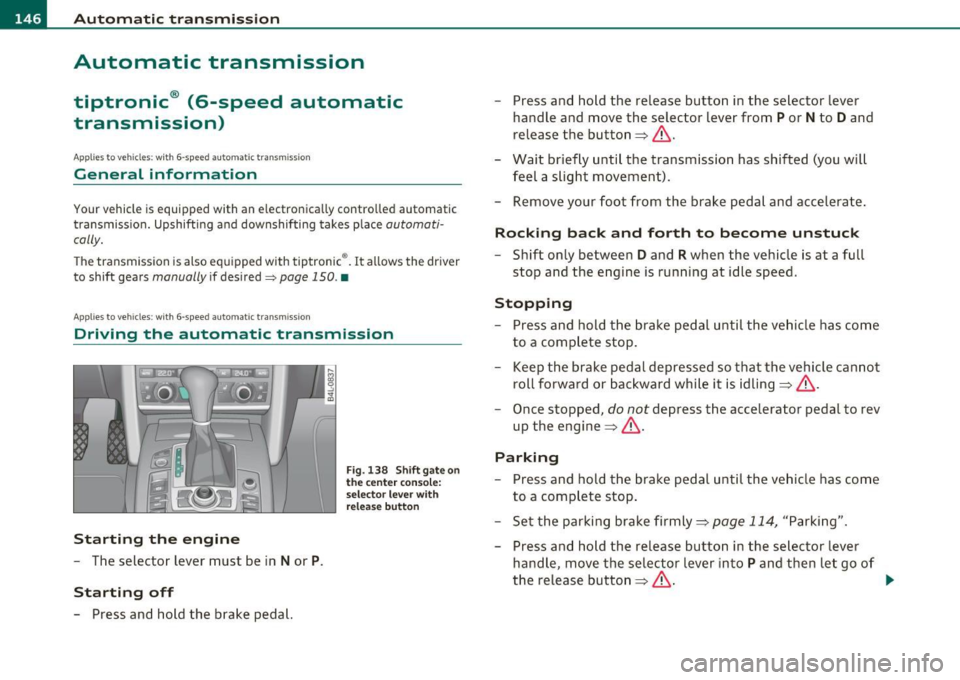
Fig . 138 Shift gate on
t he center conso le:
selec tor lever with
release button
- Press and hold the release button in the selector lever
handle and move the selector lever from
P or N to D and
release the button~ & .
- Wait briefly until the transmission has shifted (you will feel a slight movement).
- Remove your foot from the brake pedal and accelerate .
Rocking back and forth to become unstuc k
-Shift only between D and R when the vehicle is at a full
stop and the eng ine is running at idle speed.
Stopp ing
- Press and hold the brake pedal until the veh icle has come
to a complete stop .
- Keep the brake pedal depressed so that the vehicle cannot roll forward or backward while i t is idling ~ & -
- Once stopped,
do not depress the accelerator pedal to rev
up th e engine ~& .
Parking
- Press and hold the brake pedal until the vehicle has come
to a complete stop .
- Set the parking brake firmly~
page 114, "Parking" .
- Press and hold the release button in the selector lever handle, move the selector lever into
P and then let go of
the release button~ & - .,
Page 149 of 370

______________________________________________ A_ u_ t_ o _ m_ a_ t_ ic_ t_r_a _ n_ s_m_ i_ s _s_ i_ o _ n __ l!'II
The selector lever must be in Nor P. If one of the dr iv ing positions is
eng aged a safety swi tch will p reven t th e e ng ine from be ing s tarte d.
See also=>
page 109.
Before you move t he se lector lever from t he P position, yo u must
always ap ply the b rake peda l befo re and while de press ing the bu tton
in the handle of the selector lever.
_& WARNING
• Unintended vehicle movement can cau se serious injury.
- When the selector lever is in a driving position, the vehicle may creep, even at idle speed. Therefore do not release the
parking brake or foot brake until you are ready to move,
because power is transm itted to the wheels as soon as a driv ing
po sition i s engaged.
- Do not accelerate while selecting a driv ing position . At this
time the engine must be at idle speed so that undue stress i s
not placed on the clutches in the transm iss ion.
- Remember : • even when stopped briefly with the automatic
transmission in "D", "S" or "R" , engine power is being trans
mitted to the wheels . Your vehicle could "creep " forward or
backward. When stopped, keep the brake pedal fully
depre ssed and use the parking brake if neces sary to keep the
vehicle from rolling .
• If the selector lever is unintentionally moved into N while you
are driving, take your foot off the accelerator pedal and wait for
the engine to return to idle speed before selecting a driving posi
tion.
• Never shift into "R " or "P " when the vehicle is in motion .
• Never get out of the d river's seat when the engine is running.
• If you must get out of the vehicle , move the selector lever
securely into the P position and apply the parking brake firmly .
• If the engine must remain running, never have any driving
position engaged when checking under the hood.
Make sure the
selector lever has securely engaged and is locked in "P " with the
Controls and equip
ment Safety first
& WARNING (
co ntinued )
parking brake firmly set=> page 271, "Engine compartment ".
Otherwi se, any increase in engine speed may set the v ehicle in
motion , even with the par king brake applied. •
Applies to vehicles : w ith 6-s peed automatic tran smission
Selector lever positions
T his s ection describ es the selector lever positions and
driving ranges.
Fig . 139 Di splay in
the in strum ent cluster :
se lector le ver In po si
tio n P
Th e selector lever posi tion engaged appe ars next to the se lec tor lever
as well as in the instrument cluster display .
P -Park
In this selector lever position the transmission is mechan ica lly
lo cked. Engage P only when the vehi cle is
comple tely stop ped=> &
in "Driving the automatic transmissio n" on page 146.
T o sh ift in or o ut of position P, yo u must first press an d hold the brake
peda l
and then press t he release button in the se lecto r lever hand le
wh ile moving the selector lever to or from P. Yo u can s hift out of this
posit ion on ly with the ignit ion on . .,,
Vehicle care Technical data
Page 155 of 370

Automatic transmiss ion Ill _______________ ____.
Applies to vehicles : with multitronic® Continuously Variab le Transm ission (CVT)
Driving the multitronic ®
The gear ratio is continuously adapted to vehicle speed
and load.
Starting th e engin e
- The selector lever must be in Nor P.
Sta rting off
- Press and hold the brake pedal.
Fig. 146 Sec tion of
t he cente r co nso le :
selector leve r wit h loc k
but ton
- Press and hold the release button in the selector lever
handle and move the selector lever from
P (alternatively
N ) to D (alternatively S) and release the button .
- Wait briefly until the transmission has shifted (you will feel a slight movement).
- Remove your foot from the brake pedal and accelerate
=> & .
Rocking back and fo rth to become unstuck
- Shift only between D and R when the vehicle is at a full
stop and the engine is running at idle speed.
Con tro ls a nd e quip
m en t Vehicle OP-eration
Stopping
- Press and hold the brake pedal until the vehicle has come
to a complete stop.
- Keep the brake pedal depressed so that the vehicle cannot
roll forward or backward while it is idling
=> & .
- Once stopped,
do not depress the accelerator pedal to rev
up the engine=> &.
Parking
- Press and hold the brake pedal until the vehicle has come
to a complete stop .
- Set the parking brake firmly=>
page 114, "Parking".
- Press and hold the release button in the selector lever handle, move the selector lever into
P and then let go of
the release button=>& .
Your vehicle is equipped with a st ar ting ass ist that allows for easier
sta rting on inclines. The system is activa ted when the brake peda l is
depressed for a
few se con ds. After releasing the brake pedal, the
brake power is he ld for a moment to prevent the vehicle from rolling
back when starting .
The selector lever must be in Nor
P. If one of the driving positions is
engaged a safety switch will prevent the engine from be ing started .
See also=>
page 109.
Before you move the selector lever from the P position, you must
always apply the brake pedal before and while depressing the button
in the handle of the selecto r lever .
& WARNING
• Uninte nded vehi cle mov em en t ca n cau se se rious injury.
Vehicle care Do-it-yourselt service iTechnical data
Page 156 of 370
IIJIL___!A~u~t~o~m~a~t~i~c ~t~ra~n~s~m~i~s~s~i~o~n~ -------------------------------------------
& WARNING (conti nu ed )
-When the selector le ver is in a driving position, the vehicle
may creep, even at idle speed. Therefore do not relea se the
parking brake or foot brake until you are ready to mov e,
becau se power is transmitted to the wheel s as soon a s a driving
po sition i s engaged .
- Do not a ccelerate while selecting a driving position . At this
time th e engine must be at idle sp eed so that undue stres s is
not placed on the clutche s in the tran smis sion .
- Remember: -even when stopped b riefly with the automatic
tran smi ssion in "D ", "S " or "R ", engine power is being tran s
mitted to the wheels . Your vehicle could "creep " forward or
ba ckward. When stopped , keep the brake pedal fully
depre ssed and use the parking brake if necessary to keep the
vehicle from roll ing.
- If the selector lever is unintentionally moved into N while
you are driving, take your foot off the accelerator pedal and
wait for the engine to return to idle speed before s electing a
driving pos ition .
- Never shift into "R " or "P " when the vehicle i s in motion .
- Never get out of the driver 's seat when the engine i s running.
- If you must get out of the vehicle , move the selector leve r
s ecurely into the P position and apply the parking brake firmly .
-If the engine must remain running , never have any driving
po sition engaged when checking und er the hood . Make sure
the selector leve r has securely engaged and is locked in "P"
with the parking brake firmly set=>
page 271, "Engine
compartment ". Otherwise , any increase in engine speed may
set the vehicle in motion, even with the parking brake
applied. a
Applies to vehicles: with mu lt itron ic® Continu ous ly Vari able Transmission (CVT)
Selector Lever positions
This section descri bes the selector lever positions and
driving r ang es .
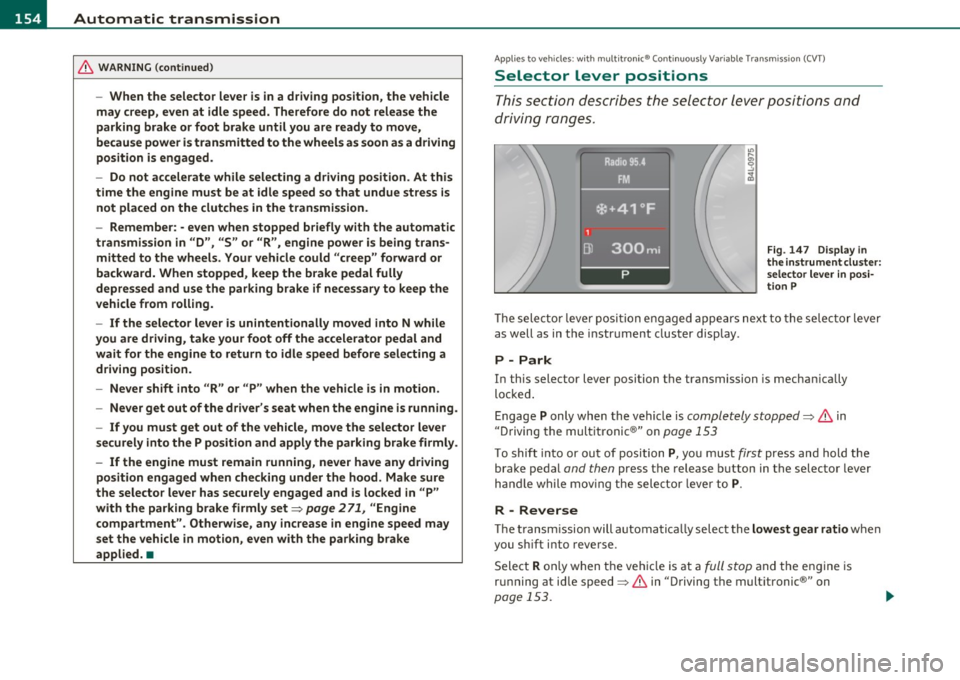
Fig . 14 7 Displ ay in
the in strume nt clu ster :
selecto r leve r in posi
ti on P
Th e sele cto r lever posi tio n engaged appears nex t to the se lec tor lever
as well as in the i nstr ument clus ter disp lay .
P - Park
In this selector lever position t he transmission is mechan ically
lo ck ed.
Engage P only wh en the vehicle is completely stopped=>
& in
" Dr iving the mult itronic ®" on page 153
T o shift into or out of position P, yo u mus t first press an d hold the
brake pedal and then press the release b utton in the selector lever
h andl e wh ile mov ing the sele cto r leve r to P.
R - Reverse
Th e tran smi ssion will a utoma tica lly selec t the lowest gear ratio when
you sh ift into reve rse.
Select R only when t he veh icle is at a full stop and the eng ine is
running at idle speed=>
& in "Driving the multitronic®" on
page 153.
~
Page 174 of 370

Ill HomeLink® ..__ ______________ _
Applies to veh icles : w ith Homelin k® un iversa l remote control
Programming the Homel ink ® transmitter
The transmitter is programmed in two phases . For rolling
code transmitters, a third phase is also necessary .
illUl~~ . l
~-1 II I Ill
Fig. 163 Over head
conso le: Homelink ®
keypad
Fig. 16 4 Front
bumper, passenger
s ide: loc ation of trans
mitter unit
Phase 1: progr amming th e overhead k eypad
1. Make sure your vehicle is within operating range of the
remote controlled garage door opener .
2. Set the parking brake~
& in "General information " on
page 171 .
3. Turn the ignition on . Do not start the engine! 4
. Press and hold the two outside Homelink ® buttons
(D
and (@)for approximately 20 seconds until indicator l ight
@ ~ fig. 163 begins to flash . Then release both buttons .
Do not hold the buttons for longer than 30 seconds .
- This procedure only needs to be performed
once . It erases
the factory-set default codes and does not have to be repeated to program additional remote controls .
5. Press and hold the Homelink ® button
(D , @ or@ until
the indicator light © starts flashing
slowly . Release the
button .
-The system will now rema in in programming mode for 5
minutes.
Co to the front of the vehicle and proceed with
phase
2 .
Phase 2:
programming the bumper mounted transmit
ter
6 . Hold the original r emote control at a distance between 0-
6 in. (0 -15 cm) from the bumper below the appropriate
headlight for your vehicle~ fig . 164 (use the shortest
distance possible) .
7 . Aim the remote control just below the
passenger side
headlight .
8. Press and hold the activation button on the remote control.
- May be d ifferent in Canada . If so, press and re-press
(cycle) the activation button on yo ur remote control every
two seconds. .-,,
Page 260 of 370
Trailer towing
"---------------------------------------------------
Speed
T he higher the speed, the more difficult it becomes for the driver to
control the rig. Do not dr ive at the max imum permiss ible speed.
Reduce your speed even more if load, weather or wind conditions are
unfavorable -part icu larly when go ing downhill.
Reduce vehicle speed
immediately if the tra iler shows the slightest
sign of swaying.
Do not try to stop the swaying by accelerating.
Observe speed limits. In some areas, speeds for veh icles towing
trailers are lower than for regu lar vehicles.
Always apply brakes early. When driv ing dow nhill, shift in to a lower
gear to use the eng ine braking effect to slow the veh icle. Use of the
bra kes alone can cause them to overheat and fail.
Coolant temperature
Th e coolant temperature gauge~ page 8 must be observed care
fully. If the needle moves close to the upper end of the scale, reduce
speed immediately and/or turn off the air conditioner.
If the coolant temperature warning light in the instrument cluster
starts flashing
_f_ , pull off the road, stop and let the engine idle for
about two m inutes to prevent heat build-up.
& WARNING
Anyone not properly restrained in a moving vehicle is at a much
greater risk in an accident. Never let anyone ride in your car who is
not properly wearing the restraints provided by Audi.•
Trailer towing tips
Important to know
------------
Your vehicle handles differently when tow ing a trailer because of the
additiona l weight and different weight distribution. Safety, perfor- mance and economy will greatly depend on how carefully you load
your trailer and operate your rig.
Before you actually tow your trailer, practice turning, stopp ing and
backing up in an area away from traffic. Keep practicing until you have
become completely familiar with the way your vehicle-t railer comb i
nation behaves and responds.
Backing up is difficult and requires practice. Backing up with a trailer
generally requires steering action oppos ite to that when backing up
your vehicle without a trai ler.
Maintain a greater distance between your vehicle and the one in front
of you. You will need more room to stop. To compensate for the
trailer, you will need a larger than normal turning radius .
When passing, remember that you cannot accelerate as fast as you normally would because of the added load . Make sure you have
enoug h room to pass. After passing, allow plenty of room for your
trai ler before changing lanes again.
Avoid jerky sta rts, sharp tur ns or rapid lane changes.
W Tips
• Do not tow a trailer during the break-in per iod of your veh icle.
• If you tow a trai ler, your Audi may require more frequent mainte
nance due to the extra load
~ page 346. •
Parking on a slope
Do not park on a slope with a trailer. If it cannot be
avoided, do so only after doing the following:
When parking:
- Apply the foot brake.
- Have someone p lace chocks under both the vehicle and the
trailer wheels . ._
Page 261 of 370

-With chocks in place, slowly release the brakes until the
wheel chocks absorb the load.
- Turn the whee ls towards the curb .
- Apply the parking brake.
- Move the selector lever to
P.
When restarting after parking:
- Apply the foot brake.
- Start the eng ine .
- M ove the selector lever to
D.
-Release the parking brake and slowly pu ll out and away
from the wheel chocks .
- Stop and have someone retrieve the wheel chocks .
[ i ) Tips
If you move the se lector lever of the automat ic t ransm ission to P
before applying the parking brake and before blocking the whee ls,
yo u may have to use mo re force later to move the leve r out of t he
P
position. •
Controls and equip
ment Safety first Vehicle operation
Vehicle care Do-it-yourself service Technical data
Page 281 of 370

___________________________________________ C..:...._ h:....:e :....:c:..:. k.::..: i..:.. n .:..:g:!:....:: a....:. n..:.. d~ f:....:. i.:..ll :.:.i:....:n :.:g !....- __
Closing the engine hood
- Pull the hood down until the pressure from the struts is
reduced.
- Let the hood
drop down and latch in place. Do not try to
push it shut;
it may fail to engage=:> &.
& WARNING
A hood that is not completely latched could fly up and block your
view while driving.
• When you close the engine hood, check it to make sure the
safety catch has properly engaged. The hood should be flush with
the surrounding vehicle body parts.
• If you notice while driving that the hood is not secured prop
erly, stop at once and close it. •
Working in the engine compartment
Be especially careful whenever you work in the engine
compartment.
Whenever you must perform any work in the engine compartment,
for example checking and filling different fluids, there is a risk of injury, burns and accidents. To prevent personal injury always
observe the following WARNINGS. The engine compartment of any
vehicle is a hazardous area=>& .
& WARNING
To help avoid injury, before you check anything under the hood:
• Turn off the engine.
• Remove the ignition key.
• Apply the parking brake.
Safety first
& WARNING (continued)
• Move selector lever to "P" (Park).
• Always let the engine cool down. Hot components will burn
skin on contact.
• To reduce the risk of being burned, never open the hood if you
see or hear steam or coolant escaping from the engine compart
ment. Wait until no steam or coolant can be seen or heard before
carefully opening the hood.
• Keep children away from the engine compartment.
• Never spill fluids on hot engine components. They can cause a
fire. • Never touch the radiator fan. The auxiliary electric fan is
temperature controlled and can switch on suddenly.
• Never open the coolant reservoir cap when the engine is still
warm. The coolant system is pressurized and hot coolant could
spray out.
• Protect your face, hands and arm from steam or hot engine
coolant by placing a thick rag over the cap when you open the
coolant reservoir.
• If work on the fuel system or the electrical system is necessary:
- Always disconnect the battery.
- Never smoke or work near heaters or open flames. Fluids in
the engine compartment could start a fire.
- Keep an approved fire extinguisher immediately available.
• To avoid electrical shock and personal injury while the engine is
running or being started, never touch:
-Ignition cables
- Other components of the high voltage electronic ignition
system.
• If you must perform a check or repair with the engine running:
- First, fully apply the parking brake, move selector lever to
"P" (Park). .,
Vehicle care Technical data