remove seats AUDI A6 2011 User Guide
[x] Cancel search | Manufacturer: AUDI, Model Year: 2011, Model line: A6, Model: AUDI A6 2011Pages: 370, PDF Size: 87.15 MB
Page 230 of 370
____ C_ h_ i _l_d _S_ a_f _e _ty ~ --------------------------------------------
- Always make sure that the child can properly wear the lap
portion of the belt low across the thighs or pelvis and
never over the stomach or abdomen.
Children up to at least 8 years old (over 40 lbs. or 18 kg) are best
protected in child safety seats designed for their age and we ight.
Experts say that the skeletal structure, particularly the pelvis, of
these children is not fully developed , and they must not use the
vehicle safety belts without a suitable child restraint .
It is usually best to put these children in appropriate booster seats.
Be sure the booster seat meets all appl icable safety standards.
Booster seats raise the seating position of the child and reposition
both the lap and shoulder parts of the safety belt so that they pass
across the child's body in the right places. The routing of the belt over
the child's body is very important for the child's protection, whether
or not a booster seat is used . Children age 12 and under must always
ride in the rear seat.
Chi ldren who are at least 4 ft. 9 in . (57 inches/1.45 meters) tall can
generally use the vehi cle's three point lap and shoulder belts. Never
use the lap belt portion of the vehicle's safety belt alone to restra in
any child, regardless of how big the child is. Always remember that
children do not have the pronounced pelvic structure required for the
proper function of lap belt portion of the vehicle 's three point lap and
shoulder belts . The chi ld's safety absolutely requires that a lap belt
portion of the safety belt be fastened snugly and as low as possible
around the pelvis . Never let the lap belt portion of the safety belt
pass over the child's stomach or abdomen.
In a crash , airbags must inflate within a blink of an eye and with
cons iderable force . In order to do its job, the airbag needs room to
inflate so that it will be there to protect the occupa nt as the occupant
moves forward into the a irbag .
A vehicle occupant who is out of position and too close to the airbag
ge ts in the way of an inflat ing airbag . When an occupant is too close,
he or she will be struck violently and will receive serious or possibly
even fatal injury. In order
for the airbag to offer protection, it is important t hat all
vehicle occupants, especially any children, who must be in the front
seat because of exceptional c ircumstances, be properly restrained
and as far away from the airbag as possible. By keeping room
between the child's body and the front of the passenger compart
ment, the airbag can inflate completely and provide supplemental
protection in certain frontal collisions.
& WARNING
Not using a booster seat, using the booster seat improperly, incor
rectly installing a booster seat or using the vehicle safety belt
improperly increases the risk of serious personal injury and death
in a collision or other emergency situation. To help reduce the risk
of serious personal injury and/or death:
• Always make sure to position the shoulder portion of the three
point belt over the middle of child's shoulder.
• Never let the shoulder portion of the belt rest against or across
the neck, face, chin, or throat of the child.
• Always make sure the lap belt portion of the three-point belt is
worn snug and passes as low as possible across the child's pelvis.
Never let the belt pass over the soft abdomen.
• Failure to properly route safety belts over a child's body will
cause severe injuries in an accident or other emergency situation
~page 187.
• The rear side of the booster seat should be positioned as close
as possible to the backrest on the vehicle seat. Adjust or remove
the rear seat head restraint if it is difficult to install the child seat
with the head restraint in place
~ page 81 . Install the head
restraint again immediately once the child seat is removed.
Driving without head restraints or with head restraints that are
not properly adjusted increases the risk of serious or fatal neck
injury dramatically.
• Children on the front seat of any car, even with Advanced
Airbags, can be seriously injured or even killed when an airbag
inflates.
Page 237 of 370

Guidance fixtures for Lower anchorages
Special guidance fixtures increase the convenience of the lower anchorages and are available from your authorized
Audi dealer .
Fig. 196 Outer rear
seats: installing the
guidance fixtures
Fig. 197 Close-up:
fitting the guidance
fixture over the lower
anchorage bracket
The lower anchorage attachment points are located on the
rear seats between the seatback and the seat cushion.
Special guidance fixtures increase the convenience of the lower anchorages and help protect the seat material from
possible damage when installing child restraints.
Safety first Vehicle OP-eration
Child Safety
Installing the guidance fixtures
- Push down on the seat cushion so that the lower anchor
ages are visible .
- Hold the guidance fixture with the part number facing
downward and push it in the direction of the arrow onto
the anchorage ~ fig . 197 .
- Make sure that each of the two guidance fixtures per seat
snaps into place .
Removing the guidance fixtures
-Remove the child restraint according the child restraint
manufacturer's instructions.
- Push down on the seat cushion so that the lower anchor
ages are visible.
- Pull off the guidance fixtures from the lower anchorages .
- Always remove the guidance fixtures and keep them in a
safe place when not in use.
You may find it easier to install child restraints equipped with hooks
attached to straps without the guidance fixtures in place.
If this is the
case, remove the guidance fixtures by pulling them off the anchor
ages . However, the guidance fixtures can help you to locate the
LATCH anchorages.
& WARNING
Improper use of tether anchorages or lower anchorages can cause
serious personal injury in a crash.
• Always carefully follow the child restraint manufacturer's
instructions for proper installation and use of child restraint
systems.
II>
Vehicle care Do-it-yourselt service iTechnical data
Page 238 of 370
lffll.___C_ h_ il_d _ S_a _ f_ e _ t--= y '------------------------------------------------
& WA RNING (conti nued)
• Never u se the LATCH or tether anchorages to attach safety
belt s or other kinds of occupant re straints .
• Child restraint tether attachments and lower attachment s are
only designed to se cure a child restraint that has been equipped to
u se the se anchorages.
• Tether anchorages and lower anchorages are designed to with ·
stand only tho se loads imposed by correctly fitted child re straints.
Under no circumstances can they be used safely for adult or child
s afety belts or harnesses .
• Never mount more than one child restraint to a s ingle tether or
to a lower anchorage point. Attaching two child restraint s to a
single anchorage point can cause the anchorage to fail and cause
seriou s personal injury in a crash.
0 Note
• Remove the g uidance fixtures before folding the rear seatback to
preven t damaging the seat cushion .
• If you leave t he gui dance fix tures ins talled for severa l days, they
co uld leave a mark o n th e upholste ry on t he seat c ushi on and bac krest
in th e area t hat the guidance fixt ures w ere install ed. The upholstery
wou ld also be permane ntly stretc hed a round the gu idance fixtures .
Th is applies especially to leathe r seats. •
Installing a child restraint with LATCH
lower anchorages
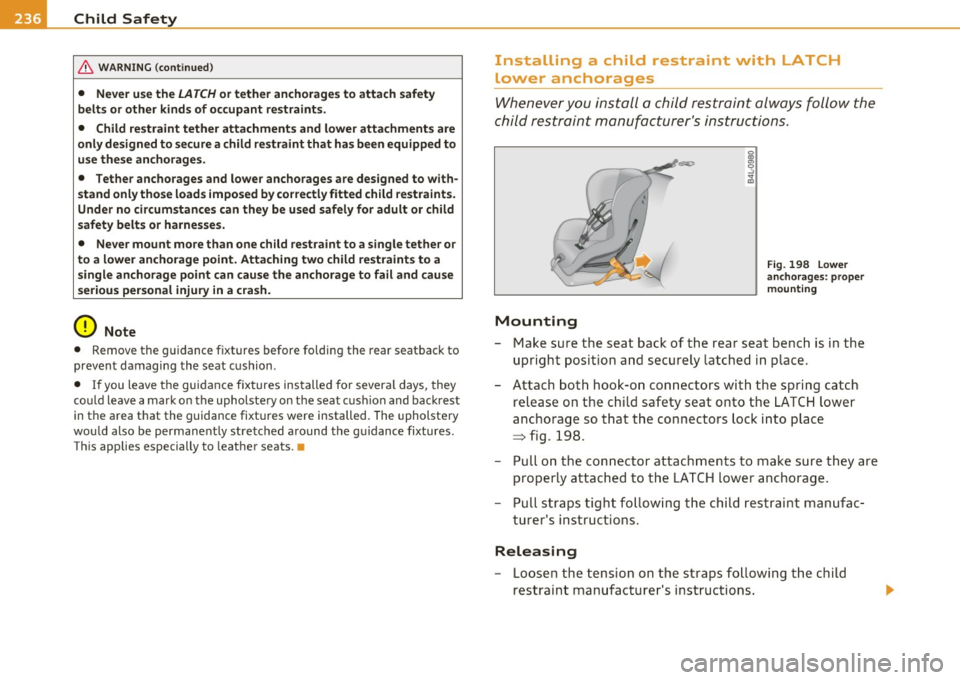
Whenev er you install a child restraint always f ollo w the
child restraint manufacturer's instructions.
Mounting
Fig. 19 8 Lower
anch ora ges : pr op er
mounting
- M ake sure the seat back of the re ar seat bench is in the
u prigh t position a nd securely latche d in p lace .
- Att ach both hook-o n con nectors wi th th e spring catc h
release on t he ch ild sa fety se at o nto the LATC H lower
anchorage so t hat th e connectors lock i nto place
~ fi g. 198 .
-Pull o n the con nec tor attac hmen ts to ma ke s ure they are
properly attac hed to t he LAT CH lower anchorage.
- Pull st ra ps t ig ht fo llow ing t he child r est raint manufa c
t u re r's instr uct io ns.
Releasing
- Loose n the tens ion on t he straps fo llowing t he child
restrain t man ufacture r's i nst ructions.
Page 269 of 370

____________________________________________ C_l_e _a_ n_ in--= g=-- a_n_ d_ p ,__r_o _t_ e_ c_ t _ io_ n __ lffll
Your authorized Audi dealer can provide cleaning products that have
bee n tested and approved for your veh icle. •
Care of interior
MMI display
- Clean the MMI display with a soft clean cloth and an LCD
cleaner .
The MMI display can be cleaned with a professionally available "LCD
cleaner". The cloth should be slightly dampened with the cleaning
fluid to clean the d isp lay .
0 Not e
To avoid scratching the MMI display, you should never clean it dry. •
MMI control console
- First clean the MMI control console with a brush to
remove dust from the housing.
- Then wipe the MMI control console with a clean, soft,
slightly damp cloth.
T he MM I control console sho uld be cleaned w ith a brush first so that
no dirt is trapped between the buttons and the housing. We recom
mend g iving the MMI contro l conso le a final w ipe with a cloth mois t
ened w ith water and dish washing detergent.
0 Note
To prevent damage, make sure that no fluid ever gets into the MMI
control console .•
Safety first
Aluminum trim
Use only neut ral-pH products to remove spots and deposits from
al uminum surfaces. Ch rome care prod ucts and al kaline cleaners w ill
attack aluminum surfaces and can damage them over t ime .
& WARNING
Alw ay s re ad and heed all WARNING S and other information
~ page 2 60. •
Fabrics and fabric coverings
Fabrics and fabr ic coverings (e .g . seats, door trim panels, etc.) should
be clean ed at regular interva ls with a vacuum cl eaner . T his removes
surfa ce di rt pa rt icl es which co uld become embedded in the fabr ic
through use . Steam cleaners should not be used, because the steam
tends to push the d irt deeper into the f abric and lock it there.
Norm al clean ing
Genera lly, we recommend using a soft sponge or a li nt-free
microfiber cloth to the clean fabric. Brushes should on ly be used for
ca rpets and floor mats , since other fab ric surfaces could be ha rmed
by brushes.
No rma l sur face sta ins can be cleaned us ing a commercially avai lab le
foam cleaner. Spread the foam on the surface of the fabr ic with a soft
sponge and work it in gently . Do not saturate the fabric. Then pat the
foam dry using absorbent , dry cloths (e .g. microfiber cloth) and
vacuum it after it has dried comp letely.
Clean ing stains
Sta ins caused by beverages (e .g. coffee, fruit juice, etc.) can be
treated with a mild detergent solut ion. Apply the detergent solut ion
with a sponge . In the case of stubborn stains, a detergent paste can
be applied directly to the stai n and worked into the fabric . After
wards, use copious amounts of clean water to remove the remaining .,.
Vehicle care Technical data
Page 271 of 370

____________________________________________ C_l_e _a_ n_ i n--= g=--- a_n_ d----' p,__ r_o _t_ e_ c_ t_ i _o_ n __ _
consider if childre n, animals or other factors might prove to be partic
ularly hard on the leathe r.
By contrast, leather types that are covered by a colored fin ish layer
are more durable . This has a positive effect on the leath er's resistance
to wear and so iling in daily use. On the othe r hand, the typical charac
teristics of natura l leathe r are barely or not apparent . However, this
does not mean that the leathe r itself is of infer io r quality.
C are and handling
Because of the exclusive nature of the types of leather that Audi uses
and the ir unique p roperties (such as sensitivity to oils, grease, so iling,
etc.), yo u will need to be somewhat ca refu l with these leat he rs , a nd
a certain type of care is required. For example, dark clothing mate
r ials ca n disco lor leather seats (especially if such clothi ng is d amp and
was not dyed correctly) . Dust and dirt particles in pores, folds, and
seams can have an abrasive effect and c an damage the le athe r
surface as well as weaken seams .
The leather s houl d be cleaned regularly as needed . After having been
used for a relatively long time, your leather sea ts w ill acquire a rich
aged finis h. This is a characteristic of natura l leather and a sign of
true quality.
I n order to maintain the value of this natural product over the life of
your vehicle, you sho uld fo llow the recommendations below :
0 Note
• To keep you r leather from b leaching out, do not allow it to be
exposed to bright sunl ight for long periods of time . If you have to
leave t he veh icle parked outside for long pe riods, cover the leather to
protect it from direct exposure to sunlig ht.
• Sharp objects on clothing, such as zippers, rivets or sha rp pieces
on belts can leave permanent scratches or scrape marks on the
s u rface of the leather.
Safety first
(I] Tips
• After each time you clean the leathe r and at regular inte rvals , u se
a leather preservative creme that contains UV-blockers and that
works into the leather. This creme will nou rish and mo istur ize the
leather, helping it to breathe and stay supp le. It also helps to build up
a p ro tect ive coa ting on the surfa ce.
• Clean the leather every 2 -3 months, and clean any areas that get
soiled.
• Remove fresh marks made by ballpoint pens, ink, lipstick, shoe
polish, etc. as soon as poss ible.
• Preserve the color of t he leather as needed by using a specia l
co lored leather ca re creme to touch up areas of uneven color .•
Ap plies to vehi cles : w it h nat ural leat her
Cleaning and caring for leather upholstery
and trim
Natural leather requires special care and attention.
Normal cleaning
- Clean so iled areas wit h a slightly mois tened cotton or
woolen cloth .
More stubborn dirt
-More stubborn d irt can be removed using a clot h satu
rated w ith a mild soap solution (2 ta blespoons m ild liq ui d
soap) .
- Never allow the soap solution to saturate the leather, and
make certa in that no water soaks i nto the seams .
- Wipe off the soap solution w ith a soft, dry c loth. .,,
Vehicle care Technical data