lights AUDI A6 2011 Service Manual
[x] Cancel search | Manufacturer: AUDI, Model Year: 2011, Model line: A6, Model: AUDI A6 2011Pages: 370, PDF Size: 87.15 MB
Page 258 of 370
Trailer towing
"---------------------------------------------------
Trailer towing
Driving with a trailer
General information
Your Audi was designed primarily for passenger transpor
tation .
If you p lan to tow a t railer, p lease remember that the additional load
w ill affect durability, economy and performance.
Tr ailer towing not on ly p laces mo re s tress on the vehicle, it also calls
for more concentration from the driver.
For this reason, a lways follow the operating and dr iv ing inst ructions
prov ided and use common sense .
0 Note
If you are going to tow a trailer, you must activate the tra iler ope ra
tion mode =>
page 170, "Towing a tra iler". •
Technical requirements
Trailer hitch
Use a we igh t-car rying h itch co nform ing to the gross tra iler we ig ht.
The h itch must be suitab le for your vehicle and trailer and must be
mou nted securely o n th e vehi cle's ch assi s at a
techni cally sound loc a
tion . Use only a trailer hitch with a removab le ball mount. Always
check wit h the t railer h itch manufactu rer to make sure that yo u are
using the correct h itch .
Do not use a bumper hitch.
The h itch mus t be installed in such a way t hat it does not in terfe re
w ith t he impact-absorb ing bumper system. No modifications shou ld be made to t
he veh icle exha ust and bra ke systems. From t ime to
time, check that a ll hitch mounting bo lts rema in securely fastened.
W hen you are no t tow in g a tra ile r, remove the t railer hit ch ball
mount. This prevents the hitc h from caus ing damage should your
vehicle be str uck from behind=>& .
Trailer brakes
If your trail er is e quipped w ith a b raking system, che ck to be s ure t hat
it conforms to all regulations.
T he tra ile r hydrau lic brake system m ust not be directly connected to
t he vehicle's hyd raulic b rake sys tem .
Safety chains
Always use safety chains between your veh icle and t he tra ile r.
Trailer lights
Trailer lights must meet all regulations. Be sure to check w ith your
Audi de aler fo r corr ec t wir ing , sw itches and re lays.
Mirrors
If you are unab le to see t he t raff ic be hind you using t he regular
outs ide mirrors, then you
must install extended mi rrors. It is impor
t an t th at yo u
always ha ve clear vi sion to the re ar.
& WARNING
After removing the trailer hitch, do not store it in your vehicle. In
case of sudden braking , the hitch could fly forward and inju re you
or your passengers. •
Page 259 of 370

Operating instructions
Max imum tr aile r weight
A trai ler for your vehicle is lim ited to a typical class 1 or class 2 trailer.
Trail er lo ad di stribut ion
Be sure the load in the t ra iler is held secu rely in place to prevent it
from shift ing forward, backward or sideways.
N ev er a llow a pa ssenge r to ride in a traile r=>
& in "Driving instr uc
tions".
Eng ine c ooling s ystem
Towing a trailer makes the eng ine work harder. It is important that
the cooling system 's performance is up to the addi tional load. Make
sure that the cooling system has enough fluid.
Tire pre ssur e
When towing a tra iler, inflate the tires of your veh icle to the co ld tire
pressu re listed under "Full load" on the label located on the d river's
side 8 -pillar (visible when the door is open) . Inflate traile r tires to
t rai ler and tire manufacture rs' specificat io n s.
Light s
The headl ight sett ings shou ld be checked with the tr ailer attached
before driving off. Check to make sure both vehicle and trailer lights
are working properly .
Safety chain s
Be sure traile r safety cha ins are p roperly connected from the trai ler
to the hitch on the vehicle. Leave enough slack in the chains to perm it
tu rning corners. When you install sa fe ty cha ins, make s ure they will
not drag on the road when you are driving.
T he chains should cross under the trai ler tongue to prevent it from
dropping in case of separation from the h itch .
Controls and equip ment Safety first Vehicle operation
0 Note
If you are going to tow a t
railer, you must activate the tra iler opera
tion mode =>
page 170, "T owing a trai ler" .
Driving instructions
Driving with a trailer always requires e xtra care and
consideration .
To obtain the best possible handling of vehic le and trailer,
please note the following:
- Do not tow a loaded trailer when your car itself is not
loaded.
- Be especially careful when passing other veh icles .
- Observe speed limits .
- Do not dr ive at the maximum permissible speed.
- Always apply brakes early .
- Monitor the temperature gauge .
Weight distribut ion
T owing a loaded tra iler w ith an empty car results in a highly unstable
distribution of we ight . If this cannot be avoided, d rive at very low
speeds only to avoid the risk of losing steering control.
A "balanced" r ig is easier to operate and control. This means that the
t ow ve hicle sho uld be loaded to the exte nt poss ible and permissib le,
wh ile keeping the tra iler as light as poss ible under the circumstances.
Whenever poss ible, tra nsfer some cargo to the l uggage compart
ment of the tow vehicle while observing tongue load requirements
and vehicle load ing considerations .
Vehicle care Do-it-yourself service Technical data
Page 284 of 370
lffl) __ C_ h_e _c_ k_ i_ n _ g_ a_ n _ d_ f_il _l _in ____ g ___________________________________________ _
Changing the engine oil
The engine oil and oil fi lter must be changed according to the mileage
(kilometers) and t ime intervals specified in your vehicle 's Warranty
&
Maintenance booklet . Do not exceed these interva ls -harmful
deposits from o ld engine oil can reduce engine performance and can
lead to expensive engine repairs .
Changing the oil at the recommended intervals is so very impo rtant
because the lubricating properties of o il decrease gradually during
normal vehicle use. If you are not sure when you have your oil
changed, ask your author ized Audi Service Adv isor .
Under some circumstances the engine oil should even be changed
mo re frequently. Change oil more often if you drive mostly short
distances, operate the vehicle in dusty areas or mostly under stop
and-go traffic conditions, or when you use your vehicle where temper
atures stay be low freezing point for long periods.
Detergent addit ives in the oi l wi ll make fresh oil look dark after the
engine has been running for a short t ime. This is normal and is not a
reason to change the oil more often than recommended .
Damage or malfunctions due to lack of maintenance
It is essential that you change your oil at the recommended intervals
using only engine oi l that complies with Audi oil standard
VW 502 00. Your Limited New Vehicle War ranty does not cover
damage or malfunctions due to fai lure to follow recommended main
tenance and use requirements as set forth in the Audi Owner 's
Manual and Warranty
& Maintenance booklet. Your dealer will have
to deny warranty coverage unless you present to the dealer proof in
the form of Serv ice or Repair Orders that all scheduled maintenance
was performed in a time ly manner. •
Engine oil consumption
The engine in your vehicle depends on an adequate
amount of oil to lubricate and cool all of its moving parts.
In order to provide effective lubrication and cooling of internal
eng ine components, all inte rnal combustion engines consume a
certain amount of oil. Oil consumption varies from engine to engine
and may change sign ifican tly over the lif e of the engine. Typically,
engines with a specified break- in period (see~
page 251) consume
more oil during the break-in period than they consume after oil
consumption has stab ilized .
Under normal conditions, the rate of oil consumption depends on the
quality and viscosity of the oil, the RPM (revolutions per minute) at
which the engine is operated, the ambient temperature and road
conditions. Further factors are the amount of oil dilution from water
condensation or fuel residue and the ox idation level of the oil. As any
eng ine is subject to wear as mileage builds up, the oil consumption
may increase over time until replacement of worn components may
become necessary.
With all these variab les coming into play, no standard rate of oil
consumption can be established or specified . There is no alternative
to regular and frequent checking of the oil level , see
Note .
If the yellow engine oil leve l warning symbol in the instrument
cl uster lights up, you should chec k the oil level as soon as possible
with the oil dipstick~ page 283. Top off the oil at your earliest
convenience ~
page 284.
& WARNING
Before you check anything in the engine compartment, always
read and heed all WARNINGS~
& in "Working in the engine
compartment" on
page 279.
Page 292 of 370
-L~C~ h~ e~c ~k :..!_i ~ n ~g ~ a~n ~d~ f~il ~l~in ~ g[_ ________________________________________ _
0 Note
Brake fluid will damage the paint of your vehicle.
the special tools required and the necessary expertise, we recom
mend that you have the brake fluid changed by your authorized Audi
dealer. •
Battery
General information
Under normal operating condit ions, the battery in your Aud i does not
need any maintenance. With
high outside temperatures or long daily
drives we recommend that you have the electrolyte level checked by
a service facility. The electrolyte level should also be checked each
time the battery is charged~
page 292.
Have the battery checked when you take your vehicle in for service.
You are well advised to replace a battery that is older than 5 years.
With certain types of a irbag deployment, the battery is disconnected
from the vehicle electrical system for safety reasons=>
& in "Repair,
care and disposal of the airbags" on
page 211.
Disconnecting the battery terminals
Some vehicle functions (power window regulators, for example) are
lost if the battery terminals are disconnected. These functions have
to be relearned after the battery terminals are connected aga in. To
prevent this, the battery should only be disconnected from the
vehicle electrical system when absolutely necessary for repairs.
Vehicles not driven for long periods
If you do not drive your veh icle over a period of severa l days or weeks,
electrical components are gradually cut back or switched off. This
reduces energy consumption and maintains starting capability over a
longer period~
page 249.
Take into consideration that when you unlock your vehicle, some
convenience functions, such as the master key remote function or
power seat adjustment, may not be available. The convenience func
tions will be available again when you turn on the ign ition and start
the engine.
Winter operation
During the winter months, battery capacity tends to decrease as
temperatures drop. This is because more power is also consumed
while starting, and the headlights, rear window defogger, etc., are used more often .
Avoid unnecessary power consumpt ion, particu larly in city traffic or
when traveling only short distances. Let your authorized Audi dealer
check the capacity of the vehicle battery before w inter sets in
=> page 292. A well charged battery will not only prevent starting
problems when the weather is cold, but will also last longe r.
(I] Tips
If your veh icle is left standing for several weeks at extreme ly low
temperatures, the vehicle battery should be removed and stored
where it will not freeze. This will prevent it from being damaged and
having to be replaced.•
Page 330 of 370

-L_!F~U:!_:S~ e~ s ~ a~ n~ d~b~ u~l~b ~s ~-------------------------------------------
Fuse assignment, cockpit driver's side
Fig. 234 Cockpit
driver's side: fuse
panel layout
No. Consume r
3 Engine management
4
5
6
7
8
9
10
12
13
Oil level sensor
Climate control, tire pressure monitoring sys
tem Electronic Stabilization Program (ESP), clutch
sensor
Diagnostic connector
Homelink control unit
Automatic dimming interior mirror
Adaptive Cruise Control Diagnostic connector
Switch module steering column
15 Instrument cluster, control module Gateway
16 Telephone, cell phone
17 Electronic Stabili zation Program (ESP)
18 Headlight electronics, left-side
Amps
5
5
5
5
5
5
s
5
10
10
10
5
10
5
No. Con sum er
19 Rain sensor
20 Heated washer nozzles
21 Seat adjustment (driver)
22 MMI display
23 Electromechanical park ing brake
31
32
33
34
36
37
38
39
40
41
42
43
Back-up light switch, transmission, engine com
ponents
I ntelligent power module driver (footwell light
and front headlights , horn, wiper system, elec
trically adjustable steering wheel)
Intelligent power module driver (lights left-side)
I ntelligent power module driver
(lights right-side)
Headlight washer system
Electronic Stabilization Program (ESP)
Wiper system Door control module left-side
Horn
Heater fan
Control module electronic ignition lock/elec tri
cally adjustable steering wheel
Rear windshield wiper (Avant)
44 Power window opener (left-side)
Amps
5
5
10
5
5
15
30
25
25
30
25
30
15
25
40
30
15
35
-
•
Page 331 of 370

______________________________________________ F _u_s _e_ s_ a_ n_ d _ b _u_l_b _ s_---J _
Fuse assignment, cockpit passenger's side
No . Consumer
Fu se pa nel (bl ack )
1 Control module Convenience key
2 Cigarette lighter front
3 Tire pressure monitoring system
4 Electrical outlet front (center console)
5 Intelligent power module passenger
(glove box lock)
6 Door control module right-s ide
7 Sunroof
8 A/C cont rols
9 Heated seats, front
10 MMI
11 Seat adjustment (passenger)
12 Communication
Fu se pan el (brown )
1 Electr ic fuel pump
Fig . 235 Cockp it
passenger 's side : fuse
pa nel layo ut
Amps
15
20
5
20
15
15
-
20 1 0
30
7 ,5
10
5
20/30
Vehicle OP-eration
No. Consume r .,
2 Adaptive Air Suspension
3 Lane assist
4 Audi side assist
S Adaptive Air Suspens ion
6 Shift gate automatic transmission/clutch switch Parking System
9
10 Control module Gateway
Automatic headlight range control (a
uxiliary
driving lights) , headl ight electronics, right -side
Airbag
11 Heated rear seats
12 Telephone
Amps
15
10
5
5
5
5
5
5
5
5
5
Fuse assignment , luggage compartment
right
F ig. 236 R ight
luggage compartment:
fuse pane l layo ut
Re ad nu mber s of the fuses in the l ug ga ge comp art men t sta rti ng
from below ~ fig . 236.
•
Vehicle care Do-it-yourself service Technical data
Page 332 of 370
lffl!I.___F_ u_ s_e _s_ a_n_ d_ b_u _ l_ b_ s _______________________________________________ _
No. Consumer
Fuse panel (black)
-
1 Digital Signal Processing (DSP)/
BOSE amplifier
2 Communication , Antenna amplifier
3 Electromechanical parking brake, left
4 Electromechanical parking brake, right
5 Luggage compartment power outlet
6 Battery energy management
7 Intelligent power module rear
(lights right-side)
8 Intelligent power module (comfort)
9 Intelligent power module rear
(lights left-side)
10 Power window opener (right-side)
11 Parking System
12 Cigarette lighter rear
Fuse panel (brown)
1 Rear view
2 Electric rear lid (Avant)
3 Electric rear lid (Avant)
Electric rear lid (Avant)
5 Communication , Antenna amplifier
7 MMI
9 Digital Tuner
Amps
-
30
5
30
30
20 5
20
-
5
30
-
35
5
20
5
30
30
20
5
5
5
•
Bulbs
Replacing light bulbs
For your safety, we recommend that you have your autho
rized Audi dealer replace burned out bulbs for you.
It is becoming increasingly more and more difficult to replace vehicle
light bulbs since in many cases, other parts of the car must first be
removed before you are able to get to the bulb . This applies especially
to the light bulbs in the front of your car which you can only reach
through the engine compartment .
Sheet metal and bulb holde rs can have sharp edges that can cause
serious cuts, and parts must be correctly taken apart and then prop
erly put back together to help p revent breakage of parts and long
term damage from water that can enter housings that have not been
properly resealed .
For your safety, we recommend that you have your authorized Audi
dealer replace any bulbs for you , since your dealer has the proper
tools, the correct bulbs and the expertise.
Gas discharge lamps (Xenon lights)*:
Due to the high electrical voltage, have the bulbs replaced by a qual
ified technician. Headlights with Xenon light can be identified by the
high voltage sticker .
& WARNING
Contact with high-voltage components of the electrical system
and improper replacement of gas discharge (Xenon) headlight
bulbs can cause serious personal injury and death.
• Xenon bulbs are pressurized and can explode when being
changed.
• Changing Xenon lamps requires the special training, instruc-
tions and equipment. .,_
Page 354 of 370
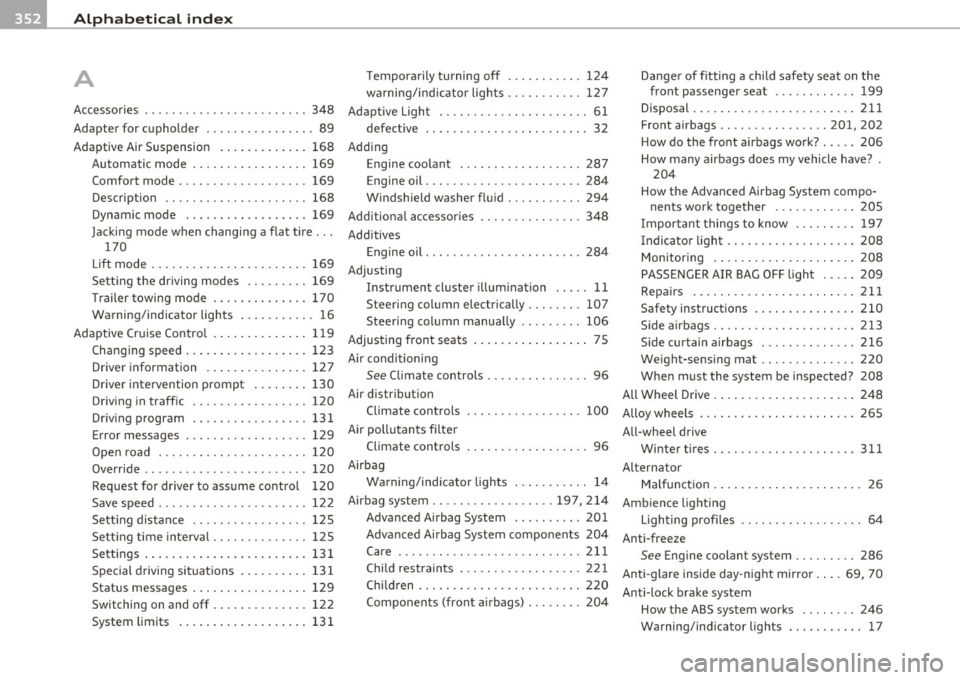
___ A_l_,_ p _ h_ a _ b_e _ t_ i_c __ a _l _i_n :...::d __ e::..: x:...::...,_ _________________________________________ _
A Temporarily turning off .......... . 124
warning/indicator lights .... ...... . 127
Danger of fitting a child safety seat on the
front passenge r seat ............
199
Accessories ..... ................... 348 Adaptive Light ......... ....... .. .. .. 61 Disposal .................. .. .... 211
Adapter for cupholder ................ 89 defective ........................ 32 Front airbags ......... ... .... 201, 202
Adaptive Air Suspension ............. 168
Automatic mode .. .. ... .... ...... 169
Comfort mode ................... 169
Description ..................... 168
Dynamic mode ... .. ... ...... .... 169
Jacking mode when changing a flat tire ...
170
Lift mode ....................... 169
Setting the driving modes ......... 169
Trailer towing mode .............. 170
Warning/indicator lights .... ....... 16
Adaptive Cruise Control ......... ... .. 119
Changing speed ....... ........... 123
Driver information .............. .
Driver intervention prompt ...... . . Adding
Engine coolant ........... ...... .
287
Engine oil ............ ...... ..... 284
Windshield washer fluid ........... 294
Additional accessories ............... 348
Additives
Engine oil ............ .. .........
284
Adjusting
Instrument cluster illum ination .....
11
Steering column electrically ........ 107
Steering column manually .. .. .. .. . 106
Adjus ting front seats ................. 75
Air conditioning
See Climate controls ...............
96
Air distribution How do the front airbags work?
.....
206
How many airbags does my vehicle have? .
204
How the Advanced Airbag System compo-
nents work together ............
205
Important things to know ... .. .. .. 197
Indicator light ................... 208
Monitoring ... .................. 208
PASSENGER AIR BAG OFF light ..... 209
Repairs ............ .. .. .. ...... 211
Safety instructions ............... 210
Side airbags .... .... ............. 213
Side curtain airbags .............. 216
Weight-sensing mat ..............
220
When must the system be inspected? 208
All Wheel Drive ... ... ............... 248 Dr iv ing in traffic ................ .
Driving program .. ...... ........ .
127
130
120
131
Climate controls 100 Alloy wheels ................. .... .. 265
Error messages . .. .. .... ........ .
Open road ... .. .. .. .. ....... ... . 129 Air pollutants filter
120 Climate controls .................. 96
All-wheel drive
Winter tire s .....................
311
Override ...................... .. 120 Airbag
Alternator
Request for driver to assume control
120 Warning/indicator lights ..... ...... 14 Malfunction ........ .............. 26
Save speed . ...... .. .. ........... 122 Airbag system .................. 197,214 Ambience lighting
Setting distance .. ...... ...... .. .
125 Advanced Airbag System .......... 201 Lighting profiles .. .. .............. 64
Setting time interval .............. 125 Advanced Airbag System components 204 Anti-freeze
Settings ...................... ..
131 Care ... .. .......... ....... .. .. . 211 See Engine coolant system ......... 286
Special driving situations .......... 131
Status messages ................. 129
Switching on and off .............. 122
System limits ................... 131
Child restraints .................. 221
Children ........................ 220
Components (front airbags) ... ..... 204
Anti-glare inside day-night mirror .... 69, 70
Anti-lock brake system
How the ABS system works ...... ..
246
Warning/indicator lights ........... 17
Page 355 of 370

Alphabetical index -________________ fWI
Anti-Slip Regulation System (ASR)
How the system works ....... .. .. . 244
Anti-theft systems Anti-theft alarm system ....... ... .. 49
Electronic immobilizer ............. 40
Ashtray Front .............. ...... .. .. .. .. 91
Rea r ........ .... .. .. ... ......... 91
ASR How the Anti-Slip Regulation System works . ...... .. ... .. .. ......... 244
Asterisk What does it mean when something is
marked with an asterisk? ........... S
Audi Service Repair Manuals and Literature
346
AUTO mode AC climate controls ...... .... .. .. .. 99
Auto Safety Hotline .... .. .. .. ....... 185
Auto-Check Control .. ........ .... ... .. 24
Automatic belt retractor ............. 191
Automatic car wash
See Washing ....... .. .... .. .. .. . 261
Automatic Shift Lock (ASL) ..... .. 148, 155
Automatic transmission 6-speed automatic transmission ... . 146
Automatic Shift Lock (ASL) .... 148, 155 Driving ............ .. .. .. .. .... . 146
Dynamic shift program ... .. .. .. .. . 149
Emergency release for selector lever . 152
Emergency release for selector lever
(mu ltitron ic®) .............. .... 159
Fail-safe mode .............. 151, 158
Controls and equip
ment Safety first
Ignition key safety lock
.... ... .. .. . 109
Kick -down . .. .. .... .. .. .. ....... 149
Manual shift program .. ... ... .... . 150
multitronic ® ....... ... ... .. .. ... 152
Selector lever .... .. .. .. .. .. . 147, 154
Shift buttons . ........... ... 151, 158
Steering wheel with tiptron ic® . 151, 158
Average speed .. ... .... .. .. .. .... .... 34
Avoid damaging the vehicle ........... 252
B
Battery ... ..... .................... 290
Battery location ins.ide the luggage
compartment . ........ ......... 291
Charging ................ .... .. .. 292
Important warnings when wo rk ing on the
battery . .. .. ..... ....... ... .. .. 291
Jump starting ..... ...... ..... .. .. 332
Low ..... .. ... ..... .. ....... .... 249
Replacing the battery .. .. ... ...... 294
State of charge .... ... ........... 249
Voltage ................. .. .. .. .. . 31
Winter operation ...... .. .. .. ..... 290
Working on the battery .... ... .. .. . 291
Before driving .. ... ... .. ... .. .. .. .. . 177
Blended gasoline ................... 273
Body cavity seal ing . ...... .. ......... 266
Booster seats . .. .. ........ ......... 227
Brake assistant ...... ............... 247
Brake booster . ........ ... ... .. .. ... 246 Brake fluid
Changing the brake fluid ....... .... 289
Checking the brake fluid level ....... 289
Reservoir . .... .. .. ... .... ... ... . 289
What is the correct brake fluid level? . 289
What should I do if the brake fluid warning
light comes on? . ................ 289
Brake light Defective ... .. ................... 21
Brake system . .. .. .. .. .. ... ..... .. .. 289
Anti-lock brake system ............. 17
Brake fluid ........ ............. . 289
Brake fluid spec ificat ions for refil l and
replacement . .... ....... ... ... . 289
Brake pads .. .. .. .. ...... .. .. .. .. 252
Electromechanical parking brake ... . 113
General informat ion ..... ...... .. . 245
How does moisture or road salt affect the
brakes? ... .................. .. 245
Malfunction ...................... 26
Warning/indicator lights ... .. .. .. .. 18
Worn brake pads symbol ........... 31
Break -in period ... .. .. .............. 251
Brake pads . ... ................ .. 252
Tires ... .... .................... 251
Bulbs .................. .. .. .. .. ... 330
Bumper cover Caution when parking near a parking barri-er or curb . ................... .. 114
C
California Proposition 65 Warning ..... 280
Battery specific .... .............. 292
Vehicle operation Vehicle care Do-it-yourself service Technical data
Page 357 of 370

Alphabetical index -________________ fNi'II
Energy management ...... .. .. ..... 96
Fan .................... ... ... .. 100
Heated seats, front .............. . 103
Key coded setting ........ ...... ... 96
Recirculation mode (automatic) .. ... 104
Recommended sett ings ............ 96
Residual heat ..................... 99
Setting the temperature ............ 99
Switching air cooling on/off .... ... .. 99
Synchronization . ... .............. lOS
Turning on and off ....... ...... .. .. 99
Using climate control economically .. 102
Clock ................ .... .. .... .... . 9
Closing Power sunroof ... .. ... ... .. .. . .... S4
Coat hooks ........... ..... .... ... ... 9S
Cold ti re inflation pressure ..... .. ..... 299
Compass mirror ........ ...... .. .... .. 73
Compliance . ... ................ .... 349
Consumer Information . . . . . . . . . . 18S, 346
Contacting NH TSA .... .............. 18S
Continuously Variable Transmission (CVT)
See multit ronic ® ................. 152
Convenience key .................... . 47
Dr iver messages ....... ... .. .. ... . 112
Locking vehicle ...... ....... .. .... . 49
START button ............. .. ... .. 110
Starting engine .. ............. .. . 110
S TOP button ............ .. .. .... . 111
Switching eng ine off .............. 111
Switching on ignition ......... .. ... 110
Unlocking vehicle ................ .. 48
Convertible child safety seats ..... .... 225
Controls and equip
ment Safety first
Convert
ible lock ing retractor
Activating ............... .. ...... 231
Deactivating ..................... 232
Us ing to secure a chi ld safety seat .. 229,
231
Coolant system ..................... 286
Cooling System Expans ion tank ..... .. .. ... .... .. 286
Cruise control Changing speed ..... ... .......... 117
Presetting your speed ... .......... 117
Switching off . .. ................. 117
Switching on .................. .. 116
Warning/indicator lights ........ .. . 16
See also Adaptive Cruise Control .... 119
Cruising range ... ................ .... 34
(upholder .... ............. .. .. . 89,90
D
Damp ing
See Adaptive A ir Suspens ion ...... .. 168
Data . .... ....................... .. 343
Data record er .. . .... .. ... .......... 242
Date display ......................... . 9
Daytime running lights . . . . . . . . . . . . 58, 59
Declaration of compl ia nee
Adaptive Cruise Contro l ... ......... 349
Audi side assist .. .. . .. ...... .. ... 349
Cell phone package . .............. 349
Convenience key .... .. .. .. .. ..... 349
E lectronic immobilizer ............ 349 Homelink
® universal remote control . 349
Remote control key .. ....... ... ... 349
def What does this mean when it appears in
the trip odometer disp lay? .. .. ..... 10
Defective light bulb warn ing ......... .. 21
Defrosting/defogging the windows .. .. . 100
Defrosting/defogging w indows ........ 101
Determining correct load limit ....... .. 304
Digital clock . ........ ................ 9
Digital compass ..................... 73
Digital speedometer .................. 21
Dimensions ............ ... .. .. ..... 341
Dipstick Reading the dipstick properly ....... 283
Distance control system
See Adaptive Cruise Control ... .. .. . 119
Doors Power ch ild safety lock .. ....... .... 47
Driver information system ............. 19
Digital speedometer ............... 21
Driver information messages ........ 24
Open door or rear lid warning . ....... 21
Outs ide temperature display ........ 20
Sound system disp lay .............. 20
Driver seat
See Seating position .............. 178
Driver's seat ... .... .. .... ........... 76
Driver's seat memory ................. 79
Activating remote control key ....... 80
Recalling a seat pos it ion . ... ..... ... 79
Storing a seat position .. ....... .... 79
Vehicle operation Vehicle care Do-it-yourself service Technical data