warning light AUDI A6 2012 Owners Manual
[x] Cancel search | Manufacturer: AUDI, Model Year: 2012, Model line: A6, Model: AUDI A6 2012Pages: 298, PDF Size: 74.43 MB
Page 189 of 298
Audi pre sense Preventative passenger
protection
App lies to veh icles: with Audi p re se nse
Audi pre sen se can ini tiate steps to help pro
t ect vehicle occupants in certain situations.
The funct ions descr ibed depend on equipment
installed in your vehicle:
Audi pre sense basic*
The following functions can be triggered in
cert ain driving situations :
- Tightening of the safety belts (for example,
during heavy braking) : the front safety belts
have reversible belt pretensione rs. If a colli
sion does not occur, the safety belts loosen
slightly and are ready to be tightened again .
- Closing the windows and the sunroof* : the
windows and the sunroof* close leaving a
small open gap .
Audi pre sense basic functions can be trig
gered at speeds above 20 mph (30 km/h) .
Vehicles with Audi drive select*: the deploy
ment time is adapted in dynamic mode.
Audi pre sense front (vehicles with
adaptive cruise control*)
Audi pre sense front includes the functions in
Audi pre sense basic. In addition, within the
limits of the system, the likelihood of a colli
sion with the vehicle immediately ahead is al
so calculated . If the system senses an immi
nent collision the following functions can be
triggered:
-Audi braking guard
¢ page 84
- Tightening the safety belts
- Closing the windows and the sunroof* ( leav-
ing a small open gap)
Audi pre sense rear (vehicles with Audi
side assist*)
Audi pre sense rear includes the functions in
Audi pre sense basic. In addition, the likeli
hood of a rear-end col lision with the vehicle
coming from behind is also calcu lated. If the
Audi pre sense 187
risk of a co llision is detected, the following
functions can be triggered :
- Tightening the safety belts
- Closing the windows and the sunroof* (leav-
ing a small open gap)
Audi pre sense plus*
Audi pre sense plus includes the functions in
Audi pre sense front and Aud i pre sense rear .
Error message
Audi pre sense: not available
Preventative passenger protection is not avail
able. See your authorized Audi dealer immedi
ate ly to have the malfunction corrected.
A WARNING
-=
Audi pre sense cannot overcome the laws
of physics. It cannot prevent a collision. Do
not let the increased safety provided
tempt you to take risks . This will increase
the r isk of a coll is ion and serious personal
injuries .
- The sensors cannot always detect all ob jects . This increases the risk of a colli
s10n .
-Audi pre sense does not detect people or
an imals or objects that are crossing the
veh icle's path ¢
page 78.
-The radar sensor's v is ion can be reduced
by heavy rain, ice, snow, heavy road spray
and reflections from guard rails, tunnel
entrances, etc. These and similar condi
tions can prevent vehicles from being ac
curately detected and in some cases they may not be detected at all.
Q) Note
The sensors can be displaced by impacts or
damage to the bumper, wheel housing and
underbody. This can affect the function of
the Audi pre sense system. Have your au
thorized Audi dealer check to make sure
that the system is working properly.
•
•
Page 193 of 298
@ Tips
-ABS and AS R on ly wor k co rrectly when
a ll fo ur wheels are eq uipped w ith identi
ca l tires . Different tire s izes can lead to a
r educt io n in eng ine power.
- You may hear noises when the sys tems
desc ribed are working.
- If the indicato r light
D] or m (USA
models) ;£1 (Canada models) appea rs,
there may be a malfunctio n ¢
page 19 ,
¢ pag e 19.
Switching on and off
ESP turns on automatically when you start
the engine .
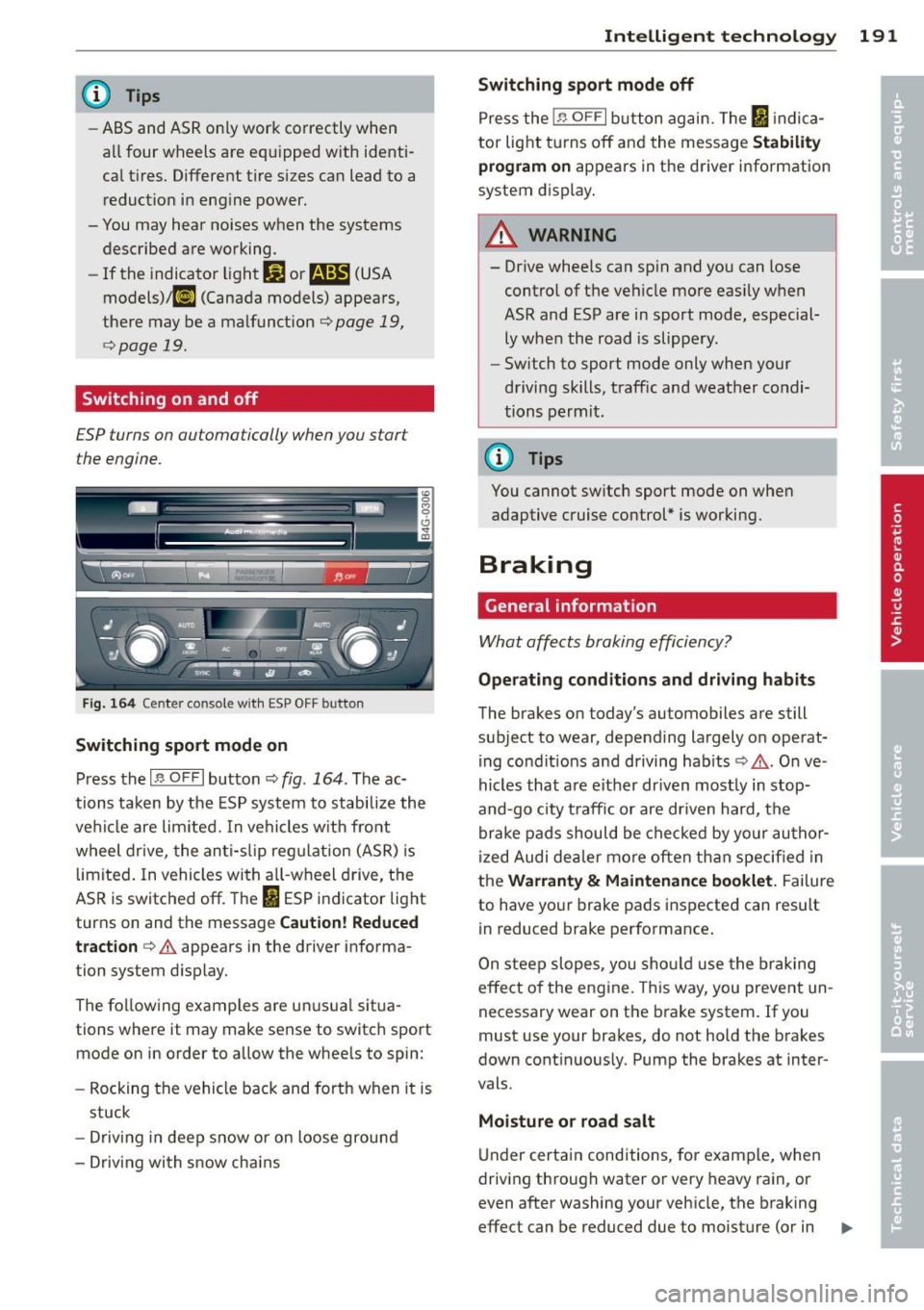
Fig. 1 64 Center co nsole wit h ESP OFF button
Switching sport mode on
Press th e I,$ OF F I button ¢ fig. 164. The ac
tions tak en by the ES P syst em to stabili ze th e
ve hicl e are lim ited. In ve hicl es w it h fro nt
wheel drive, the an ti-s lip reg ulat ion (ASR) is
limited . In vehicles wi th a ll-wheel d rive, t he
AS R is switc hed off. The
I ES P i ndicator lig ht
turns on and the message
Caution! Reduced
tract ion ¢.&
appears in the driver informa
tion system d isplay.
The fo llow ing examples a re u nusua l situa
tions where it may make sense to switc h sport
mode on in order to a llow the whee ls to spin:
- Rocking the vehi cle back and forth when it is
stuck
- D rivin g in d eep snow or on loose groun d
- D riving wi th s now cha ins
Intelligent technology 191
Switching sport mode off
Press the In OF FI but ton ag ain. T he ltJ in dica
tor lig ht tur ns off an d the message
Stability
program on
appears in t he d river info rmation
system display .
&_ WARNING
-- Drive whee ls can sp in and you can lose
contro l of t he ve hicle more eas ily w hen
ASR and ESP are in sport mode, especial
ly whe n th e road is slippery.
- Sw itch to sport mode only when your
driving sk ills, traff ic and weat her co ndi
tions perm it.
@ Tips
You cannot sw itch sport mode on whe n
adaptive c ruise control* is w orki ng.
Braking
General information
Wha t affe cts bra king effici ency?
-
Operating conditions and driving habits
The brakes on today's automobiles a re still
subject to wear, depending largely on operat i ng co nd it io ns and driving habits ¢,& . On ve
hi cles that a re e it h er dr iven most ly in stop
and-go city t raff ic or are dr iven hard, the
br ake pa ds should be check ed by yo ur au thor
iz ed Audi dea ler m ore often th an spec ified in
the
Warranty & Maintenance booklet. Failure
to have yo ur brake pads ins pected can result
in reduced brake performance .
On stee p slopes, you sho uld use the br aking
e ff ect o f the engine. This way, you prevent un
necessary wear on t he brake system. If you
must use your bra kes, do not hold the brakes
down cont in uous ly. Pump the brakes at inter
vals.
Moisture or road salt
U nder certa in conditions, for exam ple, when
driving th roug h water or very heavy rain, or
even after washing your veh icle , the b raking
effect can be reduced due to m oist ure (or in ..,.
Page 195 of 298
pressed considerably harder to make up
for the lack of booster assistance.
Electro-mechanical
power assist
The electro-mechanical power assist helps
the driver when steering.
Power steering adapts electronically based on
the vehicle speed .
Indicator lights and messages
• Steering defective! Stop the vehicle
If this indicator light turns on and stays on
and this message appears, the power steering may have failed.
Do
not continue driving. See your authorized
Audi dealer or other qualified repa ir facility
for assistance.
t -r- fl Steering: System malfunction! You may
c ontinue driving
If the indicator light turns on and the mes
sage appears, the steer ing may be more diffi
cult to move or more sensitive than usual.
Drive slowly to your authorized Audi dealer or
qualified workshop to have the malfunction
corrected.
@ Tips
If the . or t~fl indicator light only stays
on for a short time, you may continue driv
ing .
Driving with your
quattro ®
Applies to vehicles: with all-wheel drive
With all-wheel drive, all four wheels are driv
en.
General information
With all-wheel drive, power is distributed to
all four wheels. This happens automatically
depending on your driving sty le and the road
conditions at the time. See also¢
page 189. Intelligent technology 193
T
he all -whee l dr ive concept is designed for
high engine power. Your vehicle is exception
ally powerfu l and has excellent driving charac
teristics both under normal driving conditions
and on snow and ice. Always read and follow
safety precautions¢ ,&..
Winter tires
When driving in the winter, your vehicle with
all-wheel drive has an advantage, even w ith
regular tires. In winter road conditions it may
be advisable to mount winter tires (or all-sea
son tires) for improved driveability and brak
ing: these tires must be mounted on
all four
wheels.
See also¢ page 250, Winter tires.
Tire chains
Where tire chains are mandatory on certain
roads, this normally also applies to vehicles
with all-wheel drive¢
page 251, Snow
chains .
Replacing wheels/tires
Vehicles with a ll-wheel drive must always
have tires of the same size. Also avoid tires
with different tread depths. For deta ils see
page ¢
page 246, New tires and replacing
tires and wheels.
Off-Road driving?
Your Audi does not have enough ground clear
ance to be used as an off-road vehicle. It is
therefore best to avoid rough tracks and un even terrain as much as possible. Also refer to
¢page 197 .
A WARNING
Always adjust your dr iv ing to road and traf
fic conditions. Do not let the extra safety
afforded by all-wheel drive tempt you into
taking extra risks.
-Although the all-wheel drive is very ef
fective, always remember that braking
capacity is limited by tire traction. You
should therefore not drive at excessive
speeds on icy or slippery road surfaces.
•
•
Page 197 of 298

functions will be available again when you
switch on the ignition and start the engine.
With the engine turned off
If you listen to the radio, for example, with
the eng ine turned off or use othe r MM I fu nc
tions, the battery is being discha rged.
I f starting capability is jeopardized due to en
e rgy consumpt ion, the fo llow ing warning ap
pears in the MMI disp lay :
Plea se start the eng ine soon or th e sys tem
w ill b e turn ed off .
The warning ind icates that the system will be
turned off automatically after 3 m inutes . If
you wish to cont inue us ing the functions , you
have to start the engine.
With the engine running
Although electrical energy is generated when
the vehicle is be ing driven, the battery can be
come discharged . Th is happens mostly when
little energy is be ing generated and a great
deal consumed and the battery's state of
charge is no t optimal.
To br ing the energy balance back into equili
b rium, consumers which require especially
l arge amounts of energy are tempo rarily cut
back or swit ched off. Heating systems in par
ticular requ ire a g reat dea l o f energy. If you
notice, fo r example, that the heated seats* or
the heated rear window are not heating, they have been temporari ly cut back or switched
off. These systems will be ava ilab le again as
soon as the energy balance has been restored.
You will a lso notice that engine idle speed has
been increased slightly . This is norma l and not
a cause for concern . By increasing engine idle
speed the add itiona l energy required is gener
ated and the battery is charged.
Int ellig ent technolog y 195
•
•
Page 200 of 298

198 Driving and en vironm ent
Driving through water
on roads
Note the following to avoid vehicle damage
when driving through water, for example on
flooded roads:
- The water must not be any higher than the
bottom of the vehicle body.
- Do not drive faster than wa lking speed.
A WARNING
After driving through water, mud, slush,
etc., the brakes may be slow to take effect
because of wet brake rotors and pads. Dry
the brakes first by braking carefully to re
sto re the full braking effect.
@) Note
Vehicle components such as the engine,
transmiss ion, suspension or electrical sys
tem can be severely damaged by driving
through water.
- Check the depth of the water before dr iv
i ng through it.
- Do not stop the vehicle, drive in reverse
or switch the engine off when driving
through water .
- Keep in mind that oncoming vehicles
may create waves that raise the water
level and make it too deep for your vehi
cle to drive through safely.
- Avoid dr iving through salt water because
i t can cause corrosion.
Operate your vehicle
economically and
minimize pollution
General
Your personal style of driving will determine
the economy of your vehicle, as well as ex
haust and noise levels.
Fuel economy, environmenta l impact, and
wear on your engine, brakes and tires largely
depend on three factors:
- your personal driving style
- operating conditions
- technical limitations
If you anticipate what you need to do next and
drive economically, you can easily cut your
fuel consumpt ion by 10-15 percent . This sec
t ion will give you some tips on how you can
help the env ironment and your pocketbook.
@ Tips
The consumption estimates as published
by ENVIRONMENTAL PROTECTION AGENCY
(EPA) and Transport Canada may not corre
spond to your actual consumption on the
road, which will vary depending upon vehi
cle load and speed, road and weather con
ditions, trip length, etc.
Drive smoothly and keep a lookout
ahead
Vehicles use the most fuel when they are ac
celerating.
.,. Avoid unnecessary accelerating and braking.
Vehicles use the most fuel when they are ac
ce lerating. If you anticipate what is going to
happen next, you will need to brake less and,
thus, acce lerate less . Let the vehicle coast
whenever possible - for example when you see
that the next traffic light is red.
Page 201 of 298
Avoid full throttle
Driving at moderate speeds saves fuel and
improves your mileage.
"" Try and keep well below your car's maxi-
mum speed.
Accelerating gently reduces fuel consump tion, engine wear, and does not disturb the
environment.
F ue l consumption, exhaust emissions and en
g ine noise increase disproportionately at high
speeds. If you drive at approximately three
quarters of top speed, fuel consumption will be reduced by one half. Never drive faster
than the posted speed limit and weather con
d itions permit .
Reducing unnecessary idling
Even when your car is just idling it burns up
fuel.
"" Shut the engine off when you are not driv
ing the vehicle.
"" Do not warm up the veh icle by letting the
engine run at idle .
It makes sense to shut
off the engine in traff ic
jams, when waiting for trains to pass at ra il
road crossings, or at traffic lights that have
l ong wa its on red. Turning the engine
off fo r
just
30-40 seconds saves more fue l than is
bu rned starting the eng ine again .
It takes a long time for the engine to warm up
fu lly when it is running at idle. However, wear
and nox ious em issions are especially high
when the engine is warming up. So you should
drive away as soon as you start the engine and
avoid running at high rpms while the engine is
still warming up .
(D Note
Do not leave engine idling unattended af
ter starting . If warning lights should come
on to indicate improper operation, they
wou ld go unheeded. Extended idling also
produces heat, which cou ld result in over-
Dri vin g and en vironm ent 199
'
heating o r othe r damage to the veh icle or
other p roperty .
Regular maintenance
A badly tuned engine unnecessarily wastes a
lot of fuel.
"" Have your veh icle serviced at reg ular i nter-
vals.
By having your veh icle regu la rly serviced by an
Audi dealer he lps to ensu re that it runs prop
erly and economically. The condition of your
vehicle not only affects its sa fety and ability to
hold its value, it a lso affects
fuel con sump
tion .
Check your oil e ach t ime you fill your tank .
The amount of o il used is re lated to eng ine
load and speed .
It is normal for the oil consumption of a new
engine to reach its lowest value after a certa in
mileage has been driven .
You must drive your veh icle about 3,000 m iles
(5,000 kilometers) before you can properly
assess oil consumpt ion.
This also app lies to fue l consumption and en
gine output.
(U) Note
- Have your vehicle maintained properly
and in accordance with the service rec
ommendations in your Warranty
& Ma in
tenance booklet . Lack of proper mainte
nance as well as improper use of the ve
hicle will impair the function of the
em iss io n cont ro l system and cou ld lead
to damage.
- Do not alter or remove any component of
the Emission Control Sys tem unless ap
proved by the manufacture r.
- Do not alter or remove any device, such
as heat shie lds, swit ches, ign it ion w ires,
valves, which are designed to p rotec t
your vehicle's Emission Control System
and other important vehicle compo
nents .
•
•
Page 203 of 298

Trailer towing Driving with a trailer
General information
Your Audi was designed primarily for passen
ger transportation .
If you plan to tow a tra iler, p lease remember
that the addit ional load will affect durab ility,
economy and performance .
T railer towing not on ly places more stress on
the vehicle, it also calls for more concentra
tion from the driver.
F or this reason, a lways fo llow the operating
and driving instructions provided and use
common sense.
Technical requirements
Traile r hitch
Use a weight-carrying hitch conforming to the
gross trailer we ight. The hitch must be suita
b le for your veh icle and trailer and must be
mounted secure ly on t he veh icle's chassis at a
technically sound location . Use only a t railer
h itch w ith a removab le ball moun t. A lways
check with the tr ailer hitch man ufac tur er to
make sure that you are using the correct
hitch.
Do not use a bumper hitch.
T he hitc h must be installed in such a way that
it does not inte rfe re with the impac t-absorb
i ng b umper syst em. No modifica tions should
be made to the vehicle exhaus t and b rake sys
tems . From t ime to time, check that a ll hitch
mo unt ing bolt s remain securely fas tened.
W hen you are not tow ing a trailer, remove the
trai le r hi tch ball moun t. T h is prevents the
hi tch from causing damage sho uld your ve hi
cle be str uck from be hind
¢ &. .
Trailer brakes
If yo ur tra iler is equ ipped w it h a braking sys
tem, check to be su re that it conforms to a ll
r eg ulat io ns.
Trailer towin g 201
The trailer hyd ra ulic bra ke system must not be
direct ly connected to the vehicle's hydraulic
brake system .
Safety chains
Alw ays use saf ety chains between your ve hicle
and t he tra ile r.
Trailer lights
Tra iler lights must meet all reg ulations . Be
su re to check with your Audi dea ler fo r cor re ct
wir ing, swi tches and relays.
Mirrors
If you a re unable to see the traffic behind you
u sing the regula r outside m irrors, then you
must i nsta ll ext ended mir rors . It is important
t h at you
always have clea r vis ion to the rear .
.8, WARNING
-
Afte r removing the trailer hit ch, do no t
s tore i t in yo ur vehicle . In case of sudden
b raking, the h itch cou ld fly forwar d an d in
ju re you or yo ur passengers .
Operating instructions
Maximum trailer weight
A tra ile r fo r you r vehicle is limited to a ty pical
cl ass 1 or class 2 tra ile r.
Trailer load distribution
B e sure the loa d in the tr aile r is held secure ly
i n place to p reven t it from shift ing forw ard,
ba ckward or sideways.
Never allow a passenger to ride in a trailer
¢ &. in Driving instru ctions on page 20 2.
Engine cooling system
Towing a trailer makes the engine work hard
er . It is impo rtant that the cooling system's
perfo rmance is up to the additional load .
Make sure that the coo ling syst em has enough
f lui d.
Tire pressure
When towing a trailer , inflate the tires of your
vehicle to t he cold tire pressure listed under .,..
•
•
Page 204 of 298

202 Trailer towing
"Full load" on the label located on the driver's
side B-pillar (visible when the door is open).
Inflate trailer tires to trai ler and t ire manufac
turers' specif ications.
Lights
Check to make sure both vehicle and trailer
lights are working properly.
Safety chains
Be sure trailer safety chains are properly con
nected from the trailer to the hitch on the ve
hicle. Leave enough slack in the chains to per
mit turning corners. When you install safety
chains, make sure they wi ll not drag on the
road when you are driving.
The chains should cross under the trailer
tongue to prevent it from dropping in case of
separation from the hitch.
Driving instructions
Driving with a trailer always requires extra
care and consideration.
To obtain the best possible handling of vehicle
and trailer, please note the following:
.. Do not tow a loaded trailer when your car it
self is not loaded.
.,. Be especia lly careful when passing other
ve
hicles.
.. Observe speed limits .
.. Do not drive at the maximum permissible
speed.
.. Always apply brakes early .
.. Monitor the temperature gauge.
Weight distribution
Towing a loaded trai ler with an empty car re
sults in a high ly unstable distribution of
weight . If this cannot be avoided, drive at
very
low speeds only to avoid the risk of losing
steering control.
A "balanced" rig is easier to operate and con
trol. This means that the tow vehicle should
be loaded to the extent poss ible and permissi
ble, while keeping the trailer as light as possi
ble under the circumstances . Whenever possi- ble,
transfer some cargo to the luggage com
partment of the tow vehicle while observing
tong ue load requirements and vehicle loading
considerations.
Speed
T he higher the speed, the more difficult it be
comes for the driver to control the rig. Do not
drive at the maximum permissible speed . Re
duce your speed
even more if load, weather or
wind conditions are unfavorable -particularly
when going downhill.
Reduce vehicle speed
immediately if the trail
er shows the slightest sign of swaying.
Do not
try to stop the swaying by accelerating.
Observe speed limits . In some areas, speeds
for vehicles towing trai lers are lower than for
regular vehicles .
Always apply brakes early. When driving
downhi ll, shift into a lower gear to use the en
gine braking effect to s low the vehicle. Use of
the brakes alone can cause them to overheat
and fail.
Coolant temperature
The coolant temperature gauge¢ page 11
must be observed carefu lly. The coolant tem
perature can increase if you drive on long in
clines in a low gear at high engine speeds. Re
duce your speed immediately if the LEDs in
the top part of the d isplay turn on .
For more information about indicator lights,
refer to. ¢
page 16 .
A WARNING
Anyone not properly restrained in a mov
ing vehicle is at a much greater risk in an
accident. Never let anyone ride in your car
who is not properly wearing the restraints
provided by Audi.
Trailer towing tips
Important to know
Your vehicle handles differently when towing
a trai ler because of the additional weight and ..,.
Page 206 of 298

204 Cleaning and protection
Cleaning and protect ion
General information
Regular core preserves vehicle value .
Any automobile is exposed to industr ial
fumes, corrosive road salt, etc. A well cared
for Audi can look like new many years after
p ur chase . Reg ular and correct care w ill con
tr ibute to maintain ing the beauty and valu e of
your Aud i.
Furthermore, good care may be a condition
for substantiating a warranty claim should
corrosion damage or paint defects occur.
Your auth orized Audi dealer has a variety of
dedicated vehicle-care products and can ad
v ise wh ich ones to use for cleaning the ext eri
or a nd inte rior o f you r vehi cle.
Whether you use products recommended by
Aud i or other commercially ava ilable clean ing
agen ts, pleas e make sure you apply t hem cor
r ectly .
A WARNING
-Cleani ng agen ts m ay be poi sonous. Kee p
them o ut of t he rea ch of childre n.
- H eed a ll ca ution labels.
- Always read directions on th e co ntai ner
b efore using a ny produc t. Follow the di
rec tions caref ully.
- Most chemical cleaners a re concentrat ed
and have to be diluted.
- Use spot removing flui ds only i n well
ventila ted areas.
- Do not use gasoline, ke rosene, d iesel
fuel, nail pol is h remov er or ot her volati le
fluid s. T hey may be to xic, flammab le or
h azar dou s in other w ays. D o not was h,
w ax or dry the vehicle wi th the ig nit ion
on or the eng ine running .
- D o not cl ean t he under sides of ch assis,
f en ders, wheel cove rs , etc. without pro
tectin g your hands and a rms. You may
c u t yourself on s harp-ed ged metal parts . -
Moisture and ice on b rakes may impair
brak ing eff ic iency
c::> page 191 , General
information.
Test the brakes ca refully
each time you wash t he vehicle .
@ For the sake of the environment
Select on ly environ mentally frien dly clean
i ng products. Leftover cleaning pr oducts
s hou ld not d isposed of in the househo ld
waste .
Care of exterior
Washing
Frequent washing protec ts the vehicle .
The best p rotection against environmen tal i n
fluences is
frequ ent wash ing and waxing . H ow
often t his is requ ire d d epends o n:
- How much t he ve hicle is used
- W he re the veh icle is parked (garage, i n the
open under trees, etc .)
- The seasona l and weather conditions
- Environmental infl uences
T he longer b ird d roppings, inse cts, tree res in,
r oad and indus trial grime, t ar, soo t, ro ad salt
and other mater ials remain on the veh icle
body, the mo re lasting their destr uctive ef
f ects w ill be . Hig h temperatures ca used by ex
pos ure to intense su nlight i ntens ify the c orro
s ive effect, particular ly when hum id ity is high
as wel l.
U nder certa in circumstances,
weekly washing
may be necessary. Unde r other cond itions, a
monthly washing and waxi ng may be ade
quate .
After the winter, the unders ide of the vehicle
sho uld be thoroughly washed, preferab ly in a
professional ca r wash.
A WARNING
-A lways read and heed all WARNINGS a nd
other info rma tion
c::> page 204.
Page 207 of 298

Automatic car wash
The vehicle can be washed in almost any
modern automatic car wash .
The vehicle paint is so durable that the vehicle
can normally be washed without problems in
an automatic car wash. However, the effect on
the paint depends to a large extent on the de
sig n of the fac ility, the filte ring of the wash
water, the type of wash and care mater ial , etc.
If the pa int has a dull appearance afte r go ing
through the car wash or is scratched, bring
this to the attention of the operator immedi
ately. If necessary, use a different car wash.
Before going through a ca r wash, be s ure to
take the usual precautions such as closing the
windows and power roof. Factory installed an
tennas m ust not be removed.
If you have installed additional accessor ies on
the vehicle -such as spoilers, roof rack, etc. -
it is best to ask the car was h operator if these
should be removed .
A WARNING
Always read and heed a ll WARNINGS and
other information
¢ page 204.
(D Note
- Fo ld the exterior mirro rs -flat there is a
r isk of damaging the exterio r mirrors .
Power folding exterior mirrors must not
be fo lded in or out by hand. Use the pow
er function!
- Compare the track of your vehicle w ith
the d istance between the guide ra ils of
the facility- there is a risk of damage to
t h e wheels and tires .
- Compare the width of your vehicle wit h
the width of the tu nnel at the fac ility .
Cleaning and protec tion 205
Washing the vehicle by hand
A lot of water is needed when washing a vehi
cle by hand .
.,. Before you start washing, make sure you
have read and u nderstood the WARNINGS
¢ .&. in General information on page 204 .
.,. First soak all dried d irt unt il it is soft, then
r inse it off.
.,. As you clean yo ur vehicle , start w it h the
roof and wor k your way down to the bottom,
using a sponge, a sponge g love or a clean
brush.
.,. Rinse the sponge o r the sponge g love often,
flushing it clean each time.
.,. Use specia l car shampoo only for
very per
sistent d irt .
.,. Rinse the car thoroughly with water .
.,. Use a chamo is leather to gent ly w ipe the ex-
ter ior d ry.
Use a separate sponge for cleaning the
whee ls, door sills and othe r regions exposed
to road dirt . In this way, you w ill not scratch
the pa int w it h coarse par ticl es imbedded in
the sponge the next time you wash the ca r.
& WARNING ~ -
- Do not clean the underside of the chas
sis, fenders, wheel covers , or other hard
to reach parts witho ut protecting yo ur
hands and arms . You may cut yourself on
sharp-edged metal parts.
- Always read and heed a ll WARNINGS and
other information
¢ page 204.
(D Note
- Never try to remove dirt, mud or dust if the surface of the ve hicle is dry . Never
use a dry cloth or sponge, s ince this
cou ld scratch your vehicle's paint or win
dows.
- Never wash your car in bright sunlight. Drops of water act as magn ifying lenses
and may damage your paint .
- When you wash your car in the winter: if you rinse your vehicle with a hose, be careful not to aim the stream of water •
•