belt AUDI A6 2013 Owner's Manual
[x] Cancel search | Manufacturer: AUDI, Model Year: 2013, Model line: A6, Model: AUDI A6 2013Pages: 306, PDF Size: 76.92 MB
Page 132 of 306
130 Driving Saf ely
Proper adjustment of head restraints
Correctly adjusted head restraints are an im
portant part of your vehicle's occupant re
straint system and can help to reduce the risk
of injuries in accident situations.
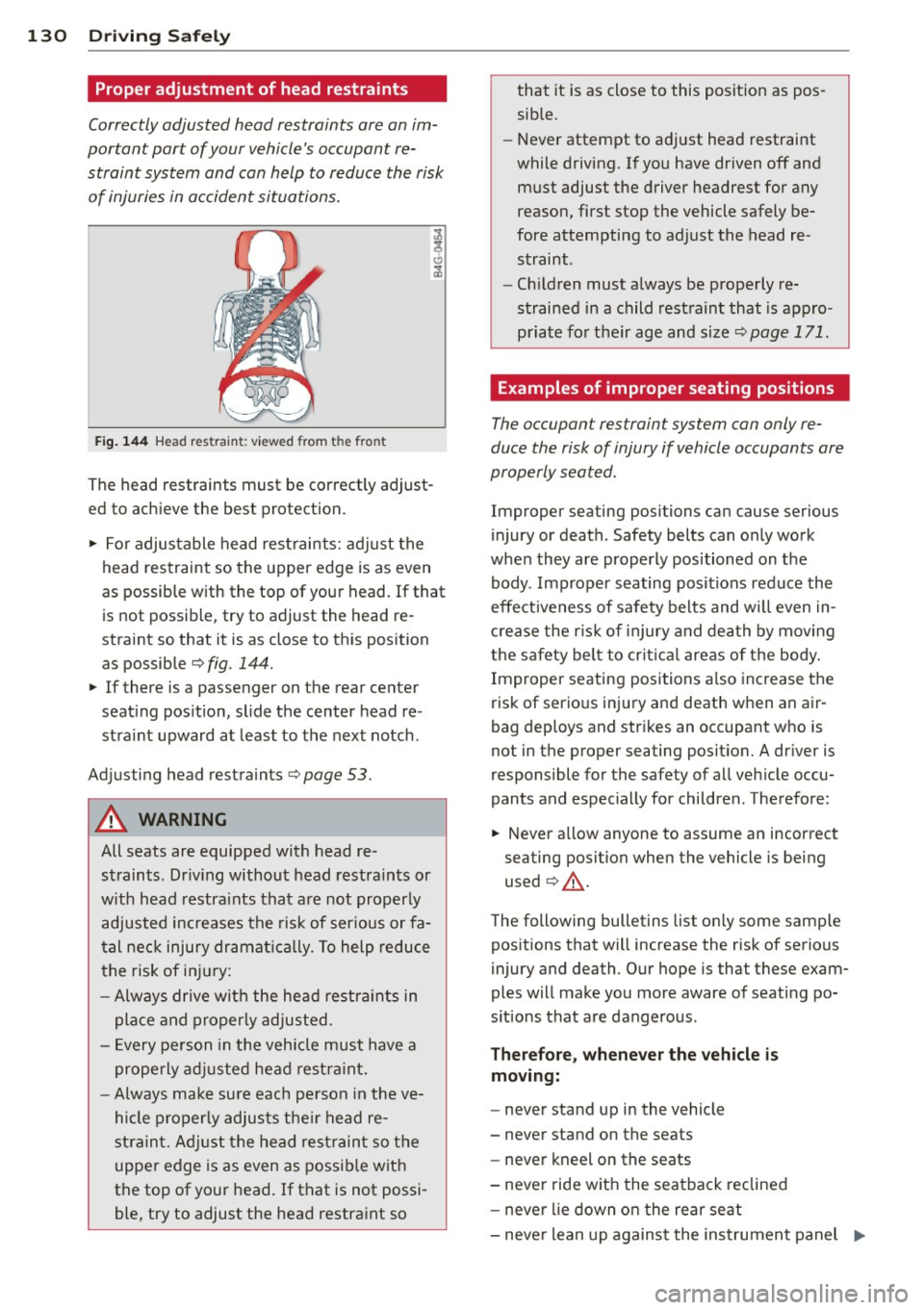
Fig . 14 4 Head restr ain t: vi ewed fro m the front
The head restraints must be correctly adjust
ed to achieve the best protection.
11> For adjustable head restraints: adjust the
head restraint so the upper edge is as even
as possible with the top of your head. If that
is not possible, try to adjust the head re
stra int so that it is as close to th is position
as possible ¢
fig. 144.
11> If there is a passenger on the rear center
seat ing pos it ion, slide the center head re
stra int upward at least to the next notch .
Adjusting head restraints¢
page 53.
A WARNING , _
All seats are equipped with head re
straints. Dr iv ing without head restraints or
w ith head restra ints that are not properly
adjusted increases the risk of ser ious or fa
tal nec k injury dramat ic al ly. To help reduce
t he risk of in ju ry:
- Always drive with the head restraints in
place and proper ly adjusted.
- E very person in the veh icle must have a
properly adj usted head restra int.
- Always make su re each pe rson in the ve
hicle proper ly adjusts the ir head re
st rain t. Ad just the head restrain t so the
upper edge is as even as possib le with
the top of your head. If that is not possi
ble, try to adjust the head restraint so that it is as close to this posit
ion as pos
sible.
- Never attempt to adjust head restraint
while driving. If you have driven off and
must adjust the driver headrest for any
reason, first stop the vehicle safely be
fore attempting to adjust the head re
straint .
- Chil dren must a lways be properly re
strained in a child restraint that is appro
priate for their age and size ¢
page 171.
Examples of improper seating positions
The occupant res traint sys tem can only re
duce the risk of injury if vehicle occupants are
properly seated .
Improper seating positions can cause serious
injury or death . Safety belts can only work
when they are properly positioned on the
body . Improper seating positions reduce the
effectiveness of safety belts and w ill even in
c rease the r is k of injury and dea th by moving
the safety be lt to cri tical areas o f the body.
Improper seating positions a lso increase the
risk of serio us injury and death when an air
bag deploys and strikes an occupant who is
not in the proper sea ting position. A dr iver is
responsible for the sa fety of all veh icle occu
pant s and espec ially for children . Therefore :
11> Never allow anyone to assume an incorrect
seating position when the vehicle is being
used ¢_& .
The following bulletins list on ly some samp le
positions that will increase the risk of serious
injury and death. Our hope is that these exam
ples will make you more aware of seat ing po
s itions that are dangerous .
Therefore, whenever the vehicle is
moving:
- never stand up i n the vehicle
- never stand on the seats
- never kneel on the seats
- never ride wit h the seatback reclined
- never lie down o n the rear seat
- neve r lean up against the instrument panel ..,_
Page 138 of 306
136 Safety belts
Safety belts
General notes
Always wear safety belts!
Wearing safe ty bel ts correctly saves lives!
This chapter exp lains why safety be lts are nec
essary, how they work and how to adjust and
wear them correctly .
.. Read a ll the information that fo llows and
heed all of the instruct ions and WARNINGS.
A WARNING
Not wearing safety belts or wearing them
improperly increases the risk of ser ious
personal in jury and death .
- Safety belts are the sing le most effective
means avai lab le to reduce the risk of se
r ious injury and dea th in a utomob ile acci
dents . For your protection and that of
yo ur passenge rs, always co rrectly wear
safety belts when the vehicle is moving .
- P regnant women, injured, or physically
im paired perso ns mu st also use safety
bel ts . Lik e all veh icle occup ants, they are
more like ly to be ser iously injured if they
do not wea r safety be lts . The best way to
protect a fetus is to protect the mother -
throughout the entire pregnancy.
Number of seats
Your Audi has a total of five seating positions: two in the front and three in the rear. Each
seating position has a safety belt.
A WARNING
Not wea ring safety belts or weari ng them
improp erly increases th e risk of ser ious
pe rsonal i njury and dea th.
- N ever st rap more than one pe rson, in
cl uding small ch ild ren, into any belt.
It is
e speci ally dange rous to pla ce a safety
belt over a child s itting on yo ur lap.
- N ever le t mo re people ride in the ve hicl e
than there are s afe ty be lts avail able. -
Be s ure everyone riding in the vehicle is
properly restrained w ith a separate safe
ty belt or child restra int.
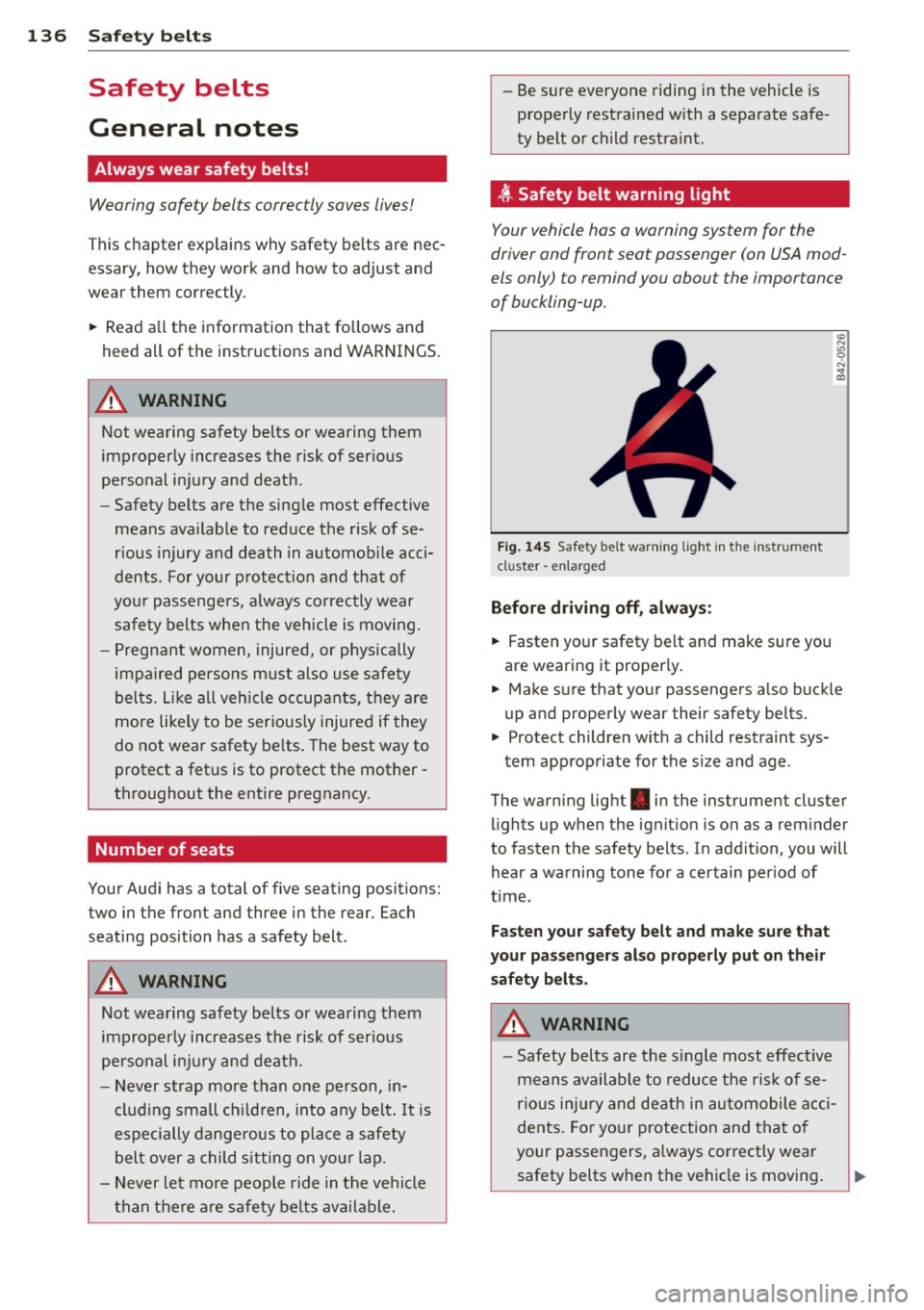
t Safety belt warning light
Your vehicle hos o warning system for the
driver and front seat passenger (on USA mod
els only) to remind you abou t the impor tance
of buckling-up .
Fi g. 14 5 Safety bel t warni ng lig ht in the inst rum ent
cl uster -e nl ar ged
Before driving off, alway s:
.. Fasten you r safety belt and make sure you
are wearing it properly .
.. Make s ure that your passengers a lso buck le
up and properly wear their safety be lts.
.. Protect children wit h a child restraint sys-
tem app ro priate for the s ize and age .
The warn ing light . in the instrument cluster
li ghts up when the ignit ion is on as a rem inder
to fasten the safety belts . In addit ion, you will
hear a wa rning tone fo r a ce rtain per iod of
t ime .
Fasten your safety belt and make sure that
your pass eng ers also properly put on the ir
s afety belt s.
A WARNING .....=-
-Safety b elts are the s ingle most eff ect ive
means availa ble to reduce t he ri sk of se
rio us inju ry and de ath in au tomobile acci
dents. Fo r yo ur protection and that of
your passengers , a lways cor rectly wear
safety belts when t he vehicle is moving .
Page 139 of 306
-Failure to pay attention to the warning
light that come on, could lead to person
al injury.
Why safety belts?
Frontal collisions and the law of physics
Frontal crashes create very strong forces for
people riding in vehicles .
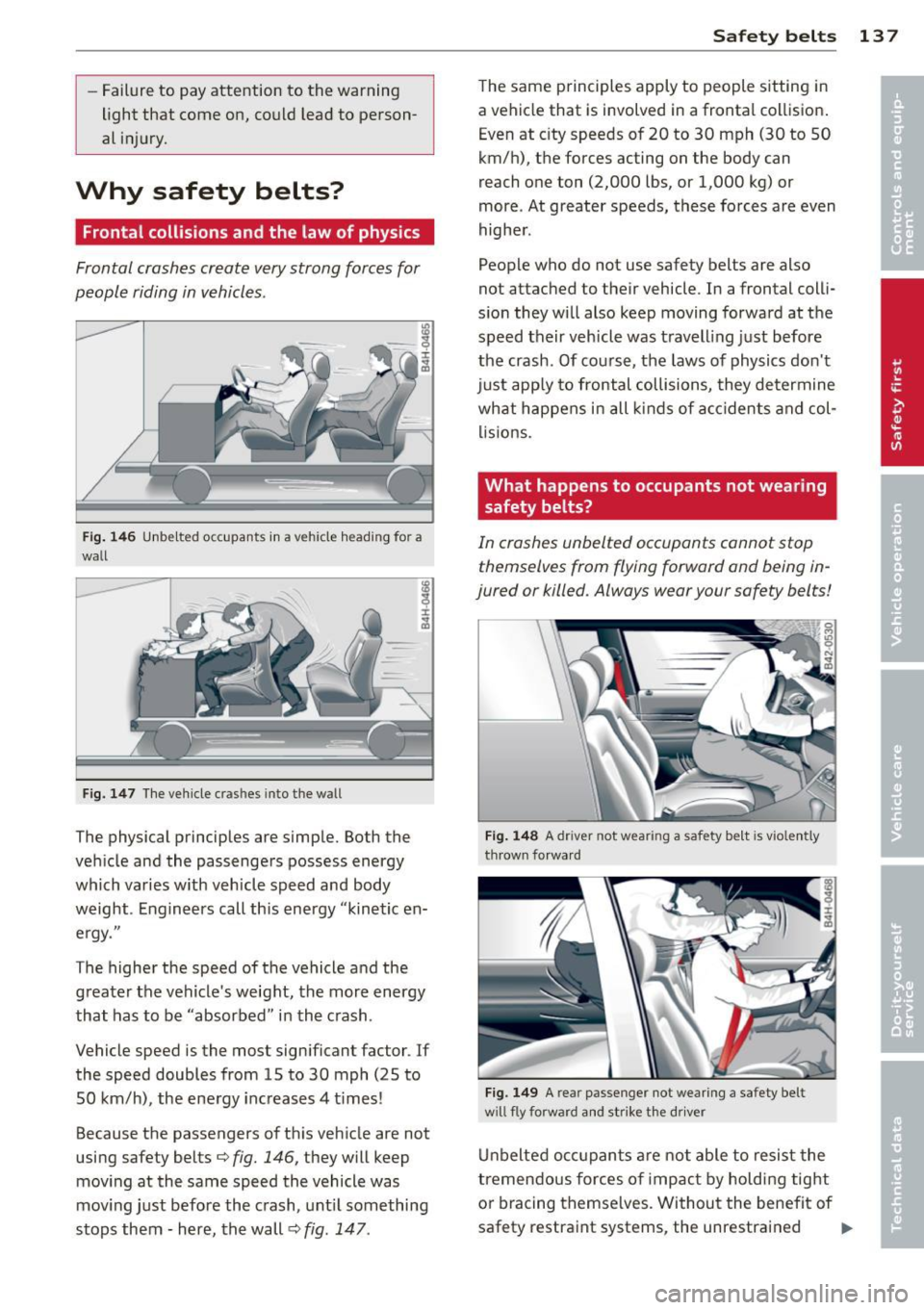
Fig. 146 Unbelted occupants in a ve hicle heading for a
wall
Fig. 147 The vehicle cras hes into the wall
The physical principles are simple. Both the
vehicle and the passengers possess energy
which varies w ith veh icle speed and body
weight . Engineers call this energy "kinetic en
ergy."
The higher the speed of the vehicle and the
greater the vehicle's weight, the more energy
that has to be "absorbed" in the crash .
Vehicle speed is the most significant factor . If
the speed doubles from 15 to 30 mph (25 to
50 km/h), the energy increases 4 t imes!
Because the passengers of this vehicle are not
using safety belts¢
fig. 146, they will keep
moving at the same speed the vehicle was
moving just before the crash, until something
stops them - here, the wall ¢
fig. 147.
Safety belts 13 7
The same principles apply to people sitting in
a vehicle that is involved in a frontal collision.
Even at city speeds of 20 to 30 mph (30 to 50
km/h), the forces acting on the body can
reach one ton (2,000 lbs, or 1,000 kg) or
more . At greater speeds, these forces are even
higher.
People who do not use safety belts are also
not attached to their vehicle . In a frontal colli
sion they will also keep moving forward at the
speed their vehicle was travelling just before
the crash . Of course, the laws of physics don't
just app ly to frontal collisions, they determine
what happens in all kinds of accidents and col
lisions.
What happens to occupants not wearing safety belts?
In crashes unbelted occupants cannot stop
themselves from flying forward and being in
jured or killed. Always wear your safety belts!
Fig. 148 A driver not wea ring a safety be lt is vio lently
thrown forward
Fig. 149 A rear passenger not wearing a safety belt
w ill fly forward and strike the driver
Unbelted occupants are not able to resist the
tremendous forces of impact by holding tight
or bracing themselves. Without the benefit of
safety restraint systems, the unrestrained .,..
Page 140 of 306
138 Safety belts
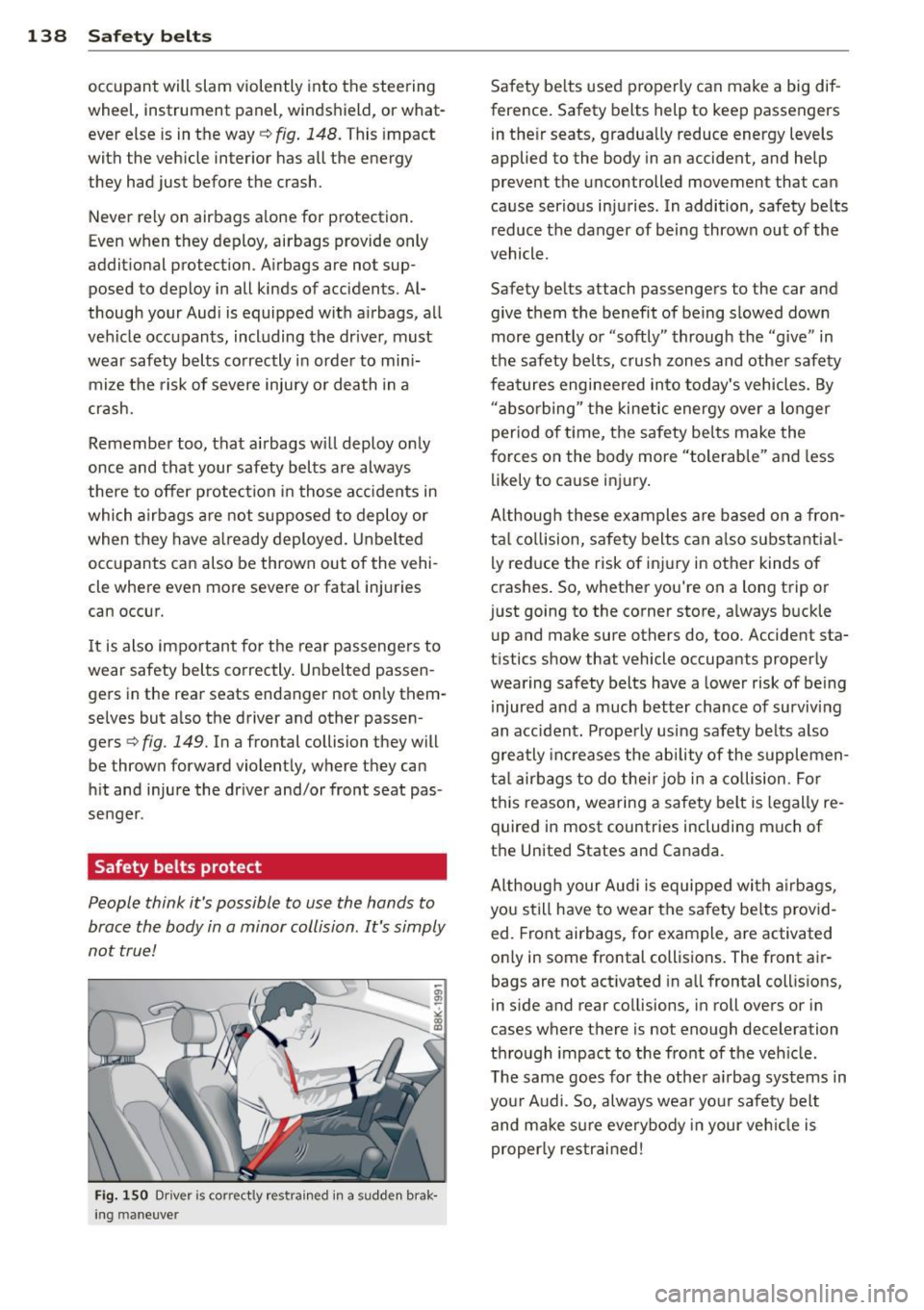
occupant will slam violently into the steering
wheel, instrument panel, windshield, or what
ever else is in the way
c::> fig. 148. This impact
with the vehicle interior has all the energy
t hey had just before the crash.
Never rely on a irbags alone for protection.
Even when they deploy, airbags provide only
additional protection. Airbags are not sup
posed to deploy in all kinds of accidents. Al
though your Audi is equipped with airbags, all
vehicle occupants, including the driver , must
wear safety belts correctly in order to mini
mize the risk of severe injury or death in a
crash.
Remember too, that airbags will deploy only
once and that your safety belts are always
there to offer protection in those accidents in
which airbags are not supposed to deploy or
when they have already deployed . Unbelted
occupants can also be thrown out of the vehi
cle where even more severe or fatal injuries
can occur.
It is also important for the rear passengers to
wear safety belts correctly. Unbelted passen
gers in the rear seats endanger not only them
selves but also the driver and othe r passen
gers ~
fig. 149. In a frontal collision they will
be thrown forward violently, where they can
hit and injure the driver and/or front seat pas
senger .
Safety belts protect
People think it's possible to use the hands to
brace the body in a minor collision . It's simply
not true !
Fig. 150 Driver is co rr ect ly re strain ed in a sudd en brak
ing maneuve r
Safety belts used properly can make a big dif
ference. Safety belts help to keep passengers
in their seats, gradually reduce energy levels
applied to the body in an accident, and help
prevent the uncontrolled movement tha t can
cause serious injuries . In addition, safety belts
reduce the danger of being thrown out of the
vehicle .
Safety belts attach passengers to the car and
give them the benefit of being slowed down
more gently or "softly" through the "give" in
the safety belts, crush zones and other safety
features engineered into today's vehicles. By
"absorbing " the kinetic energy over a longer
period of ti me, the safety belts make the
forces on the body more "tolerable" and less
likely to cause injury.
Although these examples are based on a fron
tal collision, safety belts can also substantial
ly reduce the r isk of injury in other kinds of
crashes. So, whether you're on a long trip or
just going to the corner store, always buckle up and make sure others do, too. Accident sta
tistics show that vehicle occupants properly
wearing safety belts have a lower risk of being
injured and a much better chance of surviving
an accident. Properly using safety belts also
greatly increases the ability of the supplemen
tal airbags to do their job in a collision . For
this reason, wearing a safety belt is legally re
quired in most countries including much of
the United States and Canada.
Although your Audi is equipped with airbags,
you still have to wear the safety belts provid
ed. Front airbags , for example, are activated
only in some frontal collisions. The front air
bags are not activated in all frontal collisions,
in side and rear collisions, in roll overs or in
cases where there is no t enough decelera tion
through impact to the front of the vehicle .
The same goes for the other airbag systems in
your Audi . So, always wear your safety belt
and make sure everybody in your vehicle is
properly restrained!
Page 141 of 306
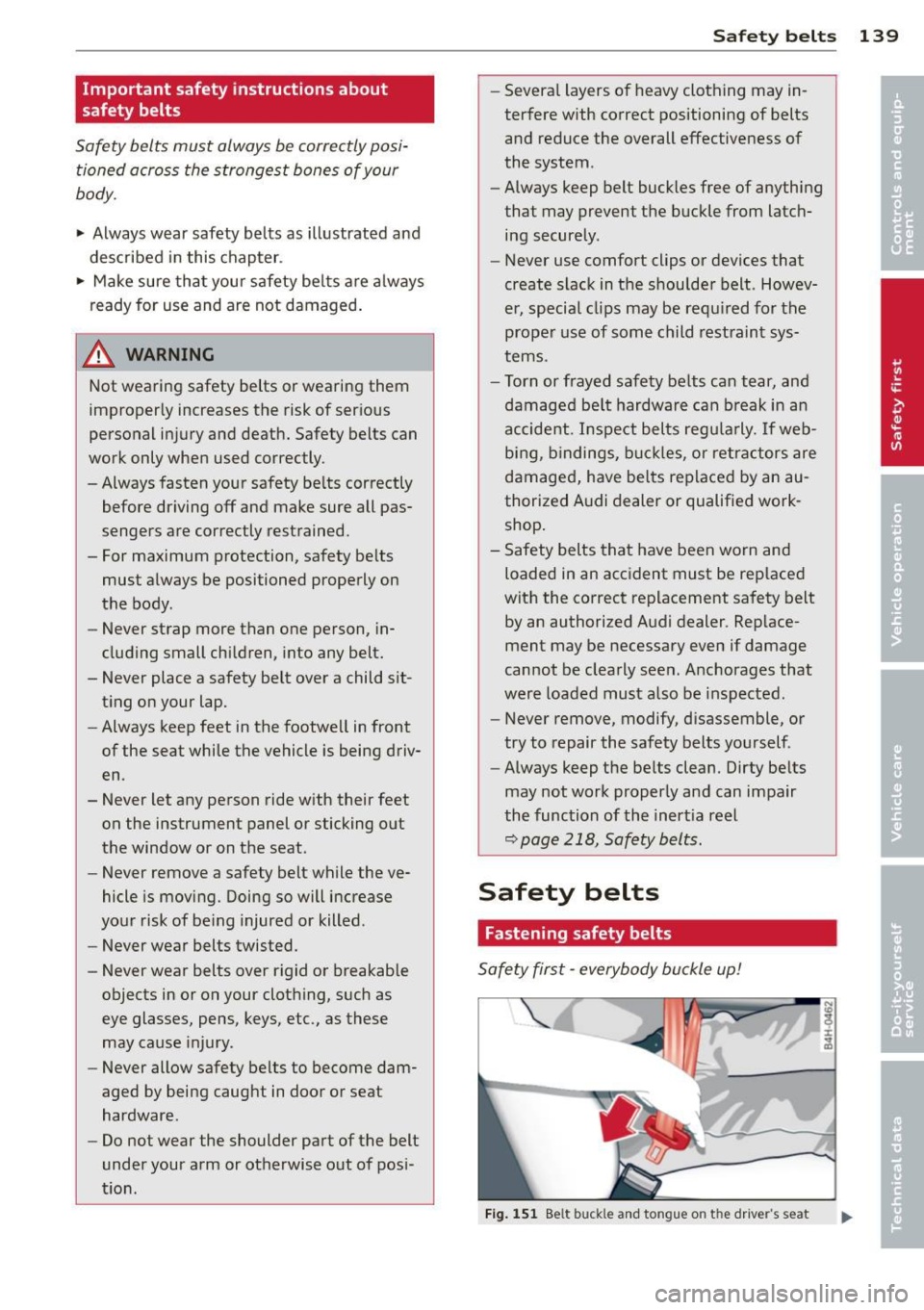
Important safety instructions about
safety belts
Safety belts must always be correctly posi
tioned across the strongest bones of your
body.
~ Always wear safety belts as illustrated and
described in this chapter.
~ Make sure that your safety belts are always
ready for use and are not damaged.
A WARNING
Not wearing safety belts or wearing them
improperly increases the risk of serious
personal injury and death. Safety belts can
work only when used correctly.
- Always fasten your safety be lts correctly
before driving off and make sure all pas
sengers are correctly restrained.
- For maximum protection, safety belts must always be positioned properly on
the body .
- Never strap more than one person, in
cluding small children, into any belt.
- Never place a safety belt over a child sit ting on your lap.
- Always keep feet in the footwell in front
of the seat while the vehicle is being d riv
en .
- Never let any person ride with their feet
on the instrument panel or sticking out
the window or on the seat.
- Never remove a safety belt while the ve
hicle is moving. Doing so will increase
your risk of be ing injured or killed.
- Never wear belts twisted.
- Never wear belts over rigid or breakable
objects in or on your clothing, such as
eye glasses, pens, keys, etc., as these may cause injury.
- Never allow safety belts to become dam
aged by being caught in door or seat
hardware .
- Do not wear the shoulder part of the belt
under your arm or otherwise out of posi
tion . Safety belts
139
- Several layers of heavy clothing may in
terfere with correct positioning of belts and reduce the overall effectiveness of
the system .
- Always keep belt buckles free of anything
that may prevent the buckle from latch
ing securely .
- Never use comfort clips or devices that
create slack in the shoulder belt . Howev
er, special clips may be requ ired for the
proper use of some child restraint sys
tems .
- Torn or frayed safety belts can tear, and
damaged belt hardware can break in an
accident. Inspect belts regularly.
If web
bing , bindings, buckles, or retractors are
damaged, have belts replaced by an au
thorized Audi dealer or qualified work
shop.
- Safety belts that have been worn and
loaded in an accident must be replaced
with the correct replacement safety belt
by an authorized Audi dealer. Replace
ment may be necessary even if damage
cannot be clearly seen . Anchorages that
were loaded must also be inspected.
- Never remove, modify, disassemble, or
try to repair the safety belts yourself.
- Always keep the belts clean. Dirty belts
may not work properly and can impair
the function of the inertia reel
r::;, page 218, Safety belts .
Safety belts
Fastening safety belts
Safety first -everybody buckle up!
Fig. 151 Bel t b uckle and to ngue on the drive r's seat
Page 142 of 306
140 Safety belts
To provide maximum protection, safety belts must always be positioned correctly on the
wearer 's body .
.,. Adjust the front seat and head restraint
properly ¢
page 50, General recommenda
t ions .
.,. Make sure the seatback of the rear seat
bench is in an upright position and securely
latched in place before using the belt¢,&.
.,. Hold the belt by the tongue and pull it
evenly across the chest and pelvis ¢ ,& .
.,. Insert the tongue into the correct buckle of
your seat until you hear it latch securely
¢fig. 151.
.,. Pull on the belt to make sure that it is se-
curely latched in the buckle.
Automatic safety belt retractors
Every safety belt is equipped with an automat
ic belt retractor on the shoulder belt. This fea
ture locks the belt when the belt is pulled out
fast, during hard braking and in an accident.
The belt may also lock when you drive up or
down a steep hill or through a sharp curve. During normal driv ing the belt lets you move
freely.
Safety belt pretensioners
The safety belts are equipped with a belt pre
tensioner that helps to tighten the safety belt
and remove slack when the pretensioner is ac
tivated ¢
page 143. The function of the pre
tensioner is moni tored by a warning light
¢ page 19.
Switchable locking feature
Every safety belt except the one on the driver
seat is equipped with a switchable locking fea
ture that
must be used when the safety belt is
used to attach a child seat. Be sure to read the important information about this feature
¢ page 182 .
.,& WARNING
Improperly positioned safety belts can
cause serious injury in an accident
¢ page 140, Safety belt position.
-Safety belts offer optimum protection
only when the seatback is upright and
belts are properly positioned on the
body .
- Always make sure that the rear seat
backrest to which the center rear safety
belt* is attached is securely latched
whenever the rear center safety belt is
being used.
If the backrest is not secure
ly latched, the passenger will move for
ward with the backrest during sudden
braking, in a sudden maneuver and espe
cially in a crash.
- Never attach the safety belt to the buck
le for another seat. Attaching the belt to
the wrong buckle will reduce safety belt
effectiveness and can cause serious per
sonal injury .
- A passenger who is not properly restrain
ed can be seriously injured by the safety
belt itself when it moves from the stron
ger parts of the body into critical areas like the abdomen .
- Always lock the convertible locking re
tractor when you are securing a child seat in the vehicle¢
page 184 .
(D Tips
For information on safety belt pretension
ers, refer to ¢
page 143.
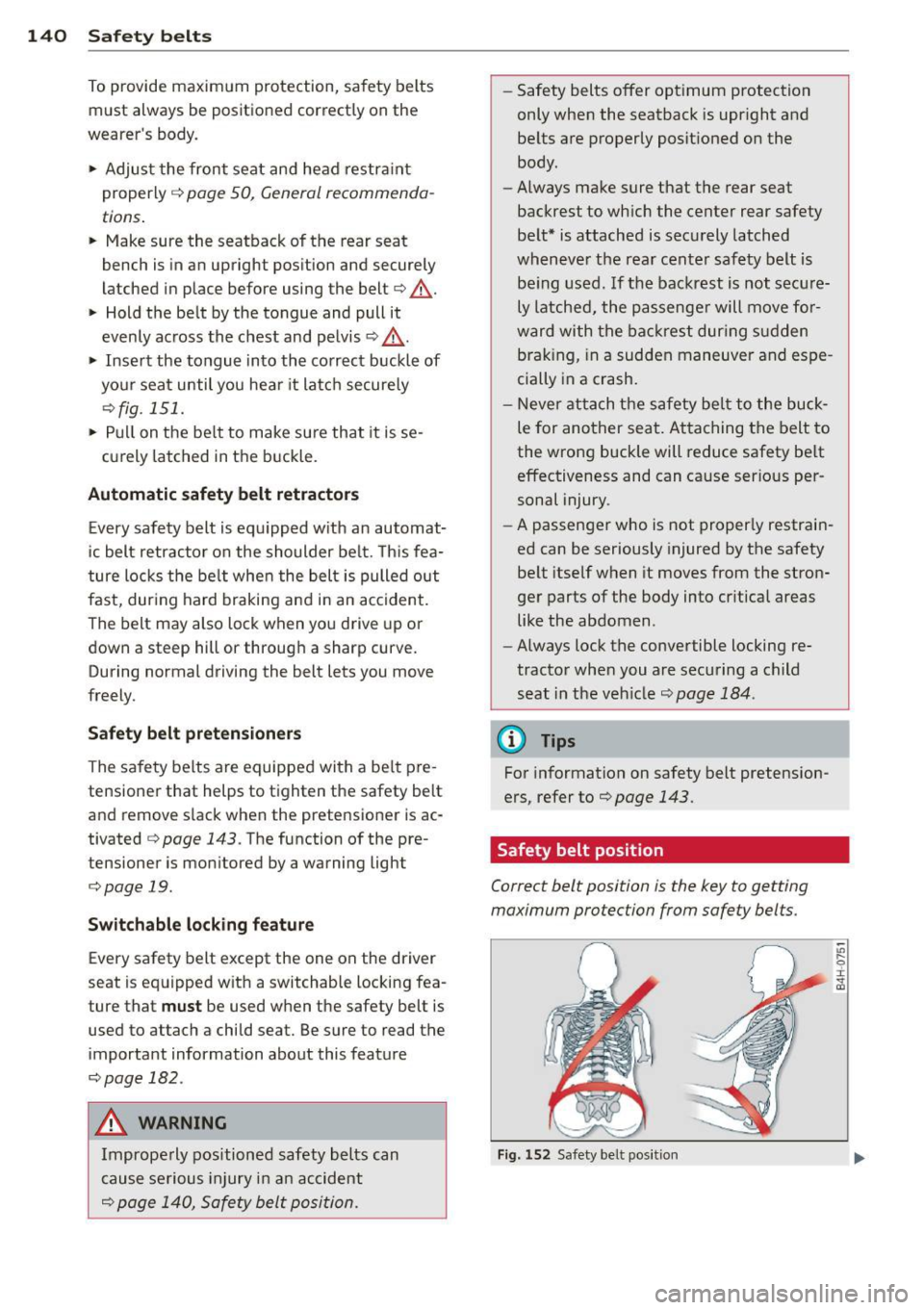
Safety belt position
Correct belt position is the key to getting
maximum protection from safety belts.
Fig. 152 Safety bel t position
"' .... 0
~ CD
Page 143 of 306
Use the height adjustment to change the posi
tion of the shoulder belt of the front safety
belts .
.&_ WARNING
Improperly positioned safety belts can
cause serious personal injury in an acci
dent.
-
- The shoulder belt should lie as close to
the center of the collar bone as possible
and should fit well on the body. Hold the
belt above the latch tongue and pull it
even ly ac ross the chest so that it sits as
low as possible on the pelvis and there is
no pressure on the abdomen. The be lt
sho uld a lways f it snugly ¢
fig. 152. Pull
on the belt to tighten if necessary.
- A loose-fitt ing safety be lt can cause seri
o us injuries by shifting its position on
yo ur body from the strong bones to more
vulnerab le, soft tissue and cause serious
injury.
- Always read and heed all WARNINGS and
other important information
¢ page 139.
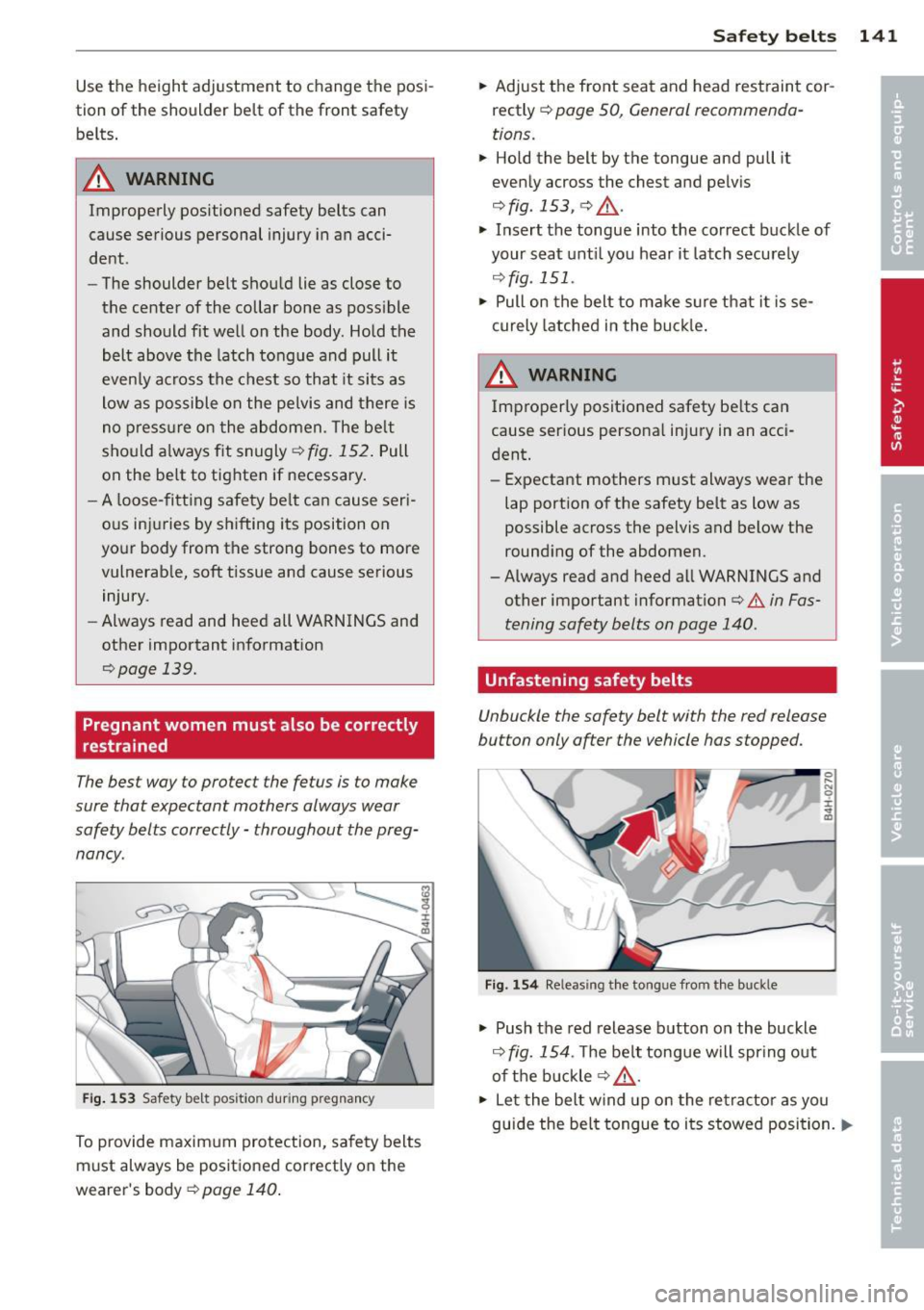
Pregnant women must also be correctly
restrained
The best way to protect the fetus is to make
sure that expectant mothers always wear
safety belts correctly -throughout the preg
nancy.
Fi g. 153 Safety belt pos itio n during pr egnancy
To provide maxim um protection, safety belts
must always be posit ioned correctly on the
wearer's body¢
page 140 .
Safety belts 141
.. Adjust the front seat and head restraint cor
rectly ¢
page 50, General recommenda
tions .
.. Hold the belt by the tongue and pull it
evenly across the chest and pelv is
¢ fig. 153, ¢ if:!. .
.. Insert the tongue into the correct buckle of
your seat until you hear it latch securely
r=:;, fig. 151 .
.. Pull on the belt to make sure that i t is se
curely latched in the buck le .
A WARNING
-
Improperly positioned safety be lts can
cause ser ious persona l injury in an acci
dent.
- Expectant mothers m ust always wear the
lap portion of the safety belt as low as
possible across the pelvis and below the
round ing of the abdomen.
-Always read and heed all WARNINGS and
other important information
i=:;, &. in Fas
tening safety belts on page 140.
Unfastening safety belts
Unbuckle the safety belt with the red release
button only ofter the vehicle has stopped.
,,,,,
Fig . 154 Re leas ing the tong ue from the buck le
.,. Push the red release button on the buckle
r=:;, fig. 154 . The be lt tongue will spr ing out
of the buckle
¢ if:!. .
0 ...
"' 0 ±
~
.,. Let the belt w ind up on the retractor as you
guide the be lt tongue to its stowed position.
Ill>
Page 144 of 306
142 Safet y belt s
A WARNING
Never unfasten safety belt while the vehi
cle is moving. Doing so will increase your
r isk of being injured or killed .
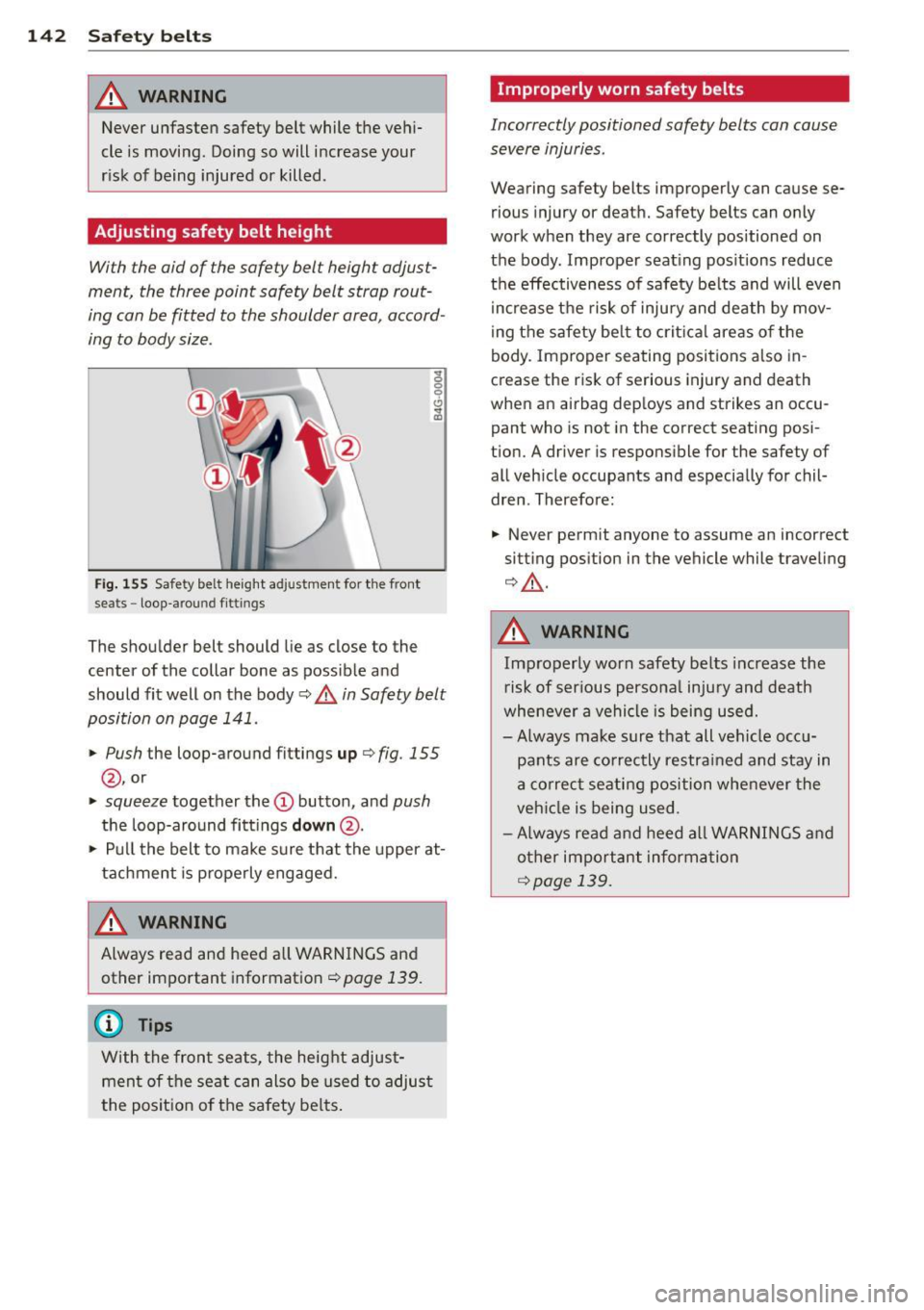
Adjusting safety belt height
With the aid of the safety belt height adjust
ment, the three point safety belt strap rout
ing can be fitted to the shoulder area, accord
ing to body size .
Fig. 155 Safety belt height adjustment for the front
sea ts - loop -around f ittings
The shoulder belt should lie as close to the
center of the collar bone as possible and
should fit well on the body
Q A in Safety belt
position on page 141.
,. Push
the loop-around fittings up Qfi g. 155
@, or
"" squeeze together the (D button , and push
the loop-around fitt ings down @.
"" Pul l the belt to ma ke sure that the upper at
tachment is p roperly engaged.
A WARNING
Always read and heed a ll WARNINGS and
other important information
Q page 139 .
@ Tips
With the front seats, the height adjust
men t of the seat can also be used to adjus t
the posit ion of the safety be lts.
Improperly worn safety belts
Incorrectly positioned safety belts can cause
severe injuries .
Wearing safety belts improperly can cause se
rious injury or death. Safety belts can o nly
work when they are correctly positioned on
the body . Improper seating pos itions reduce
the effectiveness of safety belts and will even
i ncrease t he risk of injury and death by mov
ing the safety be lt to crit ica l areas o f the
body. Improper seating positions also in
crease the risk of serious injury and death
when an airbag deploys and strikes an occu
pant who is not in the correct seating posi
tion. A driver is respons ible for the safety of
all veh icle occupants and especially for chil
dren . Therefore:
"" Never permit anyone to assume an incorrect
sitting position in the vehicle while traveling
QA .
A WARNING
Improperly worn safety belts increase the
r isk of ser ious persona l injury and death
whenever a vehicle is being used.
- Always ma ke sure that all vehicle occ u
pants are co rrectly restra ined and stay in
a correc t seating position whe never the
veh icle is being used .
- Always read and heed all WAR NINGS and
o ther important inform ation
Qpage 139.
Page 145 of 306
Safety belt preten
sioners
How safety belt pretensioners work
In fron t, side and rear-end collisions above a
parti cular severi ty and in a rollover, safety
b e lts ar e te nsion ed automatically .
Reversible safety belt tensioners
The safety belts on the front seats are equip
ped wit h power reve rsible tensioners . T he fo l
l ow ing f un ct ions are available w hen the dr iv
e r' s/fron t passenger 's sa fety bel ts are fas
tened :
- Automatic tensioners: at the start of a d rive,
the safety be lts automatically adjust to the
passenge r aft er a certai n time period o r ve
hicle speed. To switch the automa tic ten
s ioners off, select the fo llow ing in the M MI:
I CAR I funct ion button > (Car )* systems > Ve·
hide sett ings
> Seats > Driver 's seat or Pas
senger's seat
> Automat ic belt tensione r >
Off.
-In certa in driving situations, the safety belts
may t ighten with a reversib le tensioning
function
¢ page 190.
-The safety belts may also tighten w ith this
r evers ible tension ing funct ion in mino r colli
s ions .
Pyrotechnic safety belt pretensioners
The safety be lts are equipped with safety be lt
pretensioners. The system is activated by sen
s o rs in fron t, side and rear-end collisions of
great severity and in a rollover . Th is tightens
the bel t and takes up be lt slack ¢&.
in Service
and disposal of safety belt pre tensioner on
page 144.
T aking up the s lack helps to redu ce
forward occup ant movemen t during a colli
sion.
A WARNING
- It is possib le for the pre tensioners to de
ploy i ncor rect ly .
- T he pyrotechnic sys tem can only provide
protection for one co llision. If the pyro -
Safety belts 143
technic pretensioners deploy, the preten
sioning system must be replaced .
(D Tips
The pyro technic safety be lt pretensioners
ca n only deploy once .
- T he safety bel t pretensioners do not de
ploy in minor frontal and s ide collisions,
in rear-end co llisions, i n rollovers and in
co llisions involving very little impact
f o rce.
- A fine dust is released w hen the py ro
technic safety be lt pretensioners dep loy.
Th is is normal and is not caused by a fire
in the vehicle.
- The re levant safety requi rements must
be observed when the vehicle or compo
nents of the system are scrapped . A
qualified dealership is fam iliar with
these regulations and will be please d to
pa ss o n the information to yo u.
- Be sure to observe all safety, env iron
ment al and ot her regu la tio ns if t he ve hi
cle or ind ividu al p ar ts of t he system, par
t ic ular ly the s afe ty belt or airbag, are to
be disposed. We recommend you have
your authorized A udi dealer perform this
service fo r you .
Service and disposal of safety belt
pretensioner
The safety belt pretens ione rs are parts of the
saf ety be lts on your Aud i. Insta lling, remov
i ng, se rv ici ng o r repair ing of be lt pre tension
ers can dam age the safe ty belt sy stem and
prevent it from working correctly in a co lli
sio n.
T he re a re some impo rtan t thi ngs you have to
kn ow to m ake su re th at the effectiveness o f
t h e sys tem w ill not be impaired and tha t dis
ca rded components do not cause injury o r pol -
lu te the environment . ..,_ •
•
Page 146 of 306
144 Safety belts
,8. WARNING
Improper care, servicing and repair proce
dures can increase the risk of personal in
jury and death by preventing a safety belt
pretens ioner from act ivat ing when needed
or act ivat ing it unexpectedly:
- The belt pretensioner system can be acti
vated only once. If belt pretens ioners
have been act ivated, the system must be
replaced.
- Never repair, adjust, or change any parts
of the safety belt system.
- Safety belt systems includ ing safety be lt
pretensione rs cannot be repaired. Spe
ci al procedures are required for removal,
installation and disposal of this system.
- For any work on the safety belt system,
we strongly recommend that you see
your authorized Audi dealer or qualified
technician who has an Audi approved re
pair manual, training and specia l equip
ment necessary.
@ For the sake of the environment
Undep loyed airbag modu les and preten
sioners might be classified as Perchlorate
Material -specia l hand ling may apply, see
www.dtsc.ca.gov/haza rdou swaste/per
chlorate. When the vehicle or parts of the
restraint system including airbag modules
safety belts w ith pretens ioners are scrap
ped, all applicable laws and regulations
must be observed. Your authorized Aud i
deale r is familiar with these requ irements
and we recommend that you have your
dea ler perform this service for you.