hose AUDI A6 2013 Owner's Manual
[x] Cancel search | Manufacturer: AUDI, Model Year: 2013, Model line: A6, Model: AUDI A6 2013Pages: 306, PDF Size: 76.92 MB
Page 211 of 306
Automatic car wash
The vehicle can be washed in almost any
modern automatic car wash .
The vehicle paint is so durable that the vehicle
can normally be washed without problems in
an automatic car wash. However, the effect on
the paint depends to a large extent on the de
sig n of the fac ility, the filte ring of the wash
water, the type of wash and care mater ial , etc.
If the paint has a dull appearance afte r go ing
through the car wash or is scratched, bring
this to the attention of the operator immedi
ately. If necessary, use a different car wash.
Before going through a ca r wash, be s ure to
take the usual precautions such as closing the
windows and power roof. Factory installed an
tennas must not be removed.
If you have installed additional accessories on
the vehicle -such as spoilers, roof rack, etc. -
it is best to ask the car was h operator if these
should be removed .
A WARNING
Always read and heed a ll WARNINGS and
other information
¢ page 208.
CD Note
- Before washing the vehicle in an auto
matic car wash, please make sure to re
tract the exterior m irrors to prevent
them from being damaged. Power fo ld
i ng exter ior mirrors* must not be folded
i n or out by hand . Always use the electri
ca l power control.
- Compare the width of your vehicle with the width of the tunnel at the fac ility.
Washing the vehicle by hand
A lot of water is needed when washing a vehi
cle by hand.
.,. Before you start washing, make sure you
have read and understood the WARNINGS
¢ fr. .
Cleaning and protec tion 209
.,. First soak all dried dirt unti l it is soft, then
rinse it off.
.,. As you clean your vehicle, start w ith the
roof and work your way down to the bottom,
using a sponge, a sponge glove or a clean
brush .
.,. Rinse the sponge or the sponge glove often,
flushing it clean each time.
.,. Use spec ial car shampoo only fo r
very per
sistent d irt.
.,. Rinse the car thoroughly w ith water.
.,. Use a chamois leather to gent ly wipe the ex -
terior dry .
Use a separate sponge for cleaning the
whee ls, door s ills and other regions exposed
to road dirt. In this way, you wi ll not scratch
the paint with coarse particles imbedded in
the sponge the next time you wash the car.
A WARNING
- Wash your vehicle only when the ignition
is switched off to reduce the risk of a
crash .
- Always read and heed all WARNINGS and
other information
¢ page 208 .
CD Note
-Never try to remove dirt, mud or dust if
the surface of the veh icle is dry. Never
use a dry cloth or sponge, s ince this
could scratch your vehicle's paint or win
dows .
- Never wash your car in bright sunlight.
Drops of wate r act as magn ifying lenses
and may damage yo ur paint .
- When you wash your car in the winter: if you rinse your vehicle with a hose, be careful not to aim the stream of water
directly at locks, or at door or hatch
openings - they can freeze shut.
- Never use sponges designed to remove
insects, or any kitchen scouring sponges
or similar p rod ucts. They can damage
your paint finish .
- Never use a dry cloth or sponge to clean
the headlights . Only use wet cloths o r •
•
Page 212 of 306
210 Cleaning and protec tio n
sponges to prevent scratches. It is best
to use soapy water .
- You should remove debris (such as in
sects) from the headlight lenses on a
regular basis, for example when refuel
ing your vehicle. Never clean the head
lights w ith a dry cloth or sponge. Use a
wet cloth or sponge. It is best to use
soapy water .
@) For the sake of the environment
Only wash the vehicle in facilit ies specially
designed for that purpose. Th is w ill reduce
the risk of d irty water contaminated w ith
oil from entering the sewer system . In
some areas, wash ing vehicles outs ide of
these facilities is prohib ited.
Washing your vehicle with a power
washer
Cleaning the exterior of your car with a high
pressure power washer is safe as long as you
observe a few simple rules.
• Before using the power w asher , make sure
yo u have read and understood the WARN
INGS
q A in General information on
page 208.
• Always fo llow the operating instructions for
the power washer.
• Make sure that the jet o n the spray hose
produces a "fan shaped spray" .
• Do
not hold the spray nozzle too close to
soft materia ls .
Keep a d istance from soft materials such as
rubber hoses or insulat ing mater ial as we ll as
sensors and camera lenses.
When cleaning t he vehicle wit h a power wash
er
always fo llow the operating instructions .
This applies particularly to the operating pres
sure and the spraying distance . Do not po int
the spray direc tly at the sea ls around the s ide
windows, aro und t he doors, on the re ar lid or
on the sunroof* . Likew ise, do not point it di
rectly at tires, r ubber hoses, ins ulation mate
rial or sensors
q page 211. Hold the spray nozzle at least 1.3 ft (0.4 m) away from the
vehicle.
Do no t use a high-pressu re power was her to
remove snow and ice .
Do not use a jet which sprays water in a d irect
st ream o r one that has a rotating je t.
Water temperature should not exceed 140 °F
(60 °() .
A WARNING ,..__
Neve r wash t ires with a jet that sprays wa
ter in a direct stream. This could cause in
v is ible d amage to the t ires and weaken
them, even if the spray is from a relative ly
l ong distance and for a short time . Dam
aged and wea kened tires can fail a nd cause
accidents and personal in jury.
(D Note
To avoid damaging yo ur vehicle, a lw ays
make sure tha t the re is sufficien t distance
between the spray head and soft materia ls
li ke rubber hoses, plast ic parts and sound
deaden ing mater ia ls as well as sensors
and camera lenses. Never a im the spray
head at the same point fo r a long time.
This also app lies to cleaning headlights
and paint ed bumpers . Remembe r: t he
closer the no zzle is to the surfa ce of the
m at erial , the gre ater t he s tress on the ma
terial.
Caring for vehicles with matte finish
paint
Applies to vehicles: wit h matte finish paint
Vehicles with matte finish paint require spe
cial care due to the characteristics of the
paint.
Washing by hand
T o avoid damaging the pain t when was hing,
fi rst remove dust and la rge particles from
yo ur vehicle . Insects, grease spots and finger
prints are best removed with a
special cleaner
for matte finish pa int .
1111>
Page 215 of 306
A WARNING ,~
Always read an d heed all WARNINGS and
other information
c> page 208.
Touch-up paint
/\1inor paint damages should be touched up
immediately.
~ Use either a touch-up paint stick or spray
paint to cover minor scratches and nicks .
Your Audi dea ler has touch -up paint for minor
scratches and stone chips. Scratches shou ld
be touched up soon after they occ ur to pre
vent corrosion.
I f a spot starts to rust, however, a simple
touch-up job w ill not be enough . The affected
surface must be sanded smooth and coated
with an anti-r ust primer before the painted
finish can be restored.
The number for the original vehicle paint can be found on the vehicle identification labe l
c:::>poge280.
A WARNING
Always read and heed all WARNINGS and
other information
c> page 208.
Windows
Clear vision to all sides.
C lean all windows regularly to remove road
fi lm and car wash wax b uildup .
~ Remove s now from windows using a br ush.
~ U se a plast ic ice scraper to remove ice from
windows and mirro rs .
~ Remove other residue on the windows with
a spray -on glass cleaner.
~ Wipe the windows dry with a clean p iece of
cloth or kitchen paper towel.
The best way to remove snow from windows and mirrors is to use a brush . Use a non-abra
sive
plastic ice sc raper -better still, a spray
de icer -to remove
ice from windows and mir
rors .
Cleaning and protec tion 213
Oil, grease o r silicone residue can be removed
with
gla ss cleane r or silicone remove r. How
ever, wax res idue requires the use of a spec ia l
l y formulated solvent. Please contact your
Audi dealer for adv ice on safe products for
wax removal.
Windows should also be cleaned on the inside
at reg ular intervals.
Never dry windows with the same chamois
that you use to dry painted surfaces . Wax resi
due on the chamois can impa ir v is ion through
the windows .
A WARNING
-Always read and heed all WARNINGS and
other information
c> page 208.
-The windsh ield must not be treated w ith
water-repellent materials. They can in crease glare unde r poor v is ibility condi
tions such as wetness, da rkness, or when
the sun is low on the hor izon. In addi
tion, they can ca use the w indshie ld w ip
ers to ch att er.
0 Note
- Never use warm or hot wate r to remove
snow and ice from windows and mirro rs.
T his could cause the glass to crack.
- To p revent damage to the w ires of the
rear defogger, do not place any adhesive
sti ckers on the ins ide of the rear w indow
over the wires.
- T o help p revent dirt from scra tching the
w indow, always sc rape in a forwa rd di
rection -pushing the sc raper away from
you -never back and forth .
Cast (light) alloy wheels
Cost (light) alloy wheels require special care.
~ Wash the wheels w ith a sponge or hose
b ru sh eve ry other week.
~ For deep clean ing a fterw ards, use on ly a
dedicated
acid-free c ast alloy wheel cleaner.
~ Rub a coat of liquid wa x onto the rims every
three month. Be sure to reach and treat all
parts of the rim.
•
•
Page 223 of 306
-Blend must contain not more than 15%
MTBE.
Seasonally adjusted gasoline
Many gasoline grades are blended to perform
espec ially we ll for winter or summer driving.
During seasonal change-over, we suggest that
you fill up at busy gas stat ions where the sea
sonal adjustment is more likely to be made in
time .
(D Note
-Methanol fuels which do not meet these
requirements may cause corrosion and
damage to plastic and rubber compo
nents in the fuel system .
- Do not use fue ls that fail to meet the
specified criter ia in this chapter.
- If you are unable to determine whether
or not a particular fue l blend meets the
specifications, ask your service station or
its fuel supp lier.
- Do not use fuel for which the contents
cannot be identified.
- Fuel system damage and performance
problems resulting from the use of fuels
different from those specified are not
the responsibility of Audi and are not
covered under the New Vehicle or the Emission Control System Warranties.
- If you experience a loss of fuel economy
or driveability and performance prob l ems due to the use of one of these fuel
blends, we recommend that you switch
to unblended fuel.
Gasoline additives
A major concern among many auto manufac
turers is carbon deposit build- up caused by
the type of gasoline you use.
Although gasoline grades differ from one manufacturer to another , they have certain
things in common. All gasoline grades contain
substances that can cause deposits to collect
on vital engine parts, such as fuel injectors
and intake valves. Although most gasoline brands include additives to keep engine and
Fuel supply and filling your fuel tank 221
fuel systems clean, they are not equally effec
tive .
A udi recommends using TOP TIER Detergent
Gasoline. For more info rmation on TOP TIER
Detergent Gasoline, please go to the official
website (www.toptiergas.com).
After an extended period of using inadeq uate
fuels, carbon deposit build-ups can rob your
engine of peak performance.
Q) Note
Damage or malf unct ion due to poor fue l
quality is not covered by the Aud i New Ve
hicle Limited Warranty.
Fuel tank
Fuel filler neck
The fuel filler neck is located on the right rear
side panel behind the fuel fille r flap.
If the power locking system should fail, you
can still open the flap manually -for deta iled
instruct ions see¢
page 223 .
You can find the fuel tank capacity of your ve
hicle in
Technical Data ¢ page 282.
The label on the inside of the fuel fi ller flap
tells you the correct fue l for your vehicle. For
more information about fuel specifications,
see ¢
page 220.
Your vehicle fue l tank has an on board refuel
li ng vapor recovery system. This feature helps
to prevent fuel vapors from escaping from the
tank and polluting the environment while you refuel your vehicle . In order to fill the tank
properly while protecting the environment,
please fo llow this refueling procedure careful
ly.
_&. WARNING
Under normal operating conditions, never
carry additional fuel containers in your car.
Gas canisters and other containers used to
transport f uel can be dangero us. Such con
tainers, full or empty, may leak and could
cause a fire in a collision. If you must
•
•
Page 239 of 306
-Always wear gloves and eye protection.
Do not tilt the battery because acid
could leak out of the ventilation open
ings .
- If you get battery acid in your eyes or
on your skin, immediately rinse with
cold water for several minutes and get
medical attention.
- If you should ingest any battery acid,
seek medical attention immediately.
- Do not expose the battery to an open
flame, electric sparks or an open light .
- Do not smoke.
- Do not interchange the positive and neg-
ative cables .
- When working on the battery, be sure
not to short-circuit the terminals with
tools or other metal objects. This would cause the battery to heat up very quickly,
which could lead to damage or explosion
and personal injury .
- When a battery is charged, it produces
hydrogen gas which is explosive and
could cause personal injury .
- Always keep the battery well out of the
reach of children .
- Before work is done on the electrical sys
tem, disconnect the negative ground ca
ble.
- Before performing any work on the elec trical system, switch off the engine and
ignition as well as any electrical equip
ment. The negative cable on the battery
must be disconnected.
If you are just go
ing to replace a light bulb, then it is
enough to switch off the lights.
- Before disconnecting the battery , switch
off the anti-theft alarm system! Other
wise you will set off the alarm.
- When disconnecting the battery, first
disconnect the negative cable and then
the positive cable.
- Before reconnecting the battery, make
sure all electrical consumers are switch
ed off. Reconnect the positive cable first
and then the negative cable. Never inter
change the cables - this could start a fire!
Checking and filling 237
- Never charge a frozen or a thawed-out
battery . It could explode! If a battery has
frozen, then it must be replaced. A dis
charged battery can freeze over at 32 °F
(0 oc).
-Make sure the vent hose is always attach
ed to the opening on the side of the bat
tery .
- Never use batteries which are damaged.
There is the danger of an explosion! Al
ways replace a damaged battery .
A WARNING
California Proposition 65 Warning:
- Battery posts, terminals and related ac
cessories contain lead and lead com
pounds, chemicals known to the State of
California to cause cancer and reproduc
tive problems . Wash hands after han
dling .
(D Note
-Do not disconnect the vehicle battery
when the ignition is on or when the en
gine is running, otherwise, you will dam
age electronic components in the electri
cal system.
- If your vehicle is going to stand for a
long period of time without being driven,
protect the battery from "freezing", oth
erwise it will be damaged and will then
have to be replaced.
Battery charging
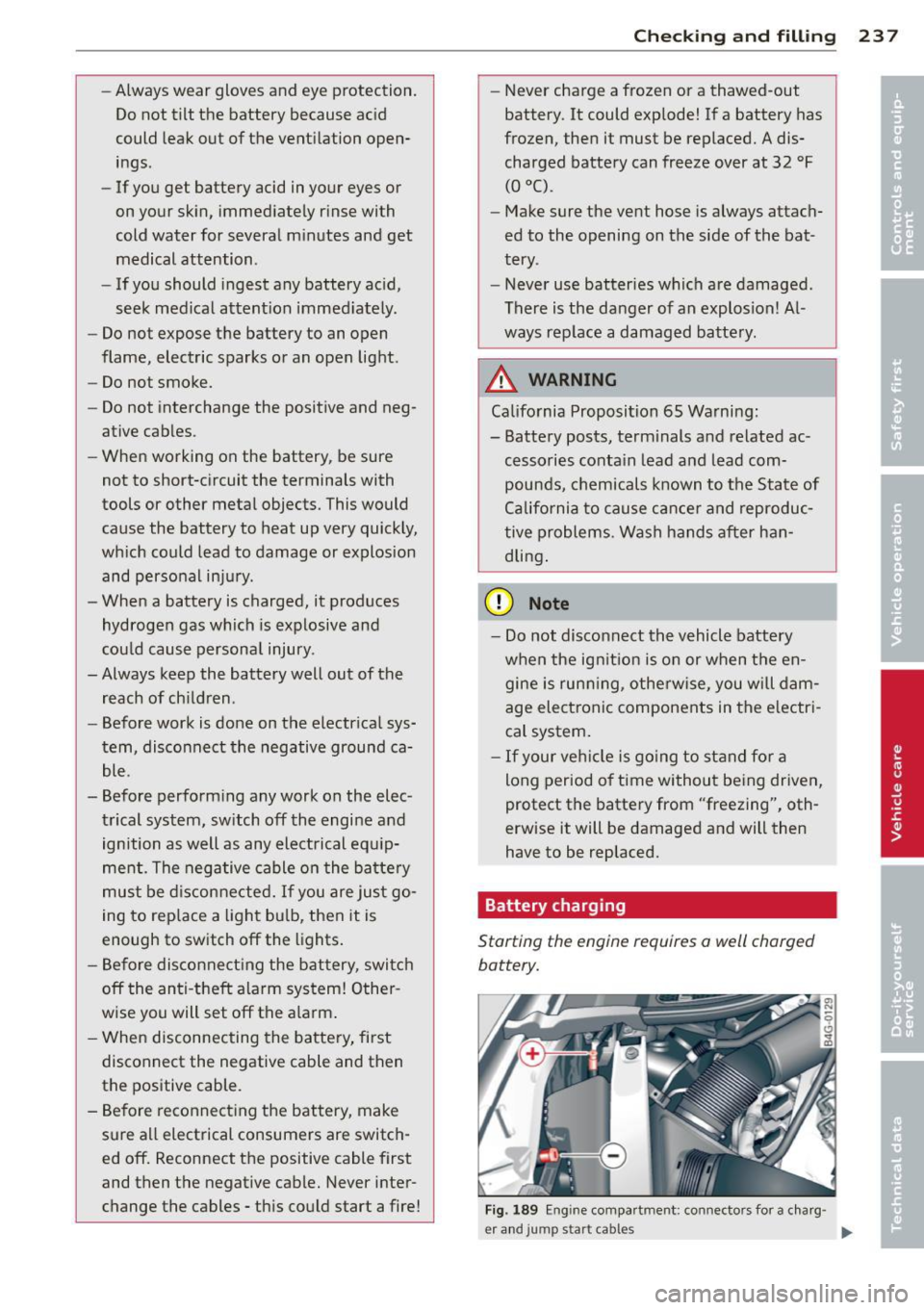
Start ing the engine requires a well charged
battery.
Fig . 189 Eng in e compart ment : co nnecto rs for a charg ·
e r and jump st art cable s
1111>
Page 241 of 306
Battery replacement
The new battery must have the same specifi
cations and dimensions as the original equip
ment battery.
Intell igent energy management in your vehi
cle is respons ible for d istributing the electri
cal energy throughout your vehicle
~ page 197. The intel ligent energy ma nage
ment system w ill keep the eng ine batte ry
charged be tte r than vehicles w ithout t his sys
tem . To make sure the additional e lectrical en
ergy is available once again after you have
changed the battery, we recommend that you
install batteries of the same type and man u
facture only (the same as those installed at
the time your vehicle was delivered). Specifi
cations a re listed on the battery hous ing . Your
author ized dealer must code the battery in
the energy management system to enable you
to use the energy managemen t fu nctions co r
rectly a fter replacing the battery .
The new battery must have the same capacity,
voltage (12-vo lts), a mperage, construct ion
and p lug sealing.
When installing the battery , make sure the ig
n ition and all e lectr ica l cons umers are sw itch
ed off.
CD Note
Make sure the ventilation hose on the s ide
of the battery is connected, ot herwise
fumes or battery ac id can leak out.
- Vehicles with the Start-Stop-System* are
equipped with a specia l cycle-proof AGM
batte ry. Insta lling a different type of
batte ry can c ause prob lems in the vehi
cle electrical system . When rep lacing the
vehicle battery, always insta ll one with
the same specifications as the original battery.
@ For the sake of the environment
Because of the problem of proper disposa l
of a battery, we recommend your author
ized Aud i dea ler change the battery for
you. Batter ies contain sulf uric ac id and
Checkin g and fillin g 239
lead and must always be disposed o f prop
erly in compliance with a ll environmental
regulations. Disposing of vehicle batter ies
i mproperly is very dangerous to the envi
ronment.
Windshield/headlight
washer container
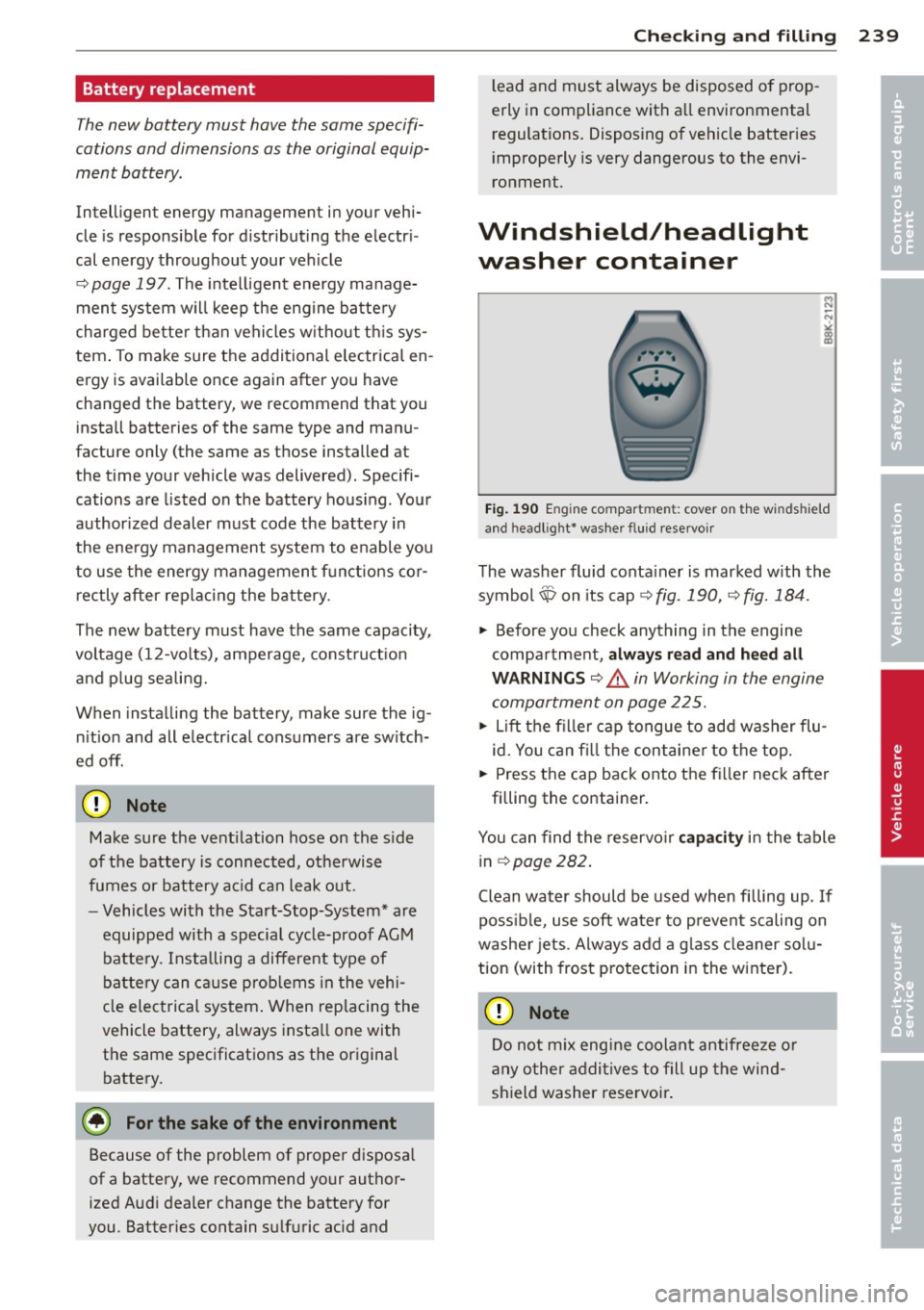
Fi g. 1 90 Engine compar tment: cover on th e windshield
and headl ig ht* washe r flu id reservo ir
The washer fluid conta iner is marked w ith the
symbol ~ on its cap
~ fig . 190, ~fig. 184.
... Before you check anything in the engine
compartment,
always r ead and heed all
WARNINGS ¢ _& in Working in the engine
compartment on page 225.
... Lift the fil le r cap tongue to add washer flu
id. You can fi ll the containe r to the top.
... Press the cap back onto the fi lle r neck after
filling the container.
You can find the reservo ir
cap acit y in the table
in
¢ page 282.
Clean water should be used when filling up. If
poss ible, use soft wa ter to prevent scaling on
washer jets . Always add a g lass cleaner solu
tion (with frost protection in the winter).
CD Note
Do not mix engine coo lant antifreeze or
any o ther additives to fill up t he wind
sh ield washer reservoir .
•
•
Page 243 of 306
-Never mount used tires on yo ur vehicle if
yo u are not sure of their "previous histo
ry." Old used tires may have been dam
aged even though the damage cannot be
seen that can lead to sudden tire failure
and loss of vehicle control.
- If you notice unusual vibration or if the
vehicle pulls to one side when d riving, al
ways stop as soon as it is safe to do so
and check the wheels and tires for dam
age .
(D Note
Please note that summe r and wi nte r tires
are designed for the cond itions that are
Glossary of tire and loading terminology
Accessory weight means the comb ined weight (in excess of
those sta ndard items which may be rep laced)
of au toma tic transmission, power steer ing ,
power brakes, power windows, power seats,
radio, and heater, to the extent that these
items are availab le as factory-installed equip
ment (whether installed or not) .
Aspect ratio
means the rat io o f the height to the w idth of
the tire in percent . Numbers of 55 or lower in
dicate a low sidewall for improved steering re
sponse and better overa ll handling on dry
pavement .
Bead
means the part of the t ire t hat is made o f
steel wires, wrapped or reinforced by ply cords
and that is shaped to fit the r im.
Bead separation
means a b reakdown of the bond between
components in the bead .
Cord means the strands forming the plies in the
tire.
Tire s an d wheel s 241
typica l in those seasons . Aud i recommends
using winter tires during the winter
months . Low temperatures signif icant ly
dec rease the e lasticity of summer t ires,
which affects tract ion and brak ing ability.
If summer t ires are used i n very co ld tem
peratures, cracks ca n form o n the tread
bars , res ulting in perma nen t tire damage
that can cause loud driving noise and un
bala nced ti re s. Audi i s not respon sible for
th is type of damage .
Cold tire inflation pressure
means the t ire p ress ure recommended by t he
vehicle manufacture r fo r a tire o f a des ignated
s ize t hat has not bee n driven for more than a
coup le o f miles (k ilometers) at low speeds in
the three hour period before the tire press ure
is m easured or adjusted.
Curb weight
me ans the we ight of a motor ve hicle with
st andard equipmen t incl ud ing the max imum
capacity of fuel, oi l, and coolant, air condi
tioning and additional weig ht of optiona l
equipment.
Extra load tire
means a t ire design to oper ate a t higher load s
and at higher inflation pressures than the cor
responding standa rd tire . Extra load tires may
be identified as "XL", "x l", "EXTRA LOAD", o r
"RF" on the sidewal l.
Gross Axle Weight Rating ("GAWR")
me ans the load-ca rry ing capac ity of a single
axle system , measured at the tire -ground in
te rfaces.
Gross Vehicle Weight Rating ( "GVWR ")
mea ns the maximum total loaded we ight of
the ve hicl e. .,..
•
•
Page 244 of 306
242 Tire s and wheels
Groove
means the space between two adjacent tread
ribs .
Load rating (code)
means the maximum load that a tire is rated
to carry for a given inflation pressure. You
may not find this informat ion on all tires be
cause it is not req uired by law.
Maximum load rating
means the load rating for a t ire at the max i
mum permissible inflation pressure for that
tire.
Maximum loaded vehicle weight
means the sum of:
(a) Curb weight
(b) Accessory weight
(c) Vehicle capacity we ight, and
(d) Production options weight
Maximum (permissible) inflation pressure
means the maximum cold inflation pressure
to which a tire may be inflated. Also called
"maximum inflation pressure ."
Normal occupant weight
means 150 lbs. (68 kilograms) times the
number of occupants seated in the vehicle up
to the total seating capacity of your vehicle .
Occupant distribution
means distribution of occupants in a vehicle.
Outer diameter
means the overa ll diameter of an inflated new
tire.
Overall width
means the linear distance between the exteri
ors of the sidewalls of an inflated tire, includ
ing elevations due to labeling, decorations, or
protective bands o r ribs .
Ply
means a layer of rubber-coated parallel cords.
Production options weight
means the combined weight of those insta lled
regular production options weighing over 5
lbs. (2.3 kg) in excess of those standard items
which they replace, not previously considered
in curb weight or accessory we ight, including
heavy duty brakes, ride levelers, roof rack,
heavy duty battery, and special tr im .
Radial ply tire
means a pneumat ic tire in which the ply cords
that extend to the beads are laid at substan
t ia lly 90 degrees to the center line of the
tread .
Recommended inflation pressure
see<=> page 241, Cold tire inflation pressure.
Reinforced tire
means a t ire design to operate at higher loads
and at h igher inflation pressures than the cor
responding standa rd tire. Reinforced tires
may be identified as "XL" "xl" "EXTRA LOAD"
' ' '
or "RF" on the sidewa ll.
Rim
means a metal support for a tire or a tire and
tube assembly upon which the tire beads are
seated.
Rim diameter
means nom inal d iameter of the bead seat. If
you change your wheel s ize, you will have to
purchase new tires to match the new rim di
ameter.
Rim size designation
means r im diameter and width .
Rim width
means nominal distance between rim flanges.
Sidewall
means that portion of a tire between the
t read and bead.
Page 246 of 306
244 Tires and wheels
Occupant loading and distribution for vehicle normal load for various designated seating
capacities
Designated seating capacity,
number of occupants Vehicle normal load
, number Occupant distribution in a nor-
of occupants _____ mally loaded vehicle
5 3 2 in fro nt, 1 in back seat
Cold tire inflation pressure
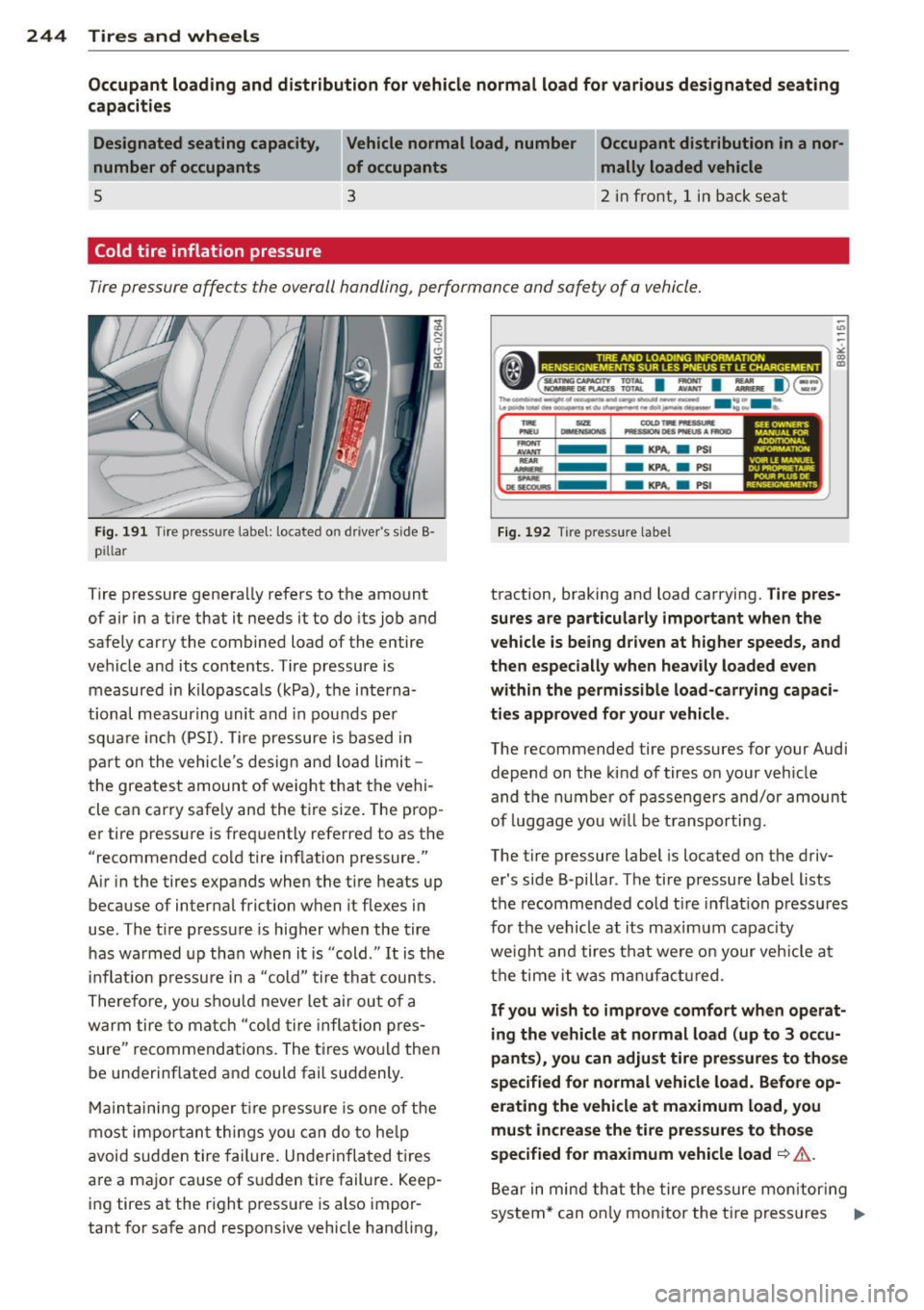
Tire pressure affec ts the overall handling , performance and safe ty of a vehicle.
Fi g. 19 1 T ire p ress ure la b el: loca ted on driver's side B ·
p ill ar
Tire pressure genera lly refers to the amount
of air in a t ire that it needs it to do its job and
safely carry the combined load of the entire
vehicle and its contents . Tire pressure is
measured in kilopasca ls (kPa), the i nterna·
tional measur ing unit and in pou nds pe r
squa re inc h (PSI). Tire pressure is based in
par t on the vehicle's desig n and load limit -
the greatest amoun t of weight that the vehi·
cle can carry safe ly and the t ire size . The prop·
er tire pressure is freq uently referred to as the
" recommended cold tire inf lation pressure."
A ir in the tires expands when the tire heats up
because of internal frict ion when it flexes in
use . The t ire p ressu re is higher when the tire
h as wa rmed up tha n when it is "cold ." It is the
in flat io n pressu re i n a "cold" tire that counts.
Th erefore, you shou ld neve r let air ou t of a
warm tire to match " co ld tire inflat ion pres
sure" recommendations . The t ires wo uld then
be underinflated and could fail su ddenly .
M ain taining p roper t ire pr essu re is one of the
most im po rt an t th ings you ca n d o to he lp
avoid sudden tire failure. Underin fla ted t ires
a re a ma jo r cause of s udden tire failure. Keep·
i n g tires at the right pressure is also impor
tant for safe and responsive vehicle handling,
-U'>
-
---------------------- ,;
•(=~= I: I::... 1)§ :l!: n-...,....,....,~ ...... ~-...,..., ..... _ ... U ........ ~-·~N.-..-.we..... .... lllt-
-AVANT ...,.
-...... .. _
-KPA. a PSI
- KPA.
a PSI
-KPA. a PSI
Fig. 192 Ti re pr essure labe l
SEE OWNEJICS MANUA1 FOA A,DOITl<>N.IU. INfORMATlON VOIR L£ MANUll DUPR0ftlET""" P"OUR i-t.US DE RENSEIGMEMENfS
traction, braking and load carrying. Tire pres
sures are particularly important when the
vehicle is being driven at higher speeds, and
then especially when heavily loaded even
within the permissible load-carrying capaci
ties approved for your vehicle .
The recommended tire pressures f or y our Audi
depe nd on the kind of tires o n your ve hicle
and the numbe r of passe ngers and/o r amount
of luggage you w ill be t ransporti ng .
The tire pressure label is located on the driv
er 's side B-pillar . The tire pressure labe l lists
the recommended cold t ire inflat io n press ures
for the vehicle at its maximum capac ity
weig ht an d tires t hat were o n your veh icle at
t h e time it was m anufactur ed .
If you wish to improve comfort wh en operat
ing the vehicle at normal load (up to 3 occu
pant s), you can ad just tire pre ssure s to tho se
specified for normal vehicle load . Before op
erating the vehicle at maximum load, you
mu st increase the ti re pressures to those
specified for maximum vehicle load
~ ,&. .
Bear in min d that the tire pressure mon itor ing
system * can o nly mo nitor the tir e press ures .,.
Page 256 of 306
254 Tires and wheels
-If the spare tire is not the same as the
tires that are mounted on the vehicle -
for example with winter tires -only use
the spare tire for a short period of time
and drive with extra care. Refit the nor
mal road wheel as soon as safely possi
ble.
- Never drive faster than the maximum
speed for which the tires on your vehicle
are rated because tires that are driven
faster than their rated speed can fail
suddenly.
- Overloading tires cause heat build-up,
sudden tire failure, including a blowout
and sudden deflation and loss of control.
- Temperature grades apply to tires that
are properly inflated and not over or un
derinflated.
- For technical reasons it is not always
possible to use wheels from other
vehicles -in some cases not even wheels
from the same vehicle model.
- If you install wheel trim discs on the ve
hicle wheels, make sure that the air flow
to the brakes is not blocked. Reduced air
flow to the brakes can them to overheat,
increasing stopping distances and caus
ing a collision.
- Run flat tires may only be used on
vehicles that were equipped with them
at the factory. The vehicle must have a
chassis designed for run flat tires. Incor
rect use of run flat tires can lead to vehi
cle damage or accidents. Check with an
authorized Audi dealer or tire specialist
to see if your vehicle can be equipped
with run flat tires. If run flat tires are
used, they must be installed on all four
wheels. Mixing tire types is not permit
ted.
- For technical reasons, it is not generally
possible to use the wheel rims from oth
er vehicles. This can hold true for wheels
of the same vehicle type.
- If the spare tire is different from the
tires that you have mounted on your ve- hicle (for example winter tires or wide
profile tires), then use the spare tire for a
short period of time only and drive with
extra care. Replace
the flat tire with the
tire matching the others on your vehicle
as soon as possible.
- Never drive without the valve stem cap.
The valves could get damaged.
@ For the sake of the environment
Dispose of old tires in accordance with the
local requirements.
Uniform tire quality grading
-Tread wear
- Traction AA A B C
- Temperature ABC
Quality grades can be found where applicable
on the tire side wall between tread shoulder
and maximum section width
~fig. 195.
For example: Tread wear 200 , Traction AA,
Temperature A.
All passenger car tires must conform to Feder
al Safety Requirements in addition to these
grades .
Tread wear
The tread wear grade is a comparative rating
based on the wear rate of the tire when tested
under controlled conditions on a specified
government test course.
Fo r example, a tire graded 150 would wear
one and one half (1 1/2) times as well on the
government course as a tire graded 100.
The relative performance of tires depends
upon the actual conditions of their use, how
ever, and may depart significantly from the
norm due to variations in driving habits, serv
ice practices and differences in road character
istics and climate.
Traction
The traction grades, from highest to lowest,
are AA, A, Band
C. Those grades represent the
tire's ability to stop on wet pavement as ..,.