change time AUDI A6 2014 User Guide
[x] Cancel search | Manufacturer: AUDI, Model Year: 2014, Model line: A6, Model: AUDI A6 2014Pages: 304, PDF Size: 76.32 MB
Page 100 of 304
98 Audi side assist
-Improper reliance on the side assist sys
tem can cause collisions and serious
personal injury:
- Never rely only on side assist when
changing lanes.
- Always check rear view mirrors to make
sure that it is safe to change lanes.
- Side assist cannot detect all vehicles un
der all conditions- danger of accident!
- Please note that side assist indicates
there are approaching vehicles, or
vehicles in your blind spot, only after
your vehicle has reached a driving speed
of at least 19 mph (30 km/h).
- In certain situations, the system may not
function or its function may be limited.
For example:
- if vehicles are approaching or being left
behind very quickly . The display may
not turn on in time.
- in poor weather conditions such as
heavy rain, snow or heavy mist .
- on very wide lanes, in tight curves or if
there is a rise in the road surface.
Vehicles in the adjacent lane may not be detected because they are outside
of the sensor range.
(D Note
The sensors can be displaced by impacts or
damage to the bumper, wheel housing and
underbody. This can affect the system.
Have your authorized Audi dealer or au
thorized Audi Service Facility check their
function.
@ Tips
- If the window glass in the driver's door
or front passenger's door has been tint ed, the display in the exterior mirror may
be misinterpreted.
- For Declaration of Compliance to United
States FCC and Industry Canada regula
tions¢
page 286.
Activating and deactivating
Applies to vehicles: rnit s ide ass ist
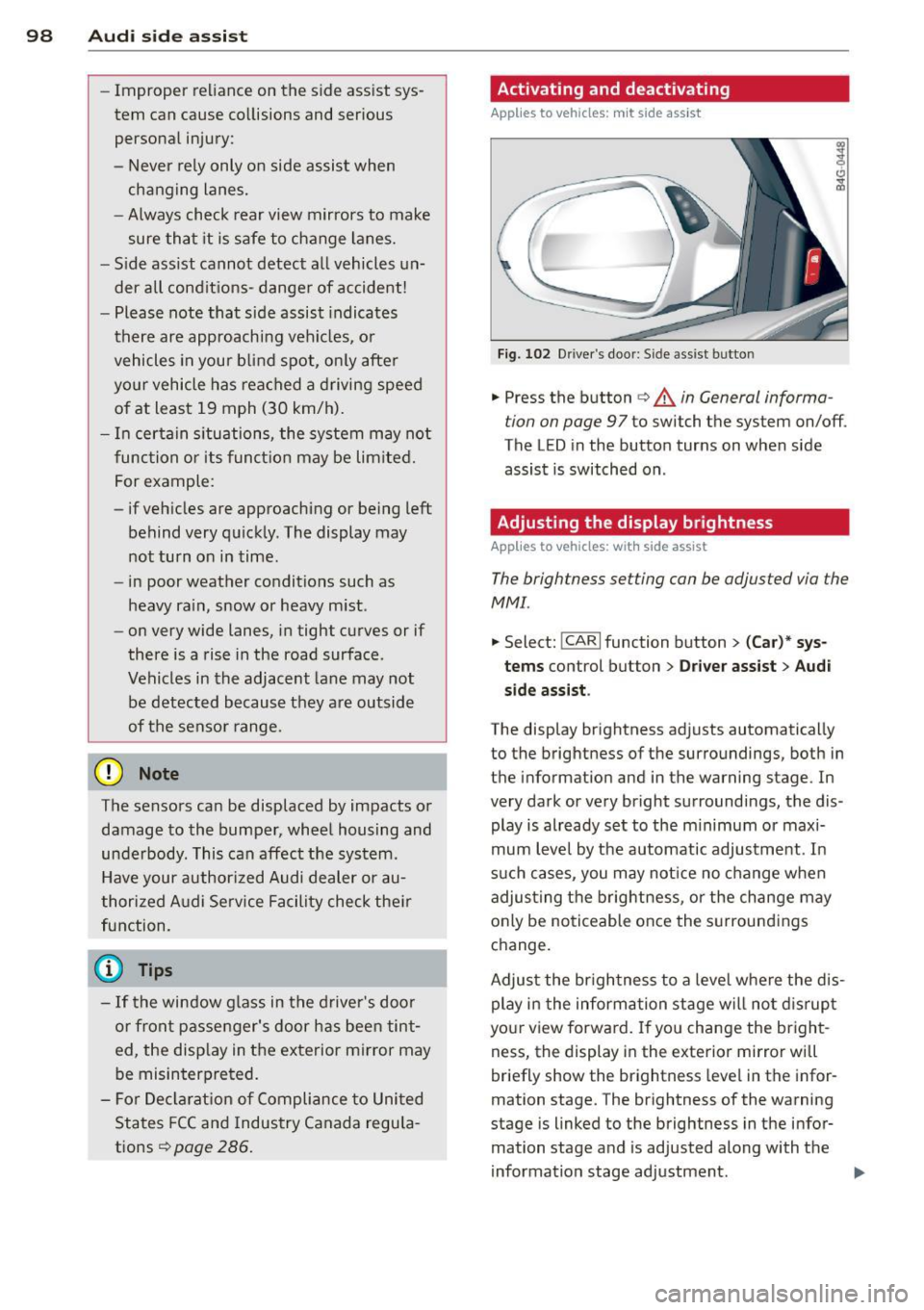
Fig. 102 Driver's doo r: Side ass ist butto n
.. Press the button c> A in General informa
tion on page 9
7 to switch the system on/off .
The LED in the button turns on when side
assist is switched on .
Adjusting the display brightness
Applies to vehicles: wit h side assist
The brightness setting can be adjusted via the
MMI.
.. Select: !CAR I function button> (Car)* sys
tems control button > Driver assist > Audi
side assist .
The display brightness adjusts automatically
to the brightness of the surroundings, both in
the information and in the warning stage. In
very dark or very bright surroundings, the dis
play is already set to the minimum or maxi
mum level by the automatic adjustment . In
such cases, you may notice no change when
adjusting the brightness, or the change may
only be noticeable once the surroundings
change.
Adjust the brightness to a level where the dis
play in the information stage will not disrupt
your view forward. If you change the bright
ness, the display in the exterior mirror will
briefly show the brightness level in the infor
mation stage. The brightness of the warning
stage is linked to the brightness in the infor mation stage and is adjusted along with the
information stage adjustment .
Page 116 of 304
114 Parking system s
Parking systems
General information
A ppl ies to vehicles: with parkin g system plus/rear view
camera/peripheral cameras
Depending on your vehicle's equ ipment, vari
ous parking a ids wi ll help you when pa rk ing
and maneuvering.
The
p ar king sy st e m plu s assists you when
pa rking by audib ly and visually indicat ing ob
jects detected
in front of and behind the vehi
cle
~ page 115.
The rear view ca m era shows the area behind
the vehicle in the Infotainment d isp lay. This
d isplay assists you when you are c ross o r par
allel parking
q page 116. In addit ion, you are
assisted by the functions from the parking
system plus
~ page 115 .
The peripher al cam era s ass ist you with park
ing and maneuvering. You are aided by var ious
cameras depending on the vehicle equipment leve l
¢page 119. In addition, you are assist
ed by the functions from the parking system
plus ¢ page 115.
A WARNING
- Always look for traff ic and check the area
around your vehicle by looking at it di
rectly as well . The parking system cannot
rep lace the d river's attent ion. The dr iver
is always respons ible for safety during
p arki ng and for all other maneuvers.
- Please note that some surfaces, such as
clothing, a re not detected by the system.
- Senso rs and cameras have blind spots in
wh ich peop le and objects ca nnot be de
te cted. Be especially cau tious of children
and animals.
- T he sensors can be displaced by impacts
or damage to the radia to r grille, bumpe r,
wheel housing and the unde rbody. The
par king systems may become impaired
as a resu lt . Have your authorized Audi
dealer or qualified workshop check their
function. -
Make s ure the sensors are not covered by
stickers, deposits or any other obstruc
tions as it may impair the sensor func
tion . For information on cleaning, refer
to
~ page 210.
(D Note
- Some objects are not detected by the
system under certain c ircumstances:
- Obje cts su ch as ba rrie r chains, trailer
draw bars, vertical po les or fences
- Objects above t he senso rs such as wall
extensions
- Objects w ith specific surfaces or struc
tures su ch as chain link fences or pow
der snow.
- If you conti nue d riving closer to a low- ly
ing object, it may disappea r from the
sensor range. Note th at yo u w ill no lon
ger be warned abo ut this obstacle.
(j) Tips
- T he system may provide a wa rni ng even
t ho ugh the re are no obs ta cl es in the cov
erage a rea in some situa tions, such as:
- certain road surfaces or for long grass.
- externa l ultrasonic sources e.g. from
clean ing vehicles.
- heavy rain, snow or thick vehicle ex
ha ust.
- We recommend that you practice park
ing in a traff ic-free location or park ing
lot to become familiar w ith the system.
When doing this, there should be good light and weather cond itions .
- You can change the volume and pitch of
the s ignals as we ll as the disp lay
¢page 124.
- Please refer to the instructions for tow
ing a t railer
¢ page 125.
- What appears in the infotainment dis
play is somewhat time-delayed.
Page 161 of 304
-Never place or attach accessories or o th
er objects (such as cup hol ders, tele
phone brackets, large, heavy or bulky ob
jects) on the doors, over or near the area
marked ''AIRBAG" on the steering wheel,
instrument panel, seat backrests or be
tween those a reas and yourself. These
objects co uld cause injury in a crash, es
pecially when the airbags inflate .
- Never recline the front passe nger's seat
to transport objec ts. Items can also
move into the area o f the side airbag or
the front airbag during braking or in a
sudden maneuver . Objects near the air
bags can become project iles and cause
injury, part icularly when the seat is re
cl ined .
- Never place or transport ob jects on the
front passenger seat. Objects on the
front passenger seat could cause the ca pacitive senso r in the seat to s ignal to
airbag system that the seat is occupied
by a person when it in fa ct is not, o r that
the person on the se at is he avier than he
or she actually is. The change in electric
capacitance beca use of such objects can
cause the passenger front airbag to be
turned on when it sho uld be
off, or can
cause the airbag to work in a way that is
different from the way it wou ld have
worked w ithout objects on the seat.
- Always make sure that there is nothing
on the front passenger seat that will
cause the capacitive passenge r detection
system in the s eat to s ignal to the A irbag
System that the seat is oc cupied by a
pers on when it is not, or to sign al th at it
is occupied by someone who is heavier
than the pe rson actually s itting on the
seat . The presence of an object co uld
cause the passenger front a irbag to be
turned on when it sho uld be
off, or co uld
cause the airbag to work in a way that is
different from the way it wou ld have
worked w ithout the object on the seat. A
irbag
sys tem 159
A WARNING
The fine dust created when airbags deploy
can cause breathing prob lems fo r people
with a history of as thma or other breath
ing cond itions.
- To reduce the risk of breath ing problems,
those wi th asthma o r other respiratory
conditions s hou ld get fresh air r ight
away by get ting o ut o f the veh icle or
open ing win dows or do ors.
- If you are in a collision in which airbags
deploy, was h your ha nds and fa ce with
mild soap and wate r be fore eating.
- Be ca reful not to get the dust in to your
eyes, o r into any c uts or sc ratches.
- If the resid ue should get into your eyes,
f lus h t hem w ith wa te r.
Monitoring the
Advanced Airbag System
fl~ Airbag monitoring indicator light
Two separate indicators monitor the function
of the Advan ced Airbag System: the airbag
monitoring indi cator light and the
PASSEN
GER AIR BAG O FF
light.
The Advanced A irbag System ( includ ing the
electron ic co ntro l unit, sensor circu its and sys
tem wir ing) is monitored con tinuously to
make sure that it is functio ning properly
whenever the ignition is on. Each time you
switch on the ignition, the airbag monitor ing
indicator light
fl will come on for a few sec
onds (self diagnost ics).
The sy stem must be in spected when the
indicator light
I :
- does not come on when the ignition is
sw itched on,
- does not go out a few seconds after you
have switched on the ignit ion, or
- comes on while driv ing.
If an airbag system malfunc tion is detec ted,
the indicator light wi ll first start f lashing to
catch the driver's attention and then stay on
llo-
•
•
Page 164 of 304
162 Airbag sys tem
cushion wit h his or her back up against the
backrest and the backrest is n ot reclined,
- the adu lt is not taking weight off the seat by
holding on to the passenger assist handle
above the front passenger door or support
ing their weight on the armrest,
- the safety be lt is being properly worn and
that there is not a lot of slack in the safety
belt webbing,
- there are no aftermarket seat covers or
cushions or other things (such as b lankets)
on the front passenger seat that might
cause the capacitive passenger detection
system to miscalculate electrical capac i
tance .
Important safety instructions on
monitoring the Advanced Airbag System
A WARNING
-If the status of the Advanced A irbag Sys
tem has changed wh ile the vehicle is
moving, the
PASSENGER AIR BAG OFF
light blinks for about 5 seconds to catch
the drive r's attent ion.
If this happens, al
ways s top as soon as it is safe to do so
and check the steps described above.
- If the
PASSENGER AIR BAG OFF light
does not go off whe n an adu lt who is no t
very small is sitting on the front passen
ger seat after taking the steps described
above, make sure the adult is properly
seated and restrained at one of the rear
seating pos itions. Have the a irbag sys
tem inspected by your authorized Audi
dealer before transpo rting anyone on the
front passenger seat.
A WARNING , --
An airbag system that is not funct io ning
prope rly cannot provide supplemental p ro
tect ion in a fron tal crash.
- If the airbag indicator light ~ page 19
comes when the vehicle is be ing used,
h ave t he system inspected immedi ate ly
by yo ur authorized Aud i dea ler .
It is pos
sible that the airbag will inflate when it is not supposed to, or will not
inflate
when it should.
A WARNING
-If the front airbag inflates, a child without
a child restraint, or in a rearward-facing
chi ld safety seat, or in a forward -facing
chi ld restraint that has not been proper ly
i nstalled w ill be seriously injured and can
b e killed.
- Even though you r vehicle is equipped
with an Adva nced A irbag System, make
certain that all children, espe cial ly 12
ye ars and you nger, always ride on the
back seat properly rest rained for their
age and size .
- Always inst all forward o r rear-fa cing
child seats on the rear sea t - even with
an Advanced A irbag System.
- If you must ins tall a rearwa rd -facing
child seat on the front passenger seat because of exceptional circumstances
and the
PASSENGER AIR BAG OFF light
does not appear and stay on, immediate
ly install the rear-facing child seat in a
rea r seat ing pos ition and have the airbag
sys tem inspected by you r Audi dealer .
- If, in exceptiona l circumstances, you
m ust install a forward-fac ing c hild re
straint on the front passenger seat, al
ways move the seat into its rearmos t po
sition in the se at's fore and aft adjust
men t range, as far away from the a irbag
as poss ible . The backrest mus t be ad just
ed to an upright pos ition . Make su re that
the
PASSENGER AIR BAG OFF light
comes on and stays on all the time when
ever the ignit ion is switched on.
A WARNING
-
- If the PASSENGER AIR BAG OFF light
does not go out when an adult is sitting
on the front passe nger seat after taking
the steps described above, make su re the
adu lt is prope rly seated a nd restra ined at
one o f the rea r seat ing pos itions.
~
Page 177 of 304
-Always read and heed a ll WARNINGS
whenever using a child restraint in ave
h icle
¢ page 138, Safety belts,
¢ page 147, Airbag system and
¢ page 173, Important things to
know.
(D Tips
Always replace child restraints that were
installed in a vehicle during a crash. Dam
age to a child rest raint that is not vis ible
could cause it to fail in another collis ion
situation.
Advanced front airbag system and children
Your vehicle is eq uipped with a front "Ad
vanced Airbag System" in compliance w ith
United States Federal Motor Vehicle Safety
Standard (FMVSS) 208 as applicable at the
time your veh icle was manufactured .
T he Advanced Airbag system in your vehicle
has been certified to meet the "low-risk" re
qu irements for 3-and 6-year old ch ildren on
the passenger s ide and small adults o n the
driver side. The low risk deployment criter ia
a re i ntended to reduce the risk of inju ry
through interaction with the a irbag that can
oc cu r, fo r example , by be ing too close to the
steering whee l and instrument panel when
the airbag inflates . In addition, the system
has been certified to comply with the "sup
press ion" requirements of the Safety Stand
ard, to turn off the front airbag for infants up
to 12 months who are restra ined on the front
passenger seat in ch ild restraints that are list
ed i n the Standard .
Even though your vehicle is equipped with an
Advanced Airbag system, all chi ldren, espe
cially those 12 years and younger, shou ld al
ways ride in t he back seat properly rest ra ined
fo r the ir age and s ize. Th e a irbag on t he pas
senger side makes the fro nt seat a poten tially
d a ngerous pla ce for a child to ride. The front
seat is not the safest place fo r a child in a fo r
ward-facing child safety seat . It can be a very
Child Sa fet y 175
dange rous place fo r an infant o r a larger child
in a rearward-facing seat.
T he veh icle's Advan ced Ai rb ag Sys tem has a
capacit ive passenger detec tion system in the
front passenger seat cush ion that can detect
the presence of a baby or a c hild in a child re
stra int system on this seat .
T he capaci tive passenge r detection system
r egisters the changes that result in an electri
ca l fie ld when a chi ld, a ch ild restraint, and a
baby blanket are on the front passenger seat .
The change in the measured capac itance due
to the presence of a child, a child restraint,
and a baby blanket on the front passenger
seat is related to the ch ild restraint system
rest ing on the seat . The meas ured capacitance
of a child res traint system va ries depend ing
o n the type of sys tem and specific m ake and
model.
T he elect rical capac itance of the va rious
types, ma kes, a nd models of child restra ints
spe cified by the U.S. Nationa l Highway Traff ic
Safety Administra tion (N HTSA) in the re levant
sa fety standard are stored in the Advanced
Airbag System contro l unit together with the
capacitances typical of infants and a 1-year
o ld child. W hen a child restraint is used on t he
front passenger seat with a typica l 1 year-old
infant, t he Advanced Airbag System compares
the capacitance measu red by the capacitive
passenger detection system with the data
s tored in the ele ctronic co ntrol unit.
Child restraints and Advanced front
airbag system
Rega rdless of the c hild restraint that you use,
make sure that it has been certified to meet
U nited States Federal Motor Vehicle Safety
Standards and has been certified by its manu
facturer for use with an airbag. A lways be sure
that the c hild restra int is properly installed at
o ne of the rear seating positions. If in excep
t iona l circumsta nces yo u must use it on the
fron t passenger sea t, ca re fully read all of the
i nformation on child sa fe ty and Advanced Air -
bags and heed all of the applicable ..,.
•
•
Page 196 of 304
194 Intelligent technology
Intelligent technology
Notice about data
recorded by vehicle
control modules
Your veh icle is not equipped with an Event Da
ta Recorde r (EDR), installed by some manu
facturers fo r the express p urpose of capturing
data for retrieval after an accident or crash
event . EDR's are sometimes ca lled "crash re
corders".
Some state laws restr ict the retr ieval or down
loading of data stored by EDR's that were in
stalled in a vehicle for the express purpose of retrieving data after an accident or crash
event without the owner's consent.
A lthough your vehicle is not equipped with an
EDR, it is equipped with a number of electron
ic control modules for various vehicle systems
such as, for examp le, eng ine function, em is
sion control, as well as for the airbags and
safety belts.
These electronic contro l modules also record
vehicle-re lated data during norma l vehicle op
erat ion for diagnostic and repa ir purposes.
The recording capacity of the electronic con
trol modules is limited to data (no sound is re
corded) and only a small amount of data is ac
tually recorded over a ve ry limited pe riod of
time and stored when a system fault or other
cond ition is sensed by a cont ro l unit. Some of
the data then stored may re late to vehicle
speed, direction, braking as we ll as restraint
system use and performance in the event of a
crash or other condit ion. Stored data can only
be read and downloaded with special equip
ment.
Electronic Stabilization
Control (ESC)
Description
ESC helps to improve road holding and vehicle
dynamics to help reduce the probability of
skidd ing and loss of vehicle control. It works
only when the eng ine is running. ESC detects certain difficult driving situat
ions, including
when the vehicle is beginning to spin (yaw)
out of control and he lps you to get the veh icle
back under control by se lectively braking the
wheels, and/or reducing eng ine power and
providing steer ing ass istance to he lp hold the
vehicle on the dr iver's intended course. The in
dicator light
G) in the inst rument cluster
blinks when ESC is ta king action to help you
control the veh icle.
ESC has limitations.
It is importa nt to remem
ber that ESC cannot overcome the laws of
physics. It wi ll not always be able to help out
under a ll cond it ions you may come up aga inst.
For example, ESC may not always be able to
help you master situations where there is a
s u dden change in the coefficient of friction of
the road surface. When there is a section of
dry road that is sudden ly covered w ith water,
slush or snow, ESC cannot perform the same
way it wou ld on the dry surface . If the ve hicle
hydroplanes (rides on a cushion of water in
stead of the road surface), ESC will not be
able to help you steer the vehicle because con
tact with the pavement has been in terrupted
and the vehicle cannot be braked or steered .
D uring fast cornering, particularly on winding
roads, ESC cannot always deal as effectively
with difficult driving situations than at lower
speeds. When towing a trailer, ESC is not able
to help you regain control as it would if you
were not tow ing a trailer.
Always adjust your speed and driving style to road, traffic and weather condit ions. ESC can
not override the vehicle's physical limits, in
crease the available tract ion, or keep a ve hicle
on the road if road departure is a result of
drive r inattent ion. Instead, ESC imp roves the
poss ibil ity of keeping the vehicle under con
trol and on the road during ex treme maneu
vers by using the d river's steering inputs to
help keep the vehicle going in the intended di
rection . If you are traveling at a speed that
ca uses you to run off the road before ESC can
provide any assistance, you may not experi
ence the benefits of ESC.
Page 197 of 304
ESC includes and/or works together with the
anti-lock brake system (ABS) , brake assist sys
tem, anti -slip regulation (ASR) , e lectronic dif
ferential lock ( EDL) and e lectronic interax le
d ifferential lock* . ESC is swi tched on all the
time. In certain situat ions when you need less
traction , you can switch off ASR by pressing
the button
[ru <::;> page 196, fig . 178 . Be sure
to switch ASR on again when you no longer
n eed less t raction.
Anti-lock br aking s ystem (ABS)
ABS prevents the wheels from locking up
when braking . The veh icle can still be steered
even during hard braking . Apply steady pres
sure to the brake pedal. Do not pump the ped
a l. A puls ing in the bra ke peda l indicates that
the system is he lping you to brake the vehicle.
Brake assist system
The brake assist system can decrease brak ing
d istance.
It increases braking power when the
driver p resses the brake pedal quic kly in emer
gency situations. You must press and ho ld the
b rake peda l until the situation is over . In
vehicles with adaptive cruise control* , the
brake assist system is more sensitive if the
d istance detected to the vehicle ahead is too
small.
Anti -slip regulation (ASR )
ASR reduces engine power when the d rive
wheels begin to spin and adapts the force to
the road condit ions. This makes it eas ie r to
s tart, accelerate and drive up hills.
El ectronic diffe rential lock (EDL )
The ED L brakes wheels that are spinn ing and
transfers the drive powe r to the other drive
wheel or whee ls if the vehicle is equipped with
all-whee l drive*. This function is available up
t o about 75 mph (120 km/h).
I n extreme cases , ED L automatica lly switches
off to help keep the brake on the braked whee l
from overheating.
E DL wi ll switch on again au
tomatically when conditions have returned to normal.
Int ellig ent technolog y 195
Electronic intera xle differential l ock */
se le ctive wheel torque cont rol *
The electronic interaxle differential lock (front
whee l drive) or the se lective whee l torque
cont rol (all-wheel dr ive) operates when dr iv
ing through curves . The front wheel on the in
s ide of the curve or both wheels on the inside
of the curve are braked selectively as needed .
T his min imizes sliding in the front wheels and
allows for more p recise d riving through
curves . T he applicable system may no t acti
vate when driv ing in wet or snowy conditions.
A WARNING
-- ESC, ABS, ASR, EDL and the electronic in
teraxle diffe rential lock function* cannot
overcome the laws of physics. This is es
pecially important on slippery or wet
roads . If the systems begin acting to sta
bilize your veh icle, you should immedi
ately change yo ur speed to match the
road and traffic cond itions. Do not let
the increased safety provided by these
systems tempt you to take risks. Do ing
so will increase the r isk o f a loss of vehi
cle control, collision and serious personal inju ries.
-Always adapt your speed to road, traffic and weather conditions . The risk of los
ing control of the vehicle increases when
driving too fast, espec ially through
curves and on slippery or wet roads, and
when dr iv ing too close to vehicles up
ahead . ESC, ABS, the brake assist sys
tem, EDL, ASR and the e lectronic inte r
axle d iffe ren tial lock function* cannot
preven t coll is ions.
- Always accelerate with spec ial care on
even, smooth surfaces su ch as those that
are wet or covered with ice and snow.
The drive wheels can spin even with
these assistance systems that cannot al
ways he lp to red uce the risk of loss of ve-
hicle control. .,.
•
•
Page 218 of 304
216 Fuel supply and filling your fuel tank
-Blend must contain not more than 1S%
MTBE.
Seasonally adjusted gasoline
Many gasoline grades are blended to perform
espec ially we ll for winter or summer driv ing.
During seasonal change-over, we suggest that
you fill up at busy gas stat ions where the sea
sonal adjustment is more likely to be made in
time.
(CT) Note
- Methanol fuels which do not meet these
requirements may cause corrosion and
damage to plastic and rubber compo
nents in the fuel system .
- Do not use fuels that fai l to meet the
specified criteria in this chapter.
- If yo u are unable to determine whether
or not a particular fuel blend meets the
specifications, ask your service station or
its fuel sup plier.
- Do not use fuel for which the contents cannot be identified.
- Fuel system damage and performance
problems resulting from the use of fuels
different from those specified are not
the respons ibility of Audi and are not
covered under the New Vehicle or the Emission Control System Warranties.
- If you experience a loss of fuel economy
or driveability and performance prob l ems due to the use of one of these fuel
blends, we recommend that you switch
to unblended fuel.
Gasoline additives
A major concern among many auto manufac
turers is carbon deposit build- up caused by
the type of gasoline you use.
A lthough gasoline grades differ from one
manufacturer to another, they have certain
things in common. All gasoline g rades contain
substances that can cause deposits to co llect
on vital engine parts, such as fuel injectors
and intake valves. Although most gasoline
brands include additives to keep engine and fuel
systems clean, they a re not equally effec
tive .
A udi recommends using TOP TIER Detergent
Gasoline. For more information on TOP TIER
Detergent Gasoline, please go to the official
website (www.toptiergas.com).
After an extended period of using inadequate
f uels, carbon deposit build-ups can rob yo ur
engine of peak performance.
(D Note
Damage or malf u nct ion due to poor fuel
quality is not covered by the Aud i New Ve
hicle Limited Warranty.
Diesel fuel
Applies to veh icles: w ith diesel engine
Always use ULSD (Ultra Low Sulfur Diesel) sul
fur content 15 ppm or less.
T he ULSD (U ltra Low Sulfur Diesel) meets the
ASTM-D-97S (grade 2).
Diesel fuel with a higher concentration than
ULSD-Diesel No. 2 ASTM 0975 and Bio-die
sel with a higher concentration than S
% like
B11, B20 or B100 are strictly prohibited.
Serv ice stat ion fue l pumps a re labeled with
the correct fuel information fo r easy recogn i
t ion by the user. If the diesel fuel pump is not
labeled ask the station operator what fue l is
being dispensed before filling up your vehicle.
Service stations offering Diesel fuel are gener
ally located on truck routes or major high
ways. Directories of Diesel fuel stations are
usually available at Diesel fuel stations.
Some states in the USA req uire permits to
purchase Diesel fuel. Check with your State
Motor Vehicle Department.
Diesel fuel may not be ava ilable outside the
USA and Canada. Be sure to check before trav-
eling to other countries . .,..
Page 229 of 304
Modern eng ine lubrication has taken a quan
tum leap in the last few years . Many synthetic
oils available today provide better engine lu
brication that can outlast traditional petrole
um-based oils, making them a smart choice
for use throughout the life of your Audi.
Whether you use synthetic or petroleum
based engine oil, the oil that you use must
conform to Audi's oil quality standard
VW 502 00 (vehicles with gasoline engine) or
VW 507 00 (veh icles with diesel engine) to
he lp keep your vehicle's eng ine running
smoothly and help prevent the fo rmation of
harmf ul depos its, sometimes ca lled "sludge,"
that over time can lead to expensive repairs.
At the time of pr inting, engine o ils availab le in
the U.S. and Canada tha t meet the exacting
specifications of A udi oil standard VW 502 00
(vehicles with gaso line engine) or VW 50 7 00
(vehicles with diesel engine) are synthetic en
gine oils . This does not mean, however, that
every synthetic engine oil will meet Aud i oil
standard VW 502 00 (vehicles with gasoline
engine) or VW 507 00 (vehicles w ith diese l
engine). So always be sure that you use an ap
proved oil.
To help prevent the formation of harmful de
posits use only oil with the follow ing spec ifi
cations printed on t he oil container:
- Aud i oil standard VW 502 00 (gasoline en
gine )
- Aud i oil standard VW 50 7 00 (d iesel en -
gine )
Oil conta iner labe ls may carry the specif ica
tion singly or in comb ination with other desig
nations and oil qua lity standards.
Vi scosi ty
Eng ine oils are graded acco rding to their v is
cosity. The prope r viscosity grade oil for your
engine depends on cl imac tic or seasonal con
d itions where you dr ive. You can use oi l with a
viscosity grade of SAE SW40 across all tem
pe rat ure ranges for normal d riving conditions .
H oweve r, if eng ine oi l viscosity grade
SAE SW40 is not ava ilable, you can a lso use
Checkin g and fillin g 22 7
viscosity grade SAE 5W -30 or SAE OW-40 as
long as it meets Audi oil q uality standard
VW 502 00 (vehicles with gasoline engine) or
VW 507 00 (vehicles w ith diese l eng ine) spec
ifications.
Because engine oil that meets the Audi oi l
standard may not be available everywhere
when you need it, we strongly recommend
that you always carry with you an extra quart
( li ter) of oil that express ly conforms to the
VW 502 00 (veh icles with gasoline engine) or
VW 507 00 (vehicles w ith d iese l eng ine) spec
ification, in case you have to top off the oil
wh ile on the road.
App lie s to vehicle s with gasoline engin e on
l y:
Only if the level of the o il is at or below the
minimum ma rk on the o il dipstick -and no oi l
that expressly conforms to Audi o il st andard
VW 502 00 spec ificat ions is available - may
you top off with a high quality engine o il, pre f
erably synthetic -based, that meets ACEA A3
or API SM specificat ions, but even then, only
in v iscosity grades SAE SW-40, SAE SW-30, or
SAE OW-40. However, during the entire time
between oil change intervals, never top off
with more than a total of 0 .5 qt/liter engine
o il that does not conform to Audi o il specifica
tion VW 502 00.
App lie s to vehicles with die sel engin e only:
Only if the level of the o il is at or below the
min imum ma rk on the o il dipstick - and no oi l
t h at exp ressly conforms to Audi o il standard
VW 507 00 spec ificat ions is available - may
you top off with a high quali ty engine o il, that
meets ACEA C3 or API CF specifications, but
even t hen, only in viscosity grades SAE
SW-40, SAE 5W-30, or SAE OW-40. However,
during the entire time between oil change in
terva ls, never top off with more than a total
of 0. 5 qt/liter engine oil that does not con-
for m to Aud i oil spec ification VW 50 7 00.
For more information about engine oi l that
has been approved for your vehicle, please
contact e ither you r autho rized Aud i deale r or
Audi Custome r Re lations at 1 (800) 822-2834
o r vis it our web site at www.audiusa.com or
www.aud ic a nada. ca. He re you w ill also fi nd a ..,.
•
•
Page 230 of 304
228 Check ing and filling
current list of oils (manufacturers , brand
names etc.) that conform to Aud i oi l standard
VW 502 00 (vehicles with gasoline engine) or
VW 507 00 (vehicles with diesel engine).
C hang in g th e en gin e oil
The engine oil and o il filter must be changed
according to the m ileage (ki lomete rs) and
time inte rva ls spec ified in your vehicle's War
ranty
& Maintenance booklet . Do not exceed
these intervals - harmful deposits from old
engine o il can reduce engine performance and
can lead to expensive engine repairs .
Changing the oil at the recommended inte r
va ls is so very important because the lubricat
ing properties of oi l decrease grad ually during
norma l vehicle use. If you are not sure when
you have your oil changed, ask your author
ized Audi Service Advisor .
Under some circumstances the engine o il
should even be changed more frequently .
Change oil more often if you drive mostly
short d istances, operate the vehicle in dusty
areas or mostly under stop-and-go traffic con
d itions, or when you use your vehicle where
temperatures stay below freezing point fo r
l ong periods.
Detergent add it ives in the o il w ill make fresh
oil look dark after the eng ine has been run
n ing fo r a short time. This is no rma l and is not
a reason to change the o il more often than
recommended.
Dama ge or ma lfun cti ons du e to la ck of
maint enan ce
It is essential that you change your oil at the
recommended intervals using only engine oil
that complies with Audi oil standard
VW 502 00 (vehicles wi th gaso lin e engine) or
VW 507 00 (veh icles with diese l engine) . Yo ur
Limited New Vehicle Warranty does not cover
damage or ma lf u nctions due to failure to fol
low recommended maintenance and use re
qu irements as set forth in the A udi Owner's
Manual and War ranty
& Maintenance book let.
Your dea ler will have to deny warranty cover
age unless you present to the dealer proof in the form o
f Service or Repair Orders that all
scheduled maintenance was performed in a
t imely manner.
Engine oil consumption
The engine in your vehicle depends on on ade
quate amount of oil to lubricate and cool oil
of its moving ports.
In order to provide effective lubrication and
cooling of interna l engine components, all in
ternal combust ion engines consume a certain
amount of oil. Oil consumpt ion varies from
engine to engine and may change sign ificantly
over the life of the engine. Typically , engines
with a spec ified break- in period (see
¢ page 201) consume more oil during the
break -in pe riod t han they consume afte r o il
consumption has stabilized.
Under normal cond it ions, the rate of oil con
sumption depends on the q ua lity and viscos ity
of the oil , the RPM (revol utio ns per minute) at
which the engine is opera ted, the ambient
temperature and road conditions . Furt her fac
tors are the amount of oil dilution from water
condensation or fue l residue and the oxida
tion level of the oil. As any engine is subject to
wear as m ileage builds up, the oil consump
t ion may increase over time until replacement
of worn components may become necessary .
With a ll these variab les coming into p lay, no
standard rate of oil consumpt ion can be es
tablished or spec ified . There is no alternative
to regular and frequent checking of the o il lev
el, see
Not e.
If the yellow engine oil level warning symbol
in the instrument clus ter
II lights up, you
shou ld check the oil leve l as soon as possib le
¢
page 229 . Top off the oil at your earl iest
convenience
9 poge 229.
,&. WARNING
Before you che ck anything in the engine
compartmen t, a lways rea d and heed al l
WAR NIN GS ¢.&
in Working in the engine
comportment on page 224 .
-