instrument cluster AUDI A6 2014 Owner's Guide
[x] Cancel search | Manufacturer: AUDI, Model Year: 2014, Model line: A6, Model: AUDI A6 2014Pages: 304, PDF Size: 76.32 MB
Page 140 of 304
138 Safety belts
Safety belts
General notes
Always wear safety belts!
Wearing safe ty bel ts correctly saves lives!
This chapter exp lains why safety be lts are nec
essary, how they work and how to adjust and
wear them correctly .
.. Read a ll the information that fo llows and
heed all of the instructions and WARNINGS.
A WARNING
Not wearing safety belts or wearing them
improperly increases the risk of ser ious
personal in jury and death .
- Safety belts are the sing le most effective
means avai lab le to reduce the risk of se
r ious injury and dea th in a utomob ile acci
dents . For your protection and that of
yo ur passenge rs, always co rrectly wear
safety belts when the vehicle is moving .
- Pregnant women, injured, or physically
im paired perso ns m ust also use safety
belts . Lik e all veh icle occup ants, they are
more like ly to be ser iously injured if they
do not wea r safety be lts . The best way to
protect a fetus is to protect the mother -
throughout the entire pregnancy.
Number of seats
Your Audi has a total of five seating positions: two in the front and three in the rear. Each
seating position has a safety belt.
A WARNING
Not wea ring safety belts or weari ng them
improp erly increases the risk of ser ious
pe rsonal i njury and deat h.
- Never st rap more than one pe rson, in
cl uding small ch ild ren, into any belt.
It is
e speci ally dange rous to pla ce a safety
belt over a child s itting on yo ur lap.
- N ever le t mo re people ride in the ve hicl e
than there are s afe ty be lts avail able. -
Be s ure everyone riding in the vehicle is
properly restrained w ith a separate safe
ty belt or child restra int.
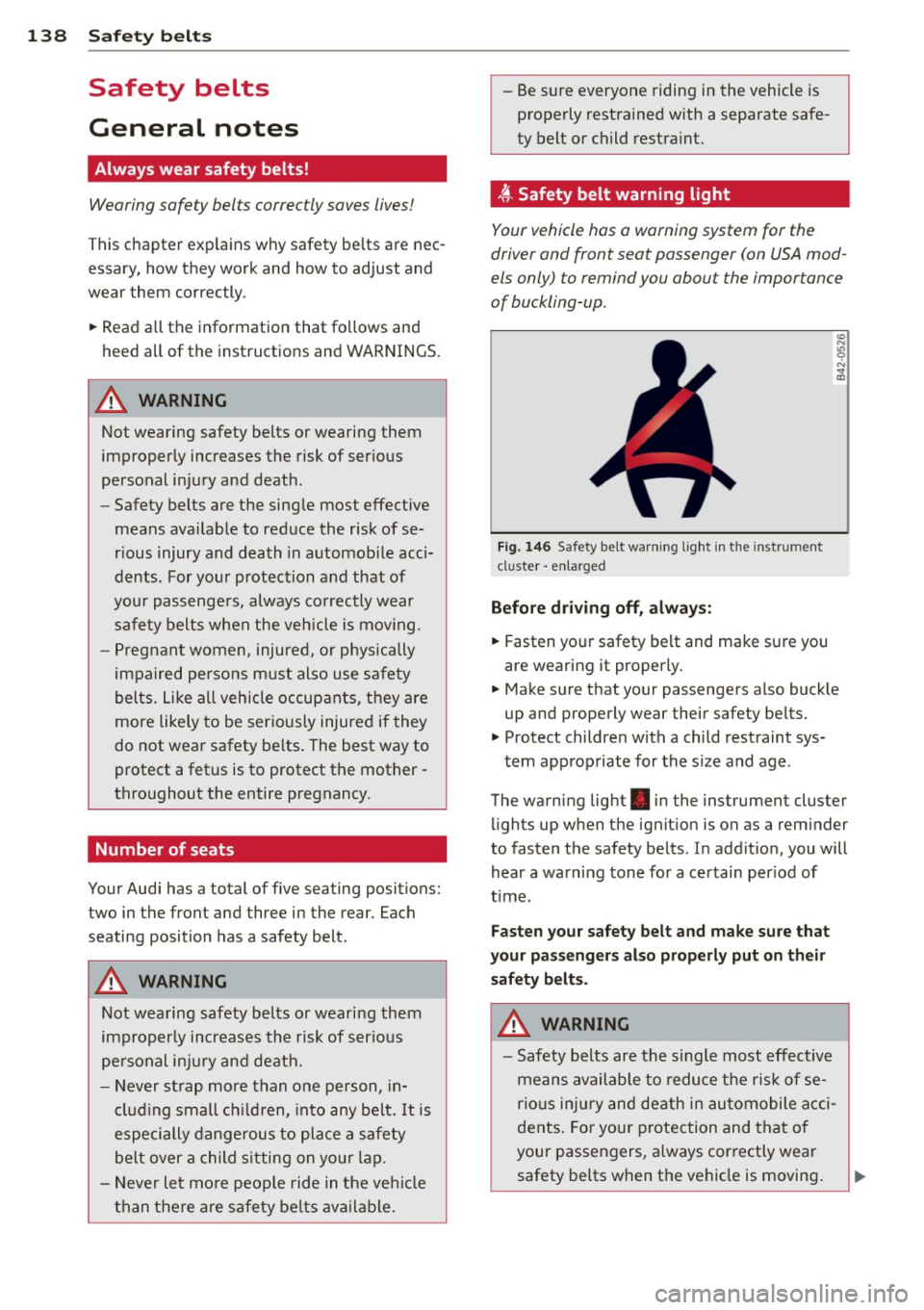
t Safety belt warning light
Your vehicle hos o warning system for the
driver and front seat passenger (on USA mod
els only) to remind you abou t the impor tance
of buckling-up .
Fi g. 146 Safety bel t warni ng lig ht in the inst rum ent
cl uster -en lar ged
Before driv ing off, alway s:
.. Fasten yo ur safety belt and make su re you
are wearing it properly .
.. Make s ure th at your passengers also buck le
up and properly wear their safety be lts.
.. Protect childre n w ith a child restraint sys-
tem app ropriate for the s ize and age .
The warn ing light . in the instrument cluster
li ghts up when the ignit ion is on as a rem inder
to fasten the safety belts . In addit ion, you will
hear a wa rning tone for a ce rtain per iod of
t ime .
Fasten your safety belt and make sure that
your pass eng ers also properly put on the ir
s afety belt s.
A WARNING .....=-
-Safety b elts are the s ingle most eff ect ive
means availa ble to reduce t he ri sk of se
rio us inju ry and de ath in au tomobile acci
dents. Fo r yo ur protection and that of
your passengers , a lways cor rectly wear
safety belts when t he vehicle is moving .
Page 152 of 304
150 Airbag sys te m
If the front passenger airbag is turned off, the
PASSENGER AIR BAG OFF light comes on in
the instrument cluster and stays on.
I f the front passenger airbag deploys, the
F ederal Standard requires the airbag to meet
the " low risk" deployment criteria to reduce
the r isk of injury through interaction with the
a irbag. "Low risk" deployment occurs in those
crashes that take place at lower decelerations
as defined in the electronic control unit
c::> page 160, PASSENGER AIR BAG OFF light.
A lways remember, a chi ld seat or infant carri
er installed on the front seat may be struck
and knocked out of position by the rap idly in
flating passenger's a irbag in a frontal colli
sion . The airbag could greatly reduce the ef
fectiveness of the ch ild restraint and even se
rio usly inju re the child during inflat ion.
For this reason, and because the back seat is
the safest place for chi ldren - when properly
restra ined accord ing to their age and size - we
strongly recommend that children always sit in the back seat
c::> page 173, Child Safety.
_& WARNING
-
A child in a rearward -facing child seat in
stalled on the front passenger seat will be
seriously injured and can be killed if the
front airbag inflates - even with an Ad
vanced Airbag System.
- The inflating a irbag will hit the child seat
or infant carrier with great force and w ill
smash the ch ild seat and child against
the backrest, center armrest, door or roof.
- Always install rear-facing child seats on the rear seat.
- If you must install a rearward facing
child seat on the front passenge r seat
because of exceptiona l circumstances
and the
PASSENGER AIR BAG OFF light
does not come on and stay on, immedi
ately install the rear-f acing chi ld seat in a
rear seating position and have the ai rbag
system inspected by your Aud i dealer. -
Forward-facing child seats installed on
the front passenger's seat may interfere
with the deployment of the a irbag and
cause serious persona l injury to the
child.
_& WARNING
-If, i n except ional circumstances, you must
i nsta ll a forward-facing child restraint on
the front passenge r's sea t:
- Always make sure the forward-facing
seat has been designed and certified by
its manufacture r fo r use on a fron t seat
with a passenger fron t and s ide a irbag.
- Never p ut the fo rward -facing child re
s tra int up against or very near the instru
men t panel.
- Always move the passenge r seat into its
rearmost pos ition in the seat's fore and
aft ad justment range, as fa r away from
the airbag as possible before installing
the forward-facing ch ild restra int . The
backrest must be ad justed to an upright
position.
-Make sure that the PASSENGER AIR BAG
OFF
li ght comes on and stays on all the
time whenever the ignition is switched on .
_& WARNING
-To reduce the risk of serious injury, make
sure that the
PASSENGER AIR BAG OFF
light w ill be displayed whenever a child re
straint is installed on the front passenger
seat and the ignition is sw itche d on .
- If the
PASSENGER AIR BAG OFF light
does not s tay on, perform the checks de
scribed
<> page 159, Monitoring the Ad
vanced Airbag System.
- Ta ke the chi ld restraint off the front pas
senger sea t and install it prope rly at one
of the rear seat positions i f the
PASSEN
GER AIR BAG OFF
light does not stay on.
- Have the airbag system inspected by
your Aud i dea ler immediately.
Page 157 of 304
backrest must be adjusted to an upri ght
posit ion.
- Always make sure that t here is nothing
on the front passenger seat that will
cause the capacitive passenger detection
system in the seat to s ignal to the A irbag
System that the seat is occupied by a person when it is not, or to signal that it
is occupied by som eone who is heavier
than t he pe rson actually s itting on the
seat. The presence of additiona l obje cts
cou ld cause the passenger front airbag
to be t urned on when it sho uld be off, or
cou ld cause t he airbag to work in a way
that is different from the way it wou ld
have worked without the object on the
seat.
- Make sure that the
PASSENGER AIR BAG
OFF
light comes on and stays on all the
t ime whenever the ignition is switc hed
on.
Advanced Airbag System components
The front passenger seat in your vehicle has a
l ot of very important parts of the Advanced
A irbag System in it. These parts incl ude the
capac itive passenger de te ct ion sys tem, wir
ing, b racke ts, and more . The cont ro l uni t
monitors the system o n the front passenger
seat when the ign ition is switched on and
turns the airbag indicator light on when a
malfunct ion in the one of the system compo
nents is detected ¢
page 160. Because the
fro nt passenge r seat contains important parts
of the Advanced Airbag System, you must
take care to p revent it from bei ng damaged.
D amage to the seat may preven t the Ad
vanced A irbag System for the front passenger
seat from doing its job in a crash .
The front Advanced Airbag System
consists of the following:
-Crash sensors in the front of the veh icle that
measure ve hicle acceleration/dece le ration
to provide information to the Advanced Air bag System about the severity of the crash.
A irbag system 15 5
- An electron ic contro l unit, with integrated
crash sensors fo r front and side impacts .
T he control un it "decides" whether to f ire
the front a irbag s based on the informat ion
received from the crash sensors. The control
unit also "decides" whether the safety belt
pretens ione rs should be act iva ted .
- An Advanced A irbag w it h gas genera tor and
cont ro l valve for the driver ins ide the steer
ing wheel h ub.
- An Advanced A irbag w ith gas generator and
cont ro l valve inside the instrument panel for
the front passenger .
- A capacit ive passenger detection system un
derneath the front passenger seat cover .
This system measu res the ele ct rical capac i
t ance of the perso n in the seat. The informa
t ion registered is se nt cont inuo usly to the
elec tronic con trol un it to regu late dep loy
ment of the front Advanced Ai rbag on the
passenger side.
-An airbag monitoring system and ind icator
light in the instr ument cluster ¢
page 159.
-A senso r in each front seat registers the dis
tance between the respective seat a nd the
steering whee l or instrument panel. The in
formation reg istered is sent cont inuo usly to
the electron ic contro l unit to regulate de
ployment of the front Adva need A irbags .
- The
PASSENGER AIR BAG OFF li ght comes
on and stays on in the center of the instr u
ment panel ¢
page 160, fig. 160 and tells
you whe n the front Advanced Airbag on the
passenger side has been tu rned off.
- A senso r in the safety belt latch fo r the d riv
er and fo r the front seat passenger that
senses whethe r th at safety belt is latched or
no t and tra nsmi ts this informa tion to the
elec tronic con trol un it.
A WARNING
D amage to the fron t passenger se at can
p revent the front air bag from work ing
p roperly.
- Imp roper repai r or disassembly of the
front passenge r and dr iver seat will pre
vent the Advanced Airbag System from
functioning properly.
-
•
•
Page 158 of 304
156 Airbag system
-Repairs to the front passenger seat must
be performed by qualified and properly
trained workshop personnel.
- Never remove the front passenger or
driver seat from the vehicle.
- Never remove the upholstery from the
front passenger seat.
- Never disassemble or remove parts from
the seat or disconnect wires from it.
- Never carry sharp objects in your pockets
or put them on the seat. The capacitive
passenger detection mat in the front
passenger seat will not function properly
if it is punctured .
- Never carry things on your lap or carry
objects on the front passenger seat.
Such objects can influence the capaci
tance registered by the capacitive pas senger detection system, so that incor
rect information is provided to the airbag
control unit.
- Never store items under the front pas
senger seat. Parts of the Advanced Air
bag System under the passenger seat
could be damaged, preventing them and
the airbag system from working proper
ly.
- Never place seat covers or replacement upholstery that have not been specifical
ly approved by Audi on the front seats.
- Seat covers can prevent the Advanced
Airbag System from recognizing child re
straints or occupants on the front pas
senger seat and prevent the side airbag
in the seat backrest from deploying prop
erly .
- If a seat heater has been retrofitted or
otherwise added to the front passenger
seat, never install any child restraint sys
tem on this seat.
- Never use cushions, pillows, blankets, or similar items on the front passenger
seat. The additional layers prevent the
capacitive passenger detection system
from accurately measuring the capaci
tance of the child safety seat and/or the
person on the seat and thus keep the Ad- vanced Airbag System from working
properly.
- Never place or use any electrical device
(such as a laptop, CD player, electronic
games device, power inverter or seat
heater for child seats) on the front pas
senger seat if the device is connected to
the 12-volt socket or the cigarette light
er socket . Such devices can influence the
capacitance registered by the capacitive
passenger detection system, so that in
correct information is provided to the air
bag control unit.
- If you must use a child restraint on the
front passenger seat and the child re
straint manufacturer's instructions re
quire the use of a towel, foam cushion or
something else to properly position the
child restraint, make certain that the
PASSENGER AIR BAG OFF light comes
on and stays on whenever the child re
straint is installed on the front passen
ger seat.
- If the
PASSENGER AIR BAG OFF light
does not come on and stay on, immedi
ately install child restraint in a rear seat
ing position and have the airbag system
inspected by your Audi dealer.
.&_ WARNING ~
If the front passenger seat gets wet, dry it
immediately.
- If liquid soaks into the front passenger
seat, this can keep the airbag system
from working properly and may, for in
stance, deactivate the passenger frontal
airbag. If this happens, the
PASSENGER
AIR BAG OFF
light will come on and stay
on together with the airbag indicator
light
fl in the instrument cluster .
- If liquid is pooled on the seat, but has
not soaked in, this may also keep the air
bag system from working properly and
cause the passenger frontal airbag to be
enabled (turned on), even though there
is a properly installed child restraint sys-
tem on the seat. Wet towels or other wet
~
Page 222 of 304
220 Fuel supply and filling your fuel tank
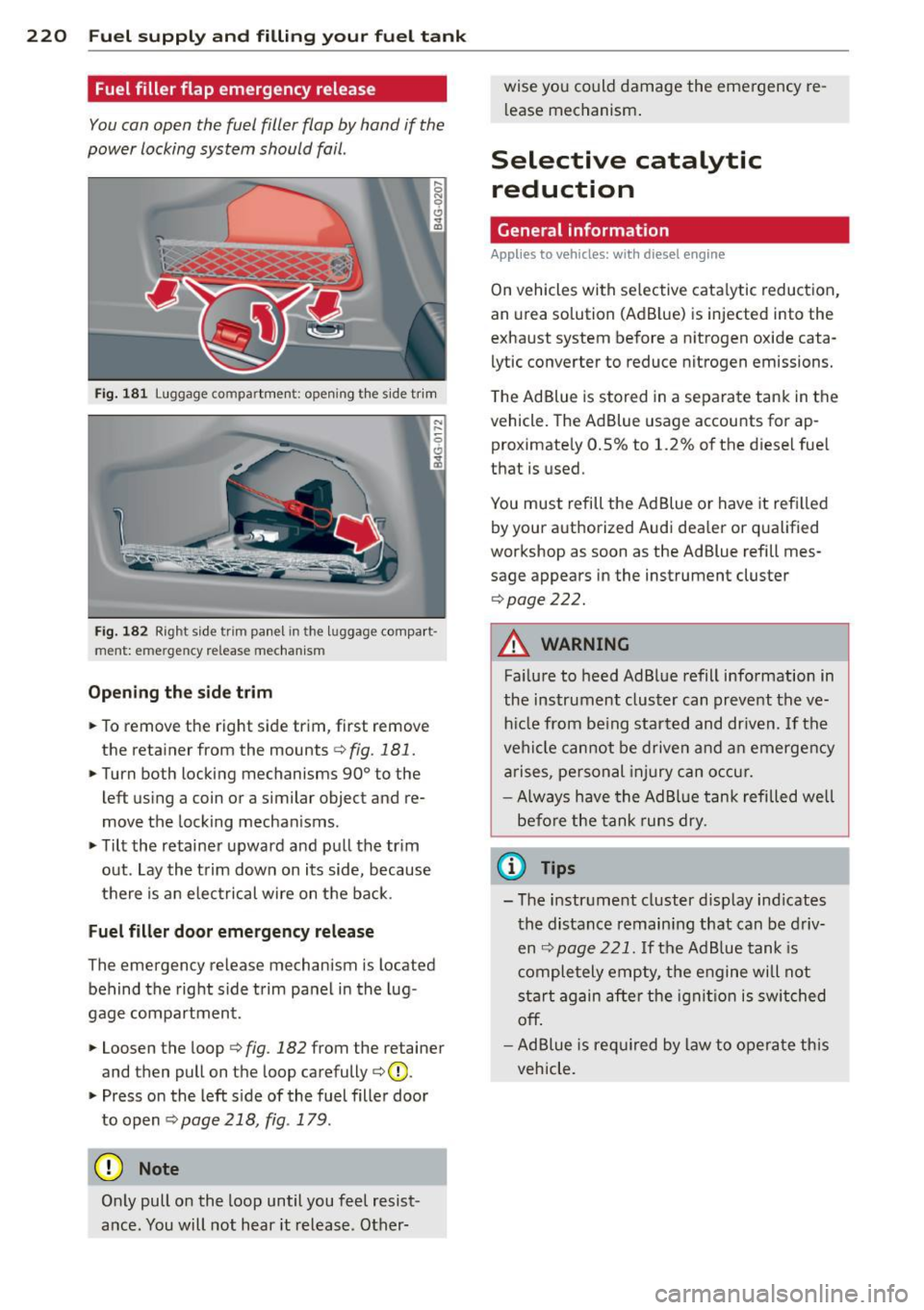
Fuel filler flap emergency release
You can open the fuel filler flap by hand if the
power locking system should fail .
Fig. 181 Luggage co m partmen t: open ing the side tr im
Fig. 182 Right side trim panel in the lu ggage compar t
ment: e mergency release mechanism
Opening the side trim
• To remove the right side trim, first remove
the retainer from the mounts
¢ fig. 181.
• Turn both locking mechanisms 90° to the
left using a coin or a similar object and re
move the locking mechanisms.
• Tilt the retainer upward and pull the trim
out . Lay the trim down on its side, because
there is an electrical wire on the back.
Fuel filler door emergency release
The emergency release mechanism is located
behind the right side trim panel in the lug
gage compartment.
• Loosen the loop i:>
fig. 182 from the retainer
and then pull on the loop carefully i:>Q).
• Press on the left side of the fuel filler door
to open
i=> page 218, fig. 179.
(D Note
Only pull on the loop until you feel resist
ance. You will not hear it release . Other- wise you could
damage the emergency re
l ease mechanism .
Selective catalytic
reduction
General information
Applies to vehicles: with diesel engine
On vehicles with selective cata lytic reduction,
an urea solution (Ad B lue) is injected into the
exhaust system before a nitrogen oxide cata
lytic converter to reduce nitrogen emissions.
The Ad Blue is stored in a separate tank in the
vehicle. The Ad Blue usage accounts for ap
proximately 0.5% to 1.2% of the diesel fuel
that is used.
You must refill the Ad Blue or have it refilled
by you r authorized Audi dea ler or qualified
workshop as soon as the Ad Blue refill mes
sage appears in the instrument cluster
¢page 222.
A WARNING
-Failure to heed AdBlue refill information in
the instrument cluster can prevent the ve
hicle from be ing started and driven . If the
vehicle cannot be driven and an emergency
arises, personal injury can occur.
- Always have the AdBlue tank refilled well
before the tank runs dry.
(D Tips
-The instrument cluster display ind icates
the distance remaining that can be driv
en
c> page 221. If the Ad Blue tank is
completely empty, the engine will not
start again after the ignition is switched
off.
-Ad Blue is required by law to operate this
vehicle.
Page 223 of 304
Indicator in the instrument cluster
display
Applies to vehicles: with diesel e ngine
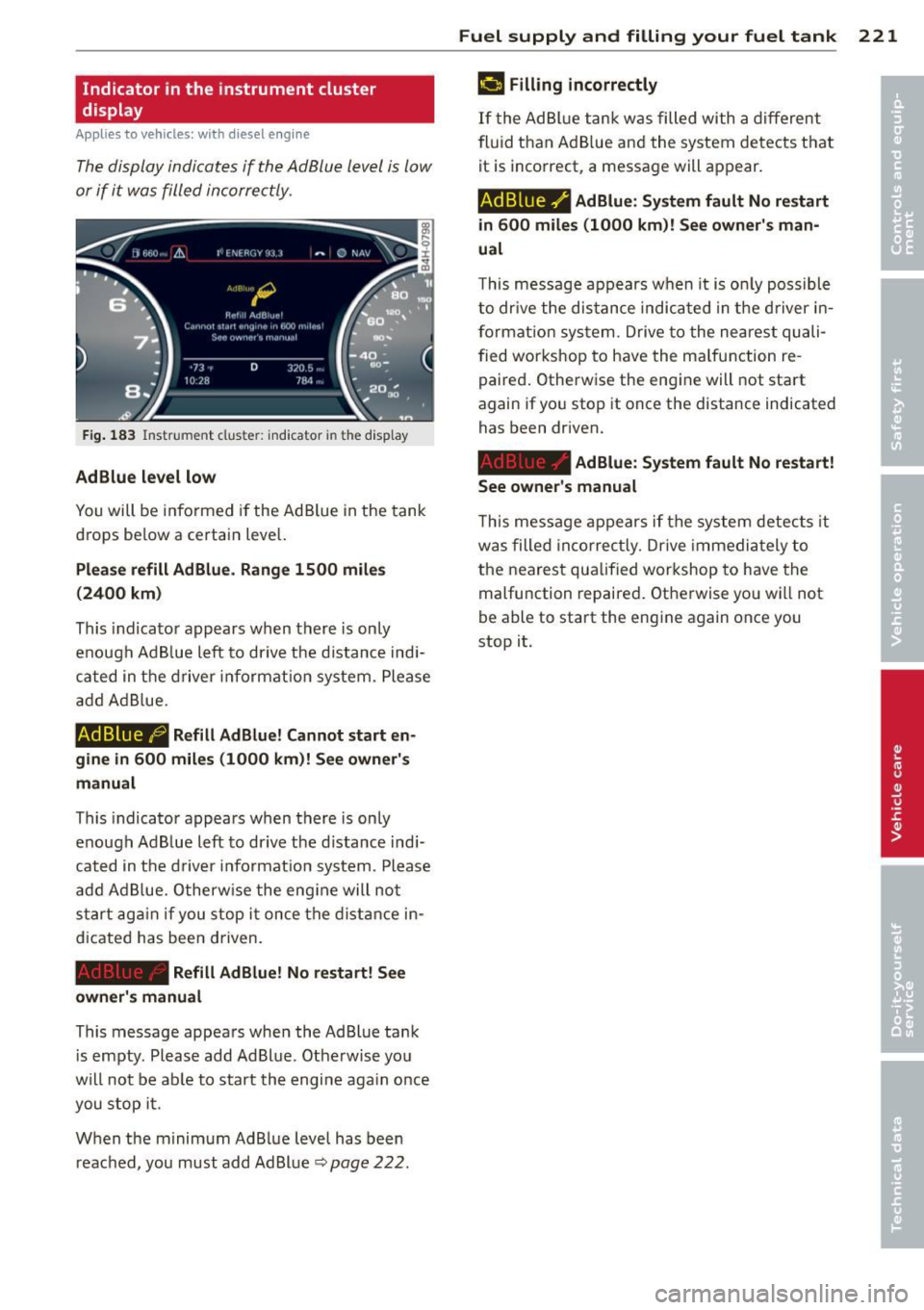
The display indicates if the Ad Blu e level is low
or if it was filled incorre ctly.
Fig . 183 In strument clus te r: indica tor in th e display
AdBlue l evel low
You will be informed if the Ad Blue in the tank
drops be low a certain level.
Plea se refill Ad B lu e. Rang e 1500 miles
(2400 km)
This indicato r appears when there is on ly
enough Ad B lue left to drive the d istance ind i
cated in the driver i nformat ion system . Please
a dd AdB lue.
AdBlue ,0 Refill Ad Blue! Cannot start en
gine in
600 miles (1000 km )! See owner's
manual
This indicato r appears when there is only
e nough Ad B lue left to dr ive t he d istance ind i
cat ed in t he d rive r in format ion system . Please
add Ad Blue. O therw ise the eng ine will not
start ag ai n if you stop i t once the distan ce in
d icated has been driven.
Refill Ad Blue! No r estart! S ee
owner 's manual
This message appears when the AdBlue ta nk
i s empty . Please add Ad Blue. Otherwise you
will not be ab le to s tart th e engi ne aga in o nce
you stop i t.
W hen the minimum AdBlue level has been
reac hed, you must add Ad Bl ue
q page 222 .
Fuel suppl y and filli ng your fuel t ank 221
¢4 Filling incorrectly
If the AdBl ue tank was filled with a different
fluid than Ad B lue and the system dete cts t hat
it is incorrect, a message will appear.
AdBlue ./ AdBlue: Sy stem fault No restart
in
6 00 mile s (1000 km)! See owner 's man
ual
T his message appears w hen it is on ly possible
to dr ive the dis tance indicated in the d river in
format ion sys tem . Drive to the nea rest quali
fied wor kshop to have the ma lfunction re
paired. Otherwise the eng ine will not start
again if yo u stop it once the distance indicated
has been driven.
AdBlue: System fault No re start!
See owne r's manual
Th is message appears if the system detects it
was filled in co rrec tly. Drive immedia tely to
the nearest qua lified workshop to have the
malfu nction repaired . Otherwise yo u wi ll not
be able to start the engine again once you
stop it.
Page 224 of 304
222 Fuel supply and filling your fuel tank
Filling AdBlue
Applies to vehicles: with diesel engine
A special refill bottle must be used to fill the
AdBlue .
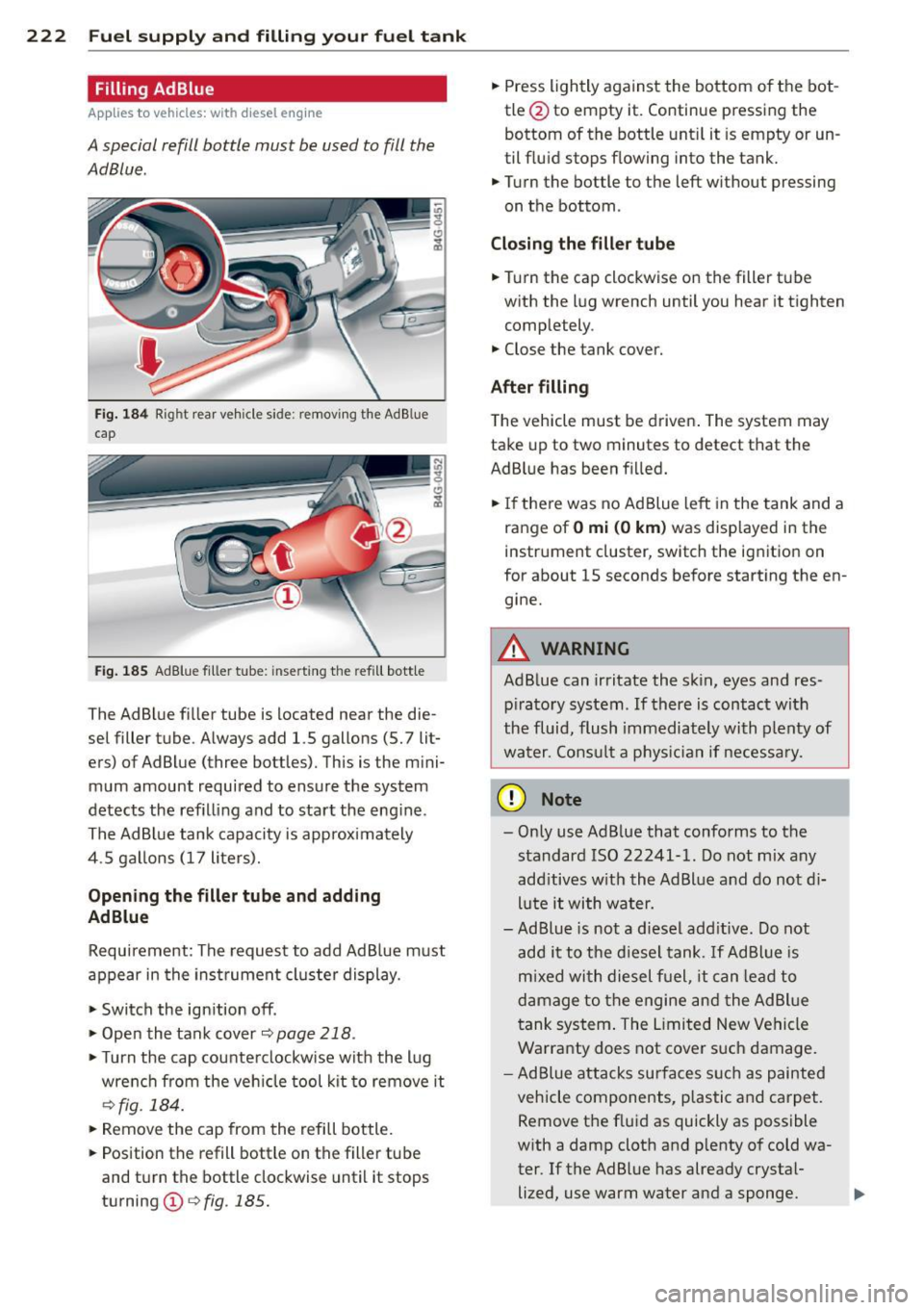
Fig. 184 Rig ht rear vehicle side: remov ing the Ad B lue
cap
Fig . 185 Ad Blue filler tube: inse rting the refill bottle
The AdBlue fi ller tube is located near the die
sel filler tube . Always add 1.5 gallons (5. 7 lit
ers) of AdBlue (three bottles). This is the mini
mum amount required to ensure the system
detects the refilling and to start the eng ine.
The AdBlue tank capacity is approximately
4 .5 gal lons (17 liters).
Opening the filler tube and adding
AdBlue
Requirement : The request to add Ad Blue must
appear in the instrument cluster display.
• Switch the ignition off .
• Open the tank cover
¢page 218.
• Turn the cap counterclockw ise with the lug
wrench from the vehicle tool kit to remove it
¢fig. 184.
• Remove the cap from the refill bottle.
• Position the refill bottle on the filler tube
and turn the bottle clockwise until it stops
turning
(D ¢ fig . 185.
• Press lightly against the bottom of the bot
tle @to empty it. Continue pressing the
bottom of the bottle until it is empty or un
til fluid stops flowing into the tank.
• Turn the bottle to the left without pressing
on the bottom .
Closing the filler tube
• Turn the cap clockwise on the filler tube
with the lug wrench until you hear it tighten
completely .
• Close the tank cover.
After filling
The vehicle must be driven. The system may
take up to two minutes to detect that the
AdBlue has been f illed.
• If there was no Ad Blue left in the tank and a
range of
O mi (0 km) was displayed in the
instrument cluster, switch the ignition on
for about 15 seconds before starting the en gine.
A WARNING
= Ad Blue can irritate the sk in, eyes and res-
piratory system. If there is contact with
the fluid, flush immediately with plenty of
water. Consult a physician if necessary.
(D Note
- Only use Ad Blue that conforms to the
standard ISO 22241-1. Do not mix any
additives with the AdBlue and do not d i
lute it with water.
-A d Blue is not a diesel add itive . Do not
add it to the diesel tank. If Ad Blue is
m ixed with diesel fuel, it can lead to
damage to the engine and the AdBlue
tank system . The Limited New Vehicle
Warranty does not cover such damage.
- Ad Blue attacks surfaces such as painted
vehicle components, plastic and carpet.
Remove the fluid as quickly as possible
w ith a damp cloth and p lenty of cold wa
ter. If the AdBlue has already crystal-
lized, use warm water and a sponge. .,..
Page 231 of 304
(D Note
Driving with an insufficient oil level is like
ly to cause severe damage to the engine.
@ Tips
- The oil pre ssure w arning di spl ay . is
n ot an indi cato r of the oil le vel. D o not
rely on it. Inste ad , c heck th e oil le vel in
y ou r engine at regula r inter vals, pref
er ably each t ime you refu el, and al way s
befor e going on a long tr ip .
- If you have the impression your engine
consumes excessive amounts of oil, we
recommend that you consult your Audi
dealer to have the cause of yo ur conce rn
properly diagnosed. Keep in mind that
the accurate measurement of oil con
sump tion requires great care and may
take some time. Your Audi dealer has in
str uctions about how to measure oil con
sumption accurately.
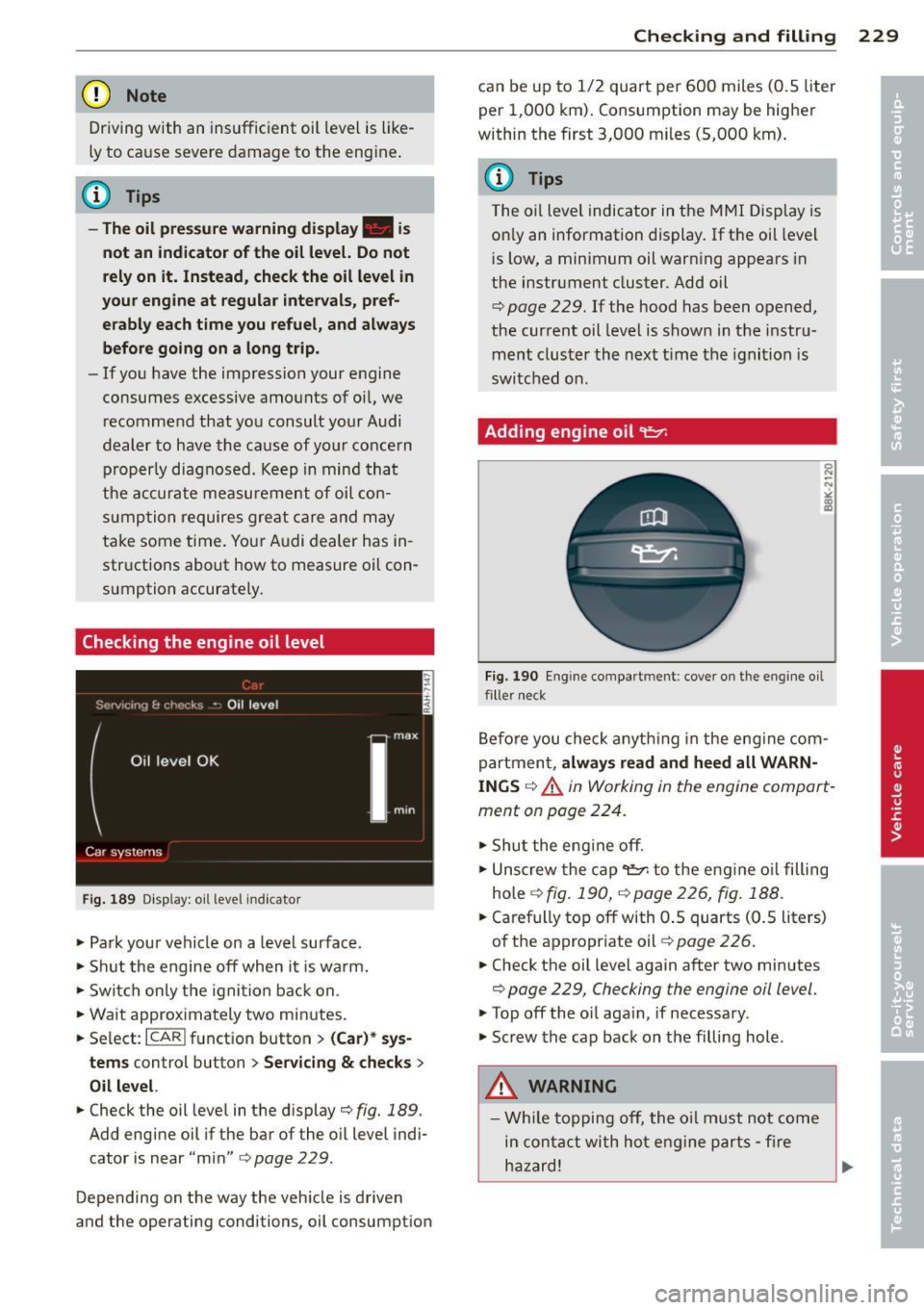
Checking the engine oil level
Fig. 18 9 Display: oil leve l indicato r
"'Park your vehicle on a level surface .
"' Shu t the engine off when it is warm.
"' Switch only the ignition back on.
"' Wait approximately two minutes.
"' Se lect :
I CARI funct ion button > ( Car )* sys -
tems
control button > Se rvicing & che ck s >
O il lev el.
"'Check the oil level in the display ¢fig. 189.
Add engine oil if the bar of the oil level indi
cator is near "min"
c::;,page 229 .
Depending on the way the veh icle is driven
and the operating conditions, oil consumption
Checkin g and fillin g 229
can be up to 1/2 quart pe r 600 miles (0.5 liter
per 1,000 km). Consumption may be higher
within the first 3,000 miles (5,000 km) .
(D Tips
The oil level indicator in the MMI Display is
on ly an information display. If the oil level
is low, a minimum oil warning appears in
the instrument cluster. Add oil
c::;, page 229. If the hood has been opened,
the current oil level is shown in the instru
ment cluster the next t ime the ignition is
switched on.
Adding engine oil~
Fig. 190 Eng in e compa rtm ent : cove r on the engine oi l
filler neck
Before you check anyth ing in the eng ine com
partment,
alw ays rea d and he ed all WARN
ING S
c::;, &. in Working in the engine compart
ment on page 224.
"' Shut the eng ine off .
"' Unscrew the cap
't".:::?: to the engine o il filling
hole
c::;, fig. 190, c::;, page 226, fig . 188.
"' Carefully top off with 0.5 quarts (0.5 liters)
of the appropriate oil
c::;, page 226.
"' Check the oil level again after two minutes
c::;, page 229, Checking the engine oil level.
"'Top off the oil again, if necessary.
"' Screw the cap back on the filling hole.
A WARNING
--Wh ile topping off, the o il must not come
in conta ct with hot engine parts -fi re
ha zard!
Page 249 of 304
the time it was manufactured. For the
l ocation of the labe l¢
page 244, fig . 195.
Most ti res lose a ir naturally over time. They
can also lose some a ir if you drive over a pot
hole or hit a curb while parking. It is usua lly
not possib le to see whether the radia l tires
used today are underinflated just by looking
at them.
Therefore, be sure to check tire pressures at
l east once a month and always before going
on a long trip. Make sure to take the number
of people and the amount of luggage into ac
count when adjusting tire pressure for a trip -
even one that you would not consider to be
"long ." See ¢
page 248 , Tires and vehicle
load limits
for more important information .
Always use an accurate tire pressure gauge
when check ing and adjusting inflation pres
sures . Check all of the t ires and be sure not to
forget the spare t ire . If the pressure in any tire
i s too high when the tire is "cold," le t air out
of the tire slowly with t he edge of the t ire
gauge and keep checking the pressure until
you reach the press ure that is correct for the
l oad (passengers and luggage) and kind of
driving you plan to do .
I f the p ressure in any tire is too low, note the
difference between the pressure in the cold
tire and the pressure yo u need and add the a ir
that you need to reach the correct pressure for
the vehicle load (passengers and luggage) for
the t ires on your vehicle as listed on the on
your veh icle and in this manua l and the kind
of dr iv ing yo u plan to do .
Never e xceed the ma ximum inflation pres
sur e listed on the t ire s idewall for any rea
son.
Remember that the vehicle manufacturer, not
the t ire manufacturer, determ ines the correct
tire pressure for the t ires on your vehicle .
It is important to check the tire pressure when
the tires are cold .
- Read the requi red ti re press ure from the tire
pressure label. The tire pressure labe l is lo
cated on the driver's side B-pi llar .
Tire s an d wheel s 24 7
- Turn the va lve stem cap counter -clockw ise
to remove it from the tire va lve .
- Place the air pressure gauge on the va lve.
- The tire pressures should o nly be checked
a nd ad justed when the tires are co ld. The
slightly raised pressures of warm tires must
not be reduced.
- Adjust the tire pressure to the load you are
carrying.
- Reins tall the valve stem cap on t he va lve.
When should I check the tire pressure?
The correct tire pressure is especially impor
tant at high speeds . The pressure should
the refore be checked at least once a month
and always before sta rting a jo urney. Do not
f o rge t to chec k the ti re p ressu re fo r the sp are
whee l
q page 26 2.
When should I adjust the tire pressures ?
Adjust the tire pressure to the load you a re
ca rrying. After chang ing a whee l
or replacing
whee ls you have to adjust the ti re p ressu res
on all whee ls. In addition, yo u m ust then
store the new tire pressures in the tire pres
s u re monito ring system*
q page 258.
A WARNING
Incorrect tire pressures and/or underinfla
tion can lead sudden tire fa ilure, loss of
control, collision, serious personal injury
or even death.
- When the warning symbol
RI] appears in
the instrument cluster, stop and inspect
the t ires.
- Incorrect tire pressure and/or underinfla
tion can cause increased tire wear and
can affect the handli ng of the vehicle and
stopping ability.
- Incorrect tire pressures and/or underin
f lation can a lso lead to sudden t ire fail
ure, including a blowout a nd sudden de
f lation, ca using loss of veh icle cont ro l.
- The drive r is responsib le for the co rrect
tire pressures for all tires on the ve hicle.
The appli cable pressure values are locat
ed on a sticker on the driver's s ide B-pil-
la~
~
•
•
Page 261 of 304
remain continuously illuminated. This se
quence will continue upon subsequent vehicle
start-ups as long as the malfunction exists.
When the malfunction indicator is illuminat
ed, the system may not be able to detect or
signal low tire pressure as intended . TPMS
malfunctions may occur for a variety of rea
sons, including the installation of replace
ment or alternate tires or wheels on the vehi
cle that prevent the TPMS from functioning
properly . Always check the TPMS malfunction
telltale after replacing one or more tires or
wheels on your vehicle to ensure that the re
placement or alternate tires and wheels allow
the TPMS to continue to function properly.
Tire pressure indicator appears
Appl ies to vehicles: with tire pressur e monitoring sys te m
The tire pressure indicator in the instrument
cluster informs you if the tire pressure is too
low or if there is a system malfunction.
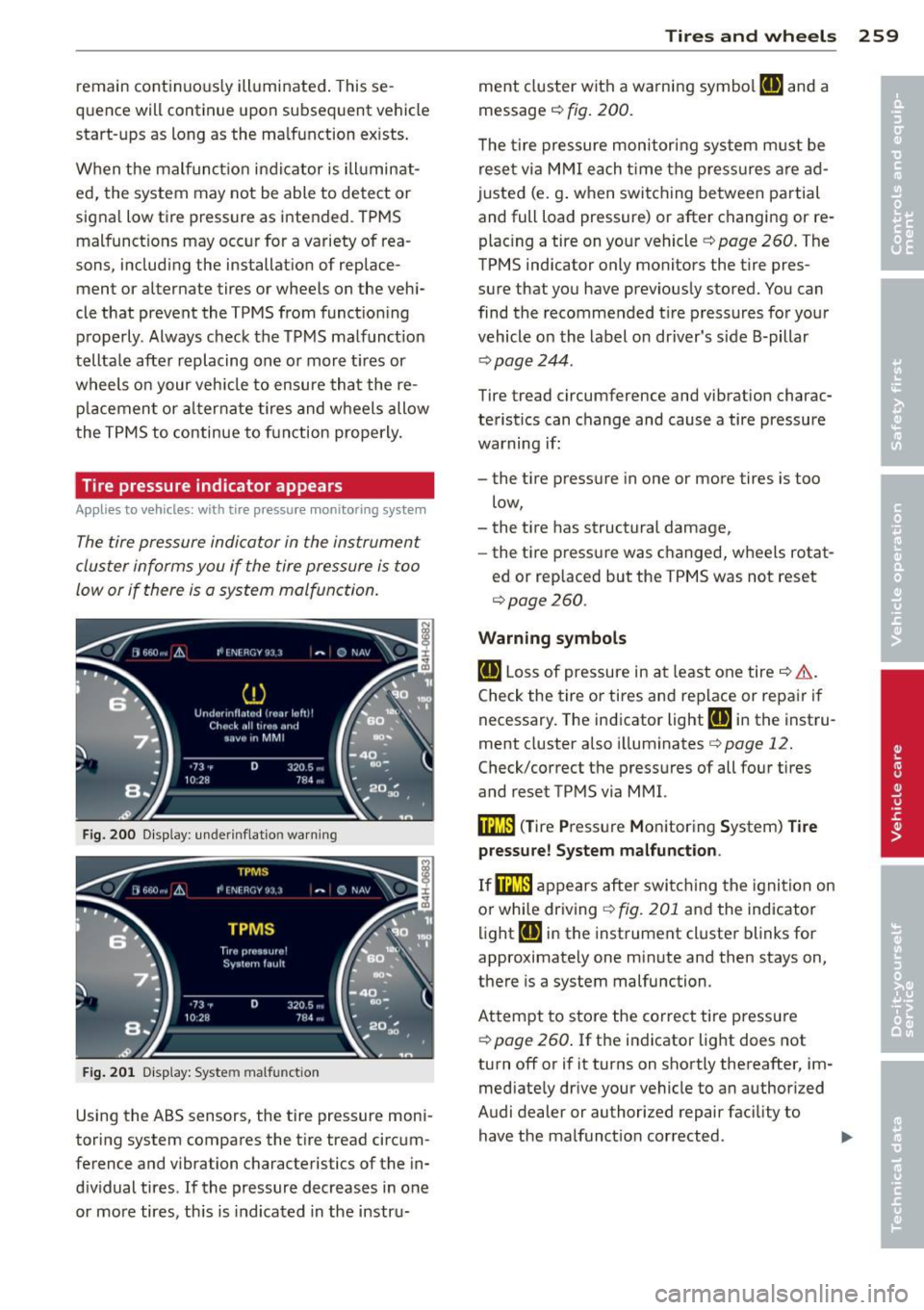
Fig. 200 Display : underinflation warning
Fig. 201 Display: System malfunction
Using the ABS sensors, the tire pressure moni
toring system compares the tire tread circum
ference and vibration characteristics of the in
dividual tires. If the pressure decreases in one
or more tires, this is indicated in the instru-
Tires and wheels 259
ment cluster with a warning symbol [I] and a
message
c::, fig. 200.
The tire pressure monitoring system must be
reset via MMI each time the pressures are ad
justed (e.g. when switching between partial
and full load pressure) or after changing or re
placing a tire on your vehicle
c::, page 260. The
TPMS indicator only monitors the tire pres
sure that you have previously stored. You can
find the recommended tire pressures for your
vehicle on the label on driver's side 8-pillar
~page 244.
Tire tread circumference and vibration charac
teristics can change and cause a tire pressure
warning if:
- the tire pressure in one or more tires is too
low,
- the tire has structural damage,
- the tire pressure was changed, wheels rotat-
ed or replaced but the TPMS was not reset
c::, page 260 .
Warning symbols
[I] Loss of pressure in at least one tire c::> &..
Check the tire or tires and replace or repair if
necessary. The indicator light
[I] in the instru
ment cluster also illuminates
c::>page 12.
Check/correct the pressures of all four tires
and reset TPMS via MMI.
i:mJ) (Tire Pressure Monitoring System) Tire
pressure! System malfunction .
If@m appears after switching the ignition on
or while driving
c::, fig. 201 and the indicator
light
[I] in the instrument cluster blinks for
approximately one minute and then stays on,
there is a system malfunction.
Attempt to store the correct tire pressure
c::, page 260. If the indicator light does not
turn off or if it turns on shortly thereafter, im
mediately drive your vehicle to an authorized
Audi dealer or authorized repair facility to
have the malfunction corrected.