steering AUDI A6 2014 Workshop Manual
[x] Cancel search | Manufacturer: AUDI, Model Year: 2014, Model line: A6, Model: AUDI A6 2014Pages: 304, PDF Size: 76.32 MB
Page 200 of 304
198 Intelligent technology
Clean off accumulated salt coating from
brake discs and pads with a few caref ul
brake applications.
- If you damage the front spoiler, or if you
install a different spoiler, be sure the air
flow to the front brakes is not obstruct ed . Otherwise the brake system could
overheat reducing the effectiveness of
the ent ire brake system.
- Failure of one brake c ircuit will impair
the braking capability resulting in an in creased stopp ing distan ce. Avoid driv ing
the vehicle a nd have it towed to t he near
est Aud i dea ler o r qualified workshop.
- Never let the vehicle rol l to a stop w ith
the engine shu t off.
- If the brake booster is not working, the
brake pedal must be pressed conside ra
bly harder to make up for the lac k of
booster assistance.
Electro-mechanical
power assist
The electro-mechanical power assist helps
the driver when steering.
Power steering adapts electronically based on
the vehicle speed.
Ind icator light s and m essages
• Steerin g defecti ve! Stop the vehicle
If th is indicator light turns on and stays on
and this message appears, t he power steering
may have fa iled.
Do
not cont inue driving . See you r autho rized
Aud i dealer or other qualified repa ir facility
fo r assistance.
l~ ij Ste ering: Sy stem malfunction ! You m ay
cont inue dri ving
If the indicator light turns on and the mes
sage appears, the steer ing may be more diffi
cult to move or more sens itive than usual.
Drive s low ly to your authorized Audi dealer or
qua lified workshop to have the malfunction
corrected.
(D Tips
If the . or
£'I' ij indicator light on ly stays
on for a short t ime, yo u may continue dr iv
i ng.
Driving with your
quattro
App lies to vehicles: wit h all-w hee l drive
With a/I-wheel drive, all four wheels ore driv
en.
General information
With all Wheel Drive, power is distributed to all four wheels. This happens automatically
depend ing on your driving style and the road
condit ions at the time. See also ¢
page 194.
With the sport diffe rent ia l*, power distribu
t ion to the rear wheels is variable and can be
adjusted with Audi drive select*¢
page 100.
Always read and follow safety precautions
¢ &.
Winter tires
When dr iving in the win ter, yo ur vehicle wi th
all-wheel drive has an advantage, eve n with
regular tires. In winter road conditions it may
be advisable to mount winter tires (or all-sea
son tires) for improved driveability and brak
ing : these tires must be mounted on
all fou r
w heel s.
See also¢ page 255, Winter tires .
Tire chain s
Where tire chains are mandatory on certain roads, this norma lly also app lies to ve hicles
with all-wheel drive¢
page 256, Snow
chains .
Replacing wheel s/tire s
Vehicles with a ll-wheel drive must always
have tires of the same size. A lso avoid tires
with different tread depths . For detai ls see
page ¢
page 251, New tires and replacing
tires and wheels.
Off -Road dr iving?
Your Audi does not have enough gro und clea r-
ance to be used as an off-road vehicle .
It is jll,,
Page 209 of 304
Make sure that the cooling system has enough
fluid.
Tire pressure
When towing a trailer, inflate the tires of your
vehicle to the cold tire pressure listed under
"Full load" on the label located on the driver's
side B-pillar (visible when the door is open).
Inflate trailer tires to trailer and tire manufac
turers' specifications.
Lights
Check to make sure both vehicle and trailer
lights are working properly.
Safety chains
Be sure trailer safety chains are properly con
nected from the trailer to the hitch on the ve
hicle. Leave enough slack in the chains to per
mit turning corners . When you install safety
chains, make sure they will not drag on the
road when you are driving.
The chains should cross under the trailer
tongue to prevent it from dropping in case of
separation from the hitch.
Adjusting the Audi drive select
Make sure the vehicle is on a level surface be
fore hitching up the trailer and before adjust
ing the tongue weight. The vehicle must be in
auto or comfort driving mode and not raised
qpage 100, ~CD .
Make sure that the vehicle is lowered. In Info
tainment, select:
ICARI function button> Low
er
control button.
If you must drive under poor road conditions,
you can raise the vehicle
after coupling the
trailer or
after adjusting the tongue weight
qpage 102.
- Changes in temperature or load can af
fect the height of the vehicle .
- Always select
auto or comfort mode.
Otherwise, the tongue load specified for
your vehicle will no longer be applicable.
Trailer towing
Driving instructions
Driving with a trailer always requires extra
care and consideration .
To obtain the best possible handling of vehicle
and trailer, please note the following:
... Do not tow a loaded trailer when your car it
self is not loaded.
... Be especially careful when passing other
vehicles.
... Observe speed limits .
... Do not drive at the maximum permissible
speed.
... Always apply brakes early .
... Monitor the temperature gauge.
Weight distribution
Towing a loaded trailer with an empty car re
sults in a highly unstable distribution of
weight. If this cannot be avoided, drive at very
low speeds only to avoid the risk of losing
steering control.
A "balanced" rig is easier to operate and con
trol. This means that the tow vehicle should
be loaded to the extent possible and permissi
ble, while keeping the trailer as light as possi
ble under the circumstances. Whenever possi
ble, transfer some cargo to the luggage com
partment of the tow vehicle while observing
tongue load requirements and vehicle loading
considerations.
Speed
The higher the speed, the more difficult it be
comes for the driver to control the rig. Do not
drive at the maximum permissible speed. Re
duce your speed even more if load, weather or
wind conditions are unfavorable -particularly
when going downhill .
Reduce vehicle speed
immediately if the trail
er shows the slightest sign of swaying .
Do not
try to stop the swaying by accelerating.
Observe speed limits. In some areas, speeds
for vehicles towing trailers are lower than for
regular vehicles . ..,..
207
•
•
Page 210 of 304
208 Trailer towing
Always apply brakes early. When driving
downhill, shift into a lower gear to use the en
g ine braking effect to slow the vehicle . Use of
the brakes alone can cause them to overheat
and fail.
Coolant temperature
The coolant temperature gauge¢ page 11
must be observed carefully. The coolant tem
perature can increase if you drive on long in
clines in a low gear at high engine speeds. Re
duce your speed immediately if the LEDs in
the top part of the display turn on .
For more information about indicator lights,
refer to.
¢ page 17 .
A WARNING
Anyone not properly restrained in a mov
ing vehicle is at a much greater risk in an
accident . Never let anyone r ide in your car
who is not properly wear ing the restraints
provided by Aud i.
Trailer towing tips
Important to know
Your vehicle handles differently when towing
a trailer because of the additional weight and
different weight distribution . Safety, perform
ance and economy w ill greatly depend on how
carefully you load your trailer and operate
your rig .
Before you actually tow your trailer, practice
turn ing, stopp ing and back ing up in an area
away from traffic. Keep practicing until you
have become comp lete ly familiar with the way
your ve hicle-trai ler comb ination behaves and
responds.
Backing up is difficult and requires practice .
Backing up with a tra iler generally requi res
steering act ion opposite to that when backing
up your vehicle without a trailer.
Maintain a greater distance between your ve
hicle and the one in front of you. You will need
more room to stop. To compensate for the trailer, you wi
ll need a larger than normal
turning radius.
When passing, remember that you cannot ac
celerate as fast as you norma lly would be
cause of the added load. Make sure you have
enough room to pass . After passing, a llow
plenty of room for your trailer before chang
ing lanes again.
Avoid jerky starts , sharp turns or rapid lane
changes.
(D Tips
- Do not tow a trailer during the break-in
period of your vehicle.
- If you tow a trailer, your Audi may re
quire more frequent maintenance due to
the extra load ¢
page 283.
Parking on a slope
Do not park on o slope with a trailer. If it can
not be avoided, do so only after doing the fol
lowing:
When parking:
.,. App ly the foot brake .
.. Have someone place chocks under both the
vehicle and the trailer wheels.
.. With chocks in place, slowly release the
brakes until the wheel chocks absorb the
load .
.. Turn the wheels towards the curb.
.. Apply the parking brake.
.. Select the P selector lever position .
When restarting after parking:
.. Apply the foot brake.
.. Start the engine.
.. Select the D/S selector lever position .
.. Release the parking brake and slowly pull
out and away from the wheel chocks .
.,. Stop and have someone retr ieve the wheel
chocks .
Ill-
Page 243 of 304
-Never mount used tires on yo ur vehicle if
yo u are not sure of their "previous histo
ry." Old used tires may have been dam
aged even though the damage cannot be
seen that can lead to sudden tire failure
and loss of vehicle control.
- If you notice unusual vibration or if the
vehicle pulls to one side when d riving, al
ways stop as soon as it is safe to do so
and check the wheels and tires for dam
age .
(D Note
Please note that summe r and wi nte r tires
are designed for the cond itions that are
Glossary of tire and loading terminology
Accessory weight means the comb ined weight (in excess of
those sta ndard items which may be rep laced)
of au toma tic transmission, power steer ing ,
power brakes, power windows, power seats,
radio, and heater, to the extent that these
items are availab le as factory-installed equip
ment (whether installed or not) .
Aspect ratio
means the rat io o f the height to the w idth of
the tire in percent . Numbers of 55 or lower in
dicate a low sidewall for improved steering re
sponse and better overa ll handling on dry
pavement .
Bead
means the part of the t ire t hat is made o f
steel wires, wrapped or reinforced by ply cords
and that is shaped to fit the r im.
Bead separation
means a b reakdown of the bond between
components in the bead .
Cord means the strands forming the plies in the
tire.
Tire s an d wheel s 241
typica l in those seasons . Aud i recommends
using winter tires during the winter
months . Low temperatures signif icant ly
dec rease the e lasticity of summer t ires,
which affects tract ion and brak ing ability.
If summer t ires are used i n very co ld tem
peratures, cracks ca n form o n the tread
bars , res ulting in perma nen t tire damage
that can cause loud driving noise and un
bala nced ti re s. Audi i s not respon sible for
th is type of damage .
Cold tire inflation pressure
means the t ire p ress ure recommended by t he
vehicle manufacture r fo r a tire o f a des ignated
s ize t hat has not bee n driven for more than a
coup le o f miles (k ilometers) at low speeds in
the three hour period before the tire press ure
is m easured or adjusted.
Curb weight
me ans the we ight of a motor ve hicle with
st andard equipmen t incl ud ing the max imum
capacity of fuel, oi l, and coolant, air condi
tioning and additional weig ht of optiona l
equipment.
Extra load tire
means a t ire design to oper ate a t higher load s
and at higher inflation pressures than the cor
responding standa rd tire . Extra load tires may
be identified as "XL", "x l", "EXTRA LOAD", o r
"RF" on the sidewal l.
Gross Axle Weight Rating ("GAWR")
me ans the load-ca rry ing capac ity of a single
axle system , measured at the tire -ground in
te rfaces.
Gross Vehicle Weight Rating ( "GVWR ")
mea ns the maximum total loaded we ight of
the ve hicl e. .,..
•
•
Page 253 of 304
unbalanced, resulting in vib rations you can
usually feel through the steering wheel.
Unba lanced wheels mus t be rebalanced to
avoid excessive wea r on s teer ing, suspens ion
and tires. A wheel must a lso be rebalanced
when a new tire is installed.
Incorrect wheel alignment
Inco rrect whee l alignment can cause exces
sive tire wea r, impair ing t he safety of the veh i
cle. If t ires show excess ive wear, have the
wheel alignment checked by an authorized
Audi dealer or qualified workshop.
All-wheel d rive
Ve hicles w it h quattro must always have tires
of the s ame s ize, construction and tread type.
F or detai ls see
¢ page 198 .
A WARNING
Sudden tire failure can lead to loss of con
trol, a crash and serious persona l injury!
- Never drive a veh icle when the tread on
any t ire is worn down to the wear indica
tors.
- Worn tires are a safety hazard , they do
not grip well on wet roads and increase
your risk of"hydrop lan ing" and loss of
co ntrol.
- Always keep chemicals that can cause
tire damage, such as grease, oil, gasoline
and brake fluid away from tires.
- Tires age even if they are not being used
and can fail suddenly, especially at high
speeds. Tires that are more than 6 years
old can only be used in an emergency
and then with special care and at lower
sp eeds.
- Never mount used tires on yo ur vehicle if
yo u are not sure of their "previous histo
ry." Old used ti res may have been dam
aged even though the damage cannot be
seen that can lead to s udden tire failure
and loss o f vehicle control.
Tires and wheels 251
New tires and replacing tires and wheels
New tires and wheels have to be broken in.
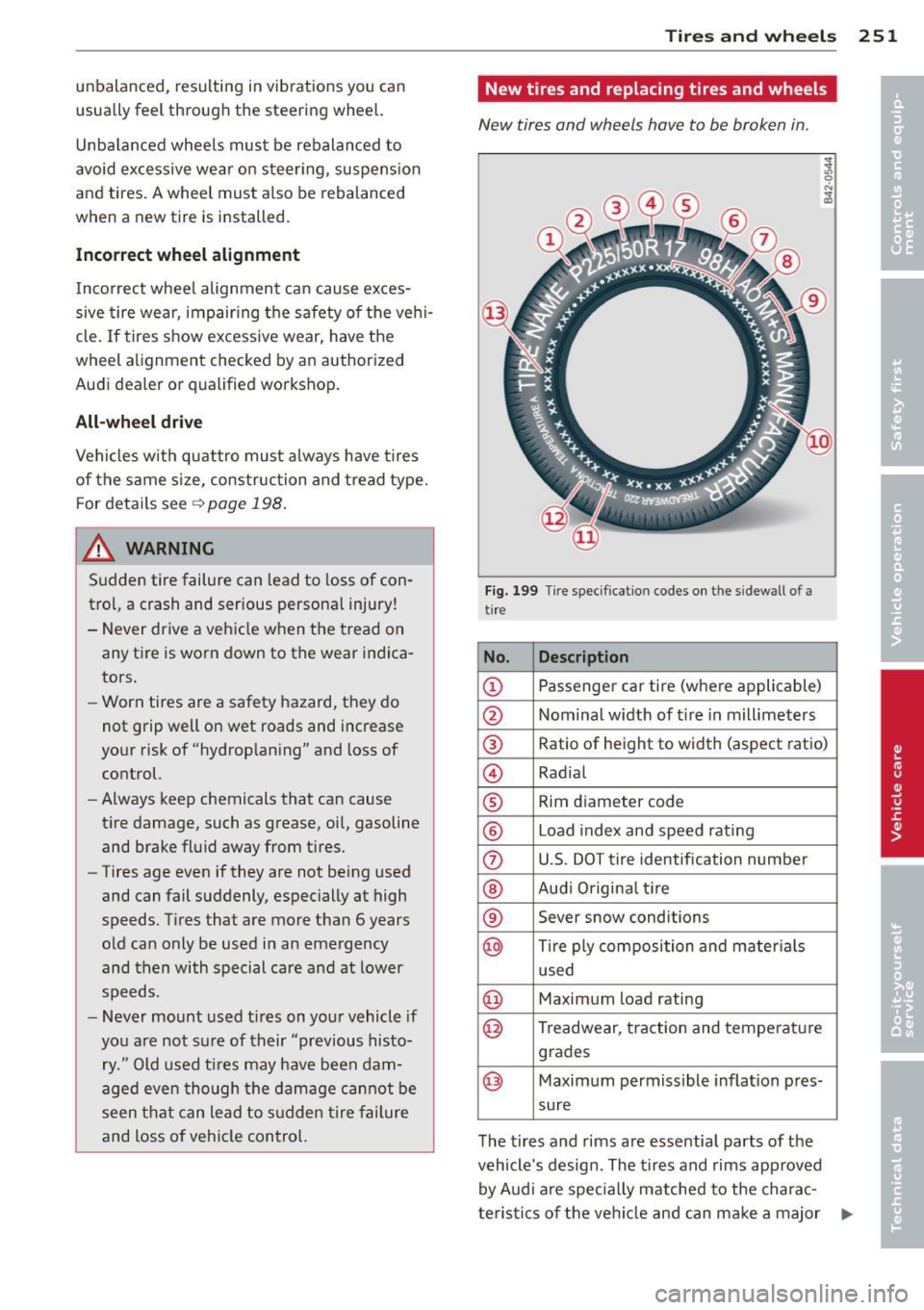
Fig. 199 Tire spec ification codes on the s idewall of a
tire
No . Description
@ Passenger car tire (where applicable)
@ Nominal w idth of t ire in millimeters
@ Ratio of height to width (aspect ratio)
© Rad ial
® Rim diameter code
® Load index and speed rati ng
0 U.S. DOT tire identification number
® Audi Original tire
® Sever snow conditions
@ Tire ply composition and ma terials
used
@ Maximum load rating
@ Treadwear, traction and tempe rat ure
grades
@ Maximum permissible inflation pres-
sure
T he tires and rims are essential parts of the
vehicle's design . The ti res and rims approved
by Audi a re spec ia lly matched to the charac
teris tics of the ve hicl e and can m ake a major .,.
Page 273 of 304
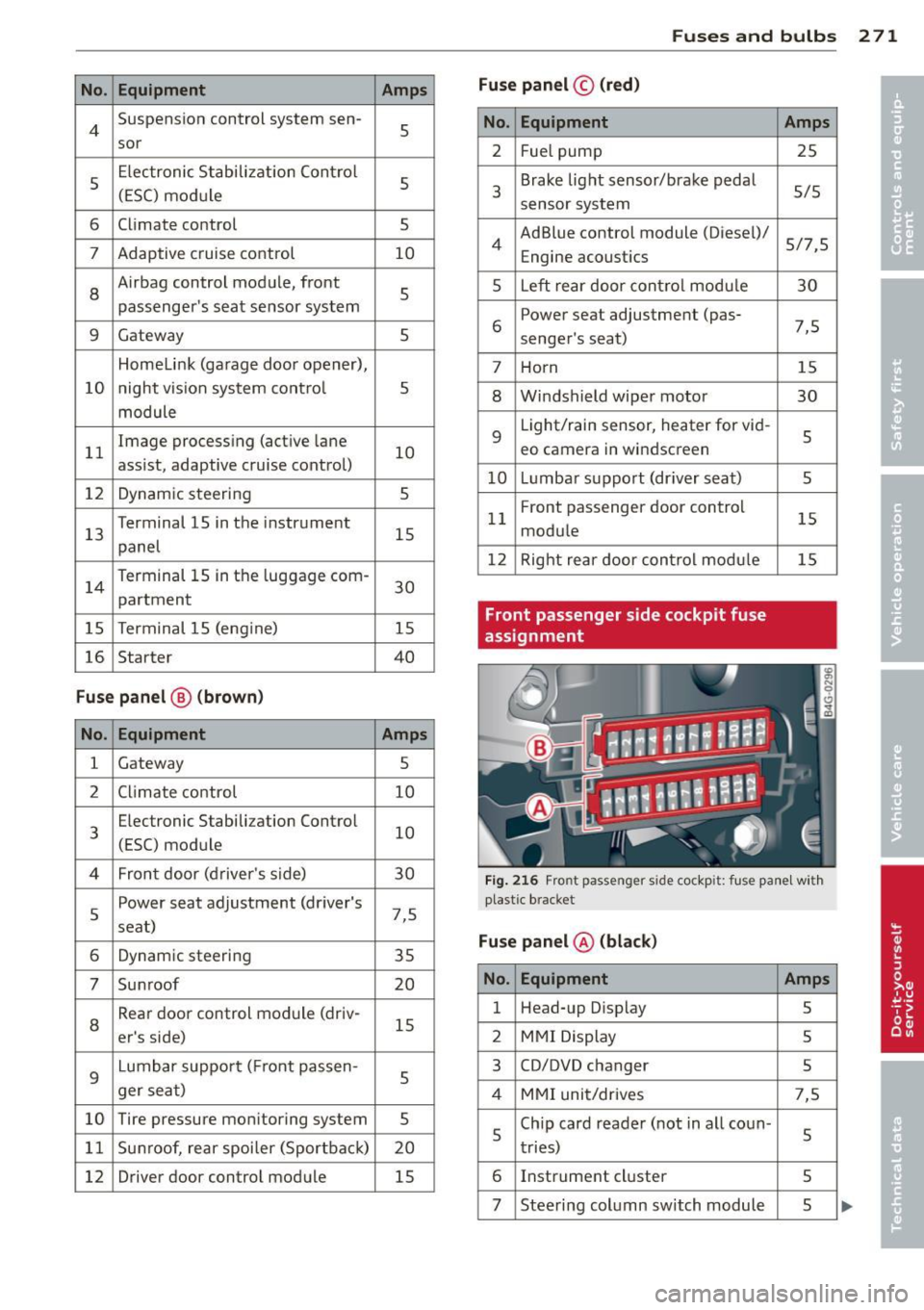
No. Equ ipment Amps
4 Suspension control system sen-s sor
s
E
lectronic Stabilization Cont rol
s (ESC) module
6 Climate control
5
7 Adaptive cruise control 10
8
Airbag control module, front
5
passenger 's seat sensor system
9 Gateway 5
Homelink (garage doo r opener),
10 night vis ion system cont ro l 5
module
11 Image
process ing (act ive lane
10
ass ist, adaptive cruise control)
12 Dynamic steering 5
13 Terminal 15 in
the instrument
15
panel
14 Terminal 15 in
the luggage com-
partment 30
15 Terminal 15 (eng
ine)
15
16 Starter 40
Fuse p anel ® (brown )
No . Equipment Amps
1 Gateway
5
2 C limate control 10
3 E
lectronic Stabili zation Contro l
10
(ESC) module
4 Fron
t door (driver 's side)
30
s
Power seat adjustment (driver's
7,5
seat)
6 Dynam
ic steering
35
7 Su nroof 20
8
Rear door control module (driv-
15
er 's side)
9 Lumbar support (
Front passen-
s ger seat)
10 Tire
pressure monitoring system
5
11 Su
nroof, rear spoi ler (Sport ba ck )
20
12 Driver door
control module
15
Fuse s and bulb s 2 71
Fuse panel © (red )
No . Equipment
2 Fuel pump
3 Brake lig
ht sensor/brake pedal
sensor system
AdBlue control module (Diesel)/
4 Engine acoustics
5 Left rear door cont rol modu le
6 Power seat adjustment
(pas-
senge r's seat)
7 Horn
8 Windshield wiper motor
9 Light/rain sensor, heater
for vid-
eo camera in windscreen
10 L umba r suppo rt (dr iver seat)
1 1 Front
passenger door control
modu le
1 2 Right rea r door cont rol mod ule
Front passenger side cockpit fuse
assignment Amp
s
25
5/5
5/7,S 30
7,5 15
30
s
5
15
15
F ig . 216 Front passenger side cockpit: f use panel w it h
plast ic brac ket
Fuse panel @ (blac k)
No . Equipment Amps
1 Head-up D
isplay
5
2 MMI Display 5
3 CO/DVD changer
5
4 MMI uni t/drives 7,5
5 Chip
card reader ( not in a ll coun -
5
tries)
6 Instrument
cluster
5
7 Steering col umn switch module 5 ...
Page 274 of 304
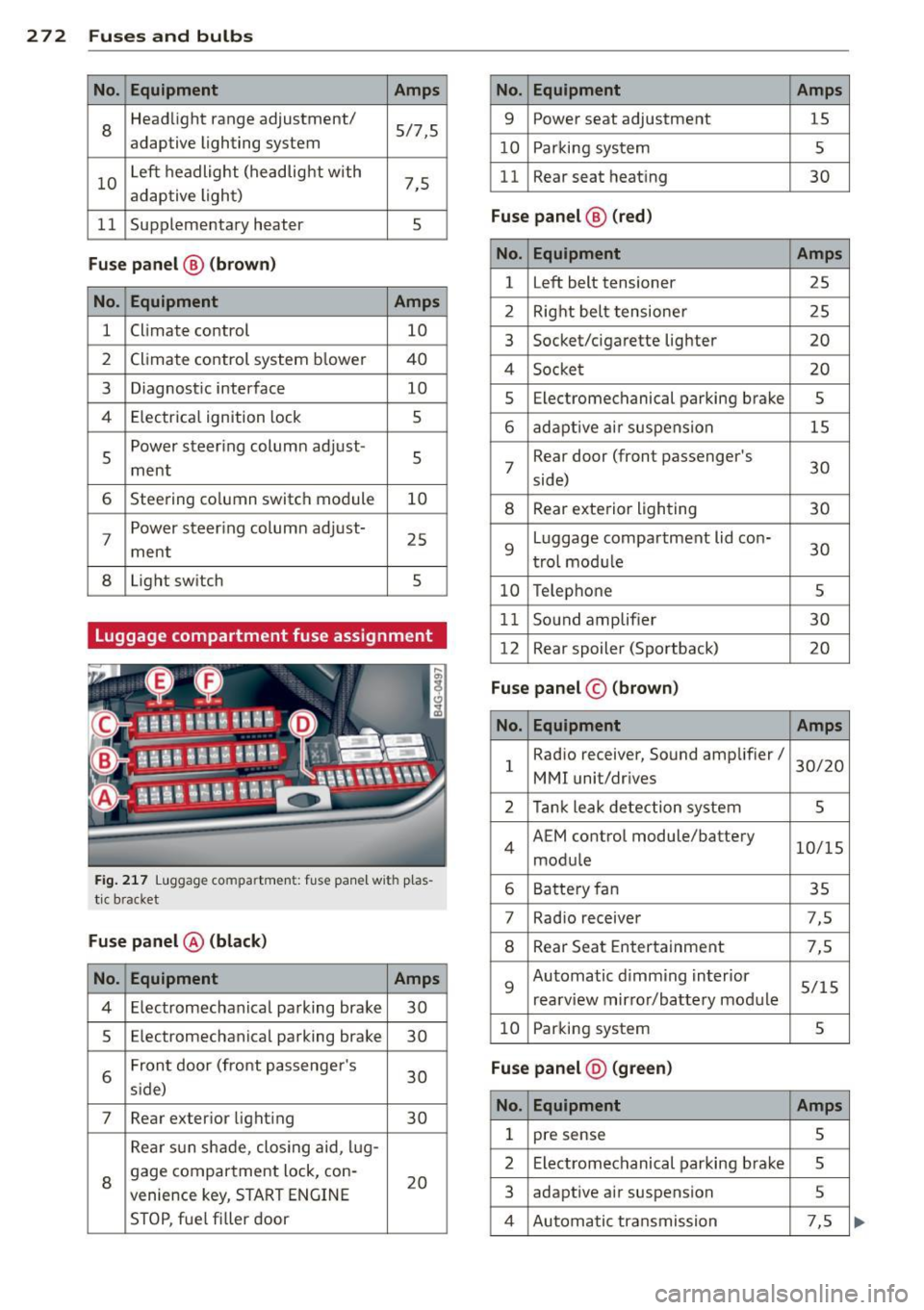
272 Fu ses and bulb s
No. Equ ipment Amps
8
Headlight range adjustment/
5/7,S
adaptive lighting system
10 Left headlight
(headlight with
7,5
adaptive light)
11 Supplementary heater
s
Fu
se p ane l@ (b ro w n)
No . Equipment Amps
1 Climate control
10
2 Climate control system blower 40
3 Diagnostic interface
10
4 E lectrical ignition lock
s
s
Power steering column adjust-
s ment
6 Steering column switch module
10
7 Power
steering column adjust-
ment 25
8 Light switch
s
Luggage compartment fuse assignment
Fig
. 217 Luggage compartment: fuse panel with plas
tic bracket
Fuse p anel @ (b la ck )
No. Equipment Amps
4 E lectromechanical parking brake 30
s Electromechanical parking brake
30
6 Front door
(front passenger's
30
s ide)
7 Rear exter ior lighting
30
Rear sun shade, closing aid, lug-
8 gage compartment
lock, con-
20
venience key, START ENGINE
STOP, fuel filler door
No. Equipment Amps
9 Power seat adjustment
15
10 Parking system
s
11 Rear seat
heating
30
Fuse pan el@ (r e d )
No . Equipment Amps
l Left belt tensioner
25
2 Right belt tensioner 25
3 Socket/cigarette
lighter
20
4 Socket 20
5 Electromechanical
parking brake
5
6 adaptive ai r suspension 15
7 Rear door
(front passenger's
30
side)
8 Rear exterior lighting 30
9 Luggage compartment
lid con-
30
t rol modu le
10 Telephone 5
11 Sound amplifier 30
12 Rear
spoiler (Sportback)
20
Fuse pan el© (brown)
No . Equipment Amps
1 Radio receiver,
Sound amplifier/
30/20
MMI unit/drives
2 Tank leak detection system
s
4 AEM
control module/battery
10/15
module
6 Battery fan 35
7 Rad
io receiver 7,5
8 Rear Seat Entertainment 7,5
9 Automatic d
imming interior
5/15
rearview mirror/battery module
10 Parking system 5
Fuse pan el@ (gre en)
No . Equipment Amps
1 pre sense 5
2 Electromechanical parking brake
s
3 adaptive
air suspension
5
4 Automatic transmission 7,5
Page 290 of 304
288 Index
A
Accessories ....... ......... ... .... . 285
Active lane ass ist . . . . . . . . . . . . . . . . . . . . 93
Activating and deactivating . . . . . . . . . . . 94
C leaning the camera area .. .. .. .. .. . 211
Description .............. .. .. .... .. 93
I nstrument cluster indicator light . . . . . 94
Messages . . . . . . . . . . . . . . . . . . . . . . . . . 94
Notes on instrument cluster display . . . . 94
Setting the steering wheel vibration . . . . 95
AC (automatic climate control) . .. .. .. .. 70
AC (climate control) . . . . . . . . . . . . . . . . . . 68
Adaptive air suspension/sport . ... .. .. . 100
Adapt ive cruise control . . . . . . . . . . . . . . . . 84
C leaning the senso r ....... .. .. .... . 211
Messages . . . . . . . . . . . . . . . . . . . . . . . . . 91
Request for driver intervention . . . . . . . . 89
Stop-and-go traffic . . . . . . . . . . . . . . . . . 88
Adapt ive Light (defective) ... .. .. .... .. 23
AdBlue .. .. .. .. . .......... .. .. .... . 220
Filling . .. .. ............... .. .... . 222
Messages in the instrument cluster dis-
play ... .. .. ... .... ...... .. .. .. .. . 22 1
Adding Engine coolant ........... .. .. .. .. . 232
Engine oil ................. .. .... . 229
Windshield washer fluid . ...... .. .. . 238
Additives Engine oil ............... .. .. .... . 229
Adjusting Air distribution (automatic climate con-
trol) . . . . . . . . . . . . . . . . . . . . . . . . . . . . . . 71
air distribution (climate control) ... .. .. 68
Front seats . . . . . . . . . . . . . . . . . . . . . . . . 52
Instrument illumination ..... .. .... .. 46
Steering column electrically .. .. .... .. 73
Steering column manually ... .. .. .. . . 73
Temperature (automat ic climate control) 71
Temperature (climate control) .... .. .. 68
Airbag system . . . . . . . . . . . . . . . . . 147, 168
Advanced Airbag System ... .. .. .... . 151
Advanced Airbag System components . 155
Care ..... .. ................ ... ... 163
Children ... ... .... ...... .. .. .. .. . 175
Ch ild restraints ........... .. .. .. .. . 175
Components (front airbags) .. .. .. .. . 155 Danger of fitting a chi
ld seat on the front
passenger seat ... ................ . 149
Disposa l .. .. .. .. ................ . 163
Front airbags . . . . . . . . . . . . . . . . 151, 153
How do the front airbags work? .. .... 157
How many airbags does my vehicle
have? ...... .. .. .. ...... ....... .. 155
How the Advanced Airbag System com-
ponents work together ......... .. .. 157
Important safety instructions on the
knee airbag system ................ 166
Important things to know ....... .. .. 147
Knee airbags ..... ................ . 164
Monitoring .... .. ............. .... 159
PASSENGER AIR BAG OFF light ... .... 160
Repairs ... .... .. ............. .... 163
Safety instructions ................. 162
S ide airbags ... .. ....... ...... .. .. 167
S ide curtain airbags ... ...... ... .. .. 170
Warning/ind icator lights ........ .. .. . 19
Warning/Indicator lights ....... .. .. 159
When must the system be inspected? 159
Aircraft Transporting your vehicle
Alcantara 278
Cleaning .. .... .. ............. .... 213
All-wheel drive .... ................ . 198
Winter tires ..... ................ . 255
Alternator . . . . . . . . . . . . . . . . . . . . . . . . . . 17
Ambience lighting .............. .... . 46
Anti-freeze
refer to Engine coolant ............ . 231
Anti-lock braking system ............. 194
Warning/indicator lights . . . . . . . . . 19, 20
Anti-slip regulation ............. .. .. 194
Warning/indicator lights ..... ... .. .. . 19
Anti-theft systems Electronic immobilizer ............... 33
Ashtray .... .... ................... . 58
Audi braking guard
refer to brak ing guard ............. .. 84
Audi drive select
refer to drive select ............ .... 100
Audi Serv ice Repair Manuals and Litera-
tu re .............................. 283
Page 300 of 304

298 Index
Steering
Electrically adjustable steering whee l 73
Manually ad justab le steer ing whee l .. . . 73
also refer to E lectro-mechanical power
assis t ... .... ............. .. .... . 198
Steering whee l
Easy entry feature . . . . . . . . . . . . . . . . . . 7 4
Indicator light . . . . . . . . . . . . . . . . . . . . . 18
Steer ing whee l heating .... .. .. .. .. . . 72
S teer ing whee l co lumn
Adjusting e lectr ica lly . .... ... .. .. ... . 73
Adjusting manually .. ... .. .. .... .. . . 73
Steer ing whee l w ith t ipt ronic . .. .. .. .. . 111
Steps for determining correct load lim it . 249
Stopping the engine ..... ... .. .. .... .. 75
Storage ... .. ... ... ... .. .. .. .. .. .. .. 59
S tronic transmission Launch Contro l Program ... .. .. .. .. . 112
S t ron ic (automatic t ransm ission) . .... . 107
Sunroof ... .. ................ ... ... . 41
Sun shade Rear window ............... .. .... .. 4 7
Side doors ............... .. .. .... .. 47
Sun visors ... ... ... ...... .... ..... .. 47
Symbols
refer to Warning/ind icator lights .. .... 12
T
Tachometer . . . . . . . . . . . . . . . . . . . . . 12, 24
Tail lights Clean ing ... .. ... ..... ... .. .. .. .. . 211
TD ! clean d iese l
refer to Ad Blue ........... .. .. .. .. . 220
Technical data ................ ... ... 280
Tec hnical modifications ... .. .. .. .... . 286
Temperatu re d isplay ........ .. .. .. .. .. 24
Tether anchors ............ .. .. .. .. . 190
Tether strap .. .... ..... ... .. .. .... . 190
Textiles Cleaning . .. ... .......... .. .. .. .. . 213
The first 1,000 miles (1,500 km) and after-
wards . .. .. .. ............... .. .... . 201
Three-zone climate control . ... .. .. ... . 68
Tie-downs . . . . . . . . . . . . . . . . . . . . . 65 , 135
Tips for the env ironment
Saving fue l . . . . . . . . . . . . . . . . . . . . . . . . 62 t
iptron ic (automatic t ransmission) 107, 111
Tire pressure ...... ................ . 246
Tire pressure monitoring system ... .. .. 258
Loss of air pressure ............ .... 259
Malfunction . .. .. .. .. ...... ... .. .. 259
Resetting t ire pressures .... ...... ... 260
Tires .. ... .. .. .. .. .. ... .. ..... ... .. 240
Service life .... .. ............. .... 250
Speed rating let ter code ...... .. .. .. 252
Tire manufacturing date ........ .. .. 252
Tire specif ications .......... ...... . 252
Tread depth . .. .. .......... ...... . 250
Un iform tire quality grading ..... .. .. 254
Winter tires . .. .. .. ........... .. .. 255
Tires and veh icle load limits ....... .. .. 248
Tires and wheels Checking tire pressure .. ... ... .. .. .. 246
Co ld tire inflation pressure ...... .... 244
Dimens ions .... .. ............. .... 251
General notes .. .. ............. .... 240
G lossary of tire and loading terminolo -
gy . .. ... ... .. .. .. ... ... ... .. .. .. 241
Low aspect ratio tires .. ...... ... .. .. 257
New t ires and whee ls ............. .. 251
Replac ing . .. .. .. ... .......... .... 252
Snow cha ins ... .. .. .... .... ... .. .. 256
Tires and vehicle load limits ... ... . .. 248
Whee l bolts ..... .. ... ..... ... .. .. 257
Winte r tires ... .. ............. .... 255
T ire service life .. .. ............. .... 250
Too ls .. ..... ... .. ..... ........... . 262
T orn or frayed safety belts ... ... .. .. .. 141
T owing
T ow t ruck p rocedu res ........... .... 276
TPMS Tire pressure monitoring system ..... 259
Trai ler towing ..... ... .. ..... .... . .. 206
Operating instr uctions ........ .. .. .. 206
Parking system . .. ... .......... .. .. 125
Technical requirements . . . . . . . . 206, 207
Tra iler tow ing tips .......... ...... . 208
T rai n (transporting your vehicle) ... .. .. 278
T ransmission .. .. .. ... .......... .... 10 7
Transmission malfunction ( indicator
li ght) .. ... ... .. .. ... .. .. ... ..... ..
112
Transpo rt Canada . . . . . . . . . . . . . . . . . . . 136
T ranspo rting your vehicle ....... .. .. .. 278