wheel AUDI A6 2014 Workshop Manual
[x] Cancel search | Manufacturer: AUDI, Model Year: 2014, Model line: A6, Model: AUDI A6 2014Pages: 304, PDF Size: 76.32 MB
Page 165 of 304
-Have the airbag system inspected by
your Audi dealer before transporting
anyone on the front passenger seat.
(D Tips
If the capacitive passenger detection sys
tem determines that the front passenger seat is empty, the frontal airbag on the
passenger side will be turned off, and the
PASSENGER AIR BAG OFF light will stay
on .
Repair, care and disposal of the airbags
Parts of the airbag system are installed at
many different places on your Audi. Installing,
removing, servicing or repairing a part in an
area of the vehicle can damage a part of an
airbag system and prevent that system from
working properly in a collision.
There are some important things you have to know to make sure that the effectiveness of
the system will not be impaired and that dis
carded components do not cause injury or pol
lute the environment.
A WARNING
Improper care, servicing and repair proce
dures can increase the risk of personal in
jury and death by preventing an airbag from deploying when needed or deploying
an airbag unexpectedly:
- Never cover, obstruct, or change the
steering wheel horn pad or airbag cover
or the instrument panel or modify them
in any way .
- Never attach any objects such as cup
holders or telephone mountings to the
surfaces covering the airbag units.
- For cleaning the horn pad or instrument
panel, use only a soft, dry cloth or one
moistened with plain water. Solvents or
cleaners could damage the airbag cover
or change the stiffness or strength of the
material so that the airbag cannot de
ploy and protect properly.
Airbag system 163
- Never repair, adjust, or change any parts
of the airbag system.
- All work on the steering wheel, instru
ment panel, front seats or electrical sys
tem (including the installation of audio
equipment, cellular telephones and CB radios, etc .) must be performed by a
qualified technician who has the training
and special equipment necessary.
- For any work on the airbag system, we
strongly recommend that you see your
authorized Audi dealer or qualified work
shop.
- Never modify the front bumper or parts
of the vehicle body.
- Always make sure that the side airbag
can inflate without interference:
- Never install seat covers or replace
ment upholstery over the front seat
backs that have not been specifically
approved by Audi.
- Never use additional seat cushions that
cover the areas where the side airbags
inflate.
- Damage to the original seat covers or
to the seam in the area of the side air
bag module must always be repaired
immediately by an authorized Audi
dealer.
- The airbag system can deploy only once .
After an airbag has been deployed, it
must be replaced with new replacement
parts designed and approved especially
for your Audi model version. Replace ment of complete airbag systems or air
bag components must be performed by
qualified workshops only. Make sure that
any airbag service action is entered in
your Audi Warranty
& Maintenance book
let under
AIRBAG REPLACEMENT RE
CORD .
-For safety reasons in severe accidents,
the alternator and starter are separated
from the vehicle battery with a pyrotech
nic circuit interrupter.
- Work on the pyrotechnic circuit inter
rupter must only be performed by a
qualified technicians who have the ...
L..._ _____________ _j ...
•
•
Page 166 of 304
164 Airbag system
experience, informat ion and specia l
too ls necessary to perform the work
safely.
- If the vehicle or the circuit interrupter
is scrapped, all applicable safety pre
cautions must be followed.
@ For the sake of the environment
Undeployed airbag modu les and preten
sioners might be classified as Perchlorate Material - special handling may apply, see
www.dtsc.ca.gov/haza rdouswaste/per
chlorate. When the vehicle or parts of the
restraint system including airbag modules
and safety belts w it h pretens ioners are
s crapped, a ll applicable laws and regula
tions mus t be observed. Your au thori zed
Audi dea le r is familiar with these requi re
ments and we recommend that you have
your dea ler perfo rm this serv ice for you.
Other things that can affect Advanced
Airbag performance
Changing the vehicle's suspension system can
change the way that the Advanced A irbag Sys
tem pe rforms in a crash. For example, us ing
tire-r im combinations not app roved by Aud i,
lowering the vehicle, ch anging the stiffness o f
the suspension, including the springs, suspen
sion struts, shock absorbers etc. can change
the forces that are measured by the a irbag
sensors and sent to the electronic control
un it. Some suspension changes can, for exam
p le, increase the force levels measured by the
sensors a nd make the airbag system deploy in
crashes in w hich it would not dep loy if the
changes had not been made . Other kinds of
ch an ges may reduce the force levels meas
u red by the sensors and prevent the airbag
from deploying when it sho uld .
The senso rs in the safety belt buckle fo r th e
d river a nd front passe nger sea t tell the elec
tronic control module if the safety belt is
l atched or not .
If the safety belt is being used,
the front airbag will dep loy at a slightly high
er rate of vehicle deceleration than if the safe
ty belt is not being used. Therefore, in a par- t
icu lar collision, it is possible that an airbag
will not dep loy at a seat ing position where the
safety belt is be ing used b ut w ill inflate at the
pos ition where the safety belt is not be ing
used. It is important that nothing interfere
with t he safety be lt buckles so that the sen
sors can send the correct info rmation about
safety belt use to the electronic control un it .
_&. WARNING
Changi ng the vehicle's suspension includ
i ng use of unapp roved tire-rim combina
tions can change Advanced Airbag per
formance and increase the risk of serious pe rsonal injury in a crash .
- Never install suspension components that do not have the same pe rformance
characteristics as the components o rigi
na lly installed on your vehicle.
- Never use tire-rim combinations that
have not been approved by Audi.
Knee airbags
Description of knee airbags
App lies to vehicles : wi th knee airbags
The knee airbag system can provide supple
mental protection to properly restrained
front seat occupants .
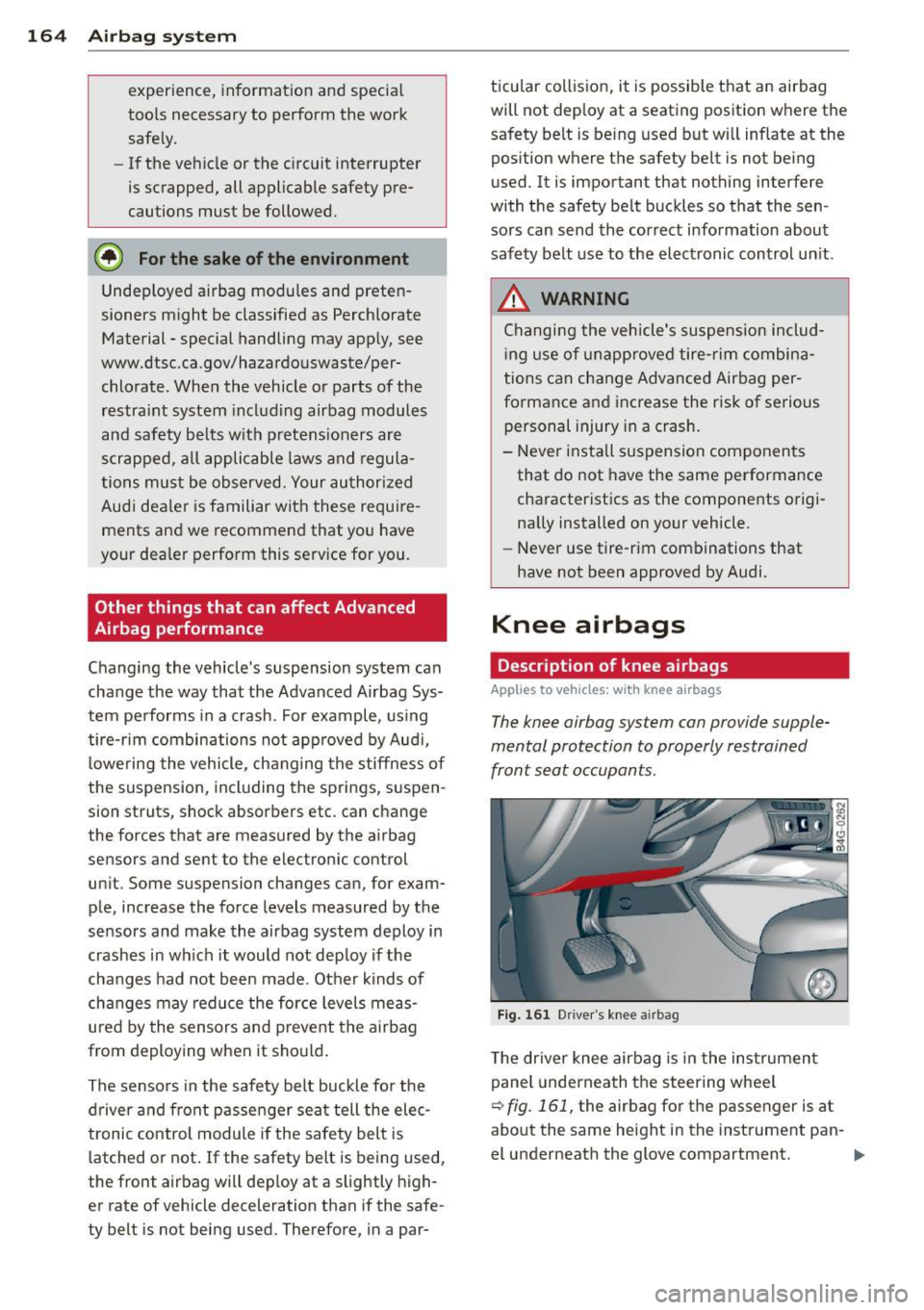
Fig . 1 61 Dr iver 's knee a irbag
T he dr iver knee airbag is in the ins trument
pane l underneath the steering wheel
~ fig. 161, the airbag for the passenger is at
about the same height in the instrument pan-
el underneat h the glove compartment. .,.
Page 168 of 304
166 Airbag system
How knee airbags work
Applies to vehicles: with knee airbags
The risk of injury to the leg area can be re
duced by fully inflated knee airbags.
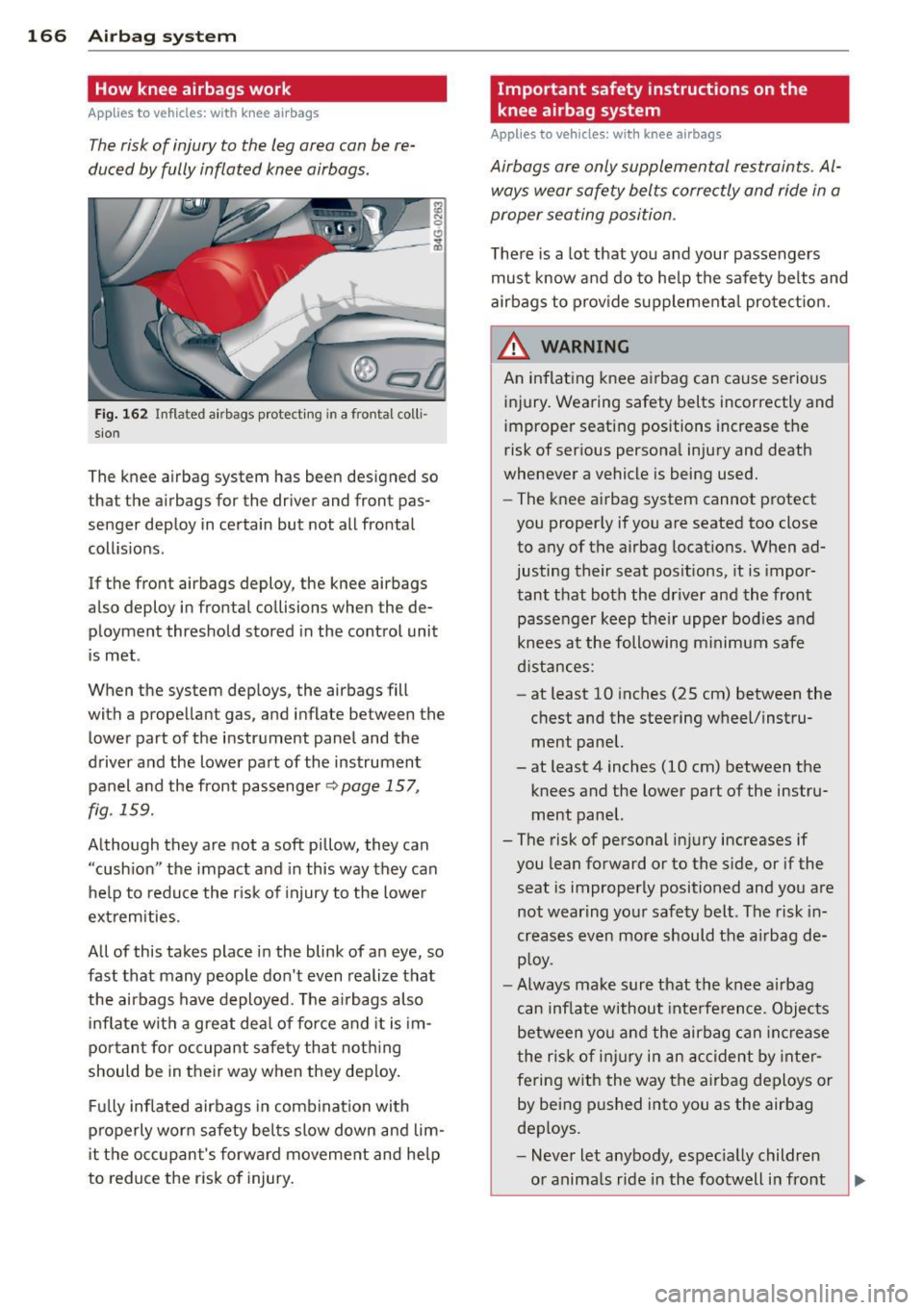
Fig. 162 Inflated airbags protecting in a frontal colli·
s io n
The knee airbag system has been designed so
that the a irbags for the driver and front pas
senger deploy in certain but not all frontal
collisions.
If the front airbags deploy, the knee airbags
a lso deploy in frontal collisions when the de
ployment threshold stored in the control unit
is met .
When the system deploys, the airbags fill
with a propellant gas, and inflate between the
lower part of the instrument panel and the
driver and the lower part of the instrument
panel and the front passenger
Q page 157,
fig . 159.
Although they are not a soft pillow, they can
"cush ion" the impact and in this way they can
help to reduce the risk of injury to the lower
extremities.
All of this takes place in the blink of an eye, so
fast that many people don't even realize that
the airbags have deployed . The airbags also
inflate with a great deal of force and it is im
portant for occupant safety that nothing
should be in their way when they deploy.
Fully inflated airbags in combination with
properly worn safety belts slow down and lim
it the occupant's forward movement and help
to reduce the risk of injury. Important safety instructions on the
knee airbag system
Applies
to vehicles: with knee airbags
Airbags are only supplemental restraints. Al
ways wear safety belts correctly and ride in a
proper seating position .
There is a lot that you and your passengers
must know and do to help the safety belts and
airbags to provide supplemental protection.
A WARNING
-An inflating knee airbag can cause serious injury. Wearing safety belts incorrectly and
improper seating positions increase the
risk of serious personal injury and death
whenever a vehicle is being used.
- The knee airbag system cannot protect
you properly if you are seated too close
to any of the airbag locations. When ad
justing their seat positions, it is impor
tant that both the driver and the front passenger keep their upper bodies and
knees at the following minimum safe
distances:
- at least 10 inches (25 cm) between the
chest and the steering wheel/instru
ment panel.
- at least 4 inches (10 cm) between the knees and the lower part of the instru
ment panel.
- The risk of personal injury increases if
you lean forward or to the side, or if the
seat is improperly positioned and you are
not wearing your safety belt . The risk in
creases even more should the airbag de
ploy .
- Always make sure that the knee airbag
can inflate without interference. Objects
between you and the airbag can increase
the risk of injury in an accident by inter
fering with the way the airbag deploys or
by being pushed into you as the airbag
deploys.
- Never let anybody, especially children
or animals ride in the footwell in front
Page 194 of 304
192 Audi pre sense
Audi pre sense
Preventative passenger
protection
A pp lies to veh icles: with Audi pre se nse
Audi pre sense can initiate steps to help pro
tect vehicle occupants in certain situations.
The functions described depend on equ ipment
installed in your vehicle:
Audi pre sense basic*
The following functions can be triggered in
certain driving situations:
- Tightening of the safety belts (for example,
during heavy braking) : the front safety belts
have reversible belt pretensioners. If a colli
sion does not occur, the safety belts loosen
slightly and are ready to be tightened again.
- Closing the windows and the sunroof*: the
windows and the sunroof* close leaving a
small open gap.
Audi pre sense basic functions can be trig
gered at speeds above 20 mph (30 km/h).
Vehicles with Aud i drive select*: the deploy
ment time is adapted in
Dynamic mode.
Audi pre sense front (vehicles with
adaptive cruise control*)
Audi pre sense front includes the functions in
Audi pre sense basic. In addition, within the
limits of the system, the likelihood of a colli
sion with the vehicle immediately ahead is al
so calculated . If the system senses an immi
nent collision the following functions can be
tr iggered :
- Braking guard c::>poge
90
-Tightening the safety be lts
- Closing the windows and the sunroof* (leav -
ing a small open gap)
Audi pre sense rear (vehicles with Audi
side assist*)
Audi pre sense rear includes the functions in
Audi pre sense basic. In addition, the likeli
hood of a rear-end collision with the vehicle
coming from behind is also calcu lated.
If the risk
of a co llision is detected, the following
functions can be triggered:
- Tig htening the safety belts
- Closing the windows and the sunroof* (leav-
ing a small open gap)
Audi pre sense plus*
Audi pre sense plus includes the functions in
Audi pre sense front and Audi pre sense rear.
Error message
Audi pre sense: not available
Preventative passenger protection is not avail
able. See your authorized Audi dealer immedi
ately to have the malfunction corrected.
_& WARNING
-=
Audi pre sense cannot overcome the laws
of physics. It cannot prevent a collision. Do
not let the increased safety provided
tempt you to take risks. This will increase
the r isk of a collis ion and serious personal
in juries .
- The sensors cannot always detect all ob
jects. This increases the risk of a colli
s10n.
-Aud i pre sense does not detect people or
an im als or objects that are crossing the
veh icle's path c::> page
84.
-The radar sensor's vis ion can be reduced
by heavy rain, ice, snow, heavy road sp ray
and reflections from guard rails, tunnel
entrances, etc. These and similar condi
tions can prevent vehicles from being ac
curately detected and in some cases they
may not be detected at all.
(D Note
The sensors can be displaced by impacts or
damage to the bumper, wheel housing and
underbody. This can affect the function of
the Audi pre sense system. Have your au
thorized Audi dealer check to make sure
that the system is working properly.
Page 196 of 304
194 Intelligent technology
Intelligent technology
Notice about data
recorded by vehicle
control modules
Your veh icle is not equipped with an Event Da
ta Recorde r (EDR), installed by some manu
facturers fo r the express p urpose of capturing
data for retrieval after an accident or crash
event . EDR's are sometimes ca lled "crash re
corders".
Some state laws restr ict the retr ieval or down
loading of data stored by EDR's that were in
stalled in a vehicle for the express purpose of retrieving data after an accident or crash
event without the owner's consent.
A lthough your vehicle is not equipped with an
EDR, it is equipped with a number of electron
ic control modules for various vehicle systems
such as, for examp le, eng ine function, em is
sion control, as well as for the airbags and
safety belts.
These electronic contro l modules also record
vehicle-re lated data during norma l vehicle op
erat ion for diagnostic and repa ir purposes.
The recording capacity of the electronic con
trol modules is limited to data (no sound is re
corded) and only a small amount of data is ac
tually recorded over a ve ry limited pe riod of
time and stored when a system fault or other
cond ition is sensed by a cont ro l unit. Some of
the data then stored may re late to vehicle
speed, direction, braking as we ll as restraint
system use and performance in the event of a
crash or other condit ion. Stored data can only
be read and downloaded with special equip
ment.
Electronic Stabilization
Control (ESC)
Description
ESC helps to improve road holding and vehicle
dynamics to help reduce the probability of
skidd ing and loss of vehicle control. It works
only when the eng ine is running. ESC detects certain difficult driving situat
ions, including
when the vehicle is beginning to spin (yaw)
out of control and he lps you to get the veh icle
back under control by se lectively braking the
wheels, and/or reducing eng ine power and
providing steer ing ass istance to he lp hold the
vehicle on the dr iver's intended course. The in
dicator light
G) in the inst rument cluster
blinks when ESC is ta king action to help you
control the veh icle.
ESC has limitations.
It is importa nt to remem
ber that ESC cannot overcome the laws of
physics. It wi ll not always be able to help out
under a ll cond it ions you may come up aga inst.
For example, ESC may not always be able to
help you master situations where there is a
s u dden change in the coefficient of friction of
the road surface. When there is a section of
dry road that is sudden ly covered w ith water,
slush or snow, ESC cannot perform the same
way it wou ld on the dry surface . If the ve hicle
hydroplanes (rides on a cushion of water in
stead of the road surface), ESC will not be
able to help you steer the vehicle because con
tact with the pavement has been in terrupted
and the vehicle cannot be braked or steered .
D uring fast cornering, particularly on winding
roads, ESC cannot always deal as effectively
with difficult driving situations than at lower
speeds. When towing a trailer, ESC is not able
to help you regain control as it would if you
were not tow ing a trailer.
Always adjust your speed and driving style to road, traffic and weather condit ions. ESC can
not override the vehicle's physical limits, in
crease the available tract ion, or keep a ve hicle
on the road if road departure is a result of
drive r inattent ion. Instead, ESC imp roves the
poss ibil ity of keeping the vehicle under con
trol and on the road during ex treme maneu
vers by using the d river's steering inputs to
help keep the vehicle going in the intended di
rection . If you are traveling at a speed that
ca uses you to run off the road before ESC can
provide any assistance, you may not experi
ence the benefits of ESC.
Page 197 of 304
ESC includes and/or works together with the
anti-lock brake system (ABS) , brake assist sys
tem, anti -slip regulation (ASR) , e lectronic dif
ferential lock ( EDL) and e lectronic interax le
d ifferential lock* . ESC is swi tched on all the
time. In certain situat ions when you need less
traction , you can switch off ASR by pressing
the button
[ru <::;> page 196, fig . 178 . Be sure
to switch ASR on again when you no longer
n eed less t raction.
Anti-lock br aking s ystem (ABS)
ABS prevents the wheels from locking up
when braking . The veh icle can still be steered
even during hard braking . Apply steady pres
sure to the brake pedal. Do not pump the ped
a l. A puls ing in the bra ke peda l indicates that
the system is he lping you to brake the vehicle.
Brake assist system
The brake assist system can decrease brak ing
d istance.
It increases braking power when the
driver p resses the brake pedal quic kly in emer
gency situations. You must press and ho ld the
b rake peda l until the situation is over . In
vehicles with adaptive cruise control* , the
brake assist system is more sensitive if the
d istance detected to the vehicle ahead is too
small.
Anti -slip regulation (ASR )
ASR reduces engine power when the d rive
wheels begin to spin and adapts the force to
the road condit ions. This makes it eas ie r to
s tart, accelerate and drive up hills.
El ectronic diffe rential lock (EDL )
The ED L brakes wheels that are spinn ing and
transfers the drive powe r to the other drive
wheel or whee ls if the vehicle is equipped with
all-whee l drive*. This function is available up
t o about 75 mph (120 km/h).
I n extreme cases , ED L automatica lly switches
off to help keep the brake on the braked whee l
from overheating.
E DL wi ll switch on again au
tomatically when conditions have returned to normal.
Int ellig ent technolog y 195
Electronic intera xle differential l ock */
se le ctive wheel torque cont rol *
The electronic interaxle differential lock (front
whee l drive) or the se lective whee l torque
cont rol (all-wheel dr ive) operates when dr iv
ing through curves . The front wheel on the in
s ide of the curve or both wheels on the inside
of the curve are braked selectively as needed .
T his min imizes sliding in the front wheels and
allows for more p recise d riving through
curves . T he applicable system may no t acti
vate when driv ing in wet or snowy conditions.
A WARNING
-- ESC, ABS, ASR, EDL and the electronic in
teraxle diffe rential lock function* cannot
overcome the laws of physics. This is es
pecially important on slippery or wet
roads . If the systems begin acting to sta
bilize your veh icle, you should immedi
ately change yo ur speed to match the
road and traffic cond itions. Do not let
the increased safety provided by these
systems tempt you to take risks. Do ing
so will increase the r isk o f a loss of vehi
cle control, collision and serious personal inju ries.
-Always adapt your speed to road, traffic and weather conditions . The risk of los
ing control of the vehicle increases when
driving too fast, espec ially through
curves and on slippery or wet roads, and
when dr iv ing too close to vehicles up
ahead . ESC, ABS, the brake assist sys
tem, EDL, ASR and the e lectronic inte r
axle d iffe ren tial lock function* cannot
preven t coll is ions.
- Always accelerate with spec ial care on
even, smooth surfaces su ch as those that
are wet or covered with ice and snow.
The drive wheels can spin even with
these assistance systems that cannot al
ways he lp to red uce the risk of loss of ve-
hicle control. .,.
•
•
Page 198 of 304
196 Intelligent technology
@ Tips
-ABS and ASR on ly work correctly when
all four wheels are equipped with identi
ca l tires. Different tire sizes can lead to a
reduct ion in engine power.
- You may hear noises when the systems
described are working.
Switching on and off
- If the indicator light DJ or til] (USA
mode ls)/ [I] (Canada models) appears,
there may be a malfunction
¢ page 20 ,
¢ page 19.
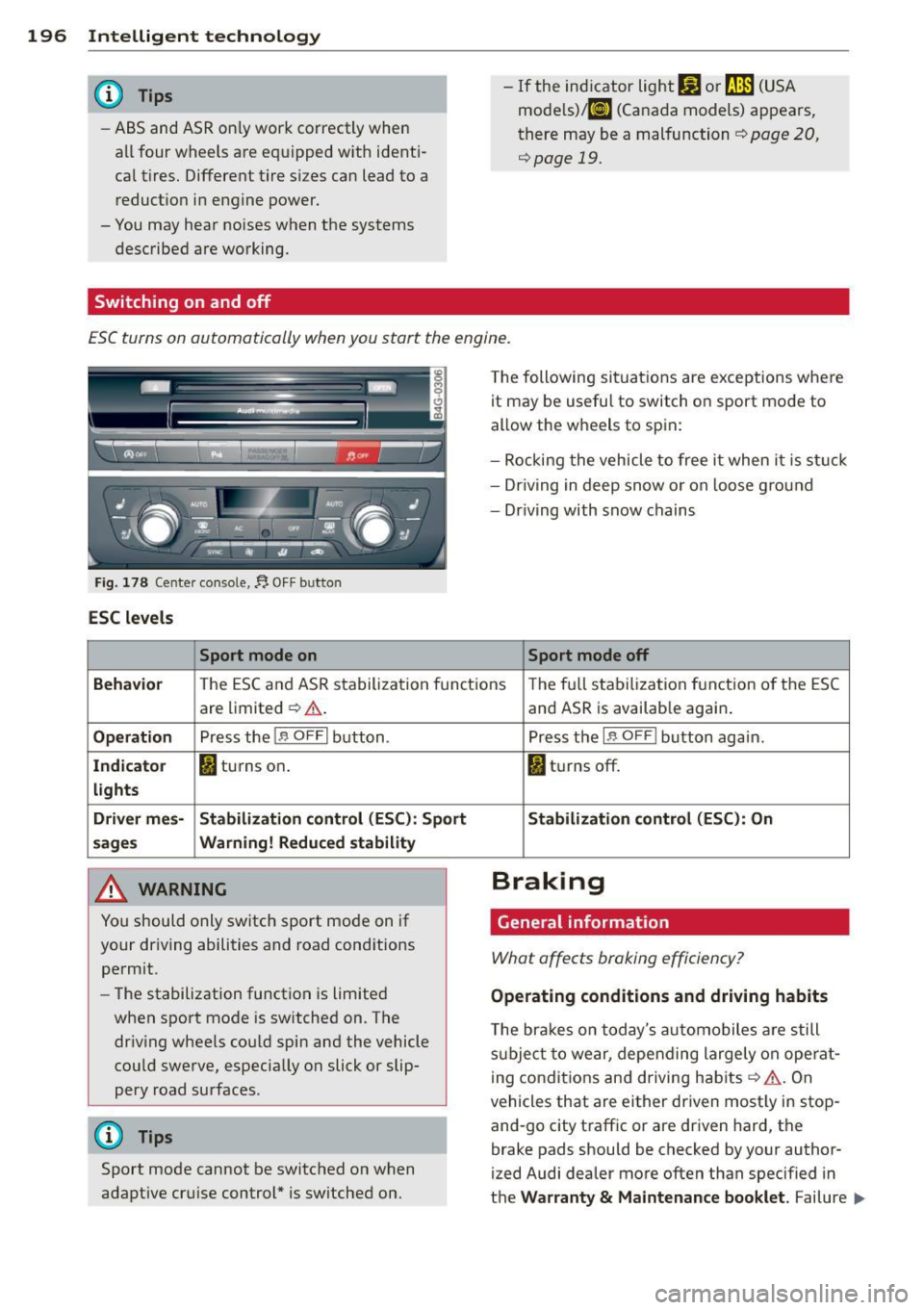
ESC turns on automatically when you start the engine.
Fig. 178 Ce nter co ns ole, f). O FF bu tton
ESC levels
Sport mode on
The following situations are exceptions where
it may be usefu l to switch on sport mode to
allow the wheels to spin:
- Rocking the vehicle to free it when it i s st uck
- Dr iving in deep snow or on loose g round
- Driving with snow chains
Sport mode off
Beha vio r
The ESC a nd ASR stabilization fun ct ions The fu ll stabilization function o f the ESC
are limited ¢.&, .
Op eration Pr ess the 1.$ O FFI button .
Indicato r I) turns on.
lights
Driv er mes- Stabiliza tion control (ESC ): Sport
sage s Warning! R educed stability
,8. WARNING
You should only switch sport mode on if
your driving abilities and road cond itions
permit.
- The stabilization function is limited
when sport mode is sw itched on. The
dr iv ing whee ls could spin and the vehicle
cou ld swe rve, especially on slick or slip
pery road surfaces .
{D) Tips
Sport mode cannot be switched on when
adapt ive cr uise control* is switched on.
-
and ASR is availab le again .
Press the
1 .$ O FF I button again.
fl tu rns off.
Stabilization c ontrol (ESC ): On
Braking
General information
What affects braking efficiency?
Operating conditions and driving habits
The bra kes on today's automobiles a re still
s u bje ct to wear, depending largely on ope rat
i ng conditions and driving hab its
¢ A . On
vehicles that are either driven most ly in stop
and-go city traff ic or are driven hard, the
brake pads should be checked by your author
ized Audi dealer more often than specified in
the
Warranty & Maintenance booklet . Failure .,,_
Page 199 of 304
to have your brake pads inspected can result
in reduced brake performance.
On steep slopes, you should use the brak ing
effect of the engine. This way, yo u prevent un
necessary wea r on the brake system . If you
must use your brakes, do not hold the brakes
down continuously. Pump the brakes at inter
vals.
Moi stu re or r oad salt
Under certain conditions, for examp le, when
driving through water or very heavy rain, or
even after washing your vehicle , the braking
effect can be reduced due to moisture (or in
free zing conditions ice) on the brake pads. A
f ew care ful brake applications should dry off
the brake pads or remove any ice coatings.
When you a re d riving at higher speeds with
the w indshield wipers on, the brake pads will
briefly touch the brake d iscs in regular inter
vals so as to improve reaction t ime when brak
ing on wet surfaces . You the driver will not no
tice anything .
The effectiveness of the brakes can be reduced
when the vehicle is dr iven on a salt -covered
road and the brakes are not used . Here too ,
you should clean off accumu lated salt coat ing
from brake discs and pads with a few carefu l
appl ications o f the brake ¢,&. .
Cor ro sion
There may be a tendency for dirt to build up
on the brake pads and corrosion to form on
the discs if the car is not dr iven regularly or
on ly for short trips with l ittle use of the
brakes .
If the brakes are not used frequently , or if cor
rosion has fo rmed on the discs, it is advisable
to clean off the pads and discs by brak ing
firm ly a few times from a moderately h igh
speed ¢.&. .
F a ults in the brake system
If you should notice a
sudden increase in
b rake pedal travel, then one of the two bra ke
circu its may have failed¢,&. .
Int ellig ent technolog y 197
Low br ake fluid lev el
Malfunctions can occu r in the brake system if
the b rake fluid level is too low. The brake fluid
level is monitored electronica lly.
Brake booster
T he brake booster wo rks with vacuum pres
s ur e which is created only when the engine is
runn ing ¢.&. .
Brake lining we ar statu s
Brake lining wear may be checked by visual in
spect ion of the condition of the brake pads
th rough the open ings in the wheel. If neces
sary, the wheel may be removed for th is in
spection ¢
page 263, Changing a wheel.
A WARNING
-=
-You should perform braking maneuvers
for the purpose of cleaning the brake
system only if road conditions permit.
Other road users must not be put at risk -
you may cause an accident!
- Before descend ing a steep grade, reduce
speed and sh ift transmission into a lower
gear or lower dr iving range. Do not ride
the brakes or hold the pedal down too
long or too often . Th is could cause the
brakes to get hot and diminish braking
efficiency.
- Do not "ride the brakes" by rest ing your
foot on the pedal when you do not intend
to b rake. This may cause the brakes to
overheat, premature wear and increased
stopping distance.
- Unde r ce rtain cl imatic and operat ing
conditions such as passing thro ugh wa
ter, driving in heavy rain or after washing
the vehicle, the effectiveness of the brakes can be reduced . In winter, ice can
accumulate on the brake pads, lin ings,
discs and drums . Carefully app ly brakes
for a test . Brakes will dry and ice coat
ings w ill be cleaned off after a few care
fu l brake applicat ions.
- Driving for an extended period of time on
salt-covered roads without using your brakes can a lso affect bra king efficiency. ..,.
•
•
Page 200 of 304
198 Intelligent technology
Clean off accumulated salt coating from
brake discs and pads with a few caref ul
brake applications.
- If you damage the front spoiler, or if you
install a different spoiler, be sure the air
flow to the front brakes is not obstruct ed . Otherwise the brake system could
overheat reducing the effectiveness of
the ent ire brake system.
- Failure of one brake c ircuit will impair
the braking capability resulting in an in creased stopp ing distan ce. Avoid driv ing
the vehicle a nd have it towed to t he near
est Aud i dea ler o r qualified workshop.
- Never let the vehicle rol l to a stop w ith
the engine shu t off.
- If the brake booster is not working, the
brake pedal must be pressed conside ra
bly harder to make up for the lac k of
booster assistance.
Electro-mechanical
power assist
The electro-mechanical power assist helps
the driver when steering.
Power steering adapts electronically based on
the vehicle speed.
Ind icator light s and m essages
• Steerin g defecti ve! Stop the vehicle
If th is indicator light turns on and stays on
and this message appears, t he power steering
may have fa iled.
Do
not cont inue driving . See you r autho rized
Aud i dealer or other qualified repa ir facility
fo r assistance.
l~ ij Ste ering: Sy stem malfunction ! You m ay
cont inue dri ving
If the indicator light turns on and the mes
sage appears, the steer ing may be more diffi
cult to move or more sens itive than usual.
Drive s low ly to your authorized Audi dealer or
qua lified workshop to have the malfunction
corrected.
(D Tips
If the . or
£'I' ij indicator light on ly stays
on for a short t ime, yo u may continue dr iv
i ng.
Driving with your
quattro
App lies to vehicles: wit h all-w hee l drive
With a/I-wheel drive, all four wheels ore driv
en.
General information
With all Wheel Drive, power is distributed to all four wheels. This happens automatically
depend ing on your driving style and the road
condit ions at the time. See also ¢
page 194.
With the sport diffe rent ia l*, power distribu
t ion to the rear wheels is variable and can be
adjusted with Audi drive select*¢
page 100.
Always read and follow safety precautions
¢ &.
Winter tires
When dr iving in the win ter, yo ur vehicle wi th
all-wheel drive has an advantage, eve n with
regular tires. In winter road conditions it may
be advisable to mount winter tires (or all-sea
son tires) for improved driveability and brak
ing : these tires must be mounted on
all fou r
w heel s.
See also¢ page 255, Winter tires .
Tire chain s
Where tire chains are mandatory on certain roads, this norma lly also app lies to ve hicles
with all-wheel drive¢
page 256, Snow
chains .
Replacing wheel s/tire s
Vehicles with a ll-wheel drive must always
have tires of the same size. A lso avoid tires
with different tread depths . For detai ls see
page ¢
page 251, New tires and replacing
tires and wheels.
Off -Road dr iving?
Your Audi does not have enough gro und clea r-
ance to be used as an off-road vehicle .
It is jll,,
Page 201 of 304
therefore best to avoid rough tracks and un
even terrain as much as possible . Also refer to
<=:> page 203.
A WARNING
Always adjust your driving to road and traf
fic conditions. Do not let the extra safety
afforded by all-wheel dr ive tempt you into
taking extra risks.
- Although the all-wheel dr ive is very ef
fective, a lways remember that braking
capacity is limited by t ire traction . Yo u
should therefore not dr ive at excessive
speeds on icy or slippery road su rfaces.
- On wet road su rfaces, be careful not to
dr ive too fast because t he fro nt wheels
c ou ld beg in to s lide on top of the wa ter
(aq uaplaning). If this sho uld occ ur, you
will have no warning from a sudden in
crease in engine speed as with a front
wheel drive vehicle. A lways drive at
speeds wh ich are suited to the road con
ditions -risk of crash.
Energy management
Starting ability is optimized
Energy management controls the distribution
of electrical energy and thus optimi zes the
availability of electrical energy for starting the engine .
If a veh icle wit h a conventional energy system
i s not d riven for a lo ng pe riod o f time, the bat
tery is discha rged by idling cu rrent co nsu mers
(e .g. immobilizer) . In ce rtain c ircumstances it
can result in there being insufficient ene rgy
avai lab le to start the engine .
I n tell igen t energy m anagemen t in your veh i
cle hand les the d istribu tion of electrical ener
gy . Starting ab ility is marked ly imp roved and
the life of the battery is extended.
B asically , energy management consists o f
battery diagnos is , idling current manage
ment
and dynamic ene rgy man agement.
Int ellig ent technolog y 199
Battery diagnosis
Battery diagnosis continuously de termines
the state of the battery . Sensors de termine
batte ry voltage, battery current and battery
temperature . This determines the current
state of charge and the power of the battery.
Idling current management
Idling curren t management reduces energy
consumption while the vehi cle is standing.
With the ignition switched off, it controls the
energy supply to the various electrica l compo
nents. Data from battery diagnos is is cons id
ered .
Depending on the battery's state of charge,
i ndivid ua l cons umers are g radually turned off
to prevent excessive discharge of the battery
and thus maintain starting capability .
Dynamic energy management
While the vehicle is being driven, dynamic en
ergy ma nagement distrib utes the energy ge n
erated accord ing to the needs of the individ u
al components . It regulates consum ption, so
that more electrical energy is not being used
than is being generated and ensures an opti
mal state of cha rge for the battery .
(D Tips
-But even ene rgy management cannot
negate the limits of physics. Consider
t hat the powe r and life of a battery are
limited .
- If start ing ability is threatened , the indi
cator light (•) appears
c::> page 17 .
What you should know
The highest priority is given to maintaining
starting capability.
The battery is severely taxed in short-distance
driv ing, in city traff ic and during the cold time
of year . Abundant electrical energy is re -
quired, but on ly a little is generated . It is also ..,. •
•