infotainment AUDI A6 2016 User Guide
[x] Cancel search | Manufacturer: AUDI, Model Year: 2016, Model line: A6, Model: AUDI A6 2016Pages: 294, PDF Size: 73.88 MB
Page 74 of 294
Warm and cold
Basic settings
Applies to vehicles: with four-zone automatic climate control
The climate control system basic settings are ac
cessed in the Infotainment system.
• Se lect : the ICARI function button> (Car)* Sys-
tems
control button > AC.
Rear seat settings
When this function is selected, all settings for
the rea r can be adjusted through the climate con
trol system in the cockpit . The climate control
system sett ings cannot be adjusted in the rear
seat at the same time. Th is function switches
off
after a certa in period of time or when one of the
controls in the cockpit is pressed .
Recirculation mode
The sensit ivity level of the automatic recircula
tion mode can be set at various levels from
Off to
Sensitive . Recirculation mode is controlled auto
matically .
If the windows fog up, press the
I@ FRONT I button .
Footwell temperature
You can adjust the footwell temperature so that
it is coo ler or warmer.
Auxiliary heater*
I n vehicles with diesel engines*, the auxiliary
heate r helps to warm the ve hicle interio r more
quickly . The auxiliary heater is controlled auto
matically in the
Auto sett ing .
Steering wheel heating
Applies to veh icles: w ith heate d steering wheel
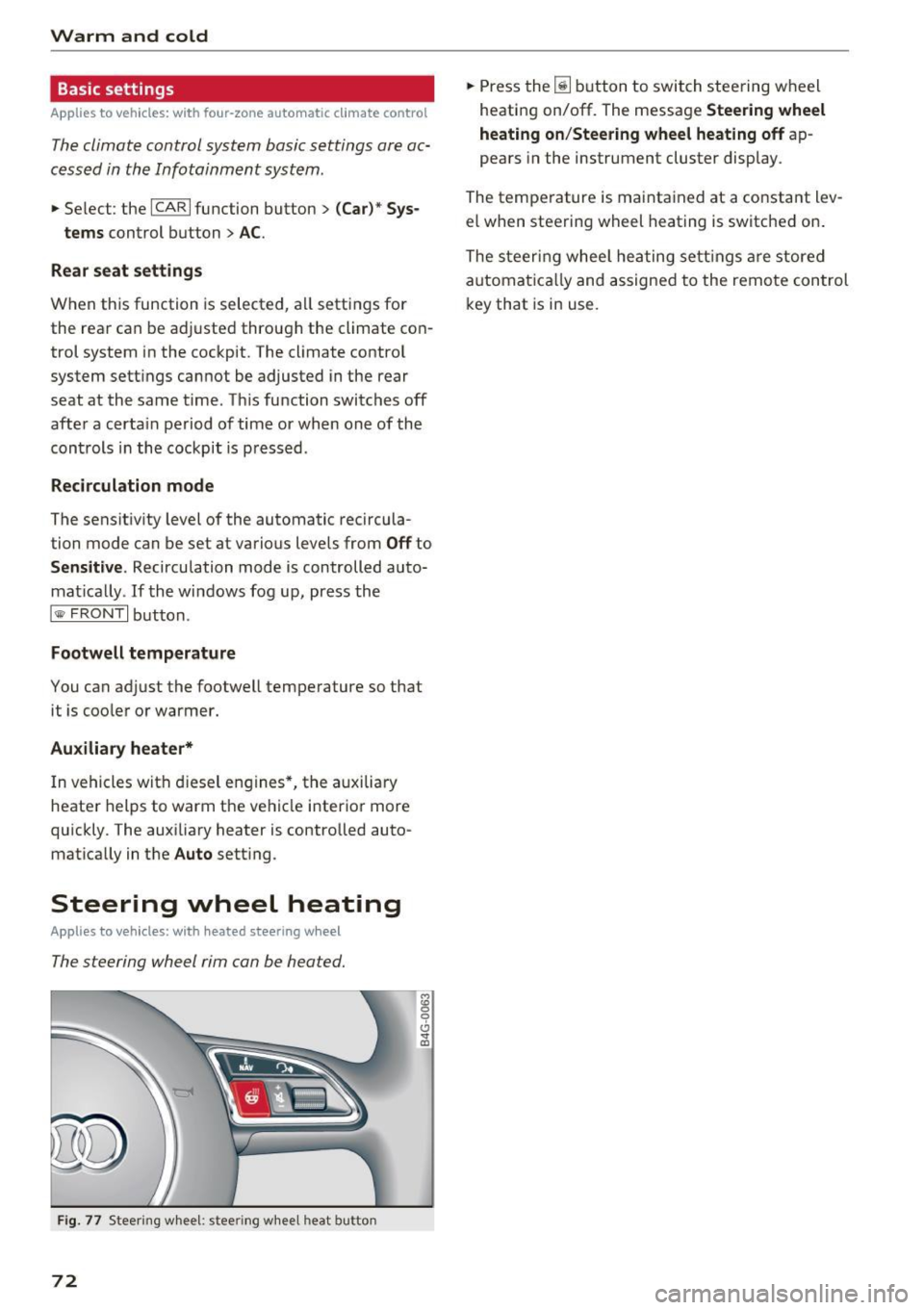
The steering wheel rim can be heated.
Fig. 77 Steer ing whee l: s tee ring w hee l h eat button
72
M :g 0
t!i
"' m
• Press the [ii button to switch steering wheel
heating on/off. The message
Steering wheel
heating on /Steering wheel heating off
ap
pears in the instrument cluster display .
The temperature is mai nta ined at a constant lev
el when steering wheel heating is switched on .
The steering wheel heating settings are stored
automatica lly and assigned to the remote control
key that is in use.
Page 76 of 294
Driving
There must be at least 10 inches (25 cm) be
tween your chest and the center of the steering
wheel. If you cannot sit more than 10 inches (25
cm) from the steer ing wheel, see if adaptive
equipment is available to help you reach the ped
als and increase the distance from the steering
wheel.
For detai led information on how to adjust the
driver's seat, see
¢ page 54 .
In vehicles with the memory function*, the steer
ing column sett ings are stored together with the
seat position.
A WARNING
Improper use of steer ing whee l adjustment
and improper seating position can cause ser i
ous pe rsonal injury.
- Adjust the steering wheel column only when
the vehicle is not moving to prevent loss of
vehicle control.
- Adjust the driver's seat or steering wheel so
that there is a minimum of 10 inches (25
cm) between your chest and the steer ing
wheel
r::.> page 126, fig. 143. If you cannot
mainta in this min imum distance, the airbag
system cannot protect you properly.
- If phys ica l limitations prevent you from sit
t ing 10 inches (25 cm) or more from the
steering wheel , check with your authorized
Audi dealer to see if adaptive equ ipment is
available.
- If the steering wheel is aligned with your
face, the supp lemental driver's airbag can
not provide as m uch protection in an acci
dent. Always make sure that the steering
wheel is aligned w ith your chest.
- Always hold the steer ing whee l with your
hands at the 9 o'clock and 3 o'clock posi
tions to reduce the risk of personal injury if
the driver's airbag deploys .
- Never hold the steer ing wheel at the 12
o'clock posit ion or w ith your hands inside
the steering wheel rim or on the steering
wheel hub . Holding the steer ing whee l the
wrong way can cause ser ious injuries to the
hands, arms and head if the driver's airbag
deploys.
74
-
Easy seat entry
Applies to vehicles: with power steering wheel adjustment
Easy seat entry makes it easier to enter and exit
the vehicle by adjusting the steering column au
tomatically .
.,. In the Infotainment system, selec t: the ICARI
function button > (Car )* Systems control but
ton
> Vehicle settings > Seats > Driver's seat>
Easy seat entry> On.
When easy seat entry is switched on, the steer ing
column goes back up into the park position when
the ignit ion is switched off . After enter ing the ve
hicle, the steering col umn returns to t he sto red
pos ition once the ign it ion is swi tched on.
Starting and stopping
the engine
Starting the engine
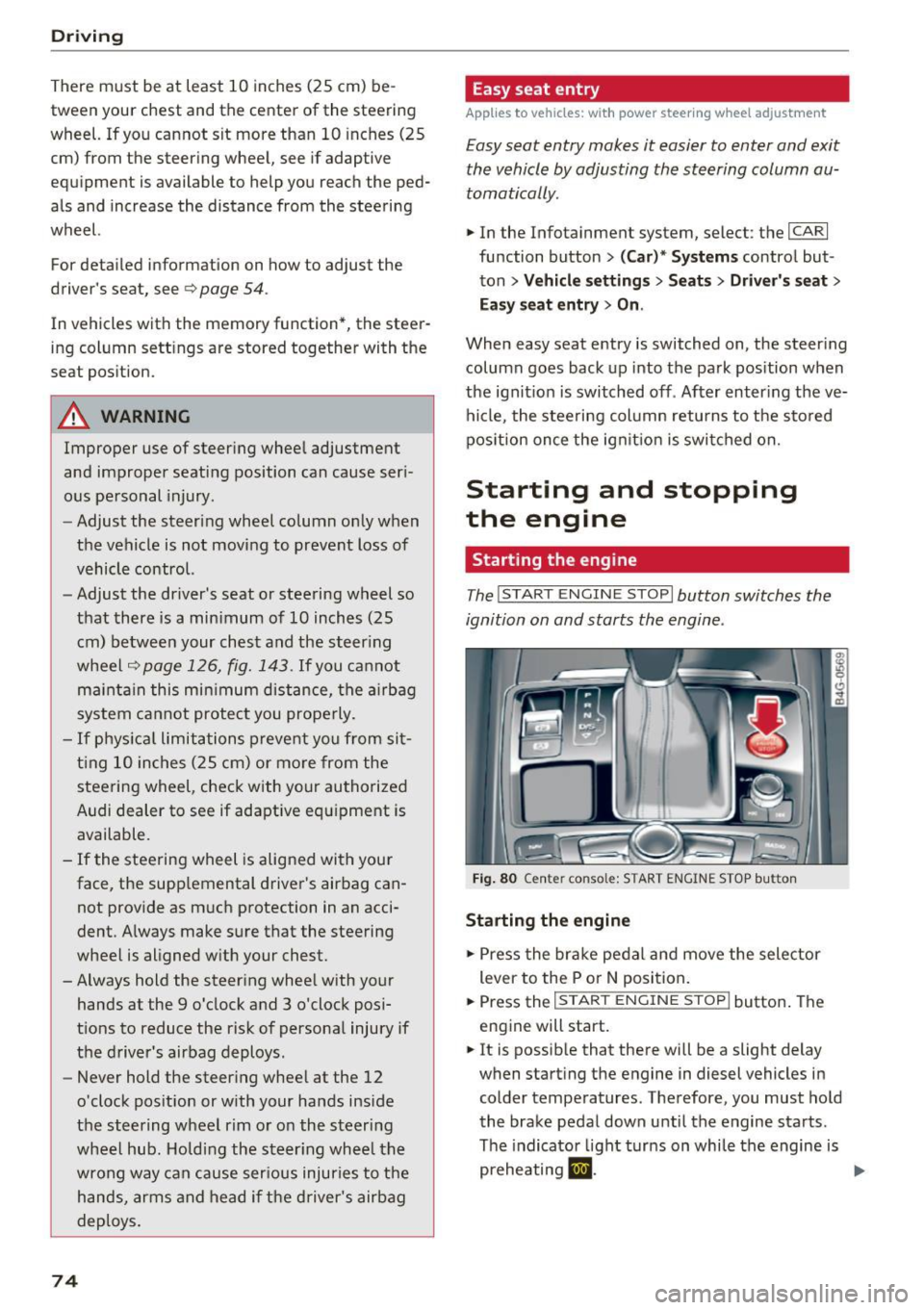
The I START ENGINE STOP I button switches the
ignition on and starts the engine .
Fig. 80 Cente r conso le: S TART ENGINE STOP b utt on
Starting the engine
.,. Press the brake pedal and move the selector
lever to the P or
N position.
... Press the
!STAR T ENGINE ST OP ! button. The
engine will start.
.,. It is possible that there will be a slight delay
when starting the engine in diesel vehicles in colder temperatures . Therefore, you must hold
the brake pedal down until the engine starts.
The indicator light turns on while the engine is
preheating
1,1 . ..,.
Page 83 of 294
..... N
0 CJ '
Switching the Start-Stop-System on/off
manually
Applies to vehicles: with Start-Stop-System
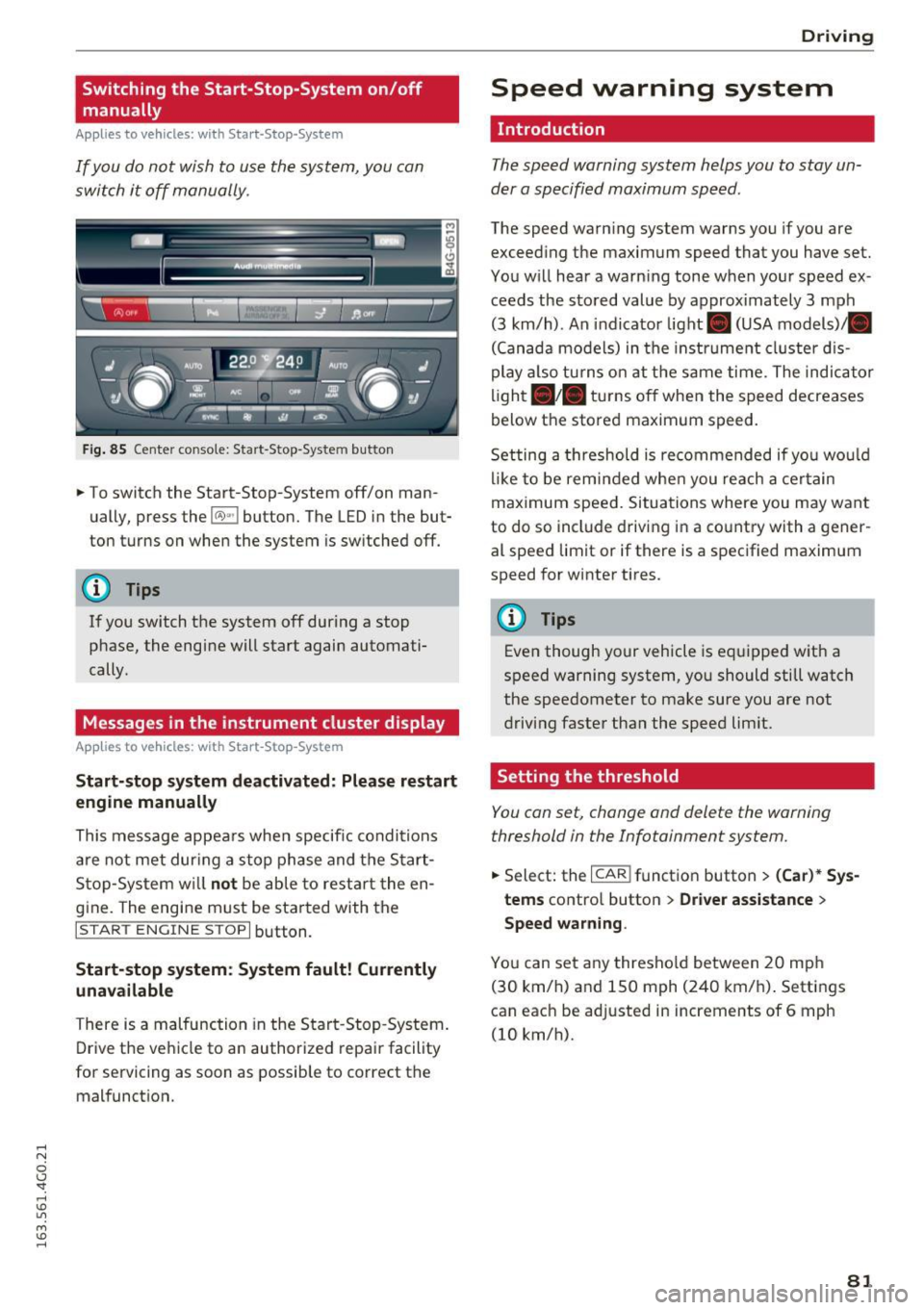
If you do not wish to use the system, you can
switch it off manually .
Fig. 85 Center co nso le: Start -S top -Syste m but ton
.. To switch the Start -Stop-System off/on man
ually, press the
l(A)••I button. The L ED in the but
ton turns on when the system is sw itched off.
@ Tips
I f you switch the system off during a stop
phase, the engine will start again automati
cally.
Messages in the instrument cluster display
Applies to vehicles: with Start-Stop-Sys tem
Start-stop system deactivated: Please restart
engine manually
This message appea rs when specifi c condi tions
are not met dur ing a stop phase and t he S tart
S top -Sy stem w ill
not be able to resta rt the en
gine. The engine must be sta rted with the
I START ENGINE ST OPI button.
Start-stop system : System fault! Currently
unavailable
There is a mal function in the Start -Stop -System .
Drive the ve hicl e to an authorized repa ir facility
for servicing as soon as possible to correct the malfunct ion .
D rivi ng
Speed warning system
Introduction
The speed warning system helps you to stay un
der a specified maximum speed.
The speed warn ing system warns you if you are
exceed ing the maximum speed that you have set.
You will hear a warn ing tone when your speed ex
ceeds the s tored value by approx imately 3 mph
(3 km/h) . An indicator light . (USA models)/ .
(Canada models) in the instrume nt cl uste r d is
play a lso tu rns on at t he same time. The indicator
lig ht •• tur ns off when the speed decreases
below the stored maximum speed.
Setting a th reshold is recommended if yo u wo uld
lik e to be rem inded whe n you reach a cer tain
ma ximum speed. Situations where you may want
to do so incl ude driving in a co untry with a gener
al speed limit or if there is a spec ified maximum
speed for winter tires.
@ Tips
Eve n though your vehicle is eq uipped w ith a
speed warning system, yo u should still watch
the speedometer to make sure you are not
driving faster than the speed lim it.
Setting the threshold
You can set, change and delete the warning
threshold in the Infotainment system.
.. Select: the I CAR ! funct ion button > (Car) * Sys
tems
contro l button > Driver as sistance >
Speed warning .
You can set a ny thresho ld between 20 mp h
(30 km/h) and 150 mph (240 km/ h). Settings
can eac h be adjusted in increments of 6 mph
(10 km/h).
81
Page 92 of 294
Audi adaptive cruise control and braking guard
Audi braking guard
Description
Applies to vehicles: w ith Audi adaptive cruise co ntro l
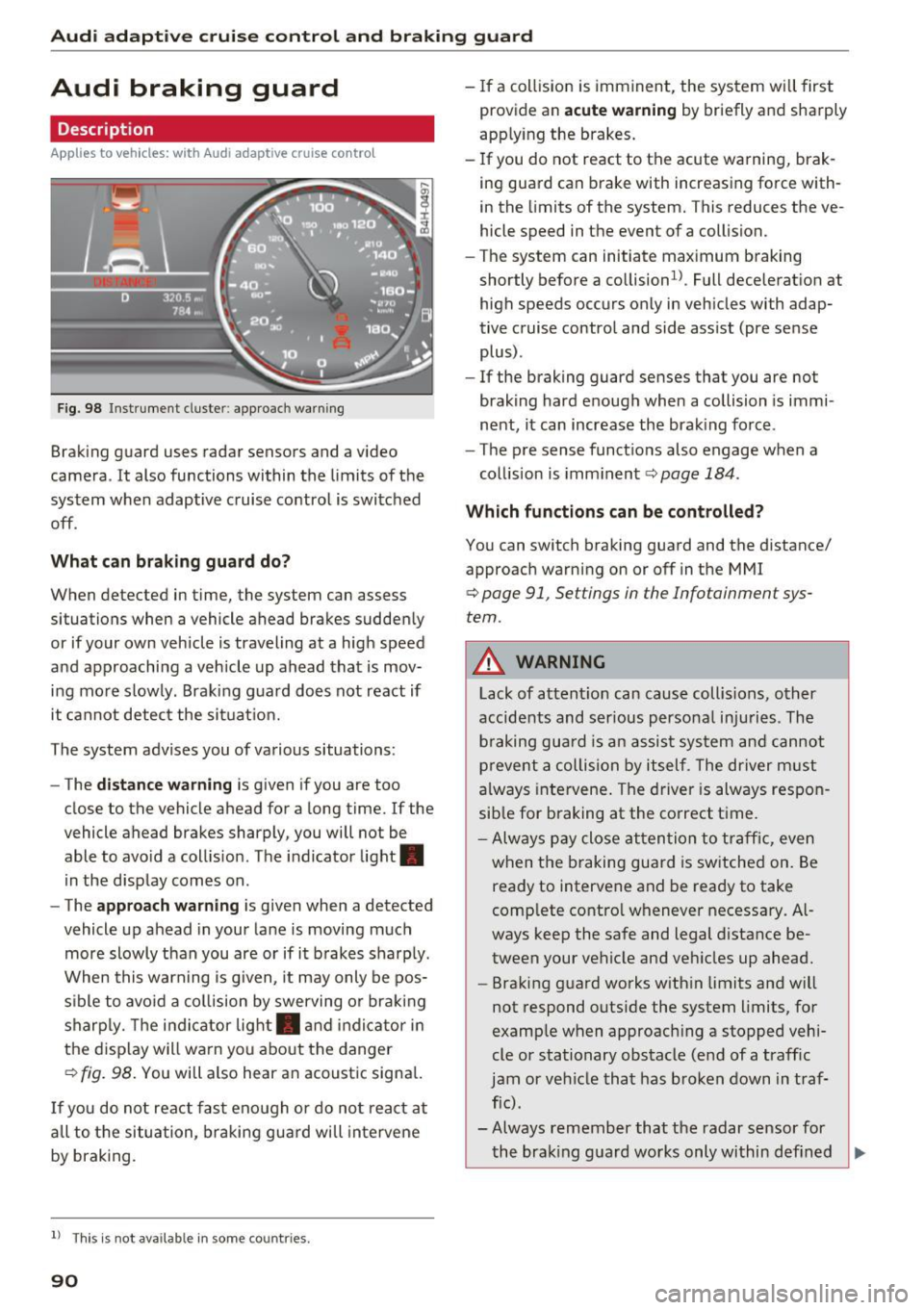
Fig. 98 Instrument cluster: approach warning
Braking guard uses radar sensors and a video
camera . It also functions within the limits of the
system when adaptive cruise control is switched
off .
What can braking guard do?
When detected in time, the system can assess
situations when a vehicle ahead brakes suddenly
or if your own vehicle is traveling at a high speed
and approaching a vehicle up ahead that is mov
ing more slowly . Braking guard does not react if
it cannot detect the situat ion.
The system advises you of various situations:
- The
distance warning is given if you are too
close to the vehicle ahead for a long time.
If the
vehicle ahead brakes sharply, you will not be
able to avo id a coll is ion. The indicator light.
in the display comes on .
- The
approach warning is given when a detected
vehicle up ahead in your lane is moving much
more slowly than you are or if it brakes sharply .
When this warning is g iven, it may only be pos
sible to avo id a collision by swerving or braking
sharp ly. Th e indicator light. and indicator in
the display will warn you about the danger
qfig. 98. You will also hear an acoustic signal.
If you do not react fast enough or do not react at
all to t he situation, braking guard will intervene
by braking.
l ) Thi s is not ava ilab le in some co un tri es .
90
-If a collision is imminent, the system will first
provide an
acute warning by briefly and sharply
app lying the brakes.
- If you do not react to the acute warning, brak
ing guard can brake with increasing force with
in the limits of the system. This reduces the ve
hicle speed in the event of a collision.
- The system can initiate maximum braking
shortly before a co llision
1
) . Full deceleration at
high speeds occurs only in vehicles with adap
tive cruise control and side assist (pre sense
plus) .
- If the braking guard senses that you are not
braking hard enough when a collision is immi
nent, it can increase the braking force .
- The pre sense functions also engage when a
collision is imminent
qpage 184.
Which functions can be controlled?
You can switch braking guard and the distance/
approach warning on or off in the MMI
q page 91, Settings in the Infotainment sys
tem .
A WARNING
Lack of attent ion can cause collisions, other
accidents and serious personal injuries . The
b ra king guard is an assist system and cannot
prevent a collision by itself. The driver must
always intervene . The driver is always respon
sib le for braking at the correct time .
- Always pay close atten tion to traffic, even
when the braking guard is switched on. Be
ready to intervene and be ready to take
comp lete contro l whenever necessary. Al
ways keep the safe and legal distance be
tween your vehicle and vehicles up ahead.
- Braking guard works with in limits and will
not respond outside the system limits, for
example when approaching a stopped vehi
cle or stationary obstacle (end of a traffic
jam or vehicle that has broken down in traf
fic) .
- Always remember that the radar sensor for
-
the brak ing guard works only within def ined Ill>
Page 93 of 294
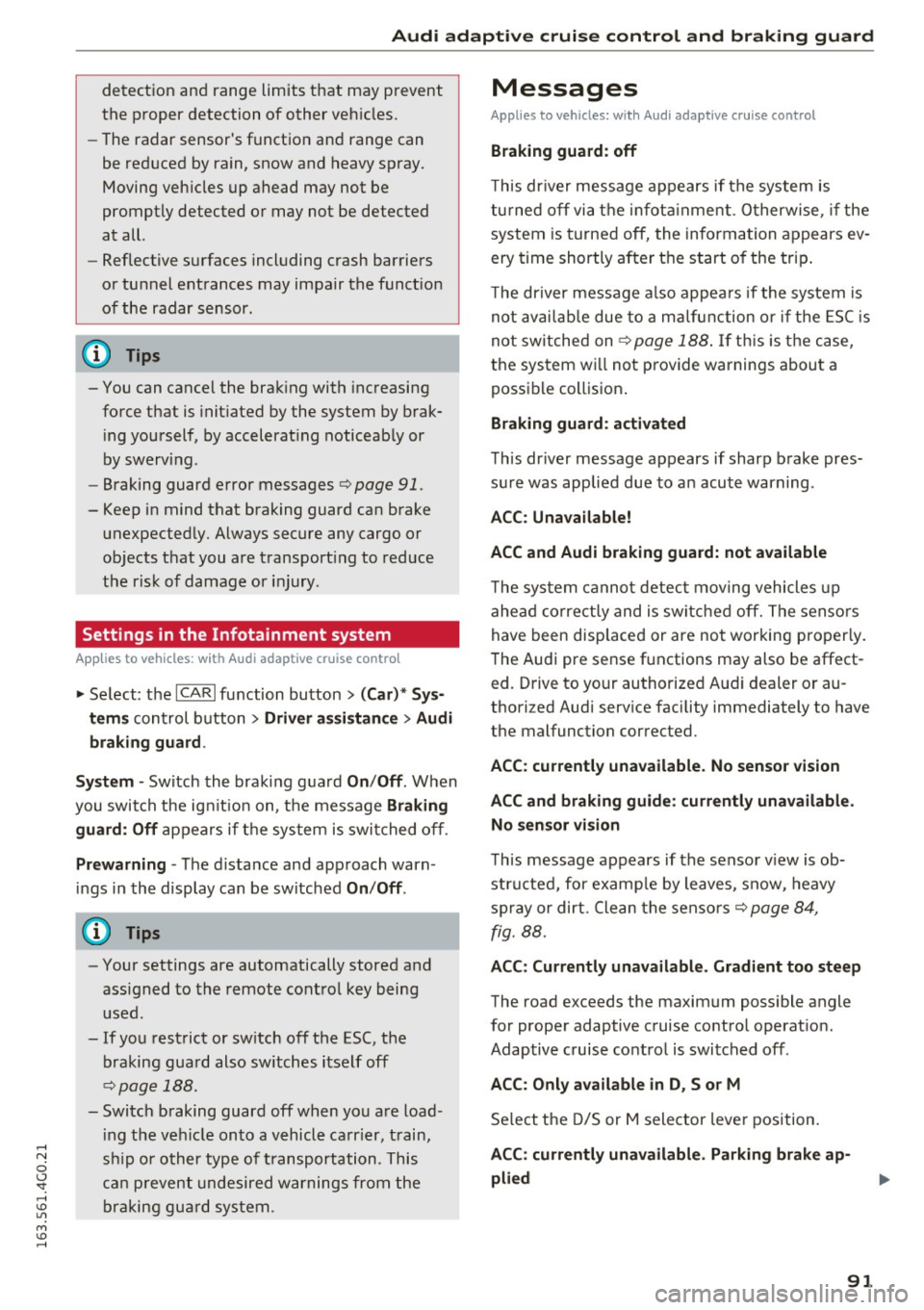
Audi adapt ive cruis e control and braking gua rd
de tect ion and range limits t hat may prevent
the proper detection of other veh icles.
- The radar sensor's function and range can
be reduced by rain, snow and heavy spray.
Moving veh icles up ahead may not be
promptly detected or may not be detected
at all .
- Reflective surfaces including crash barriers
or tunnel entrances may impair the funct ion
of the radar sensor.
(D Tips
- You can cancel the brak ing with increasing
force that is init iated by the system by b rak
i ng yourself, by accelerat ing noticeab ly or
by swerving .
- Braking guard error messages ¢
page 91.
-Keep in mind that braking guard can brake
unexpected ly. Always secure any cargo or
objects that you are transport ing to reduce
the risk of damage or injury .
Settings in the Infotainment system
Appl ies to vehicles: w ith Audi a daptive cruise co ntro l
~ Select: t he ICARI function button > (Car )* Sys
tems
con trol b utton > Driver assi stan ce > Audi
braking guard .
S ys tem -
Switch the braking guard On/ Off. When
you swit ch the ig nitio n on, the message
Brak ing
guard: Off
appears if the system is swi tched off .
Prewarning -The d istance and app roach warn
in gs i n the display can be switched
On/ Off.
(!) Tips
-Your settings are automatically stored and
ass igned to the remote cont rol key being
used.
- If you rest rict or sw itch off the ESC, the
braking gua rd also sw itches i tself off
¢ page 188 .
- Switch braking guard off when yo u are load
i ng t he ve hicle on to a vehicle ca rr ier, t rain,
s hi p or other type of transportation . This
c a n prevent undesired warnings from the
br aking gua rd system.
Messages
App lies to vehicles: wi th Audi ada ptive c ruise con trol
Braking guard : off
T his dr iver message appears if the system is
tu rned off via t he i nfot ainment. O therwise, if the
system is t urne d off, the information appears ev
ery time shortly after t he start o f the trip .
T he driver message a lso appea rs if the system is
not avai lab le due to a m alfu nction o r if the ES C i s
not switched on¢
page 188 . If th is is the case,
the sys tem wi ll not provide warnings abou t a
poss ib le collision .
Braking guard : a ctivated
This dr iver message appears if sharp brake pres
su re was applied due to an acu te warning .
ACC: Unava ilable!
ACC and Audi braking guard: not available
T he system cannot detec t moving vehicles up
ahe ad co rrectly and is swi tc h e d off. The senso rs
have been displaced or are not working proper ly.
T he Audi pre sense funct ions may also be affect
e d. D rive to yo ur authorized A udi deal er or au
thori zed Audi serv ice facility immediately to have
the malfunction corrected .
ACC: currently unavailable. No senso r vi sion
ACC and braking guide : current ly unavailable .
No s ensor vi sion
Th is message appears if the senso r view is ob
structed, for examp le by leaves, snow, heavy
sp ray or dirt. Clean the sensors ¢
page 84 ,
fig. 88.
ACC : Currently unavailable. Grad ient too steep
The road exceeds the maximum poss ible angle
for proper adaptive cruise co ntro l operat ion .
Adaptive cruise contro l is swi tched off .
ACC: Only available in D, Sor M
Select the D/S or M selector leve r position.
ACC : currently unavailable . Parking brake ap
plied
91
Page 95 of 294
Audi active lane assist Lane assist
Description
Applies to vehicles: with Audi active lane assist
Active lane ass ist detects lane marker lines with
i n the l imits of the system using a camera in the
windshie ld. If you are approaching a detected
lane marker line and it appears likely that you
will leave the lane, the system will warn you with
corrective steering. You can override this steering
at any time . If you pass over a line, the steering
wheel will vibrate lightly. In order for this warn ing vibration to occur, it must first be switched
on in the Infotainment system. Act ive lane assist
is operable when the lane marker line is detected
on at least one side of the vehicle.
The system is designed for driving on freeways
and expanded highways and thus works only at
speeds of 40 mph (65 km/h) or more .
Applies to vehicles with side assist* : If you acti
vate a turn signal when active lane assist is ready
and it classifies a lane change as critical because
of vehicles traveling alongside you or approaching you, there w ill be not iceable correct ive steer
i ng short ly before you leave the lane. This will at
tempt to keep your veh icle in the lane.
Appl ies to vehicles w ithout s ide ass ist*: the sys
tem does not warn when it is ready if you activate
the turn signa l before crossing the lane marker
line. In this case, it ass umes that you are chang
ing lanes intentionally.
Applies to vehicles w ith adapt ive cruise control*
or pa rking aid*: The corrective steering is ta rget
ed based on the driving situation . In add ition to
the lane marker lines, the system can also take
into account other objects such as guard rails. If
they are detected in close proximity to the vehi
cle, active lane assist helps prevent the vehicle
from driving too close to them. There is also passing assistance . The system does not provide
any correct ive steer ing if it detects that you are
passing another vehicle .
Audi act ive lane ass ist
A WARNING
- The system warns the driver that the vehicle
is leaving the lane using corrective steering.
The driver is always responsible for keeping
the vehicle within the lane.
- The system can help you keep the vehicle in the lane, but it does not drive by itself . Al
ways keep your hands on the stee ring
wheel.
- Corrective steering may not occur in certain
situations, such as du ring heavy b raking.
- There may be cases whe re the camera does
not recognize all la n e mar ker lines. Cor rec
tive steering can only take place on the s ide
of the vehicle where lane marker lines are
detected.
- Othe r road structures or objects could poss i
b ly be identified un inten tionally as lane
marker lines . As a result, corrective steering
may be unexpected or may not occur.
- The camera view can be rest ricted, for ex
ample by vehicles driving ahead or by rain,
snow, heavy spray or light shining into the
camera. Th is can result in active lane ass ist
not detecting the lane marker lines or de
tect ing them incorrectly.
- Under certain condit ions such as ruts in the
road, a banked roadway or crosswinds, the
correct ive steer ing alone may not be enough
to keep the vehicle in the middle of the lane .
- For safety reasons, act ive lane assist must
not be used when there are poor road and/
or weather conditions such as slippery
roads, fog, gravel, heavy rain, snow and the potential fo r hydrop laning. Using active lane
assis t under these condit ions may i ncrease
the risk of a crash .
93
Page 102 of 294
Audi drive select
Audi drive select
Driving settings
Introduction
Drive select makes it possible to experience d if
ferent types of vehicle settings in one vehicle.
The driver can select
Comfort, Auto and Dynami c
modes in the Infotainment system to switch be
tween a sporty and a comfortable driving mode.
In the
Individual mode, the settings can be ad
justed to your personal preferences. This makes it possible to combine settings such as a sporty
engine tuning with light steering.
A WARNING
-
Improper use of the Audi dr ive select can
cause collisions, other accidents and serious
personal injury.
Description
The follow ing systems are affected by drive se
lect:
Engine and transmission
Depending on the mode, the eng ine and the
transmission respond quicker or in a more bal
anced manner to acce lerator pedal movements.
I n the sporty dynamic mode, the transmission
shifts at h igher RPMs.
Air suspension*
The adaptive air suspension/adaptive air suspen
sion sport*
(Air suspension in the MMI) is an
e lectronically controlled air suspens ion and
damping system. They are adjusted depend ing
on the selected dr iv in g mode, the driver's steer
ing, braking and acceleration input and the road
surface, vehicle speed and load. A sporty setting
is generally used in vehicles with adaptive air sus
pension sport*.
The vehicle clearance varies depending on these
lected mode and the speed.
The highway setting is activated automatically
when yo u drive above 75 mph (120 km/h) for
mo re than 30 seconds in the
Auto or Dynamic
100
mode. The ground clea rance is increased auto
matically if the speed drops below 44 mph (70
km/h) for more than 120 seconds.
Steering
The steering adapts in terms of steering effort
and steering ratios. Indirect stee ring that moves
easily, like the steering in comfort mode, is best
suited to long drives on a highway. In contrast,
dynamic mode provides sporty, direct steering.
The following applies to vehicles with dynamic
steering*: the steering ratio changes based on
vehicle speed in order to maintain optimum
steering effort for the driver at a ll times . This
sets the steering to be less sensitive at higher
speeds in order to provide improved vehicle con
trol. At reduced speeds, however, steering is
more direct in order to keep the steering effort as
min imal as possible when the dr iver is maneuver
i ng the vehicle. At low and average speeds, dy
namic steering additionally provides more re
sponsive steering performance.
Sport differential*
As a component of the all wheel dr ive system
(quattro)
c::;> poge 191, the Sport differentia l*
distributes the d riving powe r to the rear axle de
pending on the situation . T he distr ibutio n of
power varies depending on the selected mode,
from ba lanced (comfort) to agile (dynamic). The
goal is a high level of agility and ability to accel
erate on curves. The vehicle is very responsive to
steering.
Curve light*
The curve light adapts to driving on curves. The
pivoting action and the lighting are also adapted
to the mode.
Adaptive cruise control*
The behav ior when accelerating can be adjusted
from comfortable to sporty, depending on the
drive select mode. Adaptive cruise control also
responds to the driving behavior of the vehicle
ahead in a more conservative or sporty manner . .,..
Page 104 of 294
Audi drive select
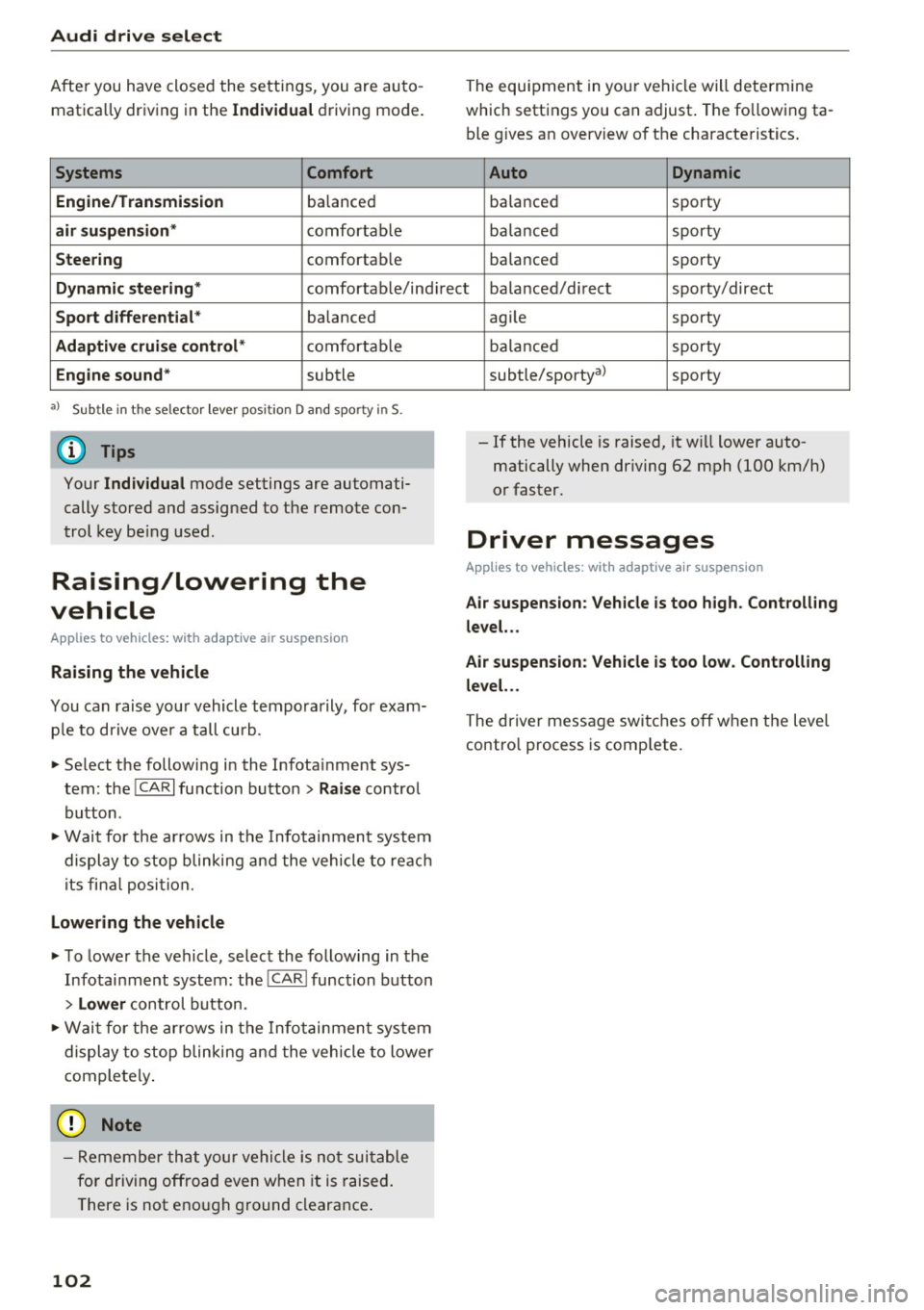
After you have closed the settings, you are auto
matica lly driving in the
Individual driving mode.
Systems Comfort
Engine/Transmission
balanced
air suspension* comfortab le
Steering comfortab le The equipment in you
r vehicle will determine
which settings you can adjust . The fo llowing ta
ble gives an overview of the characteristics .
Auto Dynamic
balanced sporty
ba lanced sporty
balanced sporty
Dynamic
steering* comfortab le/ind irect balanced/direct sporty/direct
Sport differential * balanced
Adaptive cruise control* comfortable
Engine sound* subtle
•> Subtle in t he se lector lever pos it ion D and sporty in S.
(D Tips
Your Individual mode settings are automati
cally stored and assigned to the remote con
trol key being used.
Raising/lowering the
vehicle
Applies to veh icles: w ith ad aptive air s uspensio n
Raising the vehicle
You can raise your vehicle temporarily, for exam
p le to drive ove r a tall curb .
.. Select the following in the Infota inment sys
tem: the
!CARI function button > Raise control
button .
.. Wait for the arrows in the Infotainment system
display to stop blinking and the vehicle to reach
its fina l position.
Lowering the vehicle
.. To lower the vehicle, select the following in the
Infotainment system: the
! CAR ! function button
> Lower control button .
.. Wait for the arrows in the Infotainment system
display to stop blinking and the vehicle to lower
completely .
Q) Note
-Remember that your vehicle is not suitable
for driving offroad even when it is raised.
There is not enough ground clearance.
102
agile sporty
balanced sporty
subtle/sportya) sporty
- If the vehicle is raised, it will lower auto matically when driving 62 mph (100 km/h)
or faster.
Driver messages
App lies to vehicles: wit h adaptive a ir suspension
Air suspension : Vehicle is too high. Controlling
level. . .
Air suspension: Vehicle is too low. Controlling
level. ..
The dr iver message switches off when the leve l
contro l process is comp lete .
Page 115 of 294
Parking systems
General information
Applies to vehicles: with parking system plus/rear view cam
era/peripheral cameras
Depending on your vehicle's equipment, various
parking aids will help you when parking and ma
neuvering.
The
parking system plus assists you when park
ing by audibly and visually indicating objects de
tected
in front of and behind the vehicle
r::!:>page 114.
The rear view camera shows the area behind the
vehicle in the Infotainment display. This display
assists you when you are cross or parallel parking
r::!:> page 115. In addition, you are assisted by the
functions from the parking system plus
r::!:>page 114.
The peripheral cameras assist you with parking
and maneuvering. You are aided by various cam
e ras depending on the vehicle equipment leve l
¢ page 118. In addition, you are assisted by the
functions from the parking system plus
r::!:>page 114.
A WARNING
-Always look for traffic and check the area
around your vehicle by looking at it directly
as well. The parking system cannot replace
the driver's attention. The driver is always
responsible for safety during parking and
for all other maneuvers.
-
-Please note that some surfaces, such as
clothing, are not detected by the system.
- Sensors and cameras have blind spots in
which people and objects cannot be detect ed. Be especially cautious of children and
animals.
- The sensors can be displaced by impacts or
damage to the radiator grille, bumper,
wheel housing and the underbody. The park
ing systems may become impaired as a re
sult. Have your authorized Audi dealer or
qualified workshop check their function.
- Make sure the sensors are not covered by
stickers, deposits or any other obstructions
Parking systems
as it may impair the sensor function. For in
formation on cleaning, refer to
r::!:>page203.
(D Note
-Some objects are not detected by the sys
tem under certain circumstances:
- Objects such as barrier chains, trailer draw
bars, vertical poles or fences
- Objects above the sensors such as wall ex tensions
- Objects with specific surfaces or struc
tures such as chain link fences or powder
snow.
- If you continue driving closer to a low-lying
object, it may disappear from the sensor
range. Note that you will no longer be
warned about this obstacle.
(D Tips
- The system may provide a warning even
though there are no obstacles in the cover age area in some situations, such as:
- certain road surfaces or for long grass.
- external ultrasonic sources e.g. from cleaning vehicles.
- heavy rain, snow or thick vehicle exhaust.
- We recommend that you practice parking in
a traffic-free location or parking lot to be
come familiar with the system. When doing
this, there should be good light and weath
er conditions.
- You can change the volume and pitch of the
signals as well as the display
r::!:>page 123.
-Please refer to the instructions for towing a
trailer
r::!:>page 123.
-What appears in the infotainment display is
somewhat time-delayed.
113
Page 118 of 294
Parking systems
-The camera lens enlarges and distorts the
field of vision. The object appears both al
tered and inaccurate on the screen.
- In certain situations, people or objects in
the display appear closer or farther away:
- For objects that do not touch the ground,
such as the bumper of a parked vehicle, a
trailer hitch or the rear of a truck. Do not
use the help lines in this case.
- If driven from a level surface onto an in
cline, or a downward slope.
- If driven toward protruding objects.
- If the vehicle is carrying too much load in
the rear.
(D Note
- Always read and follow the applicable warn
ings r::!>(D
in General information on
page 113 .
-The orange colored orientation lines in the
Infotainment display show the vehicle path
depending on the steering wheel angle. The
front of the vehicle front swings out more
than the rear of the vehicle . Maintain plenty
of distance so that your outside mirror or a
corner of your vehicle does not collide with
any obstacles.
Switching on/off
Applies to vehicles: with rearview camera
Switching on
.,. Shift into reverse, or
.,. Press the
P,,, A button in the center console
r:=> page 114, fig. 121. A short confirmation
tone sounds and the LED in the button turns
on.
Switching between the rearview camera and
optical display
.,. Press the Graphic control button ®
r:=> page 116, fig. 126 to see the optical display .
.,. Press the
Rear view control button to see the
. . rearv1ew camera image.
Switching off
.,. Drive forward faster than 10 km/h, or
.,. press the
P,1
1.A button, or
116
.,. Switch the ignition off.
@ Tips
- The visual display in the left part of the dis
play should help you detect the critical vehi
cle areas.
- You can change the volume and pitch of the
signals as well as the dis play
r:=> page 123.
Cross parking
Applies to vehicles: with rearview camera
This view may be used when parking in a garage
or in a parking space.
Fig. 126 Infotainment: aiming at a parking spot
Fig. 127 Infota inment: aligning the vehicle
.,. Turn the Infotainment on and shift into reverse
gear.
.,. The orange colored orientation lines
(D show
the direction of travel of the vehicle. Turn the
steer ing wheel until the orange orientation
lines appear in the parking space r::!>
fig. 126 .
Use the markings @to help you estimate the
distance from an obstacle. Each marking repre
sents approximately 3 ft
(1 m). The blue area
represents an extension of the vehicle's outline
by approximately
16 ft (5 meters) to the rear. .,._