brakes AUDI A6 2016 Owner's Manual
[x] Cancel search | Manufacturer: AUDI, Model Year: 2016, Model line: A6, Model: AUDI A6 2016Pages: 294, PDF Size: 73.88 MB
Page 206 of 294
Care and cleaning
-To reduce the risk of cuts, protect yourself
from sharp metal components when was h
ing the underbody or the inside of the wheel
housings .
- After washing the vehicle, the braking effect
may be delayed due to mo isture on the
brake rotors or ice in the winter . The brakes
must be d ried first w ith a few careful b rake
applications.
(D Note
- If you wash the vehicle in an automatic car
wash, you must fold the exte rior m irrors in
to reduce the risk of damage to the mirrors.
Power folding exte rior m irrors* must on ly
be fo lded in and out us ing the powe r folding
f u nct ion.
- To p revent paint damage , do not wash the
vehicle in di rect sunlight.
- To reduce the risk of damage to the surface,
do not use insec t remov ing sponges, kit chen
sponges or similar items. - Matte finish painted vehicle components:
-To reduce the r isk of damage to the sur-
face, do not use polis hing agents or hard
wax.
- Never use protective wax. It can destroy
the matte finish effect .
- Do not place any stickers or magnetic
signs on vehicle parts painted with matte
finish paint. The paint could be damaged
when the stickers or magnets are re
moved.
@ For the sake of the environment
Only wash t he ve hicle in facilities spec ially de
signed for that pu rpose . This will reduce the
r isk of dirty wate r contaminated with o il from
ente ring the sewe r system.
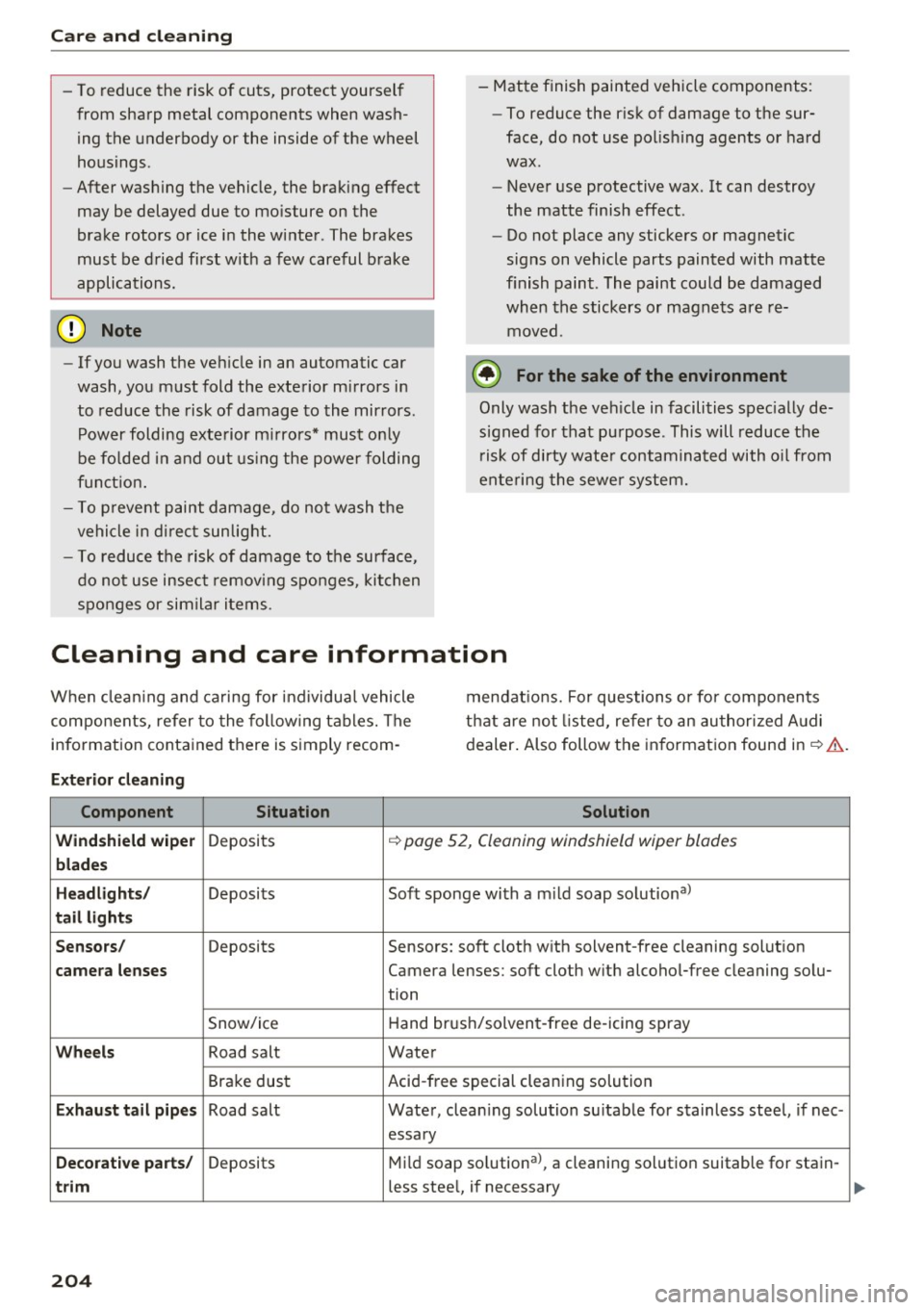
Cleaning and care information
When clean ing and c aring for ind ividua l vehicle
components, refer to the fo llow ing tables. The
information contained there is simply recom- mendat
ions. For questions or for components
t h at are not listed, refer to an author ized Audi
dealer. Also follow the informat ion found in¢&.
Ext erio r cl eaning
Component Situ ation Solution
Wind shield wip er
Deposits ¢ page 52, Cleaning windshield wiper blades
blade
s
Headligh ts/
Deposits Soft sponge with a mild soap solutiona >
tail light s
S en sors /
Deposits Sensors: soft cloth with solvent-free cleaning solution
cam era le nses Camera lenses: soft cloth with alcohol-free cleaning solu-
tion
Snow/ice H
and br ush/solvent-free de-icing spray
Wh eels Road salt Water
Brake dus t Acid-free special
cleaning solution
Ex haust tail p ipe s Road salt Water, clean ing solution su itable for stainless steel, if nee -
essary
Decorative parts / Deposits Mild
soap solution a), a cleaning solution suitable for stain-
trim less stee l, if necessary
204
Page 227 of 294
.... N
0 CJ '
Brake fluid
Checking brake fluid level
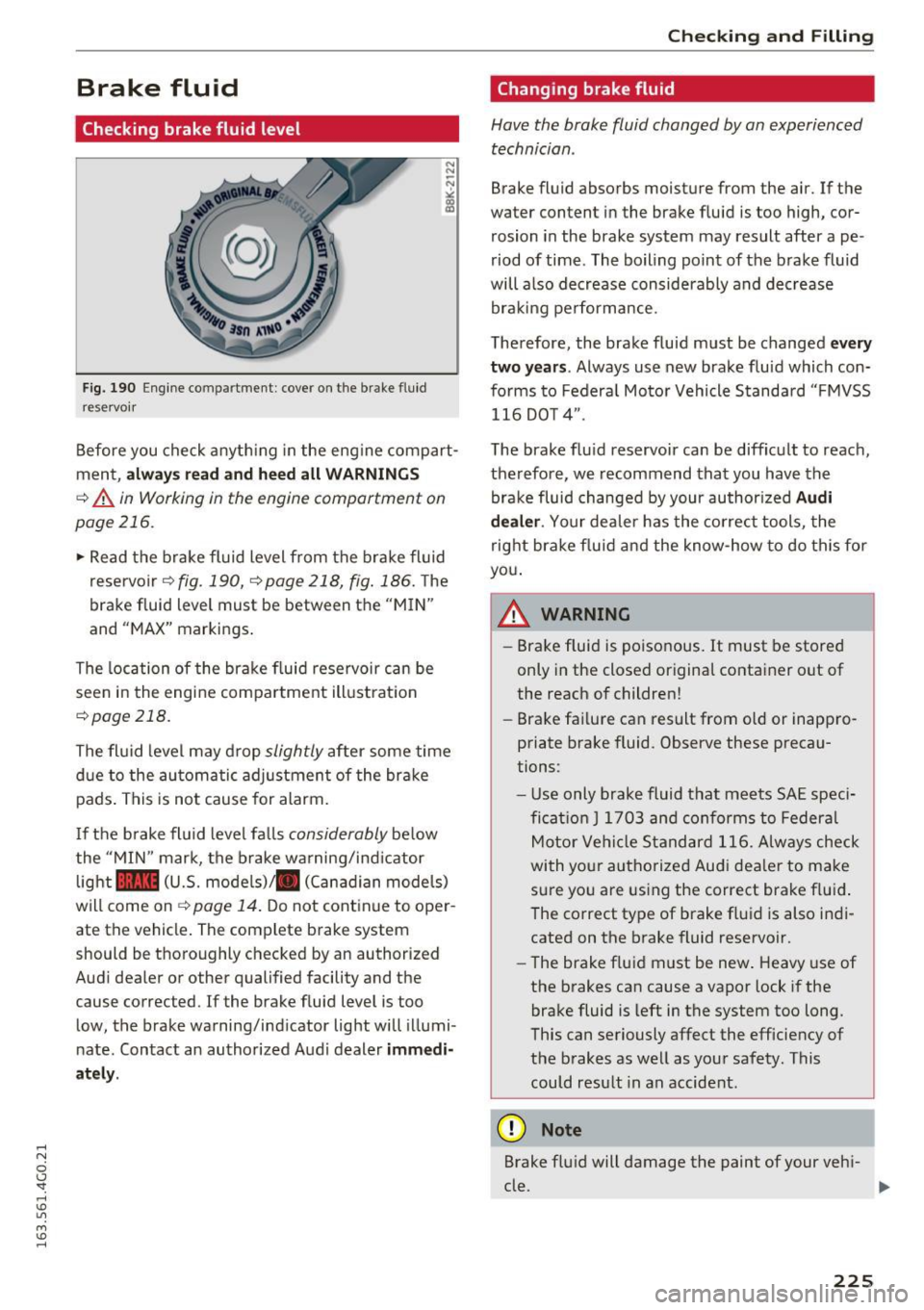
Fig. 190 Engine compartment : cover on t he brake fluid
reservoir
N
N
-N ,::
~
Before you check anything in the engine compart
ment,
always read and heed all WARNINGS
¢ A in Working in the engine compartment on
page 216.
.,. Read the brake fluid level from the brake fluid
reservoir
¢fig. 190, ¢page 218, fig. 186. The
brake fluid level must be between the "MIN "
and "MAX" markings.
The location of the brake fluid reservoir can be
seen in the engine compartment illustration
¢page 218.
The fluid level may drop slightly after some time
due to the automatic adjustment of the brake
pads. This is not cause for alarm.
If the brake fluid level falls
considerably below
the "MIN" mark, the brake warning/indicator
light
1111 (U.S. models) ;II (Canadian models)
will come on¢
page 14. Do not continue to oper
ate the vehicle. The complete brake system
should be thoroughly checked by an authorized
Audi dealer or other qualified facility and the
cause corrected. If the brake fluid level is too
low, the brake warning/indicator light will illumi
nate. Contact an authorized Audi dealer
immedi
ately.
Checking and Filling
Changing brake fluid
Have the brake fluid changed by an experienced
technician .
Brake fluid absorbs moisture from the air. If the
water content in the brake fluid is too high, cor
rosion in the brake system may result after ape
riod of time . The boiling point of the brake fluid
will also decrease considerably and decrease
braking performance.
Therefore, the brake fluid must be changed
every
two years . Always use new brake fluid which con
forms to Federal Motor Vehicle Standard "FMVSS
116 DOT 4" .
The brake fluid reservoir can be difficult to reach,
therefore, we recommend that you have the
brake fluid changed by your authorized
Audi
dealer. Your dealer has the correct tools, the
right brake fluid and the know-how to do this for
you.
A WARNING
- Brake fluid is poisonous. It must be stored
only in the closed original container out of
the reach of children!
- Brake failure can result from old or inappro
priate brake fluid . Observe these precau
tions:
- Use only brake fluid that meets SAE speci
fication
J 1703 and conforms to Federal
Motor Vehicle Standard 116. Always check
with your authorized Audi dealer to make
sure you are using the correct brake fluid.
The correct type of brake fluid is also indi
cated on the brake fluid reservoir.
- The brake fluid must be new. Heavy use of
the brakes can cause a vapor lock if the
brake fluid is left in the system too long.
This can seriously affect the efficiency of
the brakes as well as your safety. This
could result in an accident.
(D Note
Brake fluid will damage the paint of your vehi-
cle.
IJ>
225
Page 235 of 294
® Mud and snow capability
"M/5" or "M+S" indicates the tire
has characteristics that make it
suitable for driving on mud and
snow .
& indicates a winter tire .
@ Composition of the tire cord
and materials
The number of plies indicates the
number of rubber ized fabric lay
ers in the t ire. In general : the
more layers, the more weight a
tire can carry . Tire manufacturers
must also specify the materials
used in the ti re . These incl ude
stee l, nylon, polyester and other
materials .
@Maximum permitted load
This number indicates the maxi
mum load in kilograms and
pounds that the tire can carry .
@ Uniform tire quality grade
standards for treadwear,
traction and temperature resistance
Treadwear , traction and tempera
ture ranges¢
page 248.
@ Running direction
The arrows indicate the running
direction of unidirectional t ires .
You must always follow the speci- fied running direction
¢
page 258.
€3) Maximum permitted
inflation pressure
Wheels
This number indicates the max i
mum pressure to which a tire can
be inflated unde r normal operat
ing conditions.
Glossary of tire and loading
terminology
Accessory weight
means the combined we ight (in
excess of those standard items
wh ich may be replaced) of auto
matic transmission, power steer
ing, power brakes, power win
dows, power seats, radio, and
heater, to the extent that these
items are available as factory-in
stalled equipment (whether in
stalled or not).
Aspect ratio
means the ratio of the height to
the w idth of the tire in percent .
Numbers of 55 or lower indicate a
low s idewall for improved steer
ing response and better overall
handling on dry pavement . .,.
233
Page 237 of 294
(a) Curb weight
(b) Accessory weight
(c) Vehicle capacity weight, and
(d) Production options we ight
Ma ximum (permissible)
inflation pressure
means the maximum cold infla
tion pressure to which a t ire may
be inflated. Also called "maxi
mum inflation pressure."
Normal occupant weight
means 150 lbs. (68 kilograms)
times the number of occupants
seated in the veh icle up to the to
tal seating capacity of your vehi c le.
Occupant distribution
means distribution of occupants
in a vehicle.
Outer diameter
means the overall diameter of an
inflated new tire.
Overall width
means the linear distance be
tween the exteriors of the side
walls of an inflated tire, including elevations due to labeling, deco
rations, or protective bands or
ribs .
Wheels
Ply
means a layer of rubber-coated
parallel cords .
Production options weight
means the combined weight of
those installed regular production
options weighing over 5 lbs. (2.3 kg) in excess of those standard
items which they replace, not pre
viously considered in curb weight
or accessory weight, including heavy duty brakes , ride levelers,
roof rack, heavy duty battery, and
special trim .
Radial ply tire
means a pneumatic tire in which
the ply cords that extend to the beads are laid at substantially 90
degrees to the centerline of the
tread.
Recommended inflation
pressure
see ~ page 234, Cold tire infla
tion pressure .
Reinforced tire
means a tire designed to operate
at higher loads and at higher in
flation pressures than the corre sponding standard tire. Rein
forced tires may be identified as
235
Page 246 of 294
Wheels
Your safety and that of your pas
sengers also depends on making
sure that load limits are not ex
ceeded. Vehicle load includes ev
erybody and everything in and on
the vehicle. These load limits are
technically referred to as the vehi
cle's
Gross Vehicle Weight Rat
ing
("GVWR") .
The "GVWR" includes the weight of the basic vehicle, all factory in
stalled accessories, a full tank of
fuel, oil, coolant and other fluids
plus maximum load . The maxi
mum load includes the number of
passengers that the vehicle is in
tended to carry ("seating capaci
ty") with an assumed weight of 1 SO lbs. (68 kg) for each passen
ger at a designated seating posi
tion and the total weight of any
luggage in the vehicle. If you tow
a trailer, the weight of the trailer hitch and the tongue weight of
the loaded trailer must be includ
ed as part of the vehicle load.
The
Gross Axle Weight Rating
("GAWR") is the maximum load
that can be applied at each of the
vehicle's two axles.
The fact that there is an upper limit to your vehicle's Gross Vehi-
244
cle Weight Rating means that the
total weight of whatever is being carried in the vehicle (including
the weight of a trailer hitch and
the tongue weight of the loaded
trailer) is limited. The more pas
sengers in the vehicle or passen
gers who are heavier than the
standard weights assumed mean
that less weight can be carried as
luggage.
The Gross Vehicle Weight Rating
and the Gross Axle Weight Rating
are listed on the safety compli
ance sticker label located on the
driver's side B-pillar
¢ page 241,
fig. 195.
&_ WARNING ~
Overloading a vehicle can cause
loss of vehicle control, a crash
or other accident, serious per
sonal injury, and even death.
-Carrying more weight than your vehicle was designed to carry will prevent the vehicle
from handling properly and increase the risk of the loss of
vehicle control.
-The brakes on a vehicle that has been overloaded may not
be able to stop the vehicle
within a safe distance.
Page 280 of 294
Index
AUTO Automatic headlights . . . . . . . . . . . . . . . . . 44
Four-zone automatic cl imate control . . . . . 70
Three- zone climate control . . . . . . . . . . . . . 68
Auto Lock . . . . . . . . . . . . . . . . . . . . . . . . . . . . 32
Automatic belt retractor . . . . . . . . . . . . . . . 13 7
Automatic post-collision braking system . . 188
Automatic transm ission . . . . . . . . . . . . . . . . 106
Driving . . . . . . . . . . . . . . . . . . . . . . . . . . . . 108
Emergency mode . . . . . . . . . . . . . . . . . . . . 111
Hill descent contro l . . . . . . . . . . . . . . . . . . 109
Kick-down.......................... 110
Manual shift program . . . . . . . . . . . . . . . . 1 10
Selector lever . . . . . . . . . . . . . . . . . . . . . . . 106
Selector lever emergency release . . . . . . . 112
Automatic wipe/wash system . . . . . . . . . . . . 51
Auto Safety Hotline . . . . . . . . . . . . . . . . . . . 132
Auxiliary heater (four-zone automatic climate
control) . . . . . . . . . . . . . . . . . . . . . . . . . . . . . . 72
Auxiliary heater (three-zone climate control) 69
Average consumption . . . . . . . . . . . . . . . . . . . 24
Average speed . . . . . . . . . . . . . . . . . . . . . . . . 24
Avoid damaging the vehicle . . . . . . . . . . . . . 194
B
Battery ... .. .. ... .. .. .. ... .. ... .. .. .
Charge level .. .... ........... .... .. .
Charging . .. .. ............... .... .. .
Energy management ................ .
Important warnings .............. .. .
Jump starting ................... ... .
Location
. .. .. .. ............. .... .. .
Replacing the battery .. ... .... .. .. .. .
Win ter operation .... ............. .. .
Working on the battery .............. .
Before driving 226
192
228 192
226
264
226
229
226 226
12S
Belt tensioners . . . . . . . . . . . . . . . . . . . . . . . 140
Blended g asoline . . . . . . . . . . . . . . . . . . . . . 208
Blower (four-zone automatic climate control) .7.1
Blower (three-zone climate control) . . . . . . . 68
Booster seats . . . . . . . . . . . . . . . . . . . . . . . . 17 5
Brake fluid Changing the brake fluid . . . . . . . . . . . . . . 225
Checking the brake fluid level . . . . . . . . . . 225
Brakes Indicator light . . . . . . . . . . . . . . . . . . . . . . . 21
278
Brake system
Anti- lock braking syst em . . . . . . . . . . . . . . . 19
Brake booster . . . . . . . . . . . . . . . . . . . . . . . 190
Brake fluid . . . . . . . . . . . . . . . . . . . . . . . . . 22S
Brake fluid specific ations fo r refill and re
placement . . . . . . . . . . . . . . . . . . . . . . . . . 225
Brake power assist unit . . . . . . . . . . . . . . . 189
Brakes . . . . . . . . . . . . . . . . . . . . . . . . . . . . . 189
Electromechanical parking brake . . . . . . . . 77
Fluid reservoir . . . . . . . . . . . . . . . . . . . . . . 225
Warning/indicator lights . . . . . . . . . . . . . . . 14
Worn brake pads symbo l . . . . . . . . . . . . . . . 19
Braking Brake assist . . . . . . . . . . . . . . . . . . . . . . . . 187
Emergency braking function . . . . . . . . . . . . 78
Braking guard . . . . . . . . . . . . . . . . . . . . . . . . . 84
Messages . . . . . . . . . . . . . . . . . . . . . . . . . . . 91
Settings . . . . . . . . . . . . . . . . . . . . . . . . . . . . 91
Break-in period Brake pads . . . . . . . . . . . . . . . . . . . . . . . . . 189
Tires 194
Breaking in . . . . . . . . . . . . . . . . . . . . . . . . . . 194
New tires . . . . . . . . . . . . . . . . . . . . . . . . . . 238
Bulbs . . . . . . . . . . . . . . . . . . . . . . . . . . . . . . . 263
C
California Proposition 65 Warning ..... . .
Battery specific .. .. .. .. ........... . .
Capacities Ad Blue 217
227
271
212
E ngine oil ....... ... ............. .. . 218
Car carrier Tr ansporting your vehicle . . . . . . . . . . . . . 26 7
Care . . . . . . . . . . . . . . . . . . . . . . . . . . . . . . . . 203
Cargo area .. ... ... .. .. ... ..... ..... .. 131
Cargo net . . . . . . . . . . . . . . . . . . . . . . . . . . . . 65
Catalytic converter 195
Center armrest Cockpit . . . . . . . . . . . . . . . . . . . . . . . . . . . . . 56
Central locking . . . . . . . . . . . . . . . . . . . . . . . . 31
Emergency locking . . . . . . . . . . . . . . . . . . . . 36
Power windows . . . . . . . . . . . . . . . . . . . . . . 40
Setting . . . . . . . . . . . . . . . . . . . . . . . . . . . . . 33
Sunroof. . . . . . . . . . . . . . . . . . . . . . . . . . . . . 40
Certification . . . . . . . . . . . . . . . . . . . . . . . . . 276
Changing engine oil . . . . . . . . . . . . . . . . . . . 221