roof AUDI A6 2017 User Guide
[x] Cancel search | Manufacturer: AUDI, Model Year: 2017, Model line: A6, Model: AUDI A6 2017Pages: 280, PDF Size: 70.24 MB
Page 160 of 280
Airbag system
A WARNING
A child in a rearward-facing child seat instal
led on the front passenger seat will be seri
ously injured and can be killed if the front air
bag inflates - even with an Advanced Airbag
System.
- The inflating airbag will hit the child seat or
infant carrier with great force and will
smash the child seat and child against the backrest, center armrest, door or roof.
- Always install rear-facing child seats on the
rear seat.
- If you must install a rearward facing child
seat on the front passenger seat because of exceptional circumstances and the
PASSEN
GER AIR BAG OFF
light does not come on
and stay on, immediately install the rear
facing child seat in a rear seating position
and have the airbag system inspected by
your Audi dealer.
A WARNING
Objects between you and the airbag will in
crease the risk of injury in a crash by interfer
ing with the way the airbag unfolds or by be
ing pushed into you as the airbag inflates .
- Never hold things in your hands or on your
lap when the vehicle is in use .
- Never transport items on or in the area of
the front passenger seat . Objects could
move into the area of the front airbags dur
ing braking or other sudden maneuvers and
become dangerous projectiles that can
cause serious personal injury if the airbags
inflate.
- Never place or attach accessories or other
objects (such as cup holders, telephone
brackets , large, heavy or bulky objects) on
the doors, over or near the area marked "A IRBAG" on the steering wheel, instru
ment panel, seat backrests or between
those areas and yourself. These objects
could cause injury in a crash, especially
when the airbags inflate .
- Never recline the front passenger 's seat to
transport objects. Items can also move into
the area of the side airbag or the front air-
158
-
bag during braking or in a sudden maneu
ver. Objects near the airbags can become
projectiles and cause injury, particularly
when the seat is reclined.
- Never place or transport objects on the
front passenger seat. Objects on the front passenger seat could cause the capacitive
sensor in the seat to signal to airbag system
that the seat is occupied by a person when it
in fact is not , or that the person on the seat
is heavier than he or she actually is. The
change in electric capacitance because of
such objects can cause the passenger front
airbag to be turned on when it should be
off, or can cause the airbag to work in a way
that is different from the way it would have
worked without objects on the seat.
- Always make sure that there is nothing on
the front passenger seat that will cause the
capacitive passenger detection system in
the seat to signal to the Airbag System that
the seat is occupied by a person when it is not, or to signal that it is occupied by some
one who is heavier than the person actually
sitting on the seat. The presence of an ob
ject could cause the passenger front airbag to be turned on when it should be off, or
could cause the airbag to work in a way that is different from the way it would have
worked without the object on the seat.
A WARNING
The fine dust created when airbags deploy can
cause breathing problems for people with a history of asthma or other breathing condi
tions .
- To reduce the risk of breathing problems,
those with asthma or other respiratory con
ditions should get fresh air right away by
getting out of the vehicle or opening win
dows or doors .
- If you are in a collision in which airbags de
ploy , wash your hands and face with mild
soap and water before eating.
- Be careful not to get the dust into your eyes,
or into any cuts or scratches.
- If the residue should get into your eyes,
flush them with water .
Page 178 of 280
Child safety
-The child and the passenger can also in
jure each other in an accident.
- Never install rear-facing child safety seats
or infant carriers on the front passenger
seat. A child will be seriously injured and
can be killed when the passenger airbag in
flates - even with an Advanced Airbag Sys
tem.
- The inflating airbag will hit the child safety
seat or infant carrier with great force and
will smash the child safety seat and child
against the backrest, center armrest, door
or roof.
- Always install rear-facing child safety seats
or infant carriers on the rear seat.
- Make sure there is enough space in front of
the child in the child seat. If necessary, ad
just the angle and position of the seat in
front of the child seat.
- Forward-facing child safety seats installed
on the front passenger's seat can interfere
with the airbag when it inflates and cause
serious injury to the child. Always install for
ward-facing child safety seats on the rear
seat.
- If exceptional circumstances require the use
of a forward-facing child restraint on the
front passenger's seat, the child's safety
and well-being require that the following
special precautions be taken:
- Make sure the forward-facing seat has
been designed and certified by its manu
facturer for use on a front seat with a pas
senger front and side airbag.
- Always carefully follow the manufacturer's
instructions provided with the child safety
seat or carrier.
- Always move the front passenger seat to the highest position in the up and down
adjustment range and move it back to the
rearmost position in the seat's fore and
aft adjustment range, as far away from
the airbag as possible, before installing
the forward-facing child restraint.
- Always make sure that the safety belt up
per anchorage is behind the child restraint
and not next to or in front of the child re-
176
straint so that the safety belt will be prop
erly positioned.
- Always make sure that nothing prevents
the front passenger's seat from being
moved to the rearmost position in its fore
and aft adjustment range.
-Always make sure that the backrest is in the upright position.
- Never place or use any electrical device
(such as a laptop, CD player, electronic
games device, power inverter or seat heat
er for child seats) on the front passenger seat if the device is connected to the 12-
volt socket or the cigarette lighter socket.
- If a seat heater has been retrofitted or
otherwise added to the front passenger
seat, never install any child restraint sys
tem on this seat.
- Make sure that there are no wet objects
(such as a wet towel) and no water or oth
er liquids on the front passenger seat
cushion.
- Never place objects on the seat (such as a
laptop, CD player, electronic games de
vice, power inverter or seat heater for
child seats). These may influence the elec
trical capacitance measured by the capaci
tive passenger detection system and can
also fly around in an accident and cause
serious personal injury.
- Always buckle the child safety seat firmly in
place even if a child is not sitting in it. A
loose child safety seat can fly around during
a sudden stop or in a collision .
- Always read and heed all WARNINGS when
ever using a child restrained in a vehicle is
being used<::;>
page 139, Safety belts,
c::> page 147, Airbag system and
c::> page 171, Child safety.
.8. WARNING
To reduce the risk of serious injury, make sure
that the
PASSENGER AIR BAG OFF light
comes on and stays on whenever a child re
straint is installed on the front passenger seat
and the ignition is switched on. .,_
Page 180 of 280
Child safety
seats support the baby's back, neck and head in a
crash
¢fig. 164 .
The airbag on the passenger side makes the front
seat a potentially dangerous place for a child to ride. The front seat is not the safest place for a
child in a forward-facing child seat. It is a very
dangerous place for an infant or a larger child in
a rearward-facing seat .
A WARNING
Not using a child safety seat, using the wrong
child safety seat or improperly installing a
child restraint increases the risk of serious
personal injury and death in a crash.
- Never install rear -facing child safety seats
or infant carriers on the front passenger
seat -even with an Advanced Airbag System.
A child will be seriously injured and can be killed when the inflating airbag hits the
child safety seat or infant carrier with great
force and smashes the child safety seat and child against the backrest, center armrest,
door or roof<=>
page 148, Child restraints on
the front seat -some important things to
know .
-Always install rear-facing child safety seats
or infant carriers on the rear seat.
- Never install a rear-facing child restraint in the forward-facing direction. Such restraints
are designed for the special needs of infants and very small children and cannot protect
them properly if the seat is forward-facing .
- If you must install a rearward facing child safety seat on the front passenger seat because of exceptional circumstances and the
PASSENGER AIR BAG OFF light does not
come on and stay on, immediately install
the rear-facing child safety seat in a rear
seating position and have the airbag system
inspected by your Audi dealer.
- Never place or use any electrical device (such as a laptop, CD player, electronic
games device, power inverter or seat heater
for child seats) on the front passenger seat
if the device is connected to the 12-volt
socket or the cigarette lighter socket.
178
- If a seat heater has been retrofitted or oth
erwise added to the front passenger seat,
never install any child restraint system on
this seat .
- Make sure that there are no wet objects
(such as a wet towel) and no water or other
liquids on the front passenger seat cushion.
- Never place objects on the seat (such as a
laptop, CD player, electronic games device,
power inverter or seat heater for child
seats) . These may influence the electrical
capacitance measured by the capacitive pas
senger detection system and can also fly
around in an accident and cause serious per
sonal injury.
- Always read and heed all WARNINGS when
ever using a child restrained in a vehicle is being used¢
page 139, Safety belts,
¢page
147, Airbag system and
c> page 171, Important information.
Page 181 of 280
Convertible child safety seats
Properly used convertible child safety seats can
help protect toddlers and children over age one
who weigh between
20 and 40 lbs. (9 and 18 kg)
in a crash.
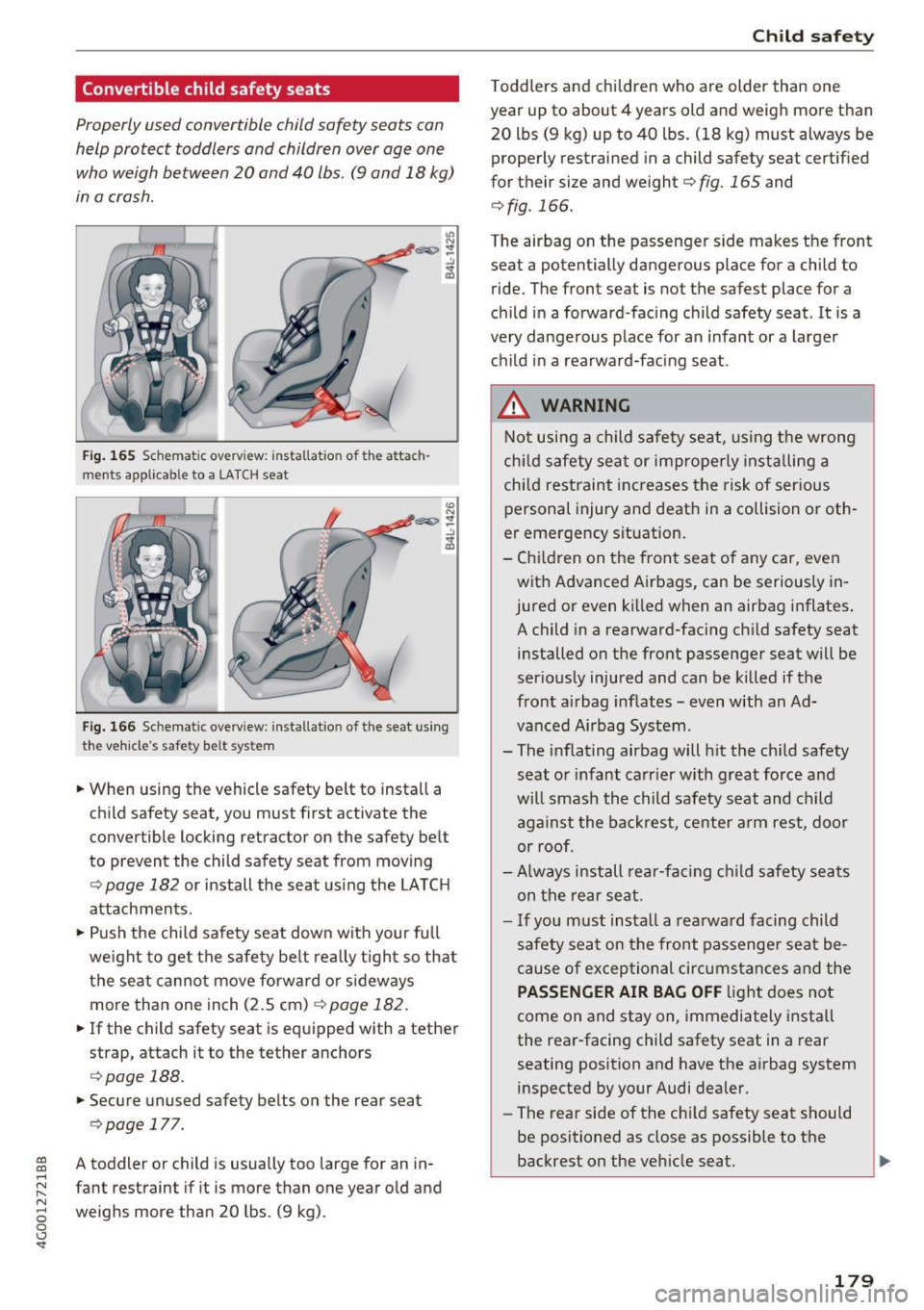
Fig. 165 Schemat ic overv iew: installatio n of the attac h
ments app lica ble to a LA TCH seat
Fig. 166 Schematic overv iew : installat io n of the seat using
the vehicle 's safe ty be lt syste m
.. When using the vehicle safety belt to install a
child safety seat, you must first activate the
convertible locking retractor on the safety belt
to prevent the child safety seat from moving
Q page 182 or install the seat us ing the LATC H
attachments .
.. Push the child safety seat down with your fu ll
weight to get the safety belt really tight so that
the seat cannot move forward o r sideways
more than one inch (2.5 cm)
Qpage 182.
.. If the child safety seat is equipped with a tether
strap, attach it to the tether anchors
Q page 188.
.. Secure unused safety belts on the rear seat
Q page 177.
~ A toddler or child is usually too large for an in-
;::j fant restraint if it is more than one year old and
" 8 weighs more than 20 lbs . (9 kg) .
0 <..:l 'SI"
Child safety
Toddlers and children who are older than one
year up to about 4 years old and weigh more than
20 lbs (9 kg) up to 40 lbs. (18 kg) must always be
properly restrained in a child safety seat certified
for their size and weight
Q fig. 165 and
q fig . 166.
The airbag on the passenger side makes the front
seat a potentially dangerous place for a child to
ride. The front seat is not the safest place for a
child in a forward -facing child safety seat. It is a
very dangerous place for an infant or a larger
child in a rearward-facing seat .
_&. WARNING
Not using a child safety seat, us ing the wrong
child safety seat or improperly instal ling a
chi ld restraint increases the risk of serious
personal injury and death in a collision or oth
er emergency situation.
- Children on the front seat of any car, even
with Advanced Airbags, can be seriously in
jured or even killed when an airbag inflates.
A child in a rearward-facing ch ild safety seat
installed on the front passenger seat will be
seriously injured and can be killed if the
front airbag inflates -even with an Ad
vanced Airbag System .
- The inflating airbag will hit the child safety
seat or infant carr ier with great force and
will smash the child safety seat and child
against the backrest, center arm rest, door
or roof.
-Al ways install rear-fa cing child safety seats
on the rear seat .
- If you must insta ll a rearward facing child
safety seat on the front passenger seat be
cause of exceptional circumstances and the
PASSENGER AIR BAG OFF light does not
come on and stay on, immediately install
the rea r-facing child safety seat in a rear
seating position and have the a irbag system
inspected by your Audi dealer .
- The rear side of the ch ild safety seat shou ld
be positioned as close as possible to the
backrest on the veh icle seat.
II>-
179
Page 185 of 280
co
co
.... N
" N .... 0 0 <..:l '
A WARNING
Improperly installed child safety seats in
crease the risk of serious personal injury and
death in a collision.
-Always make sure that the safety belt re tractor is locked when installing a child safety seat. An unlocked safety belt retrac
tor cannot hold the child safety seat in place
dur ing normal driving or in a crash .
- Always buckle the child safety seat firmly in
place even if a child is not sitting in it . A
loose child safety seat can fly around during
a sudden stop or in a collision.
- Always make sure that the rear seat back
rest to wh ich the center rea r safety be lt* is
attached is secure ly latched whenever the
rear cente r safety belt is being used to se
cure a chi ld restraint.
- If the backrest is not securely latched, the
child and the child restraint will be thrown
forward together with the backrest and will
strike parts of the vehicle interior . The chi ld
can be seriously injured or killed.
- Never install rear-facing chi ld safety seats
or infant carriers on the front passenger
seat. A child will be serious ly injured and
can be killed when the passenger airbag in
flates.
- The inflating a irbag w ill hit the child safety
seat or infant carrier with great force and
will smash the ch ild safety seat and child
against the backrest, center armrest, door
or roof.
- Always install rear -facing child safety seats
or infant carriers on the rear seat.
- Forward -facing ch ild safety seats or infant
carriers installed on the front passenger 's
seat may inte rfere with the deployment of
the a irbag and cause serious injury to the
child.
- It is safer to install a forward-fac ing ch ild
safety seat on the rear seat.
- Always read and heed all WARNINGS when
ever using a child restrained in a veh icle is
being used
r:::> page 171 . Specia l precaut ions
Ch ild safety
apply when install ing a child safety seat on
the front passenger seat
r:::> page 148, Child
restraints on the front seat -some impor
tant things to know .
A WARNING
Always take special precautions if you must
i nstall a forward or rearward-facing child re
stra int on the front passenger's seat in excep
tional s ituations:
- Whenever a forward or rearward-fac ing
child restraint is installed on the front pas
senger seat, the
PASSENGER AIR BAG OFF
light must come on and stay on whenever
the ignition is switched on .
- I f the
PASSENGER AIR BAG OFF light does
not come on and stay on, perform the
checks described
r:::> poge 159, Monitoring
the Advanced Airbag System.
- Take the child restraint off the front passen
ger seat and install it properly at one of the rear seat positions if the
PAS SENGER AIR
BAG O FF
light does not stay on whenever
the ignition is switched on.
-Improper installat ion of child restraints can
reduce the ir effectiveness or even prevent
them from providing any protect ion.
- An improperly installed child restra int can
interfere with the airbag as it deploys and
serious ly injure or even kill the child.
- Always carefully follow the manufacturer's
instructions provided with the child safety
seat or carr ier.
- After checking to make sure that the child
restraint is properly installed, make certain
that the child restraint is correctly recog
n ized by the capacitive passenge r detection
system in the front passenger seat and that
the
PASSENGER AIR BAG OFF light signals
the correct front passenger frontal airbag
stat us.
A WARNING
Forwa rd -facing child restraints :
-
183
Page 186 of 280
Child safety
-Always make sure the forward-facing seat
has been designed and certified by its man
ufacturer for use on a front seat with a
passenger front and side airbag.
- Never put the forward-facing child restraint
up, against or very near the instrument pan
el.
- Always move the front passenger seat to
the highest position in the up and down ad
justment range and move it back to the
rearmost position in the seat's fore and aft
adjustment range, as far away from the air
bag as possible, before installing the for
ward-facing child restraint.
- Always make sure that the safety belt upper
anchorage is behind the child restraint and
not next to or in front of the child restraint
so that the safety belt will be properly posi
tioned.
- Make sure that the
PASSENGER AIR BAG
OFF
light comes on and stays on all the time
whenever the ignition is switched on.
A WARNING
Rearward-facing child restraints:
- A child in a rearward-facing child safety seat
installed on the front passenger seat will be
seriously injured and can be killed if the
front airbag inflates -even with an Ad
vanced Airbag System.
- The inflating airbag will hit the child safety seat or infant carrier with great force and
will smash the child safety seat and child against the backrest, center armrest, door
or roof.
-Always be especially careful if you must in
stall a rearward facing child safety seat on
the front passenger seat in exceptional cir
cumstances.
- Make sure that the
PASSENGER AIR BAG
OFF
light comes on and stays on all the time
whenever the ignition is switched on.
- If the
PASSENGER AIR BAG OFF light does
not come on and stay on, immediately in
stall the rear-facing child safety seat in a
rear seating position and have the airbag
system inspected by your Audi dealer.
184 ·
Activating the convertible locking retractor
Use the convertible locking retractor to secure a
child restraint.
Always heed the child safety seat manufacturer's
instructions when installing a child restraint in
your vehicle. To activate the convertible locking retractor:
.. Place the child restraint on a seat, preferably
on the rear seat.
.. Slowly pull the belt
all the way out.
.. Route it around or through the child restraint
belt path
~ ,&. .
.. Push the child safety seat down with your full
weight to get the safety belt really tight.
.. Insert the belt tongue into the buckle for that
seating position.
.. Guide the safety belt back into the retractor un
til the belt lies flat and snug on the child safety
seat.
.. You should hear a "clicking" noise as the belt
winds back into the inertia reel. Test the con
vertible locking retractor by pulling on the belt.
You should no longer be able to pull the belt
out of the retractor. The convertible locking re
tractor is now activated.
.. Make sure that the red release button is facing
away from the child restraint so that it can be
unbuckled quickly.
.. Pull on the belt to make sure the safety belt is
properly tight and fastened so that the seat
cannot move forward or sideways more than
one inch (2 .5 cm) .
A WARNING
Using the wrong child restraint or an improp
erly installed child restraint can cause serious
personal injury or death in a crash.
- Always make sure that the safety belt re
tractor is locked when installing a child
safety seat. An unlocked safety belt retrac
tor cannot hold the child safety seat in place
during normal driving or in a crash.
- Always buckle the child safety seat firmly in
place even if a child is not sitting in it. A
loose child safety seat can fly around during
a sudden stop or in a crash.
IIJJ,-
Page 199 of 280
co
co
.... N
" N .... 0 0 <..:l -
tank .
.,. Remove the canister and close the fi ller tube
c:> page 197 , Comple ting AdBlue refill .
CD Note
Only use refi ll canisters that are approved for
your vehicle. Us ing other systems can cause
Ad Blue to leak.
(D Tips
- An authorized Audi dealer or authorized
Audi repair facility can tell you which ref ill
canisters are approved for your vehicle.
- A permitted refill canister conta ins approxi
mately 1.3 gallons (5 liters) of AdBlue.
Completing AdBlue refill
Applies to: vehicles with selective catalytic reduction
Clo sing the filler nec k
.,. Tu rn the cap on the filler neck to the right with
the wheel wrench until the cap clicks into place.
This t ightens the cap to the specification c::> .&.
in Filling AdBlue on page 196, c:> 0 in Filling
AdBlue on page 196.
.,. The n press on the left side of the tank doo r un-
t il it latches .
After filling
The vehicle must be dr iven so that the system
recognizes that the Ad Bl ue was refilled . Th is can
take severa l m inutes.
.,. If there was no Ad Blue left in the tank and a
range of O mi (0 km) was shown in the display,
switch the ign ition on for about 30 seconds be
fore starting the engine.
(D Tips
Ad Blue can freeze at very low temperatures.
If th is happens , the system will not detect
that the Ad Blue was refilled and it will contin
ue to inform yo u of the low Ad B lue level. The
message turns off as soon as the tank thaws
out again .
Ch eck ing and Filling
Catalytic converter
Applies to: vehicles with gasoline engine
It is very important that your emission control
system (cataly tic converter) is functioning prop
erly to ensure that your vehicle is running in an
environmentally sound manner.
.,. Always use lead-free gasoline c:> page 190 , Fuel
supply.
.,. Never run the tank down all the way to empty .
.,. Never put too much motor o il in your engine
c:> page 203, Adding engine oil.
.,. Never try to push- or tow-start your vehicle.
The catalytic co nverter is an efficient "clean -up"
device built into the exhaust system of the ve hi
cle. The catalyt ic converter b urns many of the
po llutants in the exhaust gas before they are re
leased into the atmosphere.
The exclusive use of un leaded fuel is cr itically im
portant for the life of the catalytic converte r and
prope r funct ion ing of the eng ine .
_&. WARNING
The tempera ture of t he exhaus t sys tem is
h igh, bot h when driv ing and a fter stopping
the engine .
- Never tou ch the exhaust tail pipes once they
have become hot. This cou ld resu lt in burns.
- Do not park or operate the vehicle in ar eas
where the hot exhaus t sys tem may come in
contact with dry grass, b rush, fuel spill or
other material which can ca use a fire.
- Do not app ly additiona l undercoating or
r u stp roofing on or near the exhaust mani
fold, exha ust pipes, cata lytic converter or
heat shields . D uring driving, the substance
used for undercoat ing could overheat and
cause a fire.
CD Note
- Be aware that just one tank fi lling with
leaded fuel w ill already seriously degrade
the performance of the catalytic converter .
- Do not exceed the correct engine oil leve l
c:> page 203.
197
Page 216 of 280
Wheel s
Maximum (permissible)
inflation pressure
means the max imum cold infla
tion pressure to which a t ire may
be inflated . Also called "maxi
mum inflation pressure."
Normal occupant weight
means 150 lbs. (68 k ilograms)
times the number of occupants seated in the vehicle up to the to
tal seating capacity of your vehi
cle .
Occupant distribution
means distribution of occupants
in a vehicle.
Outer d iameter
means the overall diamete r of an
inflated new tire.
Overall width
means the linear distance be
tween the exteriors of the side
walls of an inflated tire , including
elevations due to labeling, deco rations, or protective bands or
ribs .
Ply
means a layer of rubber-coated
para llel cords.
2 14
Production options we ight
means the combined weight of
those installed regular product ion
options weighing over 5 lbs . (2 .3
kg) in excess of those standard
items which they replace, not pre
viously considered in curb weight or accessory weight , including
heavy duty brakes, ride levelers,
roof rack, heavy duty battery, and
special trim.
Radial ply ti re
means a pneumatic tire in which
the ply cords that extend to the beads are la id at substantially 90
degrees to the centerline of the
tread.
Recommended inflation
pressure
see ¢ page 213 , Cold tire infla
tion pressure.
Reinforced tire
means a tire designed to operate
at higher loads and at higher in
flation pressures than the corre
sponding standard tire . Rein
forced tires may be identified as "XL", "xl", "EXTRA LOAD", or "RF"
on the sidewall. ...
Page 247 of 280
co
co
.... N
" N .... 0 0 <.,;) 'SI"
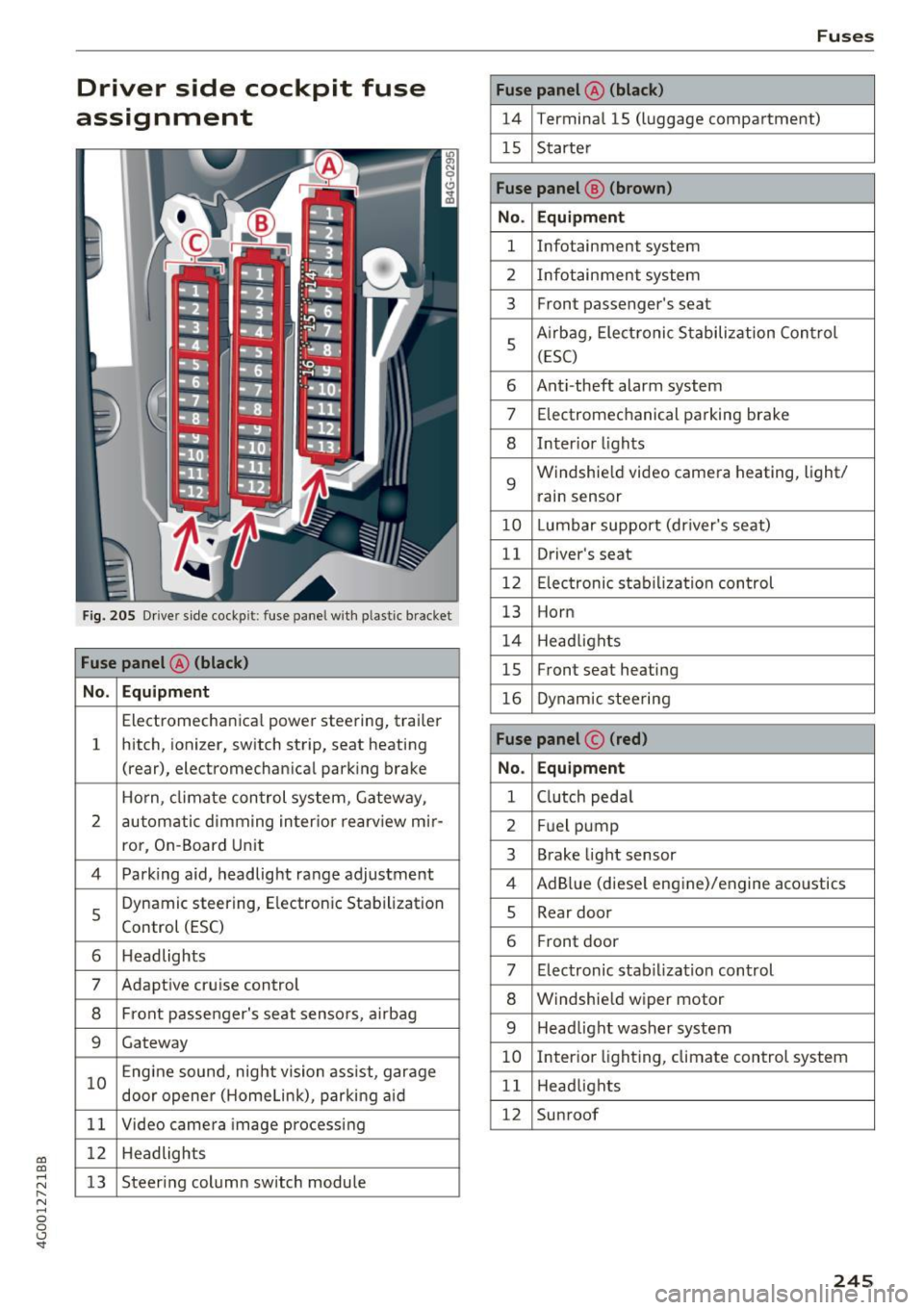
Driver side cockpit fuse
assignment
Fig. 205 Drive r side cockp it : fuse panel w ith plastic bracket
Fuse panel @ (black)
No. Equipment
Electromecha nica l powe r steering, trailer
1 hitch,
ionizer, switch strip, seat heating
(rear), electromechan ica l park ing brake
Horn, climate con trol system, Gateway,
2 automatic
dimm ing in ter ior rearview mir-
ro r, On-Board Unit
4 Park ing aid, headlight range adjustment
5
Dynamic steering, E lectron ic Stabilization
Control (ESC)
6 Headlights
7 Adapt ive cruise control
8 Front passenger's seat sensors, airbag
9 Gateway
10 Engine
sound, night vision ass ist, garage
door opener (Homelink), parking aid
11 Video camera
image processing
12 Headlights
13 Steering column sw
itch module
Fuses
Fuse panel @ (black)
14 Termina l 15 (luggage compartment)
15 Starter
Fuse panel @ (brown)
No. Equipment
1 Infotainment system
2 Infotainment system
3 Front
passenger's seat
5
Airbag, Electronic Stabilization Control
( ESC )
6 Anti
-theft alarm system
7 Electromec hanical pa rking brake
8 Inter io r li ghts
9
Windshield video camera heating, light/
rain sensor
10 Lumba r support (driver's seat)
11 Driver
's seat
12 Electronic sta bilization control
13 Horn
1 4 Headlights
15 Front seat heating
16 Dynamic steering
Fuse panel © (red)
No. Equipment
1 C lutch peda l
2 Fuel pump
3 Brake
light sensor
4 AdB lue (diese l engine)/engine aco ustics
5 Rear
door
6 Fro
nt door
7 Electronic stabilization control
8 Windshield wip er motor
9 Headlight washer system
10 Interio
r lighting, climate control system
1 1 Headlights
12 Sunroof
245
Page 249 of 280
co
co
.... N
" N .... 0 0 <..:l '
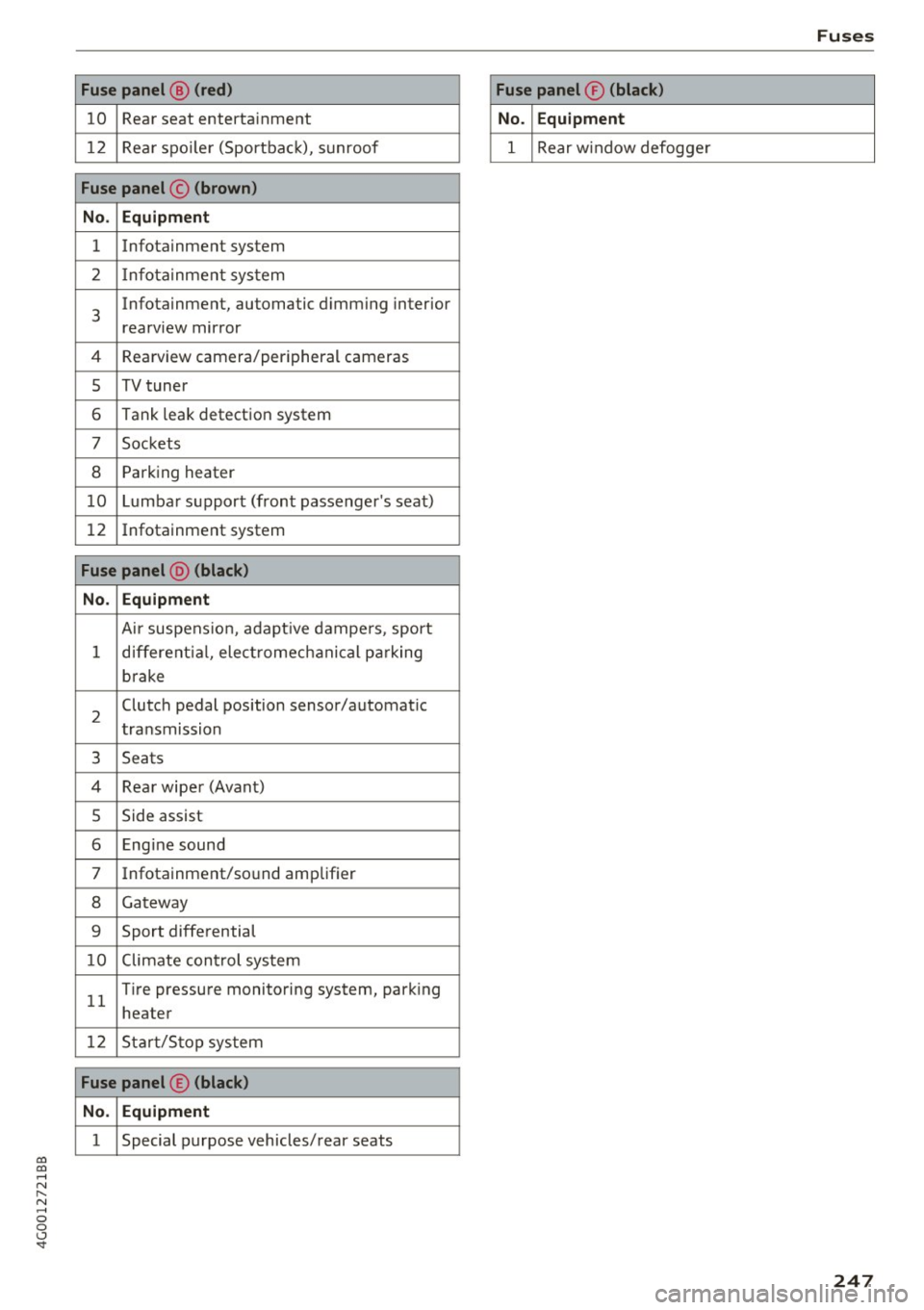
10 Rea r seat enterta inment
12 Rear spo ile r (Sportbac k), s unroof
Fuse panel © (brown)
No . Equipment
1 Infotainment system
2 I nfot ainme nt sys tem
3
Infotainment, automatic d imm ing interior
rearview mirror
4 Rearview camer a/peripheral cameras
5 TV tuner
6 Tank leak detect io n system
7 Sockets
8 Pa rk ing heater
1 0 Lumba r su pport (fro nt passenger 's seat)
1 2 Infotainment system
Fuse panel @ (black)
No. Equipment
Ai r suspe nsion , adaptive d ampe rs , sport
1 d ifferent ia l, elec tromec hanical p arking
b rake
2 Clutch pedal
position sensor/a utomat ic
t ra nsmission
3 Seats
4 Re ar wipe r (Avan t)
5 Side assist
6 Eng ine sound
7 Infotainment/so und amplif ier
8 G ateway
9 Sport diffe rential
1 0 Climate con trol sys te m
1 1 T
ire pressure m onito ring system, park ing
heater
12 Start/S top sys tem
Fuse panel ® (black)
No . Equipment
1 Special purpose vehicles/ rear seats
Fuses
Fuse panel ® (black)
No . Equipment
1 Rear w indow defogge r
247