air condition AUDI A6 2018 User Guide
[x] Cancel search | Manufacturer: AUDI, Model Year: 2018, Model line: A6, Model: AUDI A6 2018Pages: 266, PDF Size: 41.38 MB
Page 123 of 266
a co .... N
" N .... 0 0 \,;J '
wear depends largely on the way the
vehicle is driven and on operating conditions.
This is especially true if you are driving frequently
in the city and on curves or with a sporty driving
style.
Operating noise
Noises may occur when braking depending on the
speed, braking force and outside conditions such
as temperature and humidity.
Effect of water and road salt
In certain situations, for example after driving
through water, in heavy ra in, after overnight con
densat ion or after washing your car, the braking
effect can be reduced by moisture or ice on the
brake rotors and brake pads. The brakes must be
"dried" first with a few careful brake applica
tions.
At higher speeds and with the windshie ld wipers
turned on, the brake pads press against the brake rotors for a short amount of time. This action,
which is not felt by the driver, happens at regular
intervals and ensures a better reaction time for
the brakes in wet weather .
The braking effect can also be reduced if you are
driving on salted roads and you do not apply the brakes for long periods of time. The layer of salt
on the brake rotors and pads must be worn off
f ir st when the brakes are applied.
Corrosion
Leaving the vehicle parked for long periods of
time, low mileage and avo iding heavy brak ing
can contribute to corrosion on the brake rotors
and to d irty brake pads .
If you usually avoid heavy braking or if there is
corros ion present, occasional heavy braking at
high speeds is recommended to clean the brake
rotors and
pads¢ &..
Brake system malfunction
If you notice that the brake pedal travel has sud
denly
increased, then a brake circuit in the dual
circu it brake system may have malfunct ioned.
Drive to an authorized Aud i dealer or authorized
Intelligent Technology
Audi Service Facility immediately to have the
problem corrected. On the way there, drive with
reduced speed and keep in mind that you will
need a longer distance to stop and you will need
to press the brake peda l harder.
Low brake fluid level
When the brake fluid level is low, malfunctions in
the brake system may occur . The brake fluid level
is e lectronically monitored.
Brake booster
T he brake booster amplifies the press ure you ap
ply to the brake pedal. It on ly works w hen the en
gine is running.
A WARNING
-
-Only apply the brakes for the purpose of
cleaning the brake system when road and
traffic cond itions permit. You must not en
danger other road users. This increases the
risk of an accident .
- Never let the vehicle roll while the engine is
stopped because this increases the risk of an
accident .
- New brake pads do not ach ieve the ir full
braking effect dur ing the first 250 m i
(400 km). They must be "broken in" first .
However, you can compensate fo r the
slightly reduced braking force by pressing
firmly on the brake pedal. Avoid heavy b rak
ing during the break -in period.
- Ce rtain weather and operating conditions
such as driving through water, dr iv ing in
heavy rain or driving after washing your ve
hicle can impair the effectiveness of the
brakes. In the winter, ice may build up on
the brake pads, rotors and drums. Check
these components by braking carefully. Ap
plying the brakes carefully several times
dries the brakes and removes ice build-up .
- The efficiency of the brakes can also be im
pa ired by dr iv ing for long stretches on roads
covered with salt without using the brakes.
You can remove salt deposits from the
brake rotors and pads by carefully applying
the brakes several times.
121
Page 126 of 266

Intelligent Technology
Notice about data
recorded by the Event
Data Recorder and
vehicle control modules
Event Data Recorder
This vehicle is equipped with an Event Data Re
corder (EDR). The main purpose of an EDR is to
record, in certain crash or near crash-like situa
tions, such as an airbag deployment or hitting a road obstacle, data that will assist in understand
ing how a vehicle's systems performed. The EDR
is designed to record data related to vehicle dy
namics and safety systems for a short period of
time, typically 30 seconds or less . The EDR in this
veh icle is designed to record such data as :
-How various systems in your vehicle were oper
at ing;
-Whether or not the driver and passenger safety
belts were buckled/fastened;
-How far (if at all) the driver was depressing the
accelerator and/or brake pedal; and,
-How fast the vehicle was traveling.
These data can help provide a better understand ing of the circumstances in which crashes and in
juries occur. NOTE : EDR data are recorded by your
vehicle only if a non-trivial crash situation occurs;
no data are recorded by the EDR under normal
driving conditions and no personal data (e .g .,
name, gender, age, and crash location) are re
corded. However, other pa rties , such as law en
forcement, could combine the EDR data wit h the
type of persona lly identifying data routine ly ac
quired during a crash investigation.
To read data recorded by an EDR, specia l equip
ment is required, and access to the veh icle or the
EDR is needed. In add it ion to the vehicle manu
facturer, other parties, such as law enforcement,
that have the specia l equipment, can read the in
formation if they have access to the vehicle or the
E DR .
Some state laws restrict the retrieval or down
loading of data stored by ED Rs installed in a vehi
cle for the express purpose of retrieving data af
ter an accident or crash event without the own
er's consent.
124
Audi will not access the EDR and/or simi lar data
or give it to others
-
-un less t he ve hicle owne r (or lessee if the vehi
cle has been leased) agrees; or
-upon the offic ial request by the police; or
-upon the order of a court of law or a govern-
ment agency; or
-for the defense of a lawsuit through the jud icial
discovery process .
-Audi may also use the data for research about
veh icle operat ion and safety performance or
prov ide t he data to a third party for research
purposes without identify ing t he specific vehi
cle or information about the identity of its own
er or lessee and only after the recorded vehicle
data has been accessed.
Vehicle control modules
Your vehicle is also equ ipped with a numbe r of
electronic cont rol modules for various vehicle
systems, such as engine management, em iss ion
contro l, airbags, and safety be lts.
These elect ronic control modules record data
during normal vehicle operation t hat may be
needed by trained technic ia ns for diagnostic and
repair purposes. The recording capability of these
modules is limited to data (no sound is record
ed). Only a sma ll amount of data is actually re
corded over a very limited period of time, or stor
ed when a system fault is detected by a control
module . Some of the data stored may relate to
vehicle speed, d irection, or braking, as well as re
straint system use and performance in the event
of a crash. Stored data can also only be read a nd
down loaded w ith specia l equipment that is di
rectly connected to the vehicle.
(D Tips
Your vehicle may be equipped w ith Aud i con
nect. Your use of certain Audi connect fea
tures requires wire less services that are pro
vided by a third party wireless telecommuni
cations provider. For details regarding how in
formation obtained through Audi connect is
collected, processed, transmitted, used, and
shared, please see your contract with the
wireless telecommun ications provider .
Page 127 of 266

a co .... N
" N .... 0 0 \.J '
Basics
Safe driving habits
Please remember -safety first!
The individual safety features of your vehicle can
work together as a system to help protect you
and your passengers in a wide range of accidents.
These features cannot work as a system if they
are not always correctly adjusted and correctly
used .
This chapter contains important informat ion,
tips, instructions and warnings that you need to
read and observe for your own safety, the safety
of your passengers and others . We have summar
iz ed here what you need to know about safety
belts, airbags, child restraints as well as child
safety. Your safety is for us priority number 1. Al
ways observe the information and warnings in
this section -for your own safety as well as that
of your passengers.
The informa tion in t his section applies to all
model versions of your vehicle. Some of the fea
tures described in this sections may be standard
eq uip ment on some models, or may be optional
equ ipment on others. If you are not sure, ask
your author ized Audi dealer.
A WARNING
-Always make sure that you follow the in
struct ions and heed the WARNINGS in this
Manual. It is in your i nterest and in the in
terest of your passengers .
-
-Always keep the complete Owner's Litera
ture in your Audi when you lend or sell yo ur
vehicle so that this important information
w ill always be available to the driver and
passengers.
-Always keep the Owner's literature handy so
that you can find it easily if you have ques
tions .
Driving safety
Important things to do before driving
Safety is everybody 's job ! Vehicle and occupant
safety always depends on the informed and care
ful driver .
For your safety and the safety of your passen
gers,
before driving always:
.. Make sure that a ll lights and signals are operat
ing correctly.
.. Make sure tha t the tire pressure is correct .
.. Make sure that all w indows are clean and afford
good vis ibility to the outs ide.
.. Secure all luggage and othe r items ca refully
¢ page 54, ¢page 53 .
.. Make sure that nothing can interfere with the
peda ls .
.. Adjust front seat, head restraint and mirrors
correct ly for your height.
.. Instruct passengers to adjust the head re
straints according to their height.
.. Make sure to use the right child restraint cor
rectly to protect children
¢ page 166, Child
safety .
.. Sit properly in your seat and make sure t hat
your passengers do the
same¢ page 47, Seats
and storage.
.. Fasten your safety belt and wear it properly. Al
so instruct your passengers to fasten their safe
ty belts
properly ¢ page 134 .
What impairs driving safety?
Safe driving is directly related to the condition of
the vehicle , the driver as well as the driver 's abili
ty to concentrate on the road without being dis
tracted.
The driver is responsible for the safety of the ve
hicle and a ll of its occupants. If your ability to
drive is impa ired, safety risks for everybody in the
vehicle increase and you a lso become a hazard to
everyone else on the road
¢ &_ . Therefore:
.. Do not let yourse lf be distracted by passengers
or by using a cellular telephone .
.. NEVER drive when your driving abi lity is im
pa ired (by med ications, alcohol, drugs, etc .) .
.. Observe all traffic laws, rules of the road and
speed lim its and plain common sense .
125
Page 128 of 266

Driving sa fety
,.. ALWAYS adjust your speed to road, traffic and
weather conditions.
,.. Take frequent breaks on long trips. Do not drive
for more than two hours at a stretch.
,.. Do NOT drive when you are tired, under pres
sure or whe n you are stressed .
A WARNING
Impaired driv ing safety inc reases the risk of
ser ious persona l inju ry and death whenever a
vehicle is being used.
Correct passenger
seating positions
Proper seating position for the driver
The proper driver sea ting po sition is impor tan t
for safe, relaxed driving .
Fig. 138 Correc t seat ing posit ion
F or your own safety and to reduce the risk of in
jury in the event of an accident, we recommend
that you adjust the driver 's seat to the following
position :
,.. Adjust the dr iver's seat so tha t you can easily
push the pedals all the way to the floor whi le
keeping your knee(s) s light ly
bent ¢ ,A.
,.. Adjust the angle of the seatback so that it is in
an upright position so that your back comes in
full contact with it when you drive.
"' Adjust the steering wheel so that there is a dis
tance of at least 10 inches (25 cm ) between the
stee ring wheel and your breast
bone ¢ fig. 138 .
If not possib le, see you r autho rized Aud i dea l
ersh ip about adaptive equipment .
126
,.. Adjust the steering wheel so that the steering
wh eel and airbag cover points at your chest and
not at your face.
"' Grasp the top of the steering wheel with your
elbow(s) slightly bent.
"' F or ad justab le head rest raints: Adjust the head
restraint so t he upper edge is as even as possi
ble with the top of your head . If that is not pos
sible, t ry to adjust the head restraint so tha t it
is a s close to this pos it ion as poss ible . M ove the
he ad restraint so tha t it is as close to the back
o f the head as possible.
"' Fasten and wear safety belts correctly
¢ page 137 .
"'Always keep both feet in the footwell so that
you are in contro l of the veh icle at all times .
Fo r detail ed information on how to adjust the
dr iver's seat,
see ¢ page 47.
A WARNING
Drivers who are unbelted , out of position or
too close to the airbag can be seriously in-
jured by an airbag as it unfo lds . To help re-
duce the risk of serio us pe rsonal i njury:
-Always adjust the driver's seat and the steer ing whee l so that there are at least
10 inches (25 cm) between you r breastbone
and the steering wheel.
- Always ad just the driver's seat and the
steer ing whee l so that the re are at least
4 inch es (10 cm) between the knees a nd the
lower part of the ins trumen t panel.
-Always hold t he s teering wheel on the out
side of t he steering wheel r im with yo ur
hands at the 9 o'clock and 3 o'clock posi
tions to help reduce the risk of personal in
jury if the dr iver 's airbag inflates.
-Never hold the stee ring wheel at the
12 o'clock position or with you r hands at
other positions inside the steer ing whee l
rim o r on the steering wheel hub. Holding
the steering wheel the wrong way can cause
serious injuries to the hands, arms and head
-
if the driver's airbag inflates . .,_
Page 149 of 266
a co .... N
" N .... 0 0 \,;J '
o'clock position or with your hands any
where inside the steering wheel or on the steering wheel hub . Holding the steering
wheel the wrong way increases the risk of severe injury to the arms, hands, and head if
the driver airbag deploys.
A WARNING
Objects between you and the airbag will in
crease the risk of injury in a crash by interfer
ing with the way the airbag unfolds and/or by
being pushed into you as the airbag inflates.
- Always make sure nothing is in the front air-
bag deployment zone that could be struck
by the airbag when it inflates.
-
- Objects in the zone of a deploying airbag
can become projectiles when the airbag de
ploys and cause serious personal injury.
- Never hold things in your hands or on your
lap when the vehicle is in use.
- Never place accessories or other objects
(such as cup holders, telephone brackets,
note pads, navigation systems, or things
that are large, heavy, or bulky) on the doors;
never attach then to the doors or the wind
shield; never place them over or near or at
tach them to the area marked
,,AIRBAG" on
the steering wheel, instrument panel or the seat backrests; never place them between
these areas and you or any other person in
the vehicle.
- Never attach objects to the windshield
above the passenger front airbag, such as
accessory GPS navigation units or music
players. Such objects could cause serious in
jury in a collision, especially when the air bags inflate.
- Never recline the front passenger seat to
transport objects. Items can also move into
the deployment area of the side airbags or
the front airbag during breaking or in a sud den maneuver. Objects near the airbags can
fly dangerously through the passenger com partment and cause injury, particularly
when the seat is reclined and the airbags in
flate.
Airbag system
A WARNING
r--
A person on the front passenger seat, espe-
cially infants and small children, will receive
serious injuries and can even be killed by be ing too close to the airbag when it inflates .
- Although the Advanced Airbag System in your vehicle is designed to turn off the front
passenger airbag if an infant or a small child
is on the front passenger seat, nobody can
absolutely guarantee that deployment un
der these special conditions is impossible in
all conceivable situations that may happen
during the useful life of your vehicle.
- The Advanced Airbag System can deploy in accordance with the
.,low risk" option for 3-
and 6-year-old children under the U.S. Fed
eral Standard if a child with electrical capac itance greater than the combined capaci
tance of a typical one-year old infant re
strained in one of the forward facing or rear
ward-facing child seats with which your ve hicle was certified is on the front passenger
seat and the other conditions for airbag de-
ployment are met.
- Accident statistics have shown that children
are generally safer in the rear seat area than
in the front seating position.
- For their own safety, all children, especially
12 years and younger, should always ride in
the back properly restrained for their age
and size.
Advanced front airbag system
Your vehicle is equipped with a front Advanced
Airbag System in compliance with United States Federal Motor Vehicle Safety Standard 208, as
well as Canada Motor Vehicle Safety Standard (CMVSS) 208 as applicable at the time your vehi
cle was manufactured.
The front Advanced Airbag System supplements
the safety belts to provide additional protection
for the driver's and front passenger's heads and
upper bodies in frontal crashes . The airbags in
flate only in frontal impacts when the vehicle de-
celeration is high enough.
.,.
147
Page 157 of 266
a co .... N
" N .... 0 0 \,;J '
the safety belt for the front passenger seat is
properly fastened .
The PASSENGER AIR BAG OFF light will show
the status of the front seat passenger's frontal
Advanced Airbag a few seconds after the igni
tion is switched on and the airbag indicator
light goes off. The PASSENGER AIR BAG OFF
light:
- wi ll stay on if the front passenger seat is not
occupied;
- wi ll stay on if the electrical capacitance meas
ured by the capacitive passenger detection sys
tem for the front passenger seat equals the
combined capacitance of an infant up to about
one year of age and one of the rearward-facing
or forward-facing ch ild restraints listed in Fed
eral Motor Vehicle Safety Standard 208 w ith
wh ich the Advanced Airbag System in your veh i
cle was certified; Fo r a listing of the child re
straints that were used to certify your vehicle 's
compliance with the U.S. Safety Standard
¢page 168.
-will go out if the front passenger seat is occu
pied by an adult as registered by th e capacitive
passenger detection system.
- T he
PASSENGER AIR BAG OFF light must come
on and stay on if the ignition is on and ...
- a car bed has been insta lled on the front pas
senger seat, or
- a rearward -facing child rest raint has been in
sta lled on t he front passenger seat, or
- a fo rwa rd -facing child restra int has bee n in stal
l ed on the front passenger seat,
- and if the e lectr ical capacitance reg istered on
the front passenger seat is eq ual to or less th an
the combined capacitance of a typica l 1 year
o ld infant and one of the rearward-facing or
forward-facing chi ld restraints listed in Federal
Motor Vehicle Safety Standard 208 with which
the Advanced Airbag System in your vehicle was certified.
If the front passenger seat is not occupied, the
front airbag wi ll not dep loy, and the
PASSENGER
AIR BAG OFF
light will stay on. Never install a
rearward-fac ing c hild restraint on the front pas
senger seat, the safest place for a child in any
Airbag system
kind of child restraint is at one of the seating po
sitions on the rear
seat ¢ page 143, Child re
straints on the front seat -some important
things to know
and ¢ page 166, Child safety.
If the PASSENGER AIR BAG light comes
on ...
If the PASSENGER AIR BAG OFF light comes on
when one of the conditions listed above is met,
be sure to check the light regularly to make cer
ta in that the
PASSENGER AIR BAG OFF light
stays on continuously whenever the ignition is
on . If the
PASSENGER AIR BAG OFF light does
not appear on and does not stay on all the time,
stop as soon as it is safe to do so and
- reactivate the system by turning the ignit ion
off for more than 4 seconds and then turning it
on again;
- remove and re install the ch ild restraint. Make
sure that the chi ld restraint is properly insta l
led and that the safety belt for the front pas
senge r seat has been correct ly routed through
the child restraint as described in the child re
straint manufacturer's instructions;
-ma ke sure that the convertible lock ing retrac
tor on the safety belt for the front passenger
seat has been activated and that the safety belt
has been pulled tight.
- make sure that no electrica l device (such as a
laptop, CD p layer, e lectronic games device,
power inverter or seat heater for chi ld seats) is
placed or used on the front passenger seat if
the device is connected to the 12-volt socket or
the cigarette lighter socket;
- make sure that no seat heater has been retro
fitted or otherw ise added to the front passen
ger seat;
- make sure that not hing can interfere with the
safety belt buckles and t hat they are not ob
structed;
- make sure that there are no wet objects (such
as a wet towel) and no water or other liquids on
the front passenger seat cushion .
.,.
155
Page 168 of 266
Child safety
Child safety
Important information
Introduction
The rear seat is generally the safest place in a
collision .
The physical principles of what happens when
your vehicle is in a crash apply also to children
¢ page 135, What happens to occupants not
wearing safety belts? .
But unlike adults and
teenagers, their muscles and bones are not fully
developed. In many respects children are at
g reater r isk of serious injury in crashes than
adults .
Because children's bodies are not fully devel
oped, they require restraint systems especially
designed for their size, weight, and body struc
ture. Many countries and all states of the United
States and provinces of Canada have laws requir
ing the use of approved child restraint systems
for infants and small children .
I n a frontal crash at a speed of 20-35 mph
(30 -56 km/h) the forces acting on a 13-pound
(6 kg) infant will be more than 20 times the
weight of the child. This means the weight of the
child would suddenly be more than 260 pounds
(120 kg) . Under these conditions, only an appro
priate child restraint properly used can reduce
the risk of serious injury. Child restraints, like
adu lt safety belts, must be used properly to be
effect ive. Used improperly, they can increase the
risk of serious injury in an accident.
All ch ildren, especially those 12 years and young
er must always ride in the back seat properly re
strained for their age and size. If you must insta ll
a child restra int on the front passenger seat in
exceptional circumstances, be sure to read and
heed the important information and warnings
¢ page 143. Infants and other chi ldren who are
properly restrained in an appropriate child re
straint that is for their si ze and age can benefit
from the protection that supplemental side air
bags provide in some kinds of crashes .
For more information please see information
provided by the:
166
- National Highway Traffic Safety Administration
(NHTSA), currently at: http://
www.safercar .gov (for the USA)
- Tr ansport Canada Information Centre, current-
ly at: http ://www.tc .gc.ca (for Canada)
Consult the child safety seat manufacturer's in
structions in o rder to be sure the seat is right fo r
your c hild's
size ¢ page 170, Important safety
instructions for using child safety seats .
Please
be sure to read and heed all of the important in
format ion and WARNINGS about child safety,
Advanced Airbags, and the installation of child
restraints in this chapter .
T here is a lot you need to know about the Ad
vanced Airbags in your veh icle and how they work
when infants and children in child res traints are
on the front passenger seat . Because of the large
amount of important informat ion, we cannot re
peat it all he re . We urge you to read the detailed
info rmat ion in this owner's manual about airbags
and the Advanced Airbag System in your vehicle
and the very important information about trans
porting children on the front passenger seat.
P lease be sure to heed the WARNINGS -they are
extremely important for your safety and the safe
ty of your passengers, especially infants and
small children .
A WARNING
-Accident statistics have shown that children
are generally safer in the rear seat area than
in the front seating position. Always restrain
any child age 12 and under in the rear.
- All vehicle occupants and especially children
must be restrained properly whenever riding
in a vehicle. An unrestrained or improperly
restrained child could be injured by striking
the interior or by being ejected from the ve
hicle during a sudden maneuver or impact.
An unrestrained or improperly restrained
child is a lso at greater r isk of injury or death
through contact w ith an inflating airbag.
- A suitable ch ild restraint properly installed
and used at one of the rear seating positions
provides the highest degree of protection
for infants and small children in most acci
dent situat ions.
Page 218 of 266
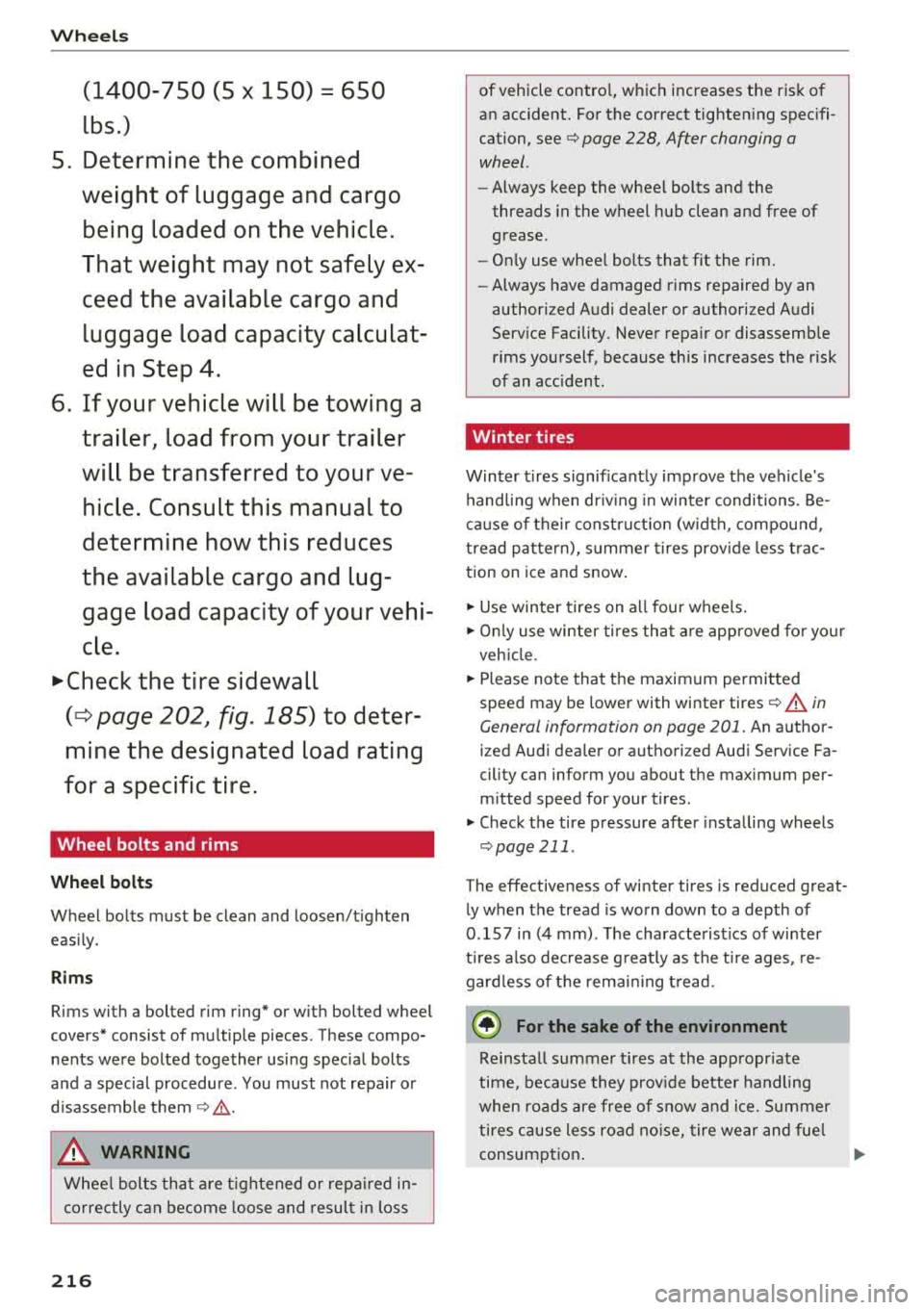
Wheels
(1400-750 (5 X 150) = 650
lbs.)
5 . Determin e the combined
w eig ht of lu ggage and cargo
b e in g load ed on the vehicle .
Th at w eight ma y not safel y ex
ce ed the avail abl e ca rg o and
lug gag e lo ad capac it y ca lculat
ed in St ep 4 .
6. If your vehi cle will be to wing a
tr aile r, lo ad fr om your tr ailer
w ill be transferred to your
ve
hicle . Con sult thi s manual to
d etermin e how thi s re du ces
th e av ail ab le carg o and lug
g age load capa cit y o f your v ehi
cle .
.,. Chec k the tir e s idewall
(c:::> pa ge 202 , fig . 185) to det er
min e the de sign ated load r ating
for a speci fic tire .
Wheel bolts and rims
Wheel bolts
Wheel bo lts must be clean and loosen/t ighten
eas ily.
Rims
Rims with a bolted rim ring* or w it h bolted whee l
covers* consist of mu ltip le pieces . These compo
nents we re bolted together using specia l bolts
a nd a special procedure . You must not repair or
d isassemble
them ¢_&. .
_& WARNING
Whee l bol ts th at ar e tightened o r rep air ed in
c orrectly c an become loose and resul t in loss
216
of vehicle contro l, w hich increases the risk o f
an accident. For the cor rect tig hten ing spec ifi
cation,
see¢ page 228, After changing a
wheel.
- Always keep the whee l bolts and the
threads in the wheel hub clean and free of
grease .
- Onl y use whee l bolts that fit the rim.
- Always have damaged rims repaired by an
author ized Audi dealer or authorized Audi
Serv ice Facility. Never repa ir or disassemb le
r ims yo urself, because th is increases the risk
of an acc ident.
Winter tires
Winter t ires signif icant ly imp rove the vehicle's
handling when dr iv ing in winter conditions. Be
c au se of their construct io n (w id th, compou nd,
t read pa ttern), s ummer tires prov ide less t rac
tion on ice and snow .
.,. Use winter tires on all four wheels.
.,. Only use winter tires that a re app roved fo r yo ur
veh icle .
.,. Please note that t he maximum permitted
speed may be lower with winter
tir es ¢ A in
G en eral information on pag e 201 .
An a uthor
i z ed Aud i dealer or authori zed Aud i Serv ice Fa
cility can inform you about the maximum per m itted speed for your tires .
.,. Check the tire pressure after installing wheels
ca:;, page 211 .
The effectiveness of winter tires is reduced great
ly when the tread is worn down to a depth of
0 .157 i n (4 mm) . The characte rist ics of winter
t ir es also decrease g reatly as the t ire ages , re
gard less of t he rema ining t read.
@ For the sake of the environment
Re insta ll summer t ires at the app ropr iate
time, bec ause they prov ide better handli ng
when ro ads are free of snow and ice. Summer
tires cause less roa d noise, tire wear and fue l
consumpt ion .
Page 219 of 266
a co .... N
" N .... 0 0 \,;J '
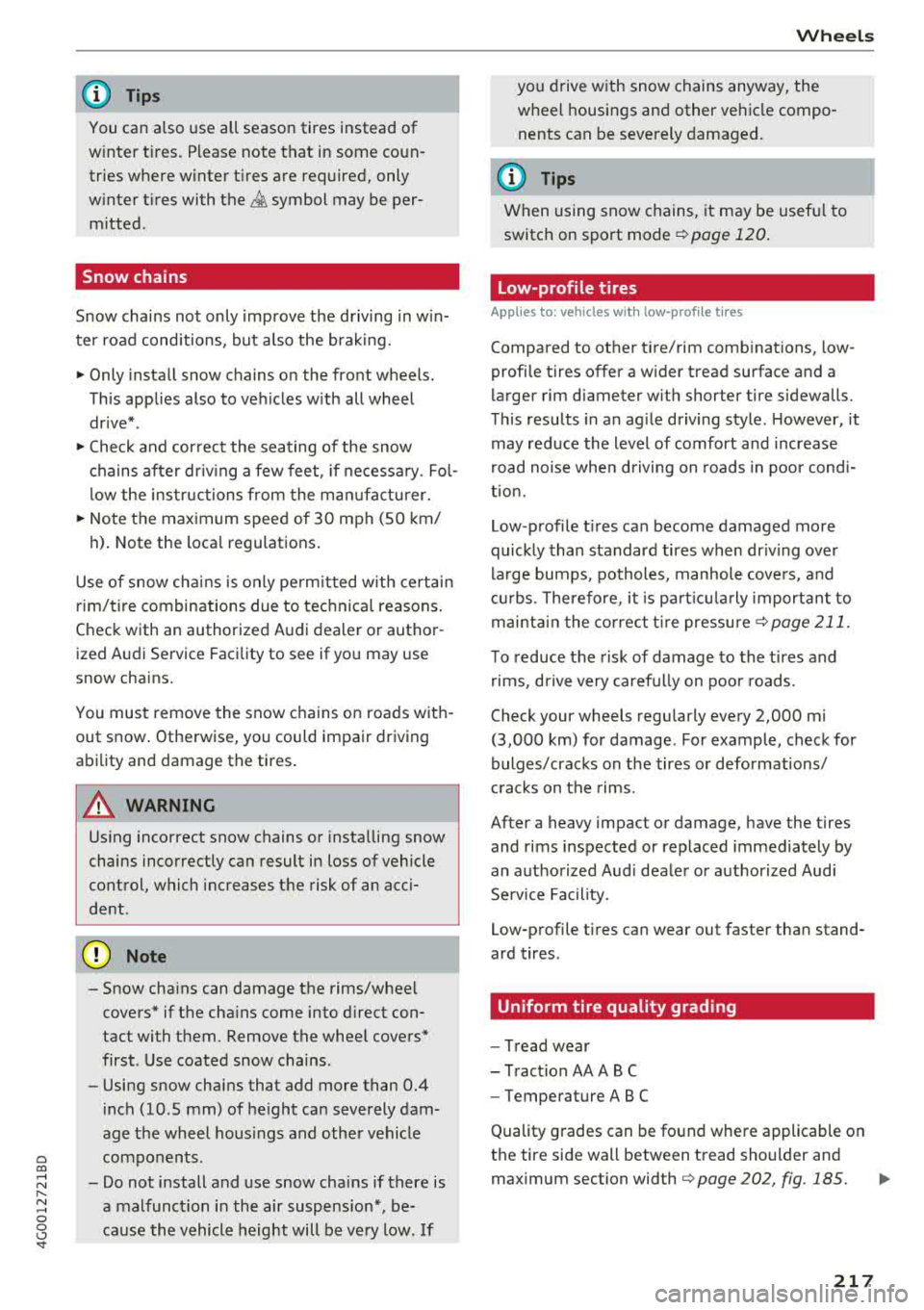
You can also use all season tires instead of
winter tires . Please note that in some coun
tries where winter tires are required, only
winter tires with
the ~ symbol may be per
mitted.
Snow chains
Snow chains not only improve the driving in win
ter road conditions, but also the braking .
.. Only install snow chains on the front wheels.
This applies also to vehicles with all wheel
drive* .
.. Check and correct the seating of the snow
chains after dr iv in g a few feet, if necessary . Fol
low the instructions from the manufacturer .
.. Note the maximum speed of 30 mph (SO km/
h). Note the loca l regulations.
Use of snow chains is only perm itted with certain
rim/tire combinations due to technical reasons.
Check with an authorized Audi dealer or author
ized Audi Service
Facility to see if you may use
snow chains.
You must remove the snow chains on roads with
out snow. Otherwise, you could impair driving
ability and damage the tires.
A WARNING
Using incorrect snow chains or installing snow
chains incorrectly can result in loss of vehicle
control, which increases the risk of an acci
dent .
{[J) Note
- Snow chains can damage the rims/wheel
covers* if the chains come into direct con
tact with them . Remove the wheel covers*
first . Use coated snow chains.
- Using snow chains that add more than 0.4
inch (10.5 mm) of height can severely dam
age the wheel housings and other vehicle
components.
- Do not install and use snow chains if there is
a malfunction in the air suspension*, be
cause the vehicle height will be very low. If
Wheels
you drive with snow chains anyway, the
wheel housings and other vehicle compo
nents can be severely damaged.
(D Tips
When using snow chains, it may be useful to
switch on sport
mode¢ page 120.
Low-profile tires
Applies to: vehicles with low-profile tires
Compared to other tire/rim combinations, low
profile tires offer a wider tread surface and a
larger rim diameter with shorter tire sidewalls.
This results in an agile driving style . However, it
may reduce the level of comfort and increase
road noise when driving on roads in poor condi
tion.
Low -profile tires can become damaged more
quickly than standard tires when driving over
large bumps, potholes, manhole covers , and
curbs . Therefore, it is particularly important to
maintain the correct tir e pressure
¢ page 211.
To reduce the risk of damage to the tires and
rims, drive very carefully on poor roads.
Check your wheels regularly every 2,000 mi
(3,000 km) for damage . For example, check for
bulges/cracks on the tires or deformations/
cracks on the rims.
After a heavy impact or damage, have the tires
and rims inspected or replaced immediately by
an authorized Audi dealer or authorized Audi
Service Facility.
Low-profile tires can wear out faster than stand
ard tires .
Uniform tire quality grading
-Tread wear
- Traction AA ABC
- Temperature ABC
Quality grades can be found where applicable on
the tire side wall between tread shoulder and maximum section width
¢ page 202, fig. 185 .
217
Page 226 of 266
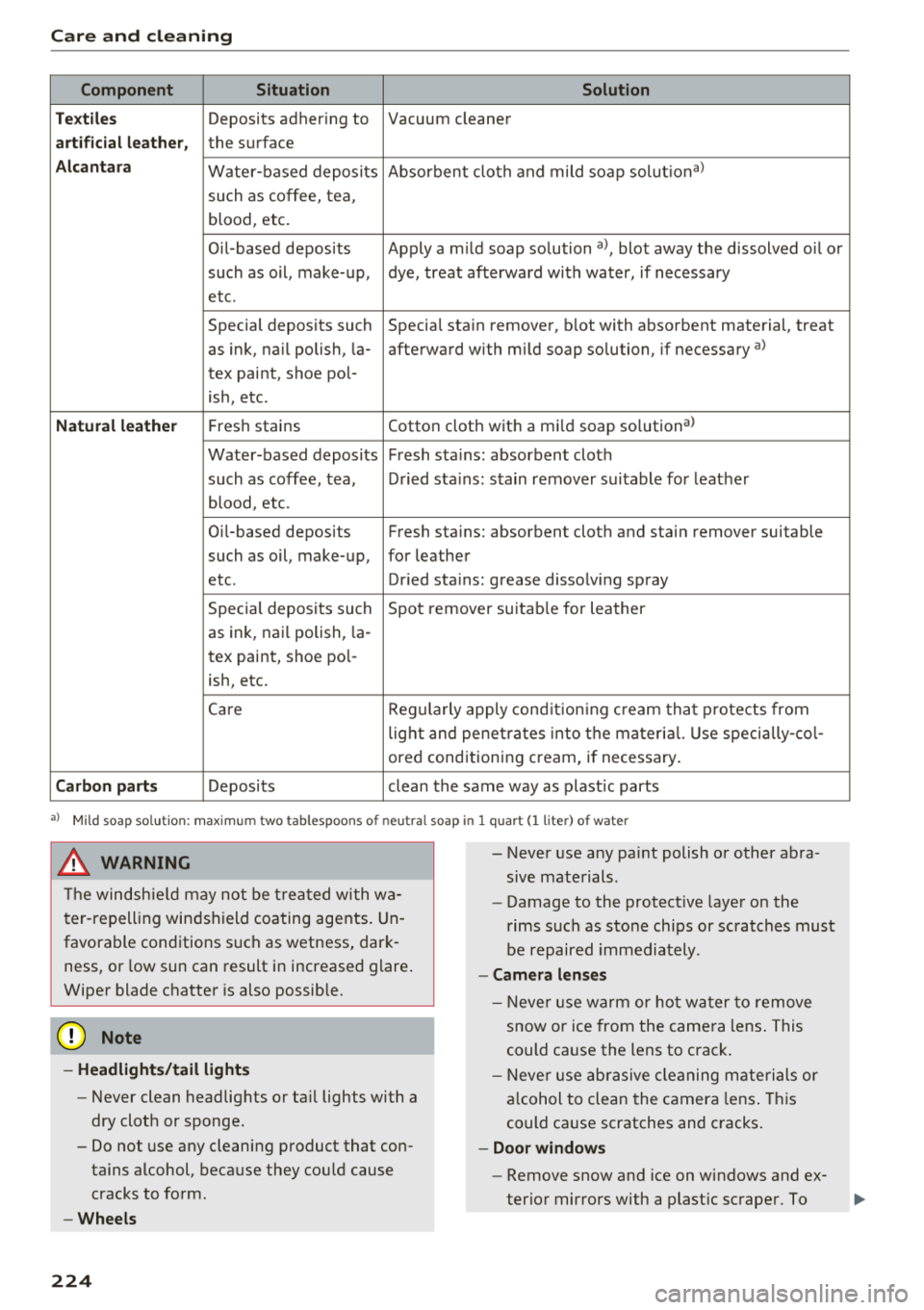
Care and cl eaning
Component Situation Solution
Tex tile s
Deposits adhering to Vacuum cleaner
art ifici al l eat her, the surface
A lca ntara Water -based deposits Absorbent cloth and mild soap solut
iona>
such as coffee, tea,
blood, etc.
O il-based deposits Apply a m ild soap solution
a), blot away the dissolved oil or
such as oil , make-up, dye, treat afterward with water, if necessary
etc.
Special deposits such Special stain remover, blot with absorbent material, treat
as ink, na il polish, la- afterward with mild soap solution, if necessary a)
tex paint, shoe pol-
ish, etc.
Natural leathe r Fresh stains Cotton cloth
with a mild soap so lutiona >
Water-based deposits Fresh stairns : absorbent cloth
such as coffee, tea, Dried sta ins : stain remover suitable for leather
blood, etc.
Oil -based deposits Fresh stairns : absorbent cloth and stain remover suitable
such as oil, make-up, for leather
etc. Dried stains : grease dissolving spray
Special deposits such Spot remover suitab le for leather
as ink, nai l polish, la -
tex paint, shoe pol-
ish, etc.
Care Regula rly apply cond it ion ing cream that p rotects from
lig ht and penetrates into the material. Use specia lly-co l-
ored conditioning cream, if necessary .
Carbon part s Deposits clean the same way as plastic parts
al Mild soap solution: maximum two tablespoons of neutral soap in 1 quart (1 liter) of water
_& WARNING
The windsh ie ld may not be treated wi th wa
ter-repelling windshield coating agents. Un
favorable conditions such as wetness, dark
ness, or low sun can result in increased glare.
Wiper blade chatter is also possible.
@ Note
-Headlight s/tail light s
-Never clean headlights or tail lights with a
dry cloth or sponge.
- Do not use any cleaning product that con
tains alcohol, because they could cause
cracks to form .
-Wheel s
224
- - Never use any paint polish or other abra
sive materials.
- Damage to the protect ive layer on the
rims such as stone chips or scratches must
be repaired immediately.
- Cam era lens es
- Neve r use wa rm or hot water to remove
snow or ice from the came ra lens . This
could cause the lens to crack .
- Neve r use ab rasive cleaning m aterials or
a lcohol to clean the camera lens . This
could cause scratches and cracks .
-Door wind ow s
- Remove snow and ice on windows and ex-
terior mirrors with a plast ic scraper. To