wheel AUDI A6 2018 Repair Manual
[x] Cancel search | Manufacturer: AUDI, Model Year: 2018, Model line: A6, Model: AUDI A6 2018Pages: 266, PDF Size: 41.38 MB
Page 215 of 266
a co .... N
" N .... 0 0 \,;J '
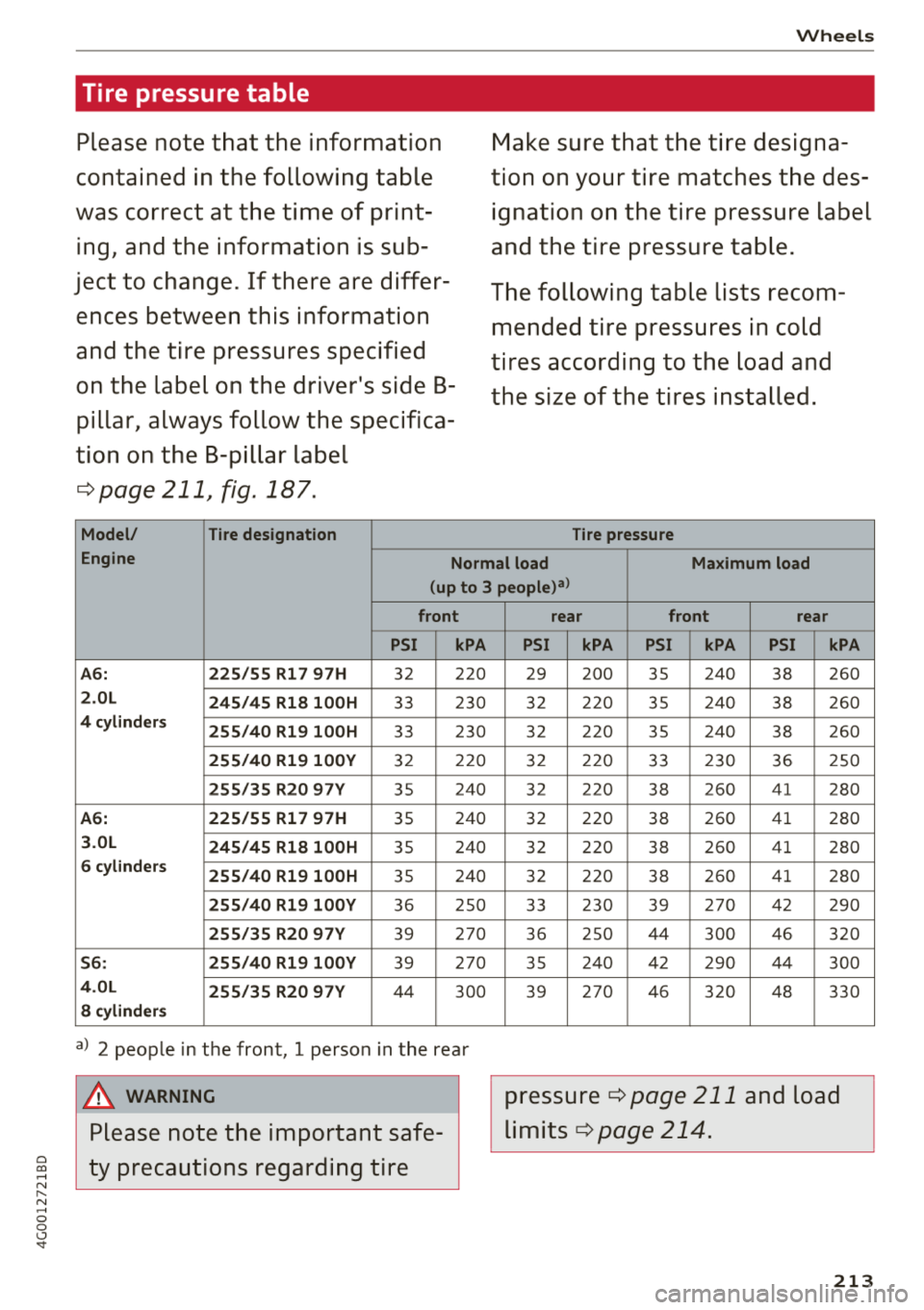
Please note that the information
contained in the following table
was correct at the time of print
ing, and the information is sub
ject to change. If there are differ
ences between this information
and the tire pressures specified
on the label on the driver's side B
pillar, always follow the specifica
tion on the B-pillar label
¢page 211, fig. 187.
Model/ Tire designation
Wheels
Make sure that the tire designa
tion on your tire matches the des
ignation on the tire pressure label
and the tire pressure table.
The following table lists recom mended tire pressures in cold
tires according to the load and
the size of the tires installed.
Tire pressure
Engine Normal load Maximum load
(up to 3
people)3>
front
PSI kPA
A6:
225/55 Rl 7 97H 3 2 220
2.0L
245/45 Rl8 l00H 33 230
4 cylinders 255/40 Rl9 l00H 33 230
255/40 Rl9 l00Y 32 220
255/35 R20 97Y 35 2
40
A6: 225/55 Rl7 97H 35 240
3.0L
245/45 Rl8 l00H 35 240
6
cylinders 255/40 Rl9 l00H 35 240
255/40 Rl9 l00Y 36 250
255/35 R20 97Y 39 270
56: 255/40 Rl9 l00Y 39 270
4.0L
255/35 R20 97Y 44 300
8 cylinders
a) 2 people in the front, 1 person in the rear
A WARNING
Please note the important safe
ty precautions regarding tire
rear front rear
PSI kPA PSI kPA PSI kPA
29 200 35 240
38 260
32 220 35 240 38 260
32 220 35 240
38 260
32 220 33 230 36 250
3 2 220
38 2
60 4 1 280
32 220 38 260 41 280
32 220 38 260 41 280
32 220 38 260 41 280
33 230
39 270 42 290
36 250 44 300 46 320
35 240 42 290 44 300
39 270 46 320 48 330
pressure ¢page 211 and load
limits
¢ page 214.
213
Page 216 of 266
Wheels
Tires and vehicle load limits
There are limits to the amount of
load or weight that any vehicle
and any tire can carry. A vehicle
that is overloaded will not handle
well and is more difficult to stop. Overloading can not only lead to loss of vehicle control, but can al
so damage important parts of the
vehicle and can lead to sudden tire failure, including a blowout
and sudden deflation that can
cause the vehicle to crash.
Your safety and that of your pas sengers also depends on making
sure that load limits are not ex
ceeded. Vehicle load includes ev
erybody and everything in and on
the vehicle. These load limits are
technically referred to as the vehi
cle's
Gross Vehicle Weight Rat
ing
("GVWR").
The "GVWR" includes the weight
of the basic vehicle, all factory in
stalled accessories, a full tank of
fuel, oil, coolant and other fluids plus maximum load. The maxi
mum load includes the number of
passengers that the vehicle is in
tended to carry ("seating capaci
ty") with an assumed weight of 150 lbs. (68 kg) for each passen-
214
ger at a designated seating posi
tion and the total weight of any luggage in the vehicle. If you tow
a trailer, the weight of the trailer
hitch and the tongue weight of
the loaded trailer must be includ
ed as part of the vehicle load.
The
Gross Axle Weight Rating
("GAWR") is the maximum load
that can be applied at each of the
vehicle's two axles.
The fact that there is an upper limit to your vehicle's Gross Vehi
cle Weight Rating means that the
total weight of whatever is being
carried in the vehicle (including
the weight of a trailer hitch and
the tongue weight of the loaded
trailer) is limited. The more pas
sengers in the vehicle or passen
gers who are heavier than the
standard weights assumed mean
that less weight can be carried as
luggage.
The Gross Vehicle Weight Rating
and the Gross Axle Weight Rating
are listed on the safety compli
ance sticker label located on the
driver's side B-pillar.
Page 217 of 266
0 0)
A WARNING
Overloading a vehicle can cause
loss of vehicle control, a crash
or other accident, serious per
sonal injury, and even death .
- Carrying more weight than
your vehicle was designed to
carry will prevent the vehicle
from handling properly and
increase the risk of the loss of
vehicle control.
- The brakes on a vehicle that has been overloaded may not
be able to stop the vehicle
within a safe distance .
- Tires on a vehicle that has
been overloaded can fail sud
denly, including a blowout and
sudden deflation, causing loss
of control and a crash .
- Always make su re that the to
tal load being transported - inc lud ing the weight of a trail
er hitch and the tongue
weight of a loaded trailer -
does not make the vehicle
heavier than the vehicle's
Gross Vehicle We ight Rating.
Determining correct load
limit
~ Use the example below to calcu-
"' 8 late the total weight of the pass ..
Wheels
sengers and luggage or other
things that you plan to transport so that you can make sure that
your vehicle will not be overload
ed .
Steps for Determining Correct
Load Limit
1 . L ocate the statement "THE
COMB INED WEIGH T OF OCCU
P ANTS AND CARGO S HOU LD
N EVER EXCEED XXX KG OR XXX
L BS " on your vehicle's placard
(tire inflation pressure label)
<=> page 211, fig. 187.
2. Determine the combined
weight of the driver and pas
sengers that will be riding in
your vehicle .
3 . Subtract the combined weight
of the driver and passengers
from
"XXX" kilograms or "XXX"
pounds shown on the sticker
<=> page 211, fig . 187 .
4. The resulting figure equals the
available amount of cargo and
luggage load capacity . For ex
ample, if the "XXX" amount
equa ls 1400 lbs. and there will
be five 150 lbs. passengers in
your vehicle, the amount of available cargo and luggage load capacity is 650 lbs.
.,.
2 15
Page 218 of 266
Wheels
(1400-750 (5 X 150) = 650
lbs.)
5 . Determin e the combined
w eig ht of lu ggage and cargo
b e in g load ed on the vehicle .
Th at w eight ma y not safel y ex
ce ed the avail abl e ca rg o and
lug gag e lo ad capac it y ca lculat
ed in St ep 4 .
6. If your vehi cle will be to wing a
tr aile r, lo ad fr om your tr ailer
w ill be transferred to your
ve
hicle . Con sult thi s manual to
d etermin e how thi s re du ces
th e av ail ab le carg o and lug
g age load capa cit y o f your v ehi
cle .
.,. Chec k the tir e s idewall
(c:::> pa ge 202 , fig . 185) to det er
min e the de sign ated load r ating
for a speci fic tire .
Wheel bolts and rims
Wheel bolts
Wheel bo lts must be clean and loosen/t ighten
eas ily.
Rims
Rims with a bolted rim ring* or w it h bolted whee l
covers* consist of mu ltip le pieces . These compo
nents we re bolted together using specia l bolts
a nd a special procedure . You must not repair or
d isassemble
them ¢_&. .
_& WARNING
Whee l bol ts th at ar e tightened o r rep air ed in
c orrectly c an become loose and resul t in loss
216
of vehicle contro l, w hich increases the risk o f
an accident. For the cor rect tig hten ing spec ifi
cation,
see¢ page 228, After changing a
wheel.
- Always keep the whee l bolts and the
threads in the wheel hub clean and free of
grease .
- Onl y use whee l bolts that fit the rim.
- Always have damaged rims repaired by an
author ized Audi dealer or authorized Audi
Serv ice Facility. Never repa ir or disassemb le
r ims yo urself, because th is increases the risk
of an acc ident.
Winter tires
Winter t ires signif icant ly imp rove the vehicle's
handling when dr iv ing in winter conditions. Be
c au se of their construct io n (w id th, compou nd,
t read pa ttern), s ummer tires prov ide less t rac
tion on ice and snow .
.,. Use winter tires on all four wheels.
.,. Only use winter tires that a re app roved fo r yo ur
veh icle .
.,. Please note that t he maximum permitted
speed may be lower with winter
tir es ¢ A in
G en eral information on pag e 201 .
An a uthor
i z ed Aud i dealer or authori zed Aud i Serv ice Fa
cility can inform you about the maximum per m itted speed for your tires .
.,. Check the tire pressure after installing wheels
ca:;, page 211 .
The effectiveness of winter tires is reduced great
ly when the tread is worn down to a depth of
0 .157 i n (4 mm) . The characte rist ics of winter
t ir es also decrease g reatly as the t ire ages , re
gard less of t he rema ining t read.
@ For the sake of the environment
Re insta ll summer t ires at the app ropr iate
time, bec ause they prov ide better handli ng
when ro ads are free of snow and ice. Summer
tires cause less roa d noise, tire wear and fue l
consumpt ion .
Page 219 of 266
a co .... N
" N .... 0 0 \,;J '
You can also use all season tires instead of
winter tires . Please note that in some coun
tries where winter tires are required, only
winter tires with
the ~ symbol may be per
mitted.
Snow chains
Snow chains not only improve the driving in win
ter road conditions, but also the braking .
.. Only install snow chains on the front wheels.
This applies also to vehicles with all wheel
drive* .
.. Check and correct the seating of the snow
chains after dr iv in g a few feet, if necessary . Fol
low the instructions from the manufacturer .
.. Note the maximum speed of 30 mph (SO km/
h). Note the loca l regulations.
Use of snow chains is only perm itted with certain
rim/tire combinations due to technical reasons.
Check with an authorized Audi dealer or author
ized Audi Service
Facility to see if you may use
snow chains.
You must remove the snow chains on roads with
out snow. Otherwise, you could impair driving
ability and damage the tires.
A WARNING
Using incorrect snow chains or installing snow
chains incorrectly can result in loss of vehicle
control, which increases the risk of an acci
dent .
{[J) Note
- Snow chains can damage the rims/wheel
covers* if the chains come into direct con
tact with them . Remove the wheel covers*
first . Use coated snow chains.
- Using snow chains that add more than 0.4
inch (10.5 mm) of height can severely dam
age the wheel housings and other vehicle
components.
- Do not install and use snow chains if there is
a malfunction in the air suspension*, be
cause the vehicle height will be very low. If
Wheels
you drive with snow chains anyway, the
wheel housings and other vehicle compo
nents can be severely damaged.
(D Tips
When using snow chains, it may be useful to
switch on sport
mode¢ page 120.
Low-profile tires
Applies to: vehicles with low-profile tires
Compared to other tire/rim combinations, low
profile tires offer a wider tread surface and a
larger rim diameter with shorter tire sidewalls.
This results in an agile driving style . However, it
may reduce the level of comfort and increase
road noise when driving on roads in poor condi
tion.
Low -profile tires can become damaged more
quickly than standard tires when driving over
large bumps, potholes, manhole covers , and
curbs . Therefore, it is particularly important to
maintain the correct tir e pressure
¢ page 211.
To reduce the risk of damage to the tires and
rims, drive very carefully on poor roads.
Check your wheels regularly every 2,000 mi
(3,000 km) for damage . For example, check for
bulges/cracks on the tires or deformations/
cracks on the rims.
After a heavy impact or damage, have the tires
and rims inspected or replaced immediately by
an authorized Audi dealer or authorized Audi
Service Facility.
Low-profile tires can wear out faster than stand
ard tires .
Uniform tire quality grading
-Tread wear
- Traction AA ABC
- Temperature ABC
Quality grades can be found where applicable on
the tire side wall between tread shoulder and maximum section width
¢ page 202, fig. 185 .
217
Page 220 of 266
Wheels
For example: Tr ead wea r 200, Traction AA, Tem
pe rature
A .
All passenge r ca r tires m ust conform to Federa l
Safety Requi rements in addition to these g rades.
Tread wear
The tread wear grade is a comparat ive rat ing
based on the wear rate of the t ire when tested
unde r contro ll ed conditions o n a specified gov
e rnmen t test co urse.
For example, a tire graded 150 would wear one
and one ha lf ( 11/2) t imes as well on the gove rn
ment course as a tire g raded 1 00.
The relative performance of t ires depends upon
the actual condi tions of their use, howeve r, and
may depart s ignificant ly from the norm d ue to
va ria tions in driving hab its, service pra ctices and
d ifferences in road ch aract eris tics and clim ate.
Traction
The traction grades, from highest to lowest, are
AA, A, Band
C. T hose grades represent the t ire's
ab ility to stop on wet pavement as meas ured un
de r contro lled condi tions o n specified gove rn
men t tes t su rfa ces of asp ha lt and conc re te. A tire
mar ked C m ay have poor trac tion pe rforma nce
q _&. ,
Temperature
The temperature grades a re A (t he highest), B,
and C, rep resent ing the tire' s resistan ce to t he
gener ation o f heat and it s abili ty to d iss ipate
heat when tested unde r controlled condi tions on
a specified in door laboratory test whee l.
Susta ined hig h tem perature can cause t he ma te
r ial of the t ire to dege nerate and re duce tire life,
an d excess ive temperatu re can lead to sudden
tire fai lure
q .&. .
The gr ade C co rresponds to a leve l of perfor m
a nce wh ich all passenge r car tir es mus t mee t un
der t he Fede ra l Mo tor Vehicle Safety Standar d
No . 109 . Grades Band A represent higher leve ls
of perfo rmance on the labo rato ry test w heel than
the min imum required by law.
218
A WARNING -
The tract io n grade assigned to this t ire is
based on straight-a head braking traction
tes ts, a nd does no t in clude acceleration, cor
ne ring, hy droplaning or pea k traction cha rac
teris tics.
A WARNING
The tem perat ure grade fo r thi s tire is estab
lishe d fo r a t ire th at is p roperl y infl ated and
n ot overloaded . Excessive s peed, under infla
tion, o r excessive loa ding, either separate ly or
i n comb inat io n, can cause heat bu ildup and
possib le t ire fai lure.
A WARNING
-
-
Tempe rature grades app ly to t ires that are
proper ly inflated a nd not over or under inflat
ed .
Tire pressure monitoring
system
ill General notes
Each tire, including the spare (if prov ided),
shou ld be checked monthly when cold and inflat
ed to the i nflat ion press ure recommended by the
vehicle manufacture r on the veh icle placard or
ti re infla tion p ressure labe l. (If your ve hicle has
t ir es of a diffe rent size t han the si ze ind icated on
t h e ve hicle placard or tire i nflat io n press ure la
bel, you sho uld dete rm ine the proper tire in fla
tion press ure for those tires) .
As a n ad ded safety featu re, you r vehicle has been
equipped wi th a t ire p ress ure mon itor ing system
(TPMS) t hat ill umi nates a low tire p ressure tell
ta le w hen one or mo re of your tires is s ignificant
l y under -inflated. According ly, w hen the low ti re
pressure telltale illum inates, you sho uld stop and
c h eck your t ires as soon as possible, and inflate
them to the proper pressure. Dr iv ing on a sign ifi
cant ly under -inflated t ire ca uses the t ire to over
heat and ca n lead to tire fa ilu re . U nder-inflation
also red uces fue l eff ic iency a nd tire tread life,
and may affect t he ve hicl e's handling a nd s top-
ping ability.
II>-
Page 221 of 266
a co ,...,
N
" N ,...,
0 0 \,;J '
proper tire maintenance, and it is the driver's re
sponsib ility to ma intain correct tire pressure,
even if under-inf lation has not reached the level
to trigger illum ination of the TPMS low tire pres
sure telltale .
Your veh icle has also been equ ipped w ith a TPMS
malfunct ion indicator to indicate when the sys
tem is not operating properly. The TPMS mal
function indicator is combined w ith the low tire
pressure telltale. Whe n the system detects a
malfunct ion, the telltale will flash for approxi
mately one minu te and then remain cont inuous ly
i llum inated. This sequence wi ll continue upon
subseq uen t veh icle start -ups as long as the ma l
function exists.
When the malfunct ion i ndicator is ill uminated,
the system m ay not be ab le to detec t or sig nal
l ow tire press ure as intended. TPMS ma lfunctions
may occur for a var iety of reasons, incl uding the
installation of replacement or alternate tires or
wheels on the vehicle that prevent the TPMS
from functioning properly. Always check the TPMS malfunction telltale after rep lacing one or
more t ires or whee ls on your vehicle to ensu re
that t he replacement or alternate ti res and
wheels allow the TPMS to cont inue to func tion
p roperly.
If the tire pressure monitoring system
indicator appears
A ppl ies to: ve hicles with Tire Pressure Moni toring System in
di cato r
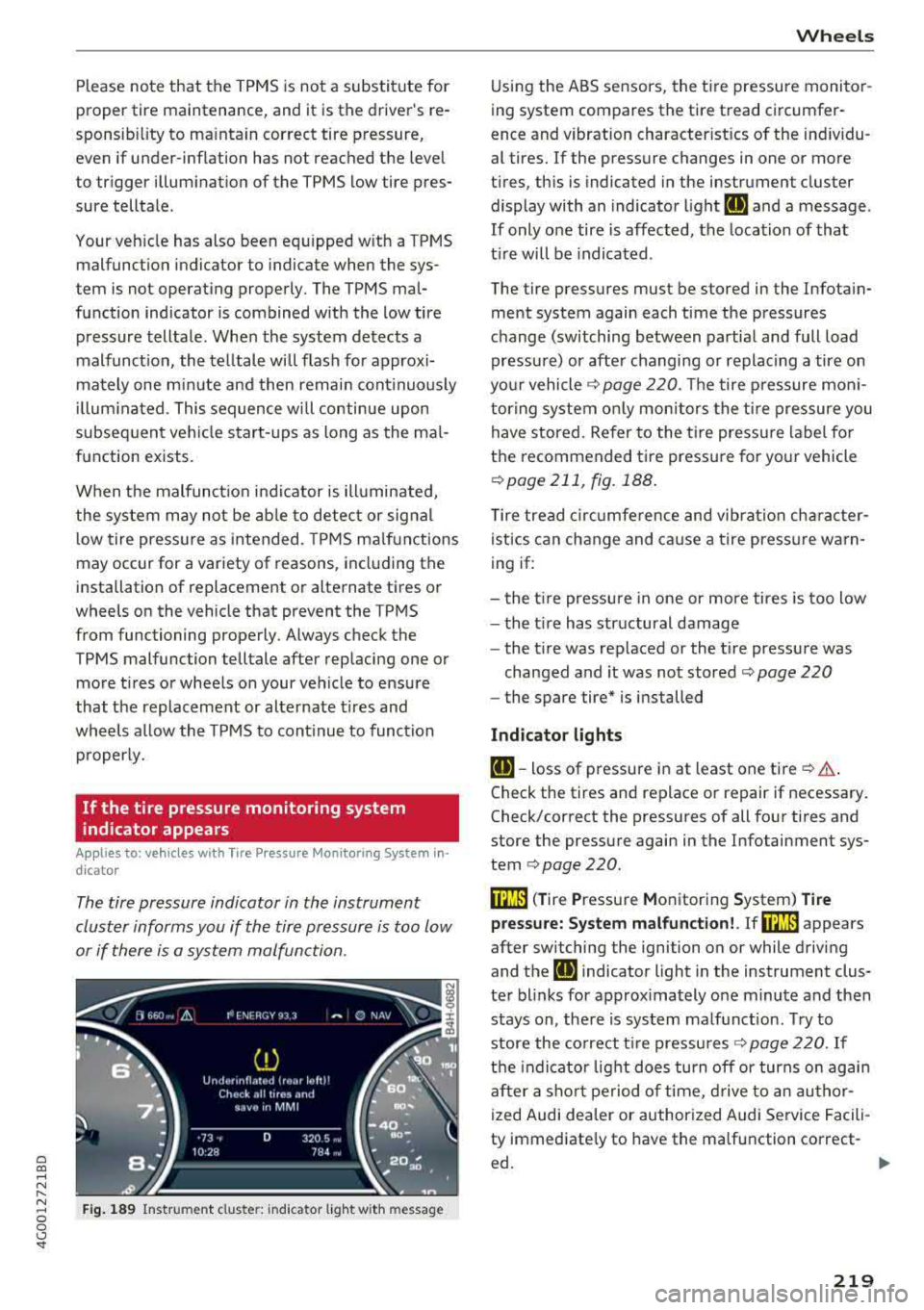
The tire pressure indicator in the instrument
cluster informs you if the tire pressure is too low
or if there is a system malfunction .
Fig. 1 89 Instrument cl uste r: in dicator l ight w it h m essage
Wheels
Using the ABS sensors, the tire pressure monito r
ing system compares the tire tread circumfer
ence and vibration characterist ics of the ind ividu
al tires. If the pressure changes in one or more
t ires, th is is indicated in the instrument cluster
display with an indicator l ight
IE and a message .
If only o ne tire is affected, the location of tha t
t ir e will be indicated .
The tire pressures must be stored in the Infotain ment system again each time the pressures
change (switching between partial and full load
pressure) or afte r changing or replac ing a tire on
yo ur vehicle
Q page 220. The tire p ressure mon i
tor ing system on ly mon itors the t ire pressure you
have stored. Refer to the t ire press ure label fo r
the recommended ti re pressure for yo ur vehicle
Q page 211, fig. 188 .
Tire tread c ircu mfe rence and vibr ation cha racter
istics can change and ca use a tire press ure warn
ing if:
- the t ire pressure in one or more tires is too low
- the t ire has str uctural damage
- the t ire was replaced or the t ire pressure was
changed and it was not stored
Q page 220
- the spare tire* is i nstalled
Indicator light s
IE-toss of pressure in at least one tire Q & .
Check the tires and replace or repair if necessary .
Check/correct the pressures of all four tires and
store the pressu re again in the Infotainment sys
tem
Q page 220.
m ( T ire Pressure Monitoring System) Ti re
pressure: System malfunction!.
If rn:m appears
after switching the ignition on or while driving
and the
IE indicator light in the instrument clus
te r blinks for approx imately one minute and then
stays on, the re is system malf unct ion . Try to
store the co rrect t ire pressu res
Q page 220. If
t h e indicat or light does turn off or turns on agai n
af ter a sho rt pe riod o f time, d rive to an au thor
ized Audi dea ler or authorized Audi Service Facili
ty immediate ly to have the ma lfunction correct-
ed.
~
219
Page 222 of 266
Wheels
A WARNING
-If the t ire pressure indicator appears in the
display, reduce your speed immediate ly and
avoid any hard s teer ing or braking maneu
vers . Stop as soon as possib le and check the
t ir es and thei r pressu re .
- The driver is responsib le for main taining the
correct tire pressure. You mus t check t he
t ir e pressure regu larly.
- Under certain conditions (such as a sporty
dr iv ing style, winter cond itions o r unpaved
ro ads), the tire p ressure mon itoring system
in dicator may be delaye d.
(D Tips
- The t ire pressu re monitoring sys tem can al
so stop work ing when there is an ESC mal
fun ct ion.
- Using snow chains may result in a system
malfu nction.
- The t ire pressu re monitoring sys tem in your
A udi was calibrated with "A udi Orig inal
T ires "~ page 208. Using these ti res is re c
ommended.
Storing tire pressures
Applies to: vehicles with Tir e Pressure Monitor ing System in
dicator
I f the tire pressure changes or a tire is replaced,
it must be confirmed in the Infotainment sys tem .
.,. Make sur e before sto ring that t he tire pressures
of a ll fo ur t ires meet the specified val ues and
are ada pted to the load
c:;> page 211 .
.,. Switch the ign ition on .
.,. Se lect : the ICARI fu nction bu tton> ( Car )* Sys
tems
con trol button > Service & control > Tire
pre ssure monitor > Store tire pre ssure > Yes,
store now .
(D Tips
Do not store the tire pre ssu res i f snow chains
are installed.
220
Page 224 of 266
Care and cl eaning
- To reduce the risk of cuts, protect yourself
from sharp metal components when wash ing the underbody or the inside of the wheel
housings .
- After washing the vehicle, the braking effect
may be delayed due to mo isture on the
brake rotors or ice in the winter . This in
c reases the risk of an acc ident. The brakes
must be d ried first w ith a few careful b rake
applica tions.
@ Note
- If you wash the veh icle in an automatic car
wash, you m ust fold the exte rior m irrors i n
to reduce the risk of damage to the mirrors.
Power folding exte rior m irro rs* must o nly
be fo lded in and out using the powe r folding
funct ion .
- To reduce t he risk of paint damage , do no t
wash the vehi cle i n direct sunlig ht. - T
o red uce the risk of damage to the s urface,
do not use insect removing sponges, kitchen
sponges o r similar items .
- Matte finish painted vehicle components:
- To reduce the r isk of damage to the sur-
face, do not use pol ish ing agents or hard
wax.
- Never use protective wax. It can destroy
the matte finish effect .
- Do not place any stickers or magnetic
signs on vehicle parts painted with matte
f inish paint. The paint could be damaged
when the stickers or magnets a re re
moved.
@ For the sake of the environment
Only wash the veh icle in facilities spec ially de
s igned for that pu rpose. This will reduce the
r isk of dirty wate r contam inated with o il from
en te ring the sewe r system.
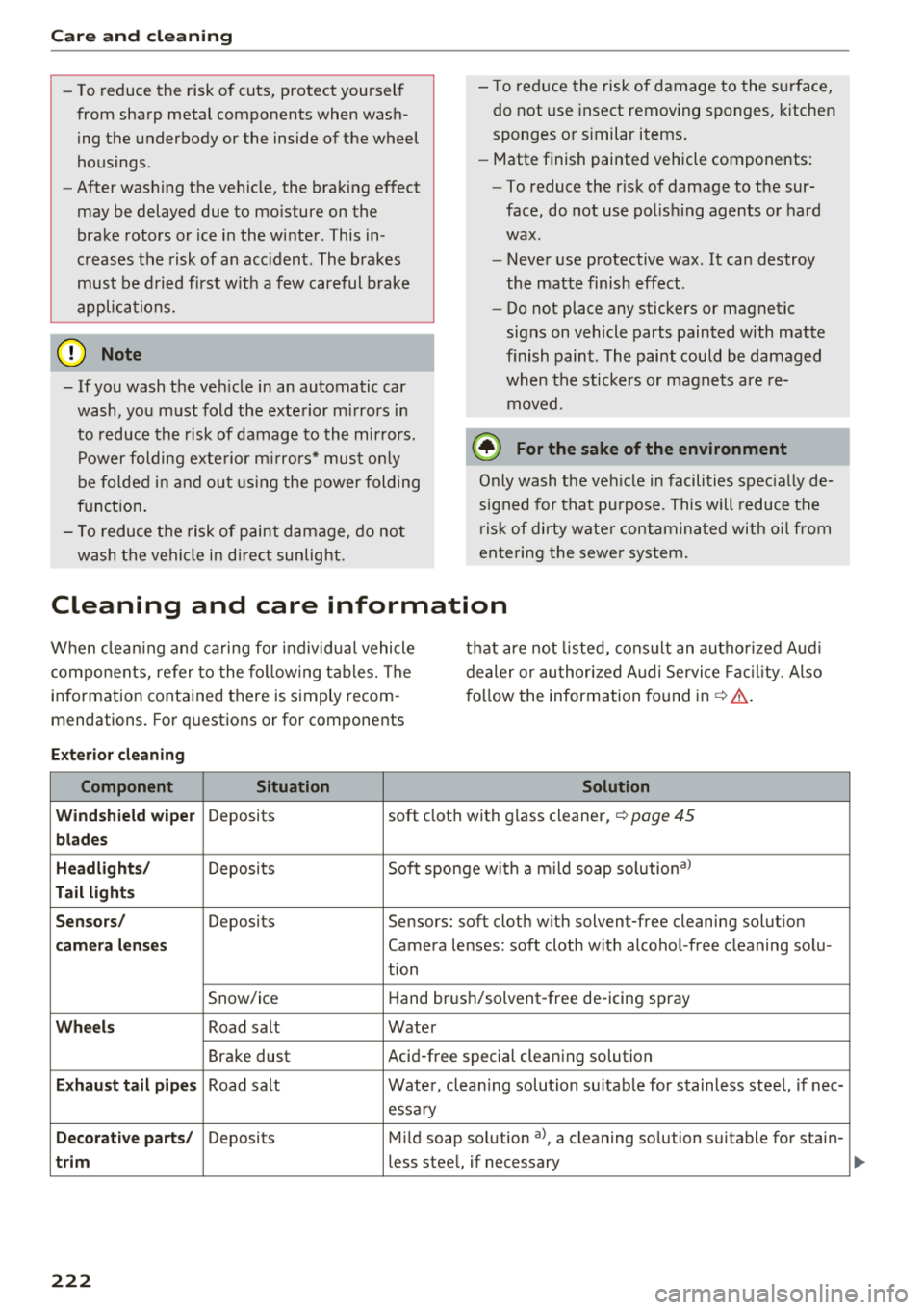
Cleaning and care information
W hen clea ning and ca ring for ind ividua l vehicle
components, refer to the fo llow ing tables. The
information contained there is simply recom
mendations. For questions or for components t
h at are not listed, cons ult an autho rized Audi
dealer or author ized A udi Servi ce Fac ility. Also
fo llow the information found
in ¢,&. .
Exterior cl eanin g
Component Situation Solution
Wind shield wiper
Deposits soft cloth with glass cleaner,
¢ page 45
blades
Headli ght s/
Deposits Soft sponge with a mild soap so lution3
)
Tail light s
S en sors /
Deposits Sensors: soft cloth with solvent-free cleaning solution
cam era l ens es Camera lenses: soft cloth w ith alcohol -free cleaning solu-
tion
Snow/ice Hand brush/solvent-free de -icing spray
Wheels Road salt Water
Brake dust Acid-free special cleaning solution
E
xhaust tail pip es Road salt Water, clean ing solution su itab le for stainless stee l, if nee-
essary
D ecor ativ e part s/ Deposits Mild soap solution a), a cleaning solution suitable for stain-
trim less steel, if necessary
222
Page 226 of 266
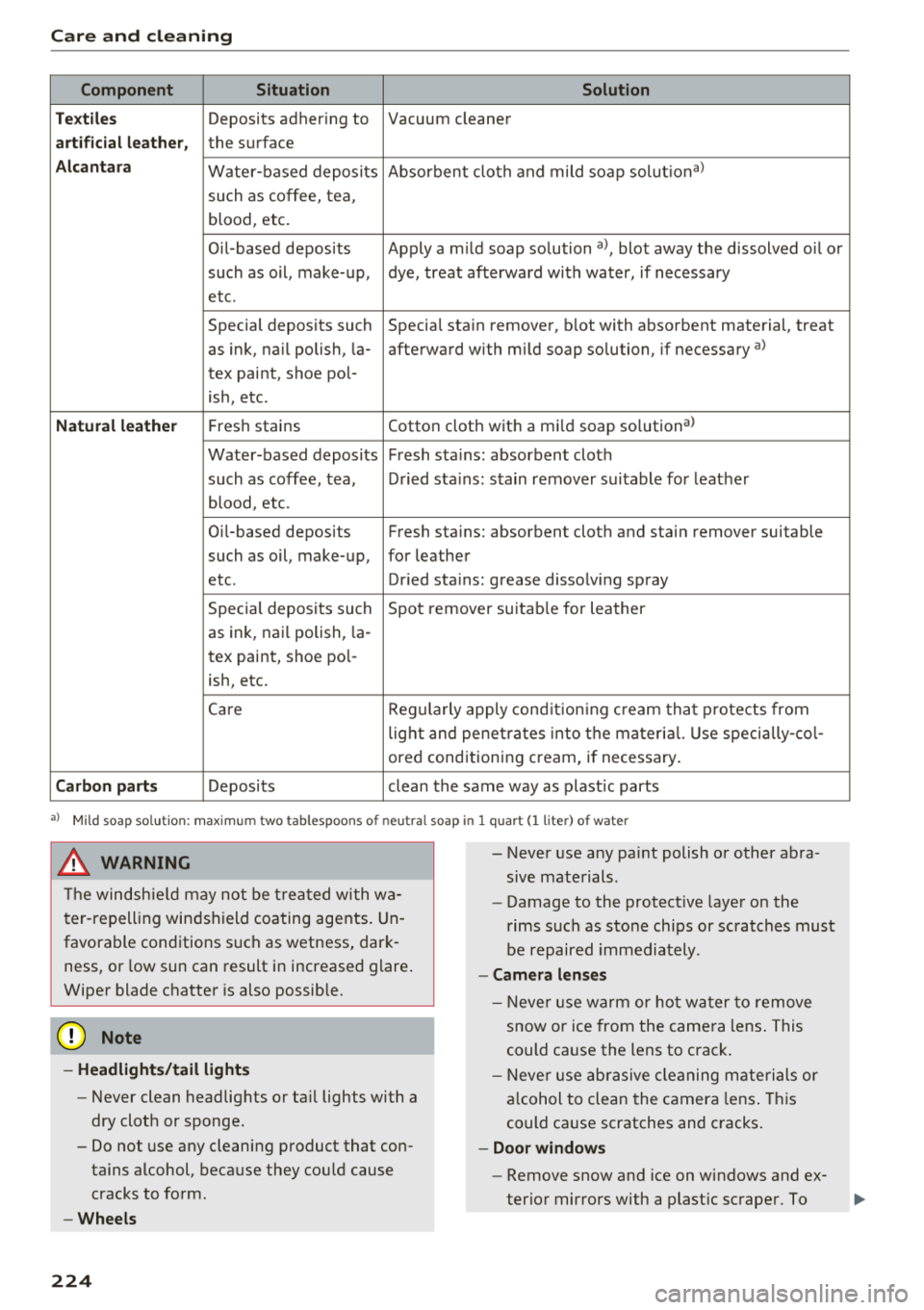
Care and cl eaning
Component Situation Solution
Tex tile s
Deposits adhering to Vacuum cleaner
art ifici al l eat her, the surface
A lca ntara Water -based deposits Absorbent cloth and mild soap solut
iona>
such as coffee, tea,
blood, etc.
O il-based deposits Apply a m ild soap solution
a), blot away the dissolved oil or
such as oil , make-up, dye, treat afterward with water, if necessary
etc.
Special deposits such Special stain remover, blot with absorbent material, treat
as ink, na il polish, la- afterward with mild soap solution, if necessary a)
tex paint, shoe pol-
ish, etc.
Natural leathe r Fresh stains Cotton cloth
with a mild soap so lutiona >
Water-based deposits Fresh stairns : absorbent cloth
such as coffee, tea, Dried sta ins : stain remover suitable for leather
blood, etc.
Oil -based deposits Fresh stairns : absorbent cloth and stain remover suitable
such as oil, make-up, for leather
etc. Dried stains : grease dissolving spray
Special deposits such Spot remover suitab le for leather
as ink, nai l polish, la -
tex paint, shoe pol-
ish, etc.
Care Regula rly apply cond it ion ing cream that p rotects from
lig ht and penetrates into the material. Use specia lly-co l-
ored conditioning cream, if necessary .
Carbon part s Deposits clean the same way as plastic parts
al Mild soap solution: maximum two tablespoons of neutral soap in 1 quart (1 liter) of water
_& WARNING
The windsh ie ld may not be treated wi th wa
ter-repelling windshield coating agents. Un
favorable conditions such as wetness, dark
ness, or low sun can result in increased glare.
Wiper blade chatter is also possible.
@ Note
-Headlight s/tail light s
-Never clean headlights or tail lights with a
dry cloth or sponge.
- Do not use any cleaning product that con
tains alcohol, because they could cause
cracks to form .
-Wheel s
224
- - Never use any paint polish or other abra
sive materials.
- Damage to the protect ive layer on the
rims such as stone chips or scratches must
be repaired immediately.
- Cam era lens es
- Neve r use wa rm or hot water to remove
snow or ice from the came ra lens . This
could cause the lens to crack .
- Neve r use ab rasive cleaning m aterials or
a lcohol to clean the camera lens . This
could cause scratches and cracks .
-Door wind ow s
- Remove snow and ice on windows and ex-
terior mirrors with a plast ic scraper. To