child restraint AUDI A6 2018 Owners Manual
[x] Cancel search | Manufacturer: AUDI, Model Year: 2018, Model line: A6, Model: AUDI A6 2018Pages: 266, PDF Size: 41.38 MB
Page 51 of 266
a
Rear head restraints
Applies to: ve hicles with a djustable head restra ints
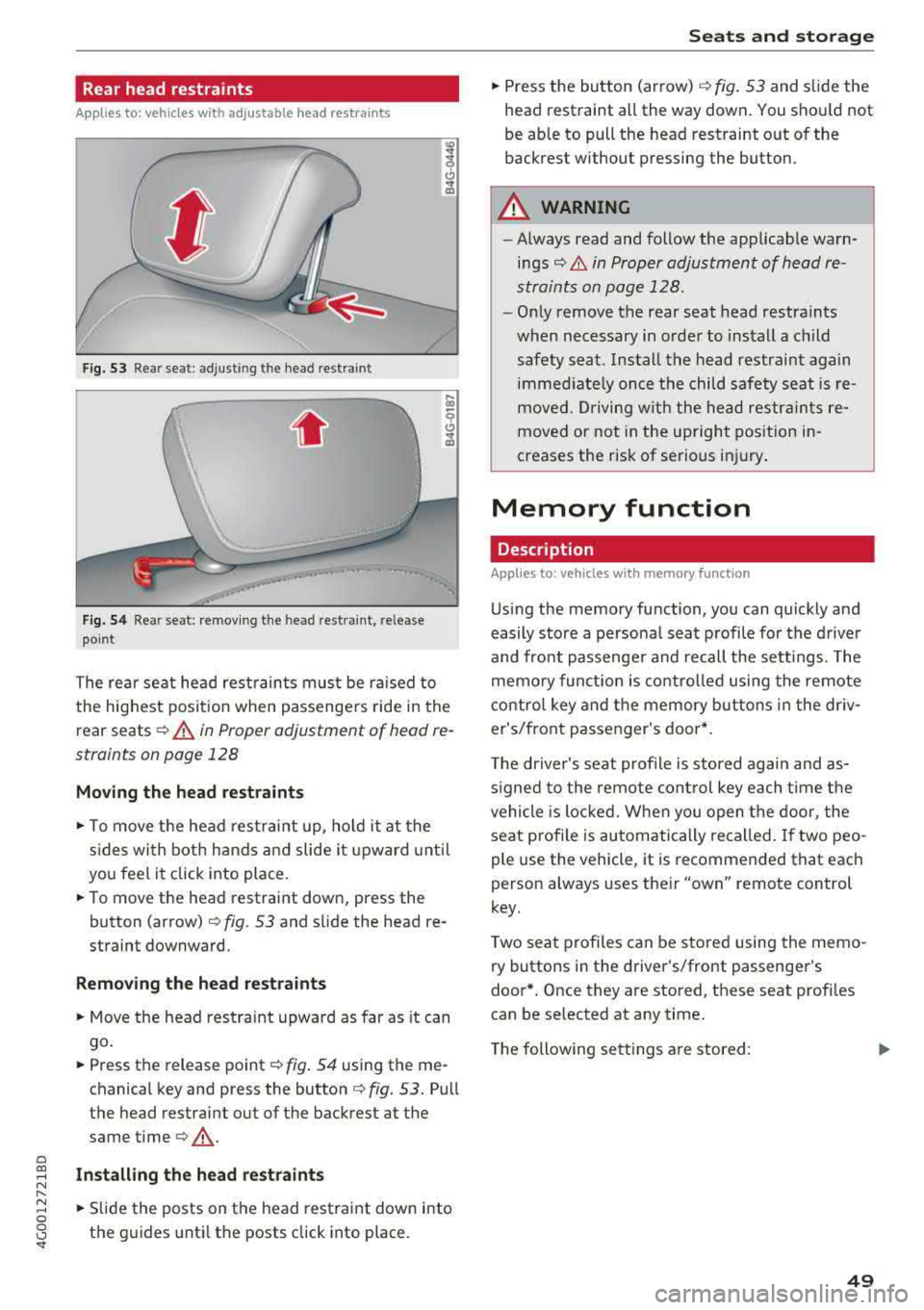
F ig. 53 Rea r seat: adjusti ng the head restraint
Fig. 54 Rear seat: remov ing the head restra int, release
point
The rear seat head restrain ts must be ra ised to
the highest posit ion when passengers ride in the
rear seats
c::> A in Proper adjustment of head re
straints on page 128
Moving the head rest raints
.,. To move the head rest raint up, ho ld it at the
s ides with both hands a nd slide i t upward unt il
you feel it click into place.
.. To move the head restraint down, press the
button (arrow)
c::> fig. 53 and s lide the head re
straint downward.
Remov ing th e head re straints
.,. Move the head restra int upward as far as it can
go .
.. Press the release point c::> fig . 54 using the me
chanical key and press the button
c::> fig. 53. Pull
the head restraint out of the backrest at the
same
time¢ .,&..
~ Install ing the head re st raint s N
" ~ .. Slide the posts on the head restraint down into 0
8 the guides until the posts click into place. '
.,. Press the button (arrow) ¢ fig. 53 and slide the
head restraint all the way down . You shou ld not
be able to pull the head restraint out of the
backrest without pressing the button.
A WARNING
-==
- Always read and follow the applicable warn-
ings
c::> & in Proper adjustment of head re
straints on page 128.
- Only remove the rear seat head restraints
when necessary in order to install a child
safety seat. Install the head restraint again immed iate ly once the child safety seat is re
moved. Driving w ith the head restraints re
moved or not in the upright position in
creases the risk of serious inj ury.
Memory function
Description
Appl ies to: vehicles wit h memo ry funct ion
Us ing the memory function, you can quickly and
easily store a persona l seat profile fo r the driver
and front passenge r and recall the sett ings. The
memo ry func tion is co ntro lled using the remote
contro l key and the memory buttons i n the dr iv
er's/front passe nger's door*.
T he driver's seat profile is stored again and as
s igned to the remote cont rol key each t ime t he
vehicle is loc ked. When you open the door, the
seat profile is automatically recalled. If two peo
ple use the vehicle, it is recommended that each
person always uses their
"own" remote control
key.
T wo sea t profiles can be stored using the memo
ry buttons in the driver's/front passenger's
door* . Once they are stored, these seat profi les
can be selected at any time .
T he following se tt ings are stored:
..,.
49
Page 127 of 266

a co .... N
" N .... 0 0 \.J '
Basics
Safe driving habits
Please remember -safety first!
The individual safety features of your vehicle can
work together as a system to help protect you
and your passengers in a wide range of accidents.
These features cannot work as a system if they
are not always correctly adjusted and correctly
used .
This chapter contains important informat ion,
tips, instructions and warnings that you need to
read and observe for your own safety, the safety
of your passengers and others . We have summar
iz ed here what you need to know about safety
belts, airbags, child restraints as well as child
safety. Your safety is for us priority number 1. Al
ways observe the information and warnings in
this section -for your own safety as well as that
of your passengers.
The informa tion in t his section applies to all
model versions of your vehicle. Some of the fea
tures described in this sections may be standard
eq uip ment on some models, or may be optional
equ ipment on others. If you are not sure, ask
your author ized Audi dealer.
A WARNING
-Always make sure that you follow the in
struct ions and heed the WARNINGS in this
Manual. It is in your i nterest and in the in
terest of your passengers .
-
-Always keep the complete Owner's Litera
ture in your Audi when you lend or sell yo ur
vehicle so that this important information
w ill always be available to the driver and
passengers.
-Always keep the Owner's literature handy so
that you can find it easily if you have ques
tions .
Driving safety
Important things to do before driving
Safety is everybody 's job ! Vehicle and occupant
safety always depends on the informed and care
ful driver .
For your safety and the safety of your passen
gers,
before driving always:
.. Make sure that a ll lights and signals are operat
ing correctly.
.. Make sure tha t the tire pressure is correct .
.. Make sure that all w indows are clean and afford
good vis ibility to the outs ide.
.. Secure all luggage and othe r items ca refully
¢ page 54, ¢page 53 .
.. Make sure that nothing can interfere with the
peda ls .
.. Adjust front seat, head restraint and mirrors
correct ly for your height.
.. Instruct passengers to adjust the head re
straints according to their height.
.. Make sure to use the right child restraint cor
rectly to protect children
¢ page 166, Child
safety .
.. Sit properly in your seat and make sure t hat
your passengers do the
same¢ page 47, Seats
and storage.
.. Fasten your safety belt and wear it properly. Al
so instruct your passengers to fasten their safe
ty belts
properly ¢ page 134 .
What impairs driving safety?
Safe driving is directly related to the condition of
the vehicle , the driver as well as the driver 's abili
ty to concentrate on the road without being dis
tracted.
The driver is responsible for the safety of the ve
hicle and a ll of its occupants. If your ability to
drive is impa ired, safety risks for everybody in the
vehicle increase and you a lso become a hazard to
everyone else on the road
¢ &_ . Therefore:
.. Do not let yourse lf be distracted by passengers
or by using a cellular telephone .
.. NEVER drive when your driving abi lity is im
pa ired (by med ications, alcohol, drugs, etc .) .
.. Observe all traffic laws, rules of the road and
speed lim its and plain common sense .
125
Page 129 of 266

a co .... N
" N .... 0 0 \,;J '
face decreases the ability of the supplemen
tal driver's airbag to protect you in a colli sion .
- Always sit in an upright position and never
lean against or place any part of your body
too close to the area where the airbags are
located .
- Before driving, always adjust the front seats
properly and make sure that all passengers
are properly restrained .
- For adjustable head restraints : before driv
ing, always also adjust the head restraints
properly .
- Never adjust the seats while the vehicle is moving . Your seat may move unexpectedly
and you could lose control of the vehicle.
- Never drive with the backrest reclined or
tilted far back! The farther the backrests are
tilted back, the greater the risk of injury due
to incorrect positioning of the safety belt
and improper seating position.
- Children must always ride in child seats
~ page 166. Special precautions apply
when installing a child seat on the front
passenger
seat ¢ page 142 .
Proper seating position for the front
passenger
The proper front passenger seating position is
important for safe, r elaxed driving.
For your own safety and to reduce the risk of in
jury in the event of an accident, we recommend that you adjust th e seat for the front passenger
to the following position:
.. Adjust the angle of the seatback so that it is in
an upright position and your back comes in full
contact with it wh enever the vehicle is moving.
.. For adjustable head restraints: adjust the head
restraint so the upper edge is as even as possi
ble with the top of your head. If that is not pos
sible , try to adjust the head restraint so that it
is as close to this position as possible
~ page 128. Move the head restraint so that it
is as close to the back of the head as possible.
Driving safety
.. Keep both feet flat on the floor in front of the
front passeng er seat.
.. Fasten and wear safety belts correctly
¢ page 137 .
For detailed information on how to adjust the
front pass enger's s eat, see
¢ pag e 47.
A WARNING
= -
Front seat passengers who are unbelted, out
of position or too close to the airbag can be
seriously injured or killed by the airbag as it
unfolds . To help reduce the risk of serious
personal injury:
- Passengers must always sit in an upright po
sition and never lean against or place any part of their body too close to the area
where the airbags are located.
- Passengers who are unbelted, out of posi
tion or too close to the airbag can be seri
ously injured by an airbag as it unfolds with
g reat force in the blink of an eye.
- Always make sure that there are at least
10 inches (25 cm) between the front pas
senger's breastbone and the instrument panel.
- Always make sure that there are at least
4 inches (10 cm) between the front passen
ger's knees and the lower part of the instru
ment panel.
- Each passenger must always sit on a seat of
their own and properly fasten and wear the
safety belt belonging to that seat .
- Before driving, always adjust the front pas
senger seat properly.
- For adjustable head restraints: before driv
ing, always also adjust the head restraints
properly .
- Always keep your feet on the floor in front
of the seat. Never rest them on the seat, in
strument panel, out of the window, etc. The
airbag system and safety belt will not be
able to protect you properly and can even in
crease the risk of injury in a crash .
- Never drive with the backrest reclined or
tilted far back! The farther the backrests are
tilted back, the greater the risk of injury due
~
127
Page 130 of 266

Driving safety
to incorrect positioning of the safety belt
and improper seating position.
- Children must always ride in child seats
c> page 166. Special precautions apply
when installing a child seat on the front
passenger seat
c> page 142.
Proper seating positions for passengers in
rear seats
Rear seat passengers must sit upright with both
feet on the floor consistent with their physical
size and be properly restrained whenever the
ve
hicle is in use.
To reduce the risk of injury caused by an incorrect
seating position in the event of a sudden braking
maneuver or an accident, your passengers on the
rear bench seat must always observe the follow
i ng:
• For adjustable head restra ints: adjust the head
restraint so the upper edge is as even as possi
ble with the top of your head. If that is not pos
sible, try to adjust the head restraint so that it
is as close to this position as possible
c> page 128 .
• Keep both feet flat in the footwell in front of
the rear seat.
• Fasten and wear safety belts properly
c>page 137.
• Make sure that children are always properly re
strained in a child restraint that is appropriate
for their size and age
c::> page 166.
_& WARNING
Passengers who are improperly seated on the
rear seat can be seriously injured in a crash.
- Each passenger must always sit on a seat of
their own and properly fasten and wear the
safety belt belonging to that seat .
- Safety belts only offer maximum protection
when the safety belts are properly posi
tioned on the body and securely latched. By
not sitting upright, a rear seat passenger
in
creases the risk of personal injury from im
properly positioned safety belts!
128
-For adjustable head restraints: always ad
just the head restraint properly so that it
can give maximum protection.
Proper adjustment of head restraints
App lies to : vehicles with adjustable head restra ints
Correctly adjusted head restraints are an impor
tant part of your vehicle's occupant restraint sys
tem and can help to reduce the risk of injuries in
accident situations.
Fig. 139 Head restra int: viewed from t he front
The head restraints must be correctly adjusted to
achieve the best protection.
• Adjust the head restraint so the upper edge is
as even as possib le w ith the top of your head . If
that is not possible, try to adjust the head
re
straint so that it is as close to this position as
possible
c> fig. 139 . Move the head restraint so
that it is as close to the back of the head as
possible.
• If the re is a passenger on the rear center seat
ing position, slide the center head restraint
up
ward at least to the next notch.
Adjusting head restraints
c> page 48.
_& WARNING
All seats are equipped with head restraints.
Driving without head restraints or with head
restraints that are not properly adjusted in
creases the risk of serious or fata l neck injury
dramatically . To help reduce the risk of injury:
-Always drive with the head restraints in
place and properly adjusted.
- Every person in the vehicle must have a
properly adjusted head restraint.
-
Page 131 of 266

a co .... N
" N .... 0 0 \.J '
properly adjusts their head restraint. Adjust
the head restra int so the upper edge is as
even as possible w ith the top of your head .
If that is not possible, try to adjust the head
restra int so that it is as close to th is position
as possib le. Move the head restra in t so that
it is as close to t he b ack of the he ad as pos
sible.
- Never attempt to adjust head restra int
w hil e d riving. If you have dr iven off and
must adjust the dr ive r headrest for any rea
son, first stop the vehicle safely before at
tempting to adjust the head restraint .
- Children must a lways be proper ly restrained
in a chi ld restraint that is appropriate for
their age and size
r=) page 166.
Examples of improper seating positions
Th e occupant r estraint syst em con only r educ e
the risk of injury if vehicle occupants ore properly
seated.
I mp roper seating posi tions can cause se rious in
jury or death . Safety belts can only work when
they ar e properly positioned on the body. Im
prope r seating positions reduce the effectiveness
of safe ty belts and w ill even increase the r isk of
injury and death by moving the s afety belt to crit
ical areas of the body . Improper seating posit ions
also increase the risk of ser ious injury and death
when an airbag deploys and strikes an occupant
who is not i n the prope r seat ing pos ition. A d rive r
i s respons ible for the safety of a ll vehicle occu
pants and especia lly fo r children . There fore:
"' Never allow anyone to assume an inco rrect
seat ing pos it ion w hen t he ve hicle is being used
r=) & .
The follow ing bulletins list only some sample po
sitions that will increase the risk of serious inju ry
and dea th. O ur hope is that these examp les w ill
make you more aware of seat ing pos it ions tha t
are dangerous .
Therefore, wh enever th e vehicle is moving:
- never stand up in the veh icle
- never stand on the seats
Dri ving saf ety
- never kneel on the seats
- neve r ride wit h the seatback recl ined
- neve r lie down on the seats
- neve r lean up against the instrument panel
- never s it on the edge of the seat
- never s it sideways
- never lean out the window
- never put your feet out the window
- neve r put your feet on t he instr ument pane l
- neve r rest your feet on the seat cushion or back
of the seat
- neve r ride in the footwell
- never ride in the cargo area
A WARNING
-
Imp roper seating positions inc rease the risk
of ser ious perso nal in jury and death whenever
a ve hicl e is being u sed .
- Always make sure that all ve hicle occupants
stay in a p roper seating posit ion and a re
p roperly restra ined whe never the veh icle is
be ing used.
Driver's and front
passenger's footwell
Important safety instructions
Applies to: vehicles with knee airbags
A WARNING
= -
A lways make s ure t hat the knee airbag can in
flate w ithout interference. Objects between
yourself and the airbag can increase the risk
of injury in an accide nt by interfering with the
way t he a irbag dep loys or by be ing pushed in
to you as the a irbag dep loys .
- No persons (ch ildren) or animals should ride
in the footwell in front of the passenger
seat . If the a irbag deploys, this can res ult in
ser io us or fatal injur ies.
- N o objects of a ny kind should be ca rr ied in
the footwell a rea in front of the dr ive r's or
p a sse nger's seat. B ulky objects (shopp ing
b ags, for exam ple) can h amper o r preven t
proper dep loymen t of the airbag . Sma ll ob
jects can be thrown thro ugh the vehicle if
129
Page 136 of 266
Safety belts
Safety belts
General information
Always wear safety belts!
Wearing safety belts correctly saves lives!
This chapter explains why safety be lts are neces
sary, how they work and how to adjust and wear
them correctly.
.,. Read all the information that follows and heed
all of the instructions and WARNINGS.
A WARNING
Not wearing safety belts or wearing them im
properly increases the risk of serious personal
injury and death.
- Safety belts are the single most effective
means available to reduce the risk of serious
injury and death in automob ile acc idents.
For your protection and that of your passen
gers, always correctly wear safety belts
when the vehicle is moving.
- Pregnant women, injured, or physically im
paired persons must also use safety belts.
Like all vehicle occupants, they are more
likely to be serious ly injured if th ey do not
wear safety belts. The best way to protect a
fetus is to protect the mother
-throughout
the entire pregnancy.
Number of seats
Your Audi has a total of five seating positions:
two in the front and three in the rear. Each seat
ing position has a safety belt.
A WARNING
Not wearing safety belts or wearing them im
properly increases the risk of serious personal
inju ry and death.
- Never strap more tha n one person, includ
i ng small children, into any belt. It is espe
cially dangerous to place a safety belt over a
child sitting on you r lap.
- Never let more people ride in the vehicle
than there are safety belts available.
134 -
Be sure everyone riding in the vehicle is
proper ly restrained with a separate safety
belt or child restraint.
~ Safety belt warning light
Your vehicle has a warning system for the driver
and front seat passenger (on USA models only) to remind you about the importance of buckling
up .
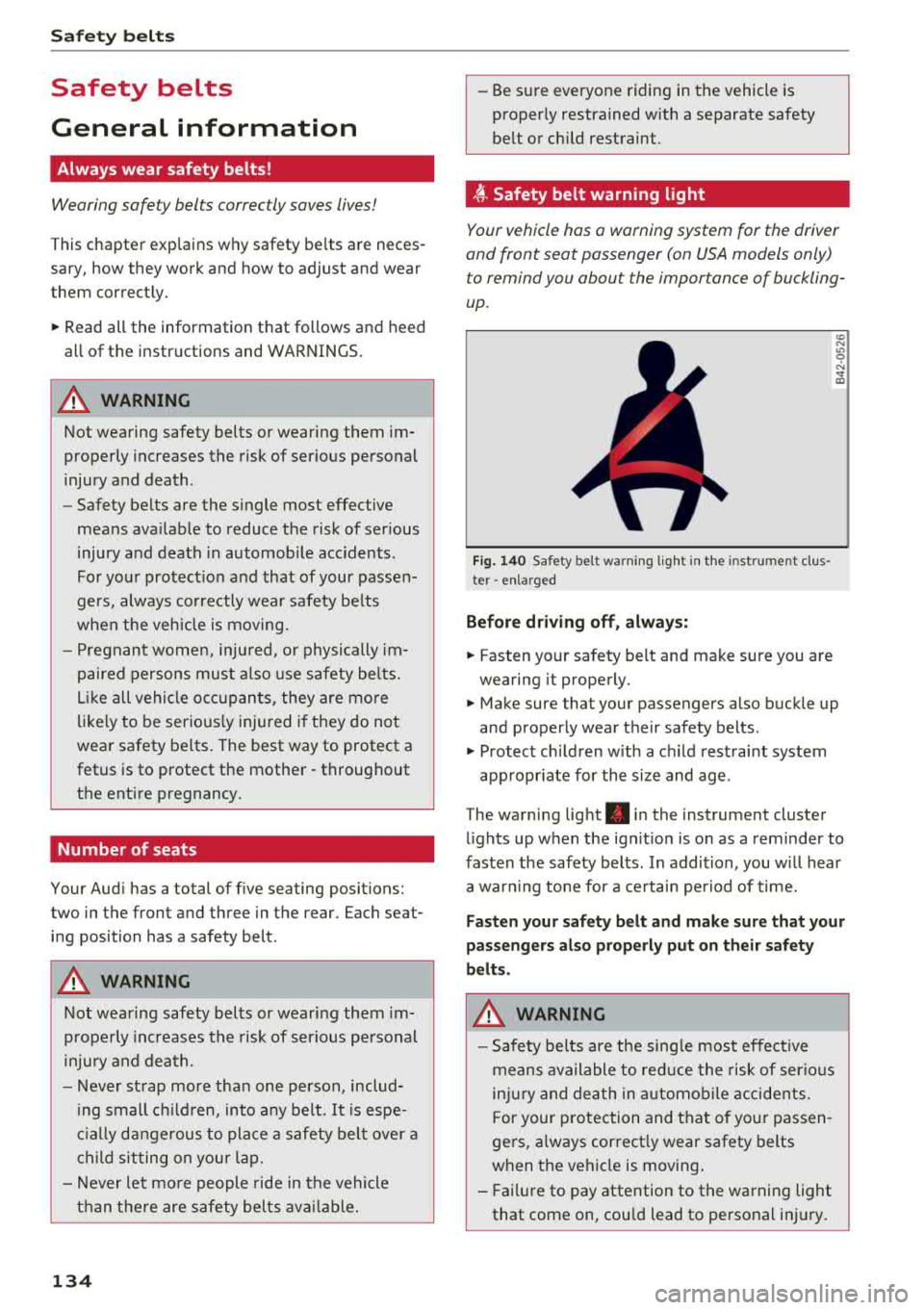
Fig. 140 Safety belt warn ing lig ht in the instrument clus
ter
-enlarged
Before driving off , always:
.,. Fasten your safety belt and make sure you are
wearing it properly .
U) N
"' 9 N
and properly wear their safety belts .
.,. Protect children with a ch ild restraint system
appropr iate for the size and age .
The warning light . in the instrument cluster
lights up when the ign it ion is on as a reminder to
fasten the safety belts . In addition , you will hear
a war ning tone for a certain period of time.
Fasten your safety belt and make sure that your
passengers also properly put on their safety
belts.
A WARNING
-
- Safety belts are the single most effective
means available to reduce the risk of serious
inj ury and death in automobile accidents.
Fo r your protection and that of your passen
gers, a lways correct ly wear safety belts
when t he vehicle is moving .
- Fai lure to pay attention to the warning light
that come on, cou ld lead to personal injury.
Page 139 of 266
a co ,...,
N
" N ,...,
0 0 \,;J '
Not wearing safety belts or wearing them im
properly increases the risk of serious personal
injury and death . Safety belts can work only
when used correctly.
-Always fasten your safety belts correctly be fore driving off and make sure all passen
gers are cor rect ly restrained.
-For maximum protection, safety belts must
always be posit ioned properly on the body .
-Never strap more than one person, includ
ing small ch ildren, into any belt .
-Never place a safety belt over a child sitting
on your lap.
- Always keep feet in the footwell in front of
the seat wh ile the vehicle is being driven.
- Never let any person ride w ith their feet on
the instrument panel or st icki ng out the
window o r on the seat.
- Never remove a safety belt while the vehicle
is moving . Do ing so will increase your risk of
being injured or k illed.
- Never wear belts twisted.
- Never wear belts over rigid or breakable ob-
jects in or on your clothing, such as eye
glasses, pens, keys, etc ., as these may cause
injury.
- Never allow safety belts to become dam
aged by being caught in doo r or seat hard
ware.
- Do not wear the shoulder part of the belt
under your arm or otherwise out of position .
- Several layers of heavy clothing may inter
fere with correct positioning of belts and re duce the overall effectiveness of the system.
- Always keep belt buckles free of anything
that may prevent the buckle from latching
securely .
-Never use comfort clips or devices that cre
ate slack in the shoulder be lt . However, spe
c ial clips may be requ ired for the prope r use
of some child restraint systems.
-Torn or frayed safety belts can tear, and
damaged belt ha rdware can break in an acc i
dent. I nspect belts regularly.
If webbing,
bind ings, buckles, or re tractors are dam-
Safet y bel ts
aged, have belts rep laced by an authorized
Aud i dea ler or qualified workshop.
- Safety belts that have been worn and loaded
in an accident must be replaced with the
correct replacement safety belt by an au
thor ized Audi dealer. Replacement may be
necessary even if damage cannot be clearly
seen. Anchorages that were loaded must al
so be inspected.
- Never remove, mod ify, d isassemble, or try
to repair the safety belts yourse lf.
-Always keep the belts clean . Dirty belts may
not work properly and can impair the func
tion of th e inert ia reel
q table on page 223.
Safety belts
Fastening safety belts
Safety first -everybody buckle up!
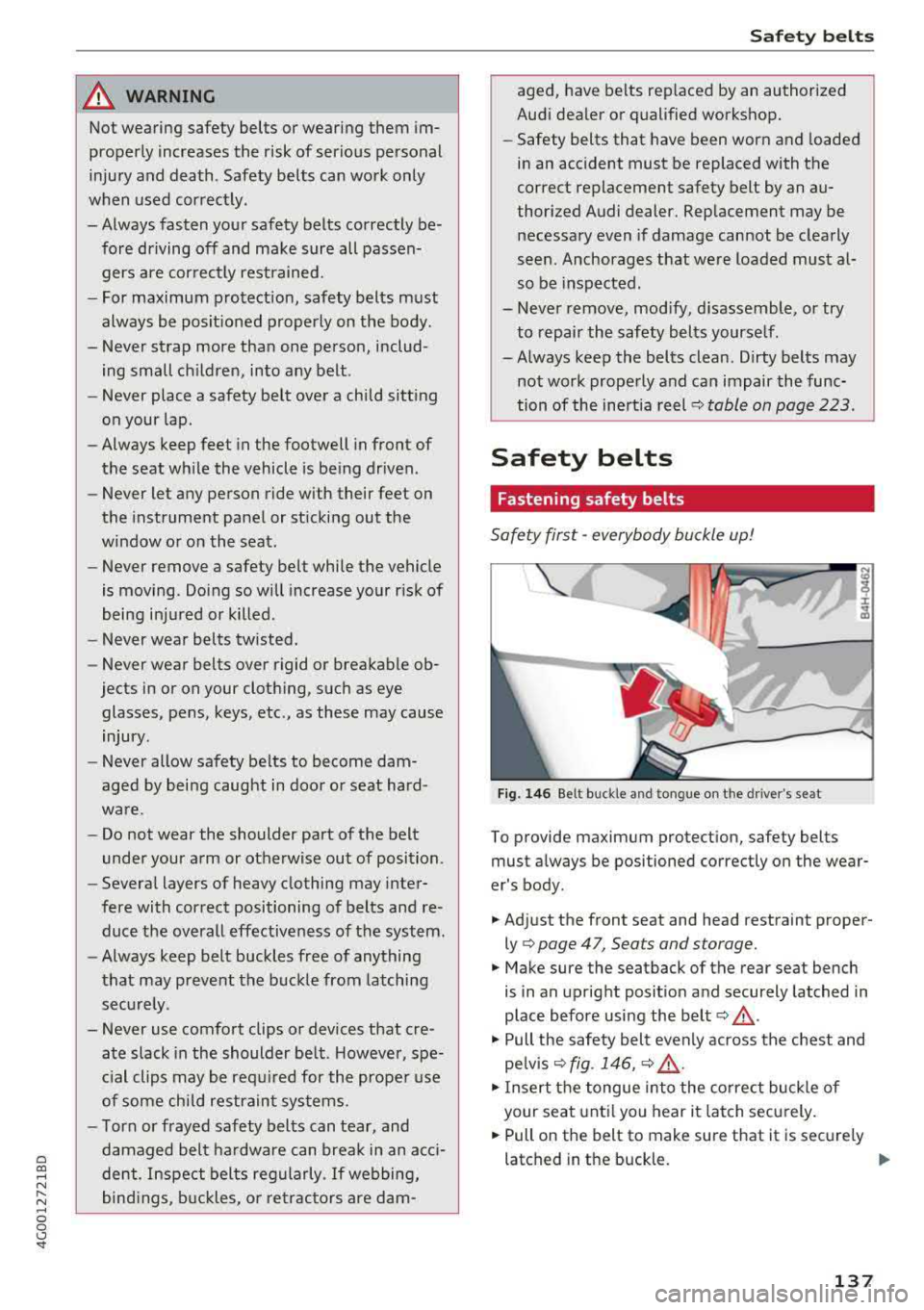
F ig. 146 Belt buckle and tongu e on t he d river' s seat
To provide maximum protect ion, safety belts
must a lways be positioned correctly on the wear
er 's body .
.. Adjust the front seat and head restraint proper
ly
q page 47, Seats and storage.
.. Make sure the seatback of the rear seat bench
is in an upright posit ion and securely latched in
p lace before using the belt
q ,&. .
.. Pull the safety belt evenly across the chest and
pe lvis
q fig . 146, q ,&. .
.. Insert the tongue in to the co rrect buck le of
your seat unt il you hear it latch securely.
.. Pull on the belt to make sure that it is sec urely
latched in the buckle.
..,
1 37
Page 144 of 266
Airbag system
Airbag system
Important information
Importance of wearing safety belts and
sitting properly
Airbags are only supplemental restraints . For
airbags to do their job, occupants must always
properly wear their safety belts and be in a prop er seating position.
For your safety and the safety of your passen
gers, before driving off, always:
.,. Adjust the dr iver's seat and steering wheel
properly~ page 126,
.,. Adjust the front passenge r's seat properly
~page 47 ,
.,. Wear safety belts p roperly ~page 136,
.. Always properly use the proper child restraint
to protect chi ldren
~page 166 .
In a coll is ion, airbags must inflate within the
blink of an eye and with considerable force. The
supp lemental airbags can cause injuries if the
driver or the front seat passenger is not seated
properly. Therefore in order to he lp the airbag to
do its job, it is important, both as a dr iver and as
a passenger to sit properly at all t imes.
By keeping room between your body and the
steering whee l and the front of the passenger
compartment, the air bag can inflate fully and
completely and provide supplemental protect ion
in certain frontal
coll isions¢ page 126, Correct
passenger seating positions .
For details on the
operation of the seat adjustment controls
¢ page 47.
It's especially important that children are proper
ly restrained
¢pag e 166.
There is a lot that the driver and the passengers
can and must do to help the ind iv idual safety fea
tures installed in your Audi work together as a
system.
Proper seating posit ion is important so that the
front airbag on the driver side can do its job. If
you have a physical impairment or cond ition that
prevents you from s itting properly on the driver
seat with the safety be lt properly fastened and
142
reaching the pedals, or if you have concerns with
regard to the function or operation of the Ad
vanced Airbag System, please contact your au
thorized Audi dea ler or qualified workshop, or
ca ll Audi Customer Relations at 1-800-822-2834
for poss ible modifications to your vehicle .
When the airbag system dep loys, a gas generator
will fill the airbags, break open the padded cov ers, and infla te between the steering wheel and
the driver and between the instrument panel and
the front passenger. The a irbags w ill deflate im
med iate ly after deployment so that the front oc
cupants can see through the windsh ield aga in
without interruption.
All of th is takes place in the blink of an eye, so
fast that many people don't even realize that the
a irbags have deployed. The airbags also inflate
with a great deal of force and nothing should be
in the ir way when they deploy. Front airbags in
combination with properly worn safety belts slow
down and limit the occupant's forward move
ment. Together they help to prevent the driver
and front seat passenger from hitting parts of
the ins ide of the vehicle while reduc ing the forces
acting on the occupant dur ing the crash . In th is
way they help to reduce the risk of injury to the
head and upper body in the crash . Airbags do not
protect the arms or the lower parts of the body.
Both front airbags will not inflate in all frontal
collisions. The triggering of t he a irbag system de
pends on the veh icle deceleration rate caused by
the collis ion and registered by the electronic con
trol unit. If this rate is be low the refe rence value
programmed into the control unit, the airbags
will not be triggered, even tho ugh t he car may be
badly damaged as a resu lt of the co llision . V ehi
cle damage, repair costs or even the lack of vehi
cle damage is not necessarily an indication of
whether an a irbag should inflate or not.
Since the circumstances wi ll vary considerab ly
between one co llision and another, it is not possi
ble to define a range of veh icle speeds that will
cover every poss ible kind and angle of impact
that w ill always trigger the airbags. Important
factors include, for example, the nature (hard or
soft) of the object which the ca r hits, the angle of
im pact, vehicle speed, etc. The front airbags will
..,.
Page 145 of 266
a co .... N
" N .... 0 0 \.J '
ro llovers .
Always re memb er: Airbags will deploy only o nce,
and on ly in ce rtain k inds of coll is ions. Yo ur safety
be lts are always there to offer protection in those
situations in which airbags are not supposed to
deploy, or when they have already deployed; for
examp le, when your vehicle str ikes or is struck by
another vehicle after the first coll is ion.
This is just one of the reasons why an airbag is a
supp lementary restraint and is not a substitute
for a safety belt. The airbag system works most
effect ively when used with the safety belts.
Therefore, always properly wear your safety belts
<=:> page 134 .
A WARNING
Sitting too close to the steer ing whee l o r i n
st rument panel w ill decrease the effe ct ive
ness of the airbags and will inc rease the risk
of persona l injury in a co llision.
- Never si t close r than 10 inches (25 cm) to
the stee ring w heel or instr ument panel.
- If you cannot sit mo re than 10 inches
(25 cm) from the s teeri ng wheel, invest i
gate whethe r adaptive equipment may be
availab le to he lp you reach the pedals and
increase your seating distance from the
steering wheel.
- All ve hicle occupants and especia lly children
must be restrained proper ly whenever riding
in a vehicle. An unrestrained or improperly
restra ined child could be injured by striking
the interior or by being ejected from the ve
hicle during a sudden maneuver or impact.
An unrestra ined o r imp roperly restrained
c hild is also at greate r risk of inju ry o r death
t h rough contact with an inflating airbag.
- If you are unrestrained, lean ing fo rwa rd, s it
ti ng s ideways or o ut of pos it ion in any way,
yo ur risk of i njury is m uch higher.
- Yo u will also receive se rious injur ies and
c ou ld eve n be killed if you are up aga inst the
air bag o r too close to it w hen it in flates -
even with an Advanced Airbag.
-
Airbag syste m
-To reduce the r is k of injury when an airbag
inf lates, always wear safety belts prope rly
r=;, page 137, Safety belts.
- Always make certain that children age 12 or
younge r always ride in the rear seat. If chil
dren are not properly restrained, they may be severely injured or killed when an airbag
i n flates.
- Never let c hildren r ide unrestra ined or im
properly restrained in the vehicle . Ad just the
front seats properly.
- Never ride w ith the backrest recl ined .
- Always sit as far as possible from the steer-
ing wheel or the instrument pane l
r=;, page 126.
-Always sit upright w ith your back against
the backrest of your seat .
- Never p lace your feet on the instrument
panel or on the seat. Always keep bot h feet
on the floor in front of t he seat to help pre
vent ser ious injur ies to the legs and hips if
the airbag inflates.
- Never recl ine t he fron t passenger's seat to
transpo rt objects . Items can also move into
the area of the s ide airbag or the front air
b ag d uring brak ing o r in a sudden ma neu
ve r. Obje cts near the a irbags can be come
p rojecti les and cause injury when an airbag
inf lates .
A WARNING ,..__ -
Airbags that have deployed in a cras h m ust be
replaced.
- Use on ly original eq uipment airbags ap
proved by A udi and insta lled by a trained
technician who has the necessary tools and
d iagnostic equipment to properly replace
any airbag in yo ur vehicle and assure system
effect iveness in a crash.
- Never permit salvaged or recycled airbags to
be installed in you r vehicle.
Child restraints on the front seat - some
important things to know
.. Be s ure to read the impo rtant info rmat io n and
heed the WARN INGS for important deta ils
143
Page 146 of 266
Airbag syste m
about children and Advanced Airbags
¢page 166 .
Even tho ugh yo ur vehicle is equ ipped with an Ad
vanced Ai rbag System, make certain that all chi l
dren, especially those 12 years and younger, al
ways ride in the back seat properly restrained for
their age and size. The airbag on the passenger
side makes the front seat a potentially dangerous
place for a child to ride. The front seat is not the
safest place for a child in a forward-facing child
seat . It ca n be a very dangerous place for an in
fant or a c hild in a rea rwa rd-fac ing seat.
The Advanced Airbag System in your veh icle has
been cert ified to comply with the requ irements
of United States Federal Moto r Vehicle Safety
Standard ( FMVSS) 208, as well as Canada Motor
Ve hicle Safety Standa rd (CMVSS) 208 as applica
b le at the time your veh icle was ma nufactu red.
Acco rding to requi rements, the front Advanced
Airbag System on the passenger side has been
certifi ed for "suppression" for infants of about
12 month old and younger and for "low risk de
p loyment" for children aged 3 to 6 years o ld (as
defined in the standard) .
Th e
PASSENGER AIR BAG O FF light in the instru
ment panel tells you when the front Advanced
Airbag on the passenger side has been turned off by the electronic control un it .
Each time yo u switch on the ignition, the
PAS·
S ENGER AIR BAG OFF
light will come on for a
few seconds and:
- will stay on if the front passenger seat is not
occupied,
- will stay on if the electrical capacitance meas
u red by the capacitive passenger detection sys
tem for the front passenger seat equals the combined capacitance of an infant up to about
one year of age and one of the rearward-facing
or forward-facing child restraints listed in Fed
eral Motor Vehicle Safety Standard (FMVSS)
208 with wh ich the Advanced Airbag System in
yo ur vehicle was ce rt ified. For a listing of the
c hi ld rest raints t hat we re used to ce rtify yo ur
vehicle 's compliance with the Safety Standard
¢ page 168 .
144 -
w ill stay on if there is a sma ll child o r chil d re
straint on the front passenger seat,
- w ill go off if the front passenger seat is occu
pied by an adu lt as registered by the capacitive
passenger detection system ¢
page 154, Mon
itoring the Advanced Airbag System.
The PASSENGER AIR BAG OFF lig ht comes on
when e lectrica l capacitance registered on the
front passenger seat is equal to or less t han the
combined capacitance of a typical
1 year-old in
fant and one of the rearward-facing or forward
facing child restrai nts listed in Federa l Motor Ve
hicle Safety Standard (FMVSS) 208 with which
the Advanced A irbag System in yo ur vehicle was
ce rt ified.
If the to tal e lectr ica l capacitance registered o n
the front passenger seat is more than that of a
typ ical 1 yea r-old ch ild but less than the weight
of a sma ll adult, the front airbag on the passen
ger side can deploy (the
PASSENGER AIR BAG
OFF
light does no t come on).
If the
PASSENGER AIR BAG OFF light does not
come on, the front airbag on the passenger s ide
has not been turned off by the electroni c con trol
u nit a nd can dep loy if the con trol unit senses an
i mpact t hat meets the cond itions stored in its
memory.
For exampl e, the airbag ma y deplo y if:
- a small ch ild that is heav ier than a typ ical 1
year-old child is on the front passenger seat (regard less of whethe r the child is in one of t he
child seats listed
¢ page 168), or
- a child who has outgrown c hild rest raints is on
the front passenge r seat.
If the front passenger a irbag is turned off, the
PASSENGER AIR BAG OFF light comes on in the
i nst rument cluster and stays on .
If the front passenger a irbag deploys, the Feder
al Standard requires the airbag to meet the "low
risk" deployment cr iteria to reduce the r isk of in
j u ry th rough interact ion w ith the airbag .
"Low
risk " dep loyment oc curs in t hose crashes tha t
t a ke place at lowe r decele ra tions as defined in
t h e e lec tronic co ntro l unit
¢ page 154 , PASSEN-
GER AIR BAG OFF light.
..,_