Level AUDI A6 ALLROAD 1999 C5 / 2.G Pneumatic Suspension System
[x] Cancel search | Manufacturer: AUDI, Model Year: 1999, Model line: A6 ALLROAD, Model: AUDI A6 ALLROAD 1999 C5 / 2.GPages: 64, PDF Size: 3.12 MB
Page 39 of 64
39
¥ Environmentally friendly, uses air
¥ Good operating safety due to great
stability.
¥ Electronic control system with
comprehensive self-diagnosis functions
¥ Maintenance-free Along with the principle advantages of self-
levelling (see Principles), the system realised
in the A6 has the following advantages:
¥ Virtually load-independent suspension
and vibration behaviour.
¥ Little space requirement due to compact
design, especially in the axle area.
¥ Self-levelling even available when engine
is off.
¥ Rapid raising and lowering times
¥ Low energy requirement
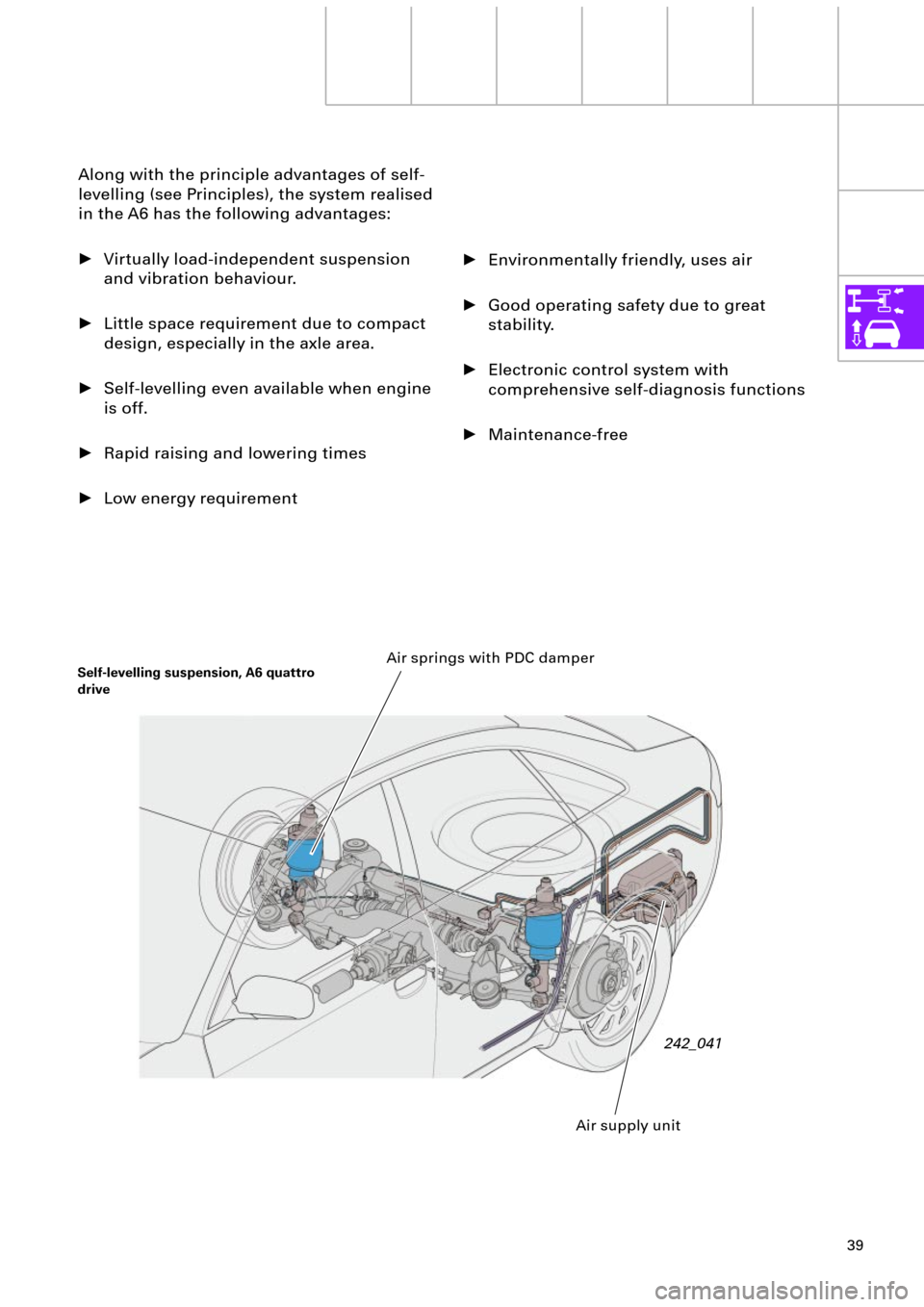
Air springs with PDC damperSelf-levelling suspension, A6 quattro
drive
Air supply unit242_041
Page 40 of 64
40
The air springs
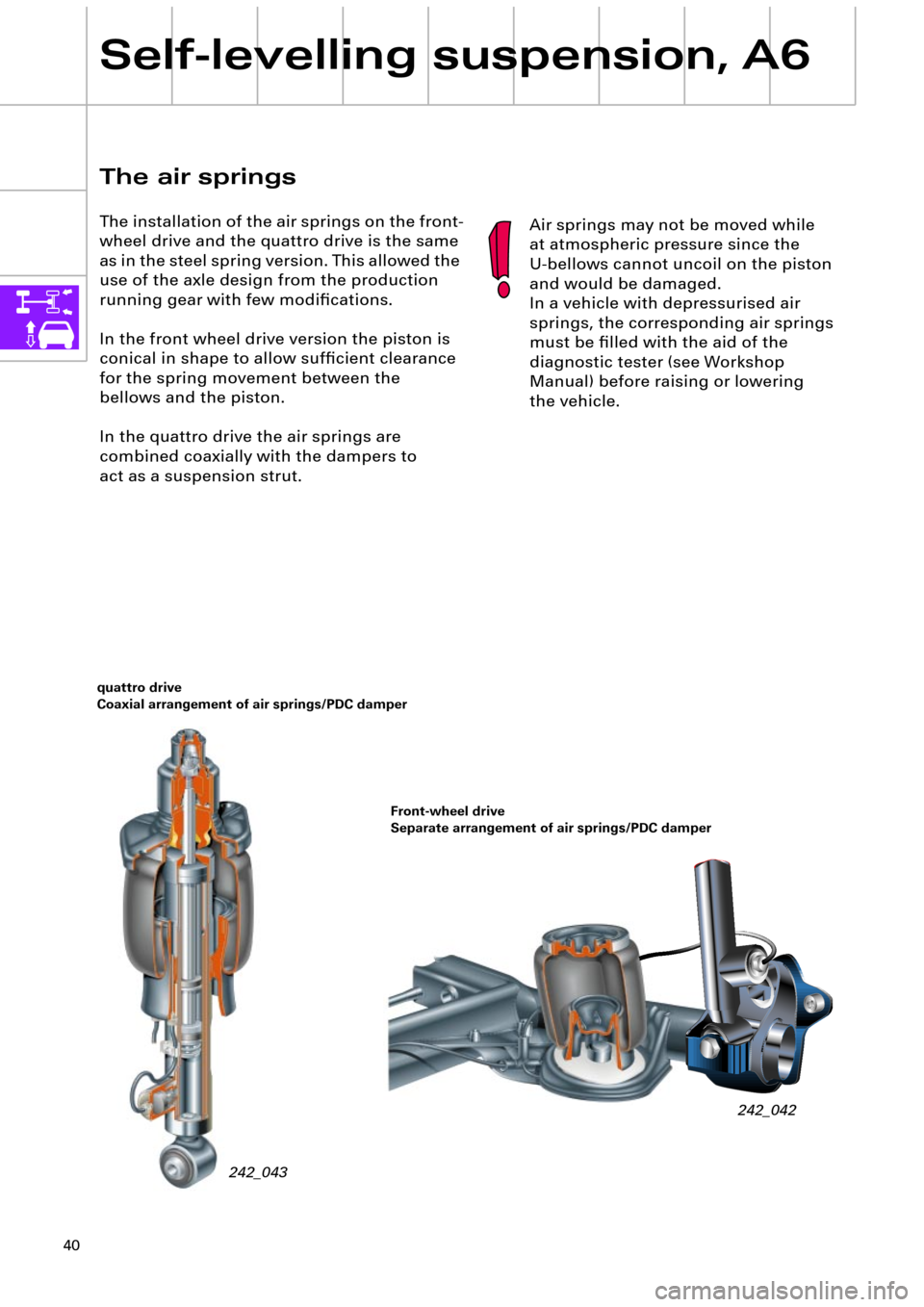
The installation of the air springs on the front-
wheel drive and the quattro drive is the same
as in the steel spring version. This allowed the
use of the axle design from the production
running gear with few modiÞcations.
In the front wheel drive version the piston is
conical in shape to allow sufÞcient clearance
for the spring movement between the
bellows and the piston.
In the quattro drive the air springs are
combined coaxially with the dampers to
act as a suspension strut.
Self-levelling suspension, A6
242_043
quattro drive
Coaxial arrangement of air springs/PDC damper
242_042
Front-wheel drive
Separate arrangement of air springs/PDC damper
Air springs may not be moved while
at atmospheric pressure since the
U-bellows cannot uncoil on the piston
and would be damaged.
In a vehicle with depressurised air
springs, the corresponding air springs
must be Þlled with the aid of the
diagnostic tester (see Workshop
Manual) before raising or lowering
the vehicle.
Page 42 of 64
42
Self-levelling suspension, A6
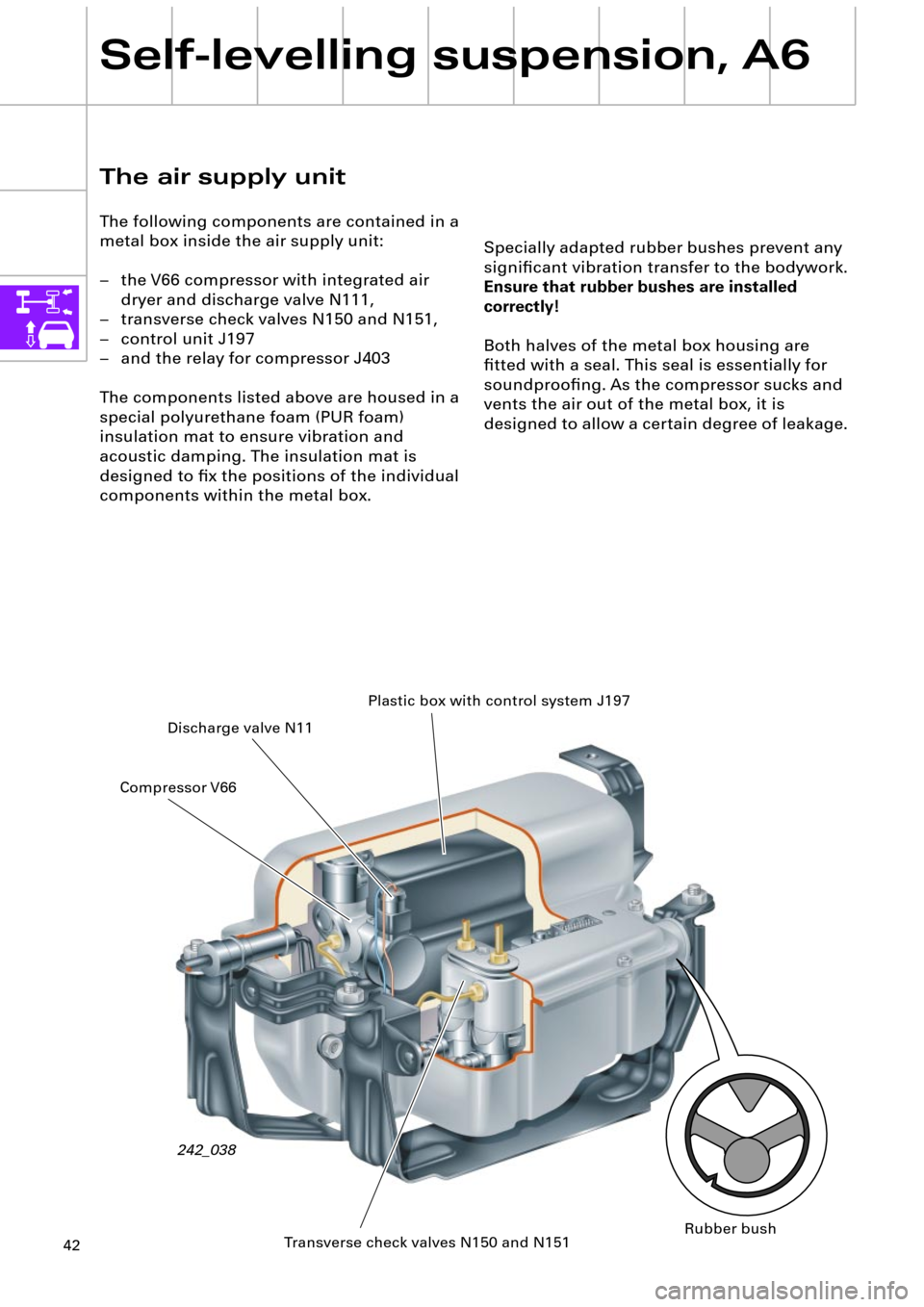
Specially adapted rubber bushes prevent any
signiÞcant vibration transfer to the bodywork.
Ensure that rubber bushes are installed
correctly!
Both halves of the metal box housing are
Þtted with a seal. This seal is essentially for
soundprooÞng. As the compressor sucks and
vents the air out of the metal box, it is
designed to allow a certain degree of leakage.
The air supply unit
The following components are contained in a
metal box inside the air supply unit:
Ð the V66 compressor with integrated air
dryer and discharge valve N111,
Ð transverse check valves N150 and N151,
Ð control unit J197
Ð and the relay for compressor J403
The components listed above are housed in a
special polyurethane foam (PUR foam)
insulation mat to ensure vibration and
acoustic damping. The insulation mat is
designed to Þx the positions of the individual
components within the metal box.
242_038Plastic box with control system J197
Discharge valve N11
Transverse check valves N150 and N151 Compressor V66
Rubber bush
Page 44 of 64
44
Self-levelling suspension, A6
The compressor
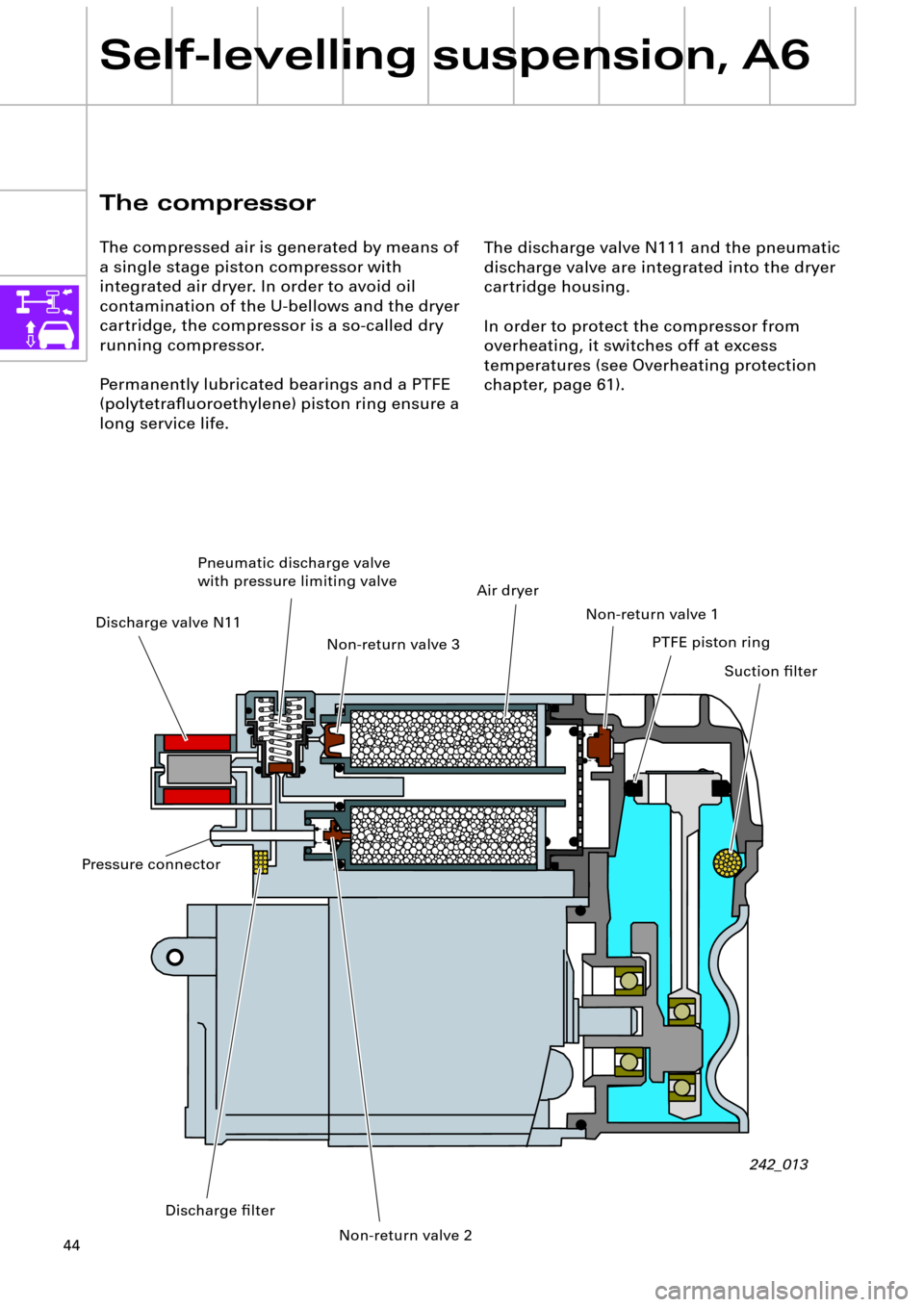
The compressed air is generated by means of
a single stage piston compressor with
integrated air dryer. In order to avoid oil
contamination of the U-bellows and the dryer
cartridge, the compressor is a so-called dry
running compressor.
Permanently lubricated bearings and a PTFE
(polytetraßuoroethylene) piston ring ensure a
long service life.The discharge valve N111 and the pneumatic
discharge valve are integrated into the dryer
cartridge housing.
In order to protect the compressor from
overheating, it switches off at excess
temperatures (see Overheating protection
chapter, page 61).
Discharge valve N11Pneumatic discharge valve
with pressure limiting valve
Non-return valve 3Air dryer
Non-return valve 1
PTFE piston ring
Suction Þlter
Discharge Þlter
Pressure connector
242_013
Non-return valve 2
Page 46 of 64
46
Self-levelling suspension, A6
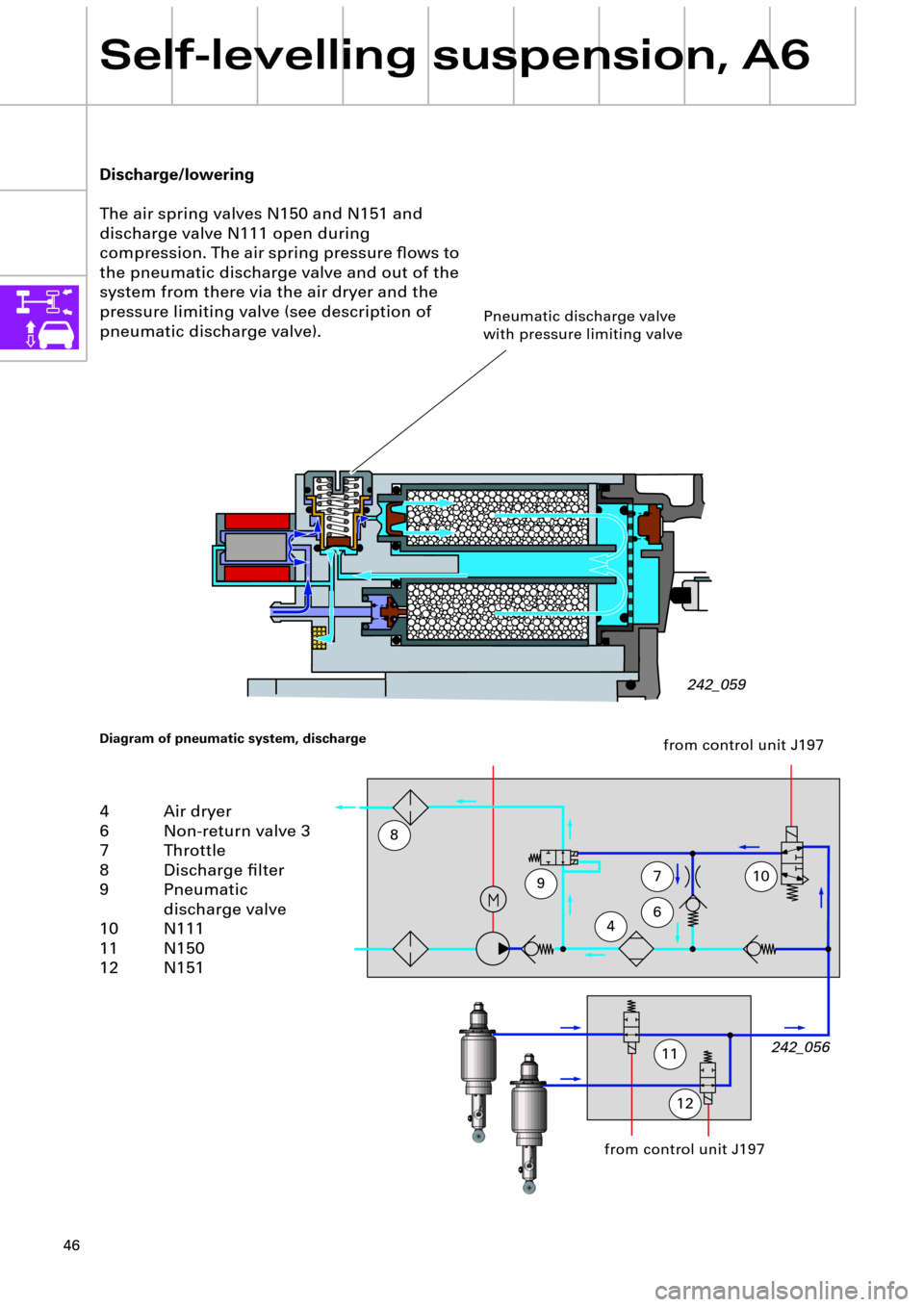
Discharge/lowering
The air spring valves N150 and N151 and
discharge valve N111 open during
compression. The air spring pressure ßows to
the pneumatic discharge valve and out of the
system from there via the air dryer and the
pressure limiting valve (see description of
pneumatic discharge valve).
242_056 Pneumatic discharge valve
with pressure limiting valve
Diagram of pneumatic system, discharge
11
12
107
64
9
8
4 Air dryer
6 Non-return valve 3
7 Throttle
8 Discharge Þlter
9 Pneumatic
discharge valve
10 N111
11 N150
12 N151
from control unit J197from control unit J197
242_059
Page 48 of 64
48
Self-levelling suspension, A6
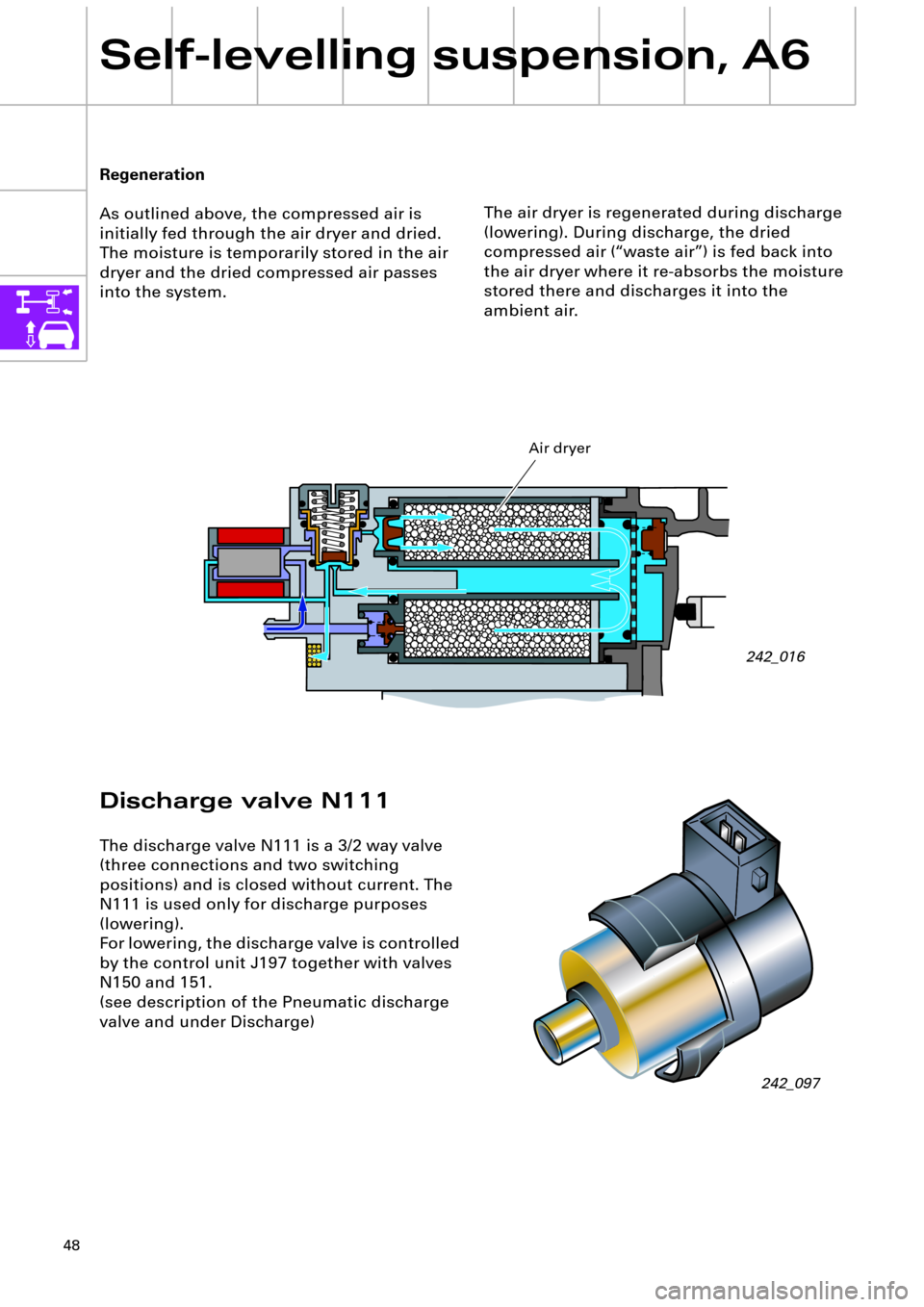
Regeneration
As outlined above, the compressed air is
initially fed through the air dryer and dried.
The moisture is temporarily stored in the air
dryer and the dried compressed air passes
into the system.
Discharge valve N111
The discharge valve N111 is a 3/2 way valve
(three connections and two switching
positions) and is closed without current. The
N111 is used only for discharge purposes
(lowering).
For lowering, the discharge valve is controlled
by the control unit J197 together with valves
N150 and 151.
(see description of the Pneumatic discharge
valve and under Discharge)
242_097
The air dryer is regenerated during discharge
(lowering). During discharge, the dried
compressed air (Òwaste airÓ) is fed back into
the air dryer where it re-absorbs the moisture
stored there and discharges it into the
ambient air.
Air dryer
242_016
Page 50 of 64
50
Self-levelling suspension, A6
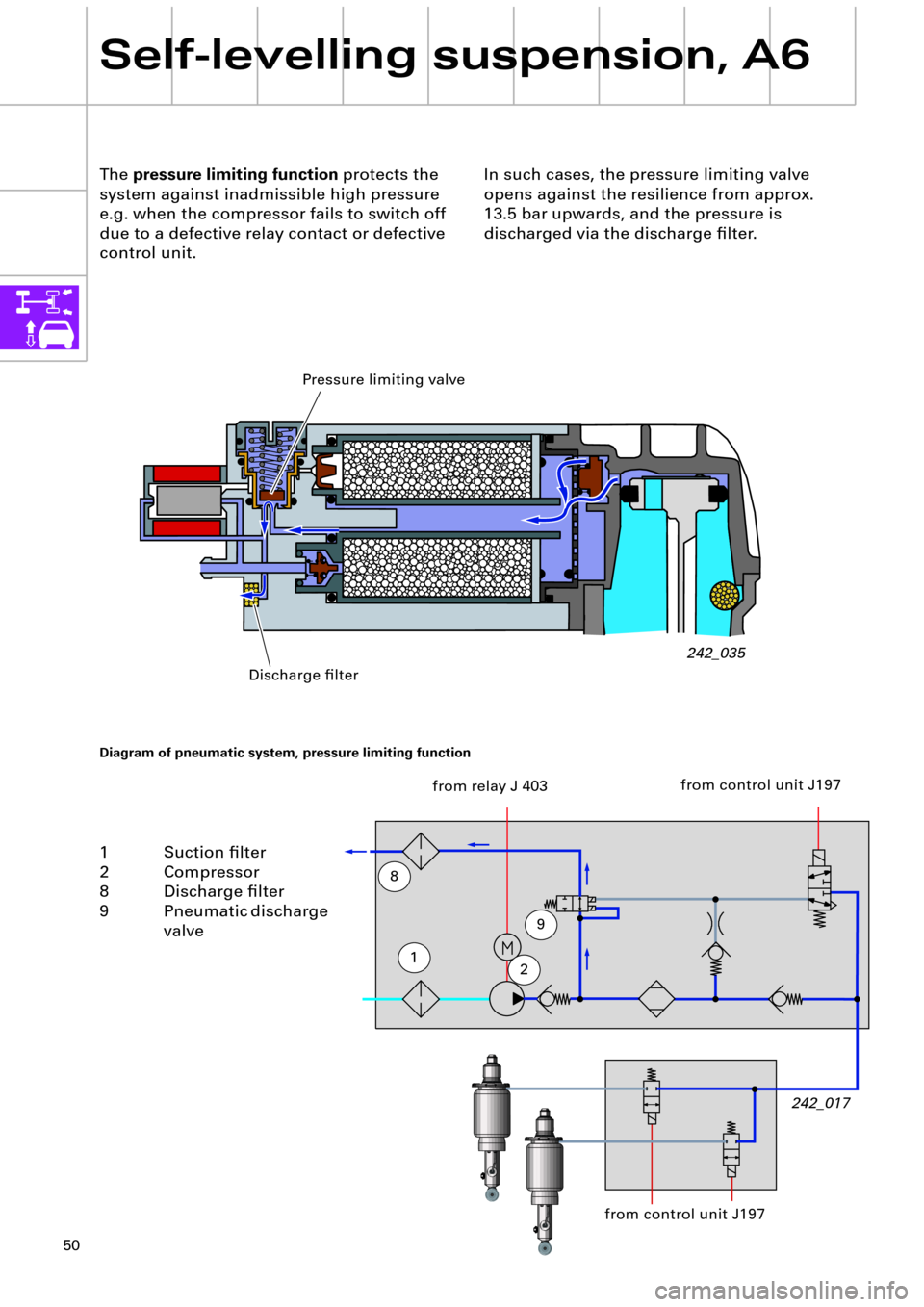
The pressure limiting function protects the
system against inadmissible high pressure
e.g. when the compressor fails to switch off
due to a defective relay contact or defective
control unit.
242_035
242_017
Diagram of pneumatic system, pressure limiting function
12
9
8
1 Suction Þlter
2 Compressor
8 Discharge Þlter
9 Pneumatic discharge
valve
from relay J 403
In such cases, the pressure limiting valve
opens against the resilience from approx.
13.5 bar upwards, and the pressure is
discharged via the discharge Þlter.
Pressure limiting valve
Discharge Þlter
from control unit J197
from control unit J197
Page 51 of 64
51
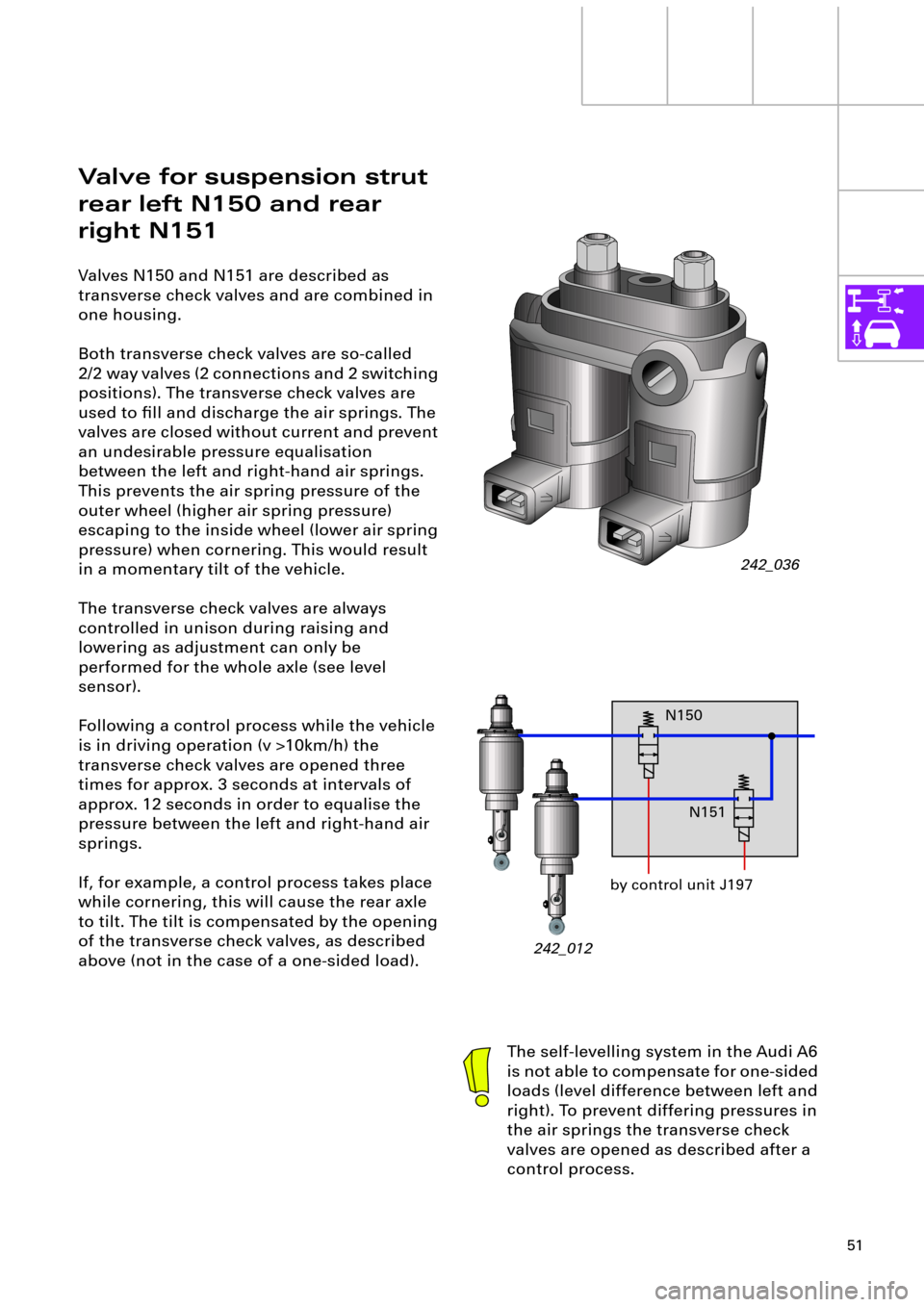
Valve for suspension strut
rear left N150 and rear
right N151
Valves N150 and N151 are described as
transverse check valves and are combined in
one housing.
Both transverse check valves are so-called
2/2 way valves (2 connections and 2 switching
positions). The transverse check valves are
used to Þll and discharge the air springs. The
valves are closed without current and prevent
an undesirable pressure equalisation
between the left and right-hand air springs.
This prevents the air spring pressure of the
outer wheel (higher air spring pressure)
escaping to the inside wheel (lower air spring
pressure) when cornering. This would result
in a momentary tilt of the vehicle.
The transverse check valves are always
controlled in unison during raising and
lowering as adjustment can only be
performed for the whole axle (see level
sensor).
Following a control process while the vehicle
is in driving operation (v >10km/h) the
transverse check valves are opened three
times for approx. 3 seconds at intervals of
approx. 12 seconds in order to equalise the
pressure between the left and right-hand air
springs.
If, for example, a control process takes place
while cornering, this will cause the rear axle
to tilt. The tilt is compensated by the opening
of the transverse check valves, as described
above (not in the case of a one-sided load).
242_036
The self-levelling system in the Audi A6
is not able to compensate for one-sided
loads (level difference between left and
right). To prevent differing pressures in
the air springs the transverse check
valves are opened as described after a
control process.
242_012by control unit J197N150
N151
Page 52 of 64
52
Self-levelling suspension, A6
Self-levelling
suspension sender G84
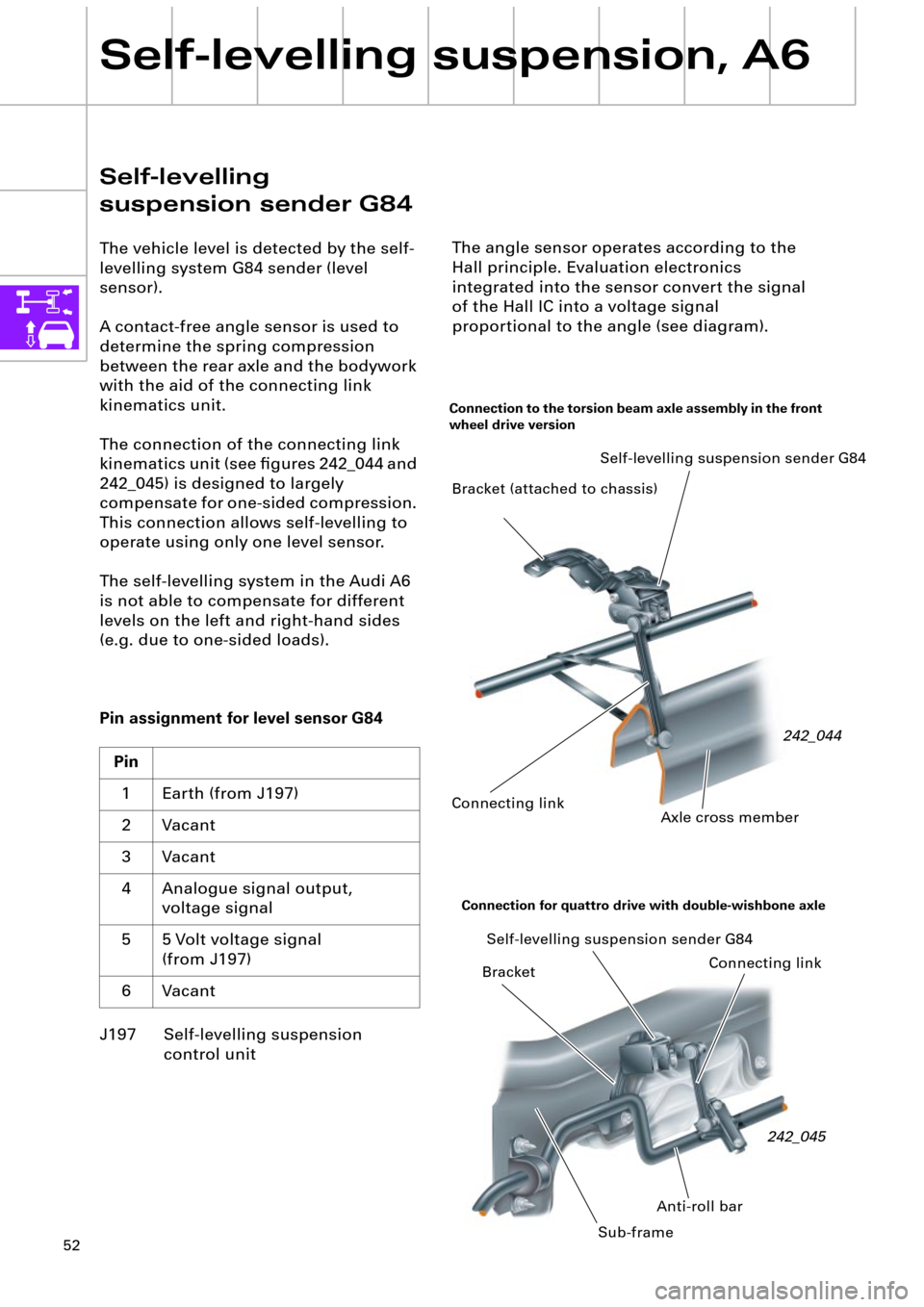
The vehicle level is detected by the self-
levelling system G84 sender (level
sensor).
A contact-free angle sensor is used to
determine the spring compression
between the rear axle and the bodywork
with the aid of the connecting link
kinematics unit.
The connection of the connecting link
kinematics unit (see Þgures 242_044 and
242_045) is designed to largely
compensate for one-sided compression.
This connection allows self-levelling to
operate using only one level sensor.
The self-levelling system in the Audi A6
is not able to compensate for different
levels on the left and right-hand sides
(e.g. due to one-sided loads).
Pin assignment for level sensor G84
J197 Self-levelling suspension
control unit Pin
1 Earth (from J197)
2 Vacant
3 Vacant
4 Analogue signal output,
voltage signal
5 5 Volt voltage signal
(from J197)
6 Vacant
242_044 Self-levelling suspension sender G84
Connecting link
Axle cross member
Connection to the torsion beam axle assembly in the front
wheel drive version
Bracket (attached to chassis)
Connecting link Self-levelling suspension sender G84
Bracket
Anti-roll bar
Connection for quattro drive with double-wishbone axle
242_045
Sub-frame
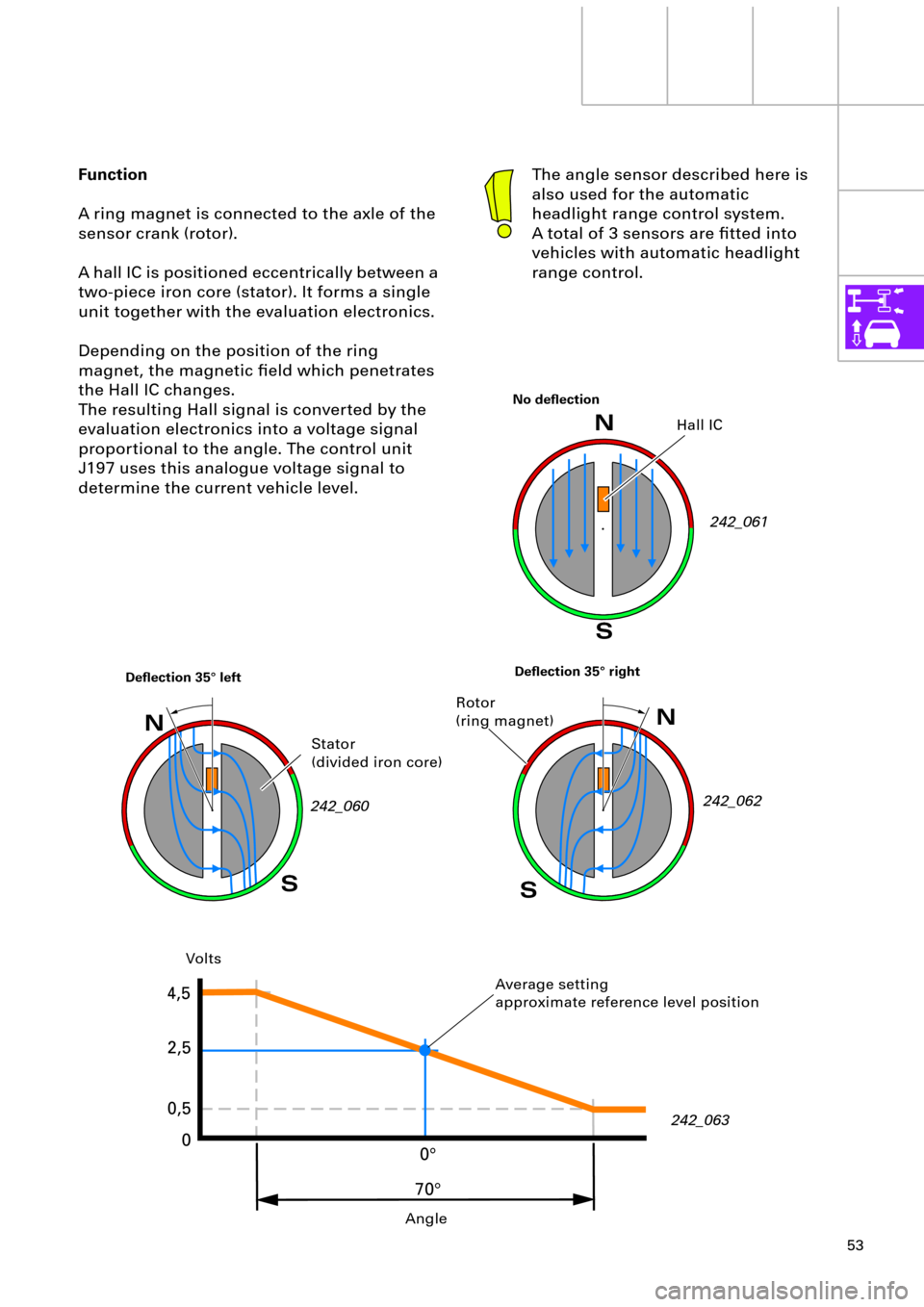
The angle sensor operates according to the
Hall principle. Evaluation electronics
integrated into the sensor convert the signal
of the Hall IC into a voltage signal
proportional to the angle (see diagram).
Page 53 of 64
53
0,5 2,5 4,5
0°
70°
0
Function
A ring magnet is connected to the axle of the
sensor crank (rotor).
A hall IC is positioned eccentrically between a
two-piece iron core (stator). It forms a single
unit together with the evaluation electronics.
Depending on the position of the ring
magnet, the magnetic Þeld which penetrates
the Hall IC changes.
The resulting Hall signal is converted by the
evaluation electronics into a voltage signal
proportional to the angle. The control unit
J197 uses this analogue voltage signal to
determine the current vehicle level.
242_062242_061
242_060
Deßection 35¡ right No deßection
Deßection 35¡ left
Rotor
(ring magnet)
Stator
(divided iron core)
N
SN
S
N
S
Angle VoltsHall IC
Average setting
approximate reference level position
242_063
The angle sensor described here is
also used for the automatic
headlight range control system.
A total of 3 sensors are Þtted into
vehicles with automatic headlight
range control.