Level AUDI A6 ALLROAD 1999 C5 / 2.G Pneumatic Suspension System
[x] Cancel search | Manufacturer: AUDI, Model Year: 1999, Model line: A6 ALLROAD, Model: AUDI A6 ALLROAD 1999 C5 / 2.GPages: 64, PDF Size: 3.12 MB
Page 54 of 64
54
Self-levelling suspension, A6
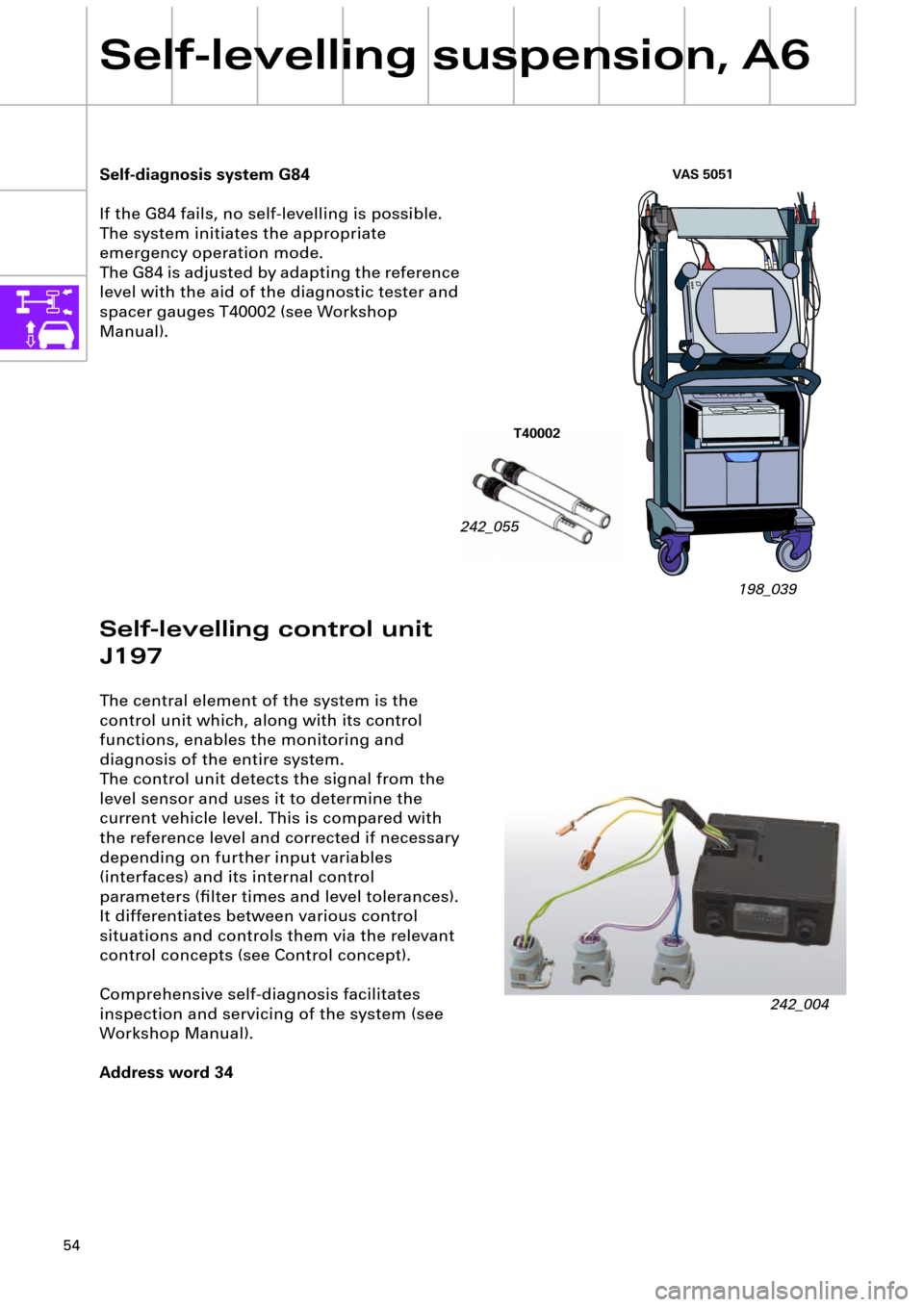
Self-diagnosis system G84
If the G84 fails, no self-levelling is possible.
The system initiates the appropriate
emergency operation mode.
The G84 is adjusted by adapting the reference
level with the aid of the diagnostic tester and
spacer gauges T40002 (see Workshop
Manual).
242_055
T40002
198_039
Self-levelling control unit
J197
The central element of the system is the
control unit which, along with its control
functions, enables the monitoring and
diagnosis of the entire system.
The control unit detects the signal from the
level sensor and uses it to determine the
current vehicle level. This is compared with
the reference level and corrected if necessary
depending on further input variables
(interfaces) and its internal control
parameters (Þlter times and level tolerances).
It differentiates between various control
situations and controls them via the relevant
control concepts (see Control concept).
Comprehensive self-diagnosis facilitates
inspection and servicing of the system (see
Workshop Manual).
Address word 34
242_004
VAS 5051
Page 55 of 64
55
Self-levelling suspension
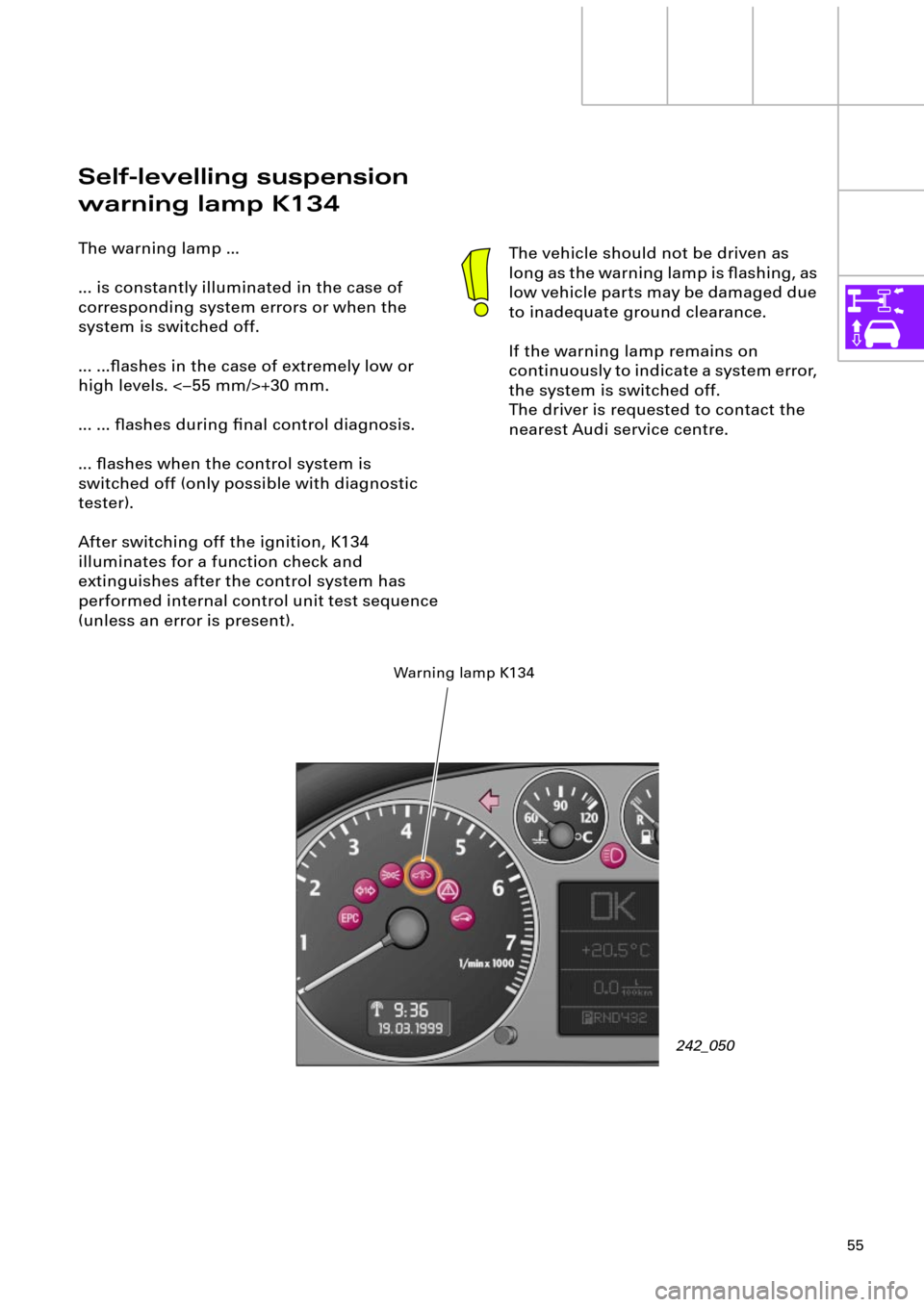
warning lamp K134
The warning lamp É
... is constantly illuminated in the case of
corresponding system errors or when the
system is switched off.
... ...ßashes in the case of extremely low or
high levels. <Ð55 mm/>+30 mm.
... ... ßashes during Þnal control diagnosis.
... ßashes when the control system is
switched off (only possible with diagnostic
tester).
After switching off the ignition, K134
illuminates for a function check and
extinguishes after the control system has
performed internal control unit test sequence
(unless an error is present).
Warning lamp K134
242_050
The vehicle should not be driven as
long as the warning lamp is ßashing, as
low vehicle parts may be damaged due
to inadequate ground clearance.
If the warning lamp remains on
continuously to indicate a system error,
the system is switched off.
The driver is requested to contact the
nearest Audi service centre.
Page 56 of 64
56
Self-levelling suspension, A6
M
+ -+ -+ -
31
1234
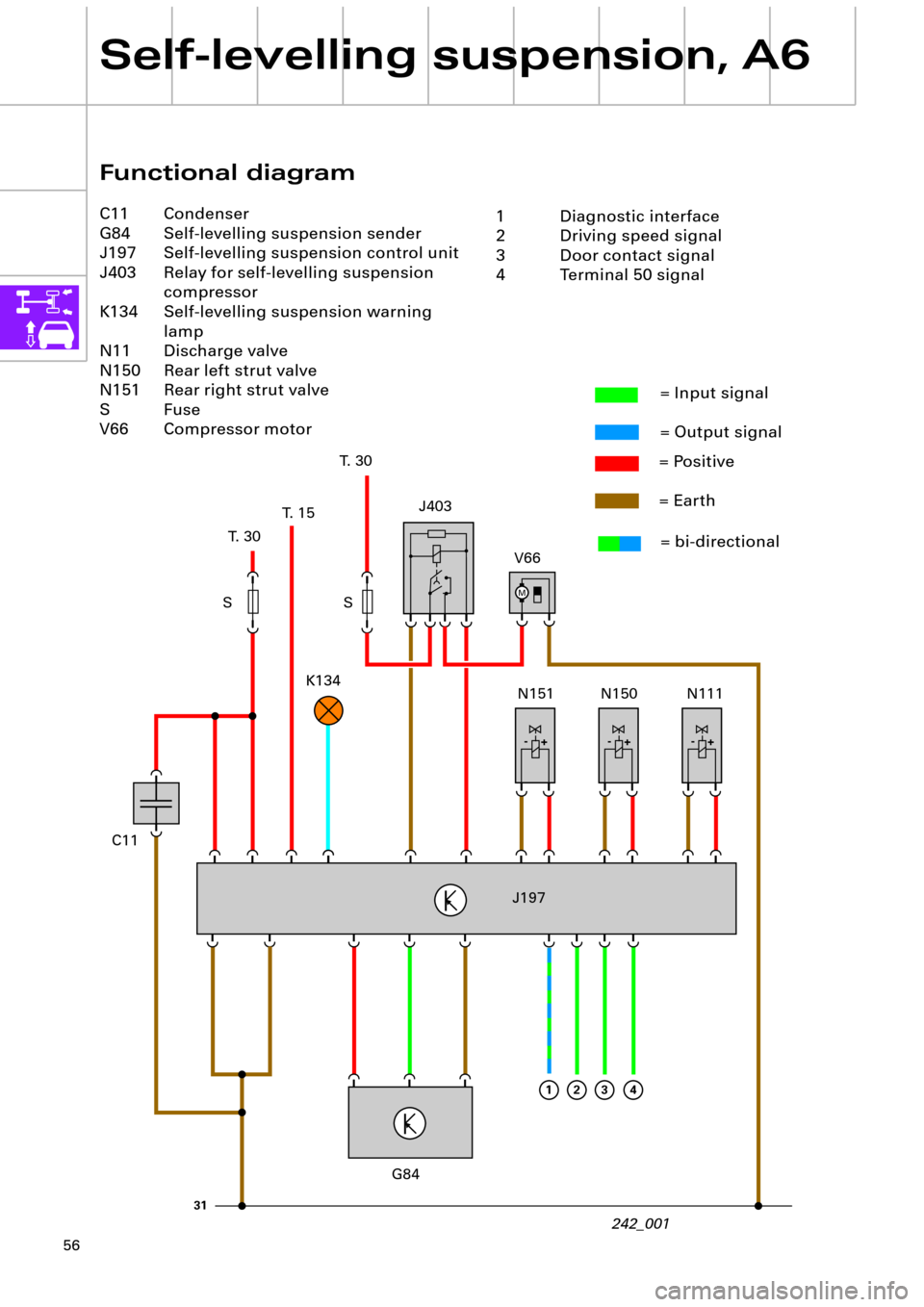
Functional diagram
C11 Condenser
G84 Self-levelling suspension sender
J197 Self-levelling suspension control unit
J403 Relay for self-levelling suspension
compressor
K134 Self-levelling suspension warning
lamp
N11 Discharge valve
N150 Rear left strut valve
N151 Rear right strut valve
S Fuse
V66 Compressor motor
T. 30T. 15T. 30
242_001 S SJ403
V66
N111 N150 N151 K134
J197
G84
= Input signal
= Output signal
= Positive
= Earth
= bi-directional
1 Diagnostic interface
2 Driving speed signal
3 Door contact signal
4 Terminal 50 signal
C11
Page 58 of 64
58
Self-levelling suspension, A6
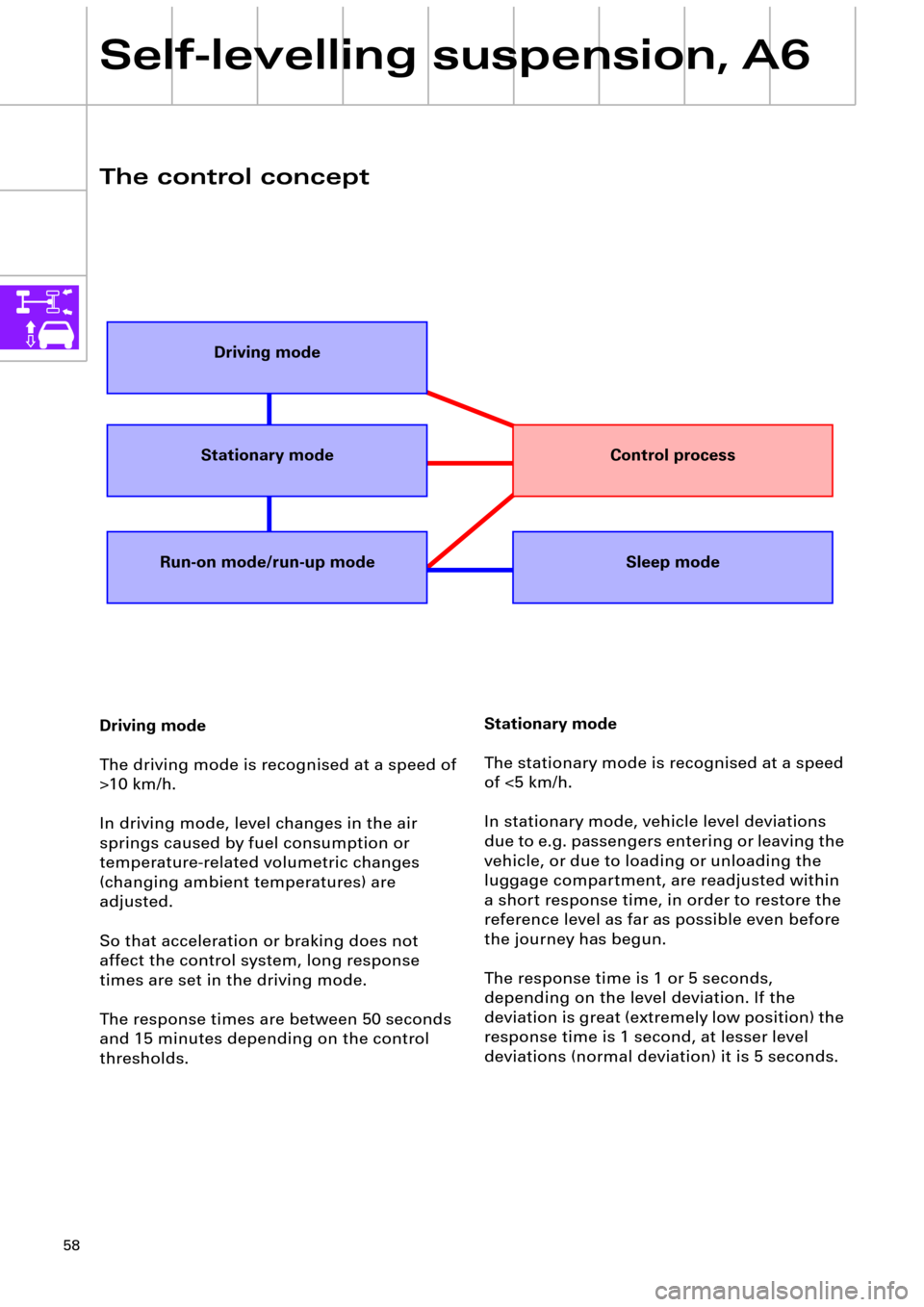
The control concept
Stationary mode
The stationary mode is recognised at a speed
of <5 km/h.
In stationary mode, vehicle level deviations
due to e.g. passengers entering or leaving the
vehicle, or due to loading or unloading the
luggage compartment, are readjusted within
a short response time, in order to restore the
reference level as far as possible even before
the journey has begun.
The response time is 1 or 5 seconds,
depending on the level deviation. If the
deviation is great (extremely low position) the
response time is 1 second, at lesser level
deviations (normal deviation) it is 5 seconds. Driving mode
The driving mode is recognised at a speed of
>10 km/h.
In driving mode, level changes in the air
springs caused by fuel consumption or
temperature-related volumetric changes
(changing ambient temperatures) are
adjusted.
So that acceleration or braking does not
affect the control system, long response
times are set in the driving mode.
The response times are between 50 seconds
and 15 minutes depending on the control
thresholds.
Driving mode
Stationary mode
Run-on mode/run-up modeSleep mode
Control process
Page 59 of 64

59
Sleep mode
To minimise electricity consumption the
control system switches to Òsystem idleÓ
(sleep mode) after 15 minutes.
There is no level adjustment in sleep mode.
ÒWake-upÓ is primarily triggered by the door
switch signal.
If the door switch signal fails, the system is
activated when the ignition is switched ÒONÓ
or by the driving speed signal.
The system can switch between sleep mode
and run-up mode, triggered by the door
switch signal, a maximum of 5 times. After
this, the system can only be activated via
terminal 15 and/or the driving speed signal. Run-on mode/run-up mode
After ÒIgnition OFFÓ, the control system is in
the so-called run-on/run-up mode. The
control unit remains active for a maximum of
15 minutes (via terminal 30) until it goes into
sleep mode.
The run-on/run-up mode is used to adjust
level deviations after parking the vehicle or
prior to starting on a journey.
The limit value in the rebound direction is
increased by 25 mm in the run-on/run-up
mode so that when the driver and/or the
passenger re-enters the vehicle, it does not
sink lower than the reference level or in order
to minimise any necessary vehicle raising
period.
The same response times apply as those
indicated for the stationary mode.
Page 60 of 64
60
Self-levelling suspension, A6
Other features of the
control concept
Lifting platform mode
System behaviour:
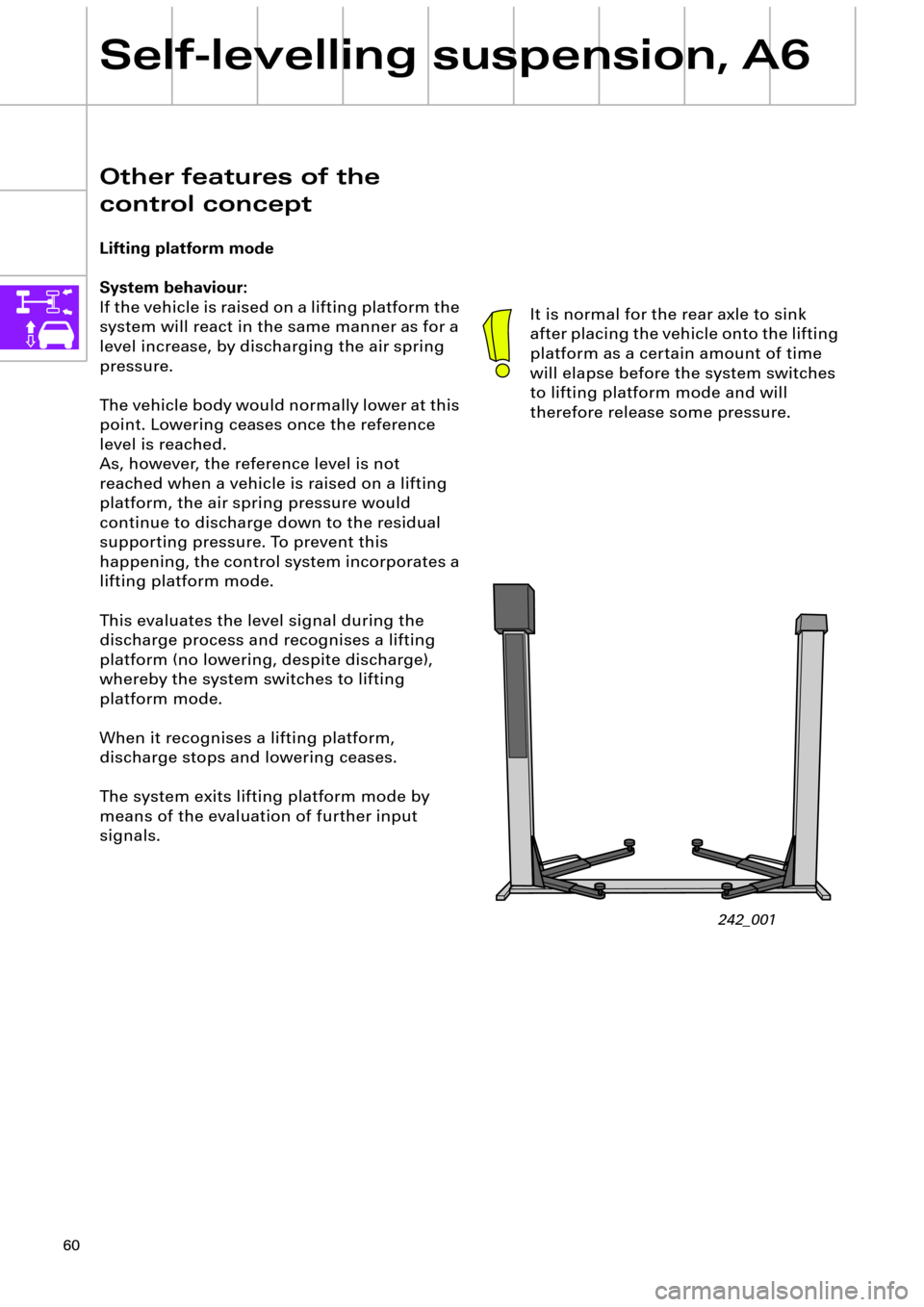
If the vehicle is raised on a lifting platform the
system will react in the same manner as for a
level increase, by discharging the air spring
pressure.
The vehicle body would normally lower at this
point. Lowering ceases once the reference
level is reached.
As, however, the reference level is not
reached when a vehicle is raised on a lifting
platform, the air spring pressure would
continue to discharge down to the residual
supporting pressure. To prevent this
happening, the control system incorporates a
lifting platform mode.
This evaluates the level signal during the
discharge process and recognises a lifting
platform (no lowering, despite discharge),
whereby the system switches to lifting
platform mode.
When it recognises a lifting platform,
discharge stops and lowering ceases.
The system exits lifting platform mode by
means of the evaluation of further input
signals.It is normal for the rear axle to sink
after placing the vehicle onto the lifting
platform as a certain amount of time
will elapse before the system switches
to lifting platform mode and will
therefore release some pressure.
242_001
Page 61 of 64
61
Overheating protection
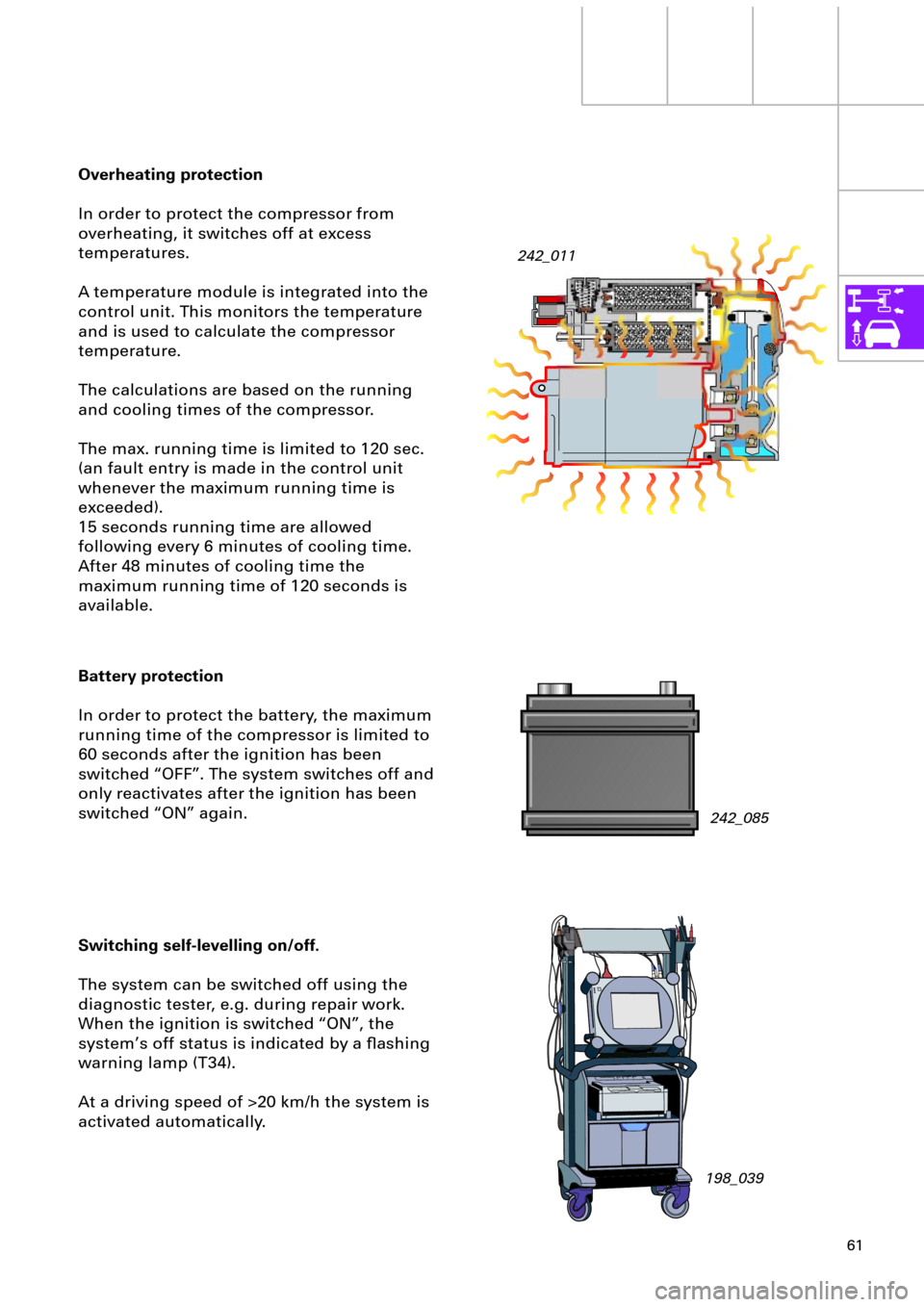
In order to protect the compressor from
overheating, it switches off at excess
temperatures.
A temperature module is integrated into the
control unit. This monitors the temperature
and is used to calculate the compressor
temperature.
The calculations are based on the running
and cooling times of the compressor.
The max. running time is limited to 120 sec.
(an fault entry is made in the control unit
whenever the maximum running time is
exceeded).
15 seconds running time are allowed
following every 6 minutes of cooling time.
After 48 minutes of cooling time the
maximum running time of 120 seconds is
available.
242_011
Battery protection
In order to protect the battery, the maximum
running time of the compressor is limited to
60 seconds after the ignition has been
switched ÒOFFÓ. The system switches off and
only reactivates after the ignition has been
switched ÒONÓ again.
Switching self-levelling on/off.
The system can be switched off using the
diagnostic tester, e.g. during repair work.
When the ignition is switched ÒONÓ, the
systemÕs off status is indicated by a ßashing
warning lamp (T34).
At a driving speed of >20 km/h the system is
activated automatically.
198_039242_085