door lock AUDI A7 2012 Owner's Manual
[x] Cancel search | Manufacturer: AUDI, Model Year: 2012, Model line: A7, Model: AUDI A7 2012Pages: 294, PDF Size: 73.33 MB
Page 127 of 294
A WARNING ,~
To help prevent poisonous exhaust gas
from being drawn into the vehicle, always
keep the rear lid closed while driving .
- Never transport objects larger than
those fitting completely into the luggage
area because the rear lid cannot be fully
closed.
- If you absolutely must drive with the rear
lid open, observe the following notes to
reduce the risk of poisoning:
- Close all windows,
- Close the power roof*,
- Open all air outlets in the instrument
panel,
- Switch off the air recirculation,
- Set the fresh air fan to the highest
speed.
A WARNING
Always make sure that the doors, all win dows, the power roof* and the rear lid are
securely closed and locked to reduce the
risk of injury when the vehicle is not being
used.
- After closing the rear lid, always make
sure that it is properly closed and locked.
- Never leave your vehicle unattended es
pecially with the rear lid left open. A
child could crawl into the vehicle through
the luggage compartment and close the
rear lid becoming trapped and unable to
get out. Being trapped in a vehicle can
lead to serious personal injury.
- Never let children play in or around the
vehicle .
- Never let passengers ride in the luggage
compartment. Vehicle occupants must
always be properly restrained in one of
the vehicle's seating positions.
Gj) Tips
-Air circulation helps to reduce window fogging. Stale air escapes to the outside
through vents in the trim panel. Be sure
to keep these slots free and open .
-
Driving Safely 125
-The tire pressure must correspond to the
load. The tire pressure is shown on the
tire pressure label. The tire pressure la
bel is located on the driver's side B-pillar.
The tire pressure label lists the recom
mended cold tire inflation pressures for
the vehicle at its maximum capacity
weight and the tires that were on your
vehicle at the time it was manufactured. For recommended tire pressures for nor
mal load conditions, please see chapter
r:!)page235.
Tie-downs
The luggage compartment is equipped with
four tie-downs to secure luggage and other
items.
Use the tie-downs to secure your cargo prop
erly<>
page 124, Loading the luggage com
partment.
In a collision, the laws of physics mean that
even smaller items that are loose in the vehi
cle will become heavy missiles that can cause
serious injury. Items in the vehicle possess en
ergy which vary with vehicle speed and the
weight of the item. Vehicle speed is the most
significant factor.
For example , in a frontal collision at a speed
of 30 mph (48 km/h), the forces acting on a 10-lb (4.5 kg) object are about 20 times the
normal weight of the item. This means that
the weight of the item would suddenly be about 200 lbs. (90 kg) . You can imagine the
injuries that a 200 lbs . (90 kg) item flying
freely through the passenger compartment
could cause in a collision like this.
A WARNING
Weak, damaged or improper straps used
to secure items to tie-downs can fail dur
ing hard braking or in a collision and cause
serious personal injury.
-Always use suitable mounting straps and properly secure items to the tie-downs in
'
•
•
Page 144 of 294

142 Airbag system
~fig. 142. The general location of the airbags
is marked "AIRBAG".
There is a lot you need to know about the air bags in your vehicle. We urge you to read the
detailed information about airbags, safety
belts and child safety in this and the other
chapters that make up the owner's literature.
Please be sure to heed the WARNINGS -they
are extremely important for your safety and
the safety of your passengers, especially in
fants and small children.
A WARNING
Never rely on airbags alone for protection.
- Even when they deploy, airbags provide
only supplemental protection .
- Airbag work most effectively when used
with properly worn safety belts.
- Therefore, always wear your safety belts
and make sure that everybody in your ve
hicle is properly restrained .
- Always hold the steering wheel with both
hands on the outside of the steering
wheel rim at the 9:00 o'clock and 3 :00
o'clock positions to help reduce the risk
of personal injury if the driver's airbag in
flates.
- Never hold the steering wheel at the 12
o'clock position or with your hands any
where inside the steering wheel or on the
steering wheel hub. Holding the steering
wheel the wrong way increases the risk
of severe injury to the arms, hands, and
head if the driver airbag deploys.
A WARNING
Objects between you and the airbag will
increase the risk of injury in a crash by in
terfering with the way the airbag unfolds
and/or by being pushed into you as the air
bag inflates.
-Always make sure nothing is in the front
airbag deployment zone that could be
struck by the airbag when it inflates.
- Objects in the zone of a deploying airbag
can become projectiles when the airbag deploys and cause serious personal
in
jury.
- Never hold things in your hands or on
your lap when the vehicle is in use.
- Never place accessories or other objects
(such as cup holders, telephone brackets,
note pads, navigation systems, or things
that are large, heavy, or bulky) on the
doors; never attach then to the doors or
the windshield; never place them over or near or attach them to the area marked
,,A IRBAG" on the steering wheel, instru
ment panel or the seat backrests; never
place them between these areas and you
or any other person in the vehicle.
- Never attach objects to the windshield
above the passenger front airbag, such
as accessory GPS navigation units or mu
sic players. Such objects could cause seri
ous injury in a collision, especially when
the airbags inflate.
- Never recline the front passenger seat to
transport objects. Items can also move
into the deployment area of the side air
bags or the front airbag during breaking
or in a sudden maneuver. Objects near
the airbags can fly dangerously through
the passenger compartment and cause
injury, particularly when the seat is re
clined and the airbags inflate.
A person on the front passenger seat, es
pecially infants and small children, will re
ceive serious injuries and can even be kil
led by being too close to the airbag when
it inflates.
- Although the Advanced Airbag System in
your vehicle is designed to turn off the
front passenger airbag if an infant or a
small child is on the front passenger
seat, nobody can absolutely guarantee
that deployment under these special
conditions is impossible in all conceiva
ble situations that may happen during
the useful life of your vehicle.
~
Page 178 of 294
176 Child Safety
-Always move the passenger seat into its
rearmost position in the seat's fore and
aft adjustment range, as far away from
the airbag as possible before installing
the forward-facing child restraint. The
backrest must be adjusted to an upright
position.
- Make sure that the
PASSENGER AIR BAG
OFF
light comes on and stays on all the
time whenever the ignition is switched
on.
A WARNING
Rearward-facing child restraints:
- A child in a rearward-facing child safety
seat installed on the front passenger
seat will be seriously injured and can be
killed if the front airbag inflates -even
with an Advanced Airbag System.
- The inflating airbag will hit the child
safety seat or infant carrier with great
force and will smash the child safety seat
and child against the backrest, center
armrest, door or roof.
- Always be especially careful if you must
install a rearward facing child safety seat
on the front passenger seat in exception
al circumstances.
- Make sure that the
PASSENGER AIR BAG
OFF
light comes on and stays on all the
time whenever the ignition is switched
on .
- If the
PASSENGER AIR BAG OFF light
does not come on and stay on, immedi
ately install the rear-facing child safety
seat in a rear seating position and have
the airbag system inspected by your Audi
dealer.
Activating the convertible locking retractor
Use the convertible locking retractor to se
cure a child restraint.
Always heed the child safety seat manufactur
er's instructions when installing a child re- straint in your vehicle. To activate the conver
tible locking retractor:
.,. Place the child restraint on a seat, prefera
bly on the rear seat.
.,. Slowly pull the belt
all the way out.
.,. Route it around or through the child re
straint belt path
¢ A -
.,. Push the child safety seat down with your
full weight to get the safety belt really tight .
.,. Insert the belt tongue into the buckle for
that seating position .
.,. Guide the safety belt back into the retractor
until the belt lies flat and snug on the child
safety seat.
.,. You should hear a "clicking" noise as the
belt winds back into the inertia reel. Test the
convertible locking retractor by pulling on
the belt. You should no longer be able to
pull the belt out of the retractor. The con
vertible locking retractor is now activated .
.,. Make sure that the red release button is fac
ing away from the child restraint so that it
can be unbuckled quickly.
.,. Pull on the belt to make sure the safety belt
is properly tight and fastened so that the
seat cannot move forward or sideways more
than one inch (2.5 cm).
A WARNING
Using the wrong child restraint or an im
properly installed child restraint can cause
serious personal injury or death in a crash.
- Always make sure that the safety belt re- tractor is locked when installing a child
safety seat. An unlocked safety belt re
tractor cannot hold the child safety seat in place during normal driving or in a
crash.
- Always buckle the child safety seat firmly
in place even if a child is not sitting in it.
A loose child safety seat can fly around
during a sudden stop or in a crash.
- Always make sure the seat backrest to
which the child restraint is installed is in
an upright position and securely latched
-
Page 204 of 294

202 Cleaning and protec tio n
directly at locks, or at door or hatch
openings -they can freeze shut.
- Never use sponges designed to remove insects, or any kitchen scouring sponges
or similar products . They can damage
your paint finish.
- Never use a dry cloth or sponge to clean
the headlights . Only use wet cloths or
sponges to prevent scratches. It is best
to use soapy water.
- You should remove debris (such as in
sects) from the headl ight lenses on a
regular basis, for example when refuel
i ng your vehicle. Never clean the head
li ghts w ith a dry cloth or sponge. Use a
wet cloth or sponge.
It is best to use
soapy wa ter.
@ For the sake of the environment
In the interest of the envi ronment, the ve
hicle sho uld only be washed i n special
was h bays.
Washing your vehicle with a power
washer
Cleaning the exterior of your car with a high
pressure power washer is safe as long as you
observe a few simple rules.
.. Befo re using the power washer , make sure
yo u have read and understood the WARN
INGS¢
A in General information on
page 200.
.. Always fo llow the operating instructions for
the power washer .
.. Make sure that the jet o n the spray hose
produces a "fan shaped spray" .
.. Do
not hold the spray nozzle too close to
soft materia ls .
When cleaning the veh icle with a power wash
er
always follow the operating instructions .
This applies particularly to the
op erating
pr essure
a nd the s pray ing di stance . Keep a
d ista nce from soft materials such as rubber
hoses o r insulat ing ma ter ial as well as sensors
and camera lenses . Do not use a jet which sprays water in a
d
ir ect
stream
or one t hat has a rotating jet .
Water temper ature sho uld not ex ceed 140 °F
(60 °().
A WARNING ~ -
Neve r wash tires with a jet that sprays wa
ter i n a direct stream. This could cause in
vis ib le damage to the t ires and weaken
them, even if the spray is from a re lative ly
l ong distance and for a short time. Dam
aged and weakened tires can fail and cause
accidents and personal inj ury.
'
([) Note
To avoid damaging your vehicle, a lways
make sure that there is suffic ient d istance
between the spray head and soft materia ls
like rubber hoses, plast ic pa rts and sound
deaden ing mater ials as w ell as sensors
and camera lenses. Neve r aim t he sp ray
head at the same point for a long time.
This also applies to cleaning headligh ts
and painted bumpers. Remembe r: the
closer the nozzle is to the surface of the
materia l, the greater the stress on the ma
terial.
Sensors and camera lenses
- Remove snow with a hand br ush and remove
ice with a de- ic ing spray that does not con
tain so lvents .
- Clea n the sensors (adaptive cruise control*,
pa rk ing system*) w ith a cleaning so lution
that does not contain so lvents and a soft
cloth .
- The camera lens or the area in front of the
came ra le ns is no rmally cleaned by the
w indshie ld w ipers o r he adlig ht wipers (night
vision system *).
If the lens or the area is ex
ceptionally di rty, clean the area wit h glass
cleaner and a soft, dry cloth .
(D Note
-If you was h your veh icle with a pres sure
washer,
Page 208 of 294
206 Cleaning and protec tio n
-Always read and heed all WARNINGS and
other information
c> page 200.
Exhaust tail pipes
Road salt and other corrosive materials will
damage the material in the exhaust tail pipes
if they are not cleaned regularly . Do not clean
the tail p ipes with wheel cleaner, paint pol ish,
chrome po lish or other abrasive cleaners.
C lean the tail p ipes with car ca re p roducts
that are su itable for stain less stee l.
Your author ized Audi dealer can provide clean
ing p roducts that have been tested and ap
p roved fo r you r vehicle.
Care of interior
Infotainment components
The MMI/RSE* display may be cleaned with a
soft cloth and commercially-ava ilable "LCD
cleaner" . The cloth should be coated lightly
when the clean ing solution when cleaning the
d isplay.
The MMI/RSE* contro ls must be cleaned first
with a brush so t hat dirt does not ente r the
un it or enter between the buttons and the
housing. Then wiping the controls with a cloth
dampened with dish detergent and water is recommended.
CJ) Note
- To avoid sc ratch ing the disp lay, you
shou ld never clean it dry.
- To prevent damage, ma ke sure fluids do
not enter the controls.
Aluminum trim
Use only n eutral-pH products to remove spots
and deposits from aluminum surfaces.
Chrome care products and alkaline cleaners
will attack aluminum s urfaces and can dam
age them over time.
A WARNING
A lways read and heed all WARNINGS and
other information
c> page 200.
Fabrics and fabric coverings
Fabr ics and fabric cover ings (e .g. seats, door
trim panels, etc.) should be cleaned at regular i ntervals w ith a vacuum cleaner. This removes
su rface di rt particles which could become em
bedded in the fabric through use. Steam
cleaners should not be used, because the
steam tends to p ush the dirt deeper into the
fabric and lock it there.
Normal clean ing
Generally, we recommend using a soft sponge
o r a lint-free microfiber cloth to the clean fab
ric. Brushes shou ld only be used for carpets
and floor mats, since other fabric surfaces
could be harmed by brushes.
Norma l su rface stains can be cleaned using a
commercially available foam cleaner . Spread
the foam on the s urface of the fabric with a
soft sponge and work it in gently. Do not satu
rate the fabric. Then pat the foam dry using
absorbent, dry cloths (e.g. m icrof iber cloth)
and vacuum it after it has dried completely.
Cle anin g sta ins
Stains caused by beverages (e .g. coffee, fruit
juice, etc.) can be treated with a mild deter
gent solution. Apply the detergent solution
with a sponge. In the case of stubborn stains, a detergent paste can be applied directly to
the stain and worked into the fabric. After
wards, use copious amounts of clean water to
remove the rema in ing deterge nt. Apply the
water wit h a damp clo th or sponge and pat
the fabric dry with an abso rbent, dry cloth .
Stains from choco late or makeup should have
detergent paste (e.g. ox-gall soap) rubbed in
to them. Afterwa rds, remove the soap with
water (damp sponge) .
Alcohol can be used to treat stains from grease, o il, lipstick or a ballpoin t pen . Melted ..,.
Page 215 of 294

transport fuel to use for your lawn mower,
snow blower, etc., be very careful and al
ways observe local and state laws regard
ing the use, transportation and storage of
such fuel containers. Make certain the con
tainer meets industry standards (ANSI/
ASTM F8S2 -86) .
@ Note
Never drive your vehicle until the fuel tank
is completely empty. The irregular supply
of fuel can cause misfiring. Gasoline could
enter the exhaust system and damage the
catalyt ic converter.
Refuelling
Fig. 163 Right rear vehicle s ide: Opening the fuel filler
flap
Fig. 164 Fuel filler flap with attached fuel cap
When activating the central locking, the fuel
f ill er flap is automatically un locked or locked.
Refuel the vehicle with the ignition switched
off.
Taking the fuel cap off
• Press the left side of the fuel filler flap to
open it¢
fig. 163 -arrow-.
• Unscrew fuel filler cap counter-clockwise
and hang it on the fuel filler flap
~ fig. 164 .
Fuel supply and filling your fuel tank 213
Refuelling procedure
• Insert the fuel nozzle from the gasoline
pump into the fuel filler neck as far as it will
go.
• Select a medium refuelling rate so that the
nozzle switches off automatically when the
tank is full.
Putting the fuel cap back on
• After filling your tank, twist the fuel filler
cap clockwise as far as it will go.
• Close the fuel filler flap.
To avoid fuel spill ing or evaporating from the
fuel tank always close fuel filler cap proper ly
and completely. An improperly closed fuel fill
er cap may also cause the MIL lamp ¢
page 2 7
to come on.
A WARNING
Improper refueling or handling of fuel can
cause fire, explosion and severe burns.
- Fuel is highly flammable and can cause
severe burns and other injuries.
- Failure to shut the engine off while refu
eling and/or to insert the pump nozzle
fully into the fuel filler neck could cause
fue l to spray out of filler neck or to over
flow. Fuel spray and overflowing fuel can
cause a fire.
- Never use a cellular telephone while re
fue ling. The electromagnet ic radiation
can cause sparks that can ignite fuel va
pors and cause a fire.
- Never get back into your vehicle while re
fueling.
If in exceptional circumstances
you must get back in your vehicle while
refueling, make certain that you close
the door and touch metal to discharge static electricity before touching the fill
er nozzle again. Static electricity can
cause sparks that can ignite fuel vapors
released during refueling.
- Never smoke or have an open flame any
where in or near your vehicle when refu
eling or filling a portable fue l container.
- For your safety, we strongly recommend
that you do not travel with a portable
Page 258 of 294
256 What do I do now ?
Loo sening
.,. Slide the wheel wr ench onto the wheel bolt
as far as it will go .
.,. Take tight hold of the
end of the wrench
hand le and turn the wheel bolts
co unter
clock wise
about one single turn in the direc
t ion of arrow
c:;, fig. 188.
Tighten ing
.,. Slide the wheel wrench onto the whee l bolt
as far as it will go .
.,. Take tight hold of the
end of the wrench
hand le and turn each wheel bolt
clock wise
until it is seated.
_& WARNING
- Do not use force or hurry when changi ng
a whee l - you can cause the vehicle to slip
off the jack and cause ser ious persona l
injuries.
- Do not loosen the wheel bolts more than
one turn
before you raise the veh icle with
the jack. -You r isk an injury.
@ Tips
- Never use the hexagonal socket in the
handle of the screwdrive r to loosen or
tighten the wheel bo lts.
- If a wheel bolt is very tight, you may find
i t easier to loosen by ca refully p ush ing
down on the end of the wheel bolt
wrench w ith
one foot only. As yo u do so,
ho ld on to the car to keep your ba lance
and take care not to slip .
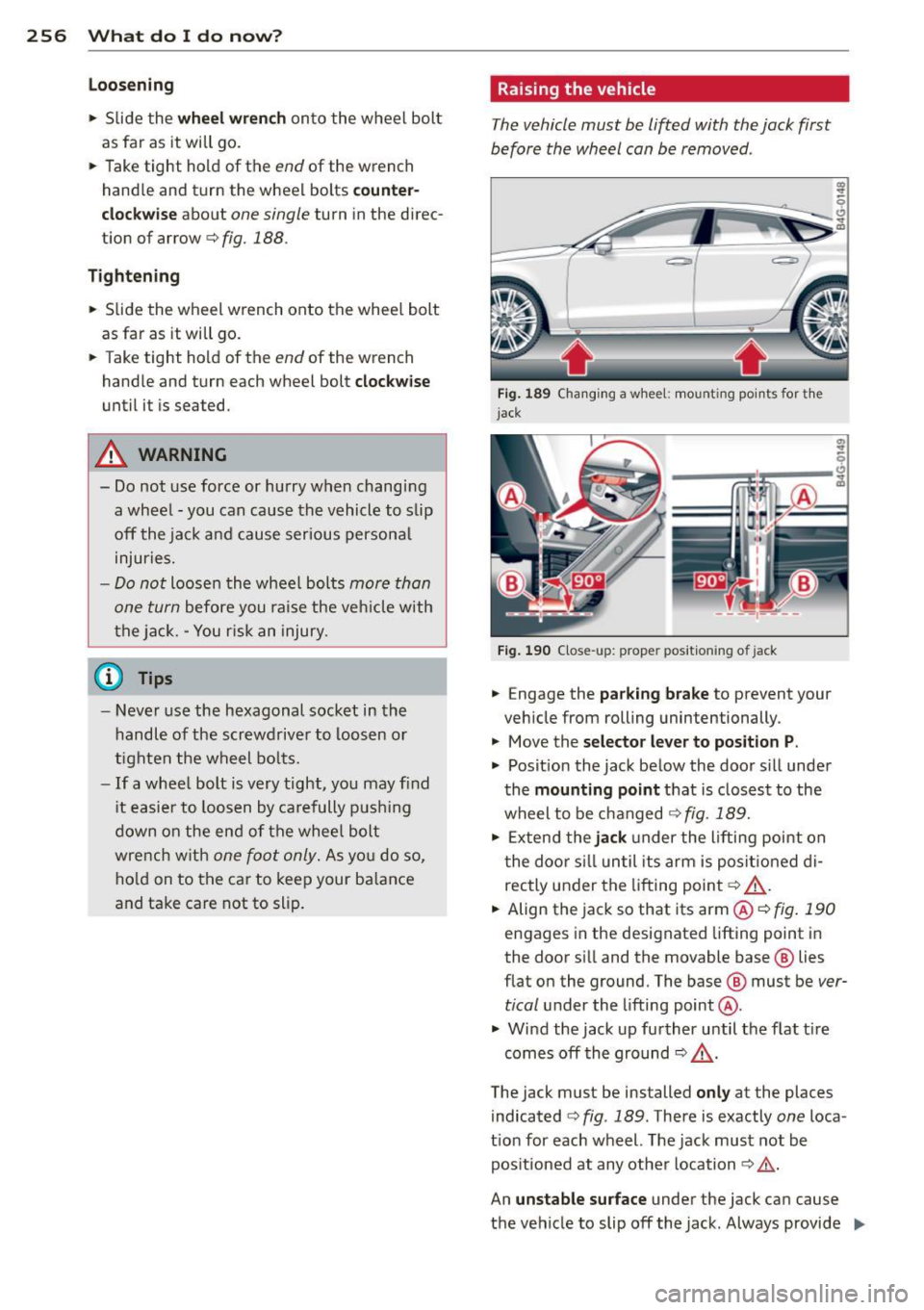
Raising the vehicle
The vehicle must be lifted with the jock first
before the wheel can be removed .
Fig . 1 89 C hang ing a whee l: moun ting po in ts for th e
j ack
Fi g. 1 90 Close -up: prope r posit io ni ng o f jack
.,. Engage the p ar king brak e to prevent your
veh icle from rolling unintentionally .
.,. Move the
select or lever to p osition P .
.,. Posit ion the jack below the door s ill under
the
mounting point that is closest to the
wheel to be changed
c:;, fig . 189.
.,. Extend the ja ck u nder the lifting point on
t he door s ill until its arm is pos it ioned di
rectly under the lifting point
c:;, &_ .
.,. Align the jack so that its arm @ c:;, fig. 190
engages in the designated lifting point in
the door s ill and the movable base @ lies
flat on the ground . The base @ must be
ver
tical
under the lifting point @ .
.,. Wind the jack up further until the flat t ire
comes off the ground
c:;, ,& .
The jack must be installed only at the places
indicated
c:;, fig . 189 . There is exactly one loca
t ion for each wheel. The jack must not be
positioned at any other location
c:;, ,&. .
An
unstab le surface under the jack can cause
the vehicle to slip off the jack . Always provide
II>-
Page 264 of 294

262 Fuses and bulb s
Fuse panel @ (black )
No . Equ ipment Amps
=
8
Headlight range adjustment/
5/7,5
adaptive lighting system
10 Left headlight (headlight with
7,5
adaptive light)
Fuse panel
@ ( brown )
No .II Equ ipm ent
II Amp s
1 Climate control 10
2 Climate control system blower 40
3 Diagnostic connector 10
4 Electrical ignition lock 5
5 Power steering column adjust-
ment
5
Steering column switch module 10
7 Power steer
ing column adjust-
ment 25
8 Light switch
Luggage compartment fuse assignment
Fig. 196 Luggage compartment: fuse panel with plas·
tic bracket
Fuse panel @ (bl ack )
No. II Equipment
I[ Amp s
4 E lectromechanical parking brake 30
5 Electromechanical parking brake 30
6 Front door (front passenger's
35
side)
7 Rear exterior lighting Rear sun shade, closing aid, lug
s gage compartment lock, con
venience key, START ENGINE
STOP, fuel filler door 30
20
-Fuse pane
l@ (blac k) I
No. Equipm ent Amps
=· 9 Power seat adjustment 15
10 Parking system
s
30
Fus e pane l
B (red)
No . Equipment Amps
1 Left belt tensioner
25
Right belt tensioner 25
3 Socket 20
20
Electromechanical parking brake
5
adaptive air suspension 15
7 Rear door (front passenger's
35
side)
Rear exterior lighting 30
9
Luggage compartment lid con-
30
t rol module
10 Telephone 5
11 Sound amp lifier 30
12 Rear spoiler 20
Fuse pane l c (b rown )
No. Equipment Amps
1 Rad
io receiver, Sound amplif ier/
30/20
MMI unit/dr ives
2 Tank leak detection system 5
AEM control module/battery 15/
4
module 7,5
6 Battery fan 35
Rad io receiver
7,5
7,5
9
Automatic dimming interior
5/15
rearview mirror/battery module
Parking system 5
Fu se panel o (gre en)
No. Equipment Amps
1 Audi pre sense 5
2 Electromechanical parking brake 5
3 adaptive a
ir suspension
5
Automatic transmission 7,5
...
Page 272 of 294

2 70 General information
General information
Explanation of
technical data
Some of the technical data listed in this man
ual requires further explanation .
The technical data for your vehicle is listed in
the charts starting on
r:::>page 27 2. This sec ·
tion provides general information, notes and restrictions which apply to this data .
Vehicle identification
The key data is given on the vehicle identifica·
tion number (VIN) plate and the vehicle data
sticker.
Fig. 206 Veh icle Ide ntific atio n Number (VlN) p late: lo
cation on driver 's sid e das h panel
Fig. 207 Th e vehicle identi fication label -inside the
luggage co mpa rtmen t
The Vehicle Identification Number (VIN)
is located on the driver's side so that it is visi
b le from the outside through the windshield
r:::> fig . 206. You can also display the Vehicle
Identification Number of your vehicle in the
MMI. Select: Function button
ICAR ! > Car sys
tems
> VIN number . The
vehicle identification label
is located in the luggage compartment in the
spare wheel wel l.
The label¢
fig. 207 shows the following vehi
cle data :
(D Production control No .
@ Vehicle identification No.
® Type code number
@ Type designation/engine output in Kilo·
watts
® Engine and transmission code letter
@ Paint No./Interior
(f) Optional equipment No.'s
Vehicle data 2 to 7 are also found in your War·
ranty
& Maintenance booklet.
The safety compliance sticker
is you r assurance that your new vehicle com
plies with all applicable Federal Motor Vehicle
Safety Standards which were in effect at the
time the vehicle was manufactured . You can
find this sticker on the left door jamb.
It
shows the month and year of production and
the ve hicle ident ification number of your vehi ·
cle (perforation) as well as the Gross Vehicle
Weight Rating (GVWR) and the Gross Axle
Weight Rating (GAWR) .
The high voltage warning label
is located on the lock carr ier .
The spark ignition system complies with
the Canadian standard ICES-002.
Weights
Gross Vehicle Weight Rating
The Gross Vehicle Weight Rating (GVWR), and
the Gross Axle Weight Rating (GAWR) for
front and rear are Listed on a sticker on the
left door jamb.
The Gross Vehicle Weight Rating includes the
weight of the basic vehicle plus full fuel tank,
oi l and coolant, plus maximum load, wh ich in·
eludes passenger weight (lSO lbs/68 kg per
Ill>
Page 282 of 294

280 Index
Child safety lock Rear doors .... .... ...... .. .. .... ..
37
C hild safety seats .......... .... .... . 169
Booster seats .......... .. .. .. .. .. . 172
Conve rtible child seats .... .. .. .... . 170
Conve rtible locking retractor . ..... .. .
How do I properly install a child safety
. h. l ? seat in my ve 1c e. . ............... .
Infant seats .. ........... .. .. .... .
Installing .. ............... .. .... .
Installing a child restraint using the
LATCH system .. .... ...... .. .. .. .. .
174
167
169
174
179
L ATC H system ............. ... .. ... 179
Lower anchorages ............ .... . 178
Mounting and releasing the anchorage
hook .. .. .. ... .... ......... ..... .
179
Safety instructions ......... ... .... . 167
Cigarette lighter . . . . . . . . . . . . . . . . . . . . . 54
Cleaning and protection ..... .. .. .... .
200
Alcantara (synthetic suede) . .. .. .. .. . 209
Eng ine compartment .... .. .. .. .... . 210
Exhaust tail pipes .......... ... .. .. . 206
Fabrics and fabr ic coverings .. .. .. .. . 206
Instrument panel ......... .. .. .... . 207
Inter ior .. .. ............. .. .. .. .. . 206
Lea ther .. .... ........... .... .... . 208
MMI display/controls ............... 206
Plastic and vinyl ................... 203
Plastic parts .. .......... ... .. .. .. . 207
Safety belts ............. .... .... . 209
trim strips 204
Trim str ips .... .. .. ... ... .. .. .. .. . 203
Climate control
Air vents ... .......... ..... .. .... .. 66
C limate controls . . . . . . . . . . . . . . . . . . . . .
64
Climate control (four-zone)
Operation .. ................ ... .. ..
67
Climate control (three-zone)
Operation . . . . . . . . . . . . . . . . . . . . . . . . . 65
C lock ... .. .. ............. .. .. .. .. .. 25
Closing Rear lid .. .. ................ ... ... . 35
Sliding/tilting sunroof ...... ..... .. ..
39
Cold tire inflation pressure ..... .. .... . 235
Com ing home ............. .. .. .... ..
43
Compact spare tire ...... .... ... .. .. . 253
Compartments .. ........ .. .. .. .... .. 55 Compliance
..... .. ... .. ........ .. ..
276
Consumer Information . . . . . . . . . . 126, 273
Consumption (fuel) ... .......... .. .. . 23
Contacting NHTSA
Convenience key ... ................ . . 126
33
Starting the engine ............. ... . 71
Stopping the engine (START ENG INE
STOP button) . . . . . . . . . . . . . . . . . . . . . .
73
Switching the ignition on ....... .. .. . 71
U nlocking and locking vehicle ...... .. . 33
Co nvertible child safety seats ... .. .. .. 170
Convertib le locking retractor
Activating . .... .. .. ........... ....
176
Deact ivat ing ... ... .............. .. 177
Using to secure a child safety seat 1.74, 176
Coolant
refer to Engine coolant ............. 223
Cooling mode (automat ic climate control) 67
Cooling mode (climate control) . . . . . . . . . 65
Cornering light .... ... .......... .. .. .
96
Cruise contro l
Changing speed .. ............. .... .
77
Presetting your speed .......... .. .. . 78
Switching off . . . . . . . . . . . . . . . . . . . . . . 78
Switching on . . . . . . . . . . . . . . . . . . . . . . . 77
Warning/ind icator lights .......... .. . 21
(upholder .... .. .. .. ........... .... . 55
D
Data ........ ... .. .. ... ........... . 272
Data recorder ... .. .. ........... .. .. 184
Date display .. .. .. ............. .... . 25
Daytime running lights ... ..... ... .. .. .
41
Declaration of compliance
Adaptive cruise control ........... ..
276
Audi s ide assist .. ............. .. .. 276
Cell phone package . ........... .. .. 276
Convenience key ... ................ 276
Electronic immob ilizer ....... ...... . 276
Homelink ® un iversal remote control .. 276
Remote control key
DEF What does this mean when it appears in 276
the tr ip odometer display? ....... ... . 25
Defective light bulb warning ...........
20