service AUDI A7 2012 Owner's Manual
[x] Cancel search | Manufacturer: AUDI, Model Year: 2012, Model line: A7, Model: AUDI A7 2012Pages: 294, PDF Size: 73.33 MB
Page 243 of 294

Tire service life
The service life of tires depends on a lot of
different things including proper installation
and balancing, correct tire pressure and driv
ing style.
F ig. 178 Tire tread: tread wea r ind ica tors (TWI)
Fi g. 179 Rotat ing t ires fo r m ore even wea r
Tread Wear Indicator (TWI)
The origina l tires on your veh icle have
1/16 in ch (1.6 mm) high "wear ind icators"
r::!;> fig . 178 run ning across the tread. Depend
ing on the make, there will be six to eight of
them evenly p laced around the t ire . Marks on
the t ire s idewall (for example "TWI" or other
symbols) indicate the positions of the tread
wear ind icators . Worn t ires must be replaced.
Different fig ures may apply in other countries
r::!) & .
Tir e pressure
Incorrect tire pressure causes premat ure wear
and can cause sudden tire blow-out . For th is
reason, tire pressure must be checked at least
once a month
r::!;> page 23 7.
Dri ving sty le
Driving fast around curves , heavy acceleration
and hard braking increase tire wear. Tires and wheels 241
Rotating tires for more even wear
For all four tires on your ve
hicl e to have the
same service life, we recomme nd that the
front and rear tires are rotated according to
the tire manufacturer 's suggested tire rota
tion inte rvals. Please remember the follow
ing :
- Tire rotation intervals may differ from the
veh icle service inte rva ls o utlined in your
Warranty & Maintenance booklet.
- The longer one tire is used in one location
on the vehicle, the more it wears at certain
points ; therefore, we recommend that you
follow the tire manufactu rer 's suggested
tire rotation intervals .
- Vehicles w ith front-wheel dr ive exper ience
more tread wear on the front wheels com
pared to all -wheel d rive (quattro ®).
- Please rotate tires as shown
r::!;> fig. 179.
-Extra care must be taken when rotat ing di-
rection-specific tires
r::!;> page 258 .
Wheel balancing
The wheels on new veh icles are balanced .
However, various situations during everyday
driving can cause them to become unba l
anced, resulting in vibrat ions you can usually
feel through the steer ing wheel.
Unbalanced wheels must be rebalanced to
avoid excessive wear on steering, s uspension
and t ires. A whee l must also be reba lanced
when a new tire is insta lled.
Inco rrect wheel alignment
Incorrect wheel alignment can cause exces
sive tire wear, impair ing the safety of the vehi
cle . If tires show excessive wear, have the
whee l alignment checked by an authori zed
Audi dealer or qualified workshop.
All-whe el drive
Vehicles wi th quattro ® mus t always have tires
of the same size, construction and tread type. For details see
r::!;> page 189.
Page 260 of 294

258 What do I do no w?
• Use the hexagonal socket in the screwdriver
hand le to screw in and tighten all wheel
bolts
slightly .
• Remove the alignment pin and insert and
t ighten the remaining wheel bolt slightly
Like the rest .
• Turn the jack handle counter-clockw ise to
lower the vehicle unt il the jack is fully re
leased .
• Use the whee l bolt wrench to t ighten al l
wheel bolts firmly¢
page 255 . Tighten
them
crosswise, from one bolt to the (ap
proximate ly) opposite one, to keep the
whee l centered.
@ Note
When removing or installing the wheel,
the rim could hit the brake rotor and dam
age the rotor. Work carefully and have a
second person help you.
@ Tips
Never use the hexagonal socket in the han
dle of the screwdriver to loosen or tighten
the wheel bolts .
- Pull the reversible b lade from the screw
driver before you use the hexagonal
socket in the handle to turn the whee l
bo lts.
- When mounting tires with
unid irectional
t re ad design
make sure the tread pat
tern is pointed the right way
~ page 258.
- The wheel bolts should be clean and easy
to turn . Check for d irt and corrosion on
the mat ing surfaces of both the whee l
and the hub. Remove all dirt from these
s ur faces before remo unt ing the wheel.
Tires with unidirectional tread design
Tires with unidirectional tread design must be
mounted with their tread pattern pointed in the right direction .
Using a sp are t ire w ith a tre ad pattern
intended for use in a specific direction
When using a spare t ire with a tread patter n
intended for use in a spec ific d irection , please
note the following :
- The direct ion of rotation is marked by an ar
row on the side of the ti re .
- If the spare tire has to be installed in the in
correct direct ion, use the spare tire only
temporarily s ince the tire will not be able to
achieve its optim um performance cha racter
is tic s wit h regard to aquap la ni ng, no ise and
wear .
- We recommend that you pay part icu la r at
t en tion to th is fact d uring wet wea ther and
t ha t you adjust you r speed to match road
conditions .
- Replace the fl at tir e with a new o ne an d
have it insta lled on you r vehicle as soon as
possible to restore the handling advantages
of a u nidirectional tire .
Notes on wheel changing
Please read the information ¢ page 242, New
tires and replacing tires and wheels
if you a re
going to use a spare tire which is different
from the ti res on your vehicle .
After you change a tire:
- Check the tire pre ssure on the spare imme
diately after install ation.
- Have th e whe el bolt tight ening torqu e
c hecked with a torque wrench as soon a s
possible by your author ized Audi dealer or
a qualified service stat ion.
- With steel and alloy wheel rims, the wheel
bolt s are cor re ctl y tightened at a torque of
90 ft lb (120 Nm ).
- If you noti ce that the wheel bolts are cor
roded and diffi cult to turn while changing
a ti re , they should be replaced before you
check the t ightening torque. .,..
Page 267 of 294
@ Tips
The disc harged battery must be properly
connected to the vehicle's electrical sys
tem. When jump starting or charg ing the
battery, never connect the negative
ground cable to the batte ry negat ive post
because the ba tte ry manager system must
be ab le to detect the battery's state of
charge. Always connect the negative
g round cab le to the negative ground pos t
of t he battery manager cont ro l unit.
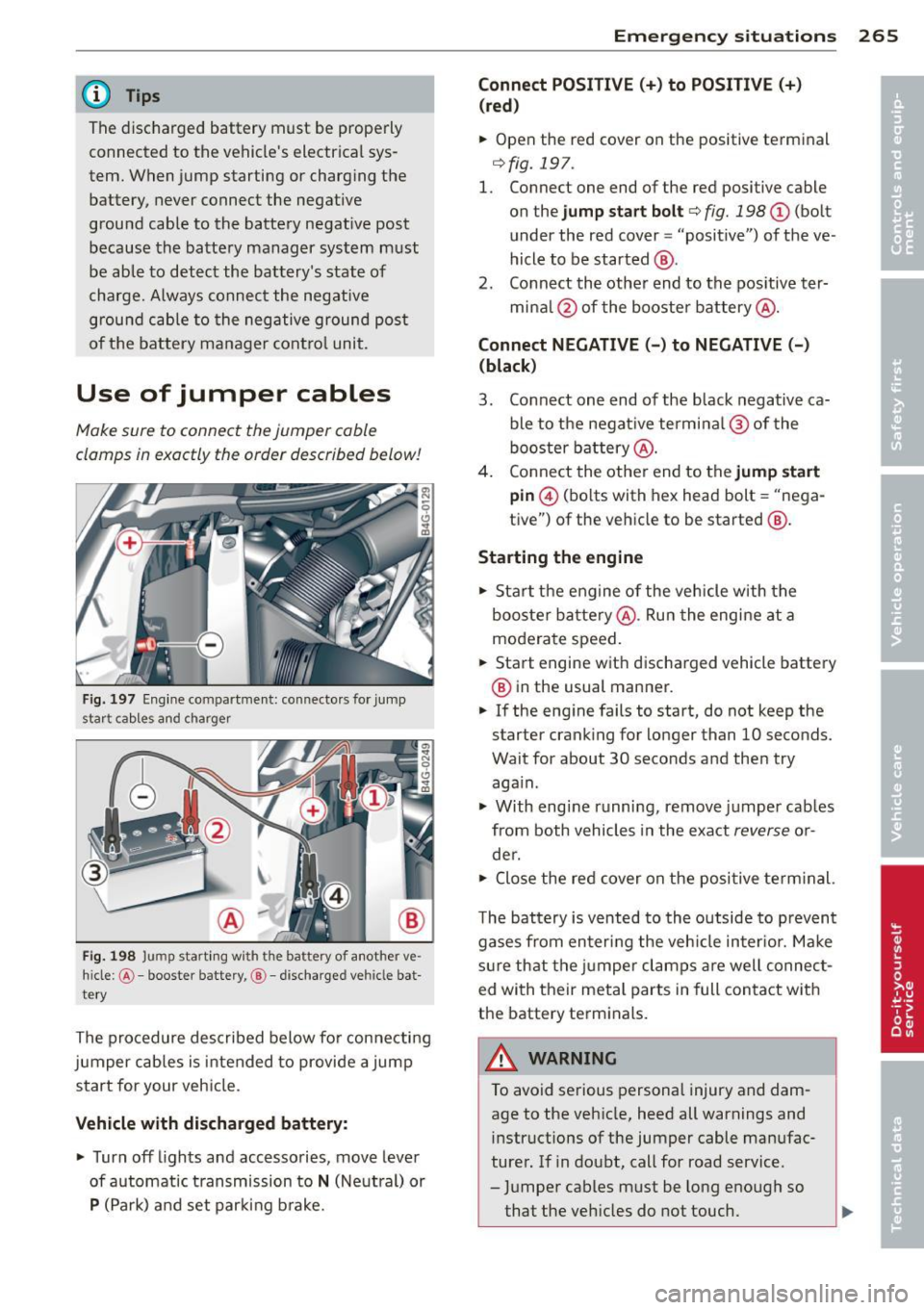
Use of jumper cables
Make sure to connect the jumper coble
clomps in exactly the order described b elow!
Fi g. 197 Eng ine co mpar tment: connecto rs for jum p
s tar t cab les and ch arg er
F ig. 1 98 Jump start in g w ith t he ba ttery of a not her ve ·
hi cle :
@-booster battery, ®-di sc harged ve hicle bat
te ry
The procedure des cribed below fo r connecti ng
jumper cables is intended to provide a jump
start for your veh icle.
Vehicle with discharged battery :
• Turn off ligh ts and accessories, move leve r
of automatic t ransmission to
N (Ne utral) or
P (Park) and set par king b rake.
Emergenc y situ ation s 265
Connect POSI TIVE(+) to POSITIVE(+ )
(red )
• Open the red cover on the positive terminal
¢fig. 19 7.
1. Connect one end of the red positive cable
on the jump sta rt bolt
¢ fig. 198 (D (bolt
under the red cover = "positive") of the ve
hicle to be started @.
2 . Connect th e othe r end to the pos itive ter-
mi na l@ of the booster battery @.
Connect NEGATIVE( -) to NEGATIVE(-)
(black )
3. Connect one end of the black negative ca ble to the negat ive termi na l@ of the
booster b attery @.
4. Connect the othe r end to the jump start
pin @ (bo lts w ith hex head bolt = "nega
tive") of the vehicle to be started @.
Starting the engine • Sta rt the engine of the veh icle w ith the
booste r ba tte ry @ . Ru n the engi ne at a
modera te speed.
• Start engine wit h discha rged vehicle battery
@ in the usual manner.
• If the eng ine fails to sta rt, do not keep the
starter c ranking for longer than 10 seconds.
Wait for about 30 seco nds a nd the n try
aga in .
• With eng ine runni ng , remove j umper cab les
from both vehicles in the exact
reverse o r
de r.
• Close the red cover on the posi tive term inal.
T he battery is v ented to th e outside to p rev ent
gases from en ter ing the veh icle in ter io r. Ma ke
s ur e th at the jumper clamps are well connec t
ed with their meta l parts in full con ta ct w ith
the battery term inals.
,8. WARNING
To avoid se rious personal injury and dam
age to the veh icle, heed all warnings and
instructions of the jumper cable man ufac
ture r. If in doubt, call for road service .
- Ju mpe r cables m ust be long enough so
that the veh icles d o not touch.
-
Page 275 of 294

Consumer Information
Warranty coverages
Your Audi is covered by the following war
ranties :
- New Vehicle Limited Warranty
- Limited Warranty Against Corrosion Perfo-
ration
- Emissions Control System Warranty
- Emissions Performance Warranty
- California Emissions Control Warranty (USA
vehicles only)
- California Emissions Performance Warranty
(USA vehicles only)
Detailed information regarding yo ur warran
ties can be found in your
Warranty & Mainte
nance booklet .
Operating your vehicle
outside the U.S.A. or
Canada
Government regulations in the United States
and Canada require that automobiles meet
specific emission regulations and safety
standards. Therefore, veh icles built for the
U.S.A. and Canada differ from vehicles sold in
other countries .
I f you p lan to take your vehicle outside the
continental limits of the United States or Can
ada, there is the possibility that
- unleaded fuels for vehicles with cata lytic
converter may not be available;
- fuel may have a considerably lower octane
rating . Improper fuel may cause engine
damage;
- service may be inadequate due to lack of
proper service facilities, tools or testing
equipment;
- replacement parts may not be readily availa
ble.
- Navigation systems for vehicles built for the
U.S.A. and Canada will not necessari ly work
in Europe, and may not work in other coun
tries outside North America .
Consumer Information 273
@ Note
Audi cannot be responsible for mechanical
damage that could result from inadequate
fuel, serv ice or parts availab ility.
Audi Service Repair
Manuals and Literature
Audi Offic ial Factory Service Manuals and Lit
erature are published as soon as possible after
model introduct ion. Service manuals and lit
erat ure are available to order from the Audi
T echnical Literature Ordering Center at:
www.audi.techliterature.com
Maintenance
' General
Your vehicle has been designed to help keep
maintenance requirements to a m inimum.
However, a certain amount of regular mainte
nance is still necessary to assure your vehicle's
safety, economy and reliability . For detailed
vehicle maintenance consult your Warranty &
Maintenance booklet.
Under difficult operating conditions , for ex
ample at extremely low outside temperatures,
in very dusty regions, when towing a trailer
very frequently, etc., some serv ice work
shou ld be pe rformed between the intervals
specified. This applies particularly to:
- oil changes, and
- cleaning or replacing the air filter.
® For the sake of the environment
By regularly maintaining your veh icle, you
help make sure that emission standards
are maintained, thus min imiz ing adverse
effects on the environment .
Important considerations for you and
your vehicle
The increasing use of electronics, sophistica t
ed fuel injection and emission contro l sys-
tems, and the genera lly increasing technica l ..,_
•
•
Page 288 of 294
286 Index
Replacing Fuses . ..... ... . ...... ... .. .. .... . 260
Light bulbs .... ... .... ... .. .. .... . 263
Tires and whee ls ......... .. .. ..... 243
W indshield wiper blades ..... .. .... .. 46
Report ing Safety Defects . ... .. ... ... . 12 6
Rese t button . . . . . . . . . . . . . . . . . . . . . . . . 25
Retractor ...... ........... ........ . 131
Revers ible ma t .......... .. .. .. .. .. .. 6 2
R ims (cleaning) ............. ... .. ... 205
Roof rac k ..... .. .. ..... ... .. .. .... .. 57
L oading . ... .. . .. ..... ... .. .. .... .. 58
Roof weight . . . . . . . . . . . . . . . . . . . . . . . 58
s
SA FE .. ... ... .. .. ..... ... .. .. .... .. 25
S afe d riving hab its ......... .. .. .. .. . 118
Safety belt position ........ .. .. .. .. . 132
Safety belt he ight ad justment .. .... . 134
Safety belts worn by p regnant women . 133
Safety belt pretensioner ... .. .. .. .. ... 135
Service and disposal .......... .. .. . 135
S afety bel t pre tens io ners
Pr e sense . .... .. ..... ... .. .. .... . 18 2
Safety belts . . . . . . . . . . . . . . . . . . . . . . . . 13 1
cleaning . .. ................ ... ... 209
D anger to passe ngers w ho do not wea r a
s a fety be lt .............. .. .. ..... 129
F asten ing . .... .. ..... ... .. .. .... . 13 1
Height adjustment . . . . . . . . . . . . . . . . . 134
Imp roperly worn . ..... ... .. .. .... . 134
Not worn . . . . . . . . . . . . . . . . . . . . . . . . 129
Safety belt position ....... .. .. .. .. . 132
Safety instructions . . . . . . . . . . . . . . . . . 131
Secur ing ch ild safety seats . . . . . . . . . . 17 4
Specia l co nsiderations fo r pregnant
women .. .. ............. .. .. .. .. . 133
Unfaste ning .. ........... .... .... . 133
War ning/ indica to r li gh t .... .. .. ..... 12 8
Warn ing ligh t . ... ..... ... .. .. .... .. 16
Why YOU MUST wear them ... ... ... . 128
Worn properly . . . . . . . . . . . . . . . . . . . . 130
Safety bel t tensione r
d rive sele ct . ... .......... .. .. .. .. .. 9 6
Safety belt warn ing light .. .. .. .. .. .. . 128
Safety compliance sticker ... .. .. .. .. . 270 Sa
fety eq uipment . .... .. ..... ... .. .. 118
Safety featu res for occupant rest ra int and
protection .. .... .. ............. .... 118
Safety gu idelines
Seat adjustment . . . . . . . . . . . . . . . . . . . . 50
Safety instr uctions
E ngine compartment . .. ..... ... .. .. 216
for side c urtain airbags ......... .... 161
for using child safety seats .... .. .. .. 167
fo r using safety belts ........... .. .. 131
Monitoring the Advanced Airbag Sys -
tem .. ..... ... .. .. .......... .... . 152
Safety systems Warning/ind icator lights ........ .... . 17
S eat adjustment
Contro ls . . . . . . . . . . . . . . . . . . . . . . . . . . 51
Drive r's seat . . . . . . . . . . . . . . . . . . . . . . . 50
Front passenger's seat .............. . 51
Front seats . . . . . . . . . . . . . . . . . . . . . . . . 50
Head restra ints . . . . . . . . . . . . . . . 52, 122
Safety gu idelines . ................ .. 50
Seat be lts
WhyYOUMUSTwearthem .... .. .. .. 128
Seat heating/ven tila tion (automat ic cli-
mate control) . . . . . . . . . . . . . . . . . . . . . . . 68
Seat heating (climate con trol) . . . . . . . . . . 66
Seating position Driver .... .... ................... 119
Front passenger ............... .... 120
How to adj ust the front seats .... .. .. 120
Incorrect seat position .............. 122
Occu pan ts .. ... .. ..... ....... ... .. 119
Rea r passengers .. ............. .... 121
Seat memory . . . . . . . . . . . . . . . . . . . . . . . 53
Seats ( number) .... ... .. ..... ... .. .. 128
Se lective unlock feature . .......... ... . 32
Se lector lever ... .. .. .... .... ... .. .. 103
Emergency re lease ............. .... 107
Se rv ice and d isposa l
Safety be lt pre tensioner ..... .... . .. 135
Se rv ice interval display . . . . . . . . . . . . . . . . 25
S hi ft buttons .. .. .. ............. .. .. 106
S id e ai rbags
D escription . ..... .. .... .... ... .. .. 15 7
How they wor k ... .. ... ..... ... .. .. 158
Page 289 of 294

Side assist Activating and deactivating . . . . . . . . . . . 88
Cleaning sensors ............ ... .. . 202
Description . ............. .... .. .... 88
Informational and alert stage signals .. 90
Messages in instrument cluster display . 94
MMI settings .... .. ...... .. .. .. .. .. 93
Operation . . . . . . . . . . . . . . . . . . . . . . . . . 89
Safety tips . . . . . . . . . . . . . . . . . . . . . . . . 94
Sensor detection area . . . . . . . . . . . . . . . 89
Side curtain airbags ........... .... .. 160
Description .... .. .. ...... .. .. .. .. . 160
How they work .............. ... ... 161
Safety instructions ........ .. .. .. .. . 161
Side marker lights ......... .. .. .. .. .. 41
Ski sack ..... .. ................ ..... 62
also refer to Trunk pass-through .. .. .. 63
Sliding/tilting sunroof Emergency closing .......... .. .. .. .. 40
Opening and closing ...... .. .. .. .. .. 39
Snow chains . ................ ... ... 247
Socket . . . . . . . . . . . . . . . . . . . . . . . . . . . . . 55
Sources of information about child re-
straints and their use ....... .. .. .. .. . 181
Space-saving spare tire ...... .. .. .. .. . 253
Spare tire .... ................ ... ... 253
Speedometer . . . . . . . . . . . . . . . . . . . . . . . 25
Speed rating letter code ..... .. .. .. .. . 243
Speed warning system ...... .. .. .. .. .. 76
Star button . . . . . . . . . . . . . . . . . . . . . . . . . 23
START ENGINE STOP button ........... 71
Starting from rest .......... .. .. .. .. .. 75
Startingoffwithatrailer .... .. .. .. .. .. 75
Starting the engine .................. 71
Steering Electrically adjustable steering wheel .. 70
Manually adjustable steering wheel .. .. 70
also refer to Electro-mechanical power
assist ..... .. ................ .... 189
Steering wheel Easy entry feature . . . . . . . . . . . . . . . . . . 71
Indicator light . . . . . . . . . . . . . . . . . . . . . 17
Steering wheel heating .... .. .. .. .. .. 69
Steering wheel column Adjusting electrically ...... .. .. .. .. .. 70
Adjusting manually ....... .. .. .. .. .. 70
Steps for determining correct load limit . 239
Index 287
Stopping the engine . ............... .. 73
Storage . . . . . . . . . . . . . . . . . . . . . . . . 55, 60
Sunroof .... .. .. .. ... ............ ... 39
Sun shade .. .. .. .. ................. . 45
Sun visors ........ .. ................ 45
Symbols
refer to Warning/indicator lights ..... . 11
T
Tachometer . . . . . . . . . . . . . . . . . . . . . 11, 22
Technical modifications .............. 276
Temperature display ............. .. .. . 22
T ether anchors . . . . . . . . . . . . . . . . . . . . . 180
Tether strap . . . . . . . . . . . . . . . . . . . . . . . 180
The first 1,000 miles (1,500 km) and after-
wards ...... .. .. .. ................. 192
Three-zone climate control . . . . . . . . . . . . 65
Tie-downs . . . . . . . . . . . . . . . . . . . . . 61, 125
Tips for the environment
Saving fuel . ... .. .. ................ 58
tiptronic ... .. .. .. ................. 102
A ut omatic Shift Lock (ASL) ...... .. .. 104
Driving .......................... 102
Dynamic shift program ............. 105
Emergency mode ... ............... 106
Kick-down . .. .. .. ................. 104
Manual shift program .............. 105
Selector lever .. .. ... ... ...... ..... 103
Tire pressure . ...................... 23 7
Tire pressure monitoring system ....... 249
Loss of air pressure ................ 250
Malfunction . .. .. ................. 250
Resetting tire pressures ............ . 251
Tires ...... ... .. .... .......... ..... 231
Service life ....... ................ 241
Speed rating letter code ........ .. .. 243
Tire manufacturing date ........ .. .. 243
Tire specifications ................ . 243
Tread depth ....... ............... 241
Uniform tire quality grading ........ . 245
Winter tires . .. ...... ............. 246
T ires and vehicle load limits ....... .... 239
Tires and wheels Checking tire pressure ............. . 237
Cold tire inflation pressure ......... . 235
Dimensions .. .. .. ................. 242
•
•