warning AUDI A7 2014 Owners Manual
[x] Cancel search | Manufacturer: AUDI, Model Year: 2014, Model line: A7, Model: AUDI A7 2014Pages: 306, PDF Size: 76.83 MB
Page 136 of 306

134 Driving Safely
Proper adjustment of head restraints
Correctly adjusted head restraints are an im
portant part of your vehicle's occupant re
straint system and can help to reduce the risk
of injuries in accident situations.
Fig. 149 H ead restraint: viewed from the front
The head restraints must be correctly adjust
ed to achieve the best protection.
i,.. For adjustable head restraints: adjust the
head restraint so the upper edge is as even
as possible with the top of your head. If that
is not possible, try to adjust the head re
stra int so that it is as close to this position
as possible¢
fig. 149. Move the head re
stra int so that it is as close to the back of
the head as possible .
i,.. If there is a passenger on the rear center
seat ing position*, slide the center head re
straint* upward at least to the next notch.
Adjusting head restraints¢
page 56.
A WARNING
All seats are equipped with head re
straints. Driving without head restraints or
with head restraints that are not properly
adjusted increases the risk of serious or fa
tal neck injury dramatically. To help reduce
the risk of injury:
- Always drive with the head restraints in
place and properly adjusted.
- Every person in the vehicle must have a
properly adjusted head restraint.
- Always make sure each person in the ve
hicle properly adjusts their head re
straint. Adjust the head restraint so the
upper edge is as even as possible with the top of your head. If that
is not possi
ble, try to adjust the head restraint so
that it is as close to this position as pos
sible. Move the head restraint so that it
is as close to the back of the head as pos
sible.
- Never attempt to adjust head restraint
while driving. If you have driven off and must adjust the driver headrest for any
reason, first stop the vehicle safely be
fore attempting to adjust the head re
straint.
- Children must always be properly re
strained in a child restraint that is appro
priate for their age and size ¢
page 175.
Examples of improper seating positions
The occupant restraint system can only re
duce the risk of injury if vehicle occupants are
properly seated.
Improper seating positions can cause serious
injury or death. Safety belts can only work
when they are properly positioned on the
body. Improper seating positions reduce the
effectiveness of safety belts and will even in
crease the risk of injury and death by moving
the safety belt to crit ica l areas of the body.
Improper seating positions also increase the
risk of serious injury and death when an air
bag deploys and strikes an occupant who is
not in the proper seating position. A driver is
responsible for the safety of all vehicle occu
pants and especially for children. Therefore:
i,.. Never allow anyone to assume an incorrect
seating position when the vehicle is being
used ¢& .
The following bulletins list only some sample
positions that will increase the risk of serious
injury and death. Our hope is that these exam
ples will make you more aware of seating po
sitions that are dangerous.
Therefore, whenever the vehicle is
moving:
- never stand up in the vehicle
- never stand on the seats
Page 137 of 306
-never knee l on the seats
- never ride with the seatback reclined
- never lie down on the rear seat
- never lean up against the instrument pa nel
- never sit on the edge of the seat
- never sit s ideways
- never lean out the window
- never put yo ur feet out the window
- never put yo ur feet o n the ins trumen t pa nel
- never rest you r feet on the seat cushion o r
back of the seat
- never r ide in the footwe ll
- never r ide in the cargo area
A WARNING
Imprope r seat ing positions increase the
r is k of se rious personal injury and death
whenever a veh icle is being used.
- Always make sure that a ll vehicle occu
pants stay in a p ro per seat ing pos it ion
and are properly restra ined whenever the
vehicle is be ing used .
Driver and passenger
side footwell
Important safety instructions
Appl ies to vehicles: with knee a irbags
A WARNING
Always make s ure that the knee ai rbag can
inf late without interfe rence. Objects be
tween yourse lf and the airbag can increase
the risk of injury in an acc ident by interfer
ing w ith the way the a irbag deploys or by
being p ushed into you as the airbag de
ploys.
- No persons (ch ildren) or animals should
ride in the footwell in front of the pas
senger seat. If the airbag deploys, this
c an res ult in serious or fata l injuries.
- No objects of any k ind sho uld be car ried
in the footwell area in fron t of the driv
er's or passenger's seat. Bul ky objects
(shopping bags, for example) can ham
per or prevent p roper deployment of the
airbag. Small objects can be thrown
Dr iving Safel y 135
through the vehicle if the airbag deploys
and in jure you or your passengers.
Pedal area
Pedals
The pedals must always be free to move and
must never be interfered with by a floor mat
or any other object.
Make sure that a ll peda ls move free ly without
i nterfe rence and that nothing prevents them
from return ing to their orig inal positions.
Only use floor mats that leave t he pedal area
free and can be secured with floor mat fasten
ers .
If a brake circ uit fai ls, increased brake pedal
trave l is required to bring the vehicle to a full
stop.
A WARNING
Pedals that ca nnot move free ly can cause
loss of vehicle control and incr ease the risk
of ser ious injury.
- Never p lace any objec ts in the drive r's
footwell. An ob je ct cou ld get into the
pedal area a nd inte rfe re wi th pedal fun c
tion. In case of sudde n brak ing o r an a c
cident, yo u wou ld not be a ble to brake or
accelerate!
- Always ma ke su re th at nothing can fall
or move into the driver's footwel l.
Floor mats on the driver side
Always use floor mats that can be securely
attached to the floor mat fas teners and do
not in terfere with the free movement of the
pedals.
.,. Ma ke s ure t hat the floor ma ts are prope rly
secured an d cannot move and interfere wi th
the peda ls ~ _& .
Use only floor mats tha t leave the peda l area
u nobstru cte d a nd th at are firmly secured so
that they cannot slip o ut o f position. You can
II>
•
•
Page 138 of 306
136 Driving Saf ely
obtain sui table flo or mats from your
authorized Audi Dealer.
F loor mat fasteners are installed in your Audi .
Floor mats used in your vehicle must be at
tached to these fasteners . Properly secur ing
the floor mats will prevent them from sliding
i nto pos itions that could interfe re wi th the
pedals or impair safe operation o f your vehicle
in other ways .
A WARNING
Pedals that cannot move freely can resu lt
in a loss of veh icle contro l and increase the
r isk of serious personal injury .
- Always make sure that floor mats are
properly secured.
- Never place or insta ll floor mats or other
floor coverings in the vehicle that cannot
be properly secured in place to prevent
them from slipping and interfering w ith
the pedals or the ability to control the
vehicle .
- Never place or install floor mats or other
floor coverings on top of a lready insta l
led floor mats . Additional floor mats and
other cove rings w ill reduce the si ze of
the pedal area and interfere with the peda ls.
- Always properly reinstall and se cu re floor
mats that have been taken out for clean
ing.
- Always make su re that obje cts canno t
f all into the driver footwe ll wh ile the ve
hicle is moving . Objects can become
t rapped under the b rake pedal and accel
erator peda l causing a loss of veh icle
control.
Stowing luggage
Loading the luggage compartment
All luggage and other objects must be prop erly stowed and secured in the luggage com
partment.
Loose i tems in the luggage compartmen t can
shift suddenly, changing veh icle hand ling characteristics. Loose items can a
lso increase
the risk of s erious persona l injury in a sudden
vehicle maneuver o r in a co llision .
.. Dis trib ute the load even ly in the luggage
compa rtment .
.. Always place and properly secure heavy
items in the luggage compartment as far
forward as possible .
.. Secure luggage using the tie-downs prov id
ed
¢ page 64, Luggage compartment .
.. Make sure that the rear seatback is securely
latched in place.
A WARNING
Imp roperly stored luggage or other items
can fly thro ugh the vehi cle causing ser ious
personal injury in the event of hard brak
i ng or an accident. To help reduce the risk
of ser ious personal in ju ry:
- Always put ob jects, fo r example, luggage
or other heavy items in the luggage com
partment.
- Always secure objects in the luggage
compa rtment us ing the tie-down hooks
and suitable straps.
A WARNING
-
Heavy loads w ill influence the way yo ur ve-
h icle handles. To help reduce the risk of a
l oss of cont ro l leading to serious personal
in Jury :
- Always keep in mind when transporting
heavy objects , that a change in the cen
ter of gravity can also cause changes in
veh icle handling:
- Always distribute the load as evenly as
poss ible .
- Place heavy objects as far forward in the luggage compartment as possible.
- Never exceed the Gross Axle We igh t Rat
ing or the Gross Vehicle Weight Rating
specif ied on the safety compliance stick
er on the left door jamb. Exceeding per
miss ible weight standards can cause the
veh icle to slide and hand le diffe rently.
- Please observe information on safe dr iv
ing¢
page 130.
Page 139 of 306
A WARNING
To help prevent poisonous exhaust gas
from being drawn into the vehicle, always keep the rear lid closed while driving .
- Never transport objects larger than
those fitting completely into the luggage
area because the rear lid cannot be fully
closed.
- If you absolutely must drive with the rear
lid open, observe the following notes to
reduce the risk of poisoning:
- Close all windows,
- Close the power roof*,
- Open all air outlets in the instrument
panel,
- Switch off the air recirculation,
- Set the fresh air fan to the highest
speed.
A WARNING
Always make sure that the doors, all win dows, the power roof* and the rear lid are
securely closed and locked to reduce the
risk of injury when the vehicle is not being
used.
- After closing the rear lid, always make
sure that it is properly closed and locked.
- Never leave your vehicle unattended es
pecially with the rear lid left open. A
child could crawl into the vehicle through
the luggage compartment and close the
rear lid becoming trapped and unable to
get out. Being trapped in a vehicle can
lead to serious personal injury.
- Never let children play in or around the
vehicle .
- Never let passengers ride in the luggage
compartment. Vehicle occupants must
always be properly restrained in one of
the vehicle's seating positions.
Gj) Tips
-Air circulation helps to reduce window
fogging. Stale air escapes to the outside
through vents in the trim panel. Be sure
to keep these slots free and open .
-
Driving Safely 137
-The tire pressure must correspond to the
load. The tire pressure is shown on the
tire pressure label. The tire pressure la
bel is located on the driver's side B-pillar.
The tire pressure label lists the recom
mended cold tire inflation pressures for
the vehicle at its maximum capacity
weight and the tires that were on your
vehicle at the time it was manufactured.
For recommended tire pressures for nor
mal load conditions, please see chapter
~page 247.
Tie-downs
The luggage compartment is equipped with
four tie-downs to secure luggage and other
items.
Use the tie-downs to secure your cargo prop
erly~
page 136, Loading the luggage com
partment.
In a collision, the laws of physics mean that
even smaller items that are loose in the vehi
cle will become heavy missiles that can cause
serious injury. Items in the vehicle possess en
ergy which vary with vehicle speed and the
weight of the item. Vehicle speed is the most
significant factor.
For example , in a frontal collision at a speed
of 30 mph (48 km/h), the forces acting on a
10-lb (4.5 kg) object are about 20 times the
normal weight of the item. This means that
the weight of the item would suddenly be about 200 lbs. (90 kg) . You can imagine the
injuries that a 200 lbs . (90 kg) item flying
freely through the passenger compartment
could cause in a collision like this.
A WARNING
Weak, damaged or improper straps used
to secure items to tie-downs can fail dur
ing hard braking or in a collision and cause
serious personal injury.
-Always use suitable mounting straps and properly secure items to the tie-downs in
.
•
•
Page 142 of 306
140 Safety belts
Safety belts
General notes
Always wear safety belts!
Wearing safety belts correctly saves lives!
This chapter explains why safety belts are nec
essary, how they work and how to adjust and
wear them correctly .
.. Read all the information that follows and
heed all of the instructions and WARNINGS.
A WARNING
Not wearing safety belts or wearing them
improperly increases the risk of serious
personal injury and death.
- Safety belts are the single most effective
means available to reduce the risk of se
rious injury and death in automobile acci
dents. For your protection and that of
your passengers, always correctly wear
safety belts when the vehicle is moving.
- Pregnant women, injured, or physically
impaired persons must also use safety
belts . Like all vehicle occupants, they are
more likely to be seriously injured if they
do not wear safety belts. The best way to
protect a fetus is to protect the mother -
throughout the entire pregnancy.
Number of seats
Your Audi has a total of four seating positions: two in the front and two in the rear. In some
vehicles, there are five seating positions: two in the front and three in the rear. Each seating
position has a safety belt.
A WARNING
Not wearing safety belts or wearing them
improperly increases the risk of serious
personal injury and death.
- Never strap more than one person, in
cluding small children, into any belt.
It is
especially dangerous to place a safety
belt over a child sitting on your lap. -
Never let more people ride in the vehicle
than there are safety belts available.
- Be sure everyone riding in the vehicle is
properly restrained with a separate safe
ty belt or child restraint.
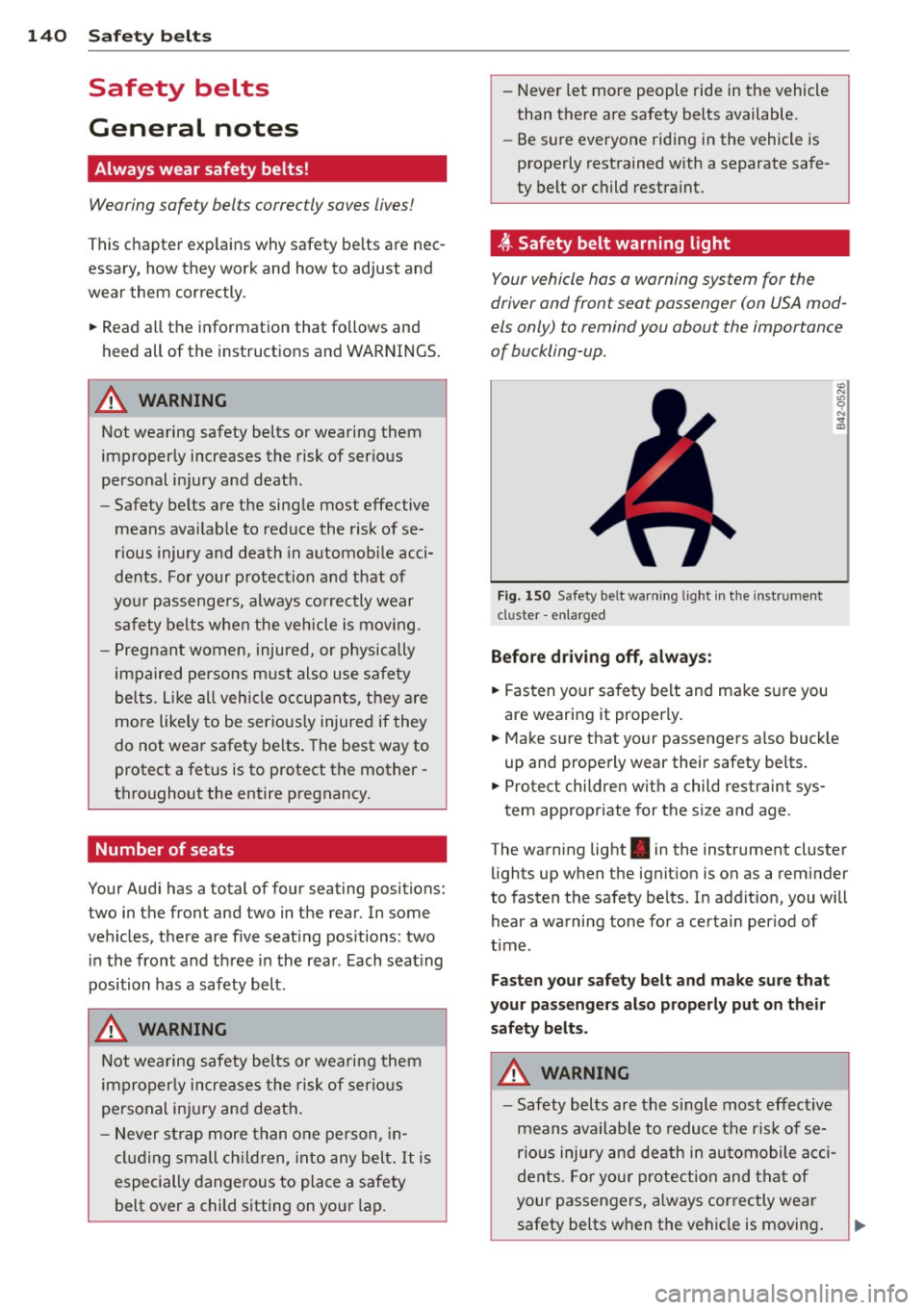
~ Safety belt warning light
Your vehicle has a warning system for the
driver and front seat passenger (on USA mod
els only) to remind you about the importance
of buckling-up.
Fig. 150 Safety belt warning light in the instrument
cluster -enlarged
Before driving off, always:
.. Fasten your safety belt and make sure you
are wearing it properly.
.. Make sure that your passengers also buckle
up and properly wear their safety belts.
.. Protect children with a child restraint sys-
tem appropriate for the size and age .
The warning light . in the instrument cluster
lights up when the ignition is on as a reminder
to fasten the safety belts. In addition, you will hear a warning tone for a certain period of
time .
Fasten your safety belt and make sure that
your passengers also properly put on their
safety belts.
A WARNING
-- Safety belts are the single most effective
means available to reduce the risk of se
rious injury and death in automobile acci
dents. For your protection and that of
your passengers, always correctly wear
safety belts when the vehicle is moving.
Page 143 of 306
-Failure to pay attention to the warning
light that come on, could lead to person
al injury.
Why safety belts?
Frontal collisions and the law of physics
Frontal crashes create very strong forces for
people riding in vehicles .
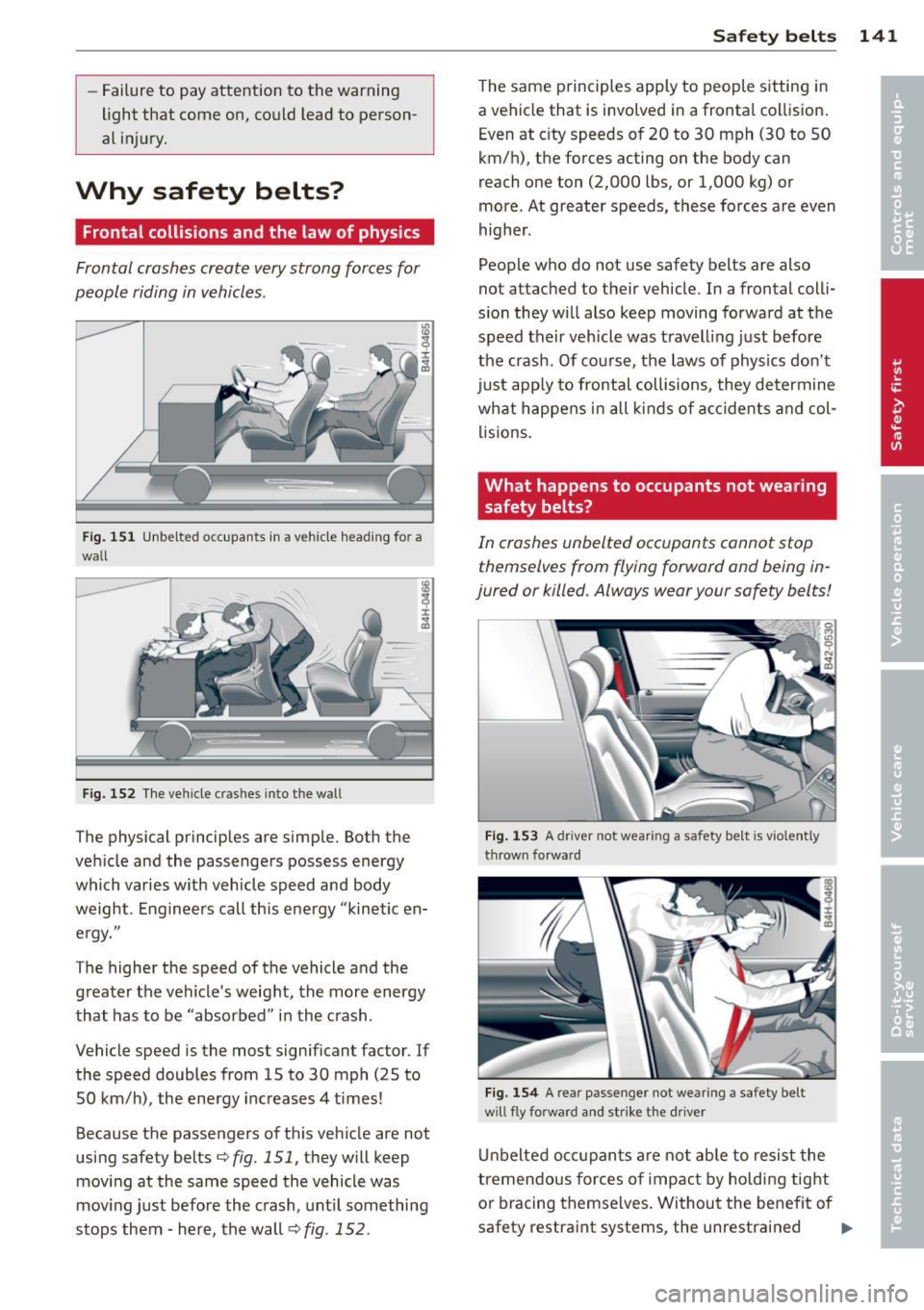
Fig. 151 Unbelted occupants in a ve hicle heading for a
wall
Fig. 152 The vehicle cras hes into the wall
The physical principles are simple. Both the
vehicle and the passengers possess energy
which varies w ith veh icle speed and body
weight . Engineers call this energy "kinetic en
ergy."
The higher the speed of the vehicle and the
greater the vehicle's weight, the more energy
that has to be "absorbed" in the crash.
Vehicle speed is the most significant factor . If
the speed doubles from 15 to 30 mph (25 to
50 km/h), the energy increases 4 t imes!
Because the passengers of this vehicle are not
using safety belts
c:::;, fig. 151, they will keep
moving at the same speed the vehicle was
mov ing just before the crash, until something
stops them - here, the wall ¢
fig. 152.
Safety belts 141
The same principles apply to people sitting in
a vehicle that is involved in a frontal collision.
Even at city speeds of 20 to 30 mph (30 to 50
km/h), the forces acting on the body can
reach one ton (2,000 lbs, or 1,000 kg) or
more . At greater speeds, these forces are even
higher.
People who do not use safety belts are also
not attached to their vehicle . In a frontal colli
sion they will also keep moving forward at the
speed their vehicle was travelling just before
the crash . Of course, the laws of physics don't
just app ly to frontal collisions, they determine
what happens in all kinds of accidents and col
lisions.
What happens to occupants not wearing safety belts?
In crashes unbelted occupants cannot stop
themselves from flying forward and being in
jured or killed. Always wear your safety belts!
Fig. 153 A driver not wea ring a safety be lt is vio lently
th rown forward
Fig. 154 A rear passenger not wearing a safety belt
w ill fly forward and strike the driver
Unbelted occupants are not able to resist the
tremendous forces of impact by holding tight
or bracing themselves. Without the benefit of
safety restraint systems, the unrestrained .,..
Page 145 of 306

Important safety instructions about
safety belts
Safety belts must always be correctly posi
tioned across the strongest bones of your
body.
~ Always wear safety belts as illustrated and
described in this chapter.
~ Make sure that your safety belts are always
ready for use and are not damaged.
A WARNING
Not wearing safety belts or wearing them
improperly increases the risk of serious
personal injury and death. Safety belts can
work only when used correctly.
- Always fasten your safety be lts correctly
before driving off and make sure all pas
sengers are correctly restrained.
- For maximum protection, safety belts must always be positioned properly on
the body .
- Never strap more than one person, in
cluding small children, into any belt.
- Never place a safety belt over a child sit ting on your lap.
- Always keep feet in the footwell in front
of the seat while the vehicle is being d riv
en .
- Never let any person ride with their feet
on the instrument panel or sticking out
the window or on the seat.
- Never remove a safety belt while the ve
hicle is moving. Doing so will increase
your risk of be ing injured or killed.
- Never wear belts twisted.
- Never wear belts over rigid or breakable
objects in or on your clothing, such as
eye glasses, pens, keys, etc., as these may cause injury.
- Never allow safety belts to become dam
aged by being caught in door or seat
hardware .
- Do not wear the shoulder part of the belt
under your arm or otherwise out of posi
tion . Safety belts
143
- Several layers of heavy clothing may in
terfere with correct positioning of belts and reduce the overall effectiveness of
the system .
- Always keep belt buckles free of anything
that may prevent the buckle from latch
ing securely .
- Never use comfort clips or devices that
create slack in the shoulder belt . Howev
er, special clips may be requ ired for the
proper use of some child restraint sys
tems .
- Torn or frayed safety belts can tear, and
damaged belt hardware can break in an
accident. Inspect belts regularly.
If web
bing , bindings, buckles, or retractors are
damaged, have belts replaced by an au
thorized Audi dealer or qualified work
shop.
- Safety belts that have been worn and
loaded in an accident must be replaced
with the correct replacement safety belt
by an authorized Audi dealer. Replace
ment may be necessary even if damage
cannot be clearly seen . Anchorages that
were loaded must also be inspected.
- Never remove, modify, disassemble, or
try to repair the safety belts yourself.
- Always keep the belts clean. Dirty belts
may not work properly and can impair
the function of the inertia reel~
ta
ble Cleaning interior on page 215 .
Safety belts
Fastening safety belts
Safety first -everybody buckle up!
Fig. 156 B el t b uckle and to ngue on the drive r's seat
Page 146 of 306

144 Safet y belt s
To provide maximum protection, sa fety belts
must always be positioned correctly on the
wearer 's body .
.,. Adjust the front seat and head restr aint
properly ¢
page 53, General recommenda
t ions .
.,. Make sure the seatback of the rear seat
bench is in an upright pos ition and securely
latched in place before using the belt¢.&,.
.,. Hold the be lt by the tongue and pull it even
ly across the chest and pelvis ¢ .&, .
.,. Insert the tongue into the correct buckle of
yo ur seat until you hea r it latc h securely
¢fig. 156.
.,. Pull on the be lt to make sure that it is se-
curely latched in the buckle.
Automatic safety belt retractors
Every safety belt is equipped w ith an automat
i c belt retractor on the shoulder be lt. This fea
ture locks the be lt whe n the belt is pulled out
fast, during hard braking and i n an accident.
The belt may also lock when you drive up or
down a steep hill or through a sharp curve. During normal driv ing the belt lets you move
freely.
Safety belt preten sione rs
The safety belts are equipped with a be lt pre
tensioner that helps to tighten the safety belt
and remove s lack when the pretensioner is ac
tivated ¢
page 147. The function of the pre
tensioner is moni tored by a warning light
¢ page 19.
Sw itchabl e lo cking fe atur e
Every safety belt except the one on the driver
seat is eq uipped w ith a switchable locking fea
ture that
m ust be used when the safety belt is
used to attach a child seat. Be sure to read the important information about this feature
¢ page 186 .
.,& WARNING
Improperly positioned safety belts can
cause serious injury in an accident
¢ page 144, Safety belt position.
- Safety belts offer optimum protection
only when the seatback is upright and
belts are properly posit ioned on the
body .
- Always make sure that the rear seat
backrest to which the center rear safety
belt* is attached is securely latched
wheneve r the rea r center safety belt is
being used.
If the backrest is not secu re
ly latched, the passenger will move for
ward with the back rest dur ing sudden
brak ing, in a sudden maneuver and espe
cially in a crash.
- Never attach the safety bel t to the buck
le for another seat. Attaching the belt to
the wrong buckle will reduce safety be lt
effectiveness and can cause serious per
sonal injury .
- A passenger who is not proper ly restrain
ed can be seriously injured by the safety belt itself when it moves from the stron
ger parts of the body into cr itical areas
like the abdomen .
- Always lock the convertible locking re
tractor when you are securing a child seat in the vehicle ¢
page 188.
(D Tips
For information on safety belt pretension
ers, refer to¢
page 147.
Safety belt position
Correct belt position is the key to getting
maximum protection from safety belts.
F ig. 157 Safety bel t pos it ion
"' .... 0
~ CD
Page 147 of 306
Use the height adjustment to change the posi
tion of the shoulder belt of the front saf ety
belts .
.&_ WARNING
Improperly positioned safety belts can
cause serious personal injury in an acci
dent .
-
-The shoulder belt should lie as close to
the center of the collar bone as possible
and should fit well on the body . Hold the
belt above the latch tongue and pull it
even ly across the chest so that it sits as
low as possible on the pelvis and there is
no pressure on the abdomen. The be lt
sho uld a lways f it snugly ¢
fig. 157. Pull
on the belt to tighten if necessary.
- A loose-fitt ing safety be lt can cause seri
o us injuries by shifting its position on
yo ur body from the strong bones to more
vulnerab le, soft tissue and cause serious
injury.
- Always read and heed all WARNINGS and
other important information
¢ page 143.
Pregnant women must also be correctly
restrained
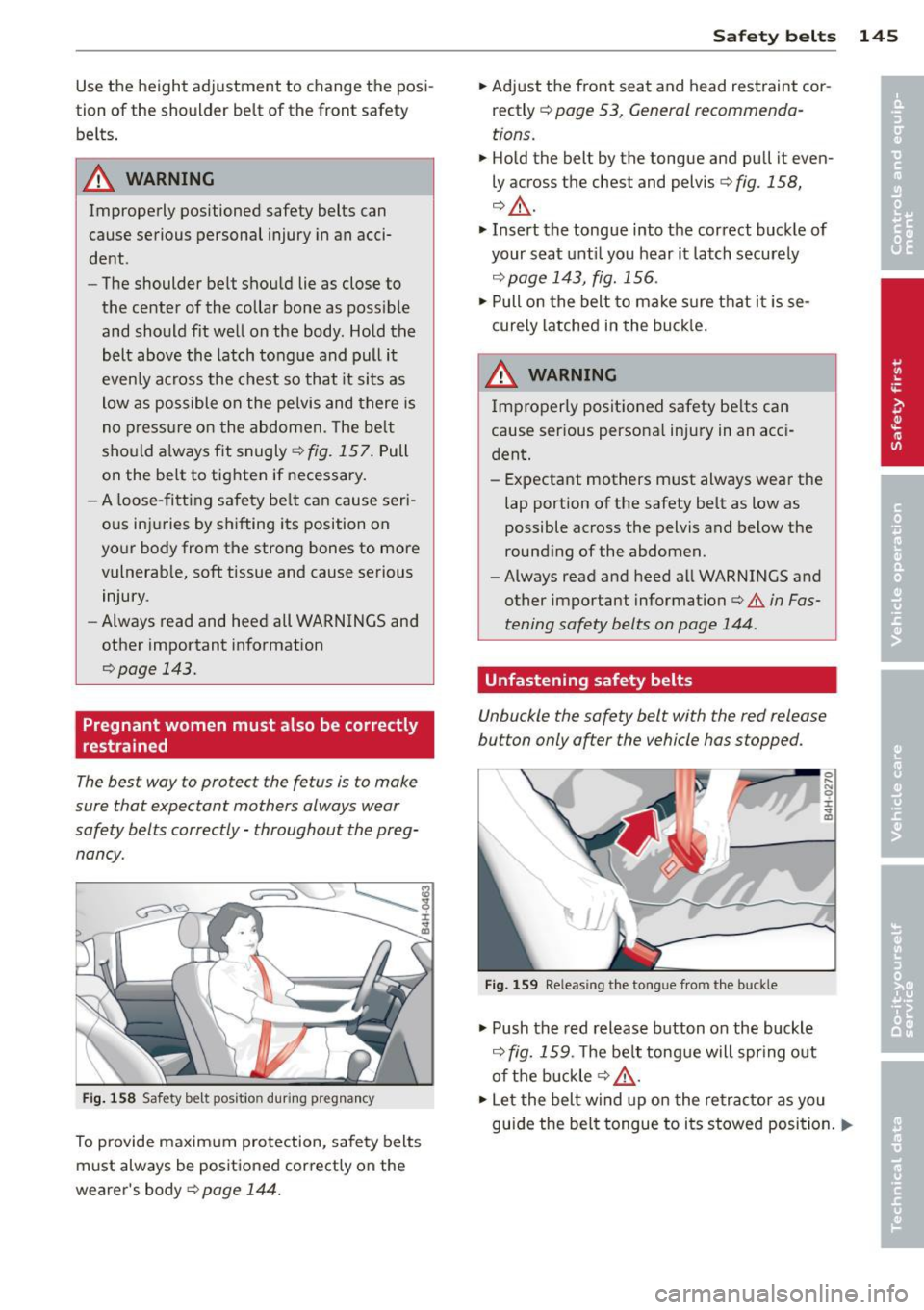
The bes t way to protec t the fe tu s is to make
sure that expectant mothers always wear
safety belts correctly -throughout the preg
nancy.
Fi g. 158 Safety belt pos it io n durin g pregnancy
To provide maxim um protection, safety belts
must always be posit ioned correctly on the
wearer's body¢
page 144 .
Safety belts 145
.. Adjust the front seat and head restraint cor
rectly ¢
page 53, G eneral r ecomm enda
tion s .
.. Hold the belt by the tongue and pull it even
ly across the chest and pelvis¢
fig. 158,
¢& .
.. Insert the tongue into the correct buckle of
your seat until you hear it latch securely
r=:;, page 143, fig. 156 .
.. Pull on the belt to make sure that it is se
curely latched in the buck le .
A WARNING
-
Improperly positioned safety be lts can
cause serious persona l injury in an acci
dent.
- Expectant mothers m ust always wear the
lap portion of the safety belt as low as
possible across the pelvis and below the
round ing of the abdomen.
- Always read and heed all WARNINGS and
other important information ¢&.
in Fas
tening safety belts on page 144 .
Unfastening safety belts
Unbuckle the safety belt with the red release
but ton only after the vehicle has stopped.
,,,,,
Fig . 159 Re leas ing the tong ue fro m t he buc kle
.,. Push the red release button on the buckle
r=:;, fig. 159. The be lt tongue will spr ing out
of the buckle ¢
.&, .
0 ...
"' 0 ±
~
.,. Let the belt wind up on the retractor as you
guide the be lt tongue to its stowed pos ition.
Ill>
Page 148 of 306
146 Safet y belt s
A WARNING
Never unfasten safety belt while the vehi
cle is moving. Doing so will increase your
r isk of being injured or killed .
Adjusting safety belt height
With the aid of the safety belt height adjust
ment, the three point safety belt strap rout
ing can be fitted to the shoulder area, accord
ing to body size .
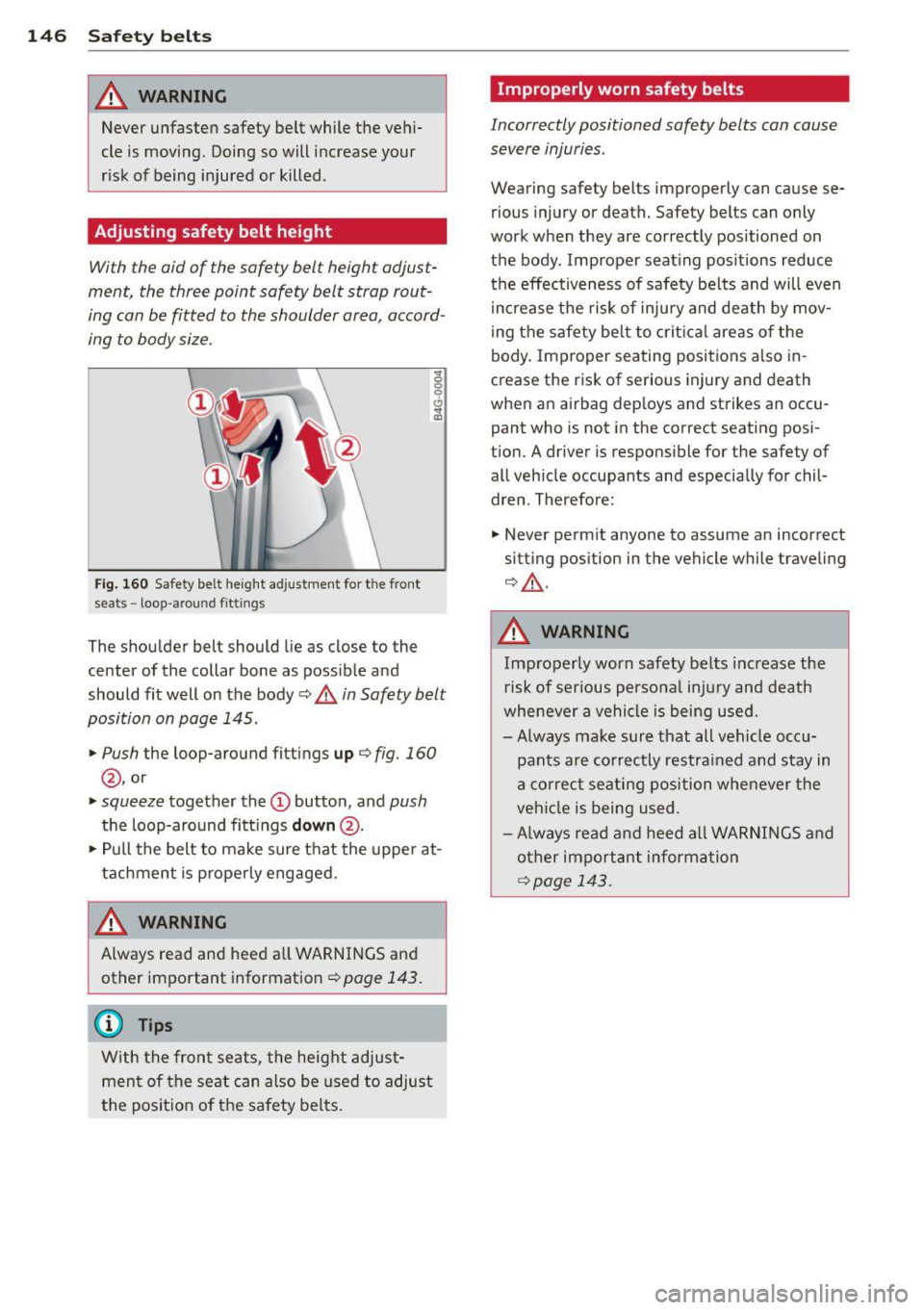
Fig. 160 Safety belt height adjustment for the front
sea ts - loop -around f ittings
The shoulder belt should lie as close to the
center of the collar bone as possible and
should fit well on the body¢
A in Safety belt
position on page 145.
,. Push
the loop-aro und fittings up ¢fi g. 160
@ , or
"'"squeeze together the@ button, and push
the loop-around fitt ings down @.
"'" Pull the belt to make sure t hat the upper at
tachment is p roperly engaged.
A WARNING
Always read and heed a ll WARNINGS and
other important information
¢page 143.
@ Tips
With the front seats, the height adjust
men t of the seat can also be used to adjus t
the posit ion of the safety be lts.
Improperly worn safety belts
Incorrectly positioned safety belts can cause
severe injuries .
Wearing safety belts improperly can cause se
rious injury or death. Safety belts can o nly
work when they are correctly positioned on
the body . Improper seat ing pos itions reduce
the effectiveness of safety belts and will even
i ncrease t he risk of inju ry and death by mov
ing the safety be lt to crit ica l areas o f the
body. Improper seating positions also in
crease the risk of serious injury and death
when an airbag deploys and strikes an occu
pant who is not in the correct seating posi
tion. A driver is respons ible for the safety of
all veh icle occupants and especially for chil
dren . Therefore:
"'" Never permit anyone to assume an incorrect
sitting position in the vehicle while traveling
¢&_ .
A WARNING
Improperly worn safety belts increase the
r isk of ser ious persona l injury and death
whenever a vehicle is being used.
- Always ma ke sure that all vehicle occ u
pants are co rrectly restra ined and stay in
a correc t seating position whe never the
veh icle is being used .
- Always read and heed all WAR NINGS and
o ther important inform ation
¢page 143.