airbag AUDI A7 2014 Repair Manual
[x] Cancel search | Manufacturer: AUDI, Model Year: 2014, Model line: A7, Model: AUDI A7 2014Pages: 306, PDF Size: 76.83 MB
Page 190 of 306
188 Child Safety
-Always be especially careful if you must
install a rearward facing child safety seat
on the front passenger seat in exception
al circumstances.
- Make sure that the
PASSENGER AIR BAG
OFF
light comes on and stays on all the
time whenever the ignition is switched
on.
- If the
PASSENGER AIR BAG OFF light
does not come on and stay on, immedi
ately install the rear-facing child safety
seat in a rear seating position and have
the airbag system inspected by your Audi dealer.
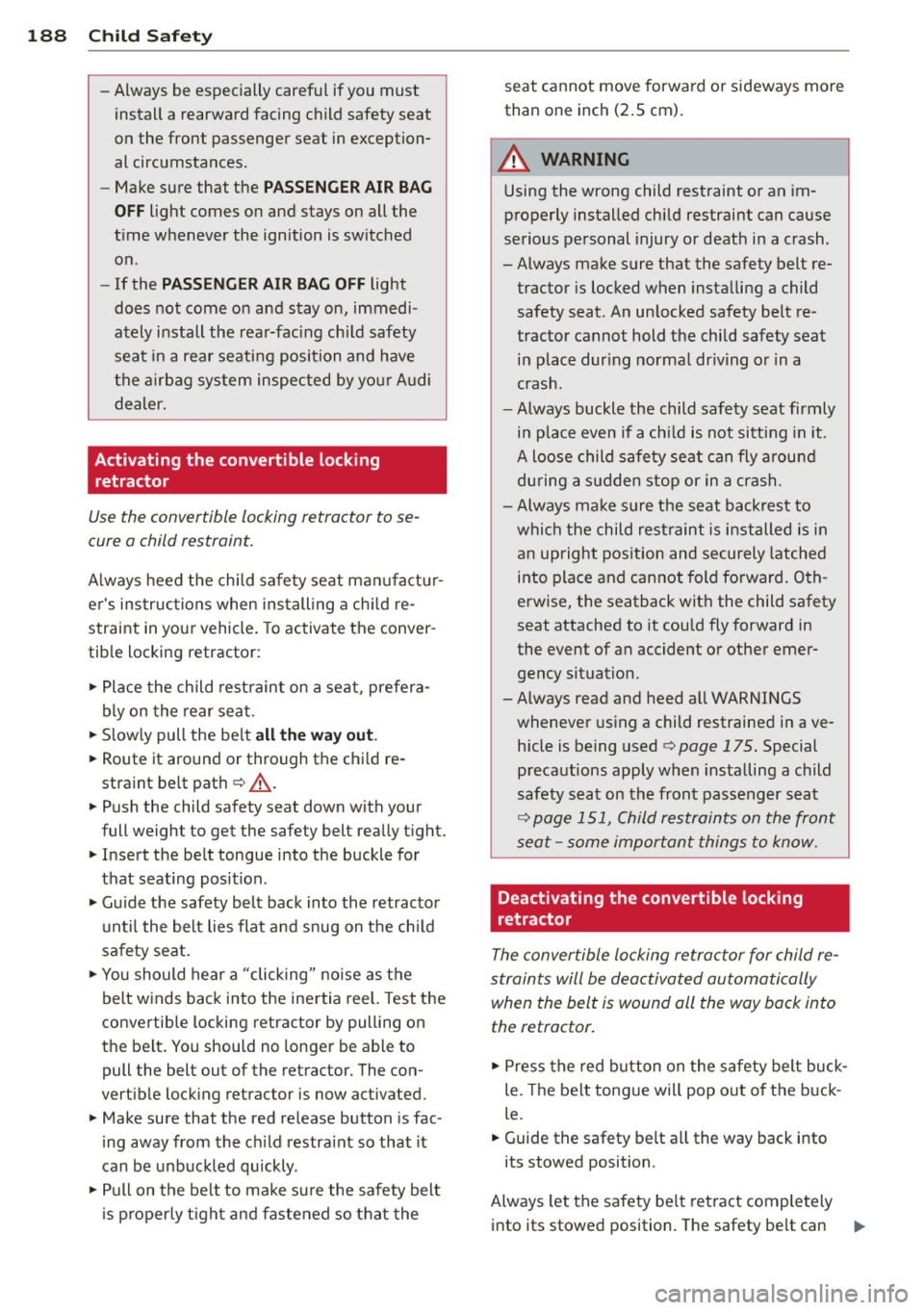
Activating the convertible locking retractor
Use the convertible locking retractor to se
cure a child restraint.
Always heed the child safety seat manufactur
er's instructions when installing a child re
straint in your vehicle. To activate the conver
tible locking retractor:
"" Place the child restraint on a seat, prefera
bly on the rear seat.
""Slowly pull the belt
all the way out.
""Route it around or through the child re
straint belt path¢,&. .
"" Push the child safety se at down with you r
full weight to get the safety belt really tight.
"" Insert the belt tongue into the buckle for
that seating position.
""Guide the safety belt back into the retractor
until the belt lies flat and snug on the child
safety seat.
""You should hear a "clicking" noise as the
belt winds back into the inertia reel. Test the
convertible locking retractor by pulling on
the belt. You should no longer be able to
pull the belt out of the retracto r. The con
vertible locking retractor is now activated.
"" Make sure that the red release button is fac
ing away from the child restraint so that it
can be unbuckled quickly .
""Pull on the belt to make sure the safety belt
is properly tight and fastened so that the seat cannot move forward or sideways more
than one inch (2.5 cm).
A WARNING .,__
Using the wrong child restraint or an im
properly installed child restraint can cause
serious personal injury or death in a crash.
- Always make sure that the safety belt re-
tractor is locked when installing a child
safety seat. An unlocked safety belt re
tractor cannot hold the child safety seat
in place during normal driving or in a
crash.
- Always buckle the child safety seat firmly
in place even if a child is not sitting in it.
A loose child safety seat can fly around
during a sudden stop or in a crash.
- Always make sure the seat backrest to
which the child restraint is installed is in
an upright position and securely latched
into place and cannot fold forward. Oth
erwise, the seatback with the child safety
seat attached to it could fly forward in
the event of an accident or other emer
gency situation.
- Always read and heed all WARNINGS
whenever using a child restrained in ave
hicle is being used
¢ page 175. Special
precautions apply when installing a child
safety seat on the front passenger seat
¢ page 151, Child restraints on the front
seat -some important things to know.
Deactivating the convertible locking
retractor
-
The convertible locking retractor for child re
straints will be deactivated automatically when the belt is wound all the way back into
the retractor.
"" Press the red button on the safety belt buck
le. The belt tongue will pop out of the buck
le.
""Guide the safety belt all the way back into
its stowed position .
Always let the safety belt retract completely
into its stowed position. The safety belt can
IJll-
Page 194 of 306
192 Child Safe ty
Tether anchors and tether straps
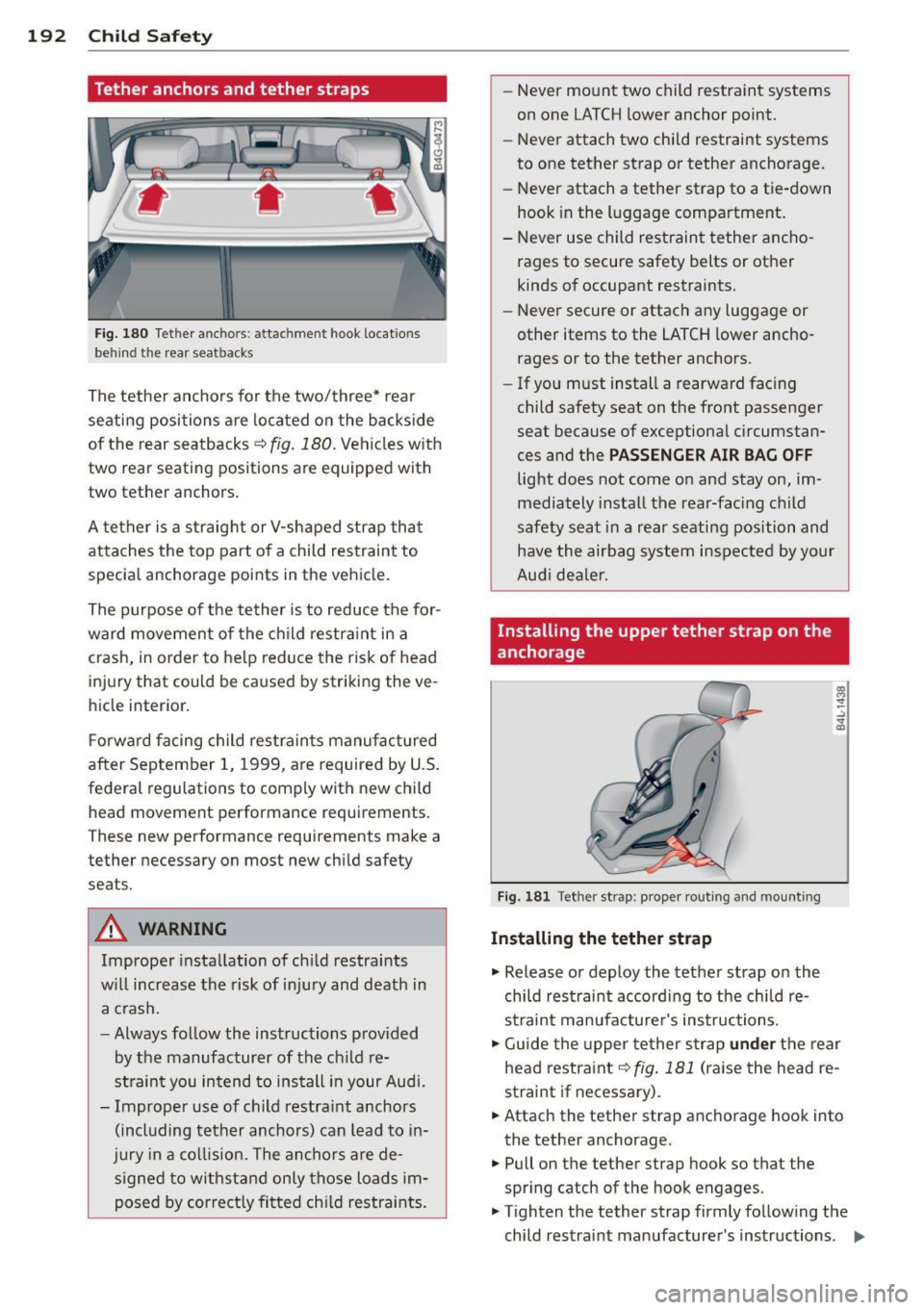
Fig. 180 Tether ancho rs: attachment hook locations
behind the rear seatbacks
The tether anchors for the two/three* rear
seating positions are located o n the backside
of the rear seatbacks ¢
fig. 180. Vehicles with
two rear seating positions are equipped with
two tether anchors.
A tether is a straight or V-shaped strap that attaches the top part o f a child restraint to
specia l anchorage points in the veh icle.
The purpose of t he tether is to reduce the for
ward movemen t of the ch ild restra int in a
crash, in order to help reduce the risk of head
injury that could be caused by striking the ve
hicle interior.
F orward facing child rest ra ints manufactured
after September 1, 1999, are required by U.S.
federal regulations to comply with new child
head movement performance requirements .
These new performance requirements make a
tether necessary on most new child safety
seats.
A WARNING
Improper insta llation of chi ld restraints
w ill increase the risk of inju ry and death in
a crash.
- Always follow the instructions prov ided
by the manufacturer of the ch ild re
st rain t you intend to install in your Audi.
- Improper use of ch ild restra int anchors
(including tether anchors) can lead to in
jury in a co llision. The anchors are de
signed to w ithstand on ly those loads im
posed by corre ctly fitted ch ild restraints. -
Never mount two child restraint systems
on one LATCH lower anchor point.
- Never attach two child restraint systems
to one tether strap or tether anchorage.
- Never attach a tether strap to a tie-down
hook in the luggage compa rtment .
- Never use child restraint tether ancho
rages to secure safety belts or other
kinds o f occupant restraints.
- Never secure or attach any luggage or
other items to the LATCH lower ancho
rages or to the tether anchors.
- If you must install a rearward fac ing
child safety seat on the front passenger
seat because of exceptiona l circumstan
ces and t he
PA SSENGER AIR BAG OFF
light does not come o n and stay on, im
mediately install the rear-fac ing ch ild
safety seat in a rear seating position and
have the airbag system i nspe cted by your
Aud i deale r.
Installing the upper tether strap on the
anchorage
F ig. 181 Tether strap: proper routing and mou nting
Installing the tether st rap
• Release or deploy the tether strap on the
child restraint according to the child re
s traint manufacture r's instructions.
• Guide the upper te ther s trap
und er the rear
head restraint¢
fig. 181 (raise the head re
straint if necessary) .
• Attach the tether strap ancho rage hook into
the tether anchorage.
.,. Pull on the tether strap hook so that the
spring catch of the hook engages.
• Tighten the tether strap firmly follow ing the
child restraint manufacturer's instructions. ..,
Page 195 of 306
Relea sin g the teth er str ap
"' Loosen the tens ion following the child re
stra int manufac turer's instructions .
"' Depress the spring catch on the hook and re
lease it from the anchorage.
(D Note
I f you leave the child restraint with the
tether strap firmly insta lled for severa l
days, this cou ld leave a mark on the up
holstery on the seat cushion and backrest
in the area where the tether strap was in
stalled . The upholstery would a lso be per
manently stretched around the tether
strap. This applies especially to leat her
seats.
Using tether straps on rearward-facing
child restraints
Currently, few rear-facing child restraint sys
tems come with a tether. P lease read and
heed the child restraint system manufactur
er's instructions carefully to determ ine how to
p roperly install the tether.
A WARNING
-
A child in a rearward-facing child safety
seat insta lled on the front passenge r seat
w ill be se riously injured and can be killed if
t he fron t air bag inflates - even with an Ad
vanced Airbag System .
- T he inf lat ing airb ag w ill hit the child
sa fety seat or infant carrier w it h great
force and w ill smash the ch ild safety seat
and child against the backrest, center
armrest, or door.
- If you must install a rearward facing
child safety seat on the front passenger
seat because of exceptional circ umstan
ces and the
PASSENGER AIR BAG OFF
light does not come on and stay on, im
med iately install the rear-facing child
safety seat in a rear seating position and
have t he a irbag system inspected by you r
Audi de aler.
Child Sa fet y 193
Additional Information
Sources of information about child
restraints and their use
There are a number o f sources of additiona l
information abo ut child restraint se lection, in
stallation and use :
N HT SA advises t hat the bes t ch ild safety seat
is the one that fits your chi ld and fits in your
vehicle, and that yo u will use correct ly and
consistently.
T ry before yo u buy!
U.S National Highway Traffic Safety Admin
istration
Tel.: 1 -888 -3 27-4 236 (TIY: 1-800-424-9153)
www. n hts a .gov
National SAFE KIDS Campaign
Tel.: (202) 66 2-0600
www.safe kids.o rg
Safety Belt Safe U .S .A
Tel.: (800) 7 45-SAFE (English)
Te l.: (800) 747-SANO (Span ish)
www.carseat .org
Transpo rt Canada Information Centre
Tel.: 1-800-333-0371 o r ca ll
1-6 13-998-86 16 if yo u are in the Ottawa a rea
http://www .t c .gc. ca/eng/ roadsafety/
men u.h tm
Audi Cu stomer R elation s
Tel.: (800) 822-2834 •
•
Page 197 of 306
@ Tips
-Certain Audi pre sense functions are not
ava ilable when ASR is sw itched off (sport
mode) or when driving in reverse.
- The Audi pre sense functions may not be
available if there is a malfunction in the
ESC system or the airbag control mod
ule.
- The Audi pre sense front/plus functions
are not available if there is a malfunction
in the adaptive cru ise control* system
9 page 93.
-The Audi pre sense rear/plus functions
are not available if there is a malfunction
i n the Audi side assist* system
9page 93.
Audi pre sense 195
•
•
Page 198 of 306
196 Intelligent technology
Intelligent technology
Notice about data
recorded by vehicle
control modules
Your vehicle is not equipped with an Event Da
ta Recorder (EDR), installed by some manu
facturers fo r the express purpose of capturing
data for retrieval after an accident or crash
event . EDR's are sometimes ca lled "crash re
corders".
Some state laws restrict the retr ieval or down
loading of data stored by EDR's that were in
stalled in a vehicle for the express purpose of
retrieving data after an accident or crash
event without the owner's consent.
A lthough your vehicle is not equipped with an
EDR, it is equipped with a number of electron
ic control modules for various vehicle systems
such as, for examp le, eng ine function, em is
sion control, as well as for the airbags and
safety belts.
These electronic contro l modules also record
vehicle-re lated data during normal vehicle op
eration for diagnostic and repair purposes.
The recording capacity of the electronic con
trol modules is limited to data (no sound is re
corded) and only a small amount of data is ac
tually recorded over a very limited pe riod of
time and stored when a system fault or other
condition is sensed by a control unit. Some of
the data then stored may relate to vehicle
speed, direction, braking as we ll as restraint
system use and performance in the event of a
crash or other condition. Stored data can only
be read and downloaded with special equip
ment.
Electronic Stabilization
Control (ESC)
Description
ESC helps to improve road holding and vehicle
dynamics to help reduce the probability of
skidd ing and loss of vehicle control. It works
only when the engine is running. ESC detects certain difficult driving situat
ions, including
when the vehicle is beginning to spin (yaw)
out of control and helps you to get the veh icle
back under control by se lectively braking the
wheels, and/or reducing engine power and
providing steering assistance to help hold the
vehicle on the driver's intended course. The in
dicator light
G) in the instrument cluster
blinks when ESC is taking action to help you
control the vehicle.
ESC has limitations.
It is important to remem
ber that ESC cannot overcome the laws of
physics. It wi ll not always be able to help out
under all conditions you may come up against.
For example, ESC may not always be able to
help you master situations where there is a
sudden change in the coefficient of friction of
the road surface. When there is a section of
dry road that is suddenly covered with water,
slush or snow, ESC cannot perform the same
way it wou ld on the dry surface . If the vehicle
hydroplanes (rides on a cushion of water in
stead of the road surface), ESC will not be
able to help you steer the vehicle because con
tact with the pavement has been interrupted
and the vehicle cannot be braked or steered.
During fast cornering, particularly on winding
roads, ESC cannot always deal as effectively
with difficult driving situations than at lower
speeds. When towing a trailer, ESC is not able
to help you regain control as it would if you
were not tow ing a trailer.
Always adjust your speed and driving style to road, traffic and weather condit ions. ESC can
not override the vehicle's physical limits, in
crease the available traction, or keep a vehicle
on the road if road departure is a result of
drive r inattention. Instead, ESC improves the
poss ibility of keeping the vehicle under con
trol and on the road during ex treme maneu
vers by using the driver's steering inputs to
help keep the vehicle going in the intended di
rection . If you are traveling at a speed that
causes you to run off the road before ESC can
provide any assistance, you may not experi
ence the benefits of ESC.
Page 240 of 306
238 Checking and filling
@ For the sake of the environment
Because of the problem of proper disposal
of brake fluid as we ll as the special tools
required and the necessary expertise, we recommend that you have the brake fluid
changed by your author ized Audi dealer.
Battery
General information
Under normal operating conditions, the bat
tery in your Audi does not need any mainte
nance. With
high outside temperatures or
long daily drives we recommend that you have
the electro lyte level checked by a service fa
cility . The electrolyte level should also be
checked each time the battery is charged
<=:> page 240.
Have the battery checked when you take your
vehicle in for service . You are well adv ised to
replace a battery that is older than 5 years .
With certain types of airbag deployment, the battery is disconnected from the vehicle elec
tr ical system for safety reasons
c::> & in Re
pair, care and disposal of the airbags on
page 165.
Disconnecting the battery terminals
Some vehicle functions (power window regu
lators, for example) are lost if the battery ter
minals are disconnected. These functions have
to be relearned after the battery terminals are
connected again. To prevent this , the battery
should only be disconnected from the vehicle
e lectrica l system when absolutely necessary
for repairs.
Vehicles not driven for long periods
If you do not drive your vehicle over a period
of severa l days or weeks, electrical compo
nents are gradually cut back or switched off.
This reduces energy consumption and main
tains starting capability over a longer period
c::> page 202. Some of the convenience func
tions may not operate, such as the interior
lights or power seat adjustment. The conven- ience
functions will be available again when
you switch on the ignition and start the en gine.
Winter operation
During the winter months, battery capac ity
tends to decrease as temperatures drop. This
is because more power is a lso consumed whi le
starting, and the headlights, rear window de
fogger, etc., are used more often.
Avoid unnecessary power consumption, par
ticularly in city traffic or when traveling only
short distances. Let your authorized Audi
deale r check the capacity of the vehicle bat
tery before winter sets in
c::> page 240 . A well
charged battery will no t only prevent star ting
problems when the weather is cold, but will
also last longer .
@ Tips
If your vehicle is left standing for several
weeks at extremely low temperatures, the
vehicle battery should be removed and
stored where it w ill not freeze. This will
prevent it from be ing damaged and having
to be replaced .
Working on the battery
Be especially careful when working on or near
the battery.
The battery is located in the luggage compart
ment under the floor . Before you check any
thing in the luggage compartment,
read and
heed all WARNINGS
c::> .&,.
Always heed the safety warnings , when work
ing on the vehicle battery or the vehicle elec
trical system to prevent injury.
The following WARNINGS are very
important when working on the battery:
Always heed the following WARNING SYM-
BOLS and safety precautions when working
on the battery.
®
Always wear eye protection.
Page 275 of 306

No. Equ ipment Amps
4 Suspension control system sen-s sor
s
E
lectronic Stabilization Cont rol
s (ESC) module
6 Climate control
s
7 Adaptive cruise control
10
8
Airbag control module, front
s passenger's seat sensor system
9 Gateway
s
Homelink (garage door opener),
10 night vis ion system cont ro l
s
module
11 Image
processing (active lane
10
ass ist, adaptive cruise control)
12 Dynamic steering
s
13 Terminal 15 in
the instrument
15
panel
14 Terminal 15
in the luggage com-
partment 30
15 Terminal 15
(engine)
15
16 Starter 40
Fu se pa nel ® (b rown )
No . Equipment Amps
1 Gateway s
2 C
limate control 10
3 E
lectronic Stabili zation Control
10
(ESC) module
4 Fron
t door (driver 's side)
30
s
Power seat adjustment (driver's
7,5
seat)
6 Dynam
ic steering
35
7 Sunroof 20
8
Rear door control module (driv-
15
er 's side)
9 Lumbar support (
Front passen-
s ger seat)
10 Tire pressure
monitoring system
s
11 Su
nroof, rear spoi ler (Sportba ck)
20
12 Driver
door control module
15
Fuse s and bulb s 2 7 3
Fuse pan el© (r e d )
No . Equipment
2 Fuel pump
3 Brake light
sensor/brake pedal
sensor system
AdBlue control module (Diesel)/
4 Engine acoust ics
s Left rear door cont rol modu le
6 Power seat adjustment
(pas-
senge r's seat)
7 Horn
8 Windshield wiper motor
9 Light/rain sensor, heater
for vid-
eo camera in windscreen
10 Lumba r support (driver seat)
11 Front
passenger door control
modu le
12 Right rea r door cont rol modu le
Front passenger side cockpit fuse
assignment Amp
s
25
S/S
S/7,S 30
7,5 15
30
s
s
15
15
F ig . 22 0 Front passenger side cockpit: fuse pa nel w it h
plast ic brac ket
Fuse panel @ (bla ck)
No . Equipment Amps
1 Head-up
Display s
2 MMI Display s
3 CD/DVD changer s
4 MMI unit/drives 7,5
s
Chip card reader (not in all coun-
s tries)
6 Instrument
cluster
s
7 Steering column switch module s ...
Page 289 of 306

-Always make sure the transm ission se
lector lever (automatic transmiss ion) is
in P (Park position) and the park brake is
applied.
@) For the sake of the environment
- Changing the eng ine settings w ill ad
versely affect em ission levels. This is det
rimental to the environment and increas
es fuel consumption .
- Always observe env ironmental regula
tions when d isposing of old engine oil,
used brake fluid, dirty engine coolant,
spent batter ies or worn out t ires.
- Undeployed airbag modules and preten
s ioners might be classified as Perchlo
rate Material -specia l hand ling may ap
ply, see www.dts c.ca .gov/hazardous
waste/perch lorate. When the veh icle or
parts of the restraint system includ ing
airbag modules safety belts wit h preten
sioners are scrapped, all applicable laws
and regulations must be observed. Your
a uthorized Audi dea ler is familiar w ith
these requirements and we recommend
that you have your dea ler perform this
serv ice for you .
Additional accessories,
modifications and
parts replacement
Additional accessories and parts
replacement
Always consult an authorized Audi dealer be
fore purchasing accessories.
Your veh icle incorporates the latest safety de
sig n featu res ensu ring a high standard of ac
tive and passive safety.
This safety could be compromised by non-ap proved changes to the veh icle. For this reason,
if parts have to be replaced, please observe
the following points when install ing addition
a l accessories:
Con sumer In formation 287
Approved Audi accesso ries and genuine Audi
parts are available from authorized Audi deal
ers.
T hese dea lers a lso have the necessary facili
ties, tools and trained specialists to install the
parts and accessories proper ly.
A WARNING
Using the wrong spare parts or using non
approved accessories can cause damage to
the vehicle and serious persona l injury.
- Use on ly accessories express ly approved
by Audi and genu ine Audi spare parts
- These parts and accessories have been
specially designed to be used on your ve
hicle .
- Never install accessories such as tele
phone cradles or beverage holders on air
bag covers or within the airbag deploy
ment zones . Do ing so will increase the
risk of injury if a irbags are triggered in an
accident!
- Before you check anything in the engine
compa rtment, always read and heed all
WARNINGS ~
page 22 7.
(D Note
- If items other than genuine Audi spare
parts, add-on equipment and accessory
items are used or if repair work is not
performed accord ing to spe cified meth
ods, this can result in severe damage to
yo ur vehicle's engine and body (such as
corrosion) and adversely affect your vehi
cle's warranty .
- If emergency repairs must be performed
elsewhere, have the vehicle examined by
an authorized Audi dealer as soon as
possible.
- The manufacturer cannot be held liable
for damage wh ich occurs due to failure
to comply with these stipulations.
•
•
Page 292 of 306

29 0 Index
A
Accessories . ...... ..... ... .. .. .... . 28 7
Active lane ass ist ... ... .. .. .. .. .. .. .. 95
Activating and deactivating . . . . . . . . . . . 96
C leaning the camera area .. .. .. .. .. . 214
Descr ipt ion ... ........... .. .. .... .. 95
I nstrument cluster indicator light . . . . . 96
Messages . . . . . . . . . . . . . . . . . . . . . . . . . 96
Notes on instrument cluster display . . . . 96
Setting the steering wheel vibrat ion . . . . 97
AC (automatic cl imate control) . .. .. .. .. 72
AC (climate control) . . . . . . . . . . . . . . . . . . 70
Adaptive air suspension/sport . ... .. .. . 102
Adapt ive cruise control . . . . . . . . . . . . . . . . 86
C leaning the senso r ....... .. .. .... . 214
Messages ............... .. .. .. .. .. 93
Request for driver intervention . . . . . . . . 91
Stop-and-go traffic . . . . . . . . . . . . . . . . . 90
Adapt ive Lig ht (defective) ... .. .. .... .. 23
AdBlue .. .. .. .. . .......... .. .. .... . 223
F illing . .. .. ............... .. .... . 225
Messages in the instrument cluster dis-
play ... .. .. ... .... .... .. .. .. .. .. . 224
Adding Eng ine coolant ........... .. .. .. .. . 235
Eng ine oil ................. .. .... . 232
W indshield washer fluid . ...... .. .. . 241
Additives Eng ine oi l ............... .. .. .... . 232
Adj usting
A ir dist ribution (au tomatic climate con-
trol) .. ... ... .. .. ..... ... .. .. .... .. 73
ai r distribution (climate control) ... .. . . 70
Front seats . . . . . . . . . . . . . . . . . . . . . . . . 53
Instrument illum inat ion ..... .. .... .. 47
Steer ing column e lectrically .. .. .... .. 75
Steer ing column manually ... .. .. .. . . 75
Temperature (automat ic climate co ntrol) 73
Temperature (climate control) .... .. .. 70
A irbag system . . . . . . . . . . . . . . . . . 149, 170
Advanced Airbag System ... .. .. .... . 153
Advanced Airbag System components . 157
Care ..... .. ................ ... ... 165
C hi ldren ... ... .... ...... .. .. .. .. . 177
C hil d restra ints ........... .. .. .. .. . 177
Componen ts (front airbags) .. .. .. .. . 157 Danger of fitting a ch
ild seat on the front
passenger seat ... .. ... ..... ... .. .. 151
Disposa l .. .. .. .. ... .. ..... ... .. .. 165
Front a irbags . . . . . . . . . . . . . . . . 153, 155
How do the front airbags work? .. .... 159
How many a irbags does my vehicle
have? ...... .. .. .. ... ... ... .. .. .. 157
How the Advanced Airbag System com-
ponents work togethe r ......... .. .. 159
Important safe ty instru ct ions on the
knee airbag system .. .. ..... ... .. .. 168
Important things to know .. ... ... . .. 149
Knee airbags ..... .. ... ..... ... .. .. 166
Monitoring .... .. ............. .... 161
PASSENGER AIR BAG OFF light ... .... 162
Repairs ... .... .. ............. .... 165
Safety instructions ................. 164
S ide a irbags ... .. ... .. .. ... ..... .. 169
S ide curtain airbags ... ...... ... .. .. 172
Warning/ind icator lights ........ .. .. . 19
Warning/Indicato r lights ....... .. .. 161
When must the system be inspected? 161
Aircraft Transporting your vehicle
Alcantara 280
Cleaning .. .... .. ............. .... 216
All -wheel drive .... .. ... ..... ... .. .. 201
Winter tires ..... ... .. ..... ... .. .. 258
Alternator . . . . . . . . . . . . . . . . . . . . . . . . . . 17
Amb ience lighting .............. .... . 47
Anti-freeze
refer to Engine coolant . ..... ... .. .. 234
Anti- lock b rak ing system ............ . 196
Wa rning/ind icator lights . . . . . . . . . 19, 20
Anti-slip regulation ............. .. .. 196
Warning/ind icator lights .. ... ..... .. . 19
Anti-theft systems Electronic immobi lizer .. ..... ... .. .. . 33
Asht ray .... .... ................... . 59
Audi braking guard
refer to brak ing guard ............. .. 86
Audi drive select
refer to drive select ............ .... 102
A udi Serv ice Repair Manuals and Litera-
tu re ... .. .. .. .. .. .. .... . ..... ... .. 285
Page 298 of 306
296 Index
Jumper cables ..... ....... ... .. .... . 277
K
Key ... .. .. .. .. . .. ..... ... .. .. .. .. .. 32
Battery replacement master key ... .. .. 33
Emergency key ... ... .... ... .. .... .. 32
K ey not recogn ized . . . . . . . . . . . . . . . . . . 78
Key replacement .... ....... .. .. .. ..
32
M as ter key ..... .. .... ... .. .. .. .. .. 32
Mech an ic a l key .... .. ..... .... .. .. .. 33
Valet key . .. ................ ... .... 32
Kick-down
t ipt ron ic
113
Knee airbags ... .... .... ..... .. .. .. . 166
Description ..... .. ... .... .. .. .. .. . 166
How they work ............ ... .... . 168
Important saf ety instructions ..... .. . 168
L
Lane assist . . . . . . . . . . . . . . . . . . . . . . . . . 95
L ane Change Ass istant
refer to side assist . . . . . . . . . . . . . . . . . . 98
LATCH .. .. .. .... .. ... ...... .. .. .. . 189
Desc rip tion ....... .... ..... .. .. .. .
Installin g a child restraint .. .. .. .. .. .
Location
Mounting and releasing the anchorage
hook
. . .. ...... .. .... ... .. .. .. .. .
190
191
190
191
La unch Con trol Prog ram .... .. .. .... . 114
Leath er clean ing/protection ....... .. . 216
Leaving home .......... ....... .. .... 46
Lifting jack ...... .. .... ... .. .. .. .. . 268
L ift ing vehicle
Light 280
Ambience lighting ............ .. .... 47
Com ing/Leaving home ..... .. .. .. .. . .
46
Daytime running lights .... .. .. .. .. . . 44
Emergency flashers ....... .. .. .. .. .. 45
Exterior lighting . ...... ... .. .. .. .. .. 44
H eadlight range control ....... .. .. .. 44
H igh b eam ............... ... .... ..
46
Low beam . ................ .. .... .. 44
Rea r fog ligh ts .. ...... ..... .. .. .. .. 44
S ide marker ligh ts ........ .. .. .... .. 44
T urn signals ................. .. ....
46
Light/rain sensor
Headlights . ..... .................. 44
I ntermittent (windshield w ipers) ...... 48
Sen sor defective . . . . . . . . . . . . . . . . . . . .
23
Loading the roof rack ... .. .... ... .... . 63
Locking
Power locking switch ................
37
Remot e control .. ... .. ..... ... .. .. . 35
Using the key .. .. ...... ....... .... .
37
Low be ams . .. .. .. ... .. ..... ... .. .. . 44
Lower un iv e rsal anchorag es (Canada) . . .
189
Luggage compartment
Bag hooks . .. .. . .. ... ... ... .. ... .. . 67
Cargo net . . . . . . . . . . . . . . . . . . . . . . . . .
66
carpeting ..... .. .................. 67
Cover ......... .. ............. ..... 64
Enlarging . . . . . . . . . . . . . . . . . . . . . . . . . 65
Load ing ... .. .. .. ...... .. .... ..... . 64
Ski sack ... .. .. .. ...... .. .... ..... . 67
S towing lugg age . .... ...... ... ....
136
T ie -downs . . . . . . . . . . . . . . . . . . . . . . . . . 66
Trunk pass-through ..... ......... .. . 68
Luggage compa rtment lid
Movement-ac tivated opening .. .. .. .. . 40
Lumbar support
Front seats . . . . . . . . . . . . . . . . . . . . . . . . 55
M
Maintenance .. .. .. ...... ....... .. .. 285
Malfun ction Indicator Lamp (M IL) . .
21, 30
Manua l shift p rogram ................ 113
Massage function
Front seats . . . . . . . . . . . . . . . . . . . . . . . . 55
Ma tte fini sh pa in t cle aning .. ....... ..
213
Mechanica l key .... ................ .. 33
Mirrors Adjusting the exterior mirrors . . . . . . . . . SO
d' . 1mmrng .. .. .. .. .... ...... ... .. .. . 51
Vanity mirrors ... .................. 48
Monitoring the Advanced Airbag System 161
Mul tifunction stee ring wheel ....... ... . 25
N
Natura l leather
Cl ean ing
216
New tir es and wheels ... ...... ... .. .. 254