warning light AUDI A7 2015 Owners Manual
[x] Cancel search | Manufacturer: AUDI, Model Year: 2015, Model line: A7, Model: AUDI A7 2015Pages: 316, PDF Size: 78.09 MB
Page 202 of 316

200 Intelligent technology
nearest Audi dealer or qualified work
shop.
- Never let the vehicle ro ll to a stop with
the engine shut off.
- If the brake booster is not working, the
brake pedal must be pressed considera
bly harder to make up for the lack of
booster assistance.
Electromechanical
power assist, dynamic
steering
The electromechanical power assist helps the
driver when steering.
Power steering adapts electronically based on
the vehicle speed.
Indicator lights and messages
• Steering defective! Stop the vehicle
If this indicator light turns on and stays on
and this message appears, the power steering
may have failed.
Do
not continue driving. See your authorized
Audi dealer or other qualified repair facility
for assistance.
l>:r-ij Steering: System fault You can continue
driving
If the indicator light turns on and the mes
sage appears, the steering may be more diffi
cult to move or more sensitive than usual. The
steering wheel may also be at an angle when
driving straight.
Drive slow ly to your authorized Audi dealer or
qualified workshop to have the malfunction
corrected.
'Tl Dynamic steering: Initializing
If th is driver message appears and the ind ica
tor light is flashing on the inst rument panel,
dynamic steering* is be ing reinitialized. After
starting the engine, the steering whee l wi ll
move slightly. Re-initialization might be nec
essary if the steering wheel was moved hard
to the left and right while the vehicle was not moving. The display
goes out as soon as initi
alization is complete.
Drive slowly to your authorized Audi dealer or
qualified wo rkshop to have the malfunct ion
corrected.
A WARNING
Have the dynamic steering * system mal
function repaired as soon as possible by an
authorized Audi dealer or qualified work
shop -risk of accident!
(D Tips
If the . or '1:I indicator light only stays
on for a short time, you may continue driv
ing.
- The dynamic steering* stability systems
are not availab le in the event of a system
malfunction .
- For additional information on dynamic
steering*, refer to¢
page 102.
Driving with your
quattro
-
With all-wheel drive, all four wheels ore driv
en .
General information
With all-wheel drive, power is distributed to
all four wheels. This happens automatically
depending on your driving style and the road
conditions at the time. See also
¢page 195.
A center differential distributes the driving
power variably to the front and rear axle.
It
works together with selective wheel torque
control, which activates when driving through
curves¢
page 196. With the sport differen
tial*, power distribution to the rear wheels is
variable and can be adjusted with drive se lect
¢ page 102.
The all-wheel drive concept is des igned for
high eng ine power. Your veh icle is except ion
ally powerfu l and has excellent driving charac
teristics both under normal driving conditions
and on snow and ice. Always read and follow
safety precautions ¢,&. . .,.
Page 204 of 316

202 Intelligent technology
than is being generated and ensures an opti
mal state of charge for the battery.
(D Tips
- But even energy management cannot
negate the limits of physics. Consider
that the power and life of a battery are
li mited.
- If starting ability is threatened, the indi
cator light (•) appears¢
page 17.
What you should know
The highest priority is given to maintaining
starting capability.
The battery is severely taxed in short-distance
driving, in city traffic and during the cold time
of year. Abundant e lectrica l energy is re
quired, but only a little is generated.
It is also
crit ical if the engine is not running and electri
cal components are turned on. In this in
stance energy is being consumed but none is be ing generated .
It is in precisely these situations that you wi ll
notice energy management actively regulat
ing the distribution of energy.
Vehicle stands for an e xtended period
If you do not drive your vehicle over a period
of severa l days or weeks, electrical compo
nents are gradually cut back or switched
off.
This reduces energy consumption and main
tains starting capab ility over a longer period.
Some of the conven ience functions may not
ope rate, such as the inter ior lights or the
power seat adjustment. The conven ience
f u nctions w ill be available again when you
switch on the ignition and start the engine.
With the engine turned off
If you listen to the radio, for example, with
the engine turned
off or use other MMI func
tions, the battery is being discha rged .
If starting capability is jeopardized due to en
ergy consumpt ion, the following warning ap
pears in t he MMI display:
Please start the engine soon or the system
will be turned off.
The wa rn ing ind icates that the system will be
turned
off automatically after 3 minutes. If
you wish to continue using the functions, yo u
have to start the engine.
With the engine running
Although electrical energy is generated when
the vehicl e is being driven, the battery can be
come discharged. This happens mostly when
little energy is being generated and a great
deal consumed and t he battery's state of
charge is not opt imal.
To bring the energy ba lance back into equili
brium , consumers which require especially
large amounts of energy are temporari ly cut
back or switched
off. Heating systems in par
t icular require a great deal of energy. If you
notice, for example, that the heated seats" or
the heated rear window are not heating, they
have been temporarily cut back or sw itched
off. These systems w ill be available again as
soon as the energy balance has been restored.
You will also notice that engine idle speed has
been increased slightly . This is normal and not
a cause for concern. By increasing engine idle
speed the addi tional energy requi red is gener
ated and the batt ery is charged.
Page 210 of 316
208 Trailer towing
Trailer towing
Driving with a trailer
General information
Your Audi was designed primarily for passen
ger transportation .
If you plan to tow a trailer, p lease remember
that the additional load will affect durability,
economy and performance .
Trailer towing not on ly places more stress on
the vehicle, it also calls for more concentra
tion from the driver.
For this reason, always follow the operating
and driving instructions provided and use
common sense.
@ Note
If you are going to tow a trai ler, you must
activate the trailer operation mode
c:::> page 208, Operating instructions.
Technical requirements
Trailer hitch
Use a weight-carrying hitch conforming to the
gross trailer weight. The hitch must be suita ble for your vehicle and trailer and must be
mounted securely on the vehicle's chassis at a
technically sound location . Use only a trailer
hitch with a removable ball mount. Always
check with the trailer hitch manufacturer to
make sure that you are using the cor rect
hitch.
Do not use a bumper hitch.
The hitch must be installed in such a way that
it does not interfere with the impact-absorb
ing bumper system. No modifications should
be made to the vehicle exhaust and brake sys
tems . From time to time, check that all hitch
mounting bolts remain securely fastened.
When you are not towing a trailer, remove the
trai ler hitch ball mount. This prevents the
hitch from causing damage should your vehi
cle be struck from behind
c:::> A.
Trailer brakes
If your trailer is equipped with a brakin g sys
tem, check to be sure that it conforms to all
regulations.
T he trailer hydraulic brake system must not be
directly connected to the vehicle's hydraulic
brake system .
Safety chains
Always use safety chains between your veh icle
and the trailer.
Trailer lights
Trailer lights must meet all regulations. Be
sure to check with your Audi dealer for correct
wiring, switches and relays.
Mirrors
If you are unable to see the traffic behind you
using the regular outside mirrors, then you
must install extended mirrors. It is important
that you
always have clear v is ion to the rear .
A WARNING
--
After removing the trailer hitch, do not
store it in your vehicle . In case of sudden
braking, the hitch could fly forward and in
jure you or your passengers.
Operating instructions
Maximum trailer weight
A trailer for your vehicle is limited to a typical
class 1 or class 2 trailer.
Trailer load distribution
Be sure the load in the trailer is held securely
in place to prevent it from shift ing forward,
backward or sideways.
Never allow a passenger to ride in a trailer
c:::> A in Driving instructions on page 210.
Engine cooling system
Towing a trailer makes the engine work hard
er . It is important that the cooling system 's
performance is up to the additional load.
Page 212 of 316
210 Trailer towing
A lways apply brakes early. When driving
downhill, shift into a lower gear to use the en
g ine braking effect to slow the vehicle . Use of
the brakes alone can cause them to overheat
and fail.
Air su spen sion *
When driving with a trai ler, activate the trailer
mode of the air suspension. Switch the air
suspension trailer mode on when you are tow
ing a trailer. This will limit the regulation by
the air suspens ion while driving. Select in the
MMI:
! CARI function button> (C ar)* sys te m s
control button > Vehicl e se tting s> Air s usp .:
t o wing > On .
Coolant t emperatur e
The coolant temperature gauge¢ page 11
must be observed carefully. The coolant tem
perature can increase if you drive on long in
clines in a low gear at high engine speeds. Re
duce your speed immed iate ly if the LEDs in
the top pa rt of the display turn on.
For more information about indicator lights,
refer to. ¢ page 16 .
A WARNING
Anyone not properly restrained in a mov
ing veh icle is at a much greater risk in an
accident. Never let anyone r ide in your car
who is not prope rly wearing the restraints
provided by Audi .
Trailer towing tips
Important to know
Your vehicle handles differently when tow ing
-
a trailer because of the addit ional weight and
d ifferent weight dist ribution. Safety, perform
ance and economy w ill greatly depend on how
carefu lly you load your trailer and operate
your rig.
Before you actually tow your trailer, practice
turn ing, stopp ing and back ing up in an area
away from traffic. Keep practicing until you
have become comp letely familiar with the way your vehicle
-trailer combination behaves and
responds .
Backi ng up is diffic ult and requi res p ractice.
Backing up w ith a trailer generally req uires
steering action opposite to that when backing
up your vehicle without a trailer.
Maintai n a greater d ista nce between yo ur ve
hicle and the one in fron t of yo u. You w ill need
more room to stop. To compensate for the
trailer, you will need a larger than normal
turning radius.
When passing, remember that you cannot ac ce le rate as fast as you norma lly would be
ca use of the added load. Make sure you have
enough room to pass . After passing, allow
plenty of room for your trailer before chang
ing lanes again.
Avoid jerky starts, sharp tu rns o r rapid lane
changes.
(D Tips
- Do not tow a trailer during the break-in
period of your vehicle.
- If you tow a trailer, your Audi may re
quire more frequent maintenance due to
the extra load ¢
page 294.
Parking on a slope
Do not park on a slope with a trailer. If it can
not be avoided, do so only after doing the fol
lowing:
When parking:
.,. App ly the foot brake .
.,. Have someone place choc ks unde r both the
vehicle and the trailer wheels.
.,. With chocks in place, slowly release the
brakes unt il the whee l chocks absorb the
load .
.,. Turn the whee ls towards the curb.
.,. Apply the parking brake.
.,. Select the P selector lever posit ion.
When re sta rting after p ark in g :
.,. App ly the foot brake .
.,. Start the engine.
Page 215 of 316

M N <( (.J
'SI: ,...., \!) 1.1'1 ,...., 1.1'1 ,....,
Vehicl e ca re a nd cl eanin g 213
A WARNING
-Only wash the vehicle when the ignition
is off and follow the instructions from
the car wash operator to reduce the risk of accidents .
- To reduce the r isk of cuts, protect your
self from sharp metal components when
wash ing the underbody or the inside of
t he wheel housings.
- After washing the vehicle, the braking ef
fec t may be delayed due to mo isture on
the brake rotors or ice in the winter. The
brakes must be dried first with a few
careful brake applications.
Q) Note
- If you wash t he vehicle in an automatic
car wash, yo u must retrac t the rear spoil
er if necessary, and fo ld the exter ior mir
rors in to reduce the risk of damage.
Power folding exterior mirrors* must on
l y be folded in and out using the power
fo ld ing funct ion.
- To prevent paint damage, do not wash
the veh icle in direct sunlight. -
To reduce the risk of damage to the sur
face, do not use insect removing spong
es, kitchen sponges or similar items.
- Matte finish painted vehicle compo
nents:
- To reduce the risk of damage to the surface, do not use polishing agents or hard wax.
- Never use car wash cycles that apply protective wax.
It can destroy the
matte fi nish effect.
- Do not place any stickers or magnet ic
signs on vehicle parts painted w ith
matte fi nish paint. The paint cou ld be
damaged when the stickers o r magnets
are removed.
@ For the sake of the environment
Only wash the vehi cle in facilities spec ial ly
designed for that purpose . This will red uce
the risk of dirty water contam inated with
oil from entering the sewer system.
Cleaning and care information
When cleaning and caring for individua l vehi
cle components, refer to the follow ing tab le.
The information contained there is s imply rec
ommendations. For quest ions or for compo- nents
that are not listed, refer to an author
ized Audi dealer or a qualified workshop. Also
follow the information found inc>,& .
Cle aning e xte rior
Component Situation Solution
W ip er bl ade s
Dirty c> page 49, Cleaning windshield wiper blades
Headlights/ Dirty Soft
sponge with a mild soap solution al
tail lights
S ensor s/
Dirty Sensors: soft cloth with a solvent-free cleaning product
cam era l enses Camera lenses: soft cloth with an alcohol-free cleaning
so lution
Snow/ice Hand brush/solvent-free de-icing spray
Whe els Road sa lt Water
Brake dust Acid-free special cleaning solution
Ex haust t ail Road sa lt Water, cleaning solut
ion suitable for sta inless steel, if
pipe s necessary
•
•
Page 217 of 316

M N <( (.J
'SI: ,...., \!) 1.1'1 ,...., 1.1'1 ,....,
Vehicl e ca re a nd cl eanin g 215
Component Situ ation Solution
T ex tiles,
Stains adhering to Vacuum cleaner
Vin yl, the surface
A lcan ta ra Water-based stains Absorbent
cloth and mild soap solutional
such as coffee, tea,
blood, etc.
Oil-based stains Apply a mild soap solutiona l, blot away the dissolved oil
such as oil, make- or dye, treat afterward with water, if necessary
up, etc.
Special stains such Special stain remover, blot with absorbent material,
as ballpoint pen, treat afterward with mild soap solutional, if necessary
na il polish, latex
pa int, shoe polish,
etc.
N atu ral le athe r Fresh stains Cotton cloth with a mild soap solutional
Water-based stains Fresh stains: absorbent cloth
such as coffee, tea, Dried stains: stain remover suitable for leather
blood , etc.
Oil-based stains Fresh stains: absorbent cloth and stain remover suitable
such as oil, make- for leather
up, etc. dried stains: Oil cleaning spray
Special stains such Sta in remover suitable for leather
as ballpo int pen,
nai l polish, latex
paint, shoe polish,
etc.
Care Regularly
apply conditioning cream that protects from
light and penetrates into the material. Use specially-col-
ored conditioning cream, if necessary.
Carbon part s Dirty Clean the same way as plastic parts
al Mild soap solution: maxi mum two tablespoons neutral soap in 1 qua rt (I lite r) of water
& WARNING
The windshie ld may not be treated with
water-repelling windshie ld coating agents.
Unfavorab le conditions such as wetness,
darkness, or low sun can result in in
creased glare. W iper blade chatter is also
possible.
- Headlights /ta il li ghts
-Never clean headlights or tail lights
w ith a dry cloth or sponge. -
Do not use any cleaning product that
contains alcohol, because they could
cause cracks to form .
-Wheels
- Never use any paint polish or other
abrasive mater ials.
- Damage to the protective layer on the
rims such as stone chips or scratches
must be repaired immediately .
-Se nsor s/came ra len ses
- Never use warm or hot water to re-
move snow or ice from the camera
l ens . This could cause the lens to crack .
IJII>
•
•
Page 225 of 316
This message appears if the system detects it
was filled incorrectly. Drive immediate ly to
the nearest qualified workshop to have the malfunct ion repaired. Otherwise you will not
be able to start the engine aga in once you
stop it.
Filling AdBlue
Ap plies to vehicles: with diesel e ng in e
A special refill bottle must be used to fill the
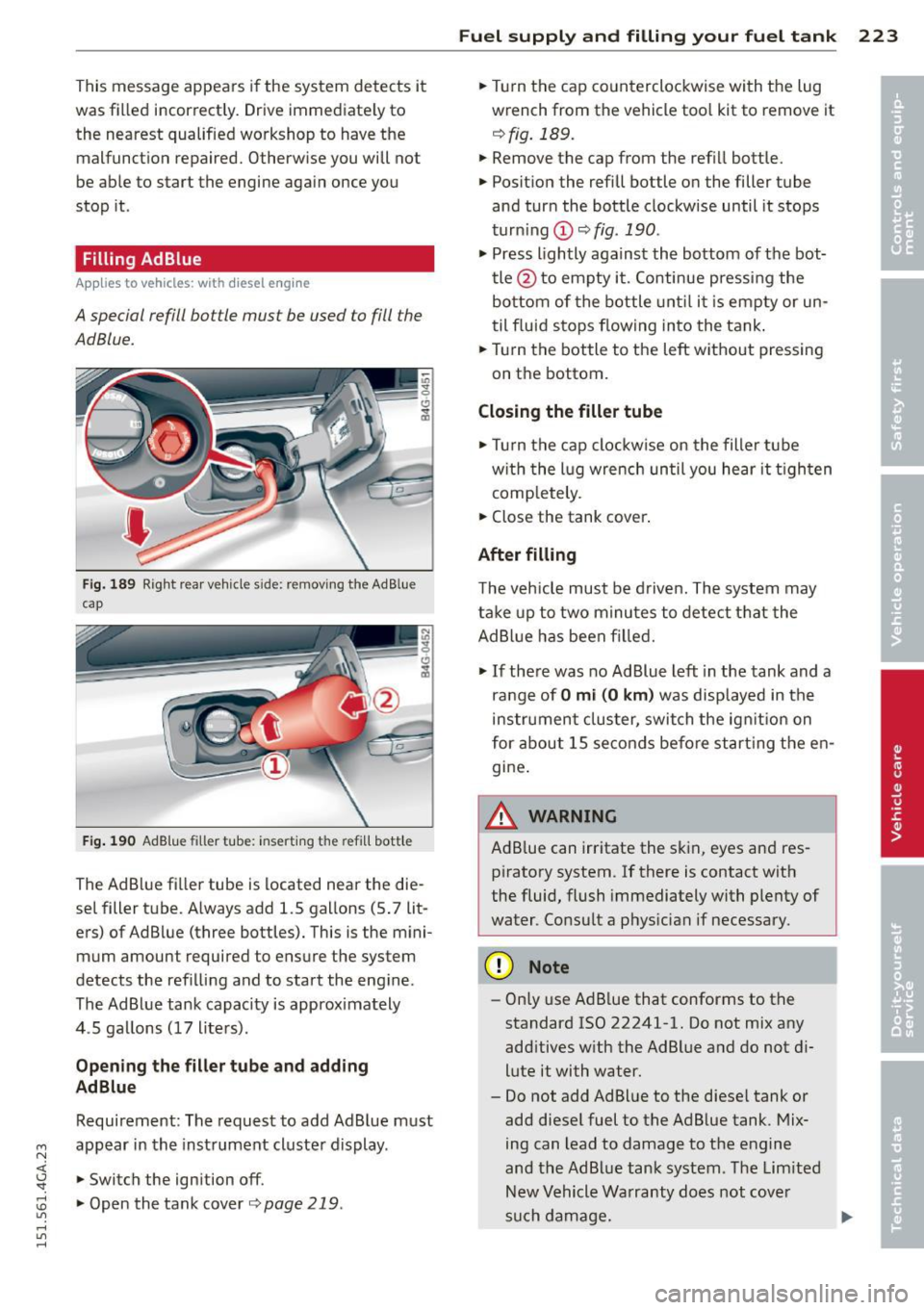
AdBlue.
Fi g. 189 Right rea r veh icle s ide: re m ov ing the Ad Blue
cap
Fig. 190 Ad Bl ue fitter t ube: insert ing the refill bott le
The Ad Blue f iller tube is located near the die
se l filler t ube. A lways add 1.5 gallons (5 .7 lit
ers) of AdBlue (three bottles). This is the m ini
mum amount required to ensure the system
detects the refilling and to start the eng ine.
The Ad Blue tank capacity is approximately
4.5 gal lons ( 17 lite rs).
Opening the filler tube and adding
AdBlue
Requirement: The request to add Ad B lue must
"' appear in the inst rument cluste r display.
N <(
~ • Switch the ignition off.
:0 • Open the tank cover r=>page 219.
"' ,....,
"' ,....,
Fuel suppl y and filli ng your fuel t ank 223
• Tur n the cap co unterclockwise with the lug
w rench from the vehicle too l kit to remove it
r=>fig. 189.
• Remove the cap from the refill bottle.
• Position the refill bottle o n the filler tube
and tur n the bottle clockw ise until it stops
tur ning
(I) ~ fig. 190.
• Press lightly against the bottom of the bot
tle @ to empty it. Continue p ressi ng the
bo ttom of the bottle unt il it i s empty or un
t il fluid s tops flow ing in to the tank .
• Turn the bottle to the left w ithout pressing
on the bottom.
Closing the filler tube
• Tu rn the cap clockw ise on the fille r tu be
w ith the l ug wrench until you hear it t ighten
c ompletely.
• Close the tank cover .
After filling
The vehicle must be d riven. The system may
t ak e up to two m inu te s to dete ct t hat the
AdB lue has been filled .
• If the re was no Ad Blue left in the tank and a
ra nge of
O m i (0 km ) was displayed in the
instrument clus ter, switch the ig nition on
for about 15 se con ds befo re st art ing the e n
gine .
WARNING
Ad B lue can irritate the sk in, eyes an d res
p iratory system. If there is contact with
the fluid, flush immediately with plenty of
water. Co nsu lt a phys ician if necessary.
(D Note
- On ly use Ad B lue that conforms to the
standard ISO 22241-1. Do not mix any
add itives w ith the AdBl ue a nd do not d i
lute it with water.
- Do not add Ad Bl ue to the diese l tank or
add diese l fuel to the Ad B lue tank. Mix
ing can lead to damage to the engine
and the AdBl ue tank system. The Lim ited
N ew Vehicle Warranty does not cove r
su ch dam age .
Page 227 of 316

M N <( I.J ""'. rl I.O
"' rl
"' rl
Checking and filling Engine hood
Releasing the engine hood
The engine hood is released from inside the
vehicle .
Fig. 191 Dr iver footwell: release leve r
Fig. 192 Rocker switch under the hood
Make sure the wiper arms are not raised up
from the w indshield. Otherw ise the paint
could be damaged.
.. With the driver's door open , pull the lever
under the instrument panel in the direction
of the arrow
c::> fig. 191.
.. Raise the hood slightly c::> .&. .
.. Press the rocker switch under the hood up
ward
c::> fig. 192. This releases the catch.
.. Open the hood .
A WARNING
Hot engine coo lant can burn you.
- To reduce the risk of being burned, never
open the hood if you see or hear steam
or coolant escaping from the engine
compartment . Wait until no steam or
coolant can be seen or heard before care
fully opening the hood.
Checkin g and fillin g 225
Working in the engine compartment
Be especially careful whenever you work in
the engine compartment.
Wh ene ve r y ou must p erform an y wor k in the
en gine com pa rtm ent , for e xample checking
a nd filling diff ere nt fluids, th ere is a risk of
inju ry, burn s and accid ent s. To pr eve nt per
so nal injury alwa ys observ e the foll owing
WARNING S. The engin e compartm ent of any
v e hicle i s a h az a rdou s area
c::> ,& .
h WARNING
To help avoid injury, before yo u check any
thing under the hood:
- Turn off the engine.
- Sw itch off the ignition .
- Apply the parki ng brake.
- Move selector leve r to P (Park) .
- Always let the engine cool down . Hot
components w ill burn skin on contact .
- To reduce the risk of being burned, never
open the hood if you see or hear steam
or coo lant escaping from the engine
compa rtment. Wait unt il no steam or
coolant can be seen or heard before care
fu lly opening the hood.
- Keep ch ildren away from the engine com
pa rtment.
- Never sp ill fluids on hot engine compo
nents . They can cause a fire .
- Never touch the rad iator fan. The auxili
ary electric fan is temperat ure controlled
and can sw itch on suddenly .
- Never open the coolant reservoir cap
when the engine is still warm . The cool
a nt system is p ressu rized and hot cool
a nt cou ld spray o ut.
- Protect your face, hands and arm from
steam or hot engine coolant by plac ing a
thick rag ove r the cap when you open the
coo lant rese rvoir.
- Do not remove the engine cover under
any circumstances. This inc reases the
ris k of burns.
- If work on the fue l system o r the elec tri -
cal system is necessary:
II>-
Page 229 of 316
M N <( I.J "". rl I.O
"' rl
"' rl
Checking and fillin g 22 7
Engine compartment
Engine compartment overview
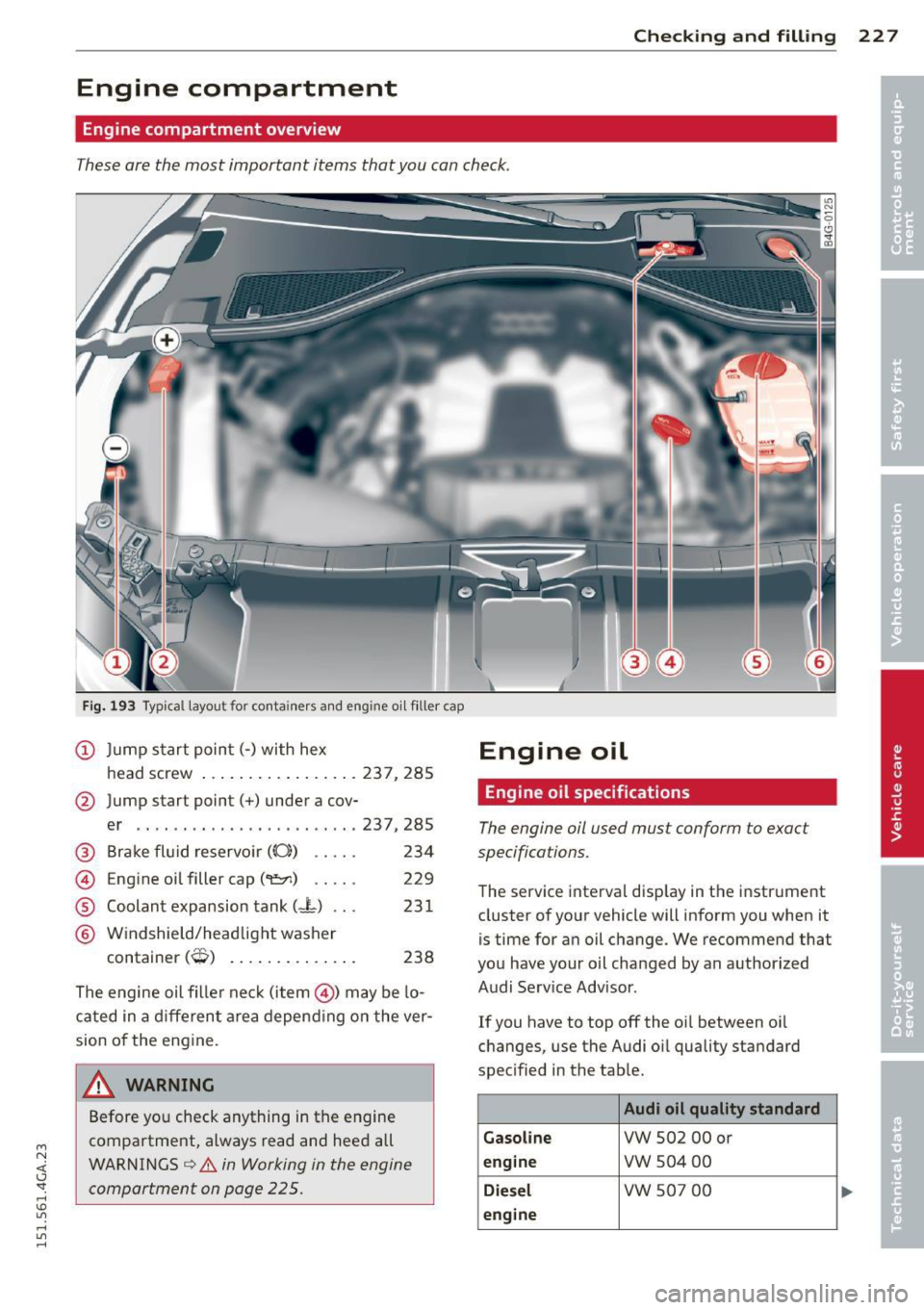
These are the most important items that you can check.
Fig. 193 Typical l ayout for conta iners and engine o il filler cap
@ Jump start poin t(-) with hex
head screw .. .. ..... ... .. .. . 237, 285
@ Jump start point(+) under a cov-
er .. .. ... ..... ...... ...... 237,285
@ Brake fl uid reservo ir ((0)) .... .
© Engine oil filler cap ("1:::r.) .... .
® Coolant expansion tank (-L) .. .
© Windshield/headlight washer
t .
(;;:;) con ainer ,..,, .. .... .. .. . .. . 234
229
23 1
238
The engine oil fille r neck (item @) may be lo
cated in a d ifferent a rea depend ing o n the
ver
sion of the eng ine.
WARNING
Before you check anything in the engine
compartment, always read and heed all
WARNINGS
c::> &. in Working in the engine
compartment on page 225.
Engine oil
Engine oil specifications
The engine oil used must conform to exact
specifications.
T he service interva l d isp lay in the instrument
cluster of yo ur vehicle will inform you when it
is time for an oil change. We recommend that
you have your oil changed by an authorized
Audi Serv ice Advisor .
If you have to top off the oi l between oi l
changes, use the Audi o il quality standard
spec ified in the table.
Audi oil quality standard
Gasoline
VW 502 00 or
engine vw 504 00
Diesel vw 507 00
eng ine
Page 230 of 316
228 Check ing and filling
Using the proper engine o il is important for
the functionality and service life of the en
g ine. Your engine was factory-filled with a
h igh-quality oil which can usua lly be used
throughout the entire year.
0 Note
Your L imited New Vehicle Warranty does
not cover damage or ma lfunctions due to
fai lure to follow recommended mainte
nance and use requ irements as set forth in
the Audi Owner's Manual and Warranty
&
Ma intenance booklet.
- Use only a high quality eng ine oil that ex
pressly complies w ith the Audi o il quality
standard spec ified for your veh icle's en
gine. Using any other oil can cause seri
ous eng ine damage.
- Do not mix any lubricants o r othe r addi
tives into the eng ine o il. Doing so can
ca use engine damage.
If you need to add oi l and there is no ne
availab le tha t mee ts the Audi oil qua lity
s tandard your engine requires, yo u may
add a tota l of no more than 0 .5 quart/liter
of a high-quality "synthetic"oil that meets
the following specifications.
- Vehicles with gaso line engine: ACEA A3
or API SM with a viscosity grade of
SAE 0W-30, SAE SW-30 or SAE SW-40.
- Vehicles with diesel engine: ACEA C3 or
API CF with a v iscosity grade of
SAE 0W-30 or SAE SW-30.
- For more information abo ut eng ine oil
that has been approved for your vehicle, please contact either your a uthorized
Audi dealer or Audi Customer Relations
at 1 (800) 822-2834 or visit our web site
at www.audiusa .com or
www.aud icanada.ca.
Engine oil consumption
The engine in your vehicle depends on on ade
quate amount of oil to lubricate and cool all
of its moving ports .
In order to provide effective lubricat ion and
cooling of interna l eng ine components, all in
ternal combust ion e ngines consume a certain
amount of oil. Oil consumpt ion va ries from
engi ne to engine and may change sig nifican tly
over the life of the engine. Typically, engines
with a spec ified break -in period (see
c> page 203) consume more oil during the
break-in period than they cons ume after oi l
consumption has stabilized.
U nder normal cond itions, the rate o f oi l con
s u mption depends on the q uality and viscos ity
of the oil, the RPM (revolutions per minute) at
which the engine is operated, the ambient
temperature and road conditions. Further fac
tors are the amount of oil dilut ion from water
condensation or fue l residue a nd the oxida
t ion level of the oil. As any eng ine is subject to
wea r as m ileage builds up, t he oil co nsump
t ion may increase over time until replacemen t
of worn components may be come necessary.
With a ll these variab les coming into play, no
standard rate of oil consumpt io n can be es
tabl ished o r spe cified . There i s no alte rnative
to regu lar and frequent che ck ing of the o il lev
el , see
Note.
If the yellow engine oil leve l wa rning symbo l
i n t he i nstr ument cluster
Ill lights up, you
sho uld check the oil leve l as soon as possib le
i=> page 229 . Top off the oil at your earliest
convenience
i=> page 229.
A WARNING
--
Before you check anything in the engine
compartment, always read and heed a ll
WARNINGS
c> & in Working in the engine
comportment on page 225.
(D Note
Driving with an insufficient o il level is like-
l y to cause severe damage to the engine. .,.