warning light AUDI A7 2015 Owners Manual
[x] Cancel search | Manufacturer: AUDI, Model Year: 2015, Model line: A7, Model: AUDI A7 2015Pages: 316, PDF Size: 78.09 MB
Page 234 of 316
232 Check ing and filling
Before you check anything in the engine com
partment,
a lways r ea d and heed all WARN
INGS ¢ A in Working in the engine compart
ment on page 225.
• Park your vehicle on a level surface.
• Switch
off the ignition .
• Read the eng ine coolant leve l from the cool
ant expansion tank
c> fig. 196, c> page 22 7,
fig. 193. With a cold eng ine, the coolant
level should be between the "min" and
"max" markings. When the engine is warm,
the leve l may be slightly above the "max"
ma rk ing.
The location of the coolant expans ion tank
can be seen in the engine compartment illus
tration ¢
page 22 7.
To obtain an accurate reading, the engine
must be sw itched
off.
The expans ion tank in your vehicle is equipped
with an electric coolant level sensor.
When the coo lant level is too low, the warning
light in the Auto-Check System ¢ page l 6 will
i l luminate unti l yo u add coolant and the level
has been restored to normal. Even though
there is an electric coolant level senso r, we
still recommend you check the coolant leve l
from time to time .
Coolant loss
Coolant loss may indicate a lea k in the cooling
system. In the event of coolant loss, the cool
ing system should be inspected immediately
by your author ized Audi dealer. It is not
enough merely to add coolant.
In a
sealed system, losses can occur only if
the boiling point of the coolant is exceeded as
a result of overheat ing.
A WARNING
T he cooling system is unde r pr essure and
c an get ve ry hot. Reduce t he risk of s cald
ing from hot coolant by followi ng these
steps .
- T urn
off the engine and allow it to cool
dow n. -
Protect your face, han ds and arms from
escaping flu id and steam by cover ing the
cap with a large, thick rag.
- Tu rn the cap slowly and very care fully in
a counte r-clockwise direct ion while ap
plying lig ht, downward pressure on the
top of the cap.
- To avo id being burned, do not sp ill anti
freeze or coolant on the exhaust system
or hot engine par ts. Under certa in cond i
tions, th e ethylen e glyco l in engine coo l
a nt can catch fire.
(D Note
Do not add a ny type o f radiator leak sea l
ant to your veh icle's engine coolant. Add
i ng radiator r epa ir fluid may adv erse ly af
fe ct the funct io n and perfo rma nce of you r
co oling syste m and could result in damage
not covered by your New Veh icle Limi ted
War ran ty.
Adding coolant
Be very careful when adding engine coolant.
Befo re you check anyth ing in the eng ine com
partment,
alway s read and heed all WARN·
INGS ¢ A in Working in the engine compart
ment on page 225.
• Requirement: The re must be a r esidua l
amount of coolant in the e xpansion ta nk
¢(D.
•Tur no ff the engine.
• Le t the engine cool down.
• Place a thick rag ove r th e coo lant expansion
tank
¢ page 231, fig. 196 and carefully
twist the cap co unte r-clockwise c> &_ .
• Add coo lant m ixed in the correct rat io
¢ page 231, Coolant up to the MAX mark
ing.
• Make s ure that the fl uid leve l remains sta-
b le. Add more coo la nt if necessary.
• Twis t the cap o n again
tightly.
Replacement engine coo la nt must confo rm to
exact spec ificat ions
¢ page 2 31, Coolant. .,.
Page 235 of 316
M N <( (.J
'SI: ,...., \!) ..,.,
,...., ..,., ,....,
We recommend using only coolant addi-
tive
Gl2++, Gl3 or in an emergency Gl2+. Do
not use a different additive. In an emergency
use plain water until you can get the correct
additive and can restore the correct ratio. This
should be done as soon as possible .
If you have lost a considerable amount of
coolant, then you should add cold antifree ze
and cold water only when the engine is cold.
Always use
new engine coolant when refilling.
Do not fill coolant above the "MAX" mark. Ex
cess coolant will be forced out through the pressure relief valve in the cap when the en
gine becomes hot.
A WARNING
-The cooling system is under pressure and
can get very hot. Reduce the risk of
scalding from hot coolant by following
these steps.
-Turn off the engine and allow itto cool
down.
- Protect your face, hands and arms from
escaping fluid and steam by covering
the cap with a large, thick rag.
- Turn the cap slowly and very carefully
in a counter-clockwise direction while
applying light, downward pressure on
the top of the cap.
- To avoid being burned, do not spill an
tifreeze or coolant on the exhaust sys
tem or hot engine parts. Under certain
conditions, the ethylene glycol in en
gine coolant can catch fire.
- Antifreeze is poisonous. Always store an
tifreeze in its original container and well
out of the reach of children.
- If you drain the coolant, it must be
caught and safely stored in a proper con
tainer clearly marked "poison".
(D Note
- Do not add coolant if the expansion tank
is empty. Air could enter the cooling sys
tem and damage the engine. If this is
Checking and filling 233
the case, do not continue driving. Seek
professional assistance .
- Coolant pollutes the environment and
could cause an engine fire. Excess cool
ant will be forced out through the pres
sure relief valve in the cap when the en
gine becomes hot.
- If, in an emergency, only water can be
added, the correct ratio between water
and antifreeze
c> page 231 must be re
stored as soon as possible.
@ For the sake of the environment
Drained coolant should not be reused. Al
ways dispose of used coolant while observ ing all environmental regulations.
Radiator fan
The radiator fan switches on automatically by
itself.
An auxiliary electric radiator fan switches on
and off depending on coolant temperature
and other vehicle operating conditions .
After you switch the engine off, the auxiliary
fan can continue running for up to 10 minutes
- even with the ignition off.
It can even switch
on again later by itself
c> .&, if
- the temperature of the engine coolant rises
due to the heat build-up from the engine in
the engine compartment, or
- the engine compartment heats up because
the vehicle is parked in intense sunlight.
A WARNING
-To reduce the risk of personal injury nev
er touch the radiator fan.
- The auxiliary electric fan is temperature controlled and can switch on suddenly
even when the engine is not running.
- The auxiliary radiator fan switches on au
tomatically when the engine coolant reaches a certain temperature and will
continue to run until the coolant temper
ature drops.
•
•
Page 236 of 316
234 Checking and filling
Brake fluid
Checking brake fluid level
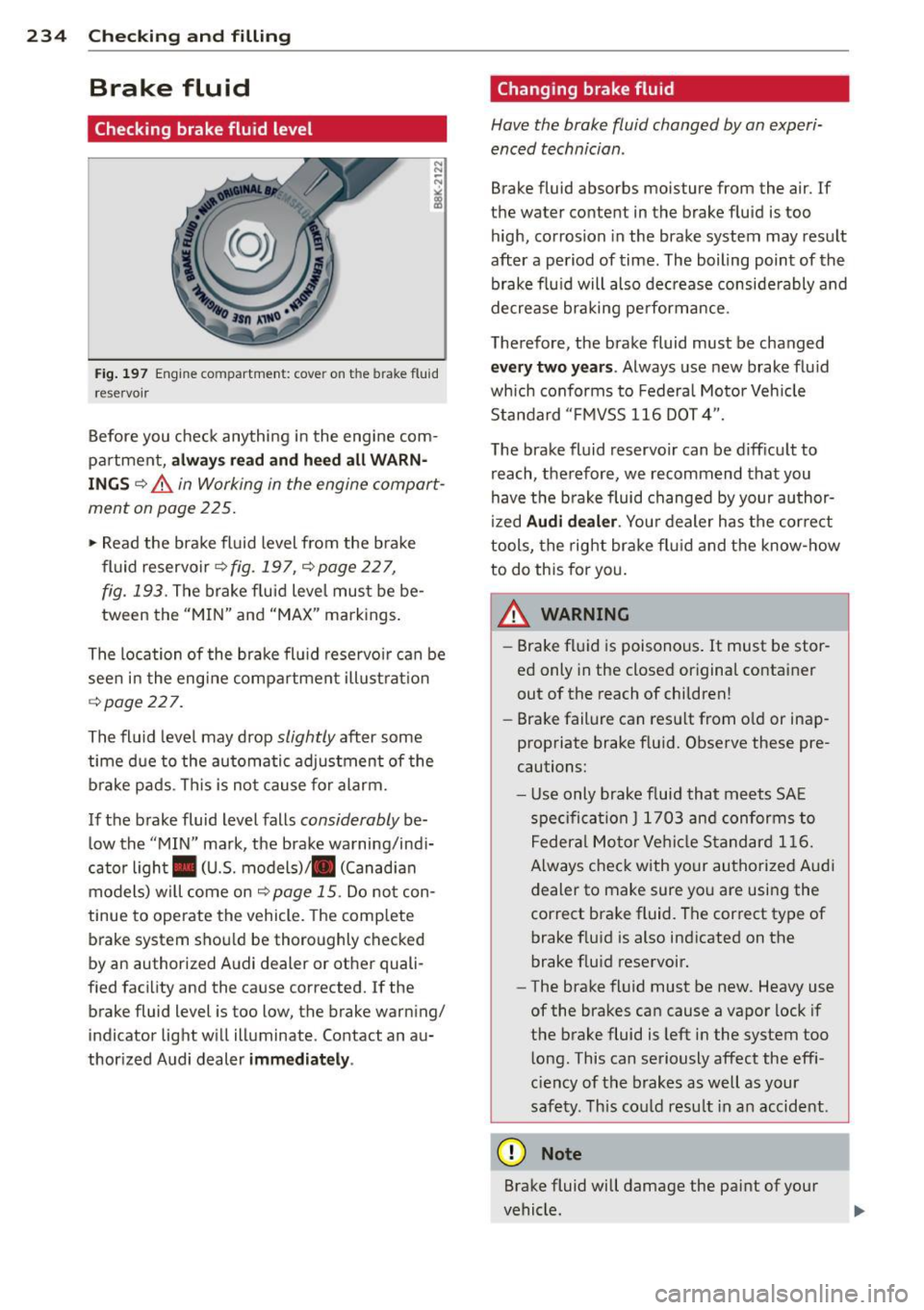
Fig . 197 Engine compartment: cove r on the brake fluid
reservo ir
Before you check anything in the engine com
partment,
always read and heed all WARN
INGS ¢&. in Working in the engine compart
ment on page 225.
,.. Read the brake fluid level from the brake
fluid reservoir¢
fig . 197, ¢ page 22 7,
fig. 193.
The brake flu id level must be be
tween the "MIN" and "MAX" markings.
The location of the brake flu id reservoir can be
seen in the engine compartment illust rat ion
¢ page 227.
The fluid level may drop
slightly after some
time due to the automatic adjustment of the
brake pads. This is not cause for alarm.
If the brake fluid level falls
considerably be
low the "MIN" mark, the brake warning/indi
cator light . (U.S. models)/ . (Canadian
models) will come on¢
page 15. Do not con
tinue to operate the vehicle. The comp lete
brake system shou ld be thoroughly checked
by an authorized A udi dealer or other quali
fied facility and the cause corrected.
If the
brake fluid level is too low, the brake warning/
indicator light will illuminate. Contact an au
thorized Audi dealer
immediately .
Changing brake fluid
Have the brake fluid changed by an experi
enced technician .
Brake fluid absorbs moisture from the air. If
the water content in the brake fluid is too high, corrosion in the brake system may result
after a period of time . The boiling point of the
brake flu id will also decrease conside rably and
decrease braking pe rformance.
Therefore, the brake fluid must be changed
every two years . Always use new brake flu id
which conforms to Federal Motor Vehicle
Standard "FMVSS 116 DOT 4".
The brake fluid reservoir can be difficult to reach, therefore, we recommend that you
have the brake fluid changed by your author
ized
Audi dealer. Your dealer has the correct
tools, the right brake fluid and the know-how
to do this for you.
A WARNING
- Brake fluid is poisonous . It must be stor
ed only in the closed original container
out of the reach of children!
- Brake failure can resu lt from o ld or inap
propriate brake fluid. Observe these pre
cautions:
- Use only brake fluid that meets SA E
specification
J 1703 and conforms to
Federal Motor Vehicle Standard 116.
Always check with your authorized Audi
dealer to make sure you are using the
correct brake fluid. The correct type of
brake f luid is also indicated on the
brake fluid reservoir.
- The brake fluid must be new. Heavy use
of the brakes can cause a vapor lock if
the brake fluid is left in the system too
long. This can seriously affect the effi
c ie ncy of the brakes as well as your
safety. This could resu lt in an accident.
(D Note
Brake fluid will damage the paint of your
vehicle .
Page 237 of 316
M N <( (.J
'SI: ,...., \!) 1.1'1 ,...., 1.1'1 ,....,
@ For the sake of the environment
Because of the pr oblem of proper d isposa l
of brake flu id as we ll as the special tools
requ ired and the necessary expert ise, we
recommend that you have the brake fluid
changed by your author ized Audi dealer .
Battery
General information
Under normal operating conditions, the bat
tery in your Audi does not need any mainte
nance. With
high outside temperatures or
long daily dr ives we recommend that you have
the electro lyte level checked by a service fa
cility . The electrolyte level shou ld also be
checked each time the battery is charged
¢ page 237.
Have the battery checked when you take your
ve hicle in for service . You are well adv ised to
replace a battery that is older than 5 yea rs .
W ith certa in types of a irbag deployment, t he
b attery is d isconnected from the vehicle elec
tr ica l system for safety reasons¢.&.
in Re
pair, core and disposal of the airbags on
page 163.
Disconnecting the battery terminals
Some vehicle functions (power w indow regu
lators , for example) are lost if the battery ter
m inals a re d isconnected. These func tions have
to be re lea rned after the batte ry term inals a re
connected agai n. T o prevent this , the bat tery
should only be d isconnec ted from the vehicle
e lec tric al system when absolu tely necessa ry
for repairs .
Vehicles not driven for long periods
If you do not drive you r vehicle over a period
of severa l days or weeks, elec trical compo
nen ts are gr adually cut b ack o r swi tched off .
This redu ces energy cons umption and main
tains starting capab ility over a longer per io d
¢ page 201. Some of the co nvenience func
tions may not operate, s uch as the inte rior
lights or power seat adjustme nt. The conven-
Checkin g and fillin g 235
ience funct ions w ill be available again when
yo u sw itch on the ign ition and start the en
gine.
Winter operation
D ur ing the w inte r mon ths, bat tery ca pa city
tends to decrease as tempera tures drop . This
is beca use more power is a lso consumed wh ile
starting, and the headlights, rear window de
fogger, etc., are used mo re often.
Avoid unnecess ary powe r consumpt ion, pa r
ticu lar ly in city traffic o r when traveling only
sho rt distances. Let yo ur authorized A udi
dealer check the capacity of the vehicle bat
tery before w inter sets in¢
page 23 7. A well
charged battery will no t on ly prevent star tin g
problems w hen the weather is cold, but w ill
also last longer .
@ Tips
If your vehicle is left standing for seve ral
weeks at extremely low temperatures, the
vehicle battery s hou ld be removed and
stored where it will not freez e. This will
p reve nt it from be ing dam aged and having
to be repl aced .
Working on the battery
Be especially careful when working on or near
the bat tery.
The battery is located in the luggage compar t
ment under the floor . B efo re you che ck any
thi ng in the luggage compartment,
read and
heed all WARNINGS
¢ .&, .
Always heed the safety warnings , when work
i ng on the veh icle batte ry or t he vehicle e lec
t rical sys tem to p reven t inju ry.
The following WARNINGS are very
important when working on the battery:
Always heed the following WARNING SYM· BO LS and safety precautions when working
on the battery .
®
Always wear eye protection.
•
•
Page 238 of 316

236 Check ing and filling
&
Batt ery aci d c ont ain s s ulfuric acid .
A lw ay s w ear gloves a nd eye protec-
ti on.
@
No
- spark s
- flame s
· sm okin g.
A
When a b atte ry is ch arged , it p rodu -
ce s hydr oge n ga s wh ich i s ex plosi ve
.
and co uld cause pe rso nal injur y.
®
Alway s keep the batt ery well out of
re ach of children.
A WARNING
Whenever working on the battery or on
the electrical system, there is the r isk of
injury, acc ident and even fire. Read and
heed the following WARNINGS:
- Always wear eye protection. Do not let
battery acid or any lead part icles get on
your sk in or cloth ing . Sh ield your eyes .
Explosive gases can cause blindness or
other injury.
- Battery acid contai ns sulfur ic acid. Sulfu
ric acid can cause blindness and severe
burns.
- Always wear gloves and eye protection.
Do not tilt the battery because ac id
could leak out of the vent ilation open
ings.
- If you get battery acid in your eyes or
on your sk in, immediately rinse with
cold water for severa l m inutes and get
medical attention .
- If you should ingest any battery acid,
seek medical attention immediately .
- Do not expose the battery to an open
flame, electric sparks or an open light.
- Do not smoke.
- Do not interchange the positive and neg-
ative cab les.
- When working on the battery, be sure
not to short-circuit the terminals with
tools or other metal objects. This would
cause the battery to heat up very quickly,
wh ich could lead to damage or explosion
and personal injury. -
When a battery is charged, it produces
hydrogen gas which is explosive and
could cause personal injury.
- Always keep the battery well out of the
reach of children.
- Before work is done on the electrical sys
tem, disconnect the negat ive ground ca
ble.
- Before performing any work on the e lec
trica l system, switch off the engine and
ignit ion as well as any electrical equip
ment. The negative cable on the battery
must be disconnected .
If you are just go
ing to replace a light bulb, then it is
enough to swi tc h off the lights.
- Before disconnecting the battery, switch
off the anti-theft alarm system! Other
wise you wi ll set off the alarm.
- When disconnecting the battery, f irst
d isconnect the negat ive cab le and then
the posit ive c ab le.
- Before reconnecting the batte ry, ma ke
sure all e lectr ica l consumers are sw itch
ed off. Re connect the pos it ive cable first
and then the negative cable. Never inter
change the cables - this could start a fire!
- Never charge a frozen or a thawed-out
battery. It could exp lode! If a battery has
frozen, then it must be replaced . A dis
charged battery can freeze over at 32
°F
(0 oc).
- Make sure the vent hose is always attach
ed to the opening on the s ide of the bat
tery.
- Never use batteries which are damaged.
There is the danger of an explosion! Al
ways rep lace a damaged battery.
A WARNING
Ca lifornia Proposition 65 Warning:
- Battery posts, terminals and related ac
cessories conta in lead and lead com
pounds, chemicals known to the State of
California to cause cancer and reproduc
tive problems . Wash hands after han-
dling.
~
Page 273 of 316

M N <( I.J "". rl I.O
"' rl
"' rl
Tire pressure indicator appears
The tire pressure indicator in the instrument
cluster informs you if the tire pressure is too
low or if there is a system malfunction.
Fig. 205 Display: underinflation warning
Fig. 206 Display: System malfunction
Using the ABS sensors, the tire pressure moni
toring system compares the tire tread circum ference and vibration characteristics of the in
dividual tires. If the pressure decreases in one
or more tires, this is indicated in the instru
ment cluster with a warning symbol
rD] and a
message
c:> fig . 205.
The tire pressure monitoring system must be
reset via MMI each time the pressures are ad
justed (e.g. when switching between partial
and fu ll load pressure) or after changing or re
placing a tire on your vehicle
c:> page272 . The
TPMS indicator only monitors the tire pres
sure that you have previously stored. You can
find the recommended tire pressures for your
vehicle on the label on driver's side 8-pillar
c:>page247.
Tire tread circumference and vibration charac
teristics can change and cause a tire pressure
warning if:
- the tire pressure in one or more tires is too
low,
Tires and wheels 2 71
- the tire has structural damage,
- the tire pressure was changed, wheels rotat-
ed or replaced but the TPMS was not reset
c:>poge272.
- the spare tire* is mounted .
Warning symbols
[I] Loss of pressure in at least one tire¢.& .
Check the tire or tires and replace or repair if
necessary. The indicator light
rD] in the instru
ment cluster also illuminates <=:>
page 12.
Check/correct the pressures of all four tires
and resetTPMS via MMI.
l!I (Tire Pressure Mon itoring System) Tire
pressure! System malfunction .
Ifljl appears
after switching the ignition on or while driving
¢
fig. 206 and the indicator light rD] in the in
strument cluster blinks for approximately one
minute and then stays on, there is a system
malfunction. Attempt to store the correct tire
pressure
c:> page 272. If the indicator light
does not turn off or if it turns on shortly
thereafter, immediately drive your vehicle to
an authorized Audi dealer or authorized repair
facility to have the malfunction corrected.
_& WARNING
- If the tire pressure indicator appears in
the instrument cluster display, one or
more of your tires is significantly under
inflated. Reduce your speed immediately
and avoid any hard steering or braking
maneuvers. Stop as soon as possible and
check the tires and their pressures. In
flate the tire pressure to the proper pres
sure as indicated on the vehicle's tire
pressure label<=:>
page 247 . Driving on a
significantly under-inflated tire causes
the tire to overheat and can lead to tire
failure. Under-inflation also is likely to
impair the vehicle's handling and stop
ping ability.
- The driver is responsible for maintaining
the correct tire pressures. You must check the tire pressures regularly.
.
Page 277 of 316

M N <( (.J
'SI: ,...., \!) ..,.,
,...., ..,., ,....,
Changing a wheel
Before changing a wheel
Observe the following precautions for your
own and your passenger's safety when chang
ing a wheel .
.,. After you experience a tire fa ilure, pull the
car well away from moving traffic and try to
reach
level gro und before you stop¢.&_ .
.. All passengers should
leav e the car and
move to a safe location (fo r instan ce, be hind
the guardra il) ¢.&_ .
.. Engage the
parkin g brake to prevent your
vehicle from ro lling unintentionally ¢.&_ .
.. Move
selecto r le ver to p osition P ¢ .&_ .
1> Ifyou are towing a trai ler, unh itch the tra iler
from your vehicle .
.,. Take the
jack and the spare tire out of the
luggage compartment
¢ page 273,
¢ page 274 .
.8, WARNING
You or your passengers cou ld be injured
while changing a whee l if yo u do not fol
low t hese safety precautions:
- If you have a flat t ire, move a safe dis
tance off the road. Tur n off the eng ine,
turn the emergency f lashers on and use
other warning dev ices to alert other mo
torists.
- Make sure that passengers wait in a safe
place away from the ve hicle and well
away from the road and traff ic.
- To help p revent the vehicle from moving
s u dden ly and possibly slipping off the
jack, always fully set the parking brake
and block the wheel diagonally opposite
the wheel being changed. Whe n one
front wheel is lifted off the ground, plac ing the A utomat ic Transm iss ion in P
(Pa rk) will
not p revent the vehicle from
moving.
- Before you change a wheel, be su re the
ground is level and fi rm. If ne cessa ry,
use a st urdy board under the jack.
-
What do I do now? 275
- Always store the vehicle tool kit, the jack
and the replaced tire in the luggage com partment
c::>page 134.
(D Tips
Before changing the whee l, you must acti
vate the jacking mode, so that the auto matic controls for the Adaptive Air Sus
pension* do not make it more d iff icult to
lift the vehicle with the jack
c::> page 2 77 .
Changing a wheel
When you change a wheel , follow these
quence described below s tep-by-s tep and in
exactly that order .
l. Activate the vehicle jack mode*
¢page 277 .
2. Remove the decorativ e wheel co ver* . For
more details see also
c::> page 2 76, Deco
rative wheel covers
or c::> page 2 76,
Wheels with wheel bolt caps .
3. Loosen the wh eel bolt s ¢page 277.
4 . Loca te the p roper moun ting poin t for the
jack and align the jack be low that point
¢ page 277 .
5.
R ais e the car with the jack¢ page 2 77.
6. Remove the
wheel with the flat tire and
then install
the spar e c::>page 279.
7. Tighten all whee l bolts lightly .
8.
Lo wer the vehicle with the jack .
9 . Use the wheel bolt w rench and
firmly
t ighten al l wheel bolts ¢ page 2 77.
10 . Replace the decorative
wh eel c ov er* .
11. Deactivate the vehicle jack mode* in the
MM I:
ICARI f u nction button > (Car )* sy s
tems
contro l button > S erv ici ng & che cks
> A ir s usp .: jac k mode > Off .
The vehicle jack mode * switches off automati
ca lly at speeds above 6 mph (10 km/h) .
.8, WARNING
-Always read and fo llow all WARNINGS and
i nformat ion
c::> A in Raising the vehicle on
page 278
and c::> poge 280.
•
•
Page 286 of 316
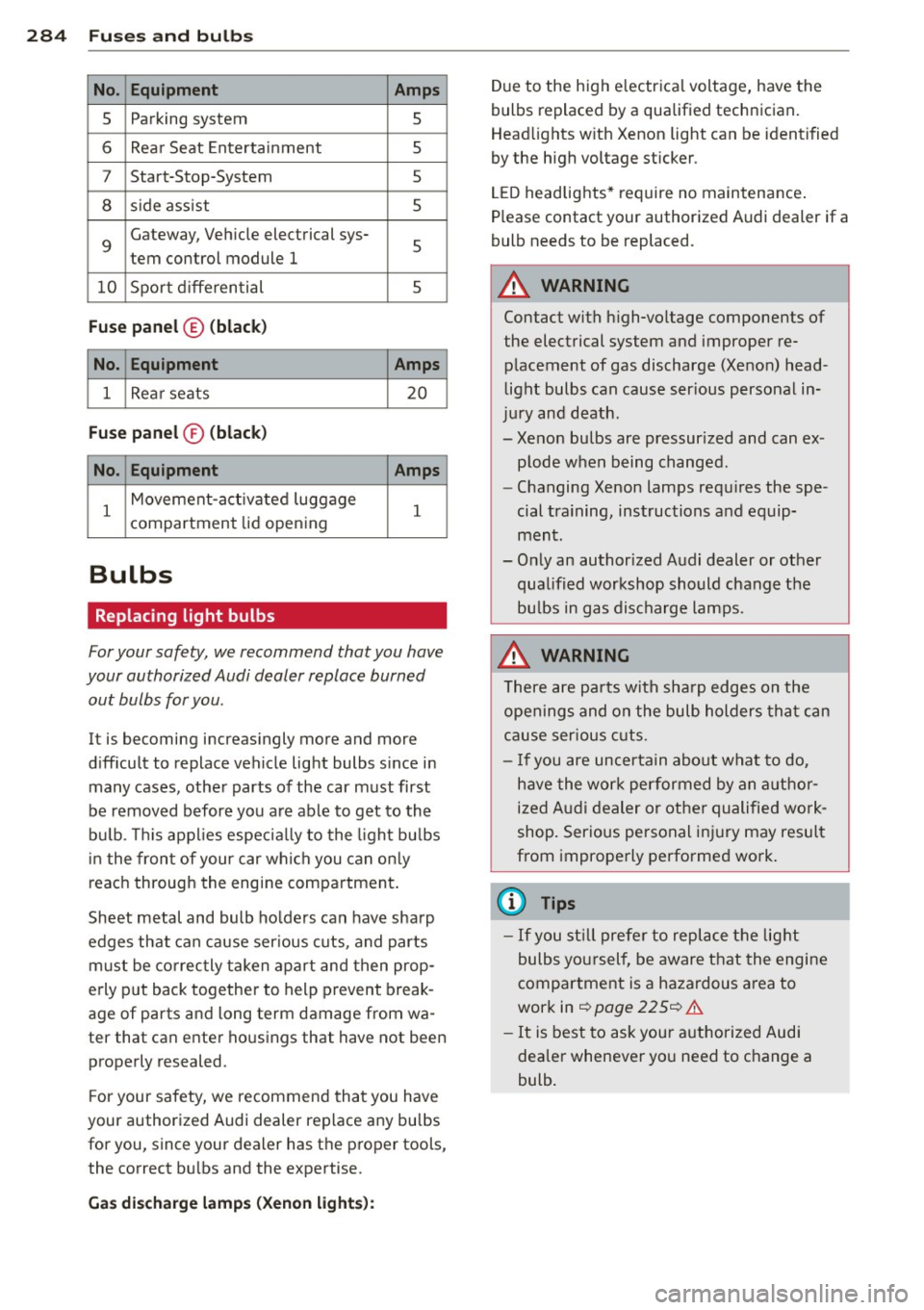
284 Fuses and bulb s
No. Equipment Amps
s Parking system s
6 Rear Seat Entertainment s
7 Start-Stop-System s
8 side ass ist s
9
Gateway, Vehicle electrical sys-
s tern control module 1
10 Sport d ifferential s
Fuse panel © (black)
No. Equipment Amps
1 Rear seats 20
Fuse panel ® (black)
No. Equipment Amps
1 Movement-activated luggage 1
compartment lid opening
Bulbs
Replacing light bulbs
For your safety, we recommend that you have
your authorized Audi dealer replace burned
out bulbs for you .
It is becoming increasingly more and more
difficult to replace vehicle light bulbs since in
many cases, other parts of the car must first
be removed before you are able to get to the
bulb . Thi s appl ies especial ly to the light bu lbs
in the front of your car which you can only
reach through the engine compartment .
Sheet metal and bulb ho lders can have sharp
edges that can cause ser ious cuts, and parts
must be co rrectly taken apart and then prop
erly put back together to help prevent break
age of parts and long term damage from wa
ter that can enter housings that have not been
properly resealed.
F or your safety, we recommend that you have
your author ized Audi dealer rep lace any bulbs
for you, since your dealer has the proper tools,
the correct bu lbs and the expertise.
Gas di scharge lamps (Xenon lights):
Due to the high e lectr ica l voltage, have the
bulbs replaced by a qualified technician.
Head lights w ith Xenon light can be identified
by the high voltage sticker .
LED headlights* require no maintenance .
P lease contact your authorized Audi dealer if a
bulb needs to be replaced.
A WARNING
Contact with high-voltage components of
the electrical system and improper re placement of gas discharge (Xenon) head
light bulbs can cause ser ious personal in
jury and death.
- Xenon bulbs are pressur ized and can ex
p lode when being changed.
- Changing Xenon lamps requ ires the spe
cial tra ining, instructions and equip
ment.
- Only an authorized Audi dealer or other
qualified workshop should change the
bu lbs in gas discharge lamps .
_& WARNING
There are parts with sharp edges on the
openings and on the bulb holders that can
cause ser ious cuts.
- If you are uncertain about what to do,
have the work performed by an author
ized Audi dealer or other qualified wo rk
shop . Serious personal injury may result
from improperly performed work .
(D Tips
-If you still prefer to replace the light
bulbs yoursel f, be aware that the engine
compartment is a hazardous area to
work in
r=)poge 22Sr=) .&.
-It is best to ask your authorized Audi
dealer whenever you need to change a
bulb .
Page 287 of 316

M N <( (.J
'SI: ,...., \!) ..,.,
,...., ..,., ,....,
Emergency situations
General
This chapter i s intended for trained emer
gency crews and working personnel who have the necessary tools and equipment to
perform these operations.
Starting by pushing or
towing
(D Note
Ve hicles w ith an au tomatic tra nsmission
cannot be started by pus hing o r tow ing.
Starting with jumper
cables
If necessary, the engine can be started by
connecting it to the battery of another vehi
cle.
If the engine shou ld fail to start because of a
discha rged o r wea k battery, the battery can be
connected to the battery o f
another vehicle,
using a
pair of jumper cables to start the en
g ine.
Jumper cables
Use only jumper cables of sufficiently la rge
c ross section to carry the starter c urrent safe
l y. Refer to the man ufacturer's specifications.
Use only jumper cables with
insulated te rm i
na l clamps wh ic h are d istinctly marked:
plus(+) cable i n mos t cases co lore d red
minu s(-) cable
in most cases colored black .
A WARNING
Batterie s contain e lec tricity, ac id, an d gas.
A ny of these can cause ve ry ser io us or fatal
inju ry. Follow the instructions below f or
safe han dling of your veh icle's b attery .
- Alway s shield you r eyes and avoid lean
ing over the bat te ry whenever possib le.
- A dis ch arged battery c an free ze at tem
peratures ju st be low 32 °F ( 0 °C ). Befo re
Emergency situations 285
connecting a jumpe r cab le, you must
thaw the fr ozen battery c omp lete ly, ot h
erwise it could explode.
- Do not allow battery acid to contact eyes
or skin. Fl ush any contacted area with
wate r immediately.
- Improper use of a booster battery to start a vehicle may cause an explosion.
- Vehicle batter ies genera te exp losive gas
es. Keep spar ks, flame and lighted c iga
rettes away from batte ries.
- Do not try to jump start any ve hicle w ith
a low ac id leve l in the battery.
- The vo ltage of the booste r batte ry m ust
a lso have a 12-volt rating. The capacity
(Ah) of the booster battery sho uld not be
lowe r tha n that of the discharged bat
tery . U se of batte rie s of d iffe ren t voltage
or substantially diffe rent "Ah" rat ing
may c au se an exp losion and persona l in
JU ry.
- N ever cha rge a fro zen battery. Gas trap
pe d in the ice may cause a n ex plosion.
- Never cha rge or use a batte ry tha t h as
been fr ozen. T he battery case may have
be weakened.
- Us e of b atter ies of differe nt voltage or
sub stant ia lly diffe ren t ca pa city (Ah) ra t
i ng may c ause an ex plosion an d injury .
Th e capac ity (Ah) of the booster bat tery
should not be lower than that of the dis
charged batte ry .
- Before you chec k any thing in the engine
compa rtment, always read and hee d all
WARNINGS
¢page 225.
(D Note
-App lyin g a higher vo ltage booster ba t
t ery w ill cause expens ive damage to se n
sit ive e lectronic com ponents, such as
cont ro l units, relays, rad io, etc.
- The re must be no electrical contact be
tween the vehicles as ot herwise c urrent
co uld a lready start to f low as soon as the
p o sit ive(+) term inals a re connected. ..,. •
•
Page 288 of 316

286 Emergency situations
@ Tips
The discharged battery must be properly
connected to the vehicle's electrical sys
tem. When jump starting or charging the
battery, never connect the negative
ground cable to the battery negative post
because the batte ry manager system must
be able to detect the battery 's state of
charge. Always connect the negative
ground cab le to the negative ground post
of the battery manager control unit.
Use of jumper cables
Make sure to connect the jumper cable
clamps in exactly the order described below!
Fig. 222 Engine compartment: connecto rs for jump
start cables and charger
Fig. 223 Jump start ing with the battery of another ve·
hide: @-booster battery, @-discharged ve hicle bat
tery
The procedure described below fo r connecting
jumper cables is intended to provide a jump
start for your vehicle.
Vehicle with discharged battery:
.,. Turn off lights and accessories, move lever
of automatic transmission to N (Neutral) or
P (Park) and set parking brake.
Connect POSITIVE(+) to POSITIVE(+)
(red)
.,. Open the red cover on the positive terminal
¢fig. 222.
1. Connect one end of the red positive cable
on the
jump start bolt c::;, fig. 223 @ (bolt
under the red cover = "positive") of the ve
hicle to be started @.
2. Connect the other end to the positive ter-
mina l@ of the booster battery@.
Connect NEGATIVE (-) to NEGATIVE (-)
(black)
3. Connect one end of the black negative ca
ble to the negat ive terminal @ of the
booster battery @.
4. Connect the other end to the
jump start
pin © (bolts with hex head bolt= "nega
tive") of the vehicle to be started @.
Starting the engine
.,. Start the engine of the veh icle w ith the
booster battery@. Run the engine at a
moderate speed .
.,. Start engine with discharged vehicle battery
@ in the usual manner.
.,. If the engine fails to start, do not keep the
starter cranking for longer than 10 seconds.
Wait for about 30 seconds and then try aga in .
.,. With engine running, remove jumper cables
from both vehicles in the exact
reverse o r
de r .
.,. Close the red cover on the positive term inal.
T he battery is vented to the outside to prevent
gases from entering the veh icle inter ior. Make
sure that the jumper clamps are well connect
ed with their metal parts in full contact with
the battery terminals.
_& WARNING
To avoid serious personal injury and dam
age to the vehicle, heed all warnings and
instructions of the jumper cable manufac
turer. If in doubt, call for road service .
- Jumper cables must be long enough so
that the veh icles do not touch.
-