brake AUDI A7 2015 Workshop Manual
[x] Cancel search | Manufacturer: AUDI, Model Year: 2015, Model line: A7, Model: AUDI A7 2015Pages: 316, PDF Size: 78.09 MB
Page 236 of 316
234 Checking and filling
Brake fluid
Checking brake fluid level
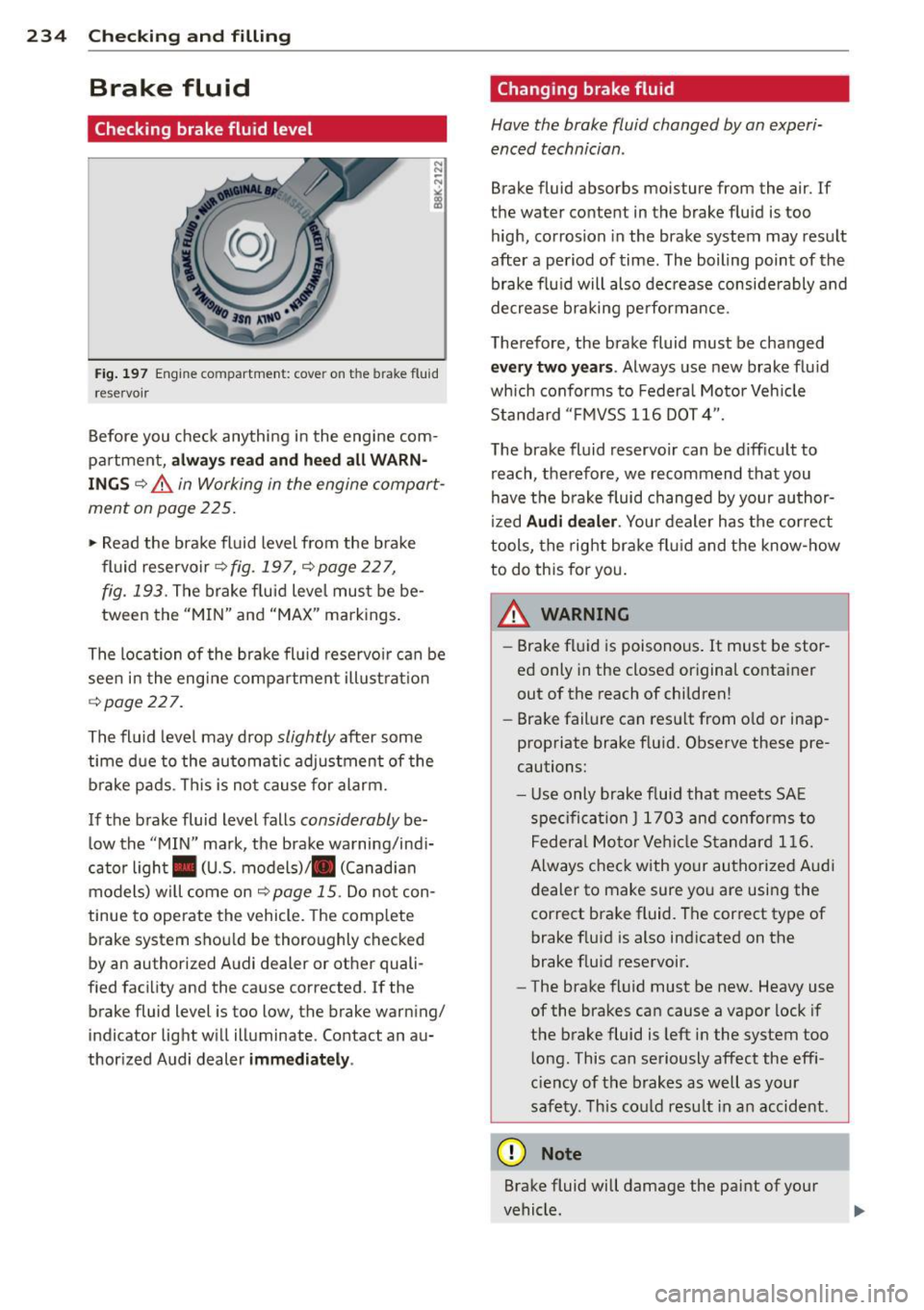
Fig . 197 Engine compartment: cove r on the brake fluid
reservo ir
Before you check anything in the engine com
partment,
always read and heed all WARN
INGS ¢&. in Working in the engine compart
ment on page 225.
,.. Read the brake fluid level from the brake
fluid reservoir¢
fig . 197, ¢ page 22 7,
fig. 193.
The brake flu id level must be be
tween the "MIN" and "MAX" markings.
The location of the brake flu id reservoir can be
seen in the engine compartment illust rat ion
¢ page 227.
The fluid level may drop
slightly after some
time due to the automatic adjustment of the
brake pads. This is not cause for alarm.
If the brake fluid level falls
considerably be
low the "MIN" mark, the brake warning/indi
cator light . (U.S. models)/ . (Canadian
models) will come on¢
page 15. Do not con
tinue to operate the vehicle. The comp lete
brake system shou ld be thoroughly checked
by an authorized A udi dealer or other quali
fied facility and the cause corrected.
If the
brake fluid level is too low, the brake warning/
indicator light will illuminate. Contact an au
thorized Audi dealer
immediately .
Changing brake fluid
Have the brake fluid changed by an experi
enced technician .
Brake fluid absorbs moisture from the air. If
the water content in the brake fluid is too high, corrosion in the brake system may result
after a period of time . The boiling point of the
brake flu id will also decrease conside rably and
decrease braking pe rformance.
Therefore, the brake fluid must be changed
every two years . Always use new brake flu id
which conforms to Federal Motor Vehicle
Standard "FMVSS 116 DOT 4".
The brake fluid reservoir can be difficult to reach, therefore, we recommend that you
have the brake fluid changed by your author
ized
Audi dealer. Your dealer has the correct
tools, the right brake fluid and the know-how
to do this for you.
A WARNING
- Brake fluid is poisonous . It must be stor
ed only in the closed original container
out of the reach of children!
- Brake failure can resu lt from o ld or inap
propriate brake fluid. Observe these pre
cautions:
- Use only brake fluid that meets SA E
specification
J 1703 and conforms to
Federal Motor Vehicle Standard 116.
Always check with your authorized Audi
dealer to make sure you are using the
correct brake fluid. The correct type of
brake f luid is also indicated on the
brake fluid reservoir.
- The brake fluid must be new. Heavy use
of the brakes can cause a vapor lock if
the brake fluid is left in the system too
long. This can seriously affect the effi
c ie ncy of the brakes as well as your
safety. This could resu lt in an accident.
(D Note
Brake fluid will damage the paint of your
vehicle .
Page 237 of 316
M N <( (.J
'SI: ,...., \!) 1.1'1 ,...., 1.1'1 ,....,
@ For the sake of the environment
Because of the pr oblem of proper d isposa l
of brake flu id as we ll as the special tools
requ ired and the necessary expert ise, we
recommend that you have the brake fluid
changed by your author ized Audi dealer .
Battery
General information
Under normal operating conditions, the bat
tery in your Audi does not need any mainte
nance. With
high outside temperatures or
long daily dr ives we recommend that you have
the electro lyte level checked by a service fa
cility . The electrolyte level shou ld also be
checked each time the battery is charged
¢ page 237.
Have the battery checked when you take your
ve hicle in for service . You are well adv ised to
replace a battery that is older than 5 yea rs .
W ith certa in types of a irbag deployment, t he
b attery is d isconnected from the vehicle elec
tr ica l system for safety reasons¢.&.
in Re
pair, core and disposal of the airbags on
page 163.
Disconnecting the battery terminals
Some vehicle functions (power w indow regu
lators , for example) are lost if the battery ter
m inals a re d isconnected. These func tions have
to be re lea rned after the batte ry term inals a re
connected agai n. T o prevent this , the bat tery
should only be d isconnec ted from the vehicle
e lec tric al system when absolu tely necessa ry
for repairs .
Vehicles not driven for long periods
If you do not drive you r vehicle over a period
of severa l days or weeks, elec trical compo
nen ts are gr adually cut b ack o r swi tched off .
This redu ces energy cons umption and main
tains starting capab ility over a longer per io d
¢ page 201. Some of the co nvenience func
tions may not operate, s uch as the inte rior
lights or power seat adjustme nt. The conven-
Checkin g and fillin g 235
ience funct ions w ill be available again when
yo u sw itch on the ign ition and start the en
gine.
Winter operation
D ur ing the w inte r mon ths, bat tery ca pa city
tends to decrease as tempera tures drop . This
is beca use more power is a lso consumed wh ile
starting, and the headlights, rear window de
fogger, etc., are used mo re often.
Avoid unnecess ary powe r consumpt ion, pa r
ticu lar ly in city traffic o r when traveling only
sho rt distances. Let yo ur authorized A udi
dealer check the capacity of the vehicle bat
tery before w inter sets in¢
page 23 7. A well
charged battery will no t on ly prevent star tin g
problems w hen the weather is cold, but w ill
also last longer .
@ Tips
If your vehicle is left standing for seve ral
weeks at extremely low temperatures, the
vehicle battery s hou ld be removed and
stored where it will not freez e. This will
p reve nt it from be ing dam aged and having
to be repl aced .
Working on the battery
Be especially careful when working on or near
the bat tery.
The battery is located in the luggage compar t
ment under the floor . B efo re you che ck any
thi ng in the luggage compartment,
read and
heed all WARNINGS
¢ .&, .
Always heed the safety warnings , when work
i ng on the veh icle batte ry or t he vehicle e lec
t rical sys tem to p reven t inju ry.
The following WARNINGS are very
important when working on the battery:
Always heed the following WARNING SYM· BO LS and safety precautions when working
on the battery .
®
Always wear eye protection.
•
•
Page 242 of 316

240 Tires and wheels
Tires and wheels
Tires
General notes
Tires may be the least appreci
ated and most abused parts of
a motor vehicle.
Tires may be the least appreci
ated and most abused parts of
a motor vehicle. Tires are, how
ever, one of the most important
parts of a vehicle, particularly
considering the comparatively
small patch of rubber on each
tire that assures that all-impor
tant contact between you, your
vehicle and the road.
Maintaining the correct tire
pressure, making sure that your
vehicle and its tires do not have
to carry more weight than they can safely handle, avoiding
damage from road hazards and
regularly inspecting tires for
damage including cuts, slashes
irregular wear and overall con
dition are the most important
things that you can do to help avoid sudden tire failure includ
ing tread separation and blow
outs.
Avoiding damage
If you have to drive over a curb
or similar obstacle, drive very
slowly and as close as possible
at a right angle to the curb.
Always keep chemicals includ
ing grease, oil, gasoline and
brake fluid off the tires.
Inspect the tires regularly for
damage (cuts, cracks or blis
ters, etc.). Remove any foreign
bodies embedded in the treads.
Storing tires
Mark tires when you remove
them to indicate the direction
of rotation. This ensures you to
be able to mount them correct
ly when you reinstall them.
When removed, the wheels or
tires should be stored in a cool,
dry and preferably dark place.
Store tires in a vertical position if they are not mounted on
rims, in a horizontal position if
they are mounted on rims.
New tires
New tires have to be broken in
¢ &.
The tread depth of new tires
may vary, according to the type .,.
Page 244 of 316

242 Tires and wheels
-If you notice unusual vibra
tion or if the vehicle pulls to
one side when driving, al
ways stop as soon as it is
safe to do so and check the
wheels and tires for dam
age.
0 Note
-Please note that summer and winter tires are de
signed for the conditions
that are typical in those sea
sons. Audi recommends us
ing winter tires during the
winter months. Low tem peratures significantly de
crease the elasticity of
summer tires, which affects
traction and braking ability. If summer tires are used
in
very cold temperatures, cracks can form on the tread
bars, resulting in perma
nent tire damage that can
cause loud driving noise and
unbalanced tires. Audi is not
responsible for this type of
damage.
-Burnished, polished or chromed rims must not be used in winter road condi
tions. The surface of the
rims does not have suffi
cient corrosion protection
for this and could be perma
nently damaged by road salt
or similar substances.
Glossary of tire and loading terminology
Accessory weight
means the combined weight (in
excess of those standard items
which may be replaced) of auto matic transmission, power
steering, power brakes, power
windows, power seats, radio, and heater, to the extent that
these items are available as fac
tory-installed equipment (whether installed or not).
Aspect ratio
means the ratio of the height to
the width of the tire in percent.
Numbers of 55 or lower indi
cate a low sidewall for im
proved steering response and
better overall handling on dry
pavement.
...
Page 246 of 316
244 Tires and whee ls
Ma ximum load r ating
means the load rating for a tire
at the maximum permissible in
flation pressure for that tire.
Maximum lo ad ed vehicle
weight
means the sum of:
(a) Curb weight
(b) Accessory weight
(c) Vehicle capacity weight, and
(d) Production options weight
Ma ximum (permissible )
inflation pressure
means the maximum cold infla
tion pressure to which a tire
may be inflated. Also called
"maximum inflation pressure."
Normal occupant weight
means 150 lbs. (68 kilograms)
times the number of occupants seated in the vehicle up to the
total seating capac ity of your
vehicle.
Occupant di stribution
means distribution of occu
pants in a vehicle .
Outer diameter
means the overall diameter of
an inflated new tire.
Overall width
means the linear distance be
tween the ex teriors of the side
walls of an inflated tire, includ
ing elevations due to labeling,
decorations, or protective bands or ribs .
Ply
means a layer of rubber -coated
parallel cords .
Production options weight
means the combined we ight of
those installed regular produc
tion options weighing over 5
lbs . (2 .3 kg) in excess of those
standard items which they re
place, no t previously consid
ered in curb weight or accessory
weight, including heavy duty
brakes, ride leve lers, roof rack,
heavy duty bat tery, and special
trim.
Radial ply tire
means a pneumatic tire in
wh ich the p ly cords that extend
to the beads are laid at sub
stantially 90 degrees to the
centerline of the tread .
Page 253 of 316
technically referred to as the
vehicle's Gross Vehicle Weight Rating ("GVWR"). The Gross
Axle Weight Rating ("GAWR") is
the maximum load that can be applied at each of the vehicle's
two axles. The Gross Vehicle
Weight Rating and the Gross
Axle Weight Rating are listed on the safety compliance stick
er label located on the driver's
side B-pillar. The tire pressure
label on your Audi lists the
maximum combined weight of
all of the occupants and lug
gage or other cargo that the ve
hicle can carry. For the location
of the tire pressure label
c> fig . 200.
A WARNING
-
Overloading a vehicle can
cause loss of vehicle control,
a crash or other accident, se rious personal injury, and
even death.
-Carrying more weight than your vehicle was designed to carry will prevent the vehicle from handling properly
and increase the risk of a
~ loss of vehicle control. <(
~ -The brakes on a vehicle that has been overloaded may
Tires and wheels 251
not be able to stop the vehi
cle within a safe distance.
- Tires on a vehicle that has
been overloaded can fail
suddenly causing loss of control and a crash.
-Always make sure that the total load being transported
- including the weight of a
trailer hitch and the tongue
weight of a loaded trailer -
does not make the vehicle
heavier than the vehicle's
Gross Vehicle Weight Rat
ing.
A WARNING
-Incorrect tire pressures
and/or underinflation can
lead to a serious or fatal ac
cident.
-Incorrect tire pressures and/or underinflation cause
increased tire wear and can
affect the handling of the
vehicle.
-Incorrect tire pressures and/or underinflation can
also lead to sudden tire fail
ure, including a blowout
and sudden deflation, caus
ing loss of vehicle control.
•
•
'
Page 259 of 316

and increase the risk of the loss of vehicle control.
-The brakes on a vehicle that
has been overloaded may
not be able to stop the vehi
cle within a safe distance.
-Tires on a vehicle that has
been overloaded can fail
suddenly, including a blow
out and sudden deflation,
causing loss of control and a
crash.
-Always make sure that the total load being transported - including the weight of a
trailer hitch and the tongue
weight of a loaded trailer - does not make the vehicle heavier than the vehicle's
Gross Vehicle Weight Rat
ing .
Determining correct load
limit
Use the example below to cal
culate the total weight of the
passengers and luggage or oth
er things that you plan to trans
port so that you can make sure
that your vehicle will not be
~ overloaded.
Steps for Determining
Correct Load Limit
1. Locate the statement "THE
COMBINED WEIGHT OF OC
CUPANTS AND CARGO
SHOULD NEVER EXCEED XXX KG OR XXX LBS" on your ve
hicle's placard (tire inflation
pressure label)
¢ page 247,
fig. 200.
2. Determine the combined
weight of the driver and passengers that will be riding in
your vehicle.
3. Subtract the combined
weight of the driver and pas
sengers from
"XXX" kilo
grams or
"XXX" pounds
shown on the sticker
¢ page 247, fig. 200.
4. The resulting figure equals the available amount of cargo and luggage load capaci
ty. For example, if the
"XXX"
amount equals 1400 lbs.
and there will be five 150 lbs. passengers in your vehi
cle, the amount of available
cargo and luggage load ca
pacity is 650 lbs. (1400-7 50
(5
X 150) = 650 lbs.)
5. Determine the combined
weight of luggage and cargo ""
•
•
'
Page 262 of 316

260 Tires and wheels
A WARNING
Sudden tire failure can lead
to loss of control, a crash and serious personal injury!
-Never drive a vehicle when the tread on any tire is worn down to the wear indica
tors.
-Worn tires are a safety haz
ard, they do not grip well on
wet roads and increase your risk of "hydroplaning" and
loss of control.
-Always keep chemicals that
can cause tire damage, such
as grease, oil, gasoline and brake fluid away from tires.
-Tires age even if they are
not being used and can fail
suddenly, especially at high
speeds. Tires that are more
than 6 years old can only be used in an emergency and
then with special care and at lower speeds.
-Never mount used tires on your vehicle if you are not sure of their "previous histo
ry." Old used tires may have
been damaged even though
the damage cannot be seen
that can lead to sudden tire
-failure and loss of vehicle control.
New tires and replacing
tires and wheels
New tires and wheels have to
be broken in.
Fig. 204 Tire specification codes on
the sidewall of a tire
No. Description
CD Passenger car tire (where
applicable)
@ Nominal width of tire in
millimeters
® Ratio of height to width
(aspect ratio)
@ Radial
® Rim diameter code
Page 267 of 316
Tires and wheels 265
sure of their "previous histo-and sudden deflation and •
ry." Old used tires may have loss of control. • '
been damaged even though -Temperature grades apply
the damage cannot be seen to tires that are properly in-
that can lead to sudden tire flated and not over or un-
failure and loss of vehicle derinflated.
control. -For technical reasons it is
-All four wheels must be fit- not always possible to use
ted with radial tires of the wheels from other vehicles -
same type , size (rolling cir-
in some cases not even
cumference) and the same wheels from the same vehi-
tread pattern. Driving with cle model.
different tires reduces vehi- -If you install wheel trim
cle handling and can lead to discs on the vehicle wheels,
a loss of control. make sure that the air flow
-If the spare tire is not the to the brakes is not blocked.
same as the tires that are Reduced airflow to the
mounted on the vehicle - for brakes can them to over-
example with winter tires - heat, increasing stopping
only use the spare tire for a distances and causing a col-
short period of time and lision.
drive with extra ca re. Refit -Run flat tires may only be
the normal road wheel as used on vehicles that were
soon as safely possible. equipped with them at the
-Never drive faster than the factory. The vehicle must
maximum speed for which have a chassis designed for
the tires on your vehicle are run flat tires. Incorrect use
rated because tires that are of run flat tires can lead to
driven faster than their rat- vehicle damage or acci-
ed speed can fail suddenly. dents. Check with an au-
M -Overloading tires cause heat thorized Audi dealer or tire N <(
build-up, sudden tire fail- specialist to see if your vehi-(.J
'SI: ,....,
ure, including a blowout cle can be equipped with ... \!) 1.1'1 ,...., 1.1'1 ,....,
Page 271 of 316
M N <( (.J
'SI: ,...., \!) ..,.,
,...., ..,., ,....,
Wheel bolts
Wheel bolts must always be tightened to the
correct torque .
The design of wheel bolts is matched to the
factory installed r ims. If differen t rims are fit
ted, the correct wheel bolts with the right l ength and correctly shaped bolt heads must
be used. This ensures that wheels are fitted
securely and that the brake system functions
correctly .
In certain circumstances, you may not use
wheel bo lts from a different vehicle -eve n if it
i s the same model
~ page 296.
_&. WARNING
Improperly tig htened or maintained whee l
bolts can become loose ca using loss of
contro l, a co llision and serious persona l in
jury.
- Always keep the wheel bolts and the threads in the wheel hubs clean so the
whee l bolts can turn easily and be prop
erly t ightened.
- Never grease or oil the wheel bo lts and
the threads in the wheel hubs. They can become loose wh ile driving if greased or
o iled, even if tightened to the specif ied
torque .
- Only use wheel bolts that belong to the
rim being installed.
- Never use different whee ls bolts on your
vehicle .
-Always maintain the correct tighten ing
torque for the wheel bo lts to reduce the
risk of a wheel loss . If the tightening tor
que of the wheel bolts is too low, they
can loosen and come out when the vehi
cl e is moving.
If the tightening torque is
too high, the whee l bolts and threads
can be damaged and the wheel can be
come loose.
Q;) Note
The spec ified torque fo r the wheel bo lts is
90 ft lb (120 Nm) w ith a toleran ce of± 7,4
ft lb(± 10 Nm). Torque wheel bo lts diago-
Tire s an d wheel s 269
nally . After changing a whee l, the torq ue
must be checked as soon as possible with a
torque wrench -preferably by an author
i zed Audi dealer or qualif ied workshop.
Low aspect ratio tires
Your Audi is factory-equ ipped w ith low aspect
ratio tires . These tires have been thoroughly
tested and been selected specifically for your model for their superb perfo rmance, road fee l
and hand ling u nder a variety of driving condi
tions . Ask your au thorized Aud i dealer for
more details .
T he low aspect ratio of these t ires is ind icated
by a numera l of
55 or l ess in the tire's si ze
designation. The n umera l represents the ra tio
of the ti re's sidewall height in relation to its
tread width expressed in percentage . Conven
tiona l tires have a height/width ratio of 60 or
more.
The perform ance o f low-a spe ct-r atio tire s is
p ar ticul arl y s ens it iv e to imp ro per infl ation
pressur e. It is t herefo re im porta nt t hat low
a spect ratio t ires are inflat ed to the specified
pr essure and that the inflation pressure is
r e gularly checked and ma int ained. Tire pr es
s ure s should be check ed at lea st on ce a
month and alwa ys befor e a long trip
~ page 252 , Checking tire pressure.
What you c an do to avoid tire and rim
damage
Low aspect ratio tires can be damaged more
easily by impact w it h potholes, curbs, gull ies
o r r idges on the road, pa rtic ularly if the tire is
u nder infla ted .
In order to minimize the occurrence of impact
damage to the tires of your vehicle, we recom
mend that you observe the following p re ca u
tions:
- Always ma inta in recommended inflation
p ressures . Check your tire pressu re eve ry
2 ,000 miles (3,000 km) and add air if neces
sary .
- Dr ive caref ully on roads wi th potholes , deep
gullies o r ridges. The impact from driv ing ..,. •
•