weight AUDI A7 2016 Owners Manual
[x] Cancel search | Manufacturer: AUDI, Model Year: 2016, Model line: A7, Model: AUDI A7 2016Pages: 294, PDF Size: 73.82 MB
Page 6 of 294
Table of contents
Front passenger s ide cockpit f use
assig nment . . . . . . . . . . . . . . . . . . . . . . . . 263
L uggage compartment fuse assignment . 263
Emergency situations . . . . . . . . . . . . 265
General . . . . . . . . . . . . . . . . . . . . . . . . . . . . 265
Starting by push ing or towing . . . . . . . . . . 265
Starting with jumper cables . . . . . . . . . . . 265
Use of jumper cab les . . . . . . . . . . . . . . . . . 266
Tow ing with a tow truck . . . . . . . . . . . . . . . 267
Ra is ing the ve hicle . . . . . . . . . . . . . . . . . . . 269
Technical Data . . . . . . . . . . . . . . . . . . . . 271
Technical data . . . . . . . . . . . . . . . . . . . . 27 1
Vehicle ident ificat io n . . . . . . . . . . . . . . . . . 27 1
Weights . . . . . . . . . . . . . . . . . . . . . . . . . . . 27 1
D imensions. . . . . . . . . . . . . . . . . . . . . . . . . 27 2
Capac ities . . . . . . . . . . . . . . . . . . . . . . . . . . 272
Gasoline engines . . . . . . . . . . . . . . . . . . . . 273
Diese l engines . . . . . . . . . . . . . . . . . . . . . . 273
Consumer information . . . . . . . . . . 274
Warranty coverages . . . . . . . . . . . . . . . . . . 274
Operating yo ur vehicle outside the U.S.A.
or Canada . . . . . . . . . . . . . . . . . . . . . . . . . . 274
Aud i Service Repair Manua ls and
Literature . . . . . . . . . . . . . . . . . . . . . . . . . . 274
Ma intenance .................. ... .. . 274
Acc esso ries and technical changes . . . . . . 276
D eclaration of Compl ian ce,
Te lecommunica tion and Electronic
Sys tems . . . . . . . . . . . . . . . . . . . . . . . . . . . 277
Index ... .. .. ............... .. .. .. . 27 8
4
Page 62 of 294
Seats and storage
-Never carry any beverage containers with
hot liquids, such as hot coffee or hot tea, in
the vehicle while it is moving. In case of an
accident, sudden braking or other vehicle movement, hot liquid could spill, causing
scalding burns . Spilled hot liquid can also
cause an accident and personal injury.
- Use only soft cups in the cupholder. Hard
cups and glasses can cause injury in an acci
dent.
- Never use the cupholder or adapter as an
ashtray- risk of fire.
(D Note
Only drink containers with lids should be car
ried in the cupholder. Liquid could spill out
and damage your vehicle's electronic equip
ment or stain the upholstery, etc.
Cooled glove compartment
A pp lies to ve hicles: w ith coole d glove compart men t
The cooled glove compartment only functions
when the AIC system is switched on.
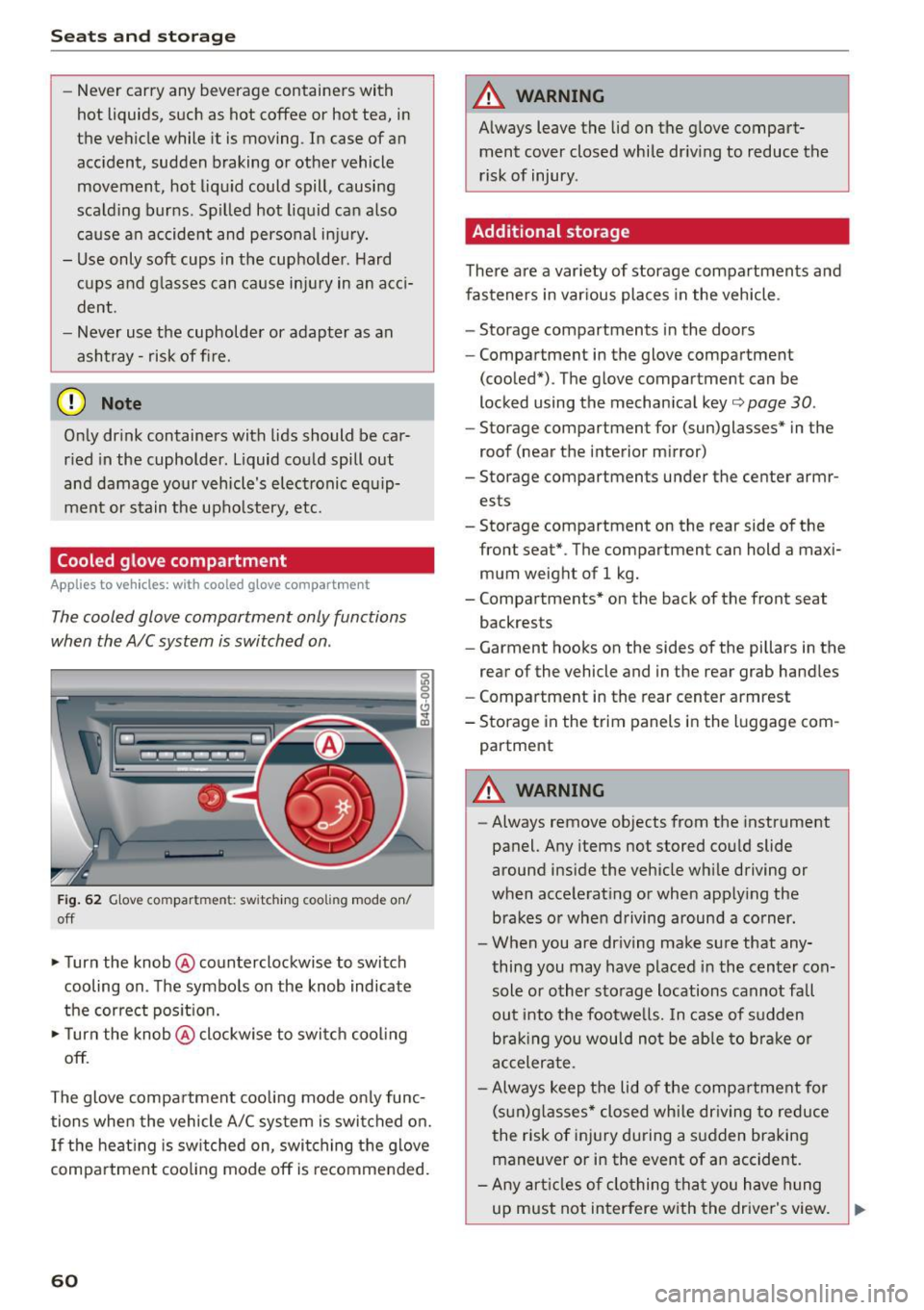
Fig. 62 Glove compartment: switching cooling mode on/
off
• Turn the knob @counterclockwise to switch
cooling on. The symbols on the knob indicate
the correct position.
• Turn the knob @clockwise to switch cooling
off.
The glove compartment cooling mode only func tions when the vehicle A/C system is switched on.
If the heating is switched on, switching the glove
compartment cooling mode off is recomme nded.
60
A WARNING
Always leave the lid on the glove compart
ment cover closed while driving to reduce the
risk of injury.
Additional storage
There are a variety of storage compartments and
fasteners in various places in the vehicle .
- Storage compartments in the doors
- Compartment in the glove compartment
(cooled*) . The glove compartment can be
locked using the mechanical key¢
page 30.
-Storage compartment for (sun)glasses* in the
roof (near the interior mirror)
- Storage compartments under the center armr
ests
- Storage compartment on the rear side of the
front
seat* . The compartment can hold a maxi
mum weight of 1 kg.
- Compartments* on the back of the front seat
backrests
- Garment hooks on the sides of the pillars in the
rear of the vehicle and in the rear grab handles
- Compartment in the rear center armrest
- Storage in the trim panels in the luggage com-
partment
A WARNING
-Always remove objects from the instrument
panel. Any items not stored could slide
around inside the vehicle while driving or
when accelerating or when applying the brakes or when driving around a corner.
- When you are driving make sure that any
thing you may have placed in the center con
sole or other storage locations cannot fall
out into the footwells. In case of sudden
braking you would not be able to brake or
accelerate .
- Always keep the lid of the compartment for
(sun)glasses* closed while driving to reduce
the risk of injury during a sudden braking
maneuver or in the event of an accident.
- Any articles of clothing that you have hung
up must not interfere with the driver's view.
~
Page 63 of 294
M N <( I.J "". rl I.O
"' N I.O rl
The coat hooks are designed only for light
weight clothing . Never hang any clothing
with hard, pointed or heavy objects in the
pockets on the coat hooks. During sudden
braking or in an accident -especially if the
airbag is deployed -these objects could in
jure any passengers inside the vehicle.
- To reduce the risk of personal injury in an ac
cident or sudden stop, always keep the
glove compartment closed while dr iv ing.
- Read and follow all WARNINGS
¢ page 163, Important safety instructions
on the side airbag system.
-Hang clothes in such a way that they do not
impair the driver's vision.
- The coat hooks must only be used for light
we ight clothing . Do not leave any heavy or
sharp edged objects in the pockets which
may in terfere with the sid e curtain airbag
deployment and can cause personal injury in
a crash .
- Do not use coat hangers for hanging cloth
ing on the coat hooks as this can interfere
with proper deployment of the side curtain
airbags in an accident.
- Do not hang heavy objects on the coat
hooks, as they could cause personal injury in
a sudden stop.
0 Note
Objects located on the rear shelf that rub
against the rear window could damage the
heating wires for the rear window defogger.
Seats and storage
Roof rack
Description and mounting locations
Additional cargo can be carried with a roof lug
gage rack.
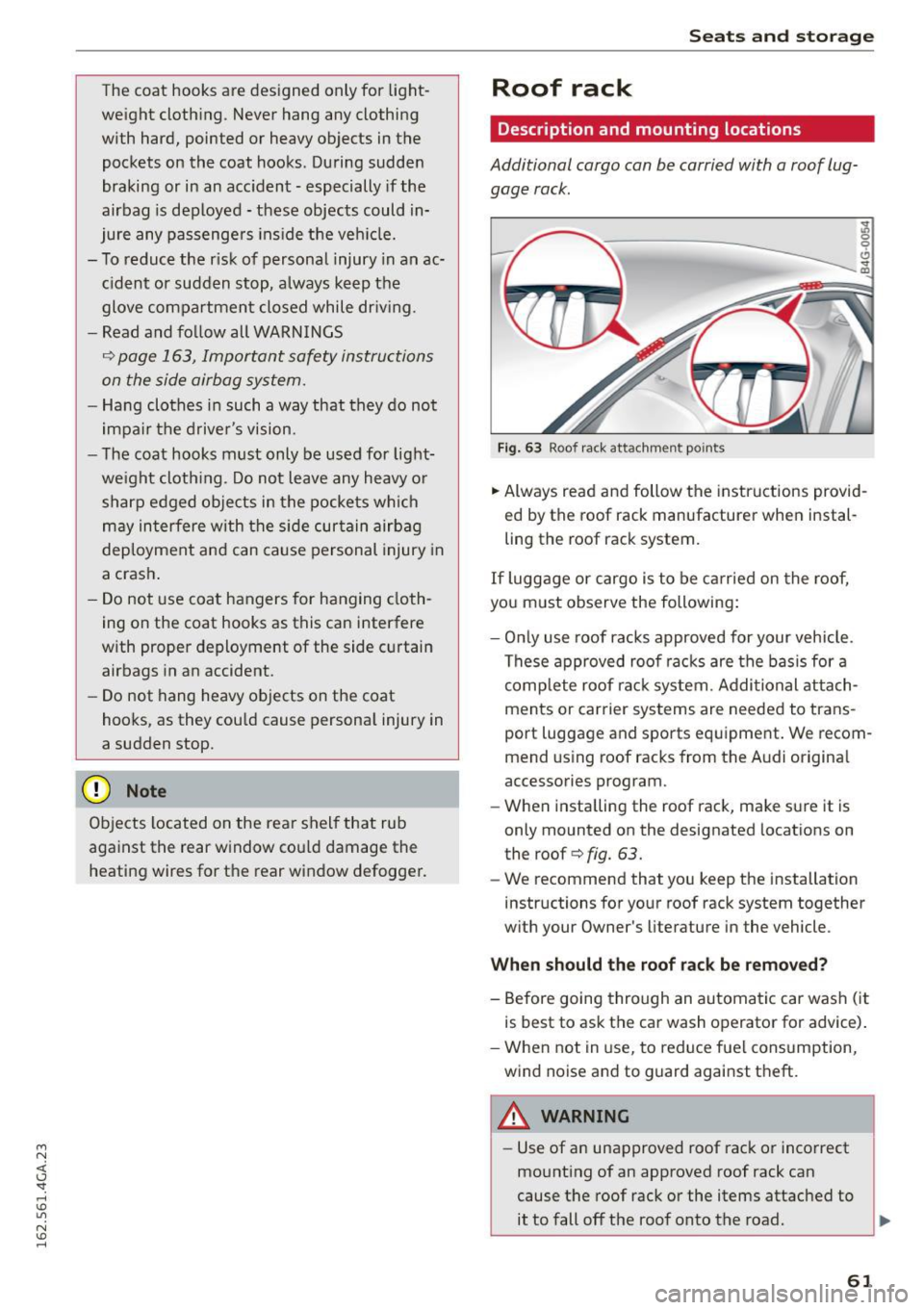
Fig. 63 Roof rack attachm en t po ints
~ 0
0 ., m
.,. Always read and follow the instructions provid
ed by the roof rack manufacturer when instal
ling the roof rack system.
If luggage or cargo is to be carried on the roof,
you must observe the following:
- Only use roof racks approved for your vehicle .
These approved roof racks are the basis for a
complete roof rack system . Additional attach
ments or carrier systems are needed to trans
port luggage and sports equipment. We recom
mend using roof racks from the Audi original
accessories program.
- When installing the roof rack, make sure it is
only mounted on the designated locations on
the roof
c> fig. 63.
- We recommend that you keep the installation
instructions for your roof rack system together
with your Owner's literature in the vehicle.
When should the roof rack be removed?
- Before going through an automatic car wash (it
is best to ask the car wash operator for adv ice).
- When not in use, to reduce fuel consumption,
wind noise and to guard against theft.
A WARNING ,...___
- Use of an unapproved roof rack or incorrect
mounting of an approved roof rack can
cause the roof rack or the items attached to
it to fall off the roof onto the road.
~
61
Page 64 of 294
Seat s and storage
- Objects falling from the roof of a vehicle can
cause a crash and personal injury.
- Only mount the roof rack on the designated
locations on the roof¢
fig. 63.
-The roof rack system must be insta lled ex
actly according to the instructions provided .
- When driving with a roof rack system, changes to the center of gravity and w ind re
sistance can change the vehicle handling
and lead to a collision. A lways adapt your
dr iving and your speed to the current cond i
t ions.
(D Note
- Your vehicle warranty does not cover any
damages to the vehicle caused by using roof
racks or mounting structures not approved
by Aud i for your vehicle . The same app lies to
damage res ulting from incorrect roof rack
i nsta llation.
-A lways check the roof rack mount ings and
hardware before each trip and dur ing a tr ip
to make su re eve rything is securely tight
ened .
If necessary, re tighten the mo untings
a nd chec k the en tire system from time to
time.
- After mounting a roof rack syste m, or when
you transport objec ts on the roof o f yo ur ve
hicle, the height of the veh icle is naturally
increased. Be caref ul when driv ing under
l ow bridges or in parking garages for exam
ple. This cou ld cause damage to the load
and even t he vehicle itself.
- Make sure the open rear lid and the sun roof* do not come into contact with the roof
rack .
Loading the roof rack
Always distribu te loads evenly. Make sure any
t hing on the roof rack is securely tied down.
~ A lways distribute the loads on the roo f rack
evenly .
~ Always attach items to the roof rack secure ly
before you drive off .
The max imum permissib le roof weight is
220 lb
( 100 kg ).
The roof weight is the total of the
62
weight o f the roof rack, the attachments and the
cargo you are carry ing . You must a lso not exceed
the maximum load weight for the roof rack yo u
a re using .
When using a roof rack system which has a lower
l oad car rying capacity, you must not use up the
total max imum permissib le load carrying capaci
ty specified above. Inste ad, you should load the
roo f rack system only to the maximum capacity
specified by the manufacturer of the roof rack
system.
A WARNING
Weak, damaged or improper straps used to
secure i tems to the roof rack can fail d uring
hard br aking o r in a collision and cause ser i
ous persona l injury.
- Ma ke su re the roof ra ck is ins talled exactly
as spe cified above
c::> page 61 .
-Always use su itable mount ing straps for se
cur ing ite ms to the roof rack to help p reven t
i t ems from shifting o r flying forwa rd .
- It ems on t he roof rac k must always be se
curely mounted .
-The use of a roof rack ca n negat ively affect
the way a vehicle handles. C argo th at i s
large, heavy, bulky, long or flat will have a
greater negative influence on the vehi cle's
aerodynamics, center of gravity and overall
handling . A lways drive slowly, avoid sudden
brak ing and maneuvers whe n transporting
cargo on the roof of your veh icle.
- Never exceed the maxim um permissible
load carrying capacity of the roof of your ve
hicle, the perm iss ible axle weig hts and the
pe rm issib le tota l we ight of your vehicle
c::>page 271, Weights.
@) For the sake of the environment
As a result of the increased wind resistance
created by a roof rack, you r vehicle is using
fuel u nnecessarily . So remove the roof rack af
ter using it.
-
Page 134 of 294
Driving safety
-Never place or install floor mats or other
floor coverings on top of already installed
floor mats. Additional floor mats and other coverings will reduce the size of the pedal
area and interfere with the pedals .
- Always properly reinstall and secure floor
mats that have been taken out for cleaning .
- Always make sure that objects cannot fall
into the driver footwell while the vehicle is
moving . Objects can become trapped under
the brake pedal and accelerator pedal caus ing a loss of veh icle control.
Storing cargo correctly
Loading the luggage compartment
All luggage and other objects must be properly
stowed and secured in the luggage compart
ment.
Loose items in the luggage compartment can
shift suddenly, changing vehicle handling charac
teristics. Loose items can also increase the risk of
serious personal injury in a sudden vehicle ma
neuver or in a collision.
.. Distribute the load evenly in the luggage com
partment.
.. Always place and properly secure heavy items in
the luggage compartment as far forward as
possible.
.. Secure luggage using the tie-downs provided
¢ page 63, Luggage compartment.
.,. Make sure that the rear seatback is securely
latched in place .
_& WARNING
Improperly stored luggage or other items can
fly through the vehicle causing serious per
sonal injury in the event of hard braking or an
accident. To help reduce the risk of serious
personal injury:
- Always put objects, for example, luggage or
other heavy items in the luggage compart
ment.
- Always secure objects in the luggage com
partment using the tie-down hooks and
suitable straps.
132
_& WARNING ~ -
Heavy loads will influence the way your vehi
cle handles. To help reduce the r isk of a loss
of control leading to serious personal injury:
- Always keep in mind when transporting
heavy objects, that a change in the center of
gravity can also cause changes in vehicle
handling:
- Always distribute the load as evenly as
possible .
- Place heavy objects as far forward in the luggage compartment as possible.
- Never exceed the Gross Axle Weight Rating
or the Gross Vehicle Weight Rating specified
on the safety compliance sticker on the left
door jamb. Exceeding permissible weight
standards can cause the vehicle to slide and
handle differently .
- Please observe information on safe driving
¢page 126.
_& WARNING
To help prevent poisonous exhaust gas from
being drawn into the vehicle, always keep the
rear lid closed wh ile driving .
- Never transport objects larger than those
fitting completely into the luggage area be
cause the rear lid cannot be fully closed .
- If you absolutely must drive with the rear lid open, observe the following notes to reduce
the risk of poisoning:
- Close all windows,
- Close the power roof*,
- Open all a ir outlets in the instrument pan-
el,
- Switch off the air rec irculat ion,
- Set the fresh air fan to the highest speed.
_& WARNING
Always make sure that the doors, all windows,
the power roof* and the rear lid are securely
closed and locked to reduce the risk of injury
when the vehicle is not be ing used.
- After closing the rear lid, always make sure
-
that it is properly closed and locked. ~
Page 135 of 294
M N <( (.J
'SI: ,...., \!) 1.1"1
N \!) ,....,
-Never leave your vehicle unattended espe
cially w ith the rear lid left open. A chi ld
could crawl into the vehicle through the lug
gage compartment and close the rear lid be
coming trapped and unable to get out . Be
ing trapped in a vehicle can lead to serious
persona l inju ry.
- Never let children play in or around the vehi
cle.
- Never let passengers r ide in the luggage
compartment . Veh icle occupants m ust al
ways be properly restrained in one of the ve
hicle's seat ing pos itions.
-Air c irculation helps to reduce window fog
ging . Stale air escapes to the outside
th rough vents in the trim pane l. Be su re to
k eep the se slots free and open.
- The t ire pressure must correspond to the
l oad. The t ire pressure is shown o n the tire
pres sure label. T he tire pressure l abe l is lo
cated on the d river 's side B-pi llar . The t ire
pressure label lists the recommended cold
tire inflation pressures for the vehicle at its max imum capacity weight and the t ires that
were on your vehicle at the time it was man
ufactured. For recommended tire pressures
for normal load cond it ions, please see chap
te r
c:> page 244.
Tie-downs
The luggage compartment is equipped with four
tie-downs to secure luggage and other items.
Use the tie-downs to secure your cargo properly
c:> page 132, Loading the luggage compartment.
I n a collision, the laws of physics mean that even
sma ller items that are loose in the vehicle wi ll
become heavy miss iles that can cause serious in
jury . Items in the vehicle possess energy which
vary with vehicle speed and the weight of the
item . Vehicle speed is the most s ignificant factor .
For example, in a frontal collis ion at a speed of
30 mph (48 km/h), the forces acting on a 10-lb
(4 .5 kg) object are about 20 times the normal
weight of the item. This means that the we ight
Dr ivin g s afet y
of the item would sudden ly be about
200 lbs. (90 kg) . You can imagine the injuries
that a 200 lbs. (90 kg) item flying freely through
the passenger compartment co uld cause in a col
li sion like this.
A WARNING
=
Weak, damaged or imprope r straps used to
secure items to tie-downs can fail during ha rd
b raking o r in a coll is ion and cause serious per
sona l injury.
- Always use su itable mount ing straps and
p roperly secu re items to the tie-downs in
the l uggage compa rtment to he lp prevent
items from sh ifting or flying forw ard as dan
ge ro us m issi les.
- W hen the rea r seat backrest is folded down,
always use s uitable mo unt ing straps and
properly secu re items to the tie -downs in
the l uggage compa rtment to he lp prevent
items from f ly ing forward as dangerous mis
siles into the passenger compartment.
- Never attach a chi ld safety seat tether strap
to a tie-down.
-
Reporting Safety Defects
Applicable to U.S.A.
If you belie ve that your vehicle
has a def ect which could cause a
c rash or could cau se injur y or
de ath, you should imm ediately in
form the National High way Traffic
S afet y Adm ini stration (NHTSA) in
a ddition to notif yin g Audi of
America, In c.
If NHT SA re ceive s similar com
pl aint s, it may open an inv estig a
tion , and if it finds that a safety
defe cts exists in a group of
ve hicles, it may ord er a recall and .,
133
Page 138 of 294
Safety belts
-Failure to pay attention to the warning light
that come on, could lead to personal injury.
Why use safety belts?
Frontal collisions and the law of physics
Frontal crashes create very strong forces for peo
ple riding in vehicles.
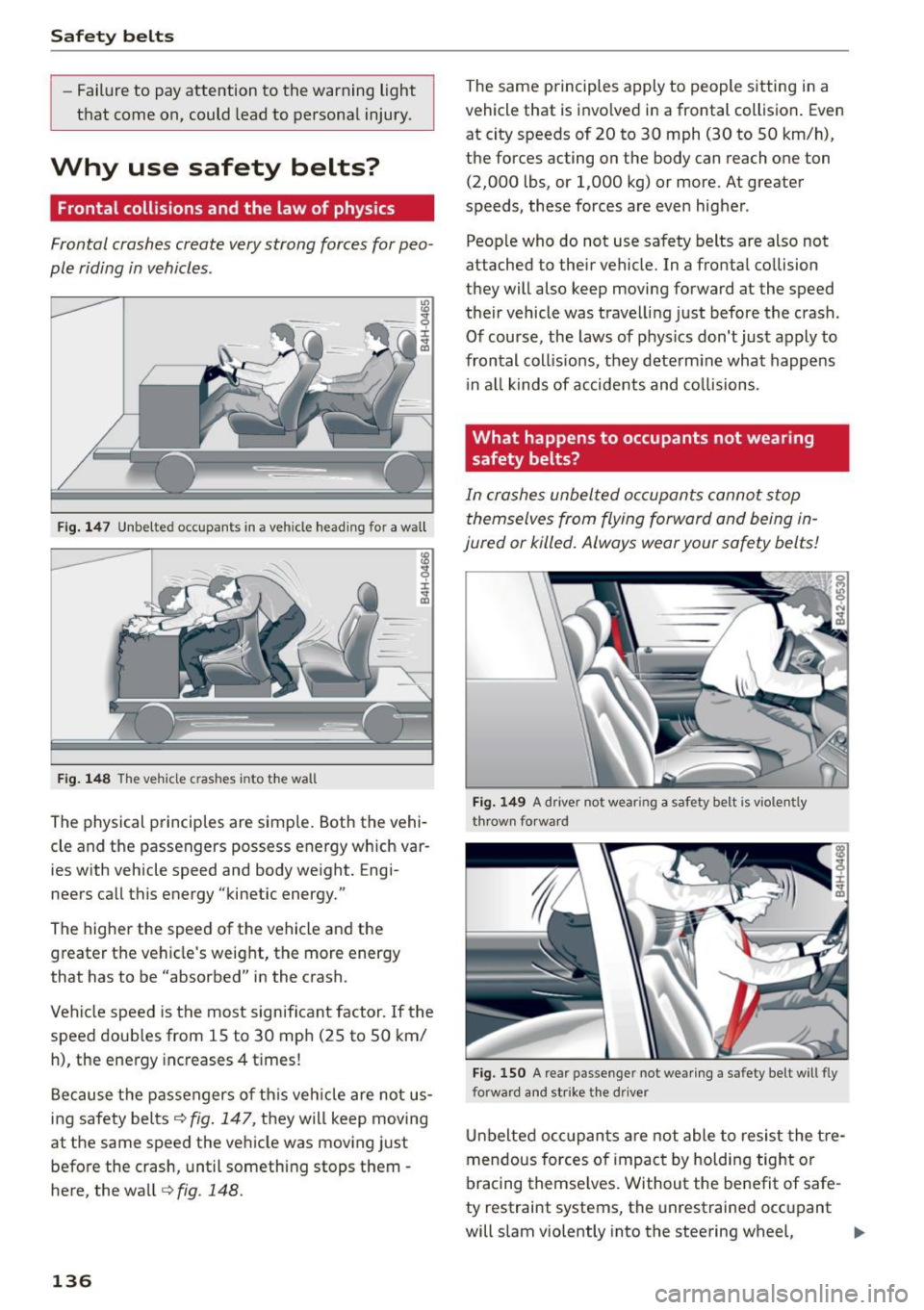
F ig. 147 Unbelted occupants in a vehicle heading for a wall
Fig . 148 The vehicle crashes into the wall
The physical principles are simple. Both the vehi
cle and the passengers possess energy which varies with vehicle speed and body weight. Engi
neers call this energy "kinetic energy."
The higher the speed of the vehicle and the
greater the vehicle's weight, the more energy
that has to be "absorbed" in the crash.
Vehicle speed is the most significant factor.
If the
speed doubles from 15 to 30 mph (25 to 50 km/
h), the energy increases 4 times!
Because the passengers of this vehicle are not us
ing safety belts¢
fig . 147, they will keep moving
at the same speed the vehicle was moving just
before the crash, until something stops them -
here, the wa ll
c> fig. 148.
136
The same principles apply to people sitting in a
vehicle that is invo lved in a frontal collision. Even
at city speeds of 20 to 30 mph (30 to 50 km/h),
the forces acting on the body can reach one ton
(2,000 lbs, or 1,000 kg) or more. At greater
speeds, these forces are even higher .
Peop le who do not use safety belts are also not
attached to their vehicle. In a fronta l co llision
they will also keep moving forward at the speed
their vehicle was travelling just before the crash.
Of course, the laws of phys ics don't just apply to
frontal coll is ions, they determine what happens
in all kinds of accidents and collisions.
What happens to occupants not wearing
safety belts?
In crashes unbelted occupants cannot stop
themselves from flying forward and being in
jured or killed. Always wear your safety belts!
Fig. 149 A driver not wearing a safety belt is violently
thrown forwar d
Fig. 150 A rear passenge r not wea ring a safety belt will fly
forward and strike the drive r
Unbelted occupa nts are not able to resist the t re
mendous forces of impact by holding tight or
bracing themselves. Without the benefit of safe
ty restraint systems, the unrestrained occupant
will slam violently into the steering wheel, .,.
Page 151 of 294
M N <( (.J
'SI: ,...., \!) 1.1'1
N \!) ,....,
and your passengers must always be properly re
strained, not just because the law requires you to
be.
The Advanced Airbag System in your vehicle has been certified to meet the "low risk" require
ments for 3 and 6 year-old children on the pas
senger side and very small adults on the driver
side. The low risk deployment criteria are intend
ed to help reduce the risk of injury through inter
action with the front airbag that can occur, for
example, by being too close to the steering wheel
and instrument panel when the airbag inflates.
In addition, the system has been certified to
comply with the "suppression" requirements of
the Safety Standard, to turn off the front airbag
for infants 12 months old and younger who are
restrained on the front passenger seat in child re
straints that are listed in the Standard
q page 169, Child restraints and Advanced front
airbag system.
"S uppression " requires the front airbag on the
passenger side to be turned off if:
- a child up to about one year of age is restrained
on the front passenger seat in one of the rear
facing or forward-facing infant restraints listed
in Federal Motor Vehicle Safety Standard 208
with which the Advanced Airbag System in your
vehicle was certified. For a listing of the child
restraints that were used to certify your vehi
cle's comp liance with the US Safety Standard
qpage 169,
- When a person is detected on the front passen
ger seat that has an electrical capacitance that
is more than the total electrical capacitance of
a child that is about 1 year old restrained in one
of the rear-facing or forward-facing infant re
stra ints (listed in Federal Motor Vehicle Safety
Standard 208 with which the Advanced Airbag
System in your vehicle was certified), the front
airbag on the passenger side may or may not
deploy.
The
PASSENGER AIR BAG OFF light comes on
when the electronic control unit detects a total
e lectr ical capacitance on the front passenger seat
that requires the front airbag to be turned off. If
the
PASSENGER AIR BAG OFF light does not
Airbag system
come on, the front airbag on the passenger side
has not been turned off by the control unit and
can deploy if the control unit senses an impact
that meets the conditions stored in its memory.
If the total electrical capacitance registered on
the front passenger seat is more than that of a
typical 1 year-old, but less than the weight of a
small adult, the front airbag on the passenger
side may deploy (the
PASSENGER AIR BAG OFF
light does not come on).
For example, the airbag may deploy if:
-a small child that is heavier than a typical 1
year-old child is on the front passenger seat (re
gardless of whether the child is in one of the
child seats listed
q page 169),
- a child who has outgrown child restraints is on
the front passenger seat.
If the front passenger airbag is turned off, the
PASSENGER AIR BAG OFF light in the center of
the instrument panel will come on and stay on.
If the front passenger airbag deploys, the Federal
Standard requires the airbag to meet the "low
risk" deployment criteria to help reduce the risk
of injury through interaction with the airbag.
"Low risk" deployment occurs in those crashes
that take place at lower decelerations as defined
in the electronic control unit
q page 154.
Always remember: Even though your vehicle is
equipped with Advanced Airbags, the safest place
for children is properly restrained on the back
seat. Please be sure to read the impor tant infor
mation in the sections that follow and be sure to
heed all of the WARNINGS .
_& WARNING
To reduce the risk of injury when an airbag in
flates, always wear safety belts properly.
- If you are unrestrained, leaning forward, sit
ting sideways or out of position in any way,
your risk of injury is much higher.
- You will also receive serious injuries and
could even be killed if you are up against the
airbag or too close to it when it inflates -
even with an Advanced Airbag
9page 143.
149
Page 159 of 294
M N <( (.J
'SI: ,...., \!) 1.1'1
N \!) ,....,
his or her back up against the backrest and the
backrest is not reclined,
- the adult is not taking weight off the seat by
holding on to the passenger assist handle
above the front passenger door or supporting
their weight on the armrest,
- the safety be lt is being properly worn and that
there is not a lot of s lack in the safety be lt web
bing,
- there are no aftermarket seat covers or cush
ions or other things (such as blankets) on the
front passenger seat that m ight cause the ca
pacit ive passenger detection system to miscal
culate electrical capac itance.
Important safety instructions on
monitoring the Advanced Airbag System
A WARNING
- If the status of the Adva need A irbag System
has changed while the vehicle is mov ing, the
PASSENGER AIR BAG OFF light blinks for
about S seconds to catch the driver's atten
t ion . If th is happens, always stop as soon as
it is safe to do so and check the steps descri
bed above.
- If the PASSENGER AIR BAG OFF light does
not go off when an adult who is not very
small is si tting on the front passenger seat
after taking the steps described above,
make sure the adult is properly seated and
restrained at one of the rear seating posi
t ions. Have the airbag system inspected by
your authorized Aud i dealer before trans
porting anyone on the front passenger seat.
A WARNING
An airbag system that is not funct ioning prop
erly cannot provide supplementa l protect ion
in a frontal crash.
- If the airbag indicator light c::;, page 18
comes when the vehicle is be ing used, have
the system inspected immed iate ly by your
au thori zed Audi dealer.
It is possible that
the a irb ag will inflate when it is not s up
posed to, or w ill not inflate when it should.
Airbag syste m
A WARNING
If the front airbag inflates, a child without a
chi ld restraint, or in a rearward-facing chi ld
safety seat, or in a forwa rd-fac ing child re
straint that has not been proper ly installed
will be ser ious ly injured and can be killed .
- Even though you r vehicle is equipped with
an Advanced A irbag System, make ce rtain
that al l children, especially 1 2 years and
younge r, al ways ride on the back seat prop
erly restra ined for their age and size.
- Always install forward o r rear-facing child
seats on the rear seat -even with an Ad
vance d Ai rbag System.
- If you must ins tall a rearwa rd-fa cing c hild
seat on the front passenger seat because of
exceptiona l circumstances and the
PASSEN
GER AIR BAG OFF
light does not appear and
stay on, immediately install the rear-facing
child seat in a rear seating position and have
the airbag system inspected by your Audi
deale r.
- If, in exceptiona l circumstances, you must
install a forwa rd-facing child restraint on
the front passenger seat , always move the
seat into i ts rearmost pos ition in the seat's
fore and a ft ad justmen t range, as fa r away
fr om the airb ag as possib le. The b ackrest
m ust be adjus ted to an upr ight position.
Make sure t hat the
PASSENGER AIR BAG
OFF
li ght comes on and stays on all the time
whenever the ignition is switched on.
A WARNING
- I f the PASSENGER AIR BAG OFF light does
not go out when an adult is s itting on the
front passenger seat after tak ing the steps
described above, make su re the adult is
p roperly seated and restrained a t one of the
rea r seat ing pos itions.
- Have the airbag system inspected by your
Aud i deale r before t ransporting anyone on
the front passenger seat.
157
Page 166 of 294
Airb ag syst em
by being pushed into you as the airbag in
flates.
- Never p lace or attach accessories or other
objects (such as cup holders, telephone brackets, or even large, bulky objects) on
the doors, over or near the area marked "AIRBAG" on the seat backrests.
- Su ch ob jects and ac cessories can become
dangerous projecti les and cause injury
when the supplemental side airbag de
p loys .
- Never carry any objects or pets in t he de
p loyment space between them and the
airbags or allow chi ldren or other passen
gers to trave l in this position .
- Always use the built-in coat hooks only for
lightweight clothing . Never leave any heavy
or sharp-edged objects in the pockets that
may interfere with side airbag deployment
and can cause personal injury in an accident .
- Always prevent the side a irbags from be ing
damaged by heavy objects knocking against
o r hitting the sides of the seatbacks .
- The airbag system can only be triggered
once . If the airbag has been triggered, the
system must be rep laced by an authorized
Audi dealership.
- Damage (c racks, deep scratches etc.) to the
o rig inal seat covers or to the seam in the
area of the side airbag module must a lways
be repaired immedia tely by an authori zed
Audi dealer .
-If children a re seated improperly, their risk
of injury i ncreases in the case of an a cciden t
~ page 167, Child safety .
-Never a ttempt to modify any com po nents of
the a irbag sys tem in any way .
- In a side collision, s ide a irbags w il l not fu nc
t ion prope rly if sensors canno t correc tly
measure increas ing air pressure inside the
doors when air escapes through larger, un
closed openings in the door panel.
- Never drive w ith inter io r doo r tr im panels
removed .
- Never drive when parts have been re
moved from the ins ide door panel and the
open ings they leave hav e not bee n prope r
ly closed.
164
- Never drive when loudspeakers in the
doors have been removed unless the
speaker ho les have bee n properly closed.
- Always make certain that openings are
covered or f illed if add itiona l speakers or
other equipment is installed i n the inside
doo r panels.
- Always have work o n the doors done by an
autho rized Aud i dea le r or q ualified work
shop .
Side curtain airbags
Description of side curtain airbags
The side curtain airbag system can provide sup
plemental protection to properly restrained oc
cupants .
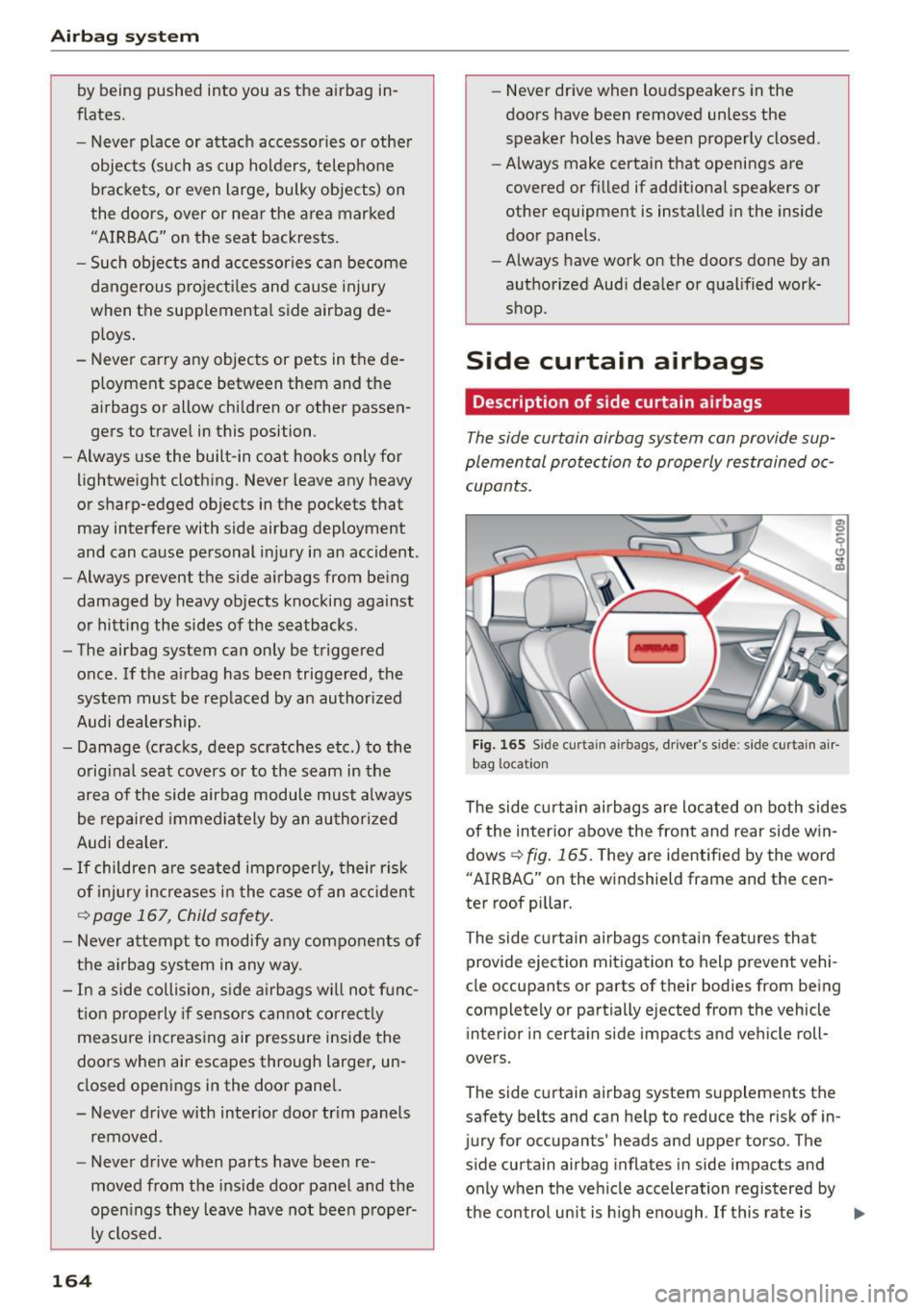
Fig. 16 5 Sid e curt ain airba gs, dr iver's s ide: side cur tain air
bag loca tion
The side curtai n airbags are located on both sides
of the inter ior above the front and rear side win
dows
~ fig. 165 . They are identif ied by the word
"AIRBAG" on the windsh ield frame and the cen
ter roof pi llar.
The side curtai n airbags contain features that
provide ejection mitigation to help prevent vehi
cle occupants or parts of their bodies from being
completely or partially ejected from the vehicle
interior in certa in side impacts and ve hicle roll
ove rs.
The side c urtain airbag system supplements the
safety belts and can he lp to reduce the risk of in
jury for occupan ts' heads and upper torso . The
side curtain airbag inflates in s ide impacts and
on ly when the ve hicle acceleration registered by
the control un it is h igh enough . If this rate is ..,.