ECO mode AUDI A7 2016 Owner's Guide
[x] Cancel search | Manufacturer: AUDI, Model Year: 2016, Model line: A7, Model: AUDI A7 2016Pages: 294, PDF Size: 73.82 MB
Page 226 of 294
Checking and F ill in g
areas, into open streams or down sewage
drains.
- Recycle used engine o il by taking it to a used
engine oil collection facility in your area, or
contact a service station.
Cooling system
Coolant
T he engine coolant performs two functions: it
keeps the engine from overheating and it pro
tects the engine from freezing in the winter .
The cooling sys tem is sealed and generally re
qu ires little attention .
T he cooling system has been filled at the facto ry
with a permanent coo lant wh ich does not need to
be changed . T he coolan t consists of a mixture of
specially condit ioned water and the manufactur
er's glycol-based coolant addit ive Gl3 ant ifreeze
with a nticorrosion add itives (50% fo r USA mod
e ls · 60% for Canadian mode ls). Thi s m ix tu re both
'
assures the ne cessary fros t protection and pro -
t ects meta l components in t he engine's cooling
system from corrosion and scaling. It a lso raises
the boiling point of the coolant.
D o not reduce the concentr ation o f the coo lant in
the summer by addi ng p la in water.
The propor
tion of coolant additive must be at least 50 %
but not more than 60 %
to maintain antifreeze
protection and cooling efficiency .
If the coolant
frost protection is too low, the coolant could
freeze and damage the ve hicle heati ng and en
g ine cooling system .
For year-round driving, antifreeze is added at the
factory for tempera tures down to:
- -3 1 °F (- 35°C)USA
- - 4 0 °F ( - 4 0 °C) Canada.
I f you must add coo lant, use a m ixt ur e of wate r
a nd coolant add it ive. Mixing the coolant additive
w ith d istilled w ate r is recommended.
_& WARNING
Before yo u check any thing in t he engine com
par tment, always read and hee d all WA RN -
224
INGS ~ &. in Working in the engine compart
ment on page 218.
(D Note
- Be fore wi nter sets in, have the coo lant
checke d to see if the coolant additive in you r
vehicle is sufficient to meet the climate con ditions. This is espec ia lly impo rtant if you
live in a region where the winter is extreme
ly cold . If necessary, increase the p roportion
of coolan t addit ive to 60% .
- Whe n adding coolant additive to your cool
ing system, remember:
- We re commend usin g on ly cool ant addi
tive Gl2++ o r Gl3 (chec k the label) fo r
your ve hicle. This coo lant additive is avai l
ab le at aut horized Aud i dea le rs . Othe r
types of ant ifreeze can significant ly re
d uce co rrosion protection. The resulting
corrosion can cause a loss of coolant a nd
serious e ngine damage .
- Do not add any type of rad iator leak sealant
to your vehicle's engine coolant. Adding ra
diator repa ir fl uid may adverse ly affec t the
func tion and perfo rmance of your cooling
system a nd could result in d amage not cov
ere d by yo ur N ew Vehi cle Lim ited War ranty.
Checking the engine coolant level
The engine coolant level can be checked with a
quick glance.
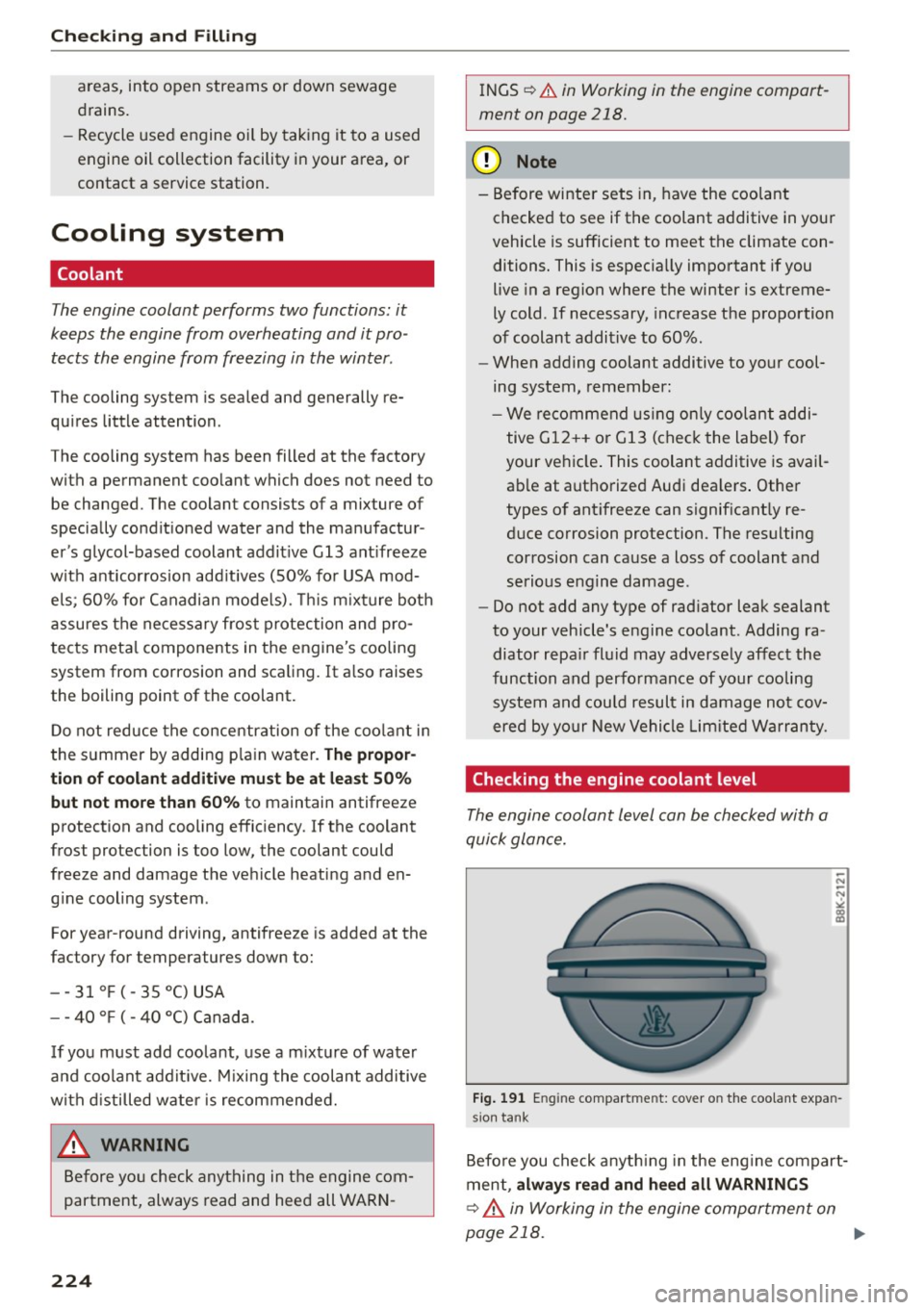
Fi g. 1 91 Eng ine co mpar tmen t: c over on t he coo la nt expa n
sio n tan k
Befo re you check a nyth ing in the eng ine compart
men t,
always read and he ed all WARNINGS
~ A in Working in the engine compartmen t on
page 218. ..,.
Page 229 of 294
M N <( I.J "". rl I.O
"' N I.O rl
Brake fluid
Checking brake fluid level
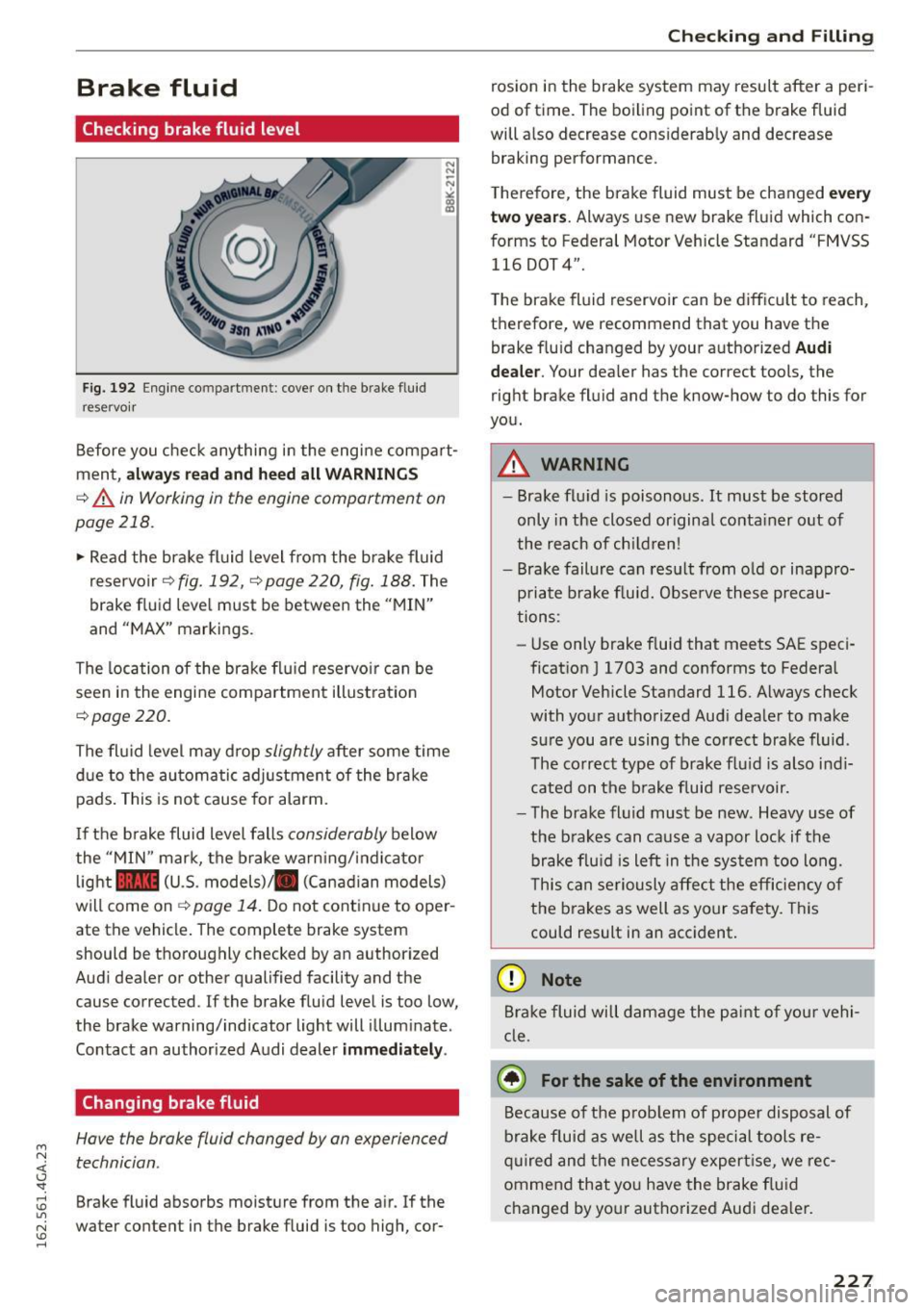
Fig. 192 Engine compa rtment : cove r on the brake f luid
reservoir
N
N
-N ,::
~
Before you check anything in the engine compart
ment,
always read and heed all WARNINGS
¢ A in Working in the engine comportment on
page 218.
.,. Read the brake fluid level from the brake fluid
reservoir
¢ fig. 192, ¢page 220, fig. 188. The
brake fluid leve l must be between the "MIN"
and "MAX" markings .
The location of the brake f luid reservo ir can be
seen in the engine compartment illustration
¢page 220.
The fl uid level may drop slightly after some time
due to the automatic adjustment of the brake
pads. This is not cause for alarm.
I f the brake fluid level falls
considerably below
the "MIN" mark, the brake warning/indicator
light
1111 (U .S. models)/ . (Canadian models)
will come on ¢
page 14. Do not cont inue to oper
ate the vehicle . The complete brake system
should be thoroughly checked by an authorized
Audi dealer or other qualified facility and the cause corrected. If the brake fluid level is too low,
the brake warning/indicator light will illuminate.
Contact an authorized Audi dealer
immediately .
Changing brake fluid
Hove the broke fluid changed by on experienced
technician .
Brake fluid absorbs moisture from the air. If the
water content in the brake fluid is too high, cor-
Checking and Filling
rosion in the brake system may result after a peri
od of time. The boiling point of the brake fluid
will also decrease considerably and decrease braking performance .
T herefore, the brake fluid must be changed
every
two years.
Always use new brake fluid which con
forms to Federal Motor Vehicle Standard "FMVSS
116 DOT 4".
The brake fluid reservoir can be difficult to reach,
therefore, we recommend that you have the brake flu id changed by your authorized
Audi
dealer .
Your dea ler has the correct tools, the
right brake fluid and the know-how to do this for
you .
_&. WARNING
-.
- Brake fluid is poisonous . It must be stored
only in the closed original conta iner out of
the reach of children!
- Brake failure can resu lt from o ld or inappro
p riate brake fluid. Observe these precau
tions:
- Use only brake fluid that meets SAE speci
fication
J 1703 and conforms to Federa l
Motor Vehicle Standard 116. Always check
with your authorized Audi dealer to make
sure you are using the correct brake fluid .
The correct type of brake flu id is also ind i
cated on the brake fluid reservoir.
- The brake fluid must be new. Heavy use of
the brakes can cause a vapor lock if the
brake fluid is left in the system too long.
T his can seriously affect the efficiency of
the brakes as well as your safety. This
could result in an accident.
(D Note
Brake fluid will damage the paint of your vehi
cle.
@ For the sake of the environment
Because of the problem of prope r disposal of
brake fluid as well as the special tools re
quired and the necessary expertise, we rec
ommend that you have the brake flu id
changed by your authorized Audi dealer.
227
Page 242 of 294
Wheels
Occupant loading and distri
bution for veh icle normal load
for various designated seat ing
capacit ies
Refer to the tire inflation pressure
label
c:> page 243, fig . 198 for
the number of seating positions .
Refer to the table
c:> table on
page 245
for the number of peo
ple that correspond to the vehicle
normal load .
New tires or wheels
Audi recommends having all wo rk
on tires or wheels performed by
an authorized Audi dea ler or au
thorized repair fac ility. These fa
cilities have the proper knowledge
and are equipped with the re
quired tools and replacement
parts.
.,. New tires do not yet have the
optimum adhesion properties. Drive carefully and at moderate
speeds fo r the first 350 miles
(500 km) with new tires .
.,. Use tires of t he same constr uc
tion, size (rolling c ircumference)
and as close to the same tread pattern as possible on all four
wheels.
2 4 0
.,.Do not replace tires individ ually .
At least re place both t ires on the
same axle at the same time.
.,. A udi recommends that you use
Aud i O riginal equipment tires . If
you wo uld li ke to use different
tires, please note that the tires may perform d ifferently even if
they are the same s ize
c:> &. -
.,. If you would like to equip you r
vehic le with a tire/rim combina
tion that is different from what
was installed at the facto ry, con
sult w ith an authorized Aud i
dealer or authorized repair facili
ty be fore making a purchase
¢ .&_ .
The spare tire* is d ifferent from
the regular t ires installed on the
vehicle -for example, if winter
tires or wi de tires are installed -
then only use the spare tire* tem
porar ily in case of emergency and
drive carefully while it is in use . It
s h o u ld be replaced w ith a regular
tire as soon as poss ib le.
On
all wheel drive ve hic les, all
four wheels must be equipped
w ith tires that are the same brand
and have the same construction
and tread pattern so that the
drive system is not damaged by
Page 251 of 294

M N <( (.J
'SI: ,...., \!) 1.1'1
N \!) ,....,
~ Check and correct the seating of the snow
chains if necessary after driving a few feet. Fol
low the instructions from the manufacturer.
~ Note the maximum permitted speed when driv
ing with snow chains. Do not exceed 30 mph
(SO km/h) .
Snow chains not only improve the driving in win
ter road conditions, but also the braking.
Use of snow chains is only permitted with certain
rim/tire combinations due to technical reasons.
Check with an authorized Audi dealer or author
i z ed repair facility to see if you may use snow
chains .
You must remove the chains when driving on roads that are free of snow. When roads are free
of snow, snow chains can impair handling and
damage the tires, and the chains will quickly be
destroyed.
A WARNING
Using incorrect snow chains or installing snow
chains incorrectly can result in loss of vehicle
control, which increases the risk of an acci
dent.
- Snow chains can damage the rims/wheel
covers* if the chains come into direct con
tact with them. Remove the wheel covers*
first. Use coated snow chains.
- Using snow chains that add more than 0 .4
inch (10.5 mm) of height can severely dam
age the wheel housings and other vehicle
components.
- Do not install and use snow chains if there is
a malfunction in the adaptive air suspen
sion*, because the vehicle height will be
very low. If you drive with snow chains any
way, the wheel housings and other vehicle
components can be severely damaged.
Low aspect ratio tires
Your Audi is factory-equipped with low aspect ra
tio tires . These tires have been thoroughly tested
and been selected specifically for your model for
Wheels
their superb performance, road feel and handling
under a variety of driving conditions. Ask your au
thorized Audi dealer for more details.
The low aspect ratio of these tires is indicated by
a numeral of
55 or less in the tire's size designa
tion. The numeral represents the ratio of the
tire's sidewall height in relation to its tread width
expressed in percentage. Conventional tires have
a heigh t/width ratio of 60 or more.
The performance of low-aspect-ratio tires is par
ticularly sensitive to improper inflation pres
sure. It is therefore important that low aspect
ratio tires are inflated to the specified pressure
and that the inflation pressure is regularly
checked and maintained. Tire pressures should be checked at least once a month and always
before a long trip
~ page 2 43.
What you can do to avoid tire and rim
damage
Low aspect ratio tires can be damaged more easi
ly by impact with potholes, curbs , gullies or
ridges on the road, particularly if the tire is un
deri nflated.
In order to minimize the occurrence of impact
damage to the tires of your vehicle, we recom
mend that you observe the following precau
tions:
- Always maintain recommended inflation pres
sures. Check your tire pressure every 2,000
miles (3 ,000 km) and add air if necessary.
- Drive carefully on roads with potholes , deep
gullies or ridges. The impact from driving
through or over such obstacles can damage
your tires. Impact with a curb may also cause
damage to your tires.
- After any impact, immediately inspect your
tires or have them inspected by the nearest au
thorized Audi dealer. Replace a damaged tire as
soon as possible.
- Inspect your tires every 2,000 miles (3,000 km)
for damage and wear. Damage is not always
easy to see . Damage can lead to loss of air and
underinflation, which could eventu ally cause
tire failure . If you believe that a tire may have
been damaged, replace the tire as soon as pos -
sible . .,.
249
Page 256 of 294
Emerg enc y ass is tance
- Never use the jack supplied with your Audi
on another vehicle, particularly on a heavier
one. The jack is only suitable for use on the
vehicle it came w ith.
(D Tips
- Some of the on board items listed above are
provided on certain models only or are op
tiona l extras .
- Before you can raise your vehicle using the
jack, you must act ivate the jacking mode
c:> page257.
Space-saving spare tire {compact spare
tire)
The spare tire/wheel is located in the luggage
compartment under the cargo floor cover. It is
intended for short-term use only.
Taking out the sp are ti re
.,. Fo ld the floor to the seatback with the help of
the handle .
.,. Turn the large sc rew
c:> page 253, fig. 201 coun
te r-clockwise .
.,. Take out the spare tire .
.,. Always store the vehicle too l kit, the jack* and
the replaced tire in the luggage compartment
c:> page 132.
Using the spare tire (compact spare tir e)
The compact spare tire is only intended for emer
gen cies until you can reach a repair shop. Rep lace
it as qu ickly as possible with a standard wheel
and tire .
There are some rest rictions on the use of the
compact spare t ire. The compact spare t ire has
been designed specifically for yo ur type of vehi
cle.
It must not be swapped w ith a compact
spare tire from another type of vehicle.
Snow chains
F or technical reasons, the use of snow chains on
the compact spa re tire is
not permitted .
If you do have to drive w ith snow chains and a
front tire fails, mount the spare whee l w ith tire
instead of a rear t ire. Install the snow chains on
254
the rear t ire and use it to replace the defect ive
front tire.
A WARNING
- Never use the spare t ire if it is damaged or if
it is worn down to the tread wear indicators.
- If the spare tire is more than 6 years old,
use it only in an emergency and with ex
treme caution and careful driv ing.
- The spare tire is intended only for tempora
ry and short-term use.
It should be replaced
as soon as poss ible with the normal wheel
and tire .
- After mount ing the compact spare t ire, the
tire pressure must be checked as soon as
possible . The tire pressure of the compact
spare tire must be 4 .2 bar; otherwise, you
r is k havi ng an accident.
- Do not dr ive faster than SO mph (80 km/h) .
You risk hav ing an accident .
-Avoid full -thrott le acceleration, heavy brak
ing, and fast cornering . You risk hav ing an
accident .
- Never d rive us ing more than one spare
w heel and ti re . You r isk having an accident .
- Normal summer or w inter t ires must not be
mou nted on the compact spare wheel rim.
- For technical reasons , the use of tire chains
on the spa re tire is not permitted .
If it is
necessary to dr ive with tire chains, the spa re
w heel must be mounted on the front a xle in
t he event of a fla t in a re ar tire. The newly
avail able front whee l m ust th en be insta lled
in place of the rear wheel with the flat tire.
Insta lling the tire c hain before mounting
the whee l and tire is recommended.
- Loose items in the passenger compartment can cause se rious personal injury d uring
hard b raking o r in an accident. Never store
the inflatable spare t ire or jack and tools in
the passenge r compartment.
Page 257 of 294
M N <( (.J
'SI: ,...., \!) 1.1'1
N \!) ,....,
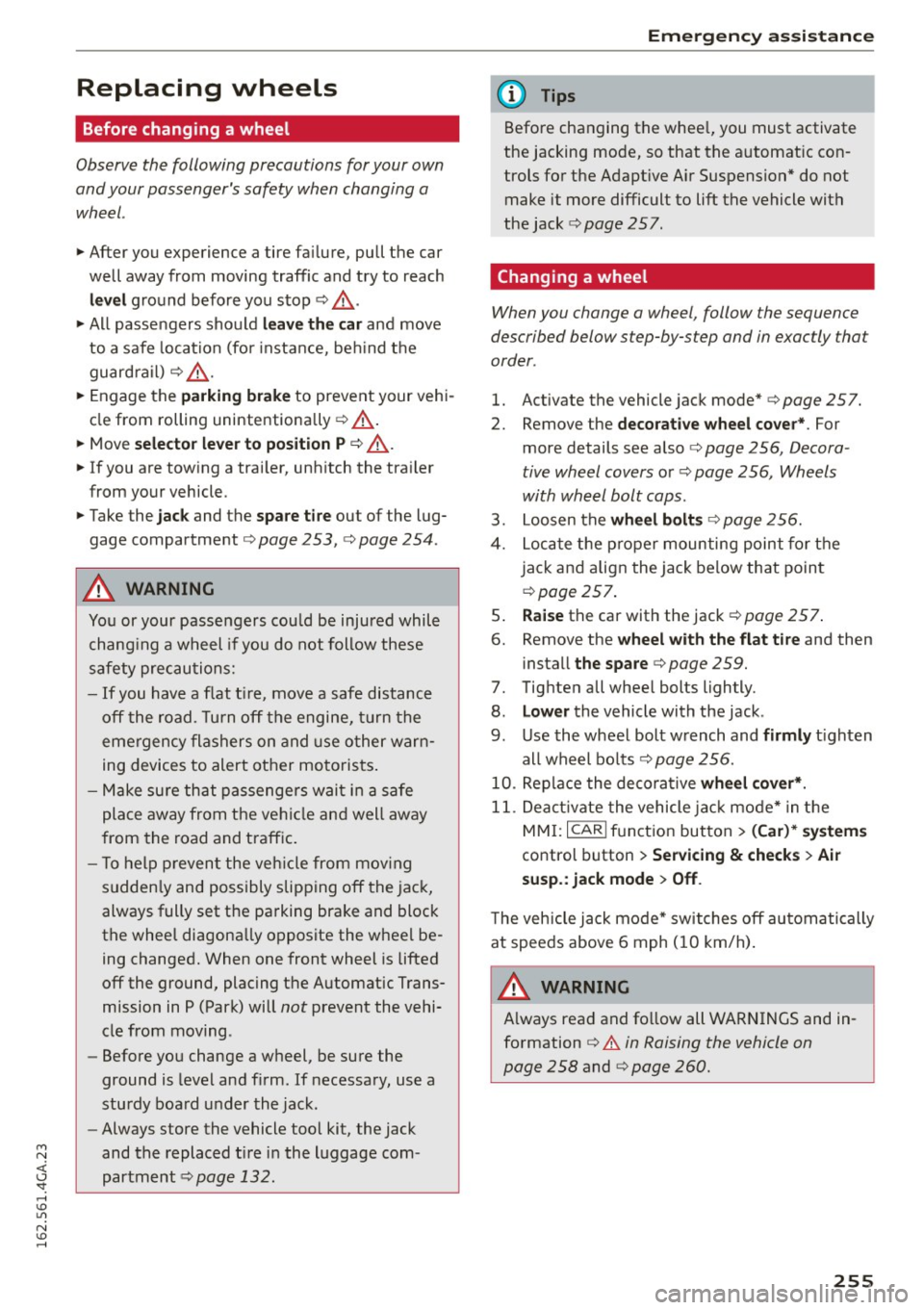
Replacing wheels
Before changing a wheel
Observe the following precautions for your own
and your passenger's safety when changing a
wheel .
.,. After you experience a tire failure, pull the car
well away from moving traffic and try to reach
level ground before you stop¢,& .
.. All passengers should
leave the car and move
to a safe location (for instance, beh ind the
guardrail) ¢ ,& .
.,. Engage the
parking brake to prevent your vehi
cle from rolling unintentiona lly ¢,& .
.. Move
selector lever to position P ¢ ,& .
1> lfyou are towing a trai ler, unhitch the trailer
from your vehicle .
.,. Take the
jack and the spare tire out of the lug
gage compartment
¢ page 253, ¢ page 254.
.,&. WARNING
You or your passengers could be injured while
changing a wheel if you do not follow these
safety precautions:
- If you have a flat tir e, move a safe distance
off the road. T urn off the engine, turn the
emergency flashers on and use other warn
ing devices to alert other mo torists.
- Make sure that passengers wait in a safe
place away from the vehicle and well away
from the road and traffic.
- T o help prevent the vehicle from moving
sudden ly and possibly slipping off the jack,
always fully set the parking brake and block
the wheel diagonally opposite the wheel be ing changed. When one front wheel is lifted
off the ground, placing the Automatic Trans
mission in P (Park) will
not prevent the vehi
cle from moving.
- Before you change a wheel, be sure the
ground is level and firm . If necessary, use a
stu rdy board under the jack.
- Always store the vehicle tool kit, the jack
and the replaced tir e in the luggage com
partment ¢
page 132.
Emergency assistance
{!) Tips
Before changing the whee l, you must activate
the jacking mode, so that the automat ic con
trols for the Adapt ive Air Suspension* do not
make it more difficult to lift the vehicle with
the jack ¢
page 257 .
Changing a wheel
When you change a wheel , follow the sequence
described below step-by-s tep and in exactly tha t
order .
l. Activate the vehicle jack mode* ¢ page 2 5 7.
2. Remove the
decorative wheel cover*. For
more details see also¢
page 256, Decora
tive wheel covers
or¢ page 256, Wheels
with wheel bolt caps .
3. Loosen the wheel bolts ¢page 256.
4. Locate the pro per mounting point for the
jack and align the jack be low that point
¢page 257.
5. Raise the car with the jack¢ page 257 .
6. Remove the wheel with the flat tire and then
install
the spare ¢ page 259.
7. Tighten all wheel bolts ligh tly.
8.
Lower the vehicle with the jack .
9. Use the wheel bolt w rench and
firmly tighten
all wheel bolts¢
page 256 .
10. Replace the decorative wheel cover*.
11. Deactivate the vehicle jack mode* in the
MMI :
ICAR I funct ion button > (C ar)* systems
control button > Servicing & checks > Air
susp.: jack mode > Off .
The vehicle jack mode* switches off automatically
at speeds above 6 mph (10 km/h) .
.,&. WARNING ~ -
Always read and follow all WARNINGS and in
formation ¢
.& in Raising the vehicle on
page 258
and ¢ page 260.
255
Page 268 of 294
Emergency situation s
When jump sta rting or charging the battery,
never connect the negative ground cable to
the batte ry negat ive post because the battery
manager system must be able to detect the
battery's state of c harge. Always connect the
negat ive grou nd cab le to the negative ground
post of the batte ry manager control unit .
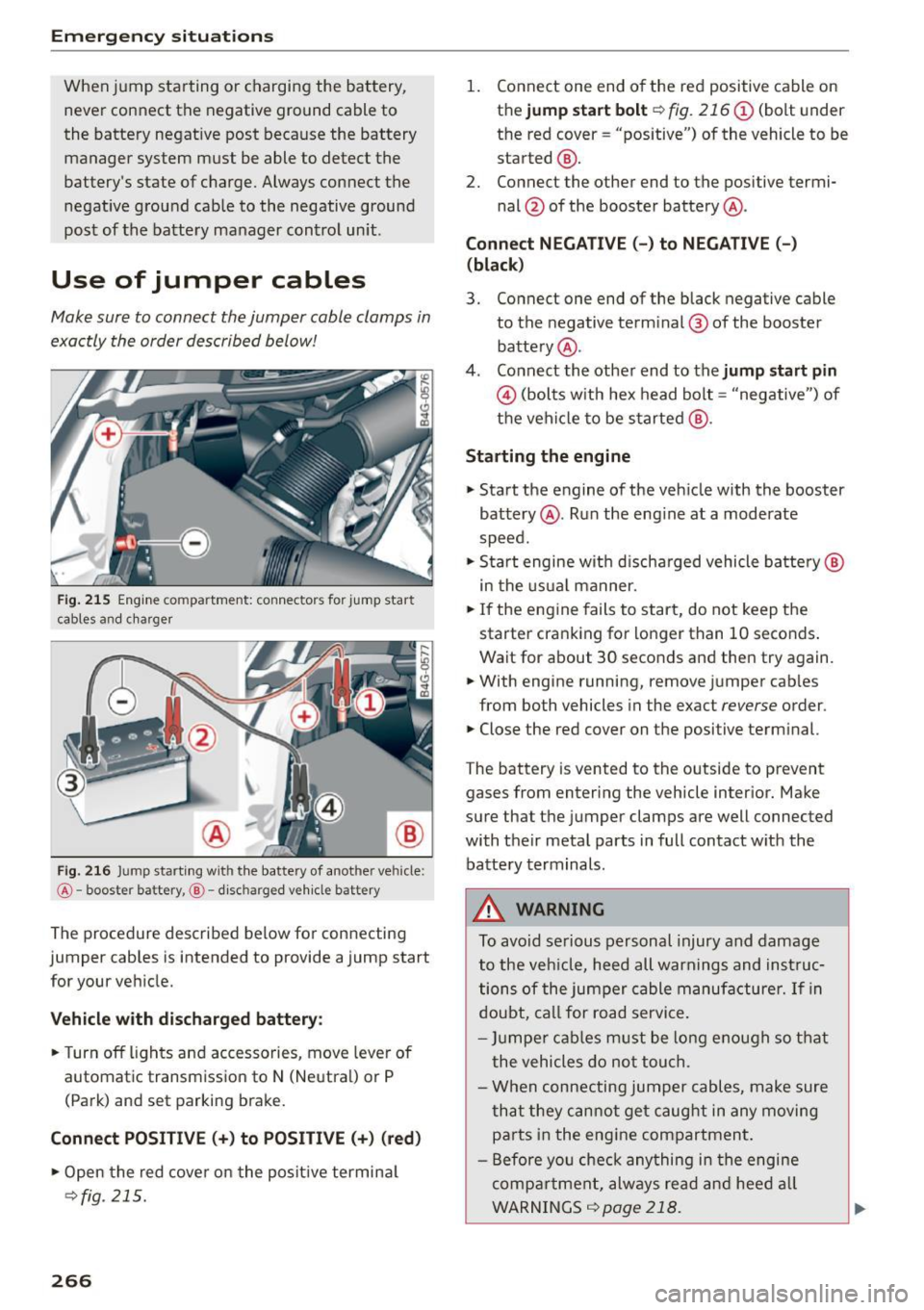
Use of jumper cables
Make sure to connect the jumper cable clamps in
ex actly the order described below!
F ig . 215 Eng ine co m pa rt m ent: con nec tors for ju mp star t
cab les a nd cha rge r
® .--l @
Fig . 2 16 Jum p start ing w it h t he bat te ry of a not her ve hicl e:
@-boos te r ba ttery , @ -disc harg ed v eh icle batt ery
The procedure described be low for con necting
jumper cables is intended to p rovide a jump start
for your ve hicle.
Vehicle with discharged battery: •T urnoff lig ht s and accesso ries , move lever of
automat ic transmiss ion to N (Ne utra l) or P
(Park) and set parking brake.
Connect POSITIVE(+) to POSITIVE(+) (red)
• Open the red cove r o n t he po sit ive termin al
~fig . 2 15.
266
1. Connect one end o f the red positive ca ble on
the
jump start bolt ~ fig. 216 /J) (bolt under
the red cover = "positive") of the vehicle to be
started @.
2. Connect the other end to the positive termi-
nal@ of the booster battery @.
Connect NEGATIVE (-) to NEGATIVE (-)
(black )
3. Co nnect one end of the black negative cable
to the negative term inal ® of the booste r
batte ry @ .
4 . Connect th e other end to the
jump start pin
@ (bolts w it h hex head bolt = "negative") of
the veh icle to be s tarte d@ .
Starting the engine • Sta rt the engine of the veh icle with the booster
bat tery @. Run the eng ine at a moderate
speed.
• Sta rt engine w it h discha rged vehicle ba ttery @
i n t he usual man ner.
• If the engine fails to start, do not keep the
starter cra nking for lo nger than 10 seco nds .
Wait for about 30 seconds and then try again .
• With engine running , remove jumper cab les
from both vehicles in the exact
reverse order .
• Close the red cover on the positive term inal.
The batt ery is vented to the o utside to prevent
gases from enter ing the vehicle inter ior. Make
su re that t he jumper clamps are well connected
with their metal parts in full contact w ith the
batte ry terminals.
&_ WARNING
To avoid se rious personal injury and damage
to the veh icle, heed all war nings and inst ruc
tion s of the jumper cable m anufa cture r.
If in
d oubt, cal l for ro ad service.
- Ju mpe r cabl es must be lo ng enoug h so tha t
t he vehicles do no t tou ch.
- When conne cting jumper cables, make sure
th at they c an not get c aug ht in any moving
p art s in the engine com partmen t.
- B efore you check any thing in the e ngine
comp artment, alw ays re ad an d hee d all
WAR NINGS
~ page 218.
Page 282 of 294
Index
Checking
Engin e coolant leve l. . . . . . . . . . . . . . . . . .
224
Ch ild restra ints
D anger of using ch ild restra ints in the front
seat... .. .. .. .... ... .. .. .... .. .. .. .
144
Where can I get additional information
about child restraints and their use? . . . .
184
Ch ild restra int system anchors . . . . . . . . . . 180
Ch ild safety . . . . . . . . . . . . . . . . . . . . . . . . . . 167
Important sa fety ins truc tions for us ing ch ild
safety seats . . . . . . . . . . . . . . . . . . . . . . . .
170
Important things to know when dr iv ing with
chi ldren . . . . . . . . . . . . . . . . . . . . . . . . . . .
167
Tethe r anchors . . . . . . . . . . . . . . . . . . . . . . 183
Tether st raps . . . . . . . . . . . . . . . . . . . . . . . 183
Ch ild safety lock
Rear doors, windows in the rear . . . . . . . . .
39
Ch ild safety seats
Booster seats . . . . . . . . . . . . . . . . . . . . . . .
176
Convertible c hild seats . . . . . . . . . . . . . . . 174
Convertible locking retractor . . . . . . . . . . . 179
H ow do I p roperly install a ch ild safety seat
. h' l 7 170 in myve 1c e .... ... ..... ... .. .. .. .. .
I nfant sea ts . . . . . . . . . . . . . . . . . . . . . . . .
173
Insta lling a child res traint using the LA T CH
system . . . . . . . . . . . . . . . . . . . . . . . . . . . .
18 2
LA T CH system . . . . . . . . . . . . . . . . . . . . . . . 182
Lower anchorages . . . . . . . . . . . . . . . . . . . 181
Mounting and re leasing the anchorage
hook . . . . . . . . . . . . . . . . . . . . . . . . . . . . . .
182
Safety instructions . . . . . . . . . . . . . . . . . . . 170
Unused safety belts on the rear seat . . . . 172
Chil d seats . . . . . . . . . . . . . . . . . . . . . . . . . . 173
Secur ing . . . . . . . . . . . . . . . . . . . . . . . . . . . 177
Ciga re tte lig hte r . . . . . . . . . . . . . . . . . . . . . . . 58
Clea ning . . . . . . . . . . . . . . . . . . . . . . . . . . . . 205
Clea ning/removing ice from windows . . . . . 207
C lea ning Alcanta ra . . . . . . . . . . . . . . . . . . . . 208
Clean ing artificia l leather. . . . . . . . . . . . . . . 208
C lean ing carbon parts . . . . . . . . . . . . . 207, 20 8
Cleaning controls . . . . . . . . . . . . . . . . . . . . . 207
Clean ing deco rative parts and trim . . . 206, 207
C lea ning displays . . . . . . . . . . . . . . . . . . . . . 207
Clean ing exhaust ta il pipes . . . . . . . . . . . . . 206
Clea ning plastic parts . . . . . . . . . . . . . . . . . . 207
Clea ning rims . . . . . . . . . . . . . . . . . . . . . . . . 206
Clean ing texti les . . . . . . . . . . . . . . . . . . . . . . 208
280
Climate control system . . . . . . . . . . . . . . . . . 68
Closing
Su nroof. . . . . . . . . . . . . . . . . . . . . . . . . . . . .
40
Windows . .. .... .. .. .. ........... .. . 39
Coming home . . . . . . . . . . . . . . . . . . . . . . . . . 45
Compact spare tire . . . . . . . . . . . . . . . . . . . . 254
Compartments . . . . . . . . . . . . . . . . . . . . . . . . 59
Compliance . . . . . . . . . . . . . . . . . . . . . . . . . .
277
Consumer info rmation . . . . . . . . . . . . . . . . . 2 74
Consumer Information . . . . . . . . . . . . . . . . . 133
Co nsumption (fuel) . . . . . . . . . . . . . . . . . . . . 24
Contacting NHTSA . . . . . . . . . . . . . . . . . . . . 133
Convenience key . . . . . . . . . . . . . . . . . . . . . . . 34
Starting the engine (START ENGINE S TOP
button) . . . . . . . . . . . . . . . . . . . . . . . . . . . . . 75
Stopping the eng ine (START ENG INE S TOP
bu tton) . . . . . . . . . . . . . . . . . . . . . . . . . . . . .
76
Swi tc hi ng the ignit ion on . . . . . . . . . . . . . . 75
U nlocking and locking vehi cle . . . . . . . . . . .
34
Convenience opening . . . . . . . . . . . . . . . . . . . 40
Convertib le child safety seats . . . . . . . . . . . 1 74
Conve rtib le locki ng retractor
Activati ng . . . . . . . . . . . . . . . . . . . . . . . . . .
179
Dea ct ivatin g . . . . . . . . . . . . . . . . . . . . . . . . 180
U sing to secure a child safety seat . . . . . . 179
Coolant
refer to Eng ine coolan t . . . . . . . . . . . . . . . 224
Cooling mode (four- zone automatic climate
control) . . . . . . . . . . . . . . . . . . . . . . . . . . . . . .
71
Cooling mode (three-zone climate control) . 69
Cross ing wa ter . . . . . . . . . . . . . . . . . . . . . . . 196
Cruise contro l
Switc hing off . . . . . . . . . . . . . . . . . . . . . . . .
84
Warning/indicator lights . . . . . . . . . . . . . . . 22
Cruise contro l system
Changi ng speed . . . . . . . . . . . . . . . . . . . . . .
83
Preselect ing speed . . . . . . . . . . . . . . . . . . . . 84
switching on . . . . . . . . . . . . . . . . . . . . . . . . . 83
(upholder . . . . . . . . . . . . . . . . . . . . . . . . . . . . 59
Cu rve light . . . . . . . . . . . . . . . . . . . . . . . . . . .
101
Cylinder management
refer to Cylinder on demand System . . . . . 24
Cylinder on demand System . . . . . . . . . . . . .
24
D
Data recorde r . . . . . . . . . . . . . . . . . . . . . . . . 18 7
Page 283 of 294

Date display . . . . . . . . . . . . . . . . . . . . . . . . . . 26
Daytime running lights . . . . . . . . . . . . . . . . . . 43
Declaration of compliance Adaptive cruise control .... .. .. .. .. .. .
277
A d' .d . u I s1 e assist . .. .... .... . .... .. .. . 277
Cell phone package ........ ... ... ... . 277
Convenience key ............. .. .... . . 277
Electronic immobilize r ..... .. .. .. .. .. . 277
Garage door opener (HomeLink) . .. .. .. . 277
Remote control key . . . . . . . . . . . . . . . . . . 277
Defective light bulb warning
Indicator light . . . . . . . . . . . . . . . . . . . . . . .
21
Defrosting (windows)
Four- zone automatic climate control . . . . .
72
Three-zone climate control . . . . . . . . . . . . . 69
DEF (instrument cluster) . . . . . . . . . . . . . . . . 26
Determining correct load limit . . . . . . . . . .
247
Diesel
Indicator light . . . . . . . . . . . . . . . . . . . . . . .
20
Prewarming . . . . . . . . . . . . . . . . . . . . . . . . . 75
Diesel fuel... .. .............. ... .... .
211
Diesel particulate filter . . . . . . . . . . . . . . . . 198
Dimensions . . . . . . . . . . . . . . . . . . . . . . . . . . 272
Dimming the rearview mirror . . . . . . . . . . . . 48
Distance . . . . . . . . . . . . . . . . . . . . . . . . . . . . . 24
Door/rear lid warning
23
Doors Ch ild safety lock . . . . . . . . . . . . . . . . . . . . . . 39
Driver information system . . . . . . . . . . . . . . . 23
CD/radio display . . . . . . . . . . . . . . . . . . . . . . 23
Door/rear lid warning . . . . . . . . . . . . . . . . . 23
Efficiency program . . . . . . . . . . . . . . . . . . . . 25
Exterior temperature display . . . . . . . . . . . 23
On-board computer . . . . . . . . . . . . . . . . . . .
24
Service interval disp lay . . . . . . . . . . . . . . . . 26
Driver seating position . . . . . . . . . . . . . . . . .
127
drive select
adaptive air suspension/spor t . . . . . . . . . .
101
Adaptive dampers . . . . . . . . . . . . . . . . . . . 101
Curve light . . . . . . . . . . . . . . . . . . . . . . . . . 101
Engine sound . . . . . . . . . . . . . . . . . . . . . . . 101
Safety belt tensioner . . . . . . . . . . . . . . . . . 101
Sport different ial . . . . . . . . . . . . . . . . . . . . 101
M N Drive select . . . . . . . . . . . . . . . . . . . . . . . . . . 101 <(
~ Driving economically . . . . . . . . . . . . . . . . . . 198 ,....,
~ Driving safely . . . . . . . . . . . . . . . . . . . . . . . . 126
~ Driving through water . . . . . . . . . . . . . . . . . 196
Index
Driving time
Duplicate key . . . . . . . . . . . . . . . . . . . . . . . . . . 24
30
Dust filter
refer to Pollutant filter . . . . . . . . . . . . . . . . 68
Dynamic steering
Indicator light
E
192
Easy seat entry . . . . . . . . . . . . . . . . . . . . . . . . 75
Economy tips (efficiency program) . . . . . . . . 25
Efficiency program . . . . . . . . . . . . . . . . . . . . . 25
Electromechanical parking brake
Operation . . . . . . . . . . . . . . . . . . . . . . . . . . .
78
Releasing and closing . . . . . . . . . . . . . . . . . 78
Warning/indicator lights . . . . . . . . . . . . . . . 15
Electromechanical steering . . . . . . . . . . . . . 192
Indicator light . . . . . . . . . . . . . . . . . . . . . . 192
Electronic differential lock
Indicator light . . . . . . . . . . . . . . . . . . . . . . .
18
Electronic Differential Lock . . . . . . . . . . . . . 188
Electronic differential lock (EDL)
Warning/ind icator lights . . . . . . . . . . . . . . .
19
Electronic immobilizer . . . . . . . . . . . . . . . . . . 31
Electronic power control (EPC)
warning/indicator light . . . . . . . . . . . . . . . .
20
Electronic speed limiter . . . . . . . . . . . . . . . . . 29
Electronic stabilization control
Indicator light . . . . . . . . . . . . . . . . . . . . . . .
18
Electronic Stabilization Control . . . . . . . . . . 188
Sport mode . . . . . . . . . . . . . . . . . . . . . . . . 189
Emergency actuation
Doors . . . . . . . . . . . . . . . . . . . . . . . . . . . . . . 36
Emergency flasher . . . . . . . . . . . . . . . . . . . . . 46
Warning/indicator lights . . . . . . . . . . . . . . . 22
Emergency operation Emergency braking function (parking brake) .7.9
Fuel filler door . . . . . . . . . . . . . . . . . . . . . .
214
Luggage compartment lid . . . . . . . . . . . . . . 38
Selector lever . . . . . . . . . . . . . . . . . . . . . . .
113
Sunroof . . . . . . . . . . . . . . . . . . . . . . . . . . . . . 41
Emergency starting . . . . . . . . . . . . . . . . . . . 265
Energy management . . . . . . . . . . . . . . . . . .
194
Engine
Compartment . . . . . . . . . . . . . . . . . . . . . . .
220
Coolant . . . . . . . . . . . . . . . . . . . . . . . . . . . . 224
Prewarming . . . . . . . . . . . . . . . . . . . . . . . . . 75
281
Page 284 of 294
Index
Starting . . . . . . . . . . . . . . . . . . . . . . . . . . . . 75
Starting with jumper cab les . . . . . . . . . . . 265
Stopping . . . . . . . . . . . . . . . . . . . . . . . . . . . . 76
Engine compartment . . . . . . . . . . . . . . . . . . 220
Closing the hood . . . . . . . . . . . . . . . . . . . . 219
Opening the hood . . . . . . . . . . . . . . . . . . . 218
Safety instructions . . . . . . . . . . . . . . . . . . . 218
Working in the engine compartment . . . . 218 Event Data Recorder (EDR)
. . . . . . . . . . . . . . 187
Expansion tank . . . . . . . . . . . . . . . . . . . . . . . 224
Exterior lighting . . . . . . . . . . . . . . . . . . . . . . . 43
Exterior mirrors
Adjusting . . . . . . . . . . . . . . . . . . . . . . . . . . . 47
Dimming ..... ..... .. ................ 48
Heating...... ..... .. ................ 47
Exterior temperature display . . . . . . . . . . . . . 23
Engine coolant . . . . . . . . . . . . . . . . . . . . . . . 224
Adding coolant . . . . . . . . . . . . . . . . . . . . . . 225
F
Checking the engine coolant leve l. . . . . . . 224
Expansion tank . . . . . . . . . . . . . . . . . . . . . . 224
Malfunction symbol . . . . . . . . . . . . . . . . . . . 15
Radiator fan . . . . . . . . . . . . . . . . . . . . . . . . 226
Temperature gauge . . . . . . . . . . . . . . . . . . . 10
Engine oil . . . . . . . . . . . . . . . . . . . . . . . . . . . 220
Adding . ..... .. ................ .... 222
Additives . . . . . . . . . . . . . . . . . . . . . . . . . . . 222
Changing . . . . . . . . . . . . . . . . . . . . . . . . . . 223
Checking oil level . . . . . . . . . . . . . . . . . . . . 222
Consumpt ion . . . . . . . . . . . . . . . . . . . . . . . 222
Indicator light . . . . . . . . . . . . . . . . . . . . . . . 17
O il consumption. .............. ... .. . 221
Pressure malfunct ion . . . . . . . . . . . . . . . . . . 16
Sensor defective . . . . . . . . . . . . . . . . . . . . . . 21
Specification and viscos ity . . . . . . . . . . . . . 220
Engine sound . . . . . . . . . . . . . . . . . . . . . . . . 101
Engine speed limitation (indicator light) 21
E ngine Start-Stop mode
refer to Start-Stop-System . . . . . . . . . . . . . 82
Engine warm -up request
Indicator light . . . . . . . . . . . . . . . . . . . . . . . 2 1
Environment Catalytic converter . . . . . . . . . . . . . . . . . . . 197
Diesel particulate filter . . . . . . . . . . . . . . . 198
Disposing of your vehicle battery . . . . . . . 231
Driving at high speeds . . . . . . . . . . . . . . . . 198
Fuel ...... ... .. ... ............. ... . 212
L eaks under your veh icle . . . . . . . . . . . . . . 218
L ett ing the veh icle stand and warm up . . . 199
Proper disposal of drained brake fluid . . . 227
Proper disposal of drained engine coo lant 225
Proper disposal of drained engine oil 222, 223
Recycling used engine oil. . . . . . . . . . . . . . 222
Unleaded fuel .................. .. ... 210
What should I do with an old battery? . . . 231
ESC Automatic post-collision braking system 189
282
Fastening
Booster seats . . . . . . . . . . . . . . . . . . . . . . . 176
Convertib le child safety seats . . . . . . . . . . 17 4
Infant seats . . . . . . . . . . . . . . . . . . . . . . . . 173
Floor mats ...... ... ... ........ ...... . 131
Foot pedals .......................... 131
For the sake of the environment Environmentally-friendly driving . . . . . . . 198
Gasoline fumes and the env ironment . . . . 212
Reducing engine noise by early upshifting . 10
Refueling . . . . . . . . . . . . . . . . . . . . . . . . . . 212
Saving fuel by early upshifting . . . . . . . . . . 10
Warming up the engine . . . . . . . . . . . . . . . . 75
Four-zone automatic climate control Air vents . . . . . . . . . . . . . . . . . . . . . . . . . . . . 72
Auxiliary heater . . . . . . . . . . . . . . . . . . . . . . 73
Basic settings . . . . . . . . . . . . . . . . . . . . . . . . 73
Operating . . . . . . . . . . . . . . . . . . . . . . . . . . . 71
Recirculation mode . . . . . . . . . . . . . . . . . . . 73
Residual heat . . . . . . . . . . . . . . . . . . . . . . . . 72
Synchronizing . . . . . . . . . . . . . . . . . . . . . . . . 72
Front airbags Description . . . . . . . . . . . . . . . . . . . . . . . . . 147
How they work . . . . . . . . . . . . . . . . . . . . . . 152
Frontal collisions and the laws of physics . . 136
Front seats . . . . . . . . . . . . . . . . . . . . . . . . . . . 53
Adjusting . . . . . . . . . . . . . . . . . . . . . . . . . . 128
Child restraints in the front seat . . . . . . . . 144
Fuel Additives .. .. .. . . . . . . . . . . . . . . . . . . . . . 210
Blended gasoline . . . . . . . . . . . . . . . . . . . . 210
Current consumption . . . . . . . . . . . . . . . . . . 24
Fuel filler neck . . . . . . . . . . . . . . . . . . . . . . 212
Fuel gauge . . . . . . . . . . . . . . . . . . . . . . . 10 , 11
Gasoline . . . . . . . . . . . . . . . . . . . . . . . . . . . 210
Gasoline additives . . . . . . . . . . . . . . . . . . . 211
Indicator light . . . . . . . . . . . . . . . . . . . . . . . 21