brake AUDI A7 2016 Service Manual
[x] Cancel search | Manufacturer: AUDI, Model Year: 2016, Model line: A7, Model: AUDI A7 2016Pages: 294, PDF Size: 73.82 MB
Page 191 of 294
M N <( I.J ""'. rl I.O
"' N I.O rl
will switch on again automatically when
conditions have returned to normal.
Steering recommendation
The ESC helps to stabilize the vehicle by changing
the steering torque.
In vehicles with dynam ic steering*, ESC also
he lps to stabilize the steering in critical situa
tions.
Selective wheel to rque control
Selective wheel torque control is used when driv
ing on curves . The front wheel on the inside of
the curve or both wheels on the i nside of the
curv e are braked selectively as needed . This al
lows more precise dr iving in curves.
Automatic post-collision braking system
The "Automatic post-collision braking system"
can help to reduce the risk of sliding and of other
collis ions after an accident. If the airbag control
module detects a coll is ion above a ce rtain veh icle
speed, the vehicle is braked by the ESC.
The vehicle does not brake automatically if:
- the driver presses the acce lerator pedal, or
- the braking force generated by the pressed
brake pedal is greater than the braking force
that would be initiated by the system, or
- the ESC, the brake system or the vehicle electri
ca l system are not functioning.
Switching on/off
Intelligent Technology
A WARNING ,-
-The ESC and its integrated systems cannot
overcome the limits posed by natural phys i
cal laws. This is especially important on slip
pe ry or wet roads. If the systems begin act
ing to stabilize your vehicle, you should im
mediately alter your speed to match the
road and traffic conditions. Do not let the in
creased safety provided tempt you into tak
ing risks. This could increase your risk of a
collis ion.
- Please note the r isk of a collision increases
when driving fast, especially thro ugh curves
and on slippery or wet roads, and when driv
ing too close to objects ahead. The ESC and its integrated systems cannot always pre
vent collisions· there is still a risk of acc i
dents!
- Press the accelerator pedal carefully when
accelerating on even, slippery surfaces such
as ice and snow. The drive wheels can spin
even when these control systems are instal
led and this can affect driving stability and
i n crease the r isk of a coll ision .
(j) Tips
-ABS and ASR only function correctly when
all four wheels are equipped with identical
tires. Different tire s izes can lead to a reduc
tion in engine power .
- You may hear noises when the systems de
scribed are working.
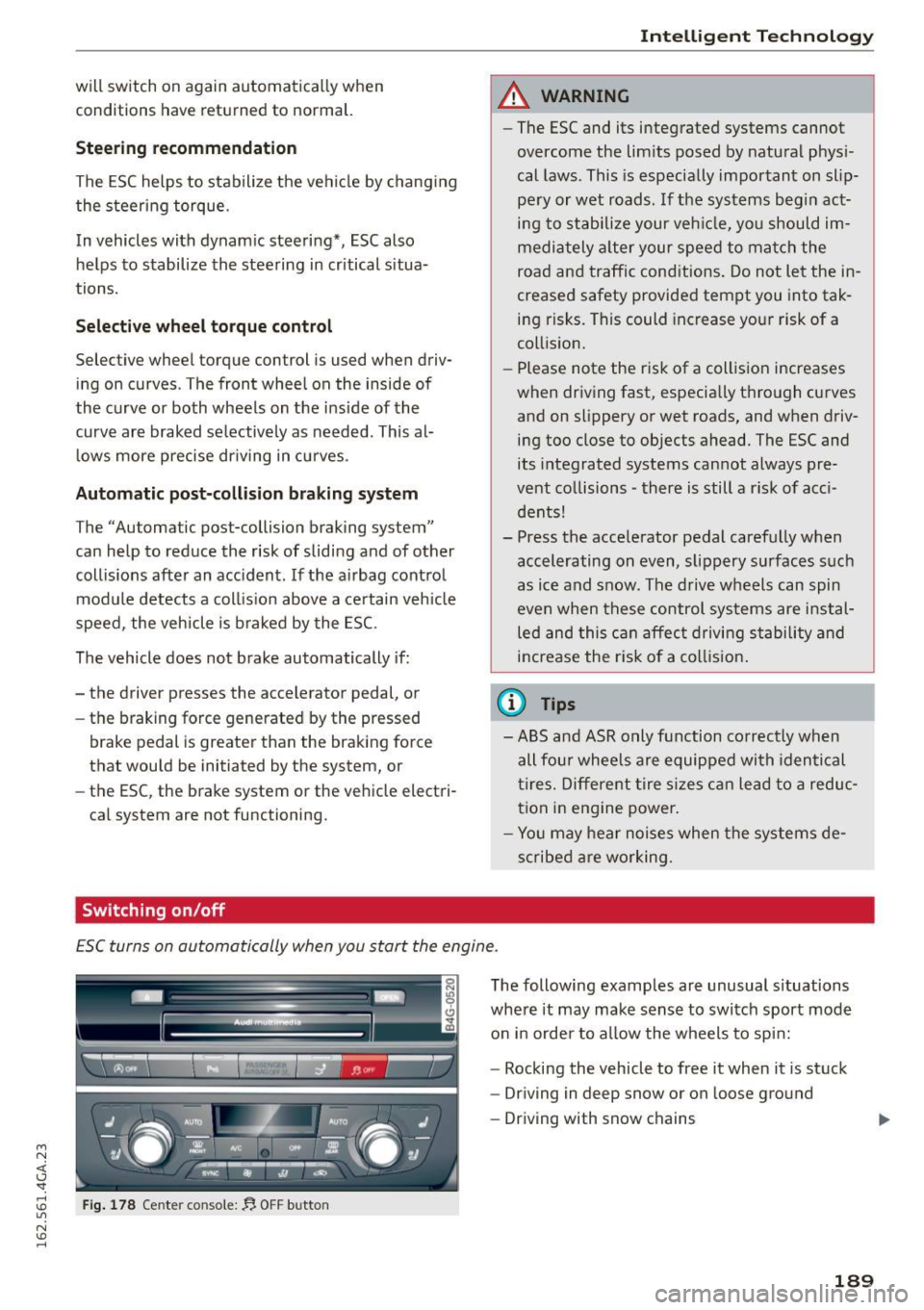
ESC turns on automatically when you start the engine .
Fig. 178 Center console: !J, OFF butto n
The following examples are unusual situations
where it may make sense to switch sport mode
on in orde r to allow the wheels to sp in:
- Rocking the vehicle to free it when it is stuck
- Driving in deep snow or on loose ground
- Driving with snow chains
189
Page 192 of 294
Intelligent Technology
ESC lev els
Sport mode on Sport mode off
Beha vior
The ESC and ASR stabilization f unctions are The full stabilization function of t he ESC
limited
c> ,& . and ASR is avai lab le again .
Operation Press the 1.$ OFF I button. Press the 1.$ OFF I button agai n.
In dicato r II turns on. II turns off.
light s
Driv er m es- S ta bi liz at ion contr ol (ESC ): sport. Warn -Stabiliz ati on c ontr ol (ESC ): on
s age s ing! Res tricted stabilit y
A WARNING
Only switch sport mode on when yo ur driving
abilities and the traffic situation permit, be
cause there is a risk of sliding.
- The stabilization function is limited when
sport mode is switched on. The dr iv ing
wheels could spin and the vehicle could
swerve, especially on slick or slippery road
s u rfaces .
(D Tips
-Sport mode cannot be switched on if the
cruise control system* or adaptive cruise
control* is switched on.
- If the rear spoiler system malfunctions,
sport mode may not switch on or it may
switch off again automat ically.
Braking
What affects braking efficiency?
New brake pads
During the f irst 250 miles (400 km), new brake
pads do not possess the ir full braking effect, they
have to be "broken in" first
c> ,& . You can com
pensate for this sl ightly reduced brak ing power
by pushing ha rder on the brake pedal. Avoid
heavy brak ing loads dur ing the b reak-in per iod.
Operat ing condit ions and d riving hab its
The brakes on today's automobi les are st ill sub
ject to wear, depending largely on operating con
d itions and dr iving habits
c> ,& . On veh icles that
are either driven mostly in stop-and-go c ity t raf
fic or are dr iven hard, the b rake pads should be
checked by your author ized Audi dea ler mo re of -
190
ten than specified in the Warrant y & Mainte
nan ce b ookl et.
F ail ure to have your brake pads
inspected can resu lt in reduced brake perform
ance.
On steep slopes, you sho uld use the braking ef
f ect of the engine. This way, you prevent unnec
essary wear on the brake system. If yo u must use
you r brakes, do not hold the brakes down contin
u ously. Pump the brakes at intervals .
Operating noise
Noises may occur when braking depend ing on the
speed, braking force and ou tside cond itions su ch
as temperature and hum idity .
Effect of wat er and road salt
In certa in situations, for examp le after driv ing
t hr ough water, in heavy rain, after overnight con
densa tion or after washing yo ur ca r, the bra king
effect can be reduced by moisture or ice on the
brake rotors and brake pads . The brakes must be
dried fi rst with a few careful brake applications .
At higher speeds and with the winds hield wipers
turned on, the brake pads press against the brake rotors for a short amount of time . This occurs at
r egular intervals without the driver noticing and
provides for better brake response time under
wet cond itions .
The effect iveness of the brakes can be reduced
when the vehicle is d riven on a salt-covered road
and the brakes are not used. Likewise, you clean
off accumulated salt coating from brake discs
and pads wi th a few caut ious applications of the
brake
c> ,& . IJI>
Page 193 of 294
M N <( (.J
'SI: ,...., \!) 1.1'1
N \!) ,....,
Corro sion
There may be a tendency fo r dirt to bui ld up on
the brake pads and corrosion to fo rm on the discs
if the car is not driven regularly or only for short
trips with little use of the brakes.
If the b rakes are not used frequently, or if corro
sion has formed on the discs, it is advisab le to
clean
off the pads and discs by braking firmly a
few times from a moderately high speed
c=> .&, .
Faults in the brake sy stem
If you should not ice a sudden increase in brake
pedal travel, then one of the two brake circuits
may have fai led
c=> .&, .
Low brake flu id level
Malfunct ions can occur in the brake system if the
brake fluid level is too low. The brake flu id leve l is
monitored e lectronically.
Br ake boo ste r
The brake booster works w ith vacuum pressure
which is created only when the engine is running
~ ,& .
Brake lining wear sta tu s
Brake lining wear may be checked by visual in
spection of the condition of the brake pads
through the openings in the wheel. If necessary,
the wheel may be removed for this inspection
c=> page 2 55, Replacing wheels.
.8, WARNING -
- New brake pads don't have the best stop
ping power and must be "broken-in" during
the initial 250 mi les ( 400 km) . You can com
pensate for this by pressing the brake peda l
more firmly. This a lso applies later when
new pads are installed.
- You should perform braking maneuvers for
the purpose of clean ing the brake system
only if road conditions perm it. Other road
users must not be put at risk -you may
cause an accident!
- Before descending a steep grade, reduce
speed and shift transmiss ion into a lower
gear or lower driving range. Do not ride the
In te llig ent T echnolog y
brakes or hold the peda l down too long o r
too often. This could cause the brakes to get
hot and dimin ish braking effic iency.
- Do not "ride the brakes" by rest ing your foot
on the pedal when you do not intend to
brake. This may cause the brakes to over
heat, premature wear and increased stop
ping distance .
- Under certain cl imatic and operat ing condi
tions such as passing through water , dr iv ing
in heavy rain or afte r washing the veh icle,
the effect iveness of the brakes can be re
duced. In winter, ice c an accumulate on the
b rake pads, lin ings, discs and drums. Care
fu lly apply brakes for a test . Brakes will dry
and ice coatings will be cleaned
off after a
few ca reful brake app lications.
- Driving for an extended period of t ime on
salt-covered roads without using your
brakes can a lso affect braking efficiency.
Clean
off accumulated salt coating from
brake discs and pads with a few careful
brake applications.
- If you damage the front spoiler, or if you in
stall a different spoiler, be su re the air f low
to the front brakes is not obstructed . Other
wise the brake system could overheat reduc ing the effect iveness of the entire brake sys
tem.
- Fai lure of one brake circuit will impa ir th e
b rak ing capability res ulting in an increased
s topping distance. Avoid driving the vehicle
a nd have it towed to the nearest Aud i dea ler
or qualified workshop .
- Never let the vehi cle roll to a s top with the
engine shut
off .
- If the b rake booste r is no t working, the
b rake peda l must be pressed cons iderably
harder to make up for the lack of booster as
sistance.
191
Page 198 of 294
Driving and the environment
Driving and the
environment
Breaking in
New engine
The engine needs to be run-in during the first
1,000 miles (1,500 km).
For the first 600 miles (1,000 kilometers ):
.,. Do not use full throttle .
.,. Do not drive at engine speeds that are more
than 2/3 of the maximum permitted RPM .
.,. Avoid high engine speeds.
From 600 to 1,000 miles (1,000 to 1,500
kilometers ):
.,. Speeds can gradually be increased to the maxi
mum perm issible road or eng ine speed.
During and after break-in period
.,. Do not rev the engine up to high speeds when it
is cold . This applies whether the transmission is
i n N (Neutral) or in gear .
After the break-in period
.,. Do not exceed maximum engine speed under
any circumstances.
.,. Upshift into the next higher gear
before reach
i ng the red area at the end of the tachometer
scale~
page 10 .
During the first few hours of driving, the engine's
internal friction is higher than later when all the
mov ing parts have been broken in. How well th is
break-in process is done depends to a cons idera
b le extent on the way the vehicle is driven during
the first 1,000 miles (1,500 kilometers).
(D Note
Extremely high engine speeds are automati
cally reduced. However, these rpm limits are
programmed for an engine wel l run-in, not a
new engine.
196
® For the sake of the environment
Do not drive with unnecessarily high engine
speeds -upshifting early saves fuel, reduces
noise and protects the environment.
New tires
If your vehicle is running on new tires, drive par
ticularly careful for the first 350 miles (500 kilo
meters) after f itting .
.8, WARNING
New tires tend to be slippery and must also
be "broken- in". Be sure to remember this dur
ing the first 350 mi les (500 kilometers).
Brake gently. Avoid following closely behind
other ve hicles or other situations that might
require sudden, hard braking.
Avoid damaging the
vehicle
When you are driving on poor roads, or over
curbs, steep ramps, etc ., make certain that low
lying parts such as spoilers and exhaust system
parts do not bottom out and get damaged .
This is especially true for vehicles with low-slung chass is (sports chassis)* and fully loaded
vehicles .
-
Driving through water on
roads
Note the following to avoid vehicle damage whe n
driving through water, for example on flooded
roads:
- The water must not be any highe r than the bot
tom of the vehicle body.
- Do not dr ive faster than walk ing speed .
.8, WARNING
After driv ing through water or mud, the brak
ing effect can be reduced due to moisture on
the brake discs and brake pads. A few careful
brake applications shou ld dry off the brakes.
Page 200 of 294
Driving and th e environment
content of the fuel be ing used. Using a differ
ent brand of fuel may help, or filling the tank
w ith lead-free super grade gasoline.
Diesel particulate filter
A pp lies to veh icles: w ith d iesel e ng in e
The diesel particulate filter filters nearly a ll of
the soot particles out of the exhaust . The filter
cleans itse lf automatically under normal driving
conditions. If the f ilter cannot clean itself (for ex
ample, because you are only driving short distan
ces), the filter becomes clogged with soot and
the
II symbo l for the diesel particulate filter il
lum inates ¢
page 20.
_& WARNING
-Do no t park your vehicle ove r flammable
materials such as g rass or leaves because
the high temperature of the diesel particu
late fi lter co uld start a fire.
-
- Do not apply an underbody protectant in the
exha ust system a rea o r a fire could start.
Placing your vehicle out
of service
If you wou ld like to take your veh icle out of serv
ice for a longer t ime, contact your authorized
Aud i dealer or authorized Aud i Service Facility.
They will advise you of important measures, such
as corrosion protection, maintenance and storage p rocedures . Also follow the informat ion about
the battery ¢
page 228.
Economical and environ
mentally-friendly driving
General
Your personal style of driving will determine the
economy of your vehicle, as well as exhaust and
noise levels .
Fuel economy, environmental impact, and wear
on your engine, brakes and t ires largely depend
on three factors:
-your personal dr iv ing style
- operating conditions
198
- technical limitat ions
If you ant ic ipate what you need to do next and
drive econom ic a lly, you can easily cut yo ur fu el
consump tion by 10-15 percent. This section will
give you some tips on how you can he lp the envi
ronment and your pocketbook .
(D Tips
'
The cons ump tion es tima tes as published by
EN VIRON MENTAL PRO TEC TION AGENCY ( EPA)
and T ransport Canada may not correspond to
your actual consumption on the road, which
will vary depending upon vehicle load and
speed, road and weather conditions, tr ip
l ength, etc.
Drive smoothly and keep a lookout ahead
Vehicles use the most fuel when they are acceler
ating.
.. Avo id unnecessary accelerating and brak ing.
Vehicles use the mos t fue l when they a re acceler
ating. I f yo u anticipate what is going to happen
next, you w ill need to b rake less and, thus, accel
erate less. Let the veh icle coast whenever possi
ble -for example when you see that the next traf
fic light is red .
Avoid full throttle
Driving at moderate speeds saves fuel and im
proves your mileage.
.. Try and keep well below your car's maximum
speed.
Acce lerating gently red uces fue l cons umption,
engine wear, and does not disturb the environ
ment .
Fuel consumpt ion, exhaust emiss ions and engine
noise increase d isproportionately at high speeds .
If you drive at approximate ly three quarte rs of
top speed, fue l consumption will be reduced by
one half. Never drive faster than the posted
speed l imit and weather cond itions permit.
Page 203 of 294
M N <( (.J
'SI: ,...., \!) ..,.,
N \!) ,....,
Trailer mode Driving with a trailer
General information
Your Audi was designed primarily for passenger
transportation .
If you plan to tow a trailer, p lease remember that
the additional load will affect durability, econo
my and performance.
Trailer towing not only places more stress on the
vehicle, it also calls for more concentration from
the driver.
For this reason, always follow the operating and
driving instructions provided and use common
sense.
(D Note
If you are going to tow a trai ler, you must ac
tivate the trailer operat ion mode
c::> page 201, Operating instructions.
Technical requirements
Trailer hitch
Use a weight-carrying hitch conforming to the
gross trailer weight. The hitch must be suitable
for your vehicle and trailer and must be mounted
securely on the vehicle's chassis at a
technically
sound
location. Use only a trailer hitch with a re
movable ball mount. Always check with the trail
e r hitch manufacturer to make sure that you are
using the correct hitch.
Do not use a bumper hitch.
The hitch must be installed in such a way that it
does not interfere with the impact-absorbing
bumper system. No modifications should be
made to the vehicle exhaust and brake systems.
From time to time, check that all hitch mounting
bolts remain securely fastened .
When you are not towing a trailer,
remove the
trailer hitch ball mount. This prevents the hitch
from causing damage should your vehicle be
struck from behind
c::> &, .
Trailer mode
Trailer brakes
If your trailer is equipped with a brak ing system,
check to be sure that it conforms to all regula
tions.
T he trailer hydraulic brake system must not be di
rect ly connected to the vehicle's hydraulic b rake
system.
Safety chains
Always use safety chains between your veh icle
and the tra iler.
Trailer lights
Trailer lights must meet all regulations. Be sure
to check with your Aud i dealer for correct wiring,
switches and relays.
Mirrors
If you are unable to see the traffic behind you us
ing the regular outside mirrors, then you
must in
stall extended mirrors. It is important that you
always have clear vision to the rear .
A WARNING
--
After removing the trailer hitch, do not store
i t in your vehicle. In case of sudden braking,
the hitch could fly forward and injure you or
your passengers.
Operating instructions
Maximum trailer weight
A trailer for your vehicle is limited to a typical
class 1 or class 2 trailer.
Trailer load distribution
Be sure the load in the trailer is held securely in
place to prevent it from sh ifting forward, back
ward or sideways.
Never allow a passenger to ride in a trailer c::> &.
in Driving instructions on page 203 .
Engine cooling system
Towing a trailer makes the engine work harder. It
is important that the cooling system's perform
ance is up to the additional load. Make sure that
the cooling system has enough fluid . .,..
201
Page 204 of 294

Trailer mode
Tire pressure
When tow ing a trailer, inflate the tires of your ve
hicle to the cold tire pressure listed under " Full
load" on the label located on the driver's side B
pillar (visible when the door is open). Inflate
trailer tires to trailer and tire manufacturers'
specifications.
Lights
Check to make sure both vehicle and trailer lights
are working properly .
Safety chains
Be sure trailer safety cha ins are p roperly connect
ed from the trailer to the hitch on the vehicle.
L eave enough slack in the chains to permit turn
ing corners. When you install safety chains, make
sure they will not drag on the road when you are
driving.
The chains should cross under the trai ler tongue
to prevent it from dropping in case of separation
from the hitch.
Adjusting the Audi drive select
Make su re the vehicle is on a level su rface before
h itching up the trailer and before adjusting the
tongue weight . The vehicle must be in
auto or
comfort driving mode and not raised
r::!> page 101, r::!> 0.
Make sure that the vehicle is lowered. In Info
tainment, select:
ICARI function button > Lower
control button.
If you must drive under poor road conditions, you
can raise the vehicle
after coupling the traile r or
after adjusting the tongue weight c::!> page 103 .
(D Note
-Changes in temperature or load can affect
the height of the vehicle.
- Always select
auto or comfort mode. Other
wise, the tongue load specified for your ve
hicle will no longer be applicable.
202
· Driving instructions
Driving with a trailer always requires extra care
and consideration .
To obtain the best possible handling of vehicle
and trailer, please note the follow ing:
.,. Do not tow a loaded trailer when your car itself
is not loaded .
.,. Be especially carefu l when passing other
vehicles.
.,. Observe speed lim its .
.,. Do not drive at the maximum permissib le
speed.
.,. Always app ly brakes early .
.,. Monitor the temperature gauge.
Weight distribution
Towing a loaded trailer with an empty car results
i n a h ighly unstab le distribution of weight. If th is
cannot be avoided, dr ive at very low speeds only
to avoid the risk of losing steer ing control.
A "balanced" rig is easier to operate and control.
This means that the tow vehicle shou ld be loaded
to the extent possible and permissib le, w hile
k eep ing the traile r as light as possible under the
circumstances. Whenever possible, transfer
some ca rgo to the luggage compartment of the
tow vehicle while observing tongue load require
ments and vehicle loading considerations.
Speed
The higher the speed, the more difficult it be
comes for the driver to contro l the rig. Do not
drive at the maximum permissible speed. Reduce
your speed even more if load, weather or wind cond itions are unfavorab le -particular ly when
going downh ill.
Red uce vehicle speed
immediately if the trailer
shows the slightest sign of swaying .
Do not try
to stop the swaying by accelerating.
Observe speed limits . In some areas, speeds for
vehicles towing trai lers are lower than for regular
vehicles.
Always apply brakes early. When driving dow n
hill, shift i nto a lower gear to use the engine
Page 205 of 294

M N <( (.J
'SI: ,...., \!) 1.1'1
N \!) ,....,
braking effect to slow the vehicle. Use of the
brakes alone can cause them to overheat and fail.
Air suspension*
When driving with a trailer, activate the trailer
mode of the air suspension. Switch the air sus
pension trailer mode on when you are towing a
trailer. This will limit the regulation by the air
suspension while driving. Select in the MMI:
ICARI function button > (Car)* systems control
button>
Vehicle settings> Air susp.: towing>
On.
Coolant temperature
The coolant temperature gauge c::> page 10 must
be observed carefully. The coolant temperature
can increase if you drive on long inclines in a low
gear at high engine speeds . Reduce your speed
immediately if the LEDs in the top part of the dis
play turn on .
For more information about indicator lights, re
fer to.
c::> page 15.
A WARNING
Anyone not properly restrained in a moving
vehicle is at a much greater risk in an acci
dent . Never let anyone ride in your car who is
not properly wearing the restraints provided
by Audi.
Trailer mode notes
Important to know
-
Your vehicle handles differently when towing a trailer because of the additional weight and dif
ferent weight distribution . Safety, performance
and economy will greatly depend on how careful
ly you load your trailer and operate your rig.
Before you actually tow your trailer, practice
turning, stopping and backing up in an area away
from traffic . Keep practicing until you have be
come completely familiar with the way your vehi
cle-trailer combination behaves and responds.
Backing up is difficult and requires practice. Back
ing up with a trailer generally requires steering
Trailer mode
action opposite to that when backing up your ve
hicle without a trailer.
Maintain a greater distance between your vehicle
and the one in front of you . You will need more
room to stop. To compensate for the trailer, you
will need a larger than normal turning radius.
When passing, remember that you cannot accel
erate as fast as you normally would because of
the added load. Make sure you have enough room
to pass. After passing, allow plenty of room for
your trailer before changing lanes again.
Avoid jerky starts, sharp turns or rapid lane
changes.
(D Tips
- Do not tow a trailer during the break-in peri
od of your vehicle.
- If you tow a trailer, your Audi may require
more frequent maintenance due to the ex
tra load
c::> page 2 7 4.
Parking on a slope
Do not park on a slope with a trailer. If it cannot
be avoided, do so only after doing the following:
When parking:
" Apply the foot brake.
" Have someone place chocks under both the ve
hicle and the trailer wheels.
"With chocks in place, slowly release the brakes
until the wheel chocks absorb the load.
"Turn the wheels towards the curb.
... Apply the parking brake.
"Select the P selector lever position.
When restarting after parking:
"Apply the foot brake.
"Start the engine.
"Select the D/S selector lever position.
"Release the parking brake and slowly pull out
and away from the wheel chocks.
"Stop and have someone retrieve the wheel
chocks .
203
Page 206 of 294
Trailer mode
(D Tips
If you move the selector lever of the a utomat
ic transmission to P be fore applying the par k
ing brake and before block ing the wheels, you
may have to use more force later to move the
lever out of the P position .
204
Page 208 of 294
Care and cleaning
- To reduce the risk of cuts, protect yourse lf
from sharp metal components when wash
ing the underbody or the inside of the wheel
housings.
- After washing the vehicle, the braking effect
may be delayed due to moisture on the
brake rotors or ice i n the winter. The brakes
must be d ried first w ith a few careful bra ke
applications.
(D Note
- If you wash the vehicle in an automatic car
wash, you must retract the rear spoiler if
necessary, and fold the exter ior mirrors in to
r educe the ris k of damage. Power folding
ex ter ior mirrors* must on ly be folded in and
out using the power folding function.
- To prevent pa int damage, do not wash the
vehicle in di re ct s unlight.
- To reduce the risk of damage to the s urface,
do not use i nsec t removing sponges, kitche n
sponges or similar ite ms. - Matte finish painted vehicle components:
-To reduce the risk of damage to the sur-
face, do not use polish ing agents or hard
wax.
- Never use protective wax.
It can destroy
the matte finish effect.
- Do not place any stickers or magnet ic
signs on vehicle parts painted w ith matte
finish paint. The pa int co uld be damaged
when the stickers o r mag nets are re
moved.
@ For the sake of the environment
Only wash t he ve hicle i n facilities spec ially de
signed for that purpose. Th is w ill re duce the
r isk of dirty water co ntaminated w ith oil from
ente ring the sewe r system.
Cleaning and care information
W hen clean ing and caring for ind ividua l vehicle
com ponents, re fer to the following tables. The
info rmation conta ined there is simply recommen- dations. For questions or for compo
nents tha t
are not li sted, refer to an au thor ized Audi dealer.
A lso follow the information found in
¢ .& .
Exterior cleaning
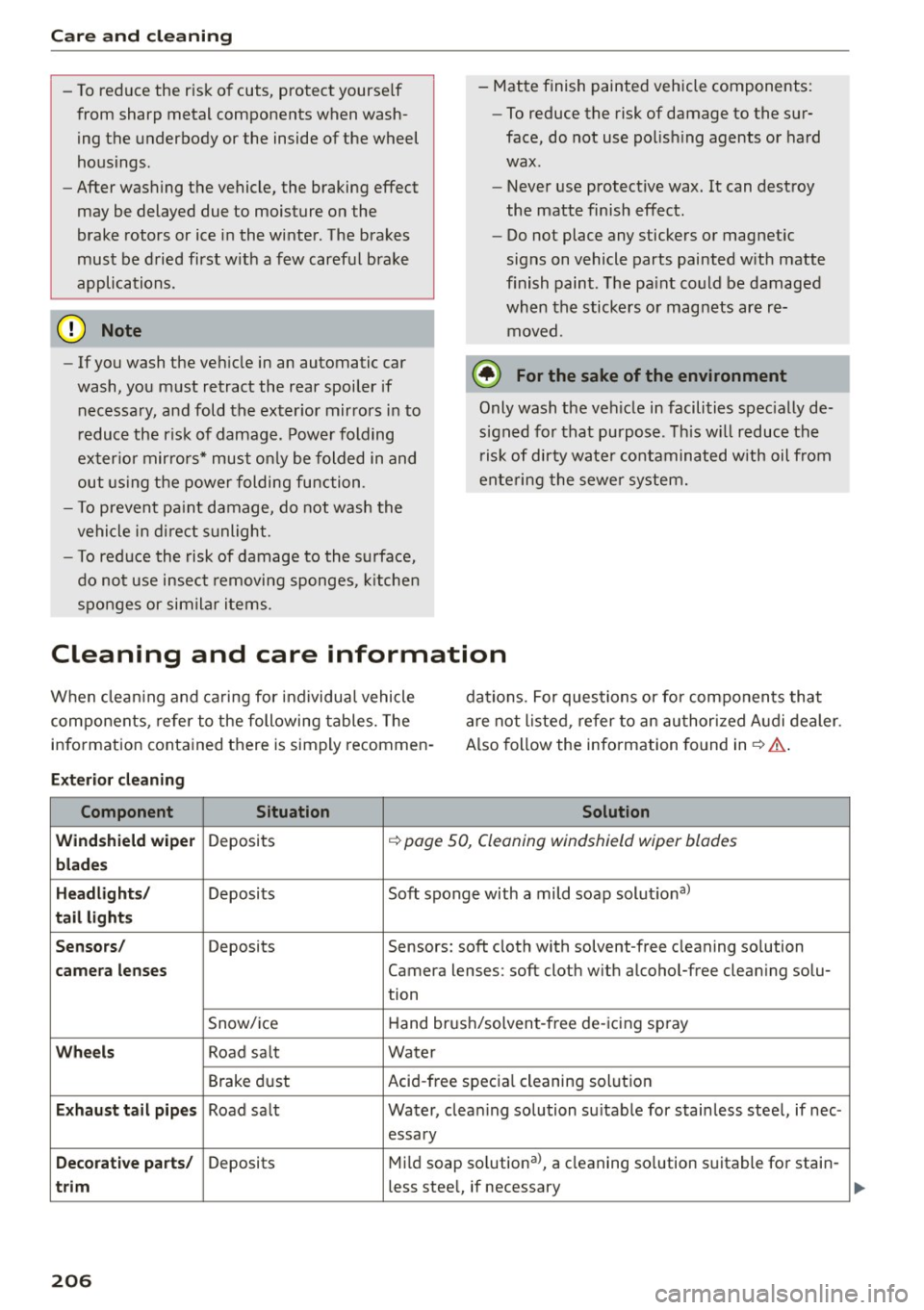
Component Situation Solution
Wind shield wiper
Deposits ¢ page 50, Cleaning windshield wiper blades
blades
Headlights /
Deposits Soft sponge with a mild soap solutional
tail lights
Sensors /
Deposits Sensors: soft cloth with solvent-free cleaning so lution
camera lenses Camera lenses: soft cloth with alcoho l-free clean ing solu-
tion
Snow/ ice H
and br ush/solvent -free de- icing sp ray
Wheels Road sa lt Water
Brake d ust Acid
-free spec ia l cleaning solut ion
E x haust t ail pipes Road sa lt Water, clea ning solution sui tab le for stain less stee l, if nee -
essary
Decorative parts / Deposits Mild soap solutiona>, a cleaning so lution suitable for stain -
trim less stee l,. if necessary
206