service AUDI A7 2016 Service Manual
[x] Cancel search | Manufacturer: AUDI, Model Year: 2016, Model line: A7, Model: AUDI A7 2016Pages: 294, PDF Size: 73.82 MB
Page 230 of 294
Checking and F ill in g
Battery
General information
Under no rmal operating conditions, the battery
in your Audi does not need any ma intenance.
W ith
high outside temperatu res or long daily
d rives we recommend that you have the electro
lyte level checked by a service facility . The elec
trolyte level should a lso be checked each time
the battery is charged ¢
page 230.
Have the bat tery checked when you take yo ur ve
hicle in for service . You are we ll advised to re
p lace a battery that is o lder than 5 years .
W ith certa in types of airbag deploymen t, the bat
tery is disconnected from the vehicle electrica l
system for safety reasons ¢
.&. in Repair, core
and disposal of the airbags on page 158.
Disconn ecting the battery t erminal s
Some veh icle funct ions (power window regula
tors, for examp le) are lost if the battery termi
na ls are disconnected. These functions have to be
re learned after the battery terminals are con
nected aga in. To prevent this, the battery shou ld
only be disconnected from the vehicle electrical
system when absolutely necessary for repairs.
Vehicl es not driven fo r long period s
If you do not drive your vehicle over a period of
several days or weeks, e lectrica l components are
gradually cut back or switched off. This reduces
energy consumption and maintains starting ca pability over a longer period¢
page 194. Some
of the convenience funct ions may not operate,
such as the inter ior lights or power seat adjust
ment. The convenience functions will be ava ilab le
again whe n you swit ch on the igni tion and sta rt
the engine.
Winte r operation
During the winter months, battery capacity tends
to decrease as temperatures drop . This is because
mo re power is also consumed w hile starting, and
the head lights, rear w indow defogger, etc ., are
used more often.
Avoid unnecessary power consumption, part icu
larly in city traffic or when traveling only short
228
distances. Let your authorized Audi dealer check
the capacity of the vehicle battery before winter
sets in
¢ page 230 . A well charged battery will
not only prevent starting problems when the
weather is cold, but will also last longer.
(D Tips
If your vehicle is left standing for several
weeks at extremely low temperatures, the ve
hicle battery should be removed and stored
where it will not freeze . This will prevent it
from being damaged and having to be re
placed.
Working on the battery
Be especially careful when working on or near
the battery.
The battery is located in the luggage compart
ment under the floor . Before you check anything
i n the luggage compartment,
re ad and he ed all
WARNINGS ¢&, .
Always heed the safety warning s, when working
o n the vehicle battery or the vehicle e lectr ical
system to prevent injury .
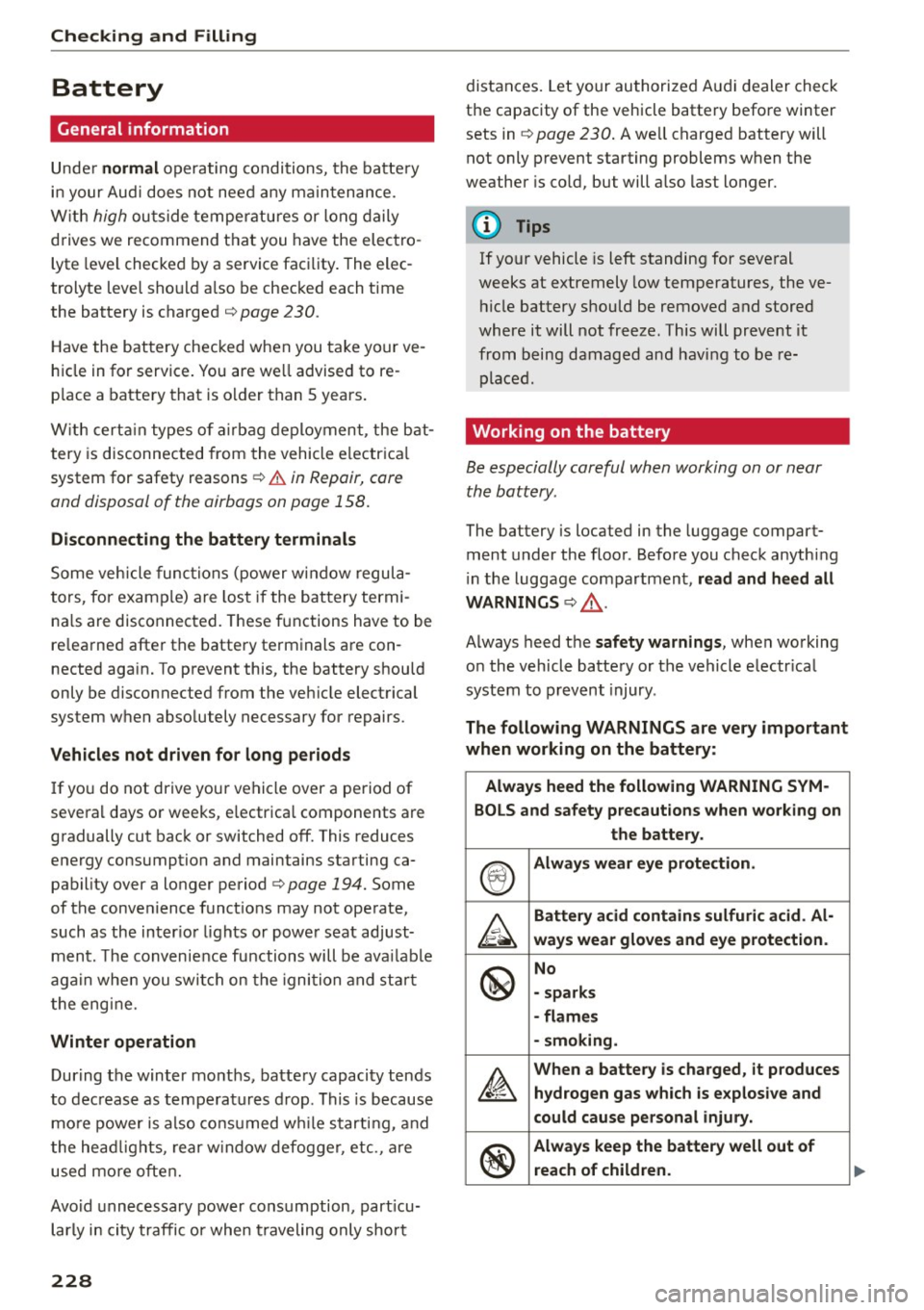
The following WARNING S are very important
when working on the battery :
Alw ay s heed the following WARNING SYM ·
BOL S and safety p recaut ions when wo rking on
the batter y.
®
Alw ay s w ear e ye protection .
~
Battery acid contains sulfuric acid . Al -
way s wear gloves and ey e protection .
@
No
· spark s
· flames
· sm oking.
~
When a battery is charged , it p roduce s
h yd rogen gas which is e xplosi ve and
'
could cause per sonal injury .
®
Always keep the battery well out of
r ea ch of ch ild ren.
...
Page 244 of 294
Wheels
check the wheel alignment if
there is unusual wear.
- Have the wheels rebalanced if an
imbalance is causing noticeable
vibration in the steering wheel. If you do not, the tires and other
vehicle components could wear more quickly.
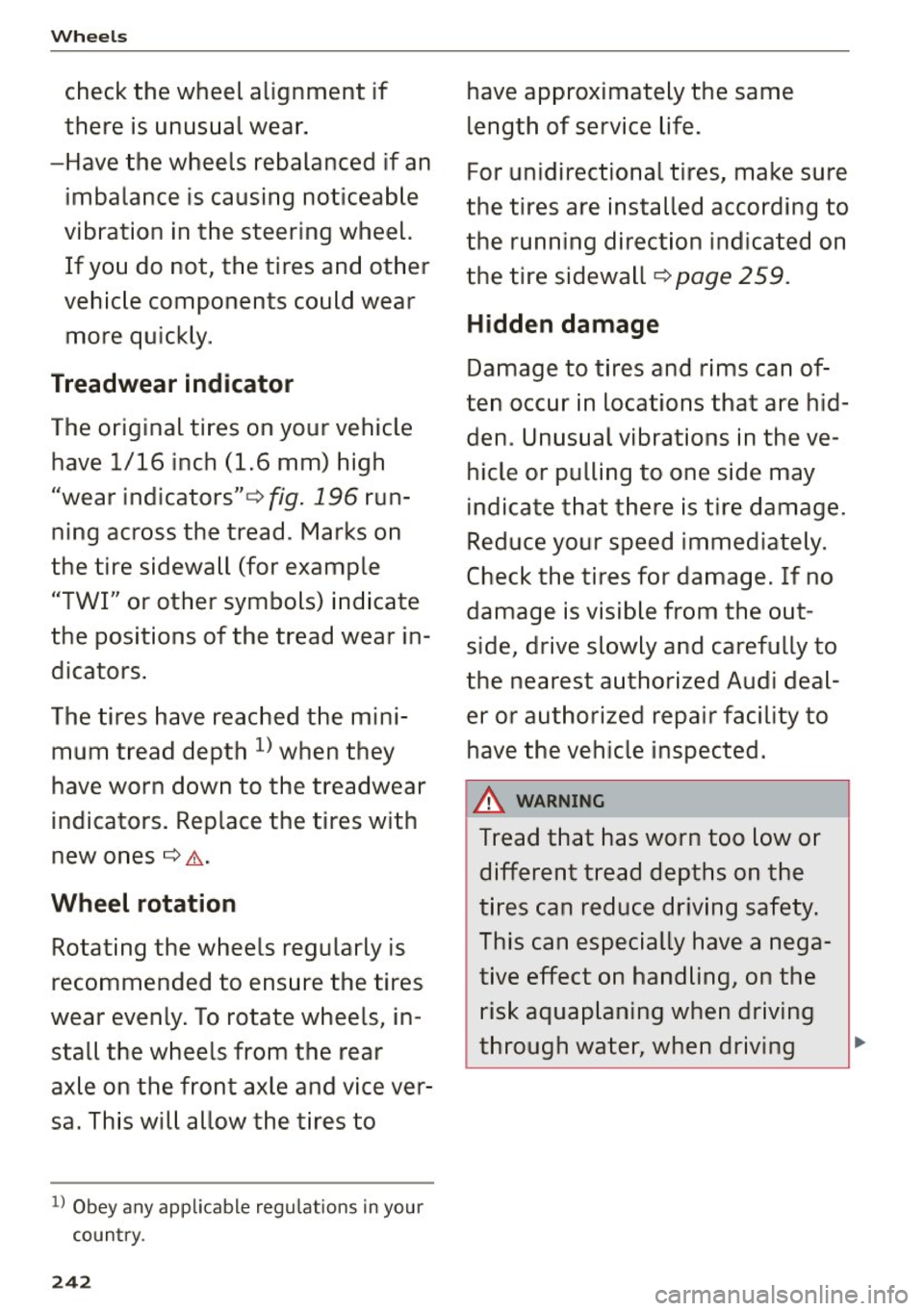
Treadwear indicator
The original tires on your vehicle have 1/16 inch (1.6 mm) high
"wear indicators" ~fig.
196 run
ning across the tread . Marks on
the tire sidewall (for example
"TWI" or other symbols) indicate
the positions of the tread wear in
dicators.
The t ires have reached the mini
mum tread depth
l) when they
have worn down to the treadwear
indicators. Replace the tires with
new ones ¢&..
Wheel rotation
Rotating the wheels regularly is
recommended to ensure the tires
wear evenly. To rotate wheels, in
stall the wheels from the rear
axle on the front axle and vice ver
sa. This will allow the tires to
1> Obey any applicable regulatio ns in you r
country .
242
have approximately the same
length of service life.
For unidirectional tires, make sure
the tires are installed according to
the running direction indicated on
the tire sidewall¢
page 259.
Hidden damage
Damage to tires and rims can of
ten occur in locations that are hid
den . Unusual vibrations in the ve
hicle or pulling to one side may
indicate that there is tire damage.
Reduce your speed immediately .
Check the tires for damage. If no
damage is visible from the out
side, drive slowly and carefully to
the nearest authorized Audi deal
er or authorized repair facility to have the vehicle inspected.
&_ WARNING
Tread that has worn too low or
different tread depths on the
tires can reduce driving safety.
This can especially have a nega
tive effect on handling, on the risk aquaplaning when driving
through water, when driving
Page 252 of 294
Wheels
-These tires may wear more quickly than others .
- Please also remember that, wh ile these ti res
deliver responsive handling, they may ride less
comfortably and make more noise than other
choices.
Reduced performance in winter/cold season
conditions
All tires are designed for certain purposes. The
low aspect ratio, ultra high performance tires
originally installed on your vehicle are intended
for maximum dry and wet road performance and handling. They are not suitable for cold, snowy or
icy weather conditions. If you drive under those
circumstances, you should equip your vehicle
with all-season or winter tires, which offer better
traction under those conditions. We suggest you
use the recommended snow or all-season tires
specified for your vehicle, or their equivalent.
Refer to ¢
page 248 for more detailed i nforma·
tion regarding winter tires .
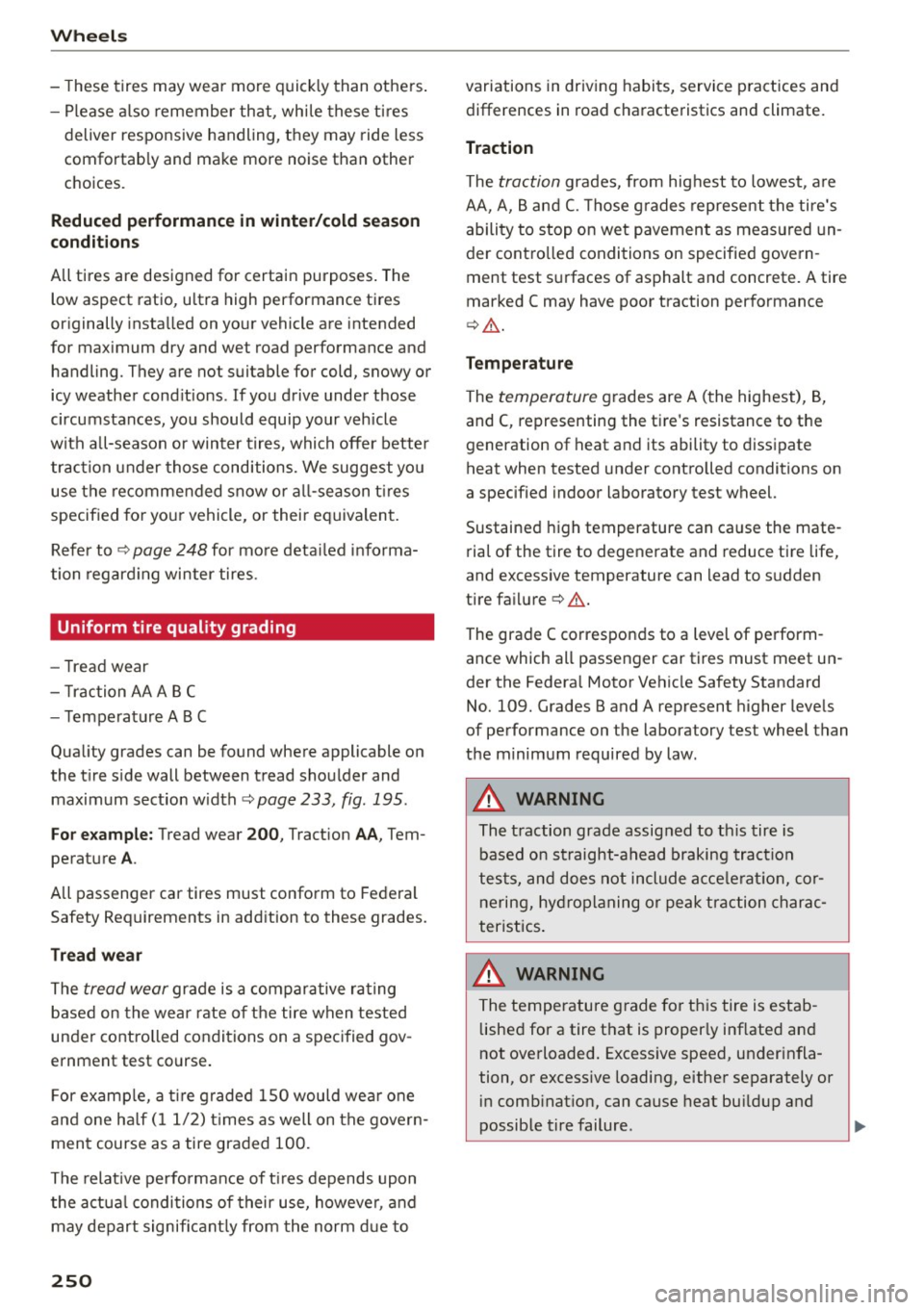
Uniform tire quality grading
-Tread wear
- Traction AA A BC
- Temperature ABC
Quality grades can be found where applicable on
the tire side wall between tread shoulder and maximum section width¢
page 233, fig. 195 .
For example: Tread wear 200, Traction AA, Tern·
perature
A.
All passenger car tires must conform to Federal
Safety Requirements in addition to these grades.
Tread wear
The tread wear grade is a comparative rating
based on the wear rate of the tire when tested
under controlled conditions on a specified gov·
ernment test course.
For example, a tire graded 150 would wear one
and one half (11/2) times as well on the govern·
ment course as a tire graded 100.
The relative performance of tires depends upon
the actual conditions of their use, however , and
may depart significantly from the norm due to
250
variations in driving habits, service practices and
differences in road characteristics and climate.
Traction
The traction grades, from highest to lowest, are
AA, A, Band
C. Those grades represent the tire's
ability to stop on wet pavement as measured un
der controlled conditions on specified govern
ment test surfaces of asphalt and concrete. A tire
marked C may have poor traction performance
¢ _& .
Temperature
The temperature grades are A (the highest), B,
and C, representing the tire 's resistance to the
generation of heat and its ability to dissipate
heat when tested under controlled conditions on
a specified indoor laboratory test wheel.
Sustained high temperature can cause the mate·
rial of the tire to degenerate and reduce tire life,
and excessive temperature can lead to sudden
tire failure ¢& .
The grade C corresponds to a level of perform·
ance which all passenger car tires must meet un·
der the Federal Motor Vehicle Safety Standard
No. 109. Grades Band A represent higher levels
of performance on the laboratory test wheel than
the minimum required by law.
A WARNING
-
The traction grade assigned to th is tire is
based on straight-ahead braking traction
tests, and does not include acceleration, cor·
nering, hydroplaning or peak traction charac
teristics.
A WARNING
The temperature grade for this tire is estab
lished for a tire that is properly inflated and
not overloaded. Excessive speed, underinfla·
tion, or excessive loading, either separately or
in combination, can cause heat buildup and
-
possible tire failure. ..,_
Page 254 of 294
Wheels
the recommended tire pressure for your vehicle
¢ page 243, fig. 198.
Tire tread ci rcumfe rence and v ibration character
istics can change and cause a tire pressure warn
ing if:
- the tire pressure in one or more t ires is too low .
- the tire has structural damage .
- the tire was replaced or the tire pressure was
changed and it was not stored
¢ page 252.
-the spare tire* is installed .
Indicator lights
IE Loss of pressure in at least one tire¢.&. .
Check the tires and replace or repair if necessary.
Check/correct the pressures of all four tires and
store the pressure again in the Infotainment sys
tem
¢page 252 .
mm (Tire Pressure Monitoring System) Tire pres
sure: System malfunction!. Ifffim
appears after
switching the ignition on or while driving and the
IE indicator light in the instrument cluster
blinks for approximately one minute and then
stays on, there is system malfunction . Try to
store the correct tire pressures¢ page 252. If
the indicator light does turn off or turns on again
after a short period of time, drive to your author
ized Audi dealer or authorized Audi Service Facili
ty immediately to have the malfunction correct
ed .
A WARNING
- If the tire pressure indicator appears in the
display, reduce your speed immediately and
avoid any hard steering or braking maneu
vers . Stop as soon as possible and check the
t ir es and their pressure .
- The driver is responsible for maintaining the correct tire pressure. You must check the
tire pressure regularly.
- Under certain conditions (such as a sporty
dr iving style, winter cond itions or unpaved
roads), the tire pressure monitoring system
indicator may be delayed.
- Do not use run-flat tires on your veh icle. Us
ing them when not permitted can lead to
vehicle damage or accidents.
252
(D Tips
-The tire pressure monitoring system can al
so stop working when there is an ESC mal
function.
- Using snow chains may result in a system
malfunction.
- The tires with the identification "AO" or
"RO" ¢
page 240 have been matched with
your Audi tire pressure monitoring system.
We recommend that you use these tires.
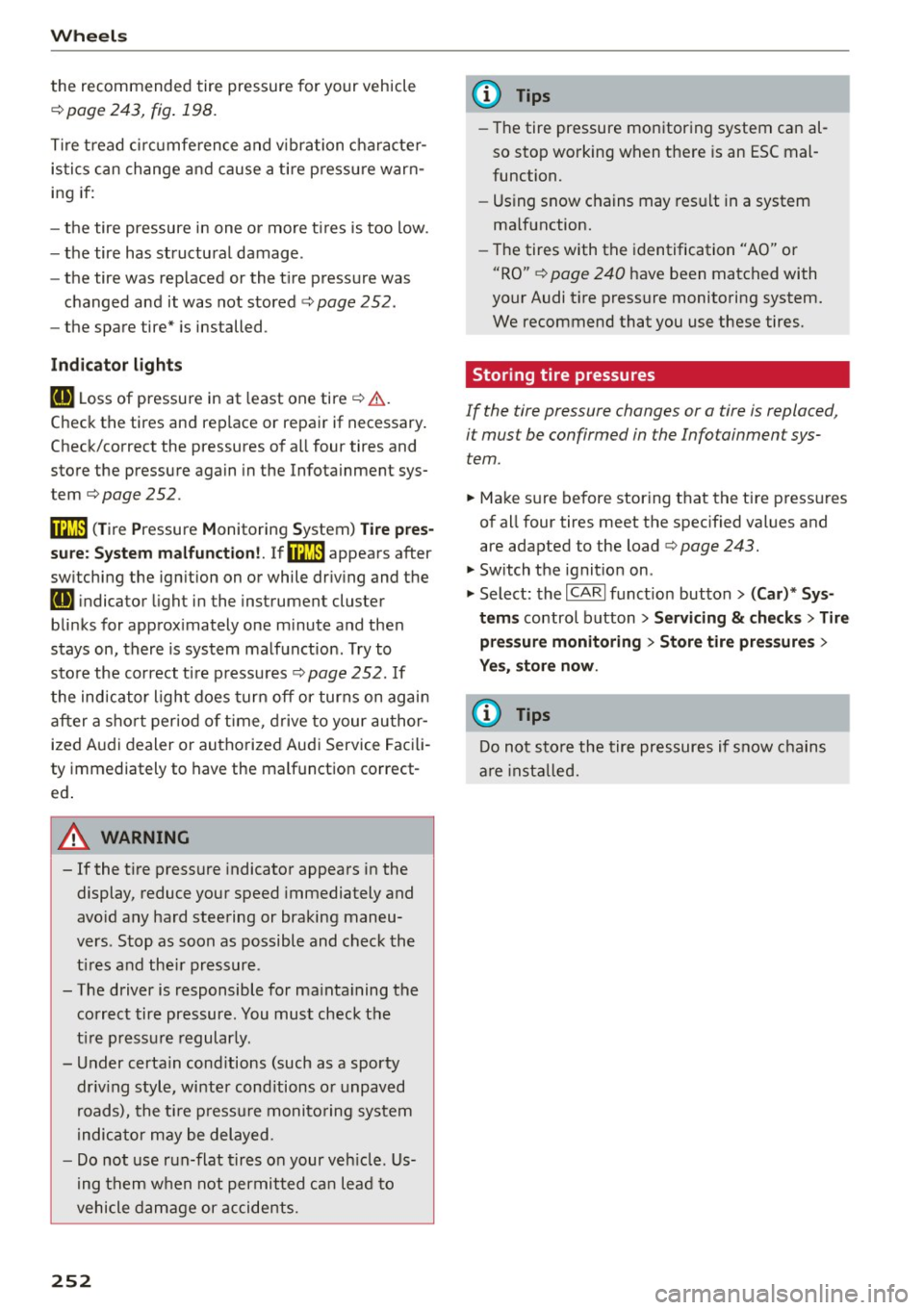
Storing tire pressures
If the tire pressure changes or a tire is replaced,
it must be confirmed in the Infotainment sys tem.
... Make sure before storing that the tire pressures
of all four tires meet the specified values and
are adapted to the load¢
page 243 .
... Switch the ignition on .
... Select: the
I CARI function button > (Car)* Sys
tems
control button > Servicing & checks > Tire
pressure monitoring
> Store tire pressures >
Yes, store now.
(D Tips
Do not store the tire pressures if snow chains
are instal led.
Page 262 of 294
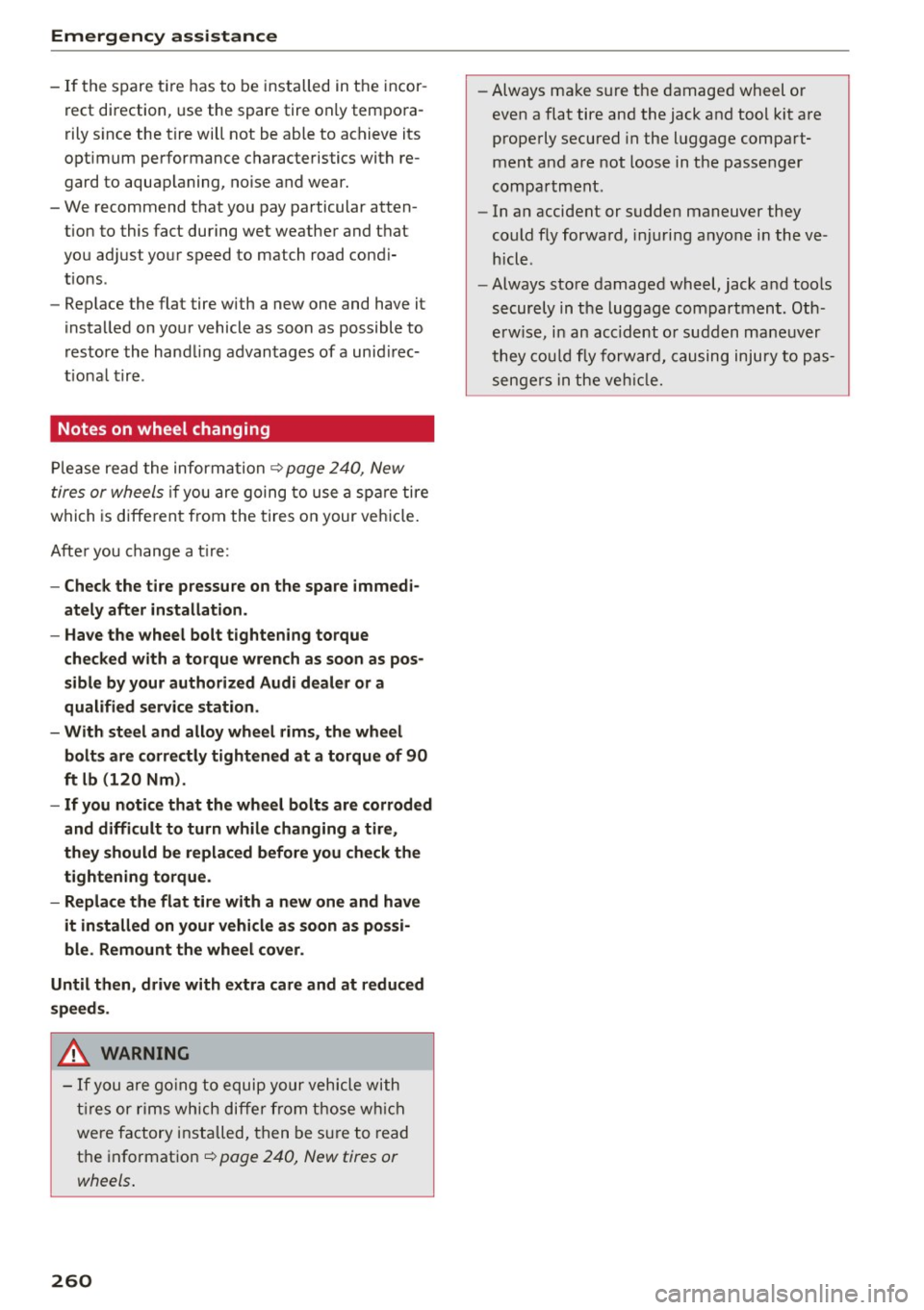
Emergency assistance
-If the spare tire has to be installed in the incor
rect direction, use the spare tire only tempora
rily s ince the tire will not be able to achieve its
optimum performance characteristics with re gard to aquaplaning, noise and wear.
- We recommend that you pay particular atten
tion to this fact during wet weather and that
you adjust your speed to match road condi
tions.
- Replace the flat tire with a new one and have it
installed on your vehicle as soon as possible to
restore the handling advantages of a unid irec
tiona l tire .
Notes on wheel changing
Please read the information r=:> page 240, New
tires or wheels
if you are going to use a spa re tire
which is diffe rent from the tires on your vehicle.
After you change a tire:
-Check the tire pressure on the spare immedi
ately after installation.
- Have the wheel bolt tightening torque
checked with a torque wrench as soon as pos
sible by your authorized Audi dealer or a
qualified service station.
- With steel and alloy wheel rims, the wheel
bolts are correctly tightened at a torque of 90
ft lb (120 Nm).
- If you notice that the wheel bolts are corroded
and difficult to turn while changing a tire,
they should be replaced before you check the
tightening torque.
- Replace the flat tire with a new one and have
it installed on your vehicle as soon as possi
ble. Remount the wheel cover .
Until then, drive with extra care and at reduced
speeds .
.8, WARNING
-If you are going to equip your vehicle with
tires or rims which differ from those which
were factory installed, then be sure to read
the information
r=;, page 240, New tires or
wheels .
260
-
-Always make sure the damaged wheel or
even a flat tire and the jack and tool kit are
properly secured in the luggage compart
ment and are not loose in the passenger
compartment.
- In an accident or sudden maneuver they
could fly forward, injuring anyone in the ve
hicle.
- Always store damaged wheel, jack and tools
securely in the luggage compartment. Oth
erwise, in an accident or sudden maneuver
they could fly forward, causing injury to pas
sengers in the vehicle.
Page 263 of 294
M N <( I.J "". rl I.O
"' N I.O rl
Fuses
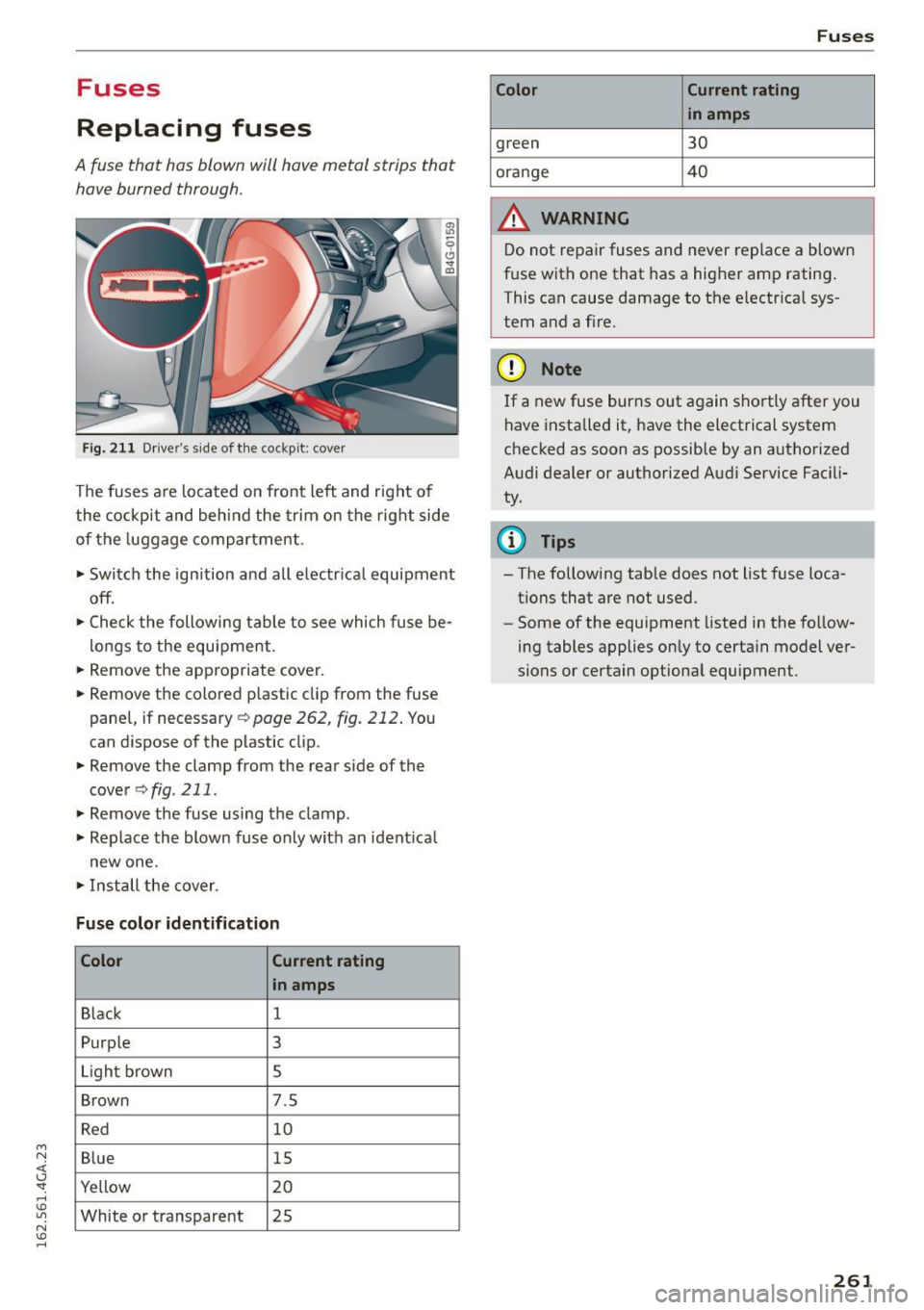
Replacing fuses
A fuse that has blown will have metal strips that have burned through.
Fig. 211 Driver's side of the cockpit : cover
The fuses are located on front left and right of
the cockpit and behind the trim on the right side
of the luggage compartment .
• Switch the ign ition and all electr ical equipment
off.
• Check the following table to see which fuse be
longs to the equipment.
• Remove the appropriate cover.
• Remove the colored plastic clip from the fuse
panel, if necessary
q page 262, fig. 212 . You
can dispose of the plastic clip.
• Remove the clamp from the rear side of the
cover qfig .
211.
• Remove the fuse using the clamp.
• Replace the blown fuse only with an ident ica l
new one.
• Install the cover.
Fuse color identification
Color Current rating
in amps
Black 1
Purp le 3
Light brown 5
Brown 7.5
Red 10
Blue 15
Yellow 20
White or transparent 25
Fuses
Color Current rating
in amps
green 30
ora nge 40
,&_ WARNING
= -Do not repair fuses and never replace a blown
fuse with one that has a higher amp rating .
This can cause damage to the e lectr ical sys
tem and a fire.
(D Note
If a new fuse burns out again shortly after you
have installed it, have the electrical system
checked as soon as possible by an authorized
Audi dealer or authorized Audi Service Facili
ty,
Ci) Tips
- The following table does not list fuse loca
tions that are not used.
- Some of the equipment listed in the follow
ing tables applies on ly to certa in model ver
sions or certain optional equipment.
261
Page 268 of 294
Emergency situation s
When jump sta rting or charging the battery,
never connect the negative ground cable to
the batte ry negat ive post because the battery
manager system must be able to detect the
battery's state of c harge. Always connect the
negat ive grou nd cab le to the negative ground
post of the batte ry manager control unit .
Use of jumper cables
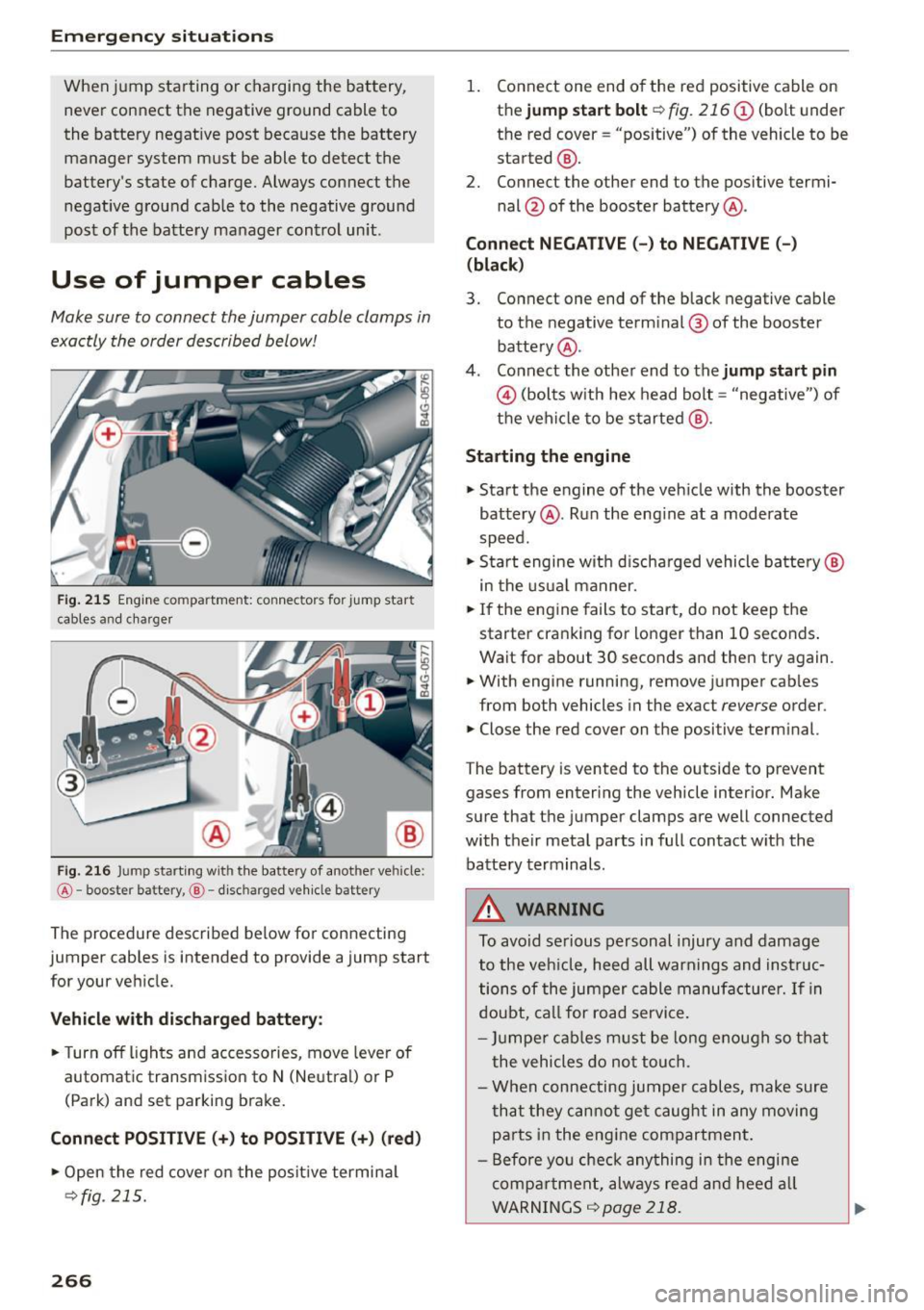
Make sure to connect the jumper cable clamps in
ex actly the order described below!
F ig . 215 Eng ine co m pa rt m ent: con nec tors for ju mp star t
cab les a nd cha rge r
® .--l @
Fig . 2 16 Jum p start ing w it h t he bat te ry of a not her ve hicl e:
@-boos te r ba ttery , @ -disc harg ed v eh icle batt ery
The procedure described be low for con necting
jumper cables is intended to p rovide a jump start
for your ve hicle.
Vehicle with discharged battery: •T urnoff lig ht s and accesso ries , move lever of
automat ic transmiss ion to N (Ne utra l) or P
(Park) and set parking brake.
Connect POSITIVE(+) to POSITIVE(+) (red)
• Open the red cove r o n t he po sit ive termin al
~fig . 2 15.
266
1. Connect one end o f the red positive ca ble on
the
jump start bolt ~ fig. 216 /J) (bolt under
the red cover = "positive") of the vehicle to be
started @.
2. Connect the other end to the positive termi-
nal@ of the booster battery @.
Connect NEGATIVE (-) to NEGATIVE (-)
(black )
3. Co nnect one end of the black negative cable
to the negative term inal ® of the booste r
batte ry @ .
4 . Connect th e other end to the
jump start pin
@ (bolts w it h hex head bolt = "negative") of
the veh icle to be s tarte d@ .
Starting the engine • Sta rt the engine of the veh icle with the booster
bat tery @. Run the eng ine at a moderate
speed.
• Sta rt engine w it h discha rged vehicle ba ttery @
i n t he usual man ner.
• If the engine fails to start, do not keep the
starter cra nking for lo nger than 10 seco nds .
Wait for about 30 seconds and then try again .
• With engine running , remove jumper cab les
from both vehicles in the exact
reverse order .
• Close the red cover on the positive term inal.
The batt ery is vented to the o utside to prevent
gases from enter ing the vehicle inter ior. Make
su re that t he jumper clamps are well connected
with their metal parts in full contact w ith the
batte ry terminals.
&_ WARNING
To avoid se rious personal injury and damage
to the veh icle, heed all war nings and inst ruc
tion s of the jumper cable m anufa cture r.
If in
d oubt, cal l for ro ad service.
- Ju mpe r cabl es must be lo ng enoug h so tha t
t he vehicles do no t tou ch.
- When conne cting jumper cables, make sure
th at they c an not get c aug ht in any moving
p art s in the engine com partmen t.
- B efore you check any thing in the e ngine
comp artment, alw ays re ad an d hee d all
WAR NINGS
~ page 218.
Page 275 of 294
M N <( (.J
'SI: ,...., \!) ..,.,
N \!) ,....,
Technical d at a
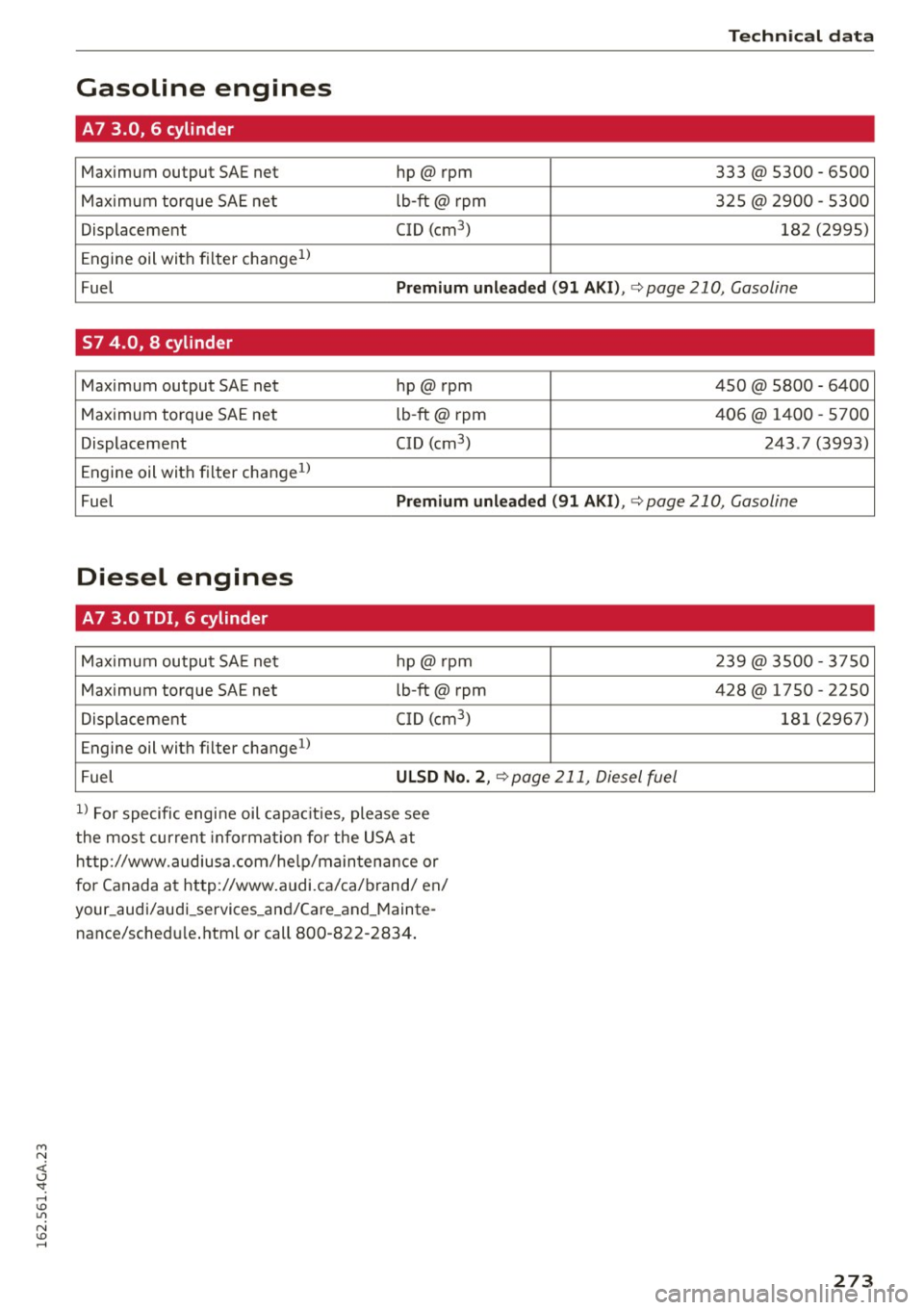
Gasoline engines
A7 3.0, 6 cylinder
Maximum output SAE net hp@rpnn 333 @ 5300 -6500
Maximum torque SAE net lb-ft@ rpm 325@ 2900 -5300
Displacement CID (cm
3
) 182 (2995)
Engine oil with filter change
1>
Fuel Premium un lead ed (9 1 A KI), ¢ page 210, Gasoline
57 4.0, 8 cylinder
Maximum output SAE net hp@ rpnn 450 @ 5800 -6400
Maximum torque SAE net lb
-ft@ rpm 406@ 1400 -5700
Displacement CID (cm
3
) 243.7 (3993)
Engine oil with filter change
1
)
Fuel Pr emi um un lead ed (9 1 AKI), ¢ page 210, Gasoline
Diesel engines
A7 3.0 TOI, 6 cylinder
Maximum output SA E net hp@rpnn
Maximum torque SAE net lb-ft@ rpm
Displacement C
ID (cm
3
)
Engine oil with filter change1
)
Fuel UL SD N o. 2 , ¢ page 211, Diesel fuel
l) For specific engine oil capacities, please see
the mos t current informat ion for the USA at
h ttp ://www.audiusa.com/he lp/maintenance or
for Canada at http://www.audi.ca/ca/brand/ en/
your_audi/audi_services _and/Care _and _Mainte
nance/schedu le . html or call 800-822-2834. 239@ 3500
-3750
428@ 1750 -2250
181 (2967)
27 3
Page 276 of 294
Consumer information
Consumer information
Warranty coverages
Your Audi is covered by the following warran
ties:
- New Vehicle Limited Warranty
- Limited Warranty Against Corrosion Perfora-
tion
- Emissions Control System Warranty
- Emissions Performance Warranty
- California Emissions Control Warranty (USA
vehicles only)
- California Emissions Performance Warranty
(USA vehicles only)
Detailed information regarding your warranties
can be found in your
Warranty & Maintenance
booklet .
Operating your vehicle
outside the U.S.A. or
Canada
Government regulations in the United States and
Canada require that automobiles meet specific
emission regulations and safety standards.
Therefore, vehicles built for the U.S.A. and Cana
da differ from vehicles sold in other countr ies.
If you plan to take your veh icle outside the conti
nenta l limits of the United States or Canada,
there is the possibility that:
- unleaded fuels for vehicles with catalytic con
verter may not be available;
- fuel may have a considerably lower octane rat
ing . Improper fuel may cause engine damage;
- serv ice may be inadequate due to lack of proper
serv ice facilities , tools or testing equipment;
- r eplacement parts may not be readily available .
- Nav igat ion systems for vehicles built for the
U.S.A. and Canada will not necessar ily work in
Europe, and may not work in othe r countries
outside North America .
274
(D Note
Aud i cannot be responsib le for mechanical
damage that could result from inadequate
fuel, service or parts availability.
Audi Service Repair
Manuals and Literature
Audi Offic ial Factory Service Manuals and Litera
ture are published as soon as possible after mod
el introduction. Service manuals and literature
are available to order from the Audi Technical Lit
erature Ordering Center at:
www.audi.techliterature .com
Maintenance
General '
Your vehicle has been designed to help keep
maintenance requirements to a minimum. How
ever, a certain amount of regular maintenance is
still necessary to assure your veh icle's safety,
economy and reliability. For deta iled vehicle
maintenance consult your Warranty & Mainte
nance booklet .
Under difficult operating conditions, for exam
ple at extremely low outs ide temperatures, in
very dusty regions, when towing a trailer very fre
quently , etc., some service work should be per
formed between the intervals specified. This ap
plies particularly to:
- oil changes, and
- cleaning or replacing the air filter .
'
@) For the sake of the environment
By regularly maintaining your vehicle, you
help make sure that emission standards are
maintained, thus minimizing adverse effects
on the environment.
Important considerations for you and your
vehicle
The increasing use of electronics, sophisticated
fuel injection and emission control systems , and
the generally increasing technical comp lexity of
llJJ,
Page 283 of 294

Date display . . . . . . . . . . . . . . . . . . . . . . . . . . 26
Daytime running lights . . . . . . . . . . . . . . . . . . 43
Declaration of compliance Adaptive cruise control .... .. .. .. .. .. .
277
A d' .d . u I s1 e assist . .. .... .... . .... .. .. . 277
Cell phone package ........ ... ... ... . 277
Convenience key ............. .. .... . . 277
Electronic immobilize r ..... .. .. .. .. .. . 277
Garage door opener (HomeLink) . .. .. .. . 277
Remote control key . . . . . . . . . . . . . . . . . . 277
Defective light bulb warning
Indicator light . . . . . . . . . . . . . . . . . . . . . . .
21
Defrosting (windows)
Four- zone automatic climate control . . . . .
72
Three-zone climate control . . . . . . . . . . . . . 69
DEF (instrument cluster) . . . . . . . . . . . . . . . . 26
Determining correct load limit . . . . . . . . . .
247
Diesel
Indicator light . . . . . . . . . . . . . . . . . . . . . . .
20
Prewarming . . . . . . . . . . . . . . . . . . . . . . . . . 75
Diesel fuel... .. .............. ... .... .
211
Diesel particulate filter . . . . . . . . . . . . . . . . 198
Dimensions . . . . . . . . . . . . . . . . . . . . . . . . . . 272
Dimming the rearview mirror . . . . . . . . . . . . 48
Distance . . . . . . . . . . . . . . . . . . . . . . . . . . . . . 24
Door/rear lid warning
23
Doors Ch ild safety lock . . . . . . . . . . . . . . . . . . . . . . 39
Driver information system . . . . . . . . . . . . . . . 23
CD/radio display . . . . . . . . . . . . . . . . . . . . . . 23
Door/rear lid warning . . . . . . . . . . . . . . . . . 23
Efficiency program . . . . . . . . . . . . . . . . . . . . 25
Exterior temperature display . . . . . . . . . . . 23
On-board computer . . . . . . . . . . . . . . . . . . .
24
Service interval disp lay . . . . . . . . . . . . . . . . 26
Driver seating position . . . . . . . . . . . . . . . . .
127
drive select
adaptive air suspension/spor t . . . . . . . . . .
101
Adaptive dampers . . . . . . . . . . . . . . . . . . . 101
Curve light . . . . . . . . . . . . . . . . . . . . . . . . . 101
Engine sound . . . . . . . . . . . . . . . . . . . . . . . 101
Safety belt tensioner . . . . . . . . . . . . . . . . . 101
Sport different ial . . . . . . . . . . . . . . . . . . . . 101
M N Drive select . . . . . . . . . . . . . . . . . . . . . . . . . . 101 <(
~ Driving economically . . . . . . . . . . . . . . . . . . 198 ,....,
~ Driving safely . . . . . . . . . . . . . . . . . . . . . . . . 126
~ Driving through water . . . . . . . . . . . . . . . . . 196
Index
Driving time
Duplicate key . . . . . . . . . . . . . . . . . . . . . . . . . . 24
30
Dust filter
refer to Pollutant filter . . . . . . . . . . . . . . . . 68
Dynamic steering
Indicator light
E
192
Easy seat entry . . . . . . . . . . . . . . . . . . . . . . . . 75
Economy tips (efficiency program) . . . . . . . . 25
Efficiency program . . . . . . . . . . . . . . . . . . . . . 25
Electromechanical parking brake
Operation . . . . . . . . . . . . . . . . . . . . . . . . . . .
78
Releasing and closing . . . . . . . . . . . . . . . . . 78
Warning/indicator lights . . . . . . . . . . . . . . . 15
Electromechanical steering . . . . . . . . . . . . . 192
Indicator light . . . . . . . . . . . . . . . . . . . . . . 192
Electronic differential lock
Indicator light . . . . . . . . . . . . . . . . . . . . . . .
18
Electronic Differential Lock . . . . . . . . . . . . . 188
Electronic differential lock (EDL)
Warning/ind icator lights . . . . . . . . . . . . . . .
19
Electronic immobilizer . . . . . . . . . . . . . . . . . . 31
Electronic power control (EPC)
warning/indicator light . . . . . . . . . . . . . . . .
20
Electronic speed limiter . . . . . . . . . . . . . . . . . 29
Electronic stabilization control
Indicator light . . . . . . . . . . . . . . . . . . . . . . .
18
Electronic Stabilization Control . . . . . . . . . . 188
Sport mode . . . . . . . . . . . . . . . . . . . . . . . . 189
Emergency actuation
Doors . . . . . . . . . . . . . . . . . . . . . . . . . . . . . . 36
Emergency flasher . . . . . . . . . . . . . . . . . . . . . 46
Warning/indicator lights . . . . . . . . . . . . . . . 22
Emergency operation Emergency braking function (parking brake) .7.9
Fuel filler door . . . . . . . . . . . . . . . . . . . . . .
214
Luggage compartment lid . . . . . . . . . . . . . . 38
Selector lever . . . . . . . . . . . . . . . . . . . . . . .
113
Sunroof . . . . . . . . . . . . . . . . . . . . . . . . . . . . . 41
Emergency starting . . . . . . . . . . . . . . . . . . . 265
Energy management . . . . . . . . . . . . . . . . . .
194
Engine
Compartment . . . . . . . . . . . . . . . . . . . . . . .
220
Coolant . . . . . . . . . . . . . . . . . . . . . . . . . . . . 224
Prewarming . . . . . . . . . . . . . . . . . . . . . . . . . 75
281