lock AUDI A7 2016 Workshop Manual
[x] Cancel search | Manufacturer: AUDI, Model Year: 2016, Model line: A7, Model: AUDI A7 2016Pages: 294, PDF Size: 73.82 MB
Page 176 of 294
Child safety
the rear-facing child safety seat in a rear
seating position and have the airbag system inspected by your Audi dealer .
- Never place or use any electrical device
(such as a laptop, CD player, electronic
games device, power inverter or seat heater
for child seats) on the front passenger seat if the device is connected to the 12-volt
socket or the cigarette lighter socket.
- If a seat heater has been retrofitted or oth
erwise added to the front passenger seat,
never install any child restraint system on
this seat .
- Make sure that there are no wet objects
(such as a wet towel) and no water or other
liquids on the front passenger seat cushion.
- Never place objects on the seat (such as a
laptop, CD player, electronic games device,
power inverter or seat heater for child
seats). These may influence the electrical
capacitance measured by the capacitive pas
senger detection system and can also fly
around in an accident and cause serious per
sonal injury.
- Always read and heed all WARNINGS when
ever using a child restrained in a vehicle is
being used
r::!;> poge 135, Safety belts,
r::!;> page 143, Airbag system and
~ page 167, Important information .
Convertible child safety seats
Properly used convertible child safety sea ts con
help protect toddlers and children over age one
who weigh between 20 and 40 lbs. (9 and 18 kg)
in a crash.
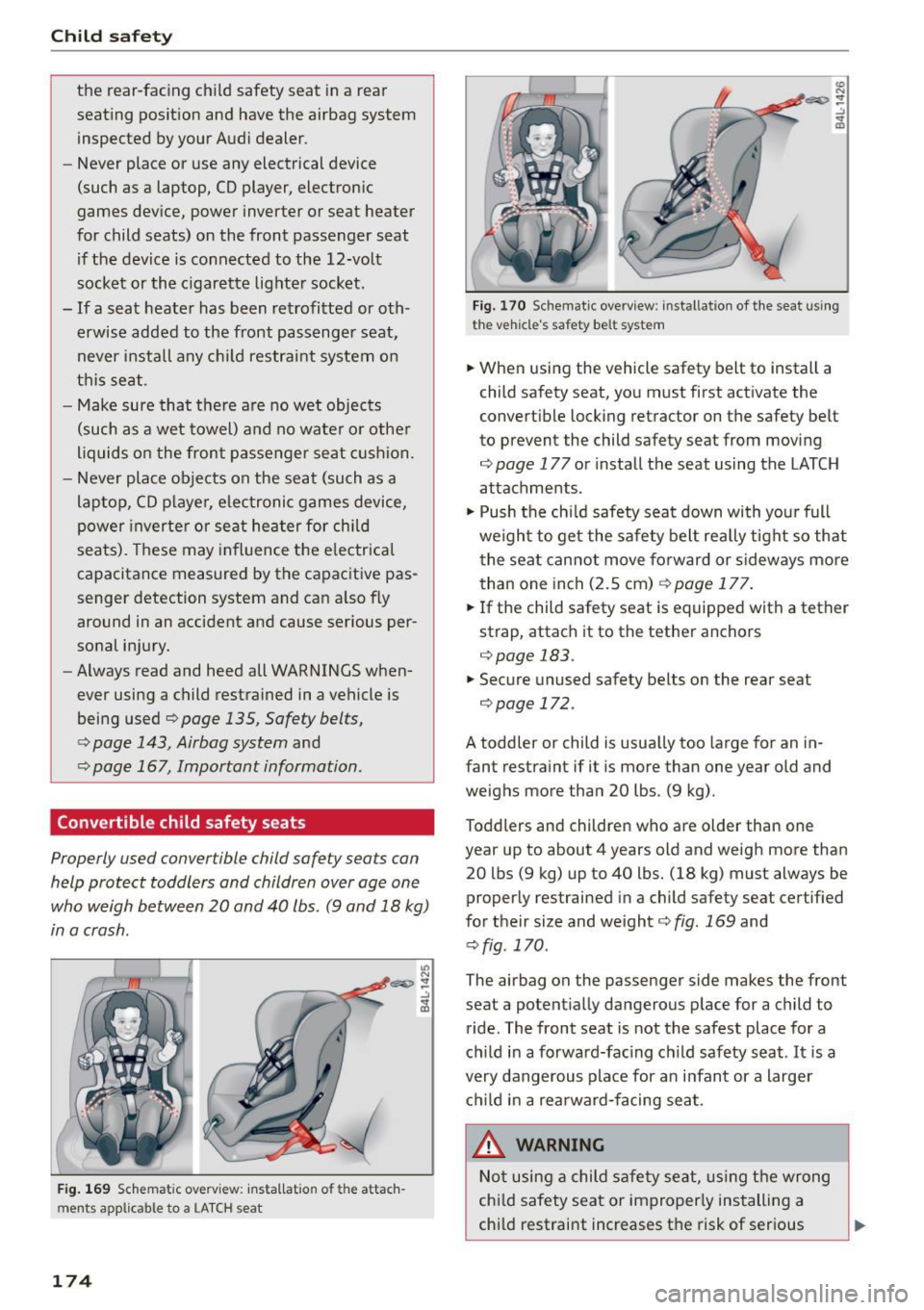
Fig. 169 Schema tic ov ervi ew: installatio n of th e atta ch
m ents app lica ble to a LATCH seat
174
Fig. 170 Schem ati c ove rview : instal la ti on of the sea t using
t he vehicle' s sa fet y bel t system
.,. When using the vehicle safety belt to install a
child safety seat, you must first activate the
convertible locking retractor on the safety belt
to prevent the child safety seat from moving
¢
page 177 or install the seat using the LATCH
attachments .
.,. Push the child safety seat down with your full
weight to get the safety belt really tight so that
the seat cannot move forward or sideways more
than one inch (2 .5 cm)
r::!;> page 177.
.,. If the child safety seat is equipped with a tether
strap, attach it to the tether anchors
¢ page 183.
.,. Secure unused safety belts on the rear seat
¢page 172.
A toddler o r child is usually too large for an in
fant restraint if it is more than one year old and
weighs more than 20 lbs. (9 kg) .
Toddlers and children who are older than one
year up to about 4 years old and weigh more than
20 lbs (9 kg) up to 40 lbs. (18 kg) must always be
properly restrained in a child safety seat certified
for their size and weight¢
fig. 169 and
¢fig. 170 .
The airbag on the passenger side makes the front
seat a potentially dangerous place for a child to
ride . The front seat is not the safest place for a
child in a forward-facing child safety seat . It is a
very dangerous place for an infant or a larger
child in a rearward-facing seat.
& WARNING
Not using a child safety seat, using the wrong
child safety seat or improperly installing a
child restraint increases the risk of serious
Page 178 of 294
Child safety
airbag system inspected by your authorized
Audi dealer.
- Take the child restraint off the front passen
ger seat and install it properly at one of the
rear seat positions if the
PASSENGER AIR
BAG OFF
light does not stay on whenever
the ignition is switched on .
Booster seats and safety belts
Properly used booster seats con help protect
children weighing between about 40 lbs. and 80
lbs. (18 kg and 36 kg) who ore less than 4
ft. 9
in . (57 inches/1 .45 meters) tall .
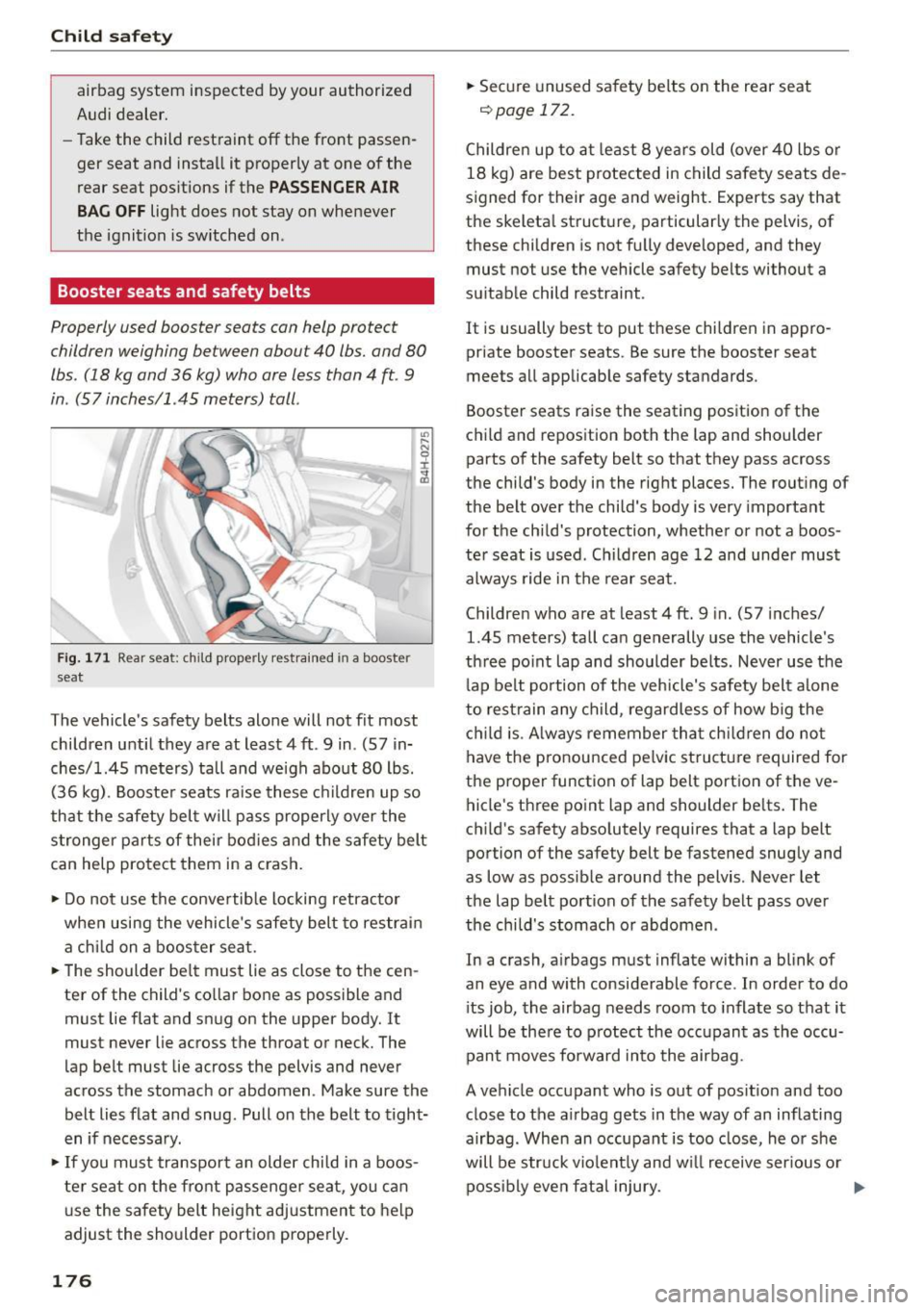
Fig. 171 Rear seat: ch ild prope rly restrained in a booster
seat
"' ,-.
i i
The vehicle's safety belts alone will not fit most
children until they are at least 4
ft. 9 in . (57 in
ches/1.45 meters) tall and weigh about 80 lbs.
(36 kg). Booster seats raise these children up so
that the safety belt will pass properly over the
stronger parts of their bodies and the safety belt
can help protect them in a crash.
• Do not use the convertible locking retractor
when using the vehicle's safety belt to restrain
a child on a booster seat.
• The shoulder be lt must lie as close to the cen
ter of the child's collar bone as possible and
must lie flat and snug on the upper body. It
must never lie across the throat or neck. The
lap belt must lie across the pelvis and never
across the stomach or abdomen . Make sure the
belt lies flat and snug . Pull on the belt to tight
en if necessary.
• If you must transport an older child in a boos
ter seat on the front passenger seat, you can
use the safety belt height adjustment to help
adjust the shoulder portion properly .
176
• Secure unused safety belts on the rear seat
r=;, page 172 .
Children up to at least 8 years old (over 40 lbs or
18 kg) are best protected in child safety seats de
signed for their age and weight . Experts say that
the skeletal structure, particularly the pelvis, of
these children is not fully developed, and they
must not use the vehicle safety belts without a
suitable child restraint .
It is usually best to put these children in appro
priate booster seats . Be sure the booster seat
meets all applicable safety standards.
Booster seats raise the seating position of the
child and reposition both the lap and shoulder parts of the safety belt so that they pass across
the child 's body in the right places. The routing of
the belt over the child 's body is very important
for the child's protection, whether or not a boos
ter seat is used. Children age 12 and under must
always ride in the rear seat.
Children who are at least 4
ft. 9 in. (57 inches/
1.45 meters) tall can generally use the vehicle's
three point lap and shoulder belts . Never use the
lap belt portion of the vehicle's safety belt alone
to restrain any child, regardless of how big the
child is. Always remember that childr en do not
have the pronounced pelvic structure required for
the proper function of lap belt portion of the ve
hicle 's three point lap and shoulder belts. The
child's safety absolutely requires that a lap belt
portion of the safety belt be fastened snugly and
as low as possible around the pelvis . Never let
the lap belt portion of the safety belt pass over
the child's stomach or abdomen .
In a crash, airbags must inflate within a blink of
an eye and with considerable force . In order to do
its job, the airbag needs room to inflate so that it
will be there to protect the occupant as the occu
pant moves forward into the airbag .
A vehicle occupant who is out of position and too
close to the airbag gets in the way of an inflating
airbag . When an occupant is too close, he or she
will be struck violently and will receive serious or
possibly even fatal injury. .,..
Page 179 of 294
M N <( (.J
'SI: ,...., \!) 1.1'1
N \!) ,....,
In order for the airbag to offer protection, it is
important that all vehicle occupants, especially
any children, who must be in the front seat be
cause of exceptional circumstances, be properly
restrained and as far away from the airbag as
possible . By keeping room between the child's
body and the front of the passenger compart
ment, the airbag can inflate completely and pro
vide supplemental protection in certain frontal
collisions .
A WARNING
Not using a booster seat, using the booster
seat improperly, incorrectly installing a boos
ter seat or using the vehicle safety belt im
properly increases the risk of serious personal
injury and death in a collision or other emer
gency situation. To help reduce the risk of se
rious personal injury and/or death:
- The shoulder belt must lie as close to the
center of the child's collar bone as possible
and must lie flat and snug on the upper
body . It must never lie across the throat or
neck. The lap belt must lie across the pelvis
and never across the stomach or abdomen.
Make sure that the belt lies flat and snug.
Pull on the belt to tighten if necessary.
- Failure to properly route safety belts over a
child's body will cause severe injuries in an
accident or other emergency situation
¢ page 135.
-The rear side of the child safety seat should
be positioned as close as possible to the
backrest on the vehicle seat.
- For adjustable head restraints : adjust or re
move the rear seat head restraint if it is dif
ficult to install the child seat with the head restraint in place¢
page 56. Install the
head restraint again immediately once the
child seat is removed. Driving without head
restraints or with head restraints that are
not properly adjusted increases the risk of
serious or fatal neck injury dramatically .
- Children on the front seat of any car, even
with Advanced Airbags, can be seriously in
jured or even killed when an airbag inflates.
- Never let a child stand or kneel on any seat,
for example the front seat.
-
Child safety
-Never let a child ride in the cargo area of
your vehicle.
- Always remember that a child leaning for
ward, sitting sideways or out of position in any way during an accident can be struck by
a deploying airbag. This will result in serious
personal injury or death.
- If you must install a booster seat on the
front passenger seat because of exceptional
circumstances the
PASSENGER AIR BAG
OFF
light must come on and stay on, when
ever the ignition is switched on.
- If the
PASSENGER AIR BAG OFF light does
not come on and stay on, perform the
checks described ¢
page 154, Monitoring
the Advanced Airbag System.
- Take the child restraint off the front passen
ger seat and install it properly at one of the
rear seat positions if the
PASSENGER AIR
BAG OFF
light does not stay on whenever
the ignition is switched on.
- Always read and heed all WARNINGS when
ever using a child restrained in a vehicle is
being used
¢ page 135, Safety belts,
¢ page 143, Airbag system and
¢ page 167, Important information.
Securing child seats
Securing a child safety seat using a safety
belt
Safety belts for the rear seats and the front pas
senger can be locked with the convertible locking
retractor to properly secure child safety seats.
The safety belts emergency locking retractors for
the rear seats safety belts and for the front pas
senger's seat safety belt have a convertible lock
ing retractor for child restraints. The safety belt
must be locked so that belt webbing cannot un
reel. The retractor can be activated to lock the
safety belt and prevent the safety belt webbing
from loosening up during normal driving. A child
safety seat can only be properly installed when
the safety belt is locked so that the child and
child safety seat will stay in place .
Always remember: Even though your vehicle is equipped with an Advanced Airbag system, all
177
Page 180 of 294
Child safety
children, especially those 12 years and younger,
should always ride in the back seat properly re
strained for their age and size.
A WARNING
Improperly installed child safety seats in
crease the risk of serious personal injury and
death in a collision.
-
-Always make sure that the safety belt re
tractor is locked when installing a child safe
ty seat . An unlocked safety belt retractor
cannot hold the child safety seat in place
during normal driving or in a crash.
- Always buckle the child safety seat firmly in
place even if a child is not sitting in it . A
loose child safety seat can fly around during
a sudden stop or in a collision.
- Always make sure that the rear seat back
rest to which the center rear safety belt* is
attached is securely latched whenever the
rear center safety belt is being used to se
cure a child restraint.
- If the backrest is not securely latched, the
child and the child restraint will be thrown
forward together with the backrest and will
strike parts of the vehicle interior. The child can be seriously injured or killed.
- Never install rear-facing child safety seats or
infant carriers on the front passenger seat.
A child will be seriously injured and can be killed when the passenger airbag inflates.
- The inflating airbag will hit the child safety seat or infant carrier with great force and
will smash the child safety seat and child against the backrest, center armrest, door
or roof.
- Always install rear-facing child safety seats
or infant carriers on the rear seat .
- Forward-facing child safety seats or infant
carriers installed on the front passenger's
seat may interfere with the deployment of
the airbag and cause serious injury to the child.
- It is safer to install a forward-facing child
safety seat on the rear seat.
- Always read and heed all WARNINGS when
ever using a child restrained in a vehicle is
being used
Qpage 167. Special precautions
178
apply when installing a child safety seat on
the front passenger seat
Q page 144, Child
restraints on the front seat -some impor
tant things to know.
A WARNING
Always take special precautions if you must
install a forward or rearward-facing child re
straint on the front passenger's seat in excep
tional situations:
- Whenever a forward or rearward-facing
child restraint is installed on the front pas
senger seat, the
PASSENGER AIR BAG OFF
light must come on and stay on whenever
the ignition is switched on.
- If the PASSENGER AIR BAG OFF light does
not come on and stay on, perform the
checks described
Q page 154, Monitoring
the Advanced Airbag System.
- Take the child restraint off the front passen
ger seat and install it properly at one of the
rear seat positions if the
PASSENGER AIR
BAG OFF
light does not stay on whenever
the ignition is switched on.
- Improper installation of child restraints can
reduce their effectiveness or even prevent
them from providing any protection.
- An improperly installed child restraint can interfere with the airbag as it deploys and
seriously injure or even kill the child .
-Always carefully follow the manufacturer's
instructions provided with the child safety
seat or carrier.
- After checking to make sure that the child
restraint is properly installed, make certain
that the child restraint is correctly recog
nized by the capacitive passenger detection
system in the front passenger seat and that
the
PASSENGER AIR BAG OFF light signals
the correct front passenger frontal airbag
status.
A WARNING
Forward-facing child restraints:
-
Page 181 of 294
M N <( (.J
'SI: ,...., \!) ..,.,
N \!) ,....,
-Always mak e sure the forward-facing seat
has been designed and certified by its man
ufacturer for use on a front seat with a
passenger front and side airbag .
- Never pu t the forward-facing child restraint
up, aga inst or very near the ins trument pan
el.
- Always move the passenger seat into its
rearmost position in the seat's fore and aft
adjustment range, as far away from the air
bag as possib le befo re installing the for
wa rd-fac ing child restra int. The backres t
must be ad justed to an up right posit io n.
- Make sure that the
PASSENGER AIR BAG
OFF
light comes on and s tays on all the t ime
whe never the ignition is switched on.
_& WARNING
Rearw ard-fac ing ch ild restra ints:
- A ch ild in a rearwa rd-facing child safety seat
installed on the fron t passenger seat will be
seriously injured and can be k ille d if the
front airbag inflates - even with an Ad
vanced Airbag System .
- The inflati ng a irbag w ill hit the child safety
seat or infant carrier with great fo rce and
will smash the ch ild safety seat and chi ld
against the backrest, center armrest, door
o r roof.
- Always be especially caref ul if you must in
stall a rearward facing ch ild safety seat on
the front passenger seat in exceptional cir
cumstances .
- Make sure that the
PASSENGER AIR BAG
OFF
light comes on and stays on all the t ime
whenever the ignition is switched on .
- If the
PASSENGER AIR BAG OFF light does
not come on and stay on, immed iately in
stall the rear-fac ing c hild safety seat in a
rear seating position and have the airbag
system inspected by your Au di deale r.
Child sa fety
Act ivating the convertible locking retractor
Use the convertible locking retractor to secure a
child restraint .
Always heed the ch ild safety seat manufac ture r's
ins truc tions when ins talling a child res train t in
your vehicle . T o activate the convertible locking
re tractor:
.. Place the child restraint on a sea t, preferably on
the rear sea t.
.. Slowly p ull the belt
all the way out .
.. Route it a round or through the child rest ra int
be lt pat h
~ .& .
.. Push the c hild safety sea t down with you r full
we igh t to ge t the sa fe ty belt re ally t igh t.
.. Insert the belt tongue into the buc kle for tha t
seating posit ion .
.. Guide the saf ety belt back into the retractor un
til the belt lies flat and sn ug on the ch ild safety
seat .
.. You should hear a "clicking" noise as the belt
w inds bac k into the ine rtia reel. Test the con
vert ible locking retracto r by pu lli ng on the belt .
Yo u shou ld no lo nger be able to pull the belt
ou t of the re tr actor. The conve rtible locking re
t racto r is now ac tiva ted .
.. Ma ke s ure that the red release button is fac ing
away from the child rest raint so that it can be
unbuckled quickly .
.. Pull on the belt to make sure the safety be lt is
properly tight and fastened so t hat the se at
cannot move forward or sideways more than
one inch (2 .5 cm) .
_& WARNING
Using the wrong child re straint o r an i mprop
e rly insta lled child rest raint can cau se serious
p erson al injury or deat h in a cra sh .
- Always ma ke sure that the safe ty belt re
tr act o r i s lo cked when in sta lling a child safe
ty seat . An unloc ked sa fety belt retrac tor
cannot hold the child safety seat in place
du ring normal d riving or in a c rash.
- Always buckle the child sa fe ty seat firmly in
p lace even if a ch ild is not sitting in it. A
loose child safety seat can fly aro und durin g
a sudden stop or in a c rash. ..,.
179
Page 182 of 294
Child safety
-Always make sure the seat backrest to which
the child restraint is installed is in an up
right position and securely latched into
place and cannot fold forward. Otherwise,
the seatback with the child safety seat at
tached to it could fly forward in the event of
an accident or other emergency situation.
- Always read and heed all WARNINGS when
ever using a child restrained in a vehicle is
being used¢
page 167 . Special precautions
apply when installing a child safety seat on
the front passenger seat¢
page 144, Child
restraints on the front seat -some impor
tant things to know.
Deactivating the convertible locking
retractor
The convertible locking retractor for child re
straints will be deactivated automatically when
the belt is wound all the way back into the re
tractor .
~ Press the red button on the safety belt buckle.
Th@ belt tongue will pop out of the buckle.
~ Guide the safety belt all the way back into its
stowed position .
Always let the safety belt retract completely into its stowed position . The safety belt can now be
used as an ordinary safety belt without the con
vertible locking retractor for child restraints.
If the convertible locking retractor should be ac
tivated inadvertently, the safety belt must be un
fastened and guided completely back into its
stowed position to deactivate this feature .
If the
convertible locking retractor is not deactivated,
the safety belt will gradually become tighter and
uncomfortable to wear.
_& WARNING
Improperly installed child safety seats in
crease the risk of serious personal injury and
death in a collision.
-
- Never unfasten the safety belt to deactivate
the convertible locking retractor for child re
straints while the vehicle is moving. You
180
would not be restrained and could be seri ously injured in an accident.
- Always read and heed all WARNINGS when
ever using a child restrained in a vehicle is
being used
¢page 167. Special precautions
apply when installing a child safety seat on
the front passenger seat
c> page 144, Child
restraints on the front seat -some impor
tant things to know.
LATCH system (Lower
anchorages and tethers
for children)
' Child Restraint System anchors and how
are they related to child safety
To provide a simpler and more practicable way to
attach the chi ld restraint on the vehicle seat, Fed
eral regulations require special lower anchorages
in vehicles and devices on new child restraints to
attach to the vehicle anchorages.
The combination of the tether anchorages and
the lower anchorages is now generally called the
LATCH system for " Lower Anchorages and
Tethers for Children ."
Forward-facing child restraints manufactured af
ter September 1, 1999, are required by U.S. fed
eral regulations to comply with new child head
movement performance requirements . These
new performance requirements make a tether
necessary on most new child seats .
Installing a child restraint that requires a top
tether without one can seriously impair the per
formance of the child restra int and its ability to
protect the child in a collision . Installing a child
restraint that requires a top tether without the
top tether may be a violation of state law.
Child restraint manufacturers offer LATCH lower
anchorages on their child seats with hook-on or push-on connectors attached to adjustable
straps.
In addition to the LATCH lower anchorages, these
child restraint systems usually require the use of
tether straps to help keep the child restraint
firmly in pla ce. .,.
Page 184 of 294
Child safet y
Please remembe r that the lower anchorage
points are on ly intended for installation and at
tachment of child restra ints specifica lly certified
for use w ith
LATCH lower anchorages . Child re
straints that are not equ ipped w ith the lower an
chorage attachme nts can still be installed in
comp liance with the child restraint manufactur
er 's instructions on using vehicle safety belts .
A WARNING
Improper use of LATCH lower anchorages can
cause serious personal injury in an accident.
- Always ca refully follow the ch ild restraints
man ufa ctu rer's instructions for proper in
sta llation of the child rest raint and proper
use of the lower anchorages or safety belts
in your vehicle .
- Never sec ure o r attach any l uggage or other
items to the
LATCH lower anchorages .
- Always read and heed the impor tant i nfor
mation about child res traints in this chap ter
and WARNINGS
<=> page 167, Child safety .
Installing a child restraint with LATCH
lower anchorages
Whenever you install a child restraint always fol
low the child restraint manufacturer 's instruc
tions.
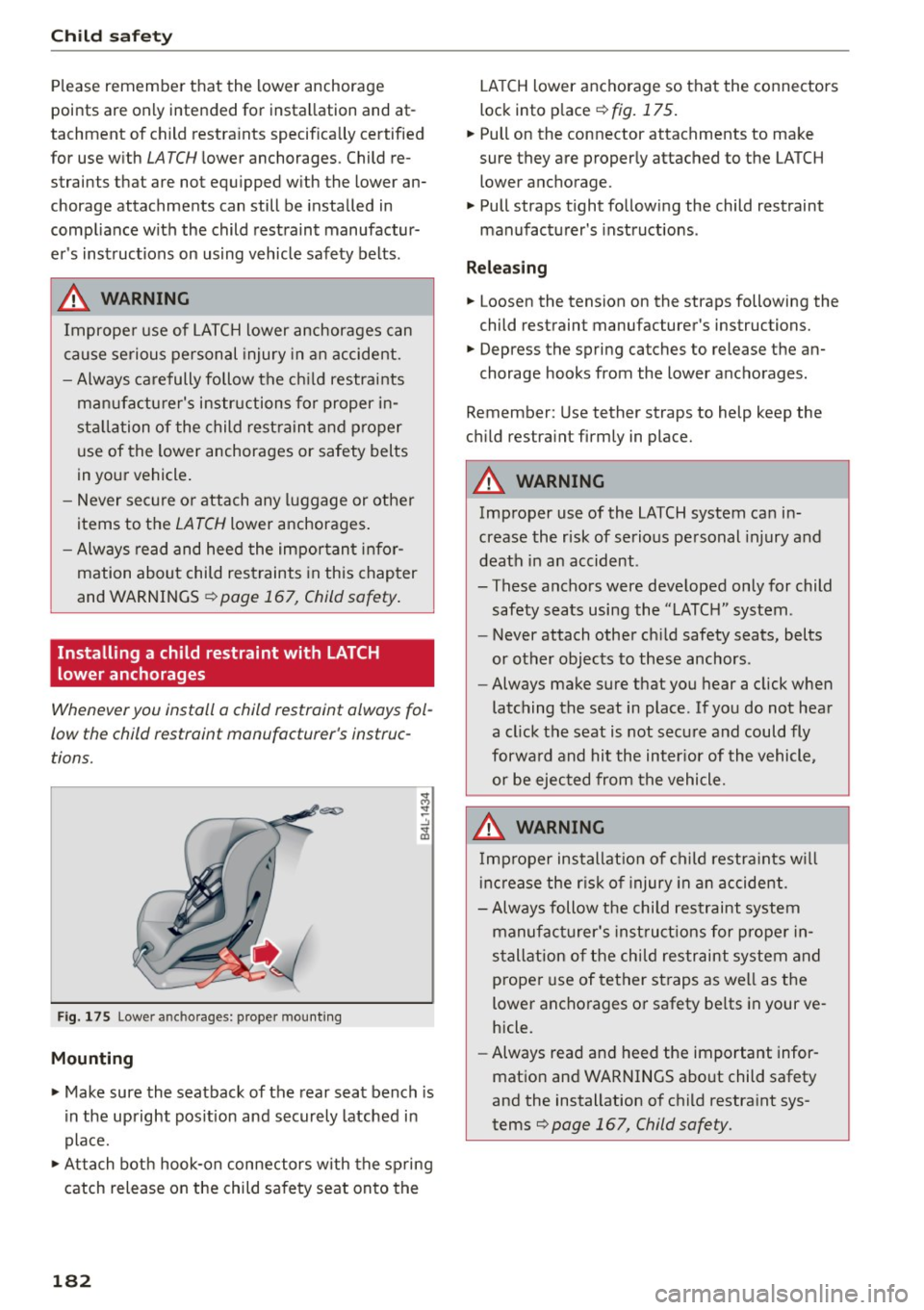
F ig . 175 Lowe r an ch orages: proper mount ing
Mounting
.,. Make sure the seatback of the rear seat bench is
i n the upright pos ition and securely latched in
place .
.. Attach both hook-on connectors with the spring
catch release on the child sa fety seat onto the
182
LA TC H lower anchorage so that the connectors
lock into p lace
<=> fig. 175 .
.. Pull on the connector attachments to make
sure they are properly attached to the LATCH lower anchorage .
.. Pull straps tight follow ing the child restraint
manufactu re r's instruct ions .
Releasing
.. Loosen the tension on the straps following the
child restraint manufacturer's instructions.
.. Depress the spring catches to release the an
chorage hooks from the lower anchorages .
Remember: Use tether straps to help keep the
ch ild restra int firmly in place.
A WARNING
-
Improper use of the LATCH system can in
crease the risk of serious pe rsonal injury and
death in an accident .
- These ancho rs were developed only for child
safety seats using the "LATCH" system .
- Never attach other ch ild safety seats, belts
or other objects to these anchors .
- Always make sure that you hear a click when
latching the seat in place. If you do not hear
a cl ick the seat is not secure and could fly
forward and hit the inter ior of the vehicle,
or be ejec ted from the vehicle.
A WARNING
Imp roper ins tallat ion of child restra ints w ill
inc rease the r is k of i njury in an a ccident.
- Always follow the chi ld restraint system
manufact urer's inst ruct ions for p rope r in
s tallat ion o f the child restraint system and
prope r use of te ther st raps as we ll as the
lower anchorages or safety be lts in your ve
hicle.
- Always read and heed the important infor
mation and WARNINGS abo ut child safety
and the installation of chi ld restra int sys
tems
r::> page 167, Child safety.
Page 190 of 294
Intelligent Technology
shared, p le a se see yo ur contract with the
wireless telecomm unications provider and the
"About Aud i connect" tab in your vehicle's
MMI:
! MENUI button> Audi connect > About
Audi connect .
Electronic Stabilization
Control (ESC)
Description
ESC helps to improve road holding and vehicle
dynamics to help reduce the probability of sk id
d ing and loss of veh icle control.
It works only
when the engine is runn ing. ESC detects certa in
d ifficult d riving situations, including when the ve
h icle is beginn ing to sp in (yaw) o ut of control and
he lps you to ge t the veh icle back u nder cont ro l b y
selec tively braking the whee ls, and/or reduc ing
engine power and providing steering assistance
to help hold the vehicle on the driver's i ntended
course. The indicator light
DJ in the instrument
cluster blinks when ESC is taking action to help
you control t he veh icle.
ESC has lim itations. It is important to remember
that ESC cannot overcome the laws of physics. It
will not a lways be ab le to he lp out under all con
d itions you may come up against. For example,
ESC may not always be able to help you master
situations where there is a sudden change in the
coefficient of friction of the road surface. Whe n
there is a section of d ry road tha t is s udden ly cov
ere d wi th wa ter, s lush or snow, ESC ca nnot per
form the same way it wou ld on the d ry s urface . If
the vehicle hydroplanes ( rides on a cushion of wa
ter instead of t he road surface), ESC wi ll not be
ab le to he lp you steer the veh icle because contact
with the pavement has been i nterrupted and the
ve hicle cannot be b raked or steered. Dur ing fast
cor ne ring, particula rly o n w inding roads, ESC
cannot a lways deal as eff ect ively wi th d iff icu lt
d riving situat ions than at lowe r speeds.
Always ad just your speed and dr iv ing style to
road, traffic and weather conditions. ESC ca nnot
over ride the vehicle's physical limi ts, increase t he
ava ilab le tract io n, or keep a vehi cle on t he road if
roa d de pa rture is a res ult o f driver in att enti on.
I nstead, ESC improves the poss ibility of keeping
188
the veh icle unde r control and on the road dur ing
extreme maneuve rs by using the dr iver's stee ring
i nputs to help keep the vehicle going in the in
tended direction. If yo u are traveling at a speed
that causes you to run off the road before ESC
can p rov ide any assistance, you may not experi
ence the benefits of ESC.
ESC is switc hed on all the time. In certain s itua
tions when you need less tracti on, you can switch
off ASR by press ing the button
[ru c:> page 189,
fig . 178. Be sure to sw itch ASR on aga in when
you no longer need l ess traction.
The following systems are integrated in the ESC:
Anti -lock braking system (ABS )
ABS prevents the whee ls from locki ng when brak
i ng . T he veh icle can st ill be stee red even during
hard braking. App ly steady pressure to the brake
pedal. Do not pump the pedal. A puls ing in the
brake pedal indicates that the system is acting to
stab ilize the veh icle.
Brake assist sy stem
The bra ke ass ist system can decrease braking dis
tance. It increases bra king power when the driver
presses the brake peda l quickly in emergency sit
uat ions. You must press and hold the b rake peda l
u nt il the dange rous situat io n is over . In vehicles
with adaptive cruise co ntro l*, the brake ass ist
system is more sensitive if t he d ista nce detected
to t he veh icle a head is too sma ll.
Anti-slip regulation (ASR)
ASR red uces eng ine power when the drive wheels
begin spin ning and adapts the force to the road
cond it ions . Th is makes it eas ier to sta rt, acce ler
ate a nd dr ive up incl ines.
Electronic differential lock (EDL)
EDL applies t he brakes to a whee l that starts
sp inning a nd tra nsfe rs the d rive power to the
othe r drivi ng whee ls. This function is not ava ila
ble at hig he r speeds.
In extreme cases, EDL automatically sw itches off
to keep the brake o n the braked whee l from over
hea ting. The vehicle is st ill work ing cor rect ly. EDL ..,.
Page 196 of 294
Intelligent Technology
& WARNING
Improp er operat ion of the rear spoiler can
cause crushing injuries.
- Always make sure that nobody, espec ially
children , is in the way when the rea r spo ile r
i s deployed or retracted.
@ Note
- Neve r push on the vehicle on the rear spoi l
er. Th is co uld cause damage .
- To prevent damage to the rear spoiler do
not lean or p lace anyth ing on it.
- Only ope rate the rear spoi ler manually when
the luggage compartment lid is close and
the rear spo iler moving parts are not
blocked . Ot herwise, damage could occur.
(D Tips
Clean the rear spoiler compartment every 2 to
3 mont hs. To function correct ly, the rear
sp oiler must be free of ice, sn ow and leav es.
Energy management
The starting ability is optimized
The energy management system manages the
ele ctrical energy distribu tion and op timi zes the
availability of elec trical energy for starting the
engine .
Whe n a ve hicle wit h a co nven tional e nergy sys
tem is not dr iven for a long time, the ba tte ry is
d rained by equipmen t (fo r example the immobil
izer). In certa in circ umstances, there cou ld may
not be eno ugh energy to start the engine .
Your veh icle i s equ ipped w ith an intellige nt ener
gy managemen t system for distr ibuting electr ic i
ty . Th is significantly improves the starti ng ability
a nd increases the battery life .
T he energy m anagemen t sys tem Is made up of
battery diagno sis, idling current management
and dynamic energy management.
Battery diagnosis
T he batte ry diagnos is determines the ba tte ry
ch arge leve l. The sen sors de te ct the ba tte ry, the
194
batte ry current, an d the batte ry tempera ture.
The c urrent charge leve l and the perfo rmance of
t h e battery are determined based on th is.
Idling current management
The idling cur ren t management decr eases the
energy used wh ile pa rke d. Wi th the eng ine
switched off, it manages the energy dis trib ution
to t he d ifferent e lectr ica l components . Date from
battery diagnos is is ta ken into acco unt for this .
Depend ing on the batte ry charge leve l, elec trical
equipmen t is switched off one item afte r th e o th
e r, to prevent the battery from dra ining and to
r etain the starting ability.
Dynamic energy management
While driv ing , d ynam ic ene rgy man agement dis
t ribu tes the ap propri ate amount of energy to the
e lectrica l equ ipment. It controls the battery
c h arge level so t hat more ene rgy is not use d then
i s be ing generated in order to maintain an opti
mal battery charge level.
(D Tips
- Energy management can not overcome the
laws of p hys ics. Note that the charge level
and length of the battery life a re limited.
- W he n the sta rting ability is endange red, the
(•j indicator light t urns on¢ page 16 .
What you should know
Maintaining the starting ability is the highest
priority .
A lot of st ress is placed on the ba ttery when dr iv
i ng sho rt distances, in t raff ic, and at cold t imes
of the year . A lot of ene rgy is used but little is
generated .
It is also critical when the engine is
not ru nning but e lectr ica l equipment is sw itched
o n. In th is case, energy is used but none is gener
ated.
In sit uat ions like this, energy ma nagement w ill
active ly regu lated the distribution of energy.
Long periods without use
If you do not drive yo ur vehicle for several days or
weeks, e lectr ica l equipment is grad ually scaled ..,.
Page 206 of 294
Trailer mode
(D Tips
If you move the selector lever of the a utomat
ic transmission to P be fore applying the par k
ing brake and before block ing the wheels, you
may have to use more force later to move the
lever out of the P position .
204