lock AUDI A7 2016 Repair Manual
[x] Cancel search | Manufacturer: AUDI, Model Year: 2016, Model line: A7, Model: AUDI A7 2016Pages: 294, PDF Size: 73.82 MB
Page 209 of 294
M N <( (.J
'SI: ,...., \!) 1.1'1
N \!) ,....,
Care and cleaning
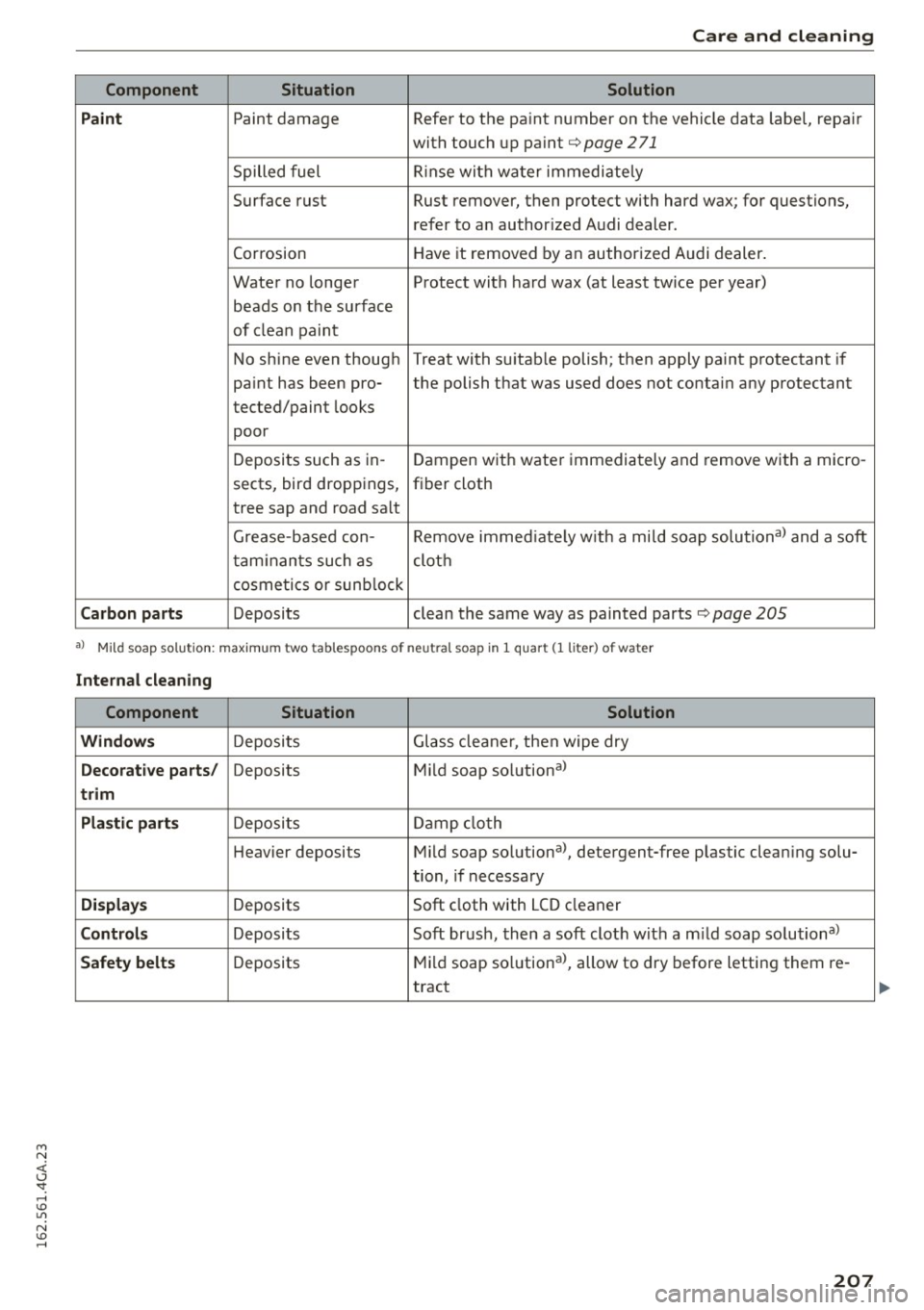
Component Situation Solution
Paint
Paint damage Refer to the paint number on the vehicle data label, repair
with touch up paint
c> page 271
Spilled fuel Rinse with water immediately
Surface rust Rust remover, then protect with hard wax; for questions,
refer to an author ized Audi dealer.
Corrosion Ha
ve it removed by an authorized Audi dealer.
Water no longer Protect with hard wax (at least tw ice per year)
beads on the surface
of clean paint
No shine even though Treat with suitab le polish; then apply paint protectant if
paint has been pro- the polish that was used does not contain any protectant
tected/paint looks
poor
Deposits such as in- Dampen with water immediately and remove with a micro-
sects, bird droppings, fiber cloth
tree sap and road sa lt
Grease-based con-Remove immediately with a mild soap solutional and a soft
taminants such as cloth
cosmetics or sunb lock
Carbon parts Deposits clean the same way as painted parts c> page 205
al Mild soap solu tion: maximu m two ta ble spoon s of neu tral soap in 1 quart (1 lit er) of water
Internal cleaning
Component Situation Solution
Windows
Deposits Glass cleaner, then wipe dry
Decorative parts/ Deposits Mild soap so lutiona>
trim
Plastic parts
Deposits Damp cloth
Heavier deposits Mild soap solutiona>, detergent-free plastic clean ing solu-
tion, if necessary
Displays Deposits
Soft cloth with LCD cleaner
Controls Deposits Soft brush, then a soft clot h with a m ild soap solutional
Safety belts Deposits Mild soap solutiona>, allow to dry before letting them re-
tract
207
Page 214 of 294
Fuel and Refueling
These fuels contain substances that can se
verely damage the fuel system and the en
gine if the engine is started.
Refueling
Fuel filler neck
The fuel filler neck is located on the right rear
side pane l beh ind the fuel filler flap .
If the power locking system should fail, you can
still open the flap manually - for detailed instruc
tions see
¢page 214.
You can find the fuel tank capacity of your vehicle
in
¢ page 272 .
The label on the inside of the fuel filler flap tells
you the correct fuel for your vehicle. For more in
formation about fuel specifications, see
¢ page 210 .
Your vehicle fuel tank has an on board refuelling
vapor recovery system. This feature helps to pre
vent fuel vapors from escaping from the tank and polluting the environment while you refue l your
vehicle. In order to fill the tank properly whi le
protec ting the environment, please follow this
refueling procedure carefully.
8_ WARNING
Under normal operating conditions, neve r ca r
ry additional fuel containers in your car. Gas
canisters and other containers used to trans
port fuel can be dangerous. Such containers,
full or empty, may leak and could cause a fire
in a collision. If you must transport fuel to
use for your lawn mowe r, snow blower, etc.,
be very careful and always observe loca l and
state laws rega rding the use, transportation
and storage of such fuel containers. Make cer
tain the con tainer meets industry standards
(ANSI/ASTM F852 -86).
(D Note
Never drive you r vehicle until the fuel tank is
completely empty. The irregu lar supply of
fue l can cause misfiring. Gasoline could enter
the exhaust system and damage the catalytic
converter.
212
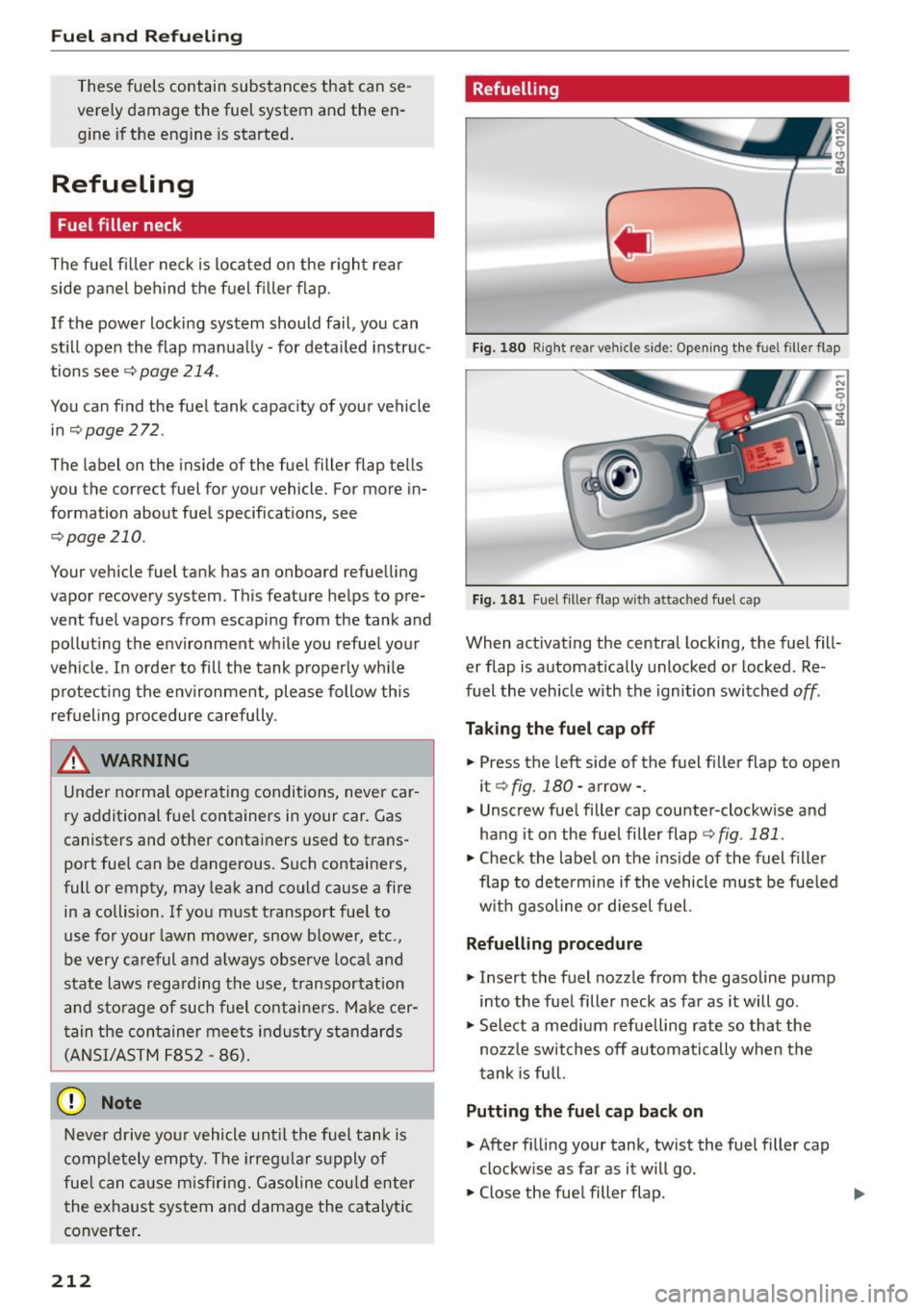
Refuelling
Fig. 180 R ig ht rea r ve hicle side : Opening the fuel fill er flap
Fig. 181 Fuel fille r flap w ith attac hed fuel cap
When act ivating the central locking, the fuel fill
er flap is automatically unlocked or locked . Re
fuel the veh icle with the ignition switched
off.
Taking the fuel cap off
.. Press the left side of the fuel f iller flap to open
it ¢
fig. 180-arrow-.
.. Unscrew fuel filler cap counter-clockwise and
hang it on the fuel filler flap
~ fig . 181 .
.. Check the label on the ins ide of the fuel filler
flap to determine if the vehicle must be fue led
w ith gasoline or diesel fuel.
Refuelling procedure
.. Insert the fuel nozzle from the gasoline pump
into the fuel filler neck as far as it will go .
.. Select a medium refuelling rate so that the
nozzle switches off automatically when the
tank is full.
Putting the fuel cap back on
.. After filling your tank, twist the fuel filler cap
clockw ise as far as it will go .
.. Close the fuel filler flap . ..,_
Page 216 of 294
Fuel and Refueling
case, try turning the nozzle before inserting
it in the fuel fi ller neck, use a different fuel
pump or see your authorized Audi dea ler or
authorized repair facility for assistance.
- The fuel filler flap of your vehicle is not
l ocked when you lock the vehicle from the
inside .
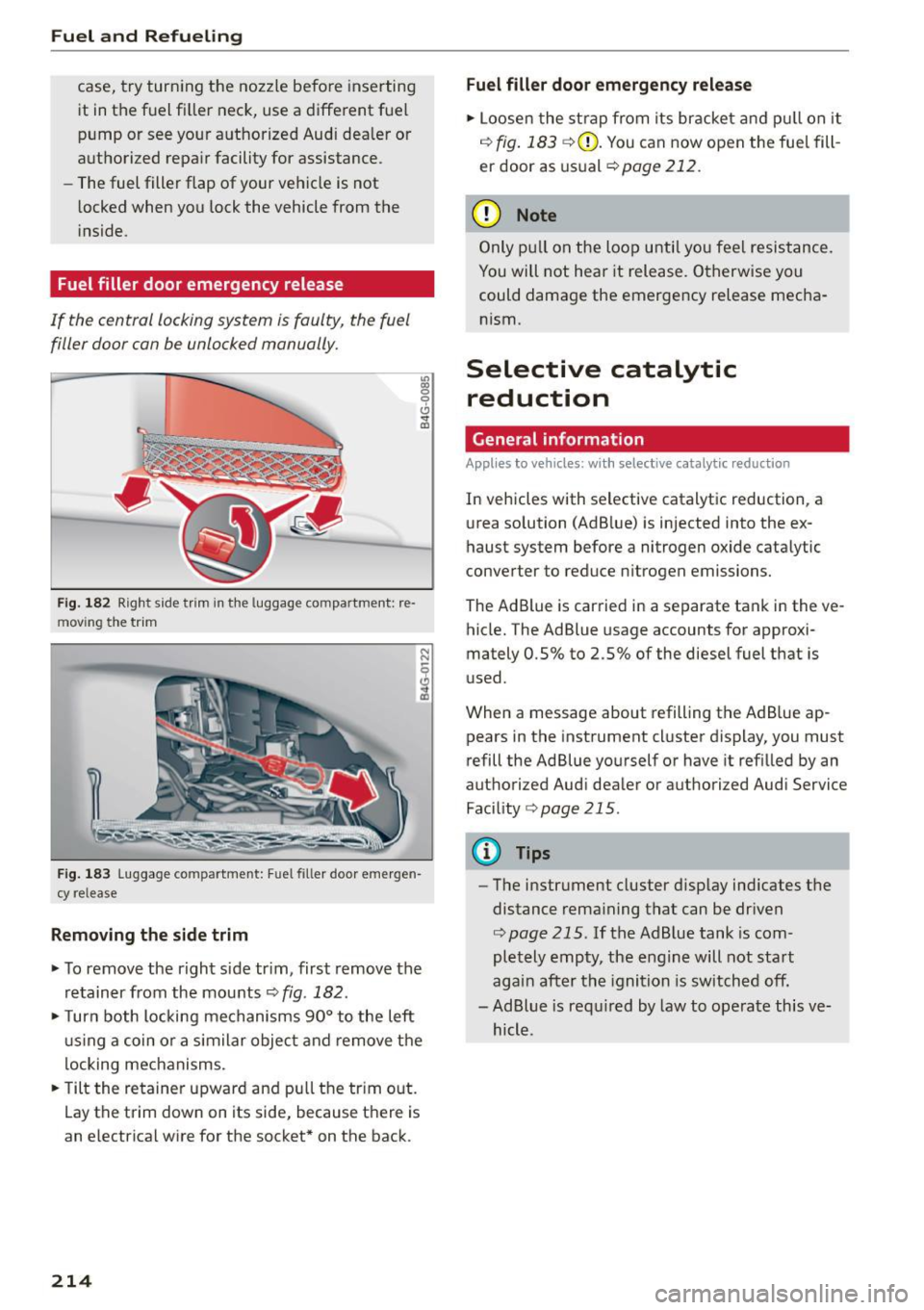
Fuel filler door emergency release
If the central locking system is faulty, the fuel
filler door can be unlocked manually.
Fig. 182 Right side tri m in the luggag e compartme nt: re·
mov ing the trim
"' ~ 0
<.:l
Fig. 183 Luggage compartment: Fuel filler door emergen
cy release
Removing the side trim
• To remove the right side tr im, first remove the
retainer from the mounts
r:!.> fig. 182.
• Turn both locking mechanisms 90° to the Left
using a coin or a similar object and remove the
locking mechanisms.
• Tilt the retainer upward and pu ll the tr im out.
Lay the trim down on its side, because there is
an electrical wire for the socket* on the back.
214
Fuel filler door emergency release
• Loosen the strap from its bracket and pull on it
r:!.> fig. 183 r:!.>{2) . You can now open the fuel fill
er door as usu al
r:!.> page 212.
(D Note
Only pull on the Loop until you feel resistance.
You will not hear it release. Otherwise you
could damage the emergency release mecha nism.
Selective catalytic reduction
General information
Applies to vehicles: with selective catalyt ic red uction
In vehicles with selective catalytic reduction, a
urea solution (AdB lue) is injected into the ex
haust system before a nitrogen oxide catalytic
converter to reduce nitrogen emissions.
The Ad Blue is carried in a separate tank in the ve
hicle. The Ad Blue usage accounts for approxi
mately O. 5 % to 2. 5% of the diesel fuel that is
used.
When a message about refilling the AdBlue ap
pears in the instrument cluster display, you must
refill the Ad Blue yourself or have it refilled by an
authorized Audi dealer or authorized Audi Service
Facility
r:!.> page 215.
{!) Tips
-The instrument cluster d isp lay indicates the
distance remaining that can be driven
r:!.>page 215. If the AdBlue tank is com
pletely empty, the engine will not start
again after the ignition is switched off.
- Ad Blue is requ ired by law to operate this ve
hicle.
Page 217 of 294
M N <( I.J "". rl I.O
"' N I.O rl
Messages in the instrument cluster display
Applies to vehicles: with selective catalyt ic reductio n
The display indicates if the Ad Blue level is low or
if there is a system malfunction .
AdBlue level low
You will be informed if the Ad Blue in the tank
drops be low a certain level.
Please refill Ad Blue. Range 1500 mi (2400 km )
This message appea rs whe n there is o nly enoug h
Ad B lue left to dr ive the d ist ance ind icated in the
d river i nfo rmation sys tem . Fill the AdBl ue.
Ad Blue ,0 Refill AdBlue! No restart in 600 mi
( 1000 km)! See owner 's manual
This message appea rs when there is o nly enoug h
Ad Blue left to dr ive the distance indicated in the
d river info rmation system . Fill the Ad Blue . Othe r
wise the eng ine will not sta rt again if you s top it
once the di stan ce in dicated ha s been driven. You
can also check t he rem ain ing distance in the on
board comp ute r*.
Refill Ad Blu e! No restart! See own -
er' s manual
This message appea rs whe n the AdBlue tank is
empty . Fill t he AdBl ue. Othe rw ise you w ill not be
ab le to start the engine aga in once yo u stop it.
T he AdBlue must be refi lled when t he amo unt in
the tank has reac hed the m inimum leve l
q page 215, Filling Ad Blue .
Incorrect filling/system malfunction
A message appears if the AdBl ue tank was filled
with a fluid other than AdBlue and the system has detected t hat the ta nk was f illed incor rectly,
or if there is a sys tem ma lf u nction .
Ad Blue -I' Ad Blue: System fault! No restart in
600 mi (1000 km). See owner's manual.
This message appea rs when it is only poss ible to
drive the d istance ind icated in the dr iver informa
tion system. Drive to the nearest authori zed Audi
dealer or authorized Aud i Service Fac ility to have
the ma lfunction corrected . Otherwise the engine
w ill not start aga in if you stop it once the dis
tance ind icated has been driven .
Fuel and Refueling
AdBlue: System fault No restart!
See owner's manual
T his mes sage ap pea rs if t he system h as detec ted
t h at the t ank was fi lled incor rectly o r tha t there
is a ma lf u nction . Drive immed iate ly to the near
est authorized A udi dealer or autho rized A udi
Se rv ice Facility to have the ma lf u nction co rrect
ed. Otherwise yo u will not be ab le to start the en
gine aga in once you stop it .
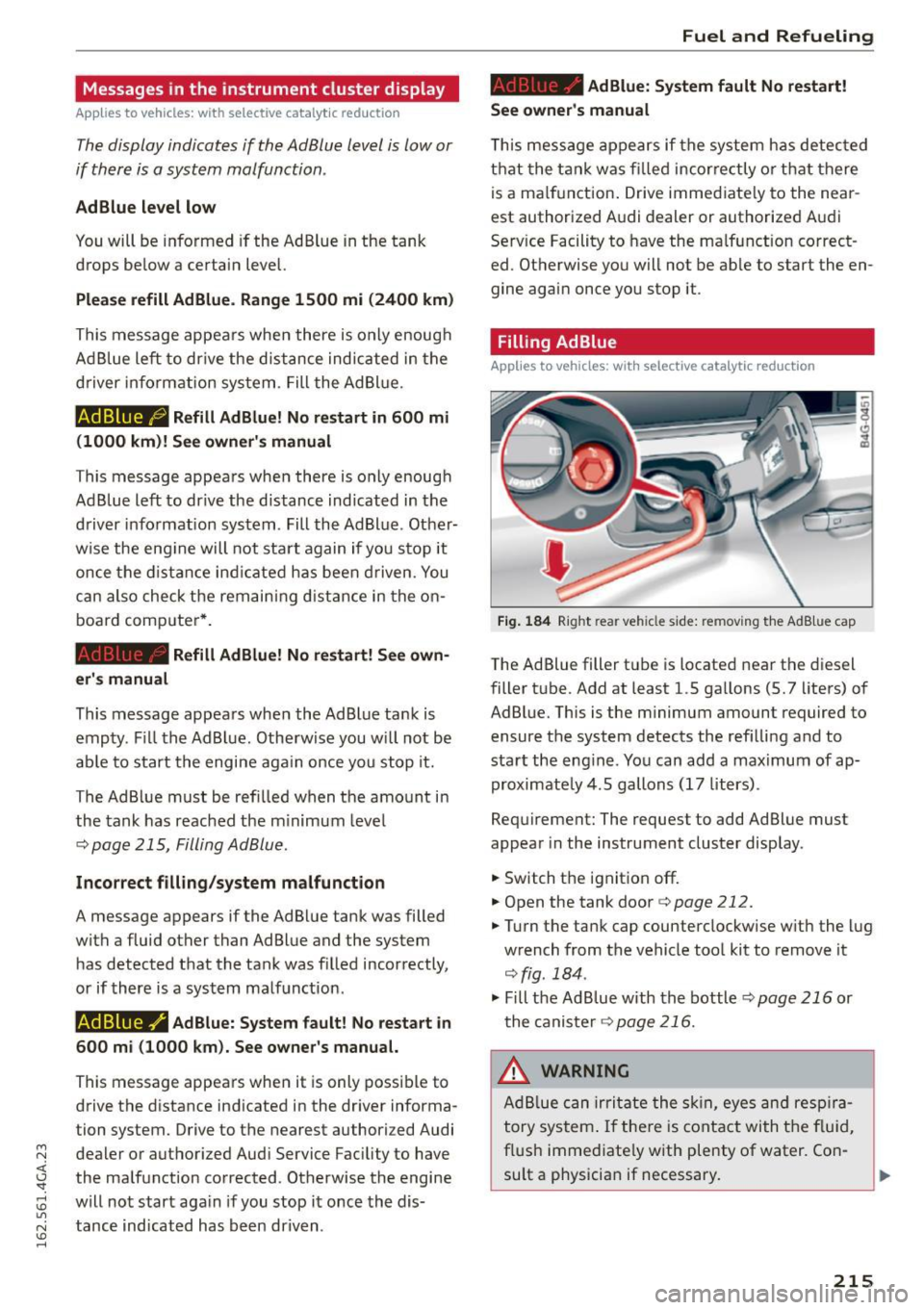
Filling AdBlue
Applies to vehicles: with selective catalytic reduction
Fig. 184 Rig ht rea r ve hicle s ide: re m oving t he AdB lu e cap
The Ad Blue filler t ube is located near the diesel
filler t ube . Add at least 1.5 ga llons (5.7 liters) of
AdBl ue. This is the m inimum amount required to
ensure the system detects the refi lling a nd to
start the eng ine . Yo u can add a max imum of ap
proximate ly 4.5 gallons (17 liters) .
Req uirement: The request to add Ad Blue must
appear in the instrument cluster display .
.. Switch t he ignit ion off .
.. Open the tank door
q page 212.
.,. Turn the tank cap counterclockwise w it h the lug
w rench from the vehicle too l kit to remove it
q fig . 184 .
.,. Fill the Ad Blue with th e bottl e ~ page 216 or
the caniste r<=>
page 216.
.&_ WARNING
Ad Bl ue can irri tate the skin , eye s and respira
tory sys tem . If the re is con tact with t he flu id,
f lush imme diate ly w ith plenty of water. Co n-
su lt a physicia n if necessary. .,,_
215
Page 218 of 294
Fuel and Refueling
CJ) Note
-Only use Ad Blue that conforms to the
standard ISO 22241-1. Do not mix any addi
tives with the AdBlue and do not di lute it
with water.
- Do not add Ad Blue to the diesel tank or add diesel fuel to the AdBlue tank. Mixing can
lead to damage to the engine and the Ad Bl
ue tank system .
- Ad Blue attacks surfaces such as painted ve
hicle components, plastic and carpet . Re
move the fluid as quickly as poss ible with a
damp cloth and plenty of cold water. If the
AdBlue has already crysta llized, use warm
water and a sponge. Ad Blue residue that is
not removed will crysta llize and can damage
the affected su rface.
- Do not store refill bottles or canisters per
manently in the vehicle. If the container
l eaks, the escaping Ad B lue cou ld damage
the vehicle interior.
- Do not allow Ad Blue to come into contact
with clothing. If there is contact with the
fluid, flush immediately with plenty of wa
ter.
{D) Tips
Follow the Ad Blue manufacturer's instruc
tions for use and storage.
Refilling AdBlue with a bottle
Applies to veh icles: w ith selective catalyt ic reductio n
"' Remove the cap from the refill bottle c:> .&. in
Filling AdB/ue on page
215, c:> (D in Filling
AdB/ue on page
216.
"' Position the bottle on the filler tube and turn
the bottle clockwise until it stops turning.
"' Press lightly against the bottom of the bottle
to empty it. Continue pressing the bottom of
the bottle unti l it is empty or until fluid stops
flowing into the tank.
"'T urn the bott le to the left without pressing on
the bottom.
"' Close the filler neck
c:> page 217, Completing
AdBlue refill .
216
(D Tips
-You can obtain refill bottles from an author
ized Audi dea ler or authorized Audi Service
Facility.
- A refill bottle contains approximately O.S
gallon (1.9 liters) of Ad B lue.
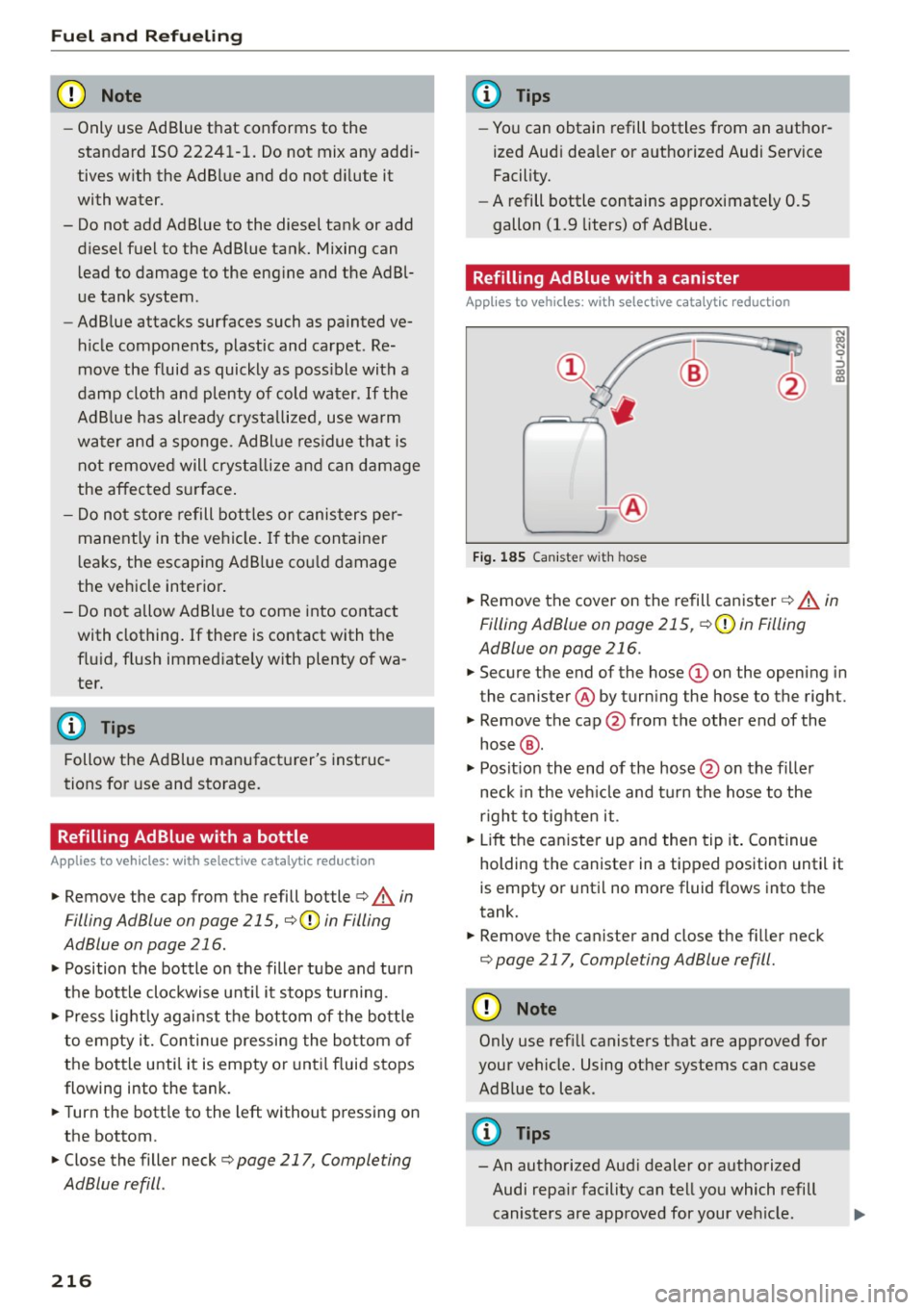
· Refilling Ad Blue with a canister
App lies to vehicles : wit h selective cata lyt ic reduction
®
+®
Fig. 185 Canis te r w ith hose
N
Filling AdBlue on page
215, c:> (D in Filling
AdBlue on page 216.
"'Secure the end of the hose (Don the opening in
the canister @by turning the hose to the right.
"' Remove the cap@from the other end of the
hose @.
"' Posit ion the end of the hose @on the filler
neck in the vehicle and turn the hose to the
r ight to tighten it.
"' Lift the canister up and then tip it. Continue
holding the canister in a tipped position until it
is empty or until no more fluid flows into the
tank.
"' Remove the canister and close the filler neck
c:> page 217, Completing AdBlue refill.
(D Note
Only use ref ill canisters that are approved for
your vehicle. Using other systems can cause Ad Blue to leak .
0) Tips
-An authorized Aud i dealer or authorized
Audi repa ir facility can tell you which refill
canisters are approved for your veh icle.
Page 221 of 294
M N <( (.J
'SI: ,...., \!) 1.1'1
N \!) ,....,
-Do not remove the engine cover under any
circumstances. This increases the risk of
burns.
- If work on the fuel system or the electrical
system is necessary :
- Always disconnect the battery.
- Never smoke or work near heaters or open
flames . Fluids in the engine compartment
could start a fire.
- Keep an approved fire extinguisher imme
diately available.
- To avoid electrical shock and personal injury
while the engine is running or being started,
never touch:
- Ignition cables
- Other components of the high voltage
electronic ignition system.
-If you must perform a check or repair with
the engine running:
- First, fully apply the parking brake, move
selector lever to P (Park).
- Always use extreme caution to prevent
clothing, jewelry, or long hair from getting
caught in the radiator fan, V-belts or other moving parts, or from contacting hot
parts. Tie back hair before starting, and do
not wear clothing that will hang or droop
into the engine.
- Minimize exposure to emission and chemi
cal hazards ¢.&. .
..&, WARNING
California Proposition 65 Warning:
- Engine exhaust, some of its constituents,
and certain vehicle components contain or
emit chemicals known to the State of Cali
fornia to cause cancer and birth defects and
reproductive harm. In addition, certain flu
ids contained in vehicles and certain prod
ucts of component wear contain or emit
Checking and Filling
chemicals known to the State of California
to cause cancer and birth defects or other
reproductive harm.
- Battery posts, terminals and related acces
sories contain lead and lead compounds,
chemicals known to the State of California
to cause cancer and reproductive harms.
Wash hands after handling .
([) Note
When adding fluids, always make sure that
they are poured into the proper container or
filler opening, otherwise serious damage to
vehicle systems will occur .
® For the sake of the environment
To detect leaks in time, inspect the vehicle
floor pan from underneath regularly. If you
see spots from oil or other vehicle fluids, have
your vehicle inspected by an authorized Audi
dealer .
Closing the engine hood
.,.. Pull the hood down until the pressure from the
struts is reduced.
.,.. Let the hood
drop down and latch in place. Do
not try to push it shut;
it may fail to engage
¢ ,& .
..&, WARNING
--A hood that is not completely latched could
fly up and block your view while driving .
- When you close the engine hood, check it to
make sure the safety catch has properly en
gaged . The hood should be flush with the
surrounding vehicle body parts .
- If you notice while driving that the hood is
not secured properly, stop at once and close
it .
-
219
Page 227 of 294
M N <( (.J
'SI: ,...., \!) 1.1'1
N \!) ,....,
~ Park your vehicle on a level surface.
~ Switch off the ignition .
~ Read the eng ine coolant leve l from the coolant
expansion tank
c> fig. 191, c> page 220,
fig. 188.
With a cold engine, the coolant level
should be between the "min" and "max" mark
i ngs. When the engine is warm, the level may
be s light ly above the "max" marking.
The location of the coolant expans ion tank can be
seen in the engine compartment illustrat ion
i=>page220.
To obtain an accurate reading, the engine must
be sw itched
off.
The expansion tank in you r vehicle is equipped
with an electric coolant level sensor.
When the coo lant level is too low, the warning
light in the Auto-Check System
c:> page 15 wi ll il
l uminate unti l you a dd coolant and the level has
been restored to norma l. Even though there is an
e lectric coolant level sensor, we still recommend
you check the coolant level from time to time.
Coolant loss
Coolant loss may i ndicate a leak in the coo ling
system . In the event of coo lant loss , the cooling
system should be inspected immed iate ly by your
author ized Audi dealer. It is not enough merely
to add coolant .
In a
sealed system, losses can occur only if the
boiling point of the coo lant is exceeded as a re
sult of overheat ing.
A WARNING
The cooling system is under pressure and can
get very hot. Reduce the risk of scalding from
hot coolant by following thes e steps.
- Turn off the engine and allow it to coo l
dow n.
- Protect yo ur face, hands and arms from es
caping fluid and steam by cove ring the cap
with a la rge, th ick rag.
- Turn the cap slowly and ve ry carefu lly in a
counte r-clockw ise direct io n wh ile a pplying
light, downwa rd pr essur e on the top of the
c ap.
Checking and Fillin g
-To avo id being burned, do not sp ill anti
freeze o r coolant on the exha ust system or
hot engine parts. Under certa in cond itions,
the ethylene glyco l in engi ne coo lant can
ca tch fire.
(D Note
Do not add any type o f radiator leak sea lant
to you r vehicle 's engi ne coolant . Add ing radia
tor repair fluid may adversely affect the func
tion and pe rformance of your coo ling system
and could r esult in damag e not cover ed by
your New Veh icle Limited Warranty.
Adding coolant
Be very careful when adding engine coolant.
Before you check a nyth ing in the eng ine compart
me nt,
always read and heed all WARNINGS
c> .&. in Working in the engine compartment on
page 218.
~ Requirement: T here must be a residua l amount
of coolant in the expansion tank
c:> (D .
~Tu rnoff the engi ne.
~ Le t the eng ine cool down.
~ Place a thick rag ove r the coo lan t expansion
t ank
c:>page 224, fig. 191 and carefully tw ist
t he cap coun ter- clockwise
c:> .&, .
~ Ad d coo lant mixed in the correc t ra tio
c:> page 224, Coolant up to the MAX marking .
~ Make sure that the fl uid leve l remains stab le.
Add more coo lant if necessary.
~ Twist the cap o n again tightly.
Rep lacement engine coo lant must confo rm to ex
act specifications
c> page 224, Coolant.
We recommend using only coo lant add it ive G1 2+
+ , G 13 or in an emergency G12+. Do
not use a
different additive. In an emergency use p lain wa
ter unt il you can get the correct add itive and can
restore the correct ratio. This should be done as
soon as possib le.
If you have lost a considerab le amou nt of cool
ant, then you shou ld add cold antifreeze and co ld
water only whe n the eng ine is co ld.
Always use
new engine coo lant w hen refilling.
225
Page 228 of 294

Checking and Filling
Do not fill coolant above the "MAX" mark. Excess
coolant will be forced out through the pressure relief valve in the cap when the engine becomes
hot.
A WARNING
- The cooling system is under pressure and
can get very hot. Reduce the risk of scalding
from hot coolant by following these steps .
- Turn off the engine and allow it to cool
down.
- Protect your face, hands and arms from
escaping fluid and steam by covering the
cap with a large, thick rag.
- Turn the cap slowly and very carefully in a
counter-clockwise direction while applying light, downward pressure on the top of
the cap.
- To avoid being burned, do not spill anti
freeze or coolant on the exhaust system or
hot engine parts. Under certain condi
tions, the ethylene glycol in engine cool
ant can catch fire .
-Antifreeze is poisonous. Always store anti
freeze in its original container and well out
of the reach of children .
- If you drain the coolant, it must be caught
and safely stored in a proper container
clearly marked "poison" .
(D Note
- Do not add coolant if the expansion tank is empty. Air could enter the cooling system
and damage the engine. If this is the case,
do not continue driving. Seek professional
assistance .
- Coolant pollutes the environment and could cause an engine fire. Excess coolant will be
forced out through the pressure relief valve
in the cap when the engine becomes hot.
- If, in an emergency, only water can be add
ed, the correct ratio between water and an
tifreeze
¢ page 224 must be restored as
soon as possible.
226
-
® For the sake of the environment
Drained coolant should not be reused. Always
dispose of used coolant while observing all
environmental regulations.
Radiator fan
The radiator fan switches on automatically by it
self
An auxiliary electric radiator fan switches on and
off depending on coolant temperature and other
vehicle operating conditions.
After you switch the engine off, the auxiliary fan
can continue running for up to 10 minutes -even
with the ignition off. It can even switch on again later by itself ¢& . if
- the temperature of the engine coolant rises due
to the heat build-up from the engine in the en
gine compartment, or
- the engine compartment heats up because the
vehicle is parked in intense sunlight.
A WARNING
- To reduce the risk of personal injury never
touch the radiator fan.
- The auxiliary electric fan is temperature con
trolled and can switch on suddenly even
when the engine is not running.
- The auxiliary radiator fan switches on auto
matically when the engine coolant reaches a
certain temperature and will continue to run
until the coolant temperature drops. -
Page 229 of 294
M N <( I.J "". rl I.O
"' N I.O rl
Brake fluid
Checking brake fluid level
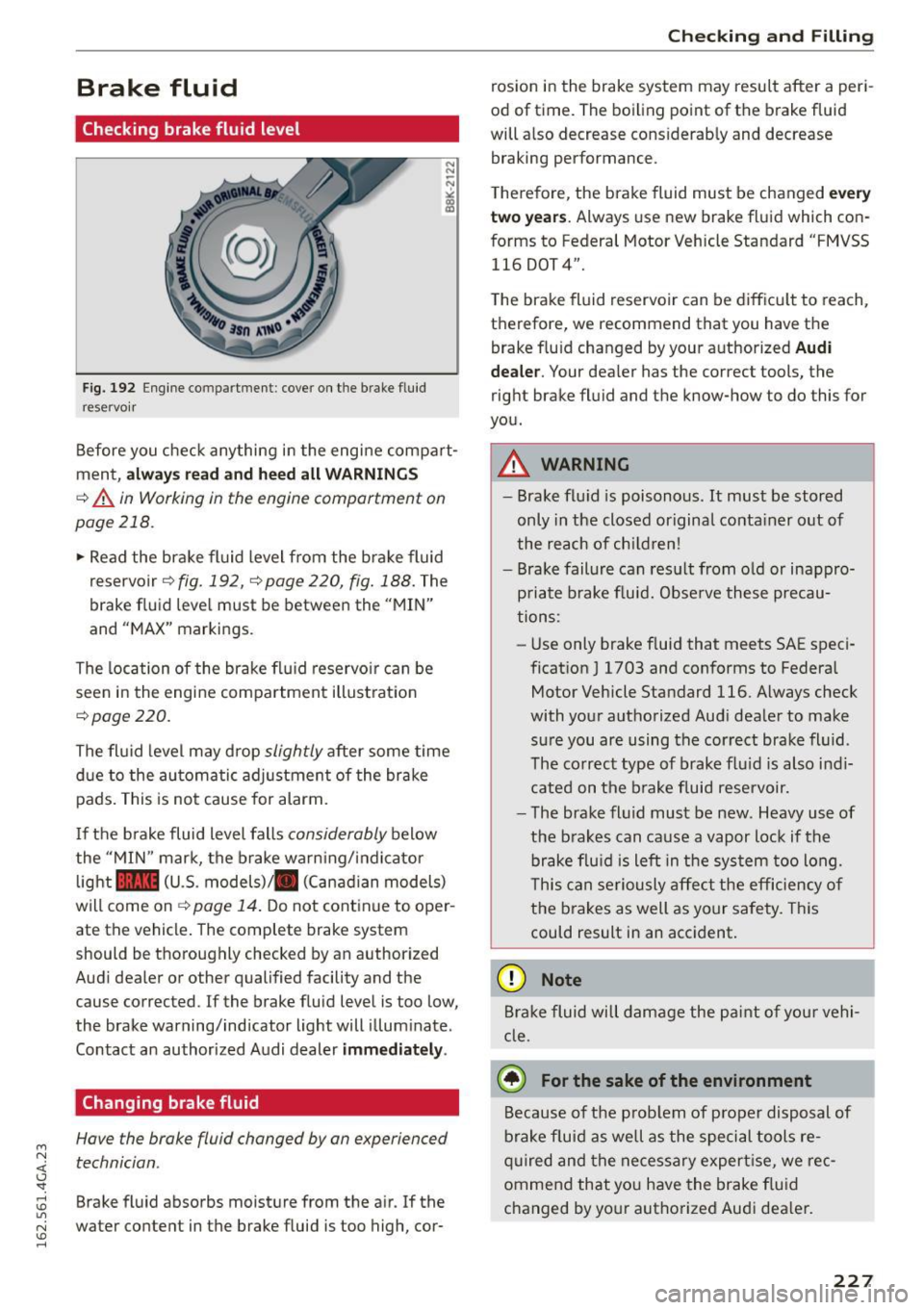
Fig. 192 Engine compa rtment : cove r on the brake f luid
reservoir
N
N
-N ,::
~
Before you check anything in the engine compart
ment,
always read and heed all WARNINGS
¢ A in Working in the engine comportment on
page 218.
.,. Read the brake fluid level from the brake fluid
reservoir
¢ fig. 192, ¢page 220, fig. 188. The
brake fluid leve l must be between the "MIN"
and "MAX" markings .
The location of the brake f luid reservo ir can be
seen in the engine compartment illustration
¢page 220.
The fl uid level may drop slightly after some time
due to the automatic adjustment of the brake
pads. This is not cause for alarm.
I f the brake fluid level falls
considerably below
the "MIN" mark, the brake warning/indicator
light
1111 (U .S. models)/ . (Canadian models)
will come on ¢
page 14. Do not cont inue to oper
ate the vehicle . The complete brake system
should be thoroughly checked by an authorized
Audi dealer or other qualified facility and the cause corrected. If the brake fluid level is too low,
the brake warning/indicator light will illuminate.
Contact an authorized Audi dealer
immediately .
Changing brake fluid
Hove the broke fluid changed by on experienced
technician .
Brake fluid absorbs moisture from the air. If the
water content in the brake fluid is too high, cor-
Checking and Filling
rosion in the brake system may result after a peri
od of time. The boiling point of the brake fluid
will also decrease considerably and decrease braking performance .
T herefore, the brake fluid must be changed
every
two years.
Always use new brake fluid which con
forms to Federal Motor Vehicle Standard "FMVSS
116 DOT 4".
The brake fluid reservoir can be difficult to reach,
therefore, we recommend that you have the brake flu id changed by your authorized
Audi
dealer .
Your dea ler has the correct tools, the
right brake fluid and the know-how to do this for
you .
_&. WARNING
-.
- Brake fluid is poisonous . It must be stored
only in the closed original conta iner out of
the reach of children!
- Brake failure can resu lt from o ld or inappro
p riate brake fluid. Observe these precau
tions:
- Use only brake fluid that meets SAE speci
fication
J 1703 and conforms to Federa l
Motor Vehicle Standard 116. Always check
with your authorized Audi dealer to make
sure you are using the correct brake fluid .
The correct type of brake flu id is also ind i
cated on the brake fluid reservoir.
- The brake fluid must be new. Heavy use of
the brakes can cause a vapor lock if the
brake fluid is left in the system too long.
T his can seriously affect the efficiency of
the brakes as well as your safety. This
could result in an accident.
(D Note
Brake fluid will damage the paint of your vehi
cle.
@ For the sake of the environment
Because of the problem of prope r disposal of
brake fluid as well as the special tools re
quired and the necessary expertise, we rec
ommend that you have the brake flu id
changed by your authorized Audi dealer.
227
Page 255 of 294
M N <( I.J "". rl I.O
"' N I.O rl
Emergency assistance
Warning triangle
A pp lies to vehicles: Wi th wa rning tri angl e
D
\,-------:----- 11
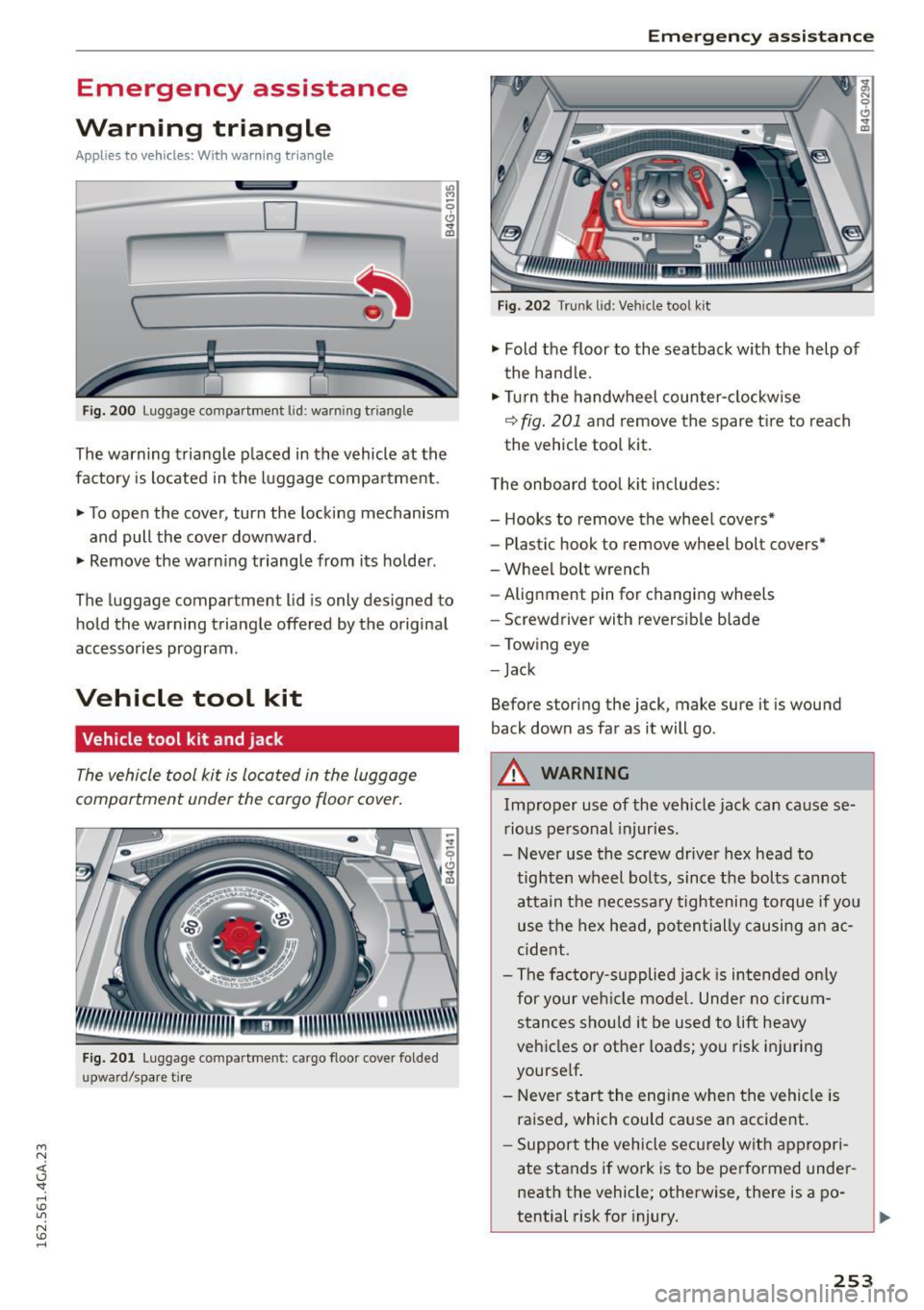
Fig. 200 Luggage co mpa rtment l id : wa rnin g t ria n gle
The warning triangle p laced in the vehicle at the
factory is located in the luggage compartment .
• To open the cover, turn the locking mechanism
and pull the cover downward .
• Remove the warn ing triangle from its holder .
The luggage compartmen t lid is only designed to
hold the warning triangle offered by the original
accessories program .
Vehicle tool kit
Vehicle tool kit and jack
The vehicle tool kit is located in the luggage
comportment under the cargo floor cover .
Fig. 201 Lugg age co mpartment : ca rgo f loo r cover folded
up ward/ spa r e ti re
Em erg en cy ass is tan ce
Fig. 202 Trun k lid: Vehicl e too l kit
• Fold the floor to the seatback with the help of
t he hand le.
• Tu rn the handwheel counter-clockwise
r=;, fig. 201 and remove the spare tire to reach
the vehicle tool kit.
T he onboard tool kit includes :
- Hooks to remove the wheel covers*
- Plastic hook to remove wheel bol t covers"
- Wheel bolt wrench
- Alignment pin for changing wheels
- Screwdriver with reversib le b lade
- Tow ing eye
- Jack
Before storing the jack , make sure it is wound
back down as far as it will go .
A WARNING
'"' -Im proper use of the vehicle jack can cause se
rious pe rsonal injuries .
- Never use the screw driver hex head to
tighten wheel bolts, since the bolts cannot attain the necessary tightening torque if yo u
use the hex head, po ten tially causing an ac
cident.
- The fa ctory-supplied jack is intended only
for your ve hicle model. Unde r no circum
stances shou ld it be used to lift heavy
vehicles or other loads; you risk injuring
yourse lf.
- Never start the engi ne when the vehicle is
raised, which could cause an accident.
- Support the vehicle securely with appropri
ate stands if work is to be pe rformed under
neath the vehicle; otherwise, there is a po
tential risk for injury.
253