warning AUDI A7 2017 Owner´s Manual
[x] Cancel search | Manufacturer: AUDI, Model Year: 2017, Model line: A7, Model: AUDI A7 2017Pages: 284, PDF Size: 72.29 MB
Page 151 of 284
co
co
.... N
" N .... 0
00
\.J -
ro llovers .
Alwa ys rememb er: Airbags will deploy only o nce,
and on ly in certain kinds of coll is ions. Your safety
be lts are always there to offer protection in those
situations in which airbags are not supposed to
deploy, or when they have a lready deployed; for
examp le, when your vehicle str ikes or is struck by
another vehicle after the first collis ion.
This is just one of the reasons why an airbag is a
supp lementary restraint and is not a substitute
for a safety belt. The airbag system works most effect ively when used with the safety belts.
T herefore, always properly wear your safety belts
c::> page 140.
A WARNING
Sitting too close to the steer ing whee l or in
st rument panel will decrease the effect ive
ness of the airbags and will inc rease the risk
o f persona l injury in a co llision.
- Never sit closer than 10 inches (25 cm) to
the steering wheel or instrument panel.
- If you cannot sit mo re than 10 inches
( 2 5 cm) from the steering wheel, inves ti
gate whethe r adaptive equipment may be
available to help you reach the pedals and
increase your seating distance from the
steering wheel.
- All veh icle occupants and especially children
must be restrained properly whenever riding
in a vehicle. An unrestrained or improperly
restra ined child could be injured by striking
the inte rior or by being ejected from the ve
hicle d uring a sudden maneuver or impact.
An unrestrained or imp roperly restrained
child is also at greate r ris k of inju ry or death
through contact with an infla ting airbag .
-If you are unrest rained, leaning fo rwa rd, s it
t ing s ideways or o ut of pos ition in any way,
yo ur risk of in jury is m uch higher.
- Yo u will also receive serious injur ies and
c ou ld even be killed if you are up aga inst the
airbag or too close to it w hen it inf lates -
even with an Advanced Ai rbag.
-
Airb ag sys tem
-To reduce the r is k of injury when an airbag
inflates, always wear sa fety belts prope rly
c::> page 143, Safety belts.
- Always make certain that children age 12 or
younge r always ride in the rear seat. If chil
dren are not properly restrained, they may be severely injured or killed when an airbag
inflates.
- Never let children r ide unrestrained or im
p roperly restrained in the vehicle. Ad just the
front seats properly.
- Never ride with the back rest recl ined .
- Always sit as far as possible from the steer-
ing wheel or the instrument panel
c::> page 130.
- Always sit upright with your back against
the backrest of your seat .
- Never p lace your feet on the instrument
panel or on t he seat. Always keep both feet
on the floor in front of the seat to help pre
vent ser ious injuries to the legs and hips if
the airbag inflates.
- Never recl ine the front passenger's seat to
transpo rt objects . Items can also move in to
the area of the s ide a irbag or the front air
b ag d uring braking o r in a sudden maneu
ver. Obje cts ne ar the airbags can be come
projecti les and cause injury when an airbag
inflates .
A WARNING ,____ -
Airbags that have deployed in a crash m ust be
replaced.
- Use on ly original equipment airbags ap
proved by A udi and installed by a t rained
technician who has the necessary tools and
d iagnostic equipment to properly replace
any airbag in yo ur vehicle and assure system
effect iveness in a crash .
- Never permit salvaged or recycled airbags to
be installed in your vehicle.
Child restraints on the front seat - some
important things to know
.,. Be s ure to read the impo rtan t in format ion and
heed the WARN INGS for important deta ils
149
Page 153 of 284
co
co
.... N
" N .... 0
00
\.J '
installed on the front seat may be struck and
knocked out of position by t he rapidly inflating
passenger 's airbag in a frontal co llision . The air
bag could greatly reduce the effectiveness of the
chi ld restraint a nd even seriously i njure the ch ild
during inflation .
For this reason, and because the back seat is the
safest place for ch ildren -when properly restra in
ed according to the ir age and size -we strongly
recommend that children always sit in the back
seat
c::> page 172, Child safety .
.8, WARNING
A child in a rearward-facing chi ld seat insta l
led on the front passenger seat will be ser i
ously injured and can be k illed if the front air
bag inf lates -even with an Advanced Airbag
System.
- The inflating a irbag w ill hit the child seat or
infant carrier with great fo rce and will
smash the ch ild seat and child against the
backrest, center arm rest, door or roof.
- Always ins tall rear-facing child seats on the
rear seat.
- If you must install a rearward fac ing child
seat on the front passenger seat because of
exceptiona l circumstances and the
PASSEN·
GER AIR BAG OFF
light does not come on
and stay on, immediately insta ll the rear
facing child seat in a rea r seat ing position
and have the airbag system inspected by
yo ur Audi dealer.
- Forward-fac ing ch ild seats installed on the
front passenge r's seat may interfe re with
the deployment of the airbag and cause se
rious person al injury to the child.
.8, WARNING
If, in except io nal circumst ances, you mus t in
stall a forward-f acing chi ld restraint on the
front passenger's seat:
- Always ma ke sure the forwar d-fa cing seat
has been designed and ce rtified by its man
ufact urer for use on a front seat with a pas
senger front and s ide a irbag .
.
Airb ag sys tem
-Never put the fo rwa rd-facing child restraint
up aga inst or very nea r the instr ument pan
el.
- Always move the front passenger seat to
the highest posit ion in the up and down ad
justment range and move it back to the rearmost posit ion in the seat's fore and aft
ad justment range, as far away from the air
bag as possible, before installing t he for
ward-facing ch ild restraint.
- Always make sure that the safety be lt upper
anchorage is behind the c hild rest raint and
not next to o r in front of the child res traint
so th at the s afety be lt will be properly posi
tioned.
- Ma ke sure that t he
PASSENGER AIR BAG
OFF
li ght comes on and stays on all the time
whenever the ignit ion is switched on .
.8, WARNING
= -
To reduce the risk of serious injury, ma ke sure
that t he
PASSENGER AIR BAG OFF light will
be d isplayed whenever a child restraint is in
stalled on the front passenger seat and the
ignition is switched on.
- If the
PASSENGER AIR BAG OFF li ght does
not stay on, perform t he checks described
c::> page 160, Monitoring the Advanced Air
bag System .
-Take the child restra int off the front passen
ge r seat and install it properly at one of the
rear seat positions if the
PASSENGER AIR
BAG OFF
light does not stay o n.
- Have the airbag system inspected by your
Aud i deale r immediately .
- Always carefully follow instructions from child r estrain t manufacture rs when instal
ling child restra ints .
.8, WARNING i=
If, in exceptional c ircumstances, you must in-
stall a forward or re arward-fa cing child re
stra int on the fron t passenger 's seat:
- I mp roper installa tion of child restrai nts can
reduce the ir effectiveness or even preven t
them from provi ding any pro te ct ion .
151
Page 154 of 284
Airbag syste m
-An improper ly installed ch ild restraint can
interfere with the airbag as it deploys and
seriously injure or even kill the child -even
with an Advanced Airbag System .
- Always carefully follow the manufacture r's
instructions provided w ith the ch ild seat or
carr ier .
- Always make sure that there is nothing on
the front passenger seat that w ill cause the
capacit ive passenger detection system in
the seat to signa l to the A irbag System that
the seat is occupied by a person when it is
not, or to signa l that it is oc cupied by some·
one who is heav ier than the person actua lly
sitting on the seat. The presence of addi ·
tiona l objects could ca use the passenger
front airbag to be turned on when it should be off, or could cause the airbag to work in a
way that is different from the way it would have worked witho ut the object on the seat .
Front airbags
Description of front airbags
The airbag system can provide supplemental
protection to properly restrained front seat occu·
pants.
F ig. 15 5 Location of d river airbag : in stee ring w heel
152
Fig. 156 Locat io n of fro nt passenger 's a irbag : in th e in
s trumen t pane l
Your vehicle is equipped with an "Advanced Air·
bag System" in compliance with United States
Federal Motor Vehicle Safety Standard
(FMVSS) 208, as well as Canada Motor Vehicle
Safety Standard (CMVSS) 208 as applicable at
the time your veh icle was manufactured . The
safe ty belts fo r the seats have "pretensioners"
that help to take slack out of the belt system.
The pretensioners are also activated by the e lec·
tronic control unit for the airbag system .
The front safety belts also have load limiters to help reduce the forces applied to the body i n a
c rash .
The airbag for the driver is in the steering wheel
hub ~
fig. 155 and the airbag for the front pas·
senger is in the instr ument panel~
fig . 156. The
general lo cat io n of the a irbags is marked "AIR·
BAG".
There is a lot you need to know abo ut the a irbags
i n your vehicle. We urge you to read the deta iled
i n forma tion abo ut airbags, safety be lts and ch ild
safety in this and the other chapte rs that make
u p the owner's literature. P lease be sure to heed
the WARNINGS· they are extremely important
for your safety and the safety of your passengers,
especially infants and small children.
A WARNING -
Never rely on airbags alone for protect ion.
- Even when they deploy, airbags provide only
supp lemental protection.
- Airbag work most effectively when used
wit h proper ly worn safety belts.
Page 155 of 284

co
co
.... N
" N .... 0
00
\.J '
make sure that everybody in your vehicle is
properly restrained.
- Always hold the steering wheel with both
hands on the outside of the steering wheel
rim at the 9:00 o'clock and 3:00 o'clock po
sitions to help reduce the risk of personal in
jury if the driver's airbag inflates .
- Never hold the steering wheel at the 12
o'clock position or with your hands any
where inside the steering wheel or on the steering wheel hub. Holding the steering
wheel the wrong way increases the risk of
severe injury to the arms, hands, and head if
the driver airbag deploys.
& WARNING
Objects between you and the airbag will in
crease the risk of injury in a crash by interfer
ing with the way the airbag unfolds and/or by
being pushed into you as the airbag inflates.
- Always make sure nothing is in the front air-
-
bag deployment zone that could be struck
by the airbag when it inflates.
- Objects in the zone of a deploying airbag
can become projectiles when the airbag de
ploys and cause serious personal injury.
- Never hold things in your hands or on your
lap when the vehicle is in use.
- Never place accessories or other objects
(such as cup holders, telephone brackets,
note pads, navigation systems, or things
that are large, heavy, or bulky) on the doors;
never attach then to the doors or the wind
shield; never place them over or near or at
tach them to the area marked ,,AIRBAG" on
the steering wheel, instrument panel or the seat backrests; never place them between
these areas and you or any other person in
the vehicle .
- Never attach objects to the windshield
above the passenger front airbag, such as
accessory GPS navigation units or music
players. Such objects could cause serious in
jury in a collision, especially when the air bags inflate .
Airbag system
-Never recline the front passenger seat to
transport objects. Items can also move into
the deployment area of the side airbags or
the front airbag during breaking or in a sud
den maneuver. Objects near the airbags can
fly dangerously through the passenger com
partment and cause injury, particularly
when the seat is reclined and the airbags in
flate.
& WARNING
= -
A person on the front passenger seat, espe
cially infants and small children, will receive
serious injuries and can even be killed by be ing too close to the airbag when it inflates.
- Although the Advanced Airbag System in
your vehicle is designed to turn off the front
passenger airbag if an infant or a small child
is on the front passenger seat, nobody can
absolutely guarantee that deployment un
der these special conditions is impossible in
all conceivable situations that may happen
during the useful life of your vehicle.
= The Advanced Airbag System can deploy in
accordance with the .,low risk" opt ion for 3-
and 6-year-old children under the U.S. Fed
eral Standard if a child with electrical capac itance greater than the combined capaci
tance of a typical one-year old infant re
strained in one of the forward facing or rear
ward-facing child seats with which your ve
hicle was certified is on the front passenger
seat and the other conditions for airbag de
ployment are met.
- Accident statistics have shown that children
are generally safer in the rear seat area than
in the front seat ing pos ition.
- For their own safety, all children, especially
12 years and younger, should always ride in
the back properly restrained for their age
and size.
Advanced front airbag system
Your vehicle is equipped with a front Advanced
Airbag System in compliance with United States
Federal Motor Vehicle Safety Standard 208, as
well as Canada Motor Vehicle Safety Standard ..,.
153
Page 157 of 284
co
co
,..,
N
" N ,..,
0
00
\.J '
heed all of the WARNINGS.
A WARNING
To reduce the risk of injury when an a irbag in
flates, always wear safety belts properly.
- If you are unrestrained, leaning forward, sit ting s ideways or out of position in any way,
your risk of injury is much h igher.
- You will also receive serious injur ies and
cou ld even be killed if you are up aga inst the
airbag or too close to it when it inflates -
even with an Advanced Airbag
r::;, page 148 .
A WARNING
A child in a rearward-facing chi ld seat insta l
led on the front passenger seat will be ser i
ously inju red and can be ki lled if the front air
bag inflates - even with an Advanced Airbag
System.
- Although the Advanced A irbag System in
yo ur vehicle is designed to t urn off the front
airbag when a rearward -facing child re
straint has been insta lled on the front pas
senger seat, nobody can absolutely g uaran
tee that deployment is impossible in a ll con
ceivable s ituations that may happen during
the useful life of you r vehicle.
- The inflating a irbag w ill hit the child seat or
infant carrier w ith great force and will
smash the ch ild seat and child against the
backrest, ce nter armrest , door, or roof.
- Always install rearward-fac ing child re
straints on the rear seat.
- If you must install a rearward facing ch ild
seat on the front passenger seat because of
exceptiona l circumstances and the
PASSEN
GER AIR BAG OFF
light does not come on
and stay on, immediately insta ll the rear
f acing child seat in a re ar seat ing position
and have the airbag system inspected by
yo ur Audi dealer .
Airbag sys tem
A WARNING
If, in exceptional c ircumstances, you must in
stall a forward-facing child restraint on the
front passenger's seat:
- Always make sure the forward-facing seat
has bee n des igned and certified by its man
ufacture r for use on a fro nt seat with a pas
senger front and side airbag.
- Never p ut the forward-facing child restra int
up aga inst or very nea r the instr ument pan
el.
- Always move the front passenger seat to
the highest posit io n in the up and down ad
justment range and move it back to the
rearmost posit ion in the seat's fo re and aft
adj ustment range, as far away from the a ir
bag as possible, before install ing the for
ward-facing ch ild restraint.
- Always make sure that the safety be lt upper
anchorage is behind the c hild restraint and
not next to or in front of the child restraint
so that the safety be lt will be p roperly posi
tioned.
-Always make sure that there is noth ing on
the front passenge r seat that will cause the
capacitive passenge r detection system in
the seat to signal to the Airbag System that
the seat is occup ied by a person when it is
not, or to signal that it is occupied by some
one w ho is heavier than the person actually
sitt ing on the sea t. The presen ce of addi
tional ob jects could cause the passenger
front ai rbag to be turned on when it should
be off, or cou ld cause the ai rbag to work in a
way that is d ifferent from the way it wou ld
have wo rked without the object on the seat.
- Make sure that the
PASSENGER AIR BAG
OFF
li ght comes on and stays on all the time
whenever the ignit ion is switched on.
Advanced Airbag System components
The front passenger seat in your veh icle has a lot
of very important parts of t he Advanced Airbag
System in it . These parts include the capacitive
passenge r detection system, wir ing, b rackets,
and more. The contro l unit moni to rs the system
on the fro nt passenge r seat when the igni tion is ..,.
155
Page 158 of 284

Airbag syste m
switched on and turns the airbag indicator light
on when a malfunction in the one of the system
components is detected ¢
page 160. Because
the front passenger seat contains important
parts of the Advanced Airbag System, you must
take care to prevent it from being damaged .
Damage to the seat may prevent the Advanced
A irbag System for the front passenger seat from
doi ng its job in a c rash.
The front Ad vanced Airb ag Sy stem con sis ts
of the following:
- Crash sensors in the front of the vehicle that
measure vehicle acceleration/decelerat ion to
provide info rmation to the Advanced Airbag
System about t he severity of the crash.
- An electron ic control un it, with integrated
c rash sensors fo r front and side impacts. The
contro l unit "decides" whethe r to fire the front
airbags based on the information received from
the crash sensors . The control unit a lso "de
cides" whether the safety be lt pretensioners
shou ld be activated.
- An Advanced Airbag with gas generator and
control valve for the driver ins ide the steer ing
wheel hub.
- An Advanced Airbag with gas gene rator and
control valve inside the instrument pane l for
the front passenger.
- A capacitive passenger detect ion system under
neath the front passenger seat cover. This sys
tem measures the electrical capac itance of the
person in the seat . T he information registe red
is sent continuous ly to the e lectron ic cont rol
unit to regula te deployment of the front Ad
vanced Airbag on the passenge r si de.
- An airbag monitoring system and indicator
l igh t in the inst rumen t cluster¢
page 160.
- A sensor in each front seat registers the dis
tance between the respect ive seat and the
stee ring wheel or instr ume nt pane l. The infor
ma tion reg istered is sent contin uously to the
electronic control un it to regulate deployment
of the front Advanced Ai rbags.
- The
PASSENGER AIR BAG OFF lig ht comes on
and stays on in the center of the instrument
panel ¢
page 160, fig. 158 and tells you when
156
the front Advanced Airbag on the passenger
side has been turned
off.
-A sensor in the safety be lt latch for the driver
and for the front seat passenger that senses
whether that safety belt is latched or not and transmits this information to the electronic
control un it.
A WARNING
Damage to the front passenger seat can pre
vent the front airbag from work ing properly.
- Improper repair or disassembly of the front
passenger and driver seat will prevent the
Advanced A irbag Sys tem from f unction ing
proper ly.
- Repairs to the front passenger seat must be
performed by qualified and prope rly train ed
wo rkshop personne l.
- Never remove the front passenger or driver
seat from the vehicle .
- Never remove the upholstery from the front
passenger sea t.
- Never d isassemble or remove parts from the
seat or disconnect w ires from
it.
- Never carry sharp objects in your pockets or
put them on the seat . The capacit ive pas
senger de tect io n mat in the front passenger
seat will not function p roperly if it is punc
tured.
- Never car ry things on your lap or carry ob
jects on the front passenge r seat. Such ob
jects ca n influen ce the capaci tan ce regis
t ered by the capaci tive passenger detection
sys tem, so tha t incorrect in format ion is pro
vided to the airbag control unit.
- Never store i tems under the front passenger
seat. Parts of the Advanced Airbag System
under the passenger seat could be dam
aged, preventing them and the airbag sys
tem from working properly.
- Never p lace seat covers or replacement up
holstery that have not been specifically ap proved by Audi on the front seats.
- Seat covers can prevent the Advanced A ir
bag System from recogni zing child re
straints or occupants on the front passenger
seat and prevent the side airbag in the seat
backrest from deploying prope rly .
Page 159 of 284

co
co
.... N
" N .... 0
00
\.J '
erwise added to the front passenger seat,
never install any child restraint system on
this seat.
- Never use cushions, pillows, blankets, or
similar items on the front passenger seat.
The additional layers prevent the capacitive
passenger detection system from accurately
measuring the ca pacita nee of the child safe
ty seat and/or the person on the seat and
thus keep the Advanced Airbag System from
working properly.
- Never place or use any electrical device
(such as a laptop, CD player, electronic
games device, power inverter or seat heater
for child seats) on the front passenger seat if the device is connected to the 12-volt
socket or the cigarette lighter socket. Such
devices can influence the capacitance regis
tered by the capacitive passenger detection system, so that incorrect information is pro
vided to the airbag control unit .
- If you must use a child restraint on the front
passenger seat and the child restraint man
ufacturer's instructions require the use of a
towel, foam cushion or something else to properly position the child restraint, make
certain that the
PASSENGER AIR BAG OFF
light comes on and stays on whenever the
child restraint is installed on the front pas
senger seat.
-If the PASSENGER AIR BAG OFF light does
not come on and stay on, immediately in
stall child restraint in a rear seating position
and have the airbag system inspected by
your Audi dealer.
.&_ WARNING
If the front passenger seat gets wet, dry it im
mediately.
- If liquid soaks into the front passenger seat,
this can keep the airbag system from work
ing properly and may, for instance, deacti
vate the passenger frontal airbag.
If this
happens, the
PASSENGER AIR BAG OFF
light will come on and stay on together with
the airbag indicator light
fl (USA models) I
Airbag system
E,I (Canada models) in the instrument clus
ter.
- If liquid is pooled on the seat, but has not
soaked in, this may also keep the airbag sys
tem from working properly and cause the
passenger frontal airbag to be enabled
(turned on), even though there is a properly
installed child restraint system on the seat.
Wet towels or other wet things on the seat
cushion can have the same effect.
If the
front passenger frontal airbag is turned on,
the
PASSENGER AIR BAG OFF light light
will go out.
How the Advanced Airbag System
components work together
The front Advanced Airbag System and the side
airbags supplement the protection offered by the
front three-point safety belts with pretensioners
and load limiters and the adjustable head re
straints* to help reduce the risk of injury in a
wide range of accident and crash situations. Be
sure to read the important information about
safety and heed the WARNINGS in this chapter.
Deployment of the Adv a need Airbag System and
the activation of the safety belt pretensioners de
pend on the deceleration measured by the crash
sensors and registered by the electronic control
unit. Crash severity depends on speed and decel
eration as well as the mass and stiffness of the
vehicle or object involved in the crash.
On the passenger side, regardless of safety belt
use, the front passenger frontal airbag will be
turned off if the electrical capacitance measured by the capacitive passenger detection system on
the front passenger seat is less than the amount
programmed in the electronic control unit . The
front passenger frontal airbag will also be turned off if the capacitance measured by the system for
the front passenger seat equals that of an infant of about one year of age in one of the child seats
that was used to certify the Advanced Airbag Sys
tem under Federal Motor Vehicle Safety Standard
208. The
PASSENGER AIR BAG OFF light comes
on and stays on to tell you when the front Ad
vanced Airbag System on the passenger side has been turned
offc::;,page 160 . Ill>-
157
Page 160 of 284
Airbag system
_&. WARNING
To reduce the risk of injury when an airbag in
flates, always wear safety belts properly.
- If you are unrestrained, leaning forward, sit
ting sideways or out of position in any way,
your risk of injury is much h igher.
- You will also receive serious injuries and
could even be killed if you are up against the
airbag or too close to it when it inflates -
even with an Advanced Airbag ¢
page 148.
More important things to know about front
airbags
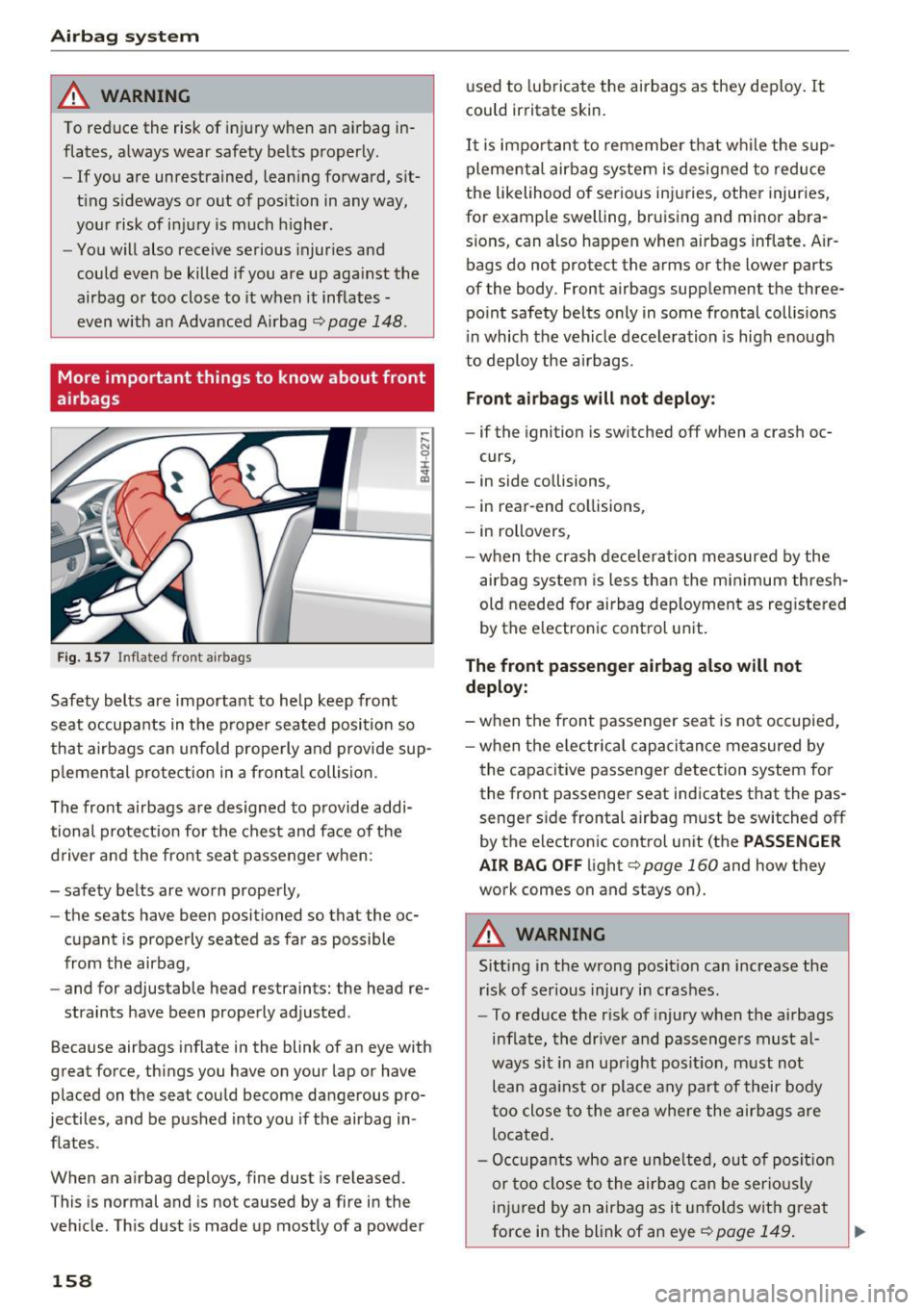
Fig. 157 Infla ted front a irbags
~ ,-. N 9 :c ..,. CD
Safety belts are important to help keep front
seat occupants in the proper seated position so
that airbags can unfold properly and provide sup
p lemental protection in a frontal collision.
The front airbags are designed to provide addi
tional protection for the chest and face of the
driver and the front seat passenger when:
- safety belts are worn properly,
- the seats have been positioned so that the oc-
cupant is properly seated as far as possible
from the airbag,
- and for adjustable head restraints: the head re-
straints have been properly adjusted .
Because airbags inflate in the blink of an eye with
great force, things you have on your lap or have
placed on the seat could become dangerous pro
jectiles, and be pushed into you if the airbag in
flates .
When an airbag deploys, fine dust is released .
This is normal and is not caused by a fire in the
veh icle . This dust is made up mostly of a powder
158
used to lubricate the airbags as they deploy. It
could irritate skin.
It is impor tant to remember that while the sup
plemental airbag system is designed to reduce
the likelihood of serious injuries, other injuries,
for example swelling, bruising and minor abra
s ions, can also happen when airbags inflate. Air
bags do not protect the arms or the lower parts
of the body . Front airbags supplement the three
po int safety belts only in some frontal collisions
i n which the vehicle deceleration is high enough
to deploy the airbags .
Front airbags will not deploy:
- if the ignition is switched off when a crash oc-
curs,
- in side collisions, - in rear-end co llisions,
- in rollovers,
- when the crash deceleration measured by the
airbag system is less than the minimum thresh
old needed for airbag dep loyment as registered
by the electronic control u nit.
The front passenger airbag also will not
deploy:
- when the front passenger seat is not occupied,
- when the e lectrical capacitance measured by
the capacitive passenger detection system for
the front passenger seat indicates that the pas
senger side frontal a irbag must be switched off
by the electronic control unit (the
PASSENGER
AIR BAG OFF
light¢ page 160 and how they
work comes on and stays on).
_&. WARNING
Sitt ing in the wrong posit ion can increase the
risk of serious injury in crashes.
- To reduce the r isk of injury when the airbags
inflate, the driver and passengers must al
ways sit in an up right posit ion, must not
lean against or place any part of their body
too close to the area where the airbags are
located .
- Occupants who are unbe lted, out of position
or too close to the airbag can be seriously
injured by an airbag as it unfolds with great
force in the blink of an eye¢
page 149. ~
Page 161 of 284

co
co
.... N
" N .... 0
00
\.J '
A child in a rearward-facing child seat instal
led on the front passenger seat will be seri
ously injured and can be killed if the front air
bag inflates - even with an Advanced Airbag
System .
- The inflating airbag will hit the child seat or
infant carrier with great force and will
smash the child seat and child against the backrest , center armrest, door or roof.
- Always install rear-facing child seats on the
rear seat.
- If you must install a rearward facing child
seat on the front passenger seat because of
exceptional circumstances and the
PASSEN
GER AIR BAG OFF
light does not come on
and stay on, immediately install the rear
facing child seat in a rear seating position and have the a irbag system inspected by
your Audi dealer.
A WARNING
Objects between you and the airbag will in
crease the risk of injury in a crash by interfer
ing with the way the airbag unfolds or by be
ing pushed into you as the airbag inflates .
- Never hold things in your hands or on your
lap when the vehicle is in use .
- Never transport items on or in the area of
the front passenger seat . Objects could
move into the area of the front airbags dur
ing braking or other sudden maneuvers and
become dangerous projectiles that can
cause serious personal injury if the airbags
inflate.
- Never place or attach accessories or other
objects (such as cup holders, telephone
brackets , large, heavy or bulky objects) on
the doors, over or near the area marked "AIRBAG" on the steering wheel, instru
ment panel, seat backrests or between
those areas and yourself . These objects
could cause injury in a crash, especially
when the airbags inflate .
- Never recline the front passenger 's seat to
transport objects . Items can also move into
the area of the side airbag or the front air-
-
Airbag system
bag during braking or in a sudden maneu
ver. Objects near the airbags can become
projectiles and cause injury, particularly
when the seat is reclined.
- Never place or transport objects on the
front passenger seat. Objects on the front
passenger seat could cause the capacitive
sensor in the seat to signal to airbag system
that the seat is occupied by a person when it
in fact is not, or that the person on the seat
is heavier than he or she actually is . The
change in electric capacitance because of
such objects can cause the passenger front
airbag to be turned on when it should be
off, or can cause the airbag to work in a way
that is different from the way it would have
worked without objects on the seat.
- Always make sure that there is nothing on
the front passenger seat that will cause the
capacitive passenger detection system in
the seat to signal to the Airbag System that
the seat is occupied by a person when it is
not , or to signal that it is occupied by some
one who is heavier than the person actually
sitting on the seat. The presence of an ob
ject could cause the passenger front airbag to be turned on when it should be off, or
could cause the airbag to work in a way that is different from the way it would have
worked without the object on the seat.
A WARNING
-The fine dust created when airbags deploy can
cause breathing problems for people with a history of asthma or other breathing condi
tions .
- To reduce the risk of breathing problems,
those with asthma or other respiratory con
ditions should get fresh air right away by
getting out of the vehicle or opening win
dows or doors.
- If you are in a collision in which airbags de
ploy, wash your hands and face with mild
soap and water before eating.
- Be careful not to get the dust into your eyes,
or into any cuts or scratches.
- If the residue should get into your eyes,
flush them with water .
159
Page 162 of 284
Airbag system
Monitoring the
Advanced Airbag System
:~ (USA models ) /!f (Canada model s)
Airbag monitoring indicator light
Two separate indicators monitor the function of
the Advanced Airbag System: the airbag moni
toring indicator light and the
PASSENGER AIR
BAG OFF
light.
The Advanced Airbag System as we ll as the side
airbags and side c urtain airbags with ejection
mitigation features (including the e lectroni c con
trol unit, sensors and system wiring) are all
monitored continuously to make sure that they
are funct ioning prope rly whenever the ignition is
on . Eve ry t ime yo u tur n on the igni tion, the air
bag sys tem ind icator light
II (USA models) ; fll
(Ca nada models) will come on for a few seconds
(func tion chec k).
The system must be inspected when the
indicator light
ffl (USA models) tfll
( Canada model s):
- does not come on w hen the ignition is switched
on,
- does not go out a few seconds after you have
switched on the ign ition, or
- comes on wh ile driving .
I f an a irbag system ma lf u nction is detected, the
indicator light wi ll come o n to serve as a constant
reminder to have the system inspected immedi
a tely.
I f a malfunc tion occurs that turns the front air
bag on the passenger side off, the
PASSENGER
AIR BAG OFF
light will come on and stay on
whenever the igni tion is on .
_& WARNING
An airbag system that is not functioning prop
erly cannot provide supplemental protection
in a frontal crash.
- If the airbag indicato r light
¢page 17
comes when the vehicle is being used, have
the system inspected immediate ly by your
authorized Aud i dealer . It is possible that
160
the airbag will inflate when it is not sup
posed to, or will not inflate when it should.
PASSENGER AIR BAG OFF light
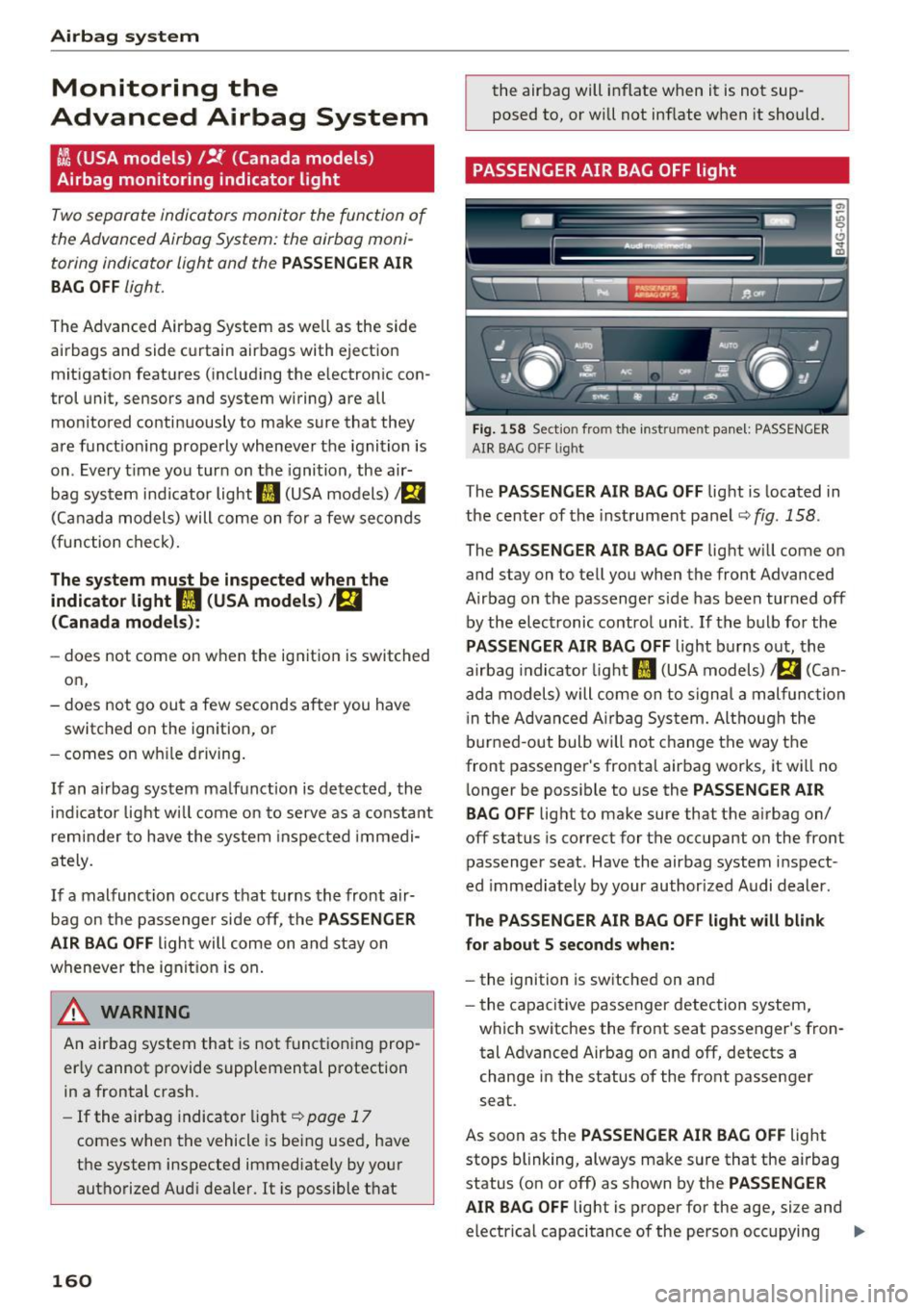
Fig . 158 Sect io n fro m t he inst rume nt panel : PASSENGER
AIR BAG O FF lig ht
The PAS SENG ER AI R BAG OFF light is located in
the center of the instrument panel~
fig. 158 .
The PASSENGER AIR BAG OFF light will come on
and stay on to tell you when the front Advanced
Airbag on the passenger side has been turned off by the electronic contro l unit . If the b ulb for the
PASSENGER AIR BAG OFF light b urns out, the
a irbag indicato r light
II (USA models) a (Ca n
ada models) will come on to signal a malfunc tion
i n the Advanced A irbag Sys tem. Alt hough the
bur ned -out bulb will not change the way the
front passenger's fronta l airbag works , it wi ll no
longer be poss ible to use the
PASSENGER AIR
BAG OFF
lig ht to make sure that the a irbag on/
off status is correct for the occupant on the front passenger seat . Have the airbag system inspect
ed immediately by your author ized Audi dealer .
The PASSENGER AIR BAG OFF l ight will blink
for about 5 seconds when:
- the ignition is switched on and
- the ca pacit ive passenger detec tion system,
which switches the front seat passenger's fron
tal Advanced Airbag on and off, detects a
change in the status of the front passenger
seat.
As soon as the
PASSENGER AIR BAG OFF light
stops blinking, always make sure that the airbag
status (on or off) as shown by the
PASS EN G ER
AIR BAG OFF
light is proper for the age, size and
electrical capacitance of the person occupying .,..