warning AUDI A7 2017 Owner´s Manual
[x] Cancel search | Manufacturer: AUDI, Model Year: 2017, Model line: A7, Model: AUDI A7 2017Pages: 284, PDF Size: 72.29 MB
Page 187 of 284
co
co
.... N
" N .... 0
00
\.J '
has been designed and certified by its man
ufacturer for use on a front seat with a
passenger front and side airbag.
- Never put the forward-facing child restraint
up, against or very near the instrument pan
el.
- Always move the front passenger seat to
the highest position in the up and down ad
justment range and move it back to the
rearmost position in the seat's fore and aft
adjustment range, as fa r away from the air
bag as possib le, before insta lling the for
wa rd-facing child restra int.
- Always make sure that the safety belt upper
anchorage is beh ind the child restraint and
not next to or in front of the chi ld restraint
so that the safety belt will be properly posi
tioned.
- Make sure that the
PAS SENGER AIR BAG
OFF
light comes on and stays on all the time
whenever the ignition is switched on .
_&. WARNING
Rearward-facing child restraints:
- A ch ild in a rearward-facing child safety seat
installed on the front passenger seat will be
seriously injured and can be killed if the
front airbag inflates - even with an Ad
vanced Airbag System.
- The inflating a irbag will hit the child safety
seat or infant carrier with great force and
will smash the ch ild safety seat and child
against the backrest, center armrest, door
or roof .
- Always be especially careful if you must in
stall a rearward facing child safety seat on
the front passenger seat in exceptional c ir
c u mstances.
- Make sure that the
PASSENGER AI R BA G
OFF
light comes on and stays on all the time
whenever the ignition is switched on.
- If the
PA SSENGER A IR BAG OFF light does
not come on and stay on, immediately in
sta ll the rear-fac ing ch ild safety seat in a
rear seating position and have the airbag
system inspected by your Audi dealer .
Child safety
Activating the convertible locking retractor
Use the convertible locking retractor to secure a
child restraint .
Always heed the ch ild safety seat manufacturer 's
instruct ions when installing a child restraint in
your vehicle. To activate the convertible locking retractor:
.. Place the child restraint on a seat, preferably
on the rear seat .
.. Slowly pull the belt
all the w ay out .
.. Route it around or through the child restra int
be lt path ¢&_ .
.. Push the ch ild safety seat down with you r full
weight to get the safety belt really tight.
.. Insert the belt tongue into the buckle for that
seating position.
.. Guide the safety belt back into the retractor un
til the belt lies flat and snug on the child safety
seat .
.. You should hear a ''cl icking" noise as the belt
w inds back into the inertia reel. Test the con
vert ible lock ing retractor by pull ing on the belt .
You shou ld no longer be able to pull the belt
out of the retractor. The convertib le loc kin g re
t ractor is now activated.
.. Make sure that the red release button is facing
away from the child restraint so that it can be
unbuckled quickly .
.. Pull on the belt to make sure the safety belt is
properly tight and fastened so that the seat
cannot move forward or sideways more than
one inch (2 .5 cm) .
,&. WARNING
Using the wrong ch ild rest raint o r an improp
e rly installed child restra int can cause se rious
personal injury or death in a crash.
- Always make sure that the safety be lt re
tr actor is locked when installing a child
safety seat . An un locked safety be lt retrac
tor cannot hold the chi ld safety seat in p lace
during normal driving or in a crash.
- Always buckle the child safety seat firm ly in
p lace even if a child is not sitting in it. A
loose child safety seat can fly around during
a sudden stop or in a crash. .,.
185
Page 188 of 284
Child safety
-Always make sure the seat backrest to which
the child restraint is installed is in an up
right position and securely latched into
place and cannot fold forward. Otherwise,
the seatback with the child safety seat at
tached to it could fly forward in the event of
an accident or other emergency situation.
- Always read and heed all WARNINGS when
ever using a child restrained in a vehicle is
being used
¢ page 172 . Special precautions
apply when installing a child safety seat on
the front passenger seat¢
page 149, Child
restraints on the front seat -some impor
tant things to know.
Deactivating the convertible locking
retractor
The convertible Locking retractor for child re
straints will be deactivated automatically when
the belt is wound all the way bock into the re
tractor .
~ Press the red button on the safety belt buckle .
Th@ belt tongue will pop out of the buckle.
~ Guide the safety belt all the way back into its
stowed position .
Always let the safety belt retract completely into
its stowed position . The safety belt can now be
used as an ordinary safety belt without the con
vertible locking retractor for child restraints .
If the convertible locking retractor should be ac
tivated inadvertently, the safety belt must be un
fastened and guided completely back into its
stowed position to deactivate this feature. If the
convertible lock ing retractor is not deactivated,
the safety belt will gradually become tighter and
uncomfortable to wear.
A WARNING
-
Improperly installed child safety seats in
crease the risk of serious personal injury and
death in a collision.
- Never unfasten the safety belt to deactivate
the convertible locking retractor for child re straints while the vehicle is moving . You
186
would not be restrained and could be seri
ously injured in an accident.
- Always read and heed all WARNINGS when
ever using a child restrained in a vehicle is
being used
¢page 172. Special precautions
apply when installing a child safety seat on
the front passenger seat¢
page 149, Child
restraints on the front seat -some impor
tant things to know.
LATCH system (lower
anchorages and tethers
for children)
' Child Restraint System anchors and how
are they related to child safety
To provide a simpler and more practicable way to
attach the child restraint on the vehicle seat, Federal regulations require special lower ancho
rages in vehicles and devices on new child re
straints to attach to the vehicle anchorages .
In the United States, the combination of the
tether anchorages and the lower anchorages is
now generally called the LATCH system for
"Lower Anchorages and Tethers for Children" . In
Canada, the terms "top tether" with "lower uni
versal anchorages" (or "lower universal anchor
age bars") are used to describe the system .
In other countries the term "ISOFIX" is used to
describe the lower anchorages .
Forward-facing child restraints manufactured af
ter September 1, 1999, are required by U.S. fed
eral regulations to comply with new child head
movement performance requirements . These
new performance requirements make a tether
necessary on most new child seats.
Installing a child restraint that requires a top
tether without one can seriously impair the per
formance of the child restraint and its ab ility to
protect the child in a collision. Installing a child
restraint that requires a top tether without the
top tether may be a violation of state law.
Child restraint manufacturers offer LATCH lower
anchorages on their child seats with hook-on or ...
Page 189 of 284
co
co
.... N
" N .... 0
00
<.,;) 'SI'
push-on connectors attached to adjustable
straps .
I n addition to the LATCH lower anchorages, these
child restraint systems usually require the use of
tether straps to h elp keep the child restraint
firm ly in place.
A WARNING
Improper installation of child restraints will
increase the risk of injury and death in a
crash.
- Always follow the instructions provided by the manufacturer of the child restra int you
intend to install in your veh icle.
- Never install a child restra int w ithout a
properly attached top tether strap if the
child restraint manufacturer's instruct ions
requ ire the top tether strap to be used .
- Improper use of child restra int LATCH lower
anchorage po ints can lead to injury in a colli
sion. The LATCH lower anchorage points are designed to withstand only those loads im
posed by correc tly fit ted child res traints .
- Never mount two chi ld restraint systems on
one LATCH lower anchorage poin t.
- Never secure or attach any luggage or other
item to the LATCH lower anchorages .
Location
F ig. 170 Sche matic o verv ie w : LA TCH an ch orag e point loc a
t io ns
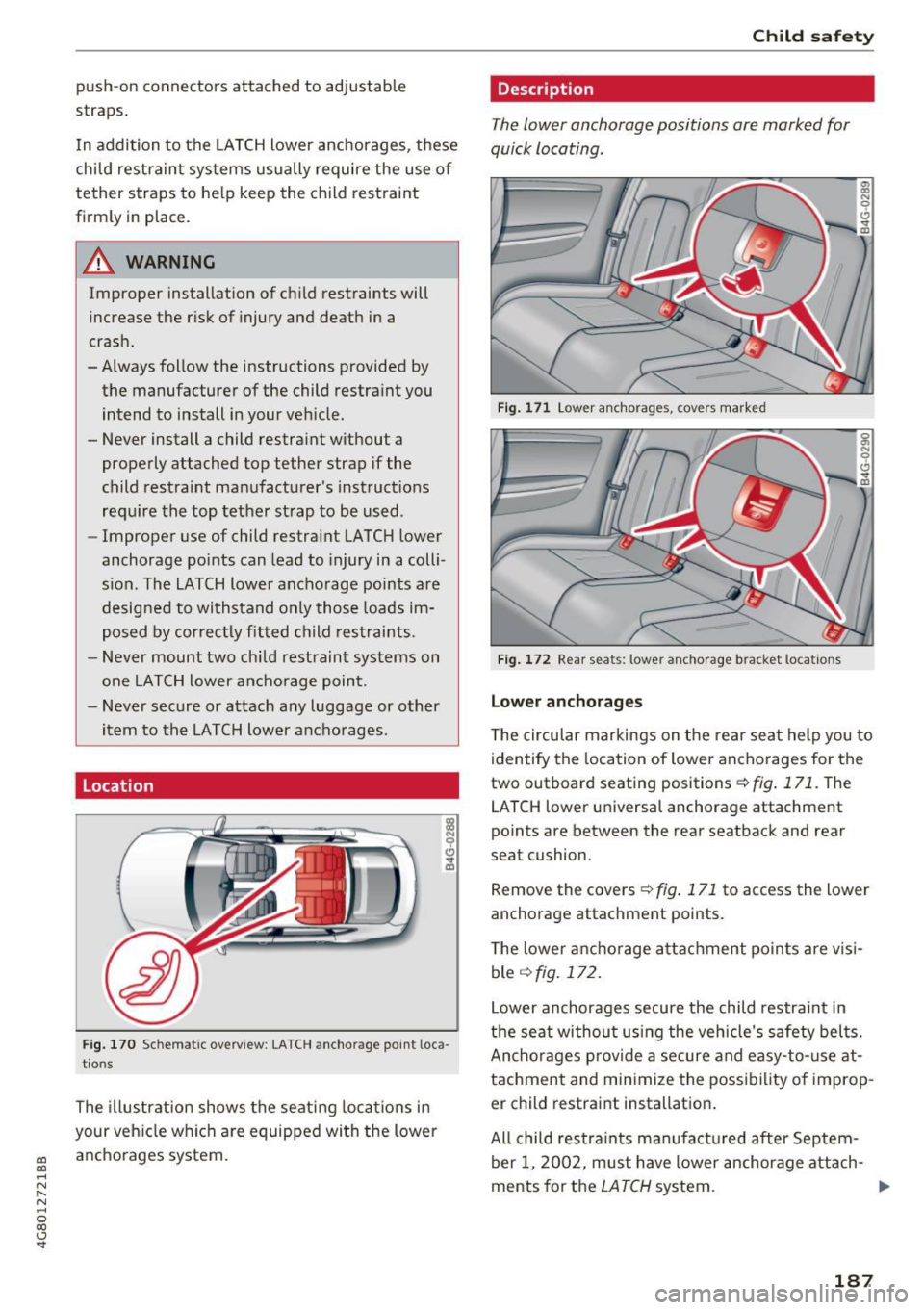
The illustration shows the seating locations in
your veh icle which a re equipped with the lower
ancho rages system.
Ch ild sa fety
Description
The lower anchorage positions are marked for
quick locating .
Fig . 1 71 Low er an cho ra g es, cov ers marked
F ig . 1 72 Rear s eats: l ower an chorag e brac ket lo ca tions
Lower anchorages
T he circular markings on the rear seat help you to
identify the location of lower anchorages for the
two outboard seating pos itions ¢
fig. 171 . The
LATCH lower univ ersal anchorage attachment
points are between the rear seatba ck and rear
seat cush ion .
Remove the covers¢
fig. 171 to access the lower
anchorage attachment points.
T he lower anc horage a ttac hment po ints a re v is i
ble
¢ fig . 172.
Lower anchorages secure the child restra int in
the seat withou t us ing the vehicle's safety belts.
Anchorages provide a secure and easy-to- use at
tachment and minimize the possibility of improp
er child restraint installation .
All child restra in ts man ufact ured after Septem
ber 1 , 2002, must have lower anchorage attach-
ments for the
LATCH system. ..,.
187
Page 190 of 284
Child safety
Please remember that the lower anchorage
points are only intended for installation and at
tachment of child restraints specifically certified
for use with
LATCH lower anchorages. Child re
straints that are not equipped with the lower an
chorage attachments can still be installed in
compliance with the child restraint manufactur
er's instructions on using vehicle safety belts .
A WARNING
Improper use of LATCH lower anchorages can
cause serious personal injury in an accident.
- Always carefully follow the child restraints
manufacturer's instructions for proper in
stallation of the child restraint and proper
use of the lower anchorages or safety belts
in your vehicle.
- Never secure or attach any luggage or other
items to the
LATCH lower anchorages.
- Always read and heed the important infor
mation about child restraints in this chapter
and WARNINGS
¢ page 172, Child safety.
Installing a child restraint with LATCH
lower anchorages
Whenever you install a child restraint always fol
low the child restraint manufacturer 's instruc
tions.
Fig. 173 Lowe r an ch orages : proper mou nting
Mounting
.,. Make sure the seatback of the rear seat bench
is in the upright position and securely latched
in place .
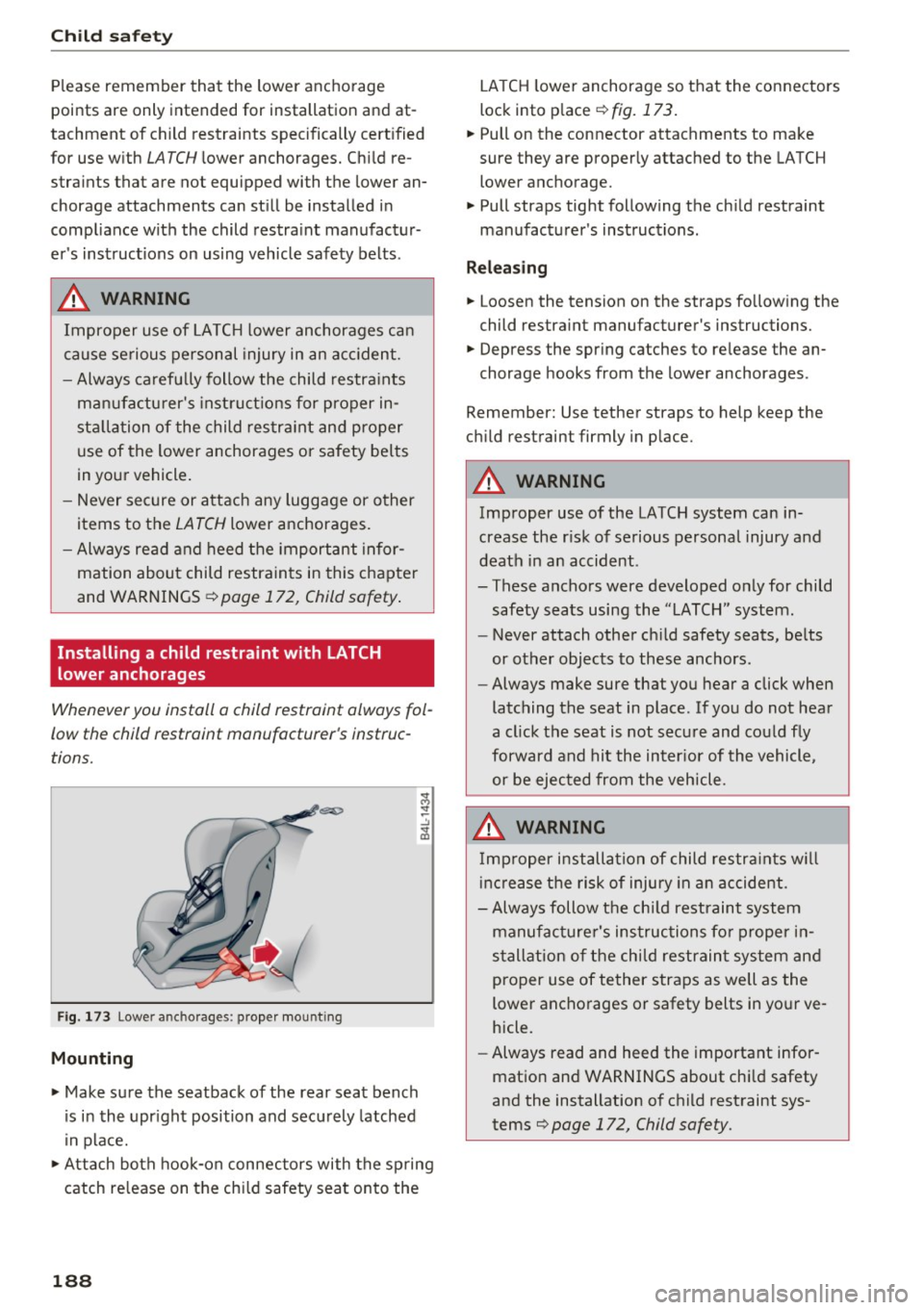
.. Attach both hook-on connectors with the spring
catch release on the child safety seat onto the
188 LATCH
lower anchorage so that the connectors
lock into place
¢ fig. 173.
.. Pull on the connector attachments to make
sure they are properly attached to the LATCH
lower anchorage.
.. Pull straps tight following the child restraint
manufacturer's instructions.
Releasing
.. Loosen the tension on the straps following the
child restraint manufacturer's instructions.
.. Depress the spring catches to release the an
chorage hooks from the lower anchorages .
Remember: Use tether straps to help keep the
child restraint firmly in place.
A WARNING
-
Improper use of the LATCH system can in
crease the risk of serious personal injury and
death in an accident .
- These anchors were developed only for child safety seats using the "LATCH" system.
- Never attach other child safety seats, belts
or other objects to these anchors .
- Always make sure that you hear a click when
latching the seat in place. If you do not hear
a click the seat is not secure and could fly
forward and hit the interior of the vehicle,
or be ejected from the vehicle.
A WARNING
Improper installation of child restraints will
increase the risk of injury in an accident.
- Always follow the child restraint system
manufacturer's instructions for proper in
stallation of the child restraint system and
proper use of tether straps as well as the lower anchorages or safety belts in your ve
hicle.
- Always read and heed the important infor
mation and WARNINGS about child safety
and the installation of child restraint sys
tems¢
page 172, Child safety.
-
Page 191 of 284
co
co
.... N
" N .... 0
00
<..:l 'SI"
Tether anchors and tether straps
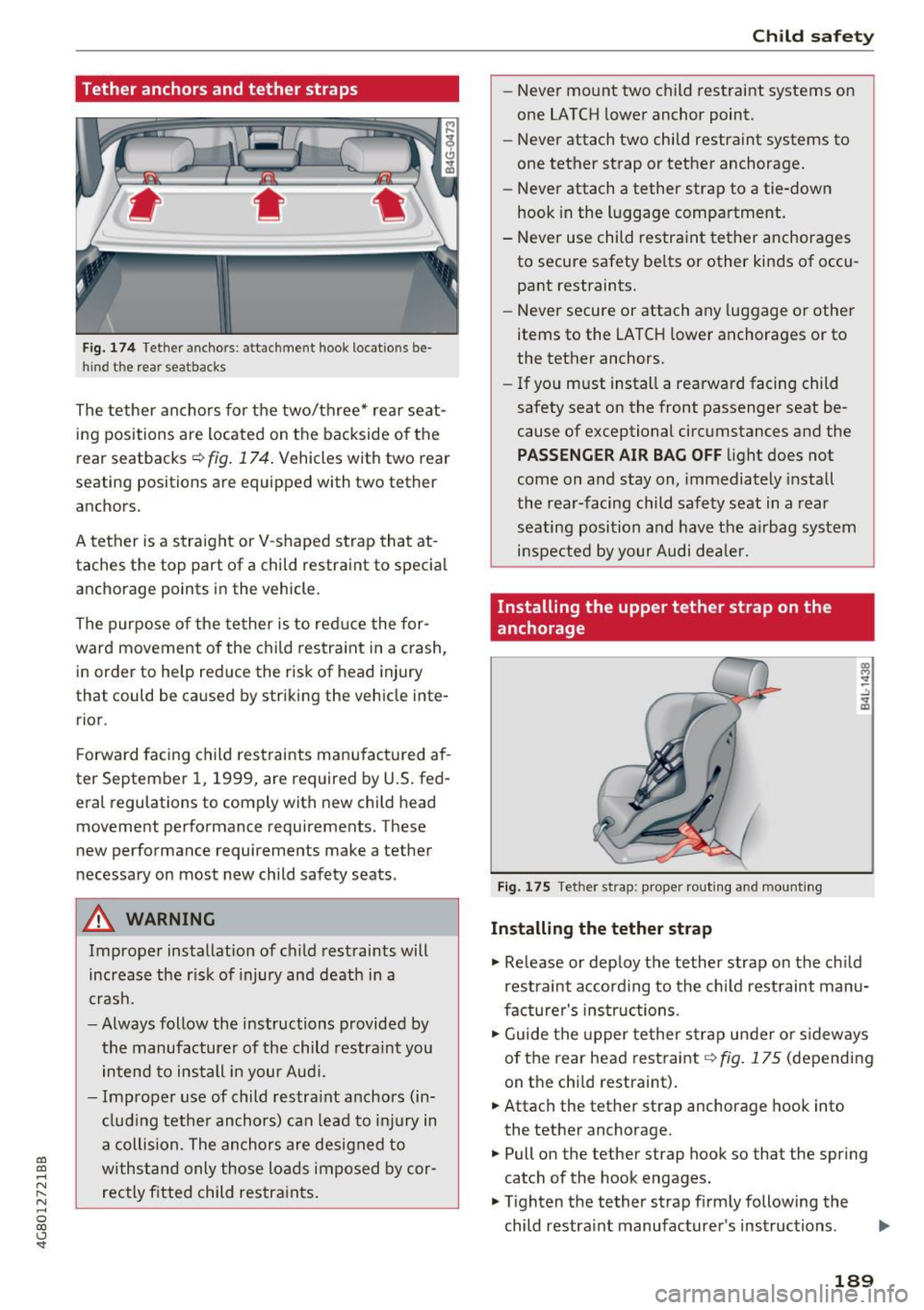
Fig. 174 Te the r ancho rs: att achm ent hook locatio ns be
hi nd the rea r seatbacks
The tether anchors for the two/three* re ar seat
ing positions are located on the backside of the
rear seatbacks
¢ fig. 174. Vehicles with two rear
seating positions are equipped with two tether
anchors.
A tether is a straight or V-shaped strap that at
taches the top part of a child restraint to special
anchorage points in the vehicle.
The purpose of the tether is to red uce the for
ward movement of the child restraint in a crash,
in order to he lp reduce the risk of head injury
that could be caused by striking the vehicle inte rior .
F orward facing child restraints manufactured af
ter September 1, 1999, are required by U.S. fed
eral regulations to comply with new child head movement performance requirements . These
new performance requirements make a tether
necessary on most new child safety seats .
A WARNING
Improper installation of child restraints will
increase the risk of injury and death in a
crash.
- Always follow the instructions provided by
the manufacturer of the child restra int you
intend to install in your Aud i.
- Improper use of child restra int anchors (in
cl uding tethe r anchors) ca n l ead to inj ury in
a collision. The anchors are designed to
withstand only those lo ads imposed by cor
rectly f itted child restraints .
Child sa fety
- Never mount two child restraint systems on
one LATCH lower anchor point.
- Never attach two child restraint systems to
one tether strap or tether anchorage.
- Never attach a tether strap to a tie-down
hook in the luggage compa rtment.
- Never use child restraint tether anchorages to secure safety be lts or other kinds of occu
pant restraints.
- Never secure or attach any luggage or other
items to the LATCH lower anchorages or to
the tether anchors.
- If you must install a rearward facing child
safety seat on the front passenger seat be
cause of exceptional circumstances and the
PAS SENGER AIR BAG OFF light does not
come on and stay on, immediately install
the rea r-facing child safety seat in a rear
seating position and have the a irbag system
i n spe cted by your Audi dea ler.
Installing the upper tether strap on the
anchorage
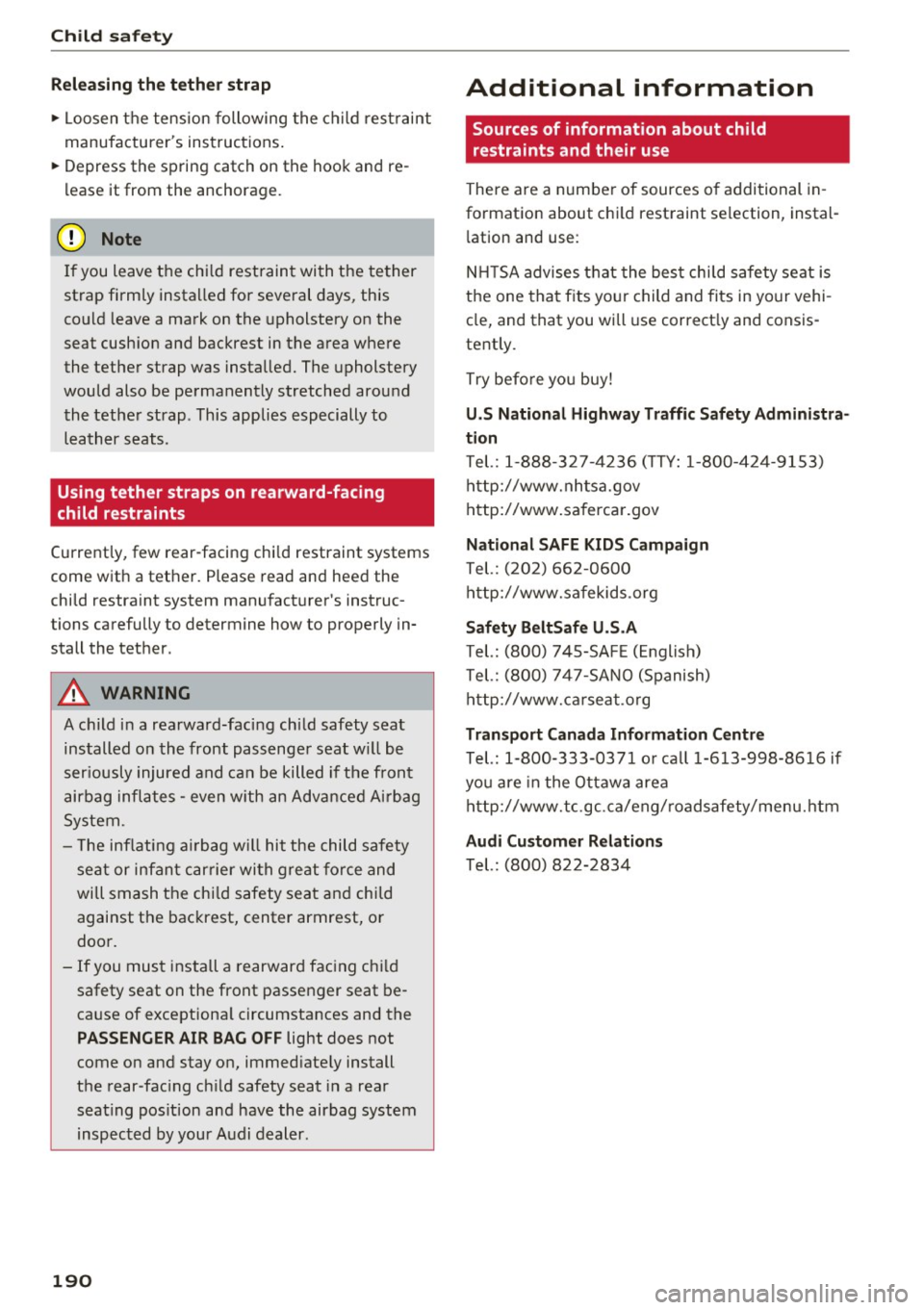
F ig . 1 75 Tet her st rap: p roper rout ing an d mount ing
Installing the tether strap
.,. Release or deploy the tether strap on the child
restraint according to the ch ild rest raint manu
facture r's instr uctions .
.,. Guide the upper te ther s trap under or s ideways
of the rear head restraint~
fig. 175 (dependi ng
on the chi ld restraint).
.. Attach the tether strap anchorage hook into
the tether anchorage.
.,. Pull on the tether strap hook so that the spring
catch of the hook engages .
.,. Tighten the tether strap firmly following the
child restra int manufacture r's instructions . .,.
189
Page 192 of 284
Child safety
Releasing the tether strap
.,. Loosen the tension following the child restraint
manufacturer's instructions.
.,. Depress the spring catch on the hook and re
leas e it from the anchorage.
(D Note
If you leave the child restraint with the tether
strap firmly installed for several days, this
could leave a mark on the upholstery on the
seat cushion and backrest in the area where
the tether strap was installed. The upholstery
would also be permanently stretched around the tether strap . This applies especially to
leather seats.
Using tether straps on rearward-facing
child restraints
Currently, few rear-facing child restraint systems
come with a tether. Please read and heed the
child restraint system manufacturer's instruc
tions carefully to determine how to properly in
stall the tether.
A WARNING
A child in a rearward-facing child safety seat
installed on the front passenger seat will be
seriously injured and can be killed if the front
airbag inflates -even with an Advanced Airbag
System.
- The inflating airbag will hit the child safety
seat or infant carrier with great force and
will smash the child safety seat and child
against the backrest, center armrest, or
door.
- If you must install a rearward facing child
safety seat on the front passenger seat be
cause of exceptional circumstances and the
PASSENGER AIR BAG OFF light does not
come on and stay on, immediately install
the rear-facing child safety seat in a rear
seating position and have the airbag system
inspected by your Audi dealer.
190
Additional information
· Sources of information about child
restraints and their use
There are a number of sources of additional in
formation about child restraint selection, instal
lation and use :
NHTSA advises that the best child safety seat is
the one that fits your child and fits in your vehi
cle, and that you will use correctly and consis
tently.
Try before you buy!
U.S National Highway Traffic Safety Administra
tion
Tel.: 1-888-327-4236 (TTY: 1-800-424-9153)
http://www.nhtsa.gov
http:/ /www.safercar.gov
National SAFE KIDS Campaign
Tel.: (202) 662-0600 http://www.safekids .org
Safety BeltSafe U.S.A
Tel.: (800) 745-SAFE (English)
Tel.: (800) 747-SANO (Spanish)
http://www.carseat.org
Transport Canada Information Centre
Tel.: 1-800-333-0371 or call 1-613-998-8616 if
you are in the Ottawa area
http://www.tc.gc.ca/ eng/roadsafety/menu. htm
Audi Customer Relations
Tel.: (800) 822-2834
Page 195 of 284

co
co
.... N
" N .... 0
00
<..:l 'SI"
These fuels contain substances that can se
vere ly damage the fuel system and the en
gine if the engine is started .
Refueling
Fuel filler neck
The fuel filler neck is located on the right rear
side panel behind the fuel filler flap.
If the power locking system should fail , you can
still open the flap manually - for detailed instruc
tions see
~ page 195 .
You can find the fuel tank capacity of your vehicle in
~ page 262 .
The label on the inside of the fuel filler flap tells
you the correct fuel for your vehicle. For mo re in
formation about fuel specifications , see
~ page 191 .
You r vehicle fuel tank has an onboa rd refuelling
vapor recovery sys tem . This fea tu re helps to pre
vent fuel vapors from escaping from the tank and polluting the environment while you refuel your
vehicle. In order to fill the tank properly while
protecting the environment, please follow this
refueling procedure carefully.
_& WARNING
Under norma l operating conditions, never car
ry additiona l fuel containers in your car. Gas
canisters and other containers used to trans
port fuel can be dangerous. Such containers,
full or empty, may leak and could cause a fire
in a collision . If you must transport fuel to
use for your lawn mower, snow blower, etc.,
be very careful and always observe local and
state laws regarding the use, transportation
and storage of such fuel containers. Make cer
tain the container meets industry standards
(ANSI/ASTM F852 -86).
(D Note
Never drive your vehicle until the fuel tank is
completely empty. The irregular supply of
fue l can cause misfiring. Gasoline could enter
the exhaust system and damage the catalyt ic
converter.
Checking and Filling
Fueling procedure
Fig. 176 Righ t re ar sid e of the v ehicl e: openin g th e fu el
fille r door
Fig. 177 Fue l filler doo r with at tached fuel cap
T he fue l filler door is unlocked or locked by the
central locking system.
Opening the fuel cap
"' Press on the left side of the fue l filler door to
open ~
fig. 176 .
"'U nscrew the tank cap counterclockwise.
"' Place the cap from above on the open fuel filler
door ~
fig. 177.
Closing the fuel cap
"' Sc rew the tank cap on to the right on the filler
neck until it cannot turn any farther.
"' Then press on the left s ide of the tank door un-
til it latches.
Once the pump nozzle switches off, the fuel tank
is "full ". Do not fill the tank mo re . Otherwise the
expans ion space in the tank w ill be filled .
The correct fuel type for your vehicle can be
found on a label located on the inside of the fuel
filler door. Fo r additional informa tion on fuel,
see
~ page 191.
193
Page 196 of 284

Checking and Filling
The fuel tank capacity of your vehicle is listed in
the
Technical Data section ~ page 262.
To avoid fuel spilling or evaporating from the fuel
tank always close fuel cap properly and com
pletely. An improperly closed fuel filler cap may
also cause the MIL lamp~
page 25 to come on.
A WARNING
Not paying attention when fueling or han
dling fuel incorrectly can lead to fires, explo
sions or serious injuries .
- Fuel ignites easily and can cause serious burns and other injuries .
- If you do not switch the engine off when fu
eling and/or do not insert the fuel no zzle
completely into the tank opening, fuel can
leak out or run over . Leaked fuel can ignite
and start a fire .
- Do not use the telephone while fueling. The
electromagnetic rays can cause sparks,
which can ignite fuel vapors and start a fire .
- Do not sit in your vehicle while fueling . If
you must make an exception and enter your
vehicle again while fueling, close the door
and touch metal to discharge static electricity before touching the fuel nozzle . Static
electricity can create sparks, which can ig
nite vapors when fueling.
- Do not smoke or have an open flame in the
area when fueling your vehicle or filling a
fuel container because this increases the risk of an explosion.
- For your safety, carrying fuel containers in
your vehicle is not recommended. Whether
full or empty, the container can leak and
cause a fire in the event of an accident.
- If you must make an exception and trans
port a fuel container, note the following:
- Never fill the fuel container with fuel
while it is in or on the vehicle. Static elec
tricity is discharged when filling which can
cause the fuel vapors to ignite and in
creases the risk of an explosion.
- Always place a fuel container on the
ground before filling.
- Always hold the fuel nozzle completely in
the fuel container when filling.
194
-If the fuel container is made of metal, the
fuel nozzle must always be in contact with
the container when filling it with fuel. This
prevents static electricity from discharg
ing .
-Never spill fuel in the vehicle or the lug
gage compartment . Evaporated fuel is ex
plosive and increases the risk of serious in
jury or death .
- Follow legal requirements when using, storing and transporting fuel containers .
- Make sure the fuel container conforms to industry standards (ANSI/ASTM F852-86).
(D Note
-Remove spilled fuel from vehicle paint im
mediately, because it can damage paint.
- Never drive until the fuel tank is completely
empty. The irregular supply of fuel that re
sults from that can cause engine misfires.
Uncombusted fuel will enter the exhaust
system and increase the risk of damage to
the catalytic converter .
(D Note
Applies to: vehicles with diesel eng ines
If the fuel tank runs completely empty, the
ignition must remain switched on for at least
30 seconds after refueling before starting the
engine. It may take longer than usual for the
engine to start, even up to a minute. This is
because the air must first bleed out of the
fuel system when starting the engine.
@ For the sake of the environment
Do not overfill the fuel tank, otherwise fuel
can leak out when the vehicle is warming up.
(y Tips
The fuel filler door on your vehicle does not lock if you lock the vehicle from the inside.
(D Tips
Applies to: veh icles with diesel e ngin es
Diesel vehicles are equipped with a misfueling
guard
l) . It allows the vehicle to be fueled on-
ly with a diesel fuel pump nozzle . .,.
Page 199 of 284

co co .... N
" N .... 0
00
\.J -
Ad Blue can irritate the skin, eyes and respira
tory system. If there is contact with the fluid,
flush immediately with plenty of water . Con
sult a physician if necessary.
CD Note
- Only use Ad Blue that conforms to the
standard ISO 22241 -1. Do not mix any addi
tives w ith the AdBlue and do not d ilute it
with water.
- Do not add Ad Blue to the diesel ta nk or add
diesel fuel to the Ad Blue tank. Do not start
the engine under any circumstances if the
wrong f uel is filled in the tank. There is a
risk of damaging the fuel tank system and
the engine. See an author ized Audi dealer or
authorized Audi Service Facility for ass is
tance .
- Ad B lue attacks surfaces such as pa inted ve
hicle components, plast ic and carpet . Re
move the fluid as quickly as poss ible with a
damp cloth and plenty of cold water. If the
Ad Blue has already crysta llized, use warm
water and a sponge . AdBlue residue that is
not removed will crysta llize a nd can damage
the affected surface.
- Do not store refill bottles or canisters per
mane ntly in the vehicle . If the container
l ea ks, the escaping AdBl ue could damage
t h e veh icle inter io r.
- Do not allow AdBlue to come into co ntact
with clothing. If there is contact w ith the
f lui d, f lush immed iate ly w ith p lenty of wa
te r.
(j) Tips
Follow the Ad B lue man ufact urer's instr uc
t ions fo r use and storage.
Refilling AdBlue using a bottle
Applies to: vehicles with selective catalytic reduction
.. Remove the cap from the refi ll bottle ¢ A in
Filling AdBlue on page 197, ¢(Din Filling
AdBlue on page 197 .
Check ing and Filling
.. Position the bott le on the fi ller tube and turn
the bottle clockwise until it stops turning .
.. Press lightly against the bottom of the bottle
to empty it. Cont inue pressing the bottom of
the bottle until it is empty or until fluid stops
flow ing into the tank .
.,. Remove the bottle and seal the filler neck
¢ page 198, Completing AdBlue refill.
CD Note
Only use refill bottles that are approved for
your vehicle . Using other systems can cause
Ad B lue to leak.
@ Tips
- You can obtain ref ill bottles from an author
ized Aud i dea le r o r aut horized Aud i Serv ice
Facility.
- A permitted refi ll bottle contains approxi
mately 0.5 gallon (1.9 liters) of AdBl ue.
Refilling AdBlue using a canister
Applies to: vehicles with selective catalytic reduction
®
+®
Fig. 181 Can iste r w ith attachable hose
.. Remove the cover from the refill canister¢ A
in Filling AdBlue on page 197, ¢(Din Filling
AdBlue on page 197 .
.,. Secure the end of the hose (Don the opening in
t he caniste r@ by turni ng the hose to the right.
.,. Remove the cap @ from the o ther end of the
hose @.
.. Position the end of the hose @ on the filler
neck in the veh icle and turn the hose to the
r ight to tighten it .
.. Lift the canister up and then t ip it. Cont inue
holding the canister in a tipped pos ition until it ..,.
197
Page 200 of 284

Check ing and F illing
is empty or until no mo re fluid flows into the
tank.
~ Remove the canister and close the fi ller tube
c> page 198 , Completing AdBlue refill .
(D Note
Only use refi ll canisters that are approved for
your vehicle. Us ing other systems can cause
Ad Blue to leak.
@ Tips
- An authorized Audi dealer or authorized
Audi repair facility can te ll you which ref ill
can isters are approved for your vehicle.
- A permitted refill canister contains approxi
mately 1.3 ga llons (5 liters) of AdB lue.
Completing AdBlue refill
Applies to: vehicles with selective catalytic reduction
C losi ng the filler neck
~ Turn the cap on the filler neck to the right with
the wheel wrench unt il the cap clicks into place.
This t ightens the cap to the specification o &
in Filling AdBlue on page 197, c> (D in Filling
AdBlue on page 197 .
~ The n press on the left side of the tank doo r un-
ti l it l atches.
After filling
The vehicle must be driven so that the system
recognizes that the Ad Blue was refilled . T his can
take severa l m in utes.
~ If there was no Ad Blue left in the tank and a
range of O mi (0 km) was shown in the d isplay,
switch the ign it ion on for about 30 seconds be
fo re sta rting the engine.
(D Tips
Ad Blue can freeze at very low temperat ures .
If this happens, the system will not detect
that the Ad Blue was refilled a nd it will contin
ue to inform yo u of the low Ad Blue level. The
message turns off as soon as the tank thaws
out again.
198
Catalytic converter
Applies to: vehicles with gasoline engine
It is very important that your emission control
system (catalytic converter) is func tioning prop
erly to ensure that your vehicle is running in an
environmentally sound manner .
~ Always use lead-free gasoline c> page 191, Fuel
supply .
~ Never run the tank down all the way to empty.
~ Never put too much motor o il in your engine
c> page 204, Adding engine oil.
~ Never try to push- o r tow-start your vehicle .
The catalytic converter is an efficient "clean -up "
device built into the exhaust system of the veh i
cle. The catalyt ic converter b urns many of the
po llutants in the exhaust g as befo re they are re
l eased into the atmosphere.
The exclusive use of un leaded fuel is critically im
po rtant fo r the life of the catalytic converte r and
prope r funct io ni ng of the engine.
_&. WARNING
The temperat ure of the exhaus t sys tem is
high, both when driv ing and a fter stopping
the engine.
-
- Never tou ch the exhaust tail pipes once they
have become hot. This cou ld resu lt in burns.
- D o not p ark or operate the vehicle in ar eas
where the hot exhaust system may come in
contact with dry g rass, brush, fuel spi ll or
other mate rial which can ca use a fire.
- Do not apply additiona l undercoating or
rustp roofing on or near the exhaust mani
fold, exha ust pipes, cata lytic conve rter or
heat shields . D uring driving, the substance
used for unde rcoat ing could overheat and
cause a fire .
Cl) Note
-Be aware that just one tank f illing wit h
leaded fu e l w ill already seriously degrade
the performance of the catalytic converter.
- Do not exceed the correct engine oil leve l
c>page204.