instrument cluster AUDI A7 2017 Owner´s Manual
[x] Cancel search | Manufacturer: AUDI, Model Year: 2017, Model line: A7, Model: AUDI A7 2017Pages: 284, PDF Size: 72.29 MB
Page 106 of 284

Ass is t
The following situations may affect the function
of th e night vision assist system:
- Poor v isibility such as snow, ra in , fog or heavy
spray
- Di rty lens on the nigh t vis ion assis t camera
Make sure the night vision ass ist camera
¢ fig . 114 is not covered by stickers, deposits or
any other obstructions because that can affect
the camera f unct io n. For info rmation on clean
ing, refer to¢
page 235.
The pedestrian and wild anima l recogn ition de
pends on the temperat ure diffe rence between
the person/w ild an imal and t he backg ro und. Peo
p le/w ild animals may not be de tected if the dif
ference is too small . The pedestrian/wi ld an imal
marking and the ma rking light* deactivate at
temperatures above approximately 77 °F (25 °C)
and during daylight. If the night vision assist im
age is selected in the instrument cluster display,
then the
II symbol appears at the top on the
right s ide .
_.&. WARNING
Pay attent ion to traffic and the area around
yo ur vehicle whe n night vision assist is switch
ed on. The dr iver is always responsible for as
sess ing the traffic s itu ation.
- Night vis ion assist can only warn about peo
ple and wild animals lo cated within the visu
al range of the i nfra red camera. The visual
ra nge cor responds to the image in the in
strument cl uster display .
- Nigh t vision assist may not de tect people or
wild animals an d mark them if
- they are not in an upright posit ion, for ex
ample if they are sitting or ly ing down
a nd/or
- the silho uette in the display appears in
comp lete o r interrup ted, fo r example be
caus e the pe rson is pa rtially covered by a
veh icle or an animal by tall grass. This
could in cr ease the risk of an ac cident .
- Never try to swerve a round animals if doing
so w ill endanger you o r other road use rs, be
ca use this increases the risk of an accide nt.
104
@ Tips
- Even though the system evaluates the
shape and heat given off by all detected ob
jects, there are limits to the system. There
may be false warnings.
- For technical reasons, the image pauses in split second intervals.
Switching on /off
App lies to: vehicles wit h night vision assist
Fig . 115 A rea around the ligh t sw itc h: ni ght vis ion assis
t an t but to n
Requirement: switch the ignit io n on and tu rn the
li ght sw itch to the
AUTO pos it ion .
.,. Press the~ button¢
fig. 115. The heat image
from the n ight vision camera appears in the in
strument cluster display .
.,. Press the~ button again to switch the night
vision ass ist off .
If conditions are bright enough, night vision as
s ist can be swi tched on w ithout moving the ligh t
switch to the
AUTO posit ion. Pedestrian and w ild
anima l hig hligh ting and wa rnings are only a ct ive
whe n it is da rk outside and the headlights are
switched on .
Adjusting the contrast
Applies to: vehicles wi th night vision assis t
.,. Sel ect : the I CAR I fu nct ion button > ( Car )* Sys
tems
control button > Dri ver a ssistance >
Night v ision ass ist contr ast .
When the night vision ass ist is sw itch ed on and
the image is v isible in the instrument cluster dis
play, you can adjust the contrast in the image
from
Min to M ax.
Page 128 of 284

Intelligent Technology
& WARNING
When extending and retracting the rear spoil
er, make sure there are no persons or objects
w ith in the spoiler range to red uce the risk of
injury .
& WARNING
Driv ing at higher speeds w ithout the rear
spoiler dep loyed can impa ir hand ling ch arac
t er istics, mak ing t he vehi cle h arder to con
t rol.
- Always make sure tha t the spoiler is de
ployed whe n driving a t speeds ove r 85 mph
(140 km/h) . If the rear spoiler warning/ind i
cator light in the instrument cluster comes
on, the rear spo iler may not have deployed.
- Never drive at speeds higher than 85 mph (140 km/ h) if the spoile r is not deployed.
Have the spoiler inspected as soon as possi
ble by an author ized Audi dealer or qualif ied
workshop.
-Always obey speed limits and other tra ffic
laws .
(D Note
-Never push on the vehicle on the rear spoi l
er . This cou ld cause damage.
- To prevent damage to the rear spoiler do
not lean o r place anything on it.
- Only opera te the rear spoiler man ually when
the luggage compartment lid is close and
the rear spoiler movi ng pa rts a re not
blocked. Otherwise, damage could occur.
(D Tips
Clean the rear spoi ler compartment eve ry 2 to
3 mont hs. To function correctly, the rear
spoiler m ust be free of ice, snow and leaves.
126
Energy management
' The starting ability is optimized
T he energy management system manages the
electrical energy distribution and optimizes the
availability of electrical energy for starting the
engine.
When a vehicle with a conventional energy sys
tem is no t drive n for a long time, the ve hicle bat
te ry is drained by equ ipment (fo r example, t he
i mmob il iz er). I n cer ta in circ umstan ces, the re
could m ay no t be e nough energy to s tart the en
gine.
You r vehicle is equipped with an inte lligent e ner
gy management system fo r dist ributing elec trici
ty. Thi s sign ifica ntl y improves the start ing ability
and incre ases the vehicle battery life .
The ene rgy ma nagement system Is made up of
battery diagnosi s, idling current management ,
and dynamic energy management .
Battery diagnosis
T he battery diagnos is determines the vehicle bat
tery charge level. The sensors detect the ba tte ry,
the batt ery cur rent, and t he battery temperature .
The curren t cha rge level and the pe rformance of
t h e ve hicle battery are dete rm ined based on th is .
Idling current management
The idling current management decreases the
energy used while parked . With the engine
switched off , it m anages t he e ne rgy dis trib ution
to the d ifferen t electr ica l components . Data from
t h e b attery d iagnosis is ta ken into a ccou nt for
th is .
De pen ding on the vehicle batte ry c ha rge level,
e le ctri ca l eq uipme nt is switched off one i tem af
te r th e o ther to p revent t he vehi cle b attery from
dra ining and to ma intain the s tarting ab ility.
Dynamic energy management
While dr iv ing , dynam ic energy management dis
t ributes the app ropr iate amo unt of energy to t he
ele ctrica l eq uipm ent. It contro ls t he batte ry
c harge level so tha t the amou nt o f energy is no t
ll>
Page 142 of 284
Safety belt s
Safety belts
General information
Always wear safety belts!
Wearing safety belts correctly saves lives!
This chapter explains why safety be lts are neces
sary, how they work and how to adjust and wear
them correctly.
.. Read all the information that follows and heed
all of the instructions and WARNINGS.
&_ WARNING
Not wearing safety belts or wearing them im
properly increases the risk of serious personal
injury and death.
- Safety belts are the s ingle most effective
means ava ilable to reduce the risk of serious
injury and death in automobile accidents.
For your protect ion and that of your passen
gers, always co rre ctly wea r safety be lts
when the vehicle is moving .
- Pregnant wome n, inju red, o r physically im
paired persons mus t also use safety be lts.
L ik e all vehicle occ upants, they are mo re
likely to be serio usly injured i f they do not
wea r safety be lts. The best way to protect a
fetus is to protect the mother -throughout
the ent ire pregnancy .
Number of seats
Your Audi has a total of four seating positions:
two in the front and two in the rear. In some
veh icles, there are f ive seating positions: two in
the front and three in the rear . Each seating posi
tion has a safety belt .
&_ WARNING
Not wea ring safety belts or weari ng them im
pro perly in cre ases the risk of ser io us personal
injury and dea th.
- Never st rap more tha n one perso n, includ
ing small ch ild ren, in to any be lt .
It is espe
c ia lly da ngerous to place a safety belt over a
child sitting on your lap .
140
-Never let more people ride in the vehicle
than there are safety be lts available .
- Be sure everyone riding in the vehicle is
properly restrained with a separate safety
be lt or ch ild restraint.
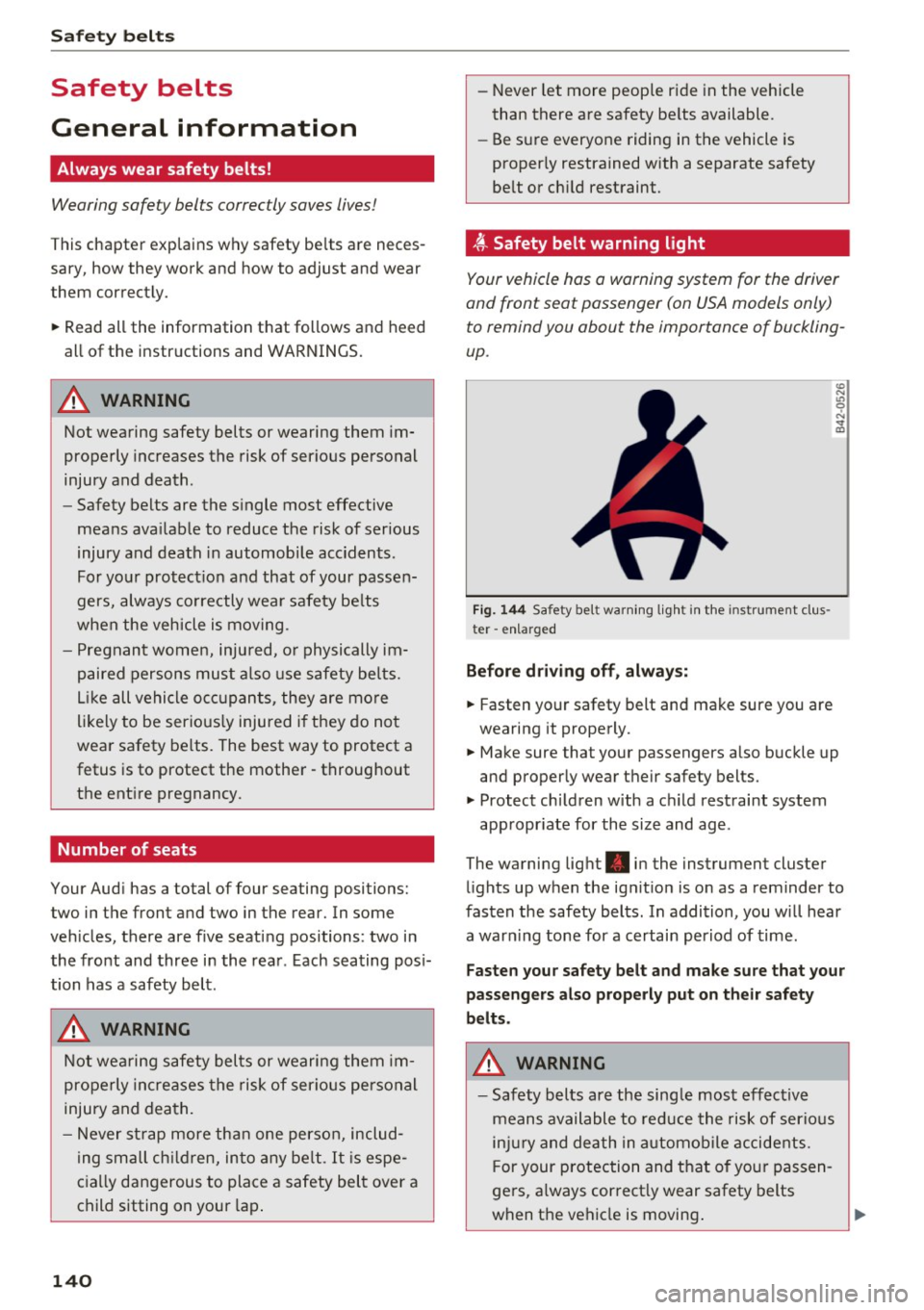
~ Safety belt warning light
Your vehicle has a warning system for the driver
and front seat passenger (on USA models only) to remind you about the importance of buckling
up .
Fig. 1 44 Safety belt wa rning lig ht in th e i nst rument clus ·
ter · en larged
Befor e dri ving off , always:
.. Fasten your safety belt and make sure you are
wearing it properly.
(0
"'
"' 0 N .. m
.. Make sure that your passengers also buckle up
and properly wear their safety belts.
.,. Protect children with a c hild restraint system
app ropr iate for the size and age .
The warning lig ht . in the instrument cluster
lights up when the ig nition is o n as a reminder to
fasten the safety belts. In addition, you will hear a war ning tone for a certain period of time .
Fasten your safety belt and make su re that your
passengers al so properly put on th eir safety
b e lts.
&_ WARNING
- Safety belts are the sing le most effective
means available to red uce the risk of serio us
inj ury and death in a utomobile accidents.
F or your protection and t hat of yo ur passen
ge rs, a lways correct ly wear safety belts
when t he vehicle is moving .
~
Page 158 of 284

Airbag syste m
switched on and turns the airbag indicator light
on when a malfunction in the one of the system
components is detected ¢
page 160. Because
the front passenger seat contains important
parts of the Advanced Airbag System, you must
take care to prevent it from being damaged .
Damage to the seat may prevent the Advanced
A irbag System for the front passenger seat from
doi ng its job in a c rash.
The front Ad vanced Airb ag Sy stem con sis ts
of the following:
- Crash sensors in the front of the vehicle that
measure vehicle acceleration/decelerat ion to
provide info rmation to the Advanced Airbag
System about t he severity of the crash.
- An electron ic control un it, with integrated
c rash sensors fo r front and side impacts. The
contro l unit "decides" whethe r to fire the front
airbags based on the information received from
the crash sensors . The control unit a lso "de
cides" whether the safety be lt pretensioners
shou ld be activated.
- An Advanced Airbag with gas generator and
control valve for the driver ins ide the steer ing
wheel hub.
- An Advanced Airbag with gas gene rator and
control valve inside the instrument pane l for
the front passenger.
- A capacitive passenger detect ion system under
neath the front passenger seat cover. This sys
tem measures the electrical capac itance of the
person in the seat . T he information registe red
is sent continuous ly to the e lectron ic cont rol
unit to regula te deployment of the front Ad
vanced Airbag on the passenge r si de.
- An airbag monitoring system and indicator
l igh t in the inst rumen t cluster¢
page 160.
- A sensor in each front seat registers the dis
tance between the respect ive seat and the
stee ring wheel or instr ume nt pane l. The infor
ma tion reg istered is sent contin uously to the
electronic control un it to regulate deployment
of the front Advanced Ai rbags.
- The
PASSENGER AIR BAG OFF lig ht comes on
and stays on in the center of the instrument
panel ¢
page 160, fig. 158 and tells you when
156
the front Advanced Airbag on the passenger
side has been turned
off.
-A sensor in the safety be lt latch for the driver
and for the front seat passenger that senses
whether that safety belt is latched or not and transmits this information to the electronic
control un it.
A WARNING
Damage to the front passenger seat can pre
vent the front airbag from work ing properly.
- Improper repair or disassembly of the front
passenger and driver seat will prevent the
Advanced A irbag Sys tem from f unction ing
proper ly.
- Repairs to the front passenger seat must be
performed by qualified and prope rly train ed
wo rkshop personne l.
- Never remove the front passenger or driver
seat from the vehicle .
- Never remove the upholstery from the front
passenger sea t.
- Never d isassemble or remove parts from the
seat or disconnect w ires from
it.
- Never carry sharp objects in your pockets or
put them on the seat . The capacit ive pas
senger de tect io n mat in the front passenger
seat will not function p roperly if it is punc
tured.
- Never car ry things on your lap or carry ob
jects on the front passenge r seat. Such ob
jects ca n influen ce the capaci tan ce regis
t ered by the capaci tive passenger detection
sys tem, so tha t incorrect in format ion is pro
vided to the airbag control unit.
- Never store i tems under the front passenger
seat. Parts of the Advanced Airbag System
under the passenger seat could be dam
aged, preventing them and the airbag sys
tem from working properly.
- Never p lace seat covers or replacement up
holstery that have not been specifically ap proved by Audi on the front seats.
- Seat covers can prevent the Advanced A ir
bag System from recogni zing child re
straints or occupants on the front passenger
seat and prevent the side airbag in the seat
backrest from deploying prope rly .
Page 197 of 284
-A worn or damaged nozzle or a nozz le that
i s too sma ll may not be ab le to open the
diesel misfueling guard. If this is the case,
try turning the nozzle before insert ing it in
the fue l fi ller neck, use a different fuel
pump, o r see an a uth orized Audi dea ler or
aut horized Aud i Serv ice Fac ility fo r ass is
tance.
- The m isfueling guard does not open when
adding fue l from a fue l conta iner . You ca n
bypass it by addi ng the diesel fuel s low ly.
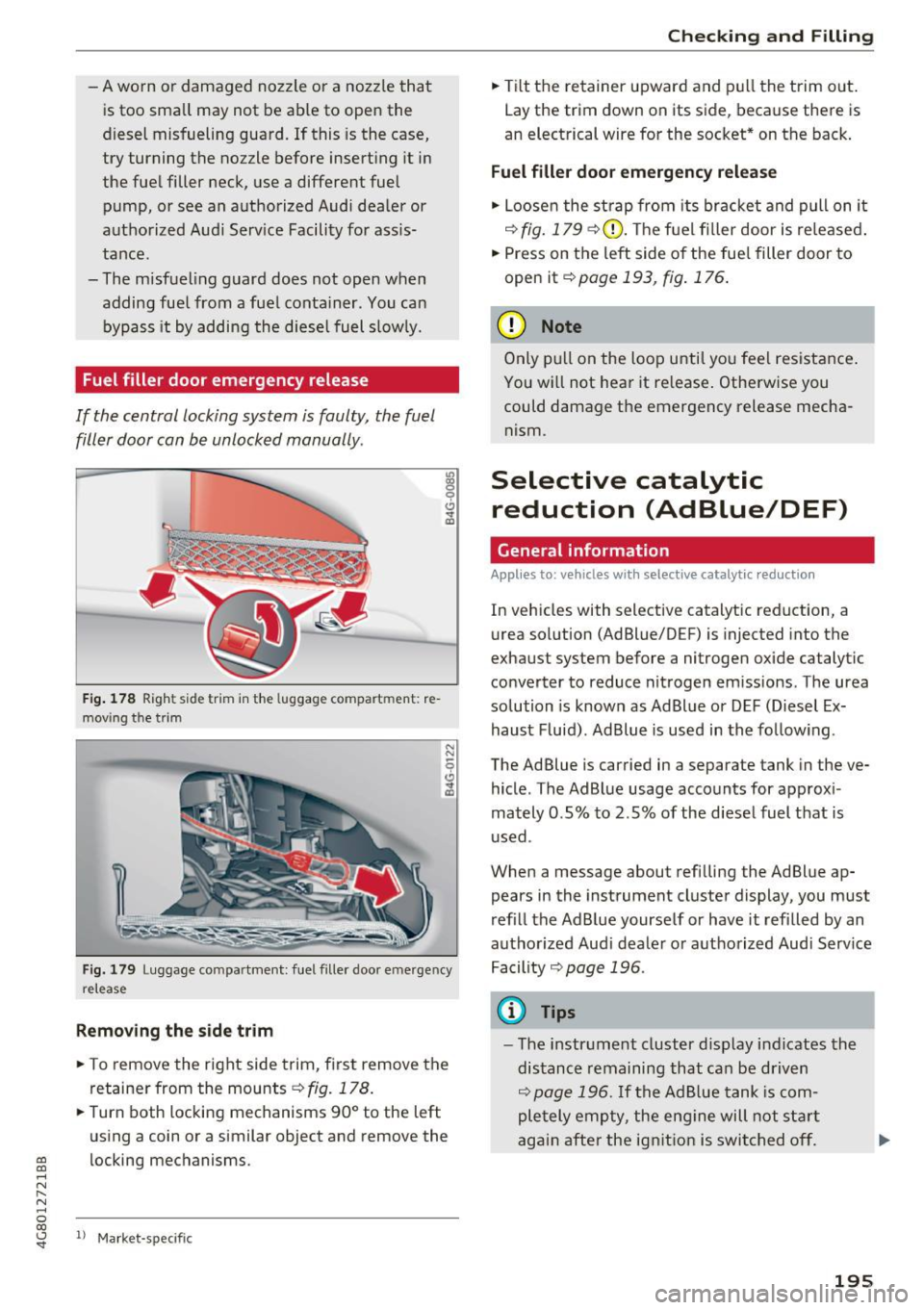
Fuel filler door emergency release
If the central locking system is faulty, the fuel
filler door con be unlocked manually .
Fig. 178 Righ t side tr im in the luggage compart ment : re
mov ing t he trim
N N
9
~
Fig . 17 9 Luggage compartme nt: fuel f iller door emerge ncy
release
Removing the side trim
.,. To remove the right side trim, first remove the
retaine r from the mounts
c::> fig. 178 .
.. Turn both locking mechanisms 90° to the left
us ing a coin or a similar object and remove the
~ locking mec hanisms . .-, N
" N .-, 0
00
~ ll Ma rket -spe cific
Checking and Filling
.. Tilt the retainer upward and pull the trim out .
Lay the trim down on its side, beca use there is
an elect rical wire for the soc ket* on the back .
Fuel filler door emergency release
.. Loose n the st rap from its br acke t and pull on it
c::> fig. 179 c::> (i) . The f uel f iller door is re le ased .
.. Press on the left side of the fue l filler door to
open it
c::> page 193, fig. 176 .
(D Note
Only pull on the loo p until yo u fee l resista nce .
You w ill not hea r it re lease . Othe rw ise you
could damage the emergency release mecha
nism.
Selective catalytic reduction (AdBlue/DEF)
General information
Appl ies to: vehicles with selective catalytic reduct io n
In vehicles with selective catalyt ic reduction, a
urea sol ution (AdBlue/DEF) is injected into the
exhaust system before a nitrogen oxide catalytic
converter to reduce nitrogen em issions . The urea
solution is known as Ad Blue or DEF (Diesel Ex
haust F luid) . Ad Blue is used in the fo llow ing .
The Ad Blue is carried in a separate tank in the ve
hicle . The AdBlue usage acco unts for app rox i
mately 0 .5% to 2.5% of the diesel fuel that is
u sed .
When a message about refi lling the AdBlue ap
pears in the instrument cluste r display, you must
r efil l the Ad B lue yourse lf or have it refilled by an
autho rized Aud i dea le r or a utho rized Aud i Serv ice
Fa cility
c::> page 196 .
(D Tips
-The instr ument cluster d isp lay i ndicates the
distanc e remaining that ca n be driven
c::> page 1 96. If the Ad B lue tank is com
ple tely emp ty, the eng ine will not s tart
agai n afte r the ign it io n is swit ched of f.
195
Page 198 of 284

Checking and Filling
-Ad Blue is required by law to operate this ve
hicle .
Messages in the instrument cluster display
Applies to: vehicles with selective catalytic reduction
The display indicates if the Ad Blue level is low or
if there is a system malfunction.
AdBlue level low
You will be informed if the Ad Blue in the tank
drops below a certain level.
Please refill AdBlue . Range x mi (km)
This message appears when there is only enough
Ad Blue left to drive the distance indicated in the
driver information system . Fill the AdBlue.
Ad Blue ,0 Refill AdBlue! Cannot start engine
in x mi (x km)! See owner's manual
This message appears when there is only enough
Ad Blue left to drive the distance indicated in the
driver information system. Fill the AdBlue. Other
wise the engine will not start again if you stop it
once the distance indicated has been driven. You
can also check the remaining distance in the on
board computer* .
Refill Ad Blue! No restart! See own-
er's manual
This message appears when the Ad Blue tank is
empty . Fill the Ad Blue . Otherwise you will not be
able to start the engine again once you stop it .
The AdB lue must be refilled when the amount in
the tank has reached the minimum level
c::> page 196, Filling AdBlue.
Incorrect filling/system malfunction
A message appears if the Ad Blue tank was filled
with a fluid other than AdBlue and the system
has detected that the tank was fi lled incorrect ly,
or if there is a system malfunction .
Ad Blue-/' Ad Blue : system fault. No re start in
x mi (x km) See owner's manual
This message appears when it is only possible to
d rive the distance indicated in the driver informa
tion system. Drive to the nearest authorized Aud i
dealer or authorized Aud i Serv ice Facility to have
196
the malfunction corrected . Otherwise the engine
will not start again if you stop it once the dis
tance indicated has been driven.
AdBlue: System fault No restart!
See owner's manual
This message appears if the system has detected
that the tank was fi lled incorrect ly or that there
i s a ma lfunction. Drive immed iate ly to the near
est authorized Audi dealer or authorized Audi
Service Facility to have the ma lfunction co rrect
ed. Otherwise you wi ll not be able to start the en
gine again once you stop it.
Filling AdBlue
Applies to: vehicles with selective cata lytic reduct ion
Fig. 180 R ig ht rea r side of t he ve hicle: removing the Ad B l
ue cap
The Ad Blue tank open ing is located near the die
sel tank opening . Add at least 1.5 gallons (S . 7
lit ers) of Ad Blue . This is the minimum amount re
quired to ensure the system detects the refilling
and to start the eng ine. You can add a maximum
of 4.5 gallons (17 lite rs).
Requirement: the request to add AdBl ue must
appear in the ins trument cluster display .
.,. Switch the ignition off.
.,. Open the tank filler door
c::> page 193.
.,. Tu rn the cap on the filler neck counter-clock
w ise using the wheel wrench from the vehicle
tool kit to remove it
c::> fig. 180.
.. Fill the Ad Blue using a bottle c::> page 197 or a
canister
c::> page 19 7.
Page 212 of 284

Check ing and F illing
instrument cluster display each time the ign i
tion is switched on or off . The remaining dis
tance or time is displayed br iefly.
- Inspection or oil change due: if yo ur vehicle
has reached an inspection o r oi l change interval
or both intervals at the same time, the mes
sage
Inspection due! or Oil change due! or Oil
change and inspection due!
appears briefly af
ter switch ing the ignit ion on/off .
Checking service intervals
You can check the rema ining distance o r time un
til the next oil change o r next inspection in the
Car menu. To do this, select : the
IC ARI function
button
> (Car) * Systems control button > Service
& checks > Service interv als .
Resetting the indicator
Your author ized Audi dealer or authoriz ed A udi
Serv ice Facility will reset the serv ice interval d is
p lay after performing serv ice.
If you have changed the oil yourself, you must re
set the oil change interva l.
fo reset the indica to r, se lec t: the
ICAR I fu nction
but ton
> (Car) * Systems con trol b utton > Service
& checks > Service intervals. Tu rn the control
knob downward to
Reset oil change interval and
press the cont rol knob.
(D Note
- Only reset the oil change indicato r if the oil
was changed .
- Fo llow ing the service i nte rva ls is critical to
maintai ning the service life an d va lue of
your ve hicle, especia lly the engine. Even if
the m ileage on the vehicle is low, do not ex
ceed the time for the next service.
- Ca lculating the t ime to the next oi l change
i s interrupted when the ve hicle battery is
d iscon nected¢
page 239 .
210
Page 232 of 284

Wheels
As an added safety feature, your vehicle has been
equipped with a tire pressure mon itor ing system
(TPMS) that illuminates a low tire pressure tell
tale when one or more of your tires is significant
ly under-inflated . Accordingly, when the low tire
pressure telltale illuminates, you should stop and
check your tires as soon as possible, and inflate
them to the proper pressure . Driving on a signifi
cantly under-inflated tire causes the tire to over
heat and can lead to tire failure. Under-inflation
also reduces fuel efficiency and ti re tread life,
and may affect the vehicle's handling and stop
ping ability.
Please note that the TPMS is not a substitute for
proper tire maintenance, and it is the driver's re
sponsibility to maintain correct tire pressure,
even if under- inflation has not reached the level
to trigger illumination of the TPMS low tire pres
sure telltale.
Your vehicle has also been equipped with a TPMS
malfunction indicator to indicate when the sys
tem is not operating properly. The TPMS mal
function indicator is combined with the low tire
pressure telltale . When the system detects a
malfunction, the telltale will flash for approxi
mately one m inute and then remain cont inuously
illuminated . This sequence will continue upon
subsequent vehicle start-ups as long as the mal
function exists .
When the malfunct ion indicator is illuminated,
the system may not be able to detect or signal
low tire pressure as intended. TPMS malfunctions
may occur for a variety of reasons, including the
installation of replacement or alternate tires or
wheels on the vehicle that prevent the TPMS
from functioning properly. Always check the
TPMS malfunction telltale after replacing one or more tires or wheels on your vehicle to ensure
that the replacement or alternate tires and
wheels allow the TPMS to continue to function
properly.
230
Tire pressure monitoring system
Applies to: vehicles with Tire Pressure Monitoring System in
dicator
The tire pressure indicator in the instrument
cluster informs you if the tire pressure is too low
or if there is a system malfunction.
Fig. 194 Instrumen t cl uster : indicator l ig ht with me ssage
Using the ABS sensors, the tire pressure monitor
ing system compares the tire tread circumfer
ence and vibration characteristics of the individu
al tires. If the pressure changes in one or more
tires, this is indicated in the instrument cluster
display with an indicator light
Rt] and a message.
If only one tire is affected, the location of that
tire will be indicated.
The tire pressures must be stored in the Infotain
ment system again each time the pressures
change (switching between partial and full load
pressure) or after changing or replacing a tire on
your vehicle
¢ page 231. The tire pressure mon i
toring system only monitors the tire pressure you have stored . Refer to the tire pressure label for
the recommended tire pressure for your vehicle
¢page 221, fig. 193.
Tire tread circumference and vibrat ion character
istics can change and cause a tire pressure warn
ing if :
- the tire pressure in one or more tires is too low.
- the tire has structural damage.
- the tire was replaced or the tire pressure was
changed and it was not stored¢
page 231 .
-the spare tire* is installed.
Indicator lights
RI]-Loss of pressure in at least one tire¢.&_ .
Check the tires and replace or repair if necessary . .,..
Page 273 of 284

co
co
.... N
" N .... 0
00
\.J -
mat e control) . . . . . . . . . . . . . . . . . . . . . . . . . 62
Cooling mode (deluxe automatic climate con-
trol) . . . . . . . . . . . . . . . . . . . . . . . . . . . . . . . . . 60
Cooling system Adding coolant . . . . . . . . . . . . . . . . . . . . . . 206
Coolant . . . . . . . . . . . . . . . . . . . . . . . . . . . . 205
Coolant level checking . . . . . . . . . . . . . . . . 206
Coolant temperature indicator . . . . . . . . . . . 9
Indicator light . . . . . . . . . . . . . . . . . . . . . . . 14
Cornering light . . . . . . . . . . . . . . . . . . . . . . . 105
Crossing water . . . . . . . . . . . . . . . . . . . . . . . . 65
Cruise control system Changing speed . . . . . . . . . . . . . . . . . . . . . . 86
Preselecting speed . . . . . . . . . . . . . . . . . . . . 86
Switching off . . . . . . . . . . . . . . . . . . . . . . . . 86
switching on . . . . . . . . . . . . . . . . . . . . . . . . . 85
Cup holders . . . . . . . . . . . . . . . . . . . . . . . . . . . 53
Current consumption . . . . . . . . . . . . . . . . . . . 22
Cylinder management
refer to Cylinder on demand system . . . . . . 22
Cylinder on demand system . . . . . . . . . . . . . . 22
D
Data recorder . . . . . . . . . . . . . . . . . . . . . . . . 127
Date display . . . . . . . . . . . . . . . . . . . . . . . . . . 24
Daytime running lights . . . . . . . . . . . . . . . . . 40
Declar ation of compliance
Adaptive cruise control . . . . . . . . . . . . . . . 267
Aud i side assist . . . . . . . . . . . . . . . . . . . . . 267
Ce ll phone package . . . . . . . . . . . . . . . . . . 267
Convenience key . . . . . . . . . . . . . . . . . . . . . 267
Electronic immobilizer. . . . . . . . . . . . . . . . 267
Garage door opener (Homelink) . . . . . . . . 267
Remote control key . . . . . . . . . . . . . . . . . . 267
Tire pr essure monitoring system . . . . . . . 267
DEF
refer to Ad Blue . . . . . . . . . . . . . . . . . . . . . . 195
Defective light bulb warning Indicator light . . . . . . . . . . . . . . . . . . . . . . . 19
Defrosting (windows) Deluxe automati c climate control . . . . . 60, 62
DEF (instrument cluster) . . . . . . . . . . . . . . . . 24
Deluxe automatic climate control Air vents . . . . . . . . . . . . . . . . . . . . . . . . . . . . 61
Dete rmining correct load limit . . . . . . . . . . 226
Index
Diesel
Indicator light . . . . . . . . . . . . . . . . . . . . . . . 17
Prewarming . . . . . . . . . . . . . . . . . . . . . . . . . 69
Diesel Exhaust Fluid (DEF)
refer to Ad Blue . . . . . . . . . . . . . . . . . . . . . . 195
Diesel fuel . . . . . . . . . . . . . . . . . . . . . . . . . . . 192
Di esel particulate filter . . . . . . . . . . . . . . . . 199
Dimensions . . . . . . . . . . . . . . . . . . . . . . . . . . 261
Dimming the rearview mirror . . . . . . . . . . . . 44
Distance driven . . . . . . . . . . . . . . . . . . . . . . . . 22
Door/rear lid warning . . . . . . . . . . . . . . . . . . . 21
Doo rs
Child safety lock . . . . . . . . . . . . . . . . . . . . . . 36
Closing aid . . . . . . . . . . . . . . . . . . . . . . . . . . 27
Emergency locking . . . . . . . . . . . . . . . . . . . . 32
Driver information system . . . . . . . . . . . . . . . 21
Boost . . . . . . . . . . . . . . . . . . . . . . . . . . . . . . 87
CD/radio display . . . . . . . . . . . . . . . . . . . . . . 21
Door/rear lid warning . . . . . . . . . . . . . . . . . 21
Efficiency program . . . . . . . . . . . . . . . . . . . . 23
Engine oil temperature d isplay . . . . . . . . . . 87
Exterior temperature display . . . . . . . . . . . 21
On-board computer . . . . . . . . . . . . . . . . . . . 22
Service interval display . . . . . . . . . . . . . . . 209
Shifting indicator . . . . . . . . . . . . . . . . . . . . . 87
Driver seating position . . . . . . . . . . . . . . . . . 130
Drive select . . . . . . . . . . . . . . . . . . . . . . . . . . 105
Driving economically . . . . . . . . . . . . . . . . . . . 66
Driving safely . . . . . . . . . . . . . . . . . . . . . . . . 129
Driving through water . . . . . . . . . . . . . . . . . . 65
Driving time . . . . . . . . . . . . . . . . . . . . . . . . . . 22
Dust filter
refer to Pollutant filter . . . . . . . . . . . . . . . . 59
Dynamic steering . . . . . . . . . . . . . . . . . . . . . 105
Indicator light . . . . . . . . . . . . . . . . . . . . . . 124
E
Easy seat entry . . . . . . . . . . . . . . . . . . . . . . . . 69
Economy tips (efficiency program) . . . . . . . . 23
ED L
refer to Electronic Differential Lock . . . . . 120
Efficiency program . . . . . . . . . . . . . . . . . . . . . 23
Electromechanical parking brake . . . . . . . . . 7 4
Electromechanical steering . . . . . . . . . . . . . 124
I ndicato r light . . . . . . . . . . . . . . . . . . . . . . 124
271
Page 275 of 284

co
co
.... N ,..._
N .... 0
00
\.J '
Adjusting . . . . . . . . . . . . . . . . . . . . . . . . . . 131
Ch ild restraints in the front seat . . . . . . . . 149
also refer to Seats . . . . . . . . . . . . . . . . . . . . 48
Fu el
Additives ... .. ................ ..... . 191
Blended gasoline . . . . . . . . . . . . . . . . . . . . 191
Current consumption . . . . . . . . . . . . . . . . . . 22
Fuel filler neck . . . . . . . . . . . . . . . . . . . . . . 193
Fuel gauge . . . . . . . . . . . . . . . . . . . . . . . . 9, 10
Fuel tank capacity . . . . . . . . . . . . . . . . . . . 262
Gasoline . . . . . . . . . . . . . . . . . . . . . . . . . . . 191
Gasoline additives . . . . . . . . . . . . . . . . . . . 192
Indicator light . . . . . . . . . . . . . . . . . . . . . . . 18
Octane rat ing . . . . . . . . . . . . . . . . . . . . . . . 191
Recommendation . . . . . . . . . . . . . . . . . . . . 191
Saving fuel . . . . . . . . . . . . . . . . . . . . . . 66, 105
Fue ling
Fuel gauge . . . . . . . . . . . . . . . . . . . . . . . . . . 10
Fuel tank capacity . . . . . . . . . . . . . . . . . . . 262
Opening the fuel filler door . . . . . . . . . . . . 193
Fuses Assignment . . . . . . . . . . . . . . . . . . . . . . . . 251
Replac ing . . . . . . . . . . . . . . . . . . . . . . . . . . 250
G
Garage door opener (Home Link) . . . . . . . . . . 38
Garment hook . . . . . . . . . . . . . . . . . . . . . . . . . 54
Glasses holder . . . . . . . . . . . . . . . . . . . . . . . . 54
Glossary of tire and loading terminology .. 213
Glove compartment . . . . . . . . . . . . . . . . . . . . 54
cooled . . . . . . . . . . . . . . . . . . . . . . . . . . . . . . 54
Gross Vehicle Weight Rat ing (GVWR) . . . . . 261
H
Head-up Display . . . . . . . . . . . . . . . . . . . . . . . 24
Headlight range control
Indicator light . . . . . . . . . . . . . . . . . . . . . . . 19
Headlight range control system . . . . . . . . . . 40
H eadlights . . . . . . . . . . . . . . . . . . . . . . . . . . . 41
Cleaning . . . . . . . . . . . . . . . . . . . . . . . . . . . 236
Headlight range contro l system . . . . . . . . . 40
Washer system . . . . . . . . . . . . . . . . . . . . . . 46
He ad restraints . . . . . . . . . . . . . . . . . . . . . . . 132
Adjusting ................ .... 49, 50, 132
Removing and installing . . . . . . . . . . . . . . . 50
Index
Heated
Exterior mirrors . . . . . . . . . . . . . . . . . . . . . . 44
Rear w indow (4-zone deluxe automat ic cli
mate control) . . . . . . . . . . . . . . . . . . . . . . . . 63
Rear window (deluxe automatic climate con-
trol) . . . . . . . . . . . . . . . . . . . . . . . . . . . . . . . 61
Seats (4-zone deluxe automatic climate con-
trol) . . . . . . . . . . . . . . . . . . . . . . . . . . . . . . . 62
Seats (deluxe automatic climate control) . . 61
Washer nozzles . . . . . . . . . . . . . . . . . . . . . . 46
Heating . . . . . . . . . . . . . . . . . . . . . . . . . . . . . . 59
Heavy clothing and safety be lts . . . . . . . . . . 142
High beams
Ass istant . . . . . . . . . . . . . . . . . . . . . . . . . . . . 41
High voltage warning label . . . . . . . . . . . . . 260
Hill descent control . . . . . . . . . . . . . . . . . . . . 79
Hill hold assist . . . . . . . . . . . . . . . . . . . . . . . . 7S
also refer to Hill hold assist . . . . . . . . . . . . 75
Hold assist (hill) . . . . . . . . . . . . . . . . . . . . . . . 75
Homelink (garage door opener) . . . . . . . . . . 38
Hooks . . . . . . . . . . . . . . . . . . . . . . . . . . . . . . . 57
Horn . . . . . . . . . . . . . . . . . . . . . . . . . . . . . . . . . 6
How are child restraint system anchors relat-
ed to child safety . . . . . . . . . . . . . . . . . . . . . 186
How many airbags does my vehicle have? . . lSS
How safety belt pretensioners work . . . . . . 146
I
Ignition
Indicator light . . . . . . . . . . . . . . . . . . . . . . . lS
Switching on/off . . . . . . . . . . . . . . . . . . . . . 69
Imbalance (wheels) . . . . . . . . . . . . . . . . . . . 219
Immobilizer . . . . . . . . . . . . . . . . . . . . . . . 24, 28
Important things to do before driving . . . . 129
Improperly worn safety belts . . . . . . . . . . . 146
Indicator lights . . . . . . . . . . . . . . . . . . . . . . . . 10
Infant seats . . . . . . . . . . . . . . . . . . . . . . . . . 178
Inflation pressure (tires) . . . . . . . . . . . . . . . 221
Inspection interval . . . . . . . . . . . . . . . . . . . . 209
Installing child safety seats
Safety belts . . . . . . . . . . . . . . . . . . . . . . . . 183
Installing the upper tether strap on the an
chorage . . . . . . . . . . . . . . . . . . . . . . . . . . . . . 189
Instrument cluster . . . . . . . . . . . . . . . . . . . . . . 9
Indicator lights . . . . . . . . . . . . . . . . . . . . . . 10
Messages . . . . . . . . . . . . . . . . . . . . . . . . . . . 10
273