wheel AUDI A7 2017 Owner´s Manual
[x] Cancel search | Manufacturer: AUDI, Model Year: 2017, Model line: A7, Model: AUDI A7 2017Pages: 284, PDF Size: 72.29 MB
Page 158 of 284

Airbag syste m
switched on and turns the airbag indicator light
on when a malfunction in the one of the system
components is detected ¢
page 160. Because
the front passenger seat contains important
parts of the Advanced Airbag System, you must
take care to prevent it from being damaged .
Damage to the seat may prevent the Advanced
A irbag System for the front passenger seat from
doi ng its job in a c rash.
The front Ad vanced Airb ag Sy stem con sis ts
of the following:
- Crash sensors in the front of the vehicle that
measure vehicle acceleration/decelerat ion to
provide info rmation to the Advanced Airbag
System about t he severity of the crash.
- An electron ic control un it, with integrated
c rash sensors fo r front and side impacts. The
contro l unit "decides" whethe r to fire the front
airbags based on the information received from
the crash sensors . The control unit a lso "de
cides" whether the safety be lt pretensioners
shou ld be activated.
- An Advanced Airbag with gas generator and
control valve for the driver ins ide the steer ing
wheel hub.
- An Advanced Airbag with gas gene rator and
control valve inside the instrument pane l for
the front passenger.
- A capacitive passenger detect ion system under
neath the front passenger seat cover. This sys
tem measures the electrical capac itance of the
person in the seat . T he information registe red
is sent continuous ly to the e lectron ic cont rol
unit to regula te deployment of the front Ad
vanced Airbag on the passenge r si de.
- An airbag monitoring system and indicator
l igh t in the inst rumen t cluster¢
page 160.
- A sensor in each front seat registers the dis
tance between the respect ive seat and the
stee ring wheel or instr ume nt pane l. The infor
ma tion reg istered is sent contin uously to the
electronic control un it to regulate deployment
of the front Advanced Ai rbags.
- The
PASSENGER AIR BAG OFF lig ht comes on
and stays on in the center of the instrument
panel ¢
page 160, fig. 158 and tells you when
156
the front Advanced Airbag on the passenger
side has been turned
off.
-A sensor in the safety be lt latch for the driver
and for the front seat passenger that senses
whether that safety belt is latched or not and transmits this information to the electronic
control un it.
A WARNING
Damage to the front passenger seat can pre
vent the front airbag from work ing properly.
- Improper repair or disassembly of the front
passenger and driver seat will prevent the
Advanced A irbag Sys tem from f unction ing
proper ly.
- Repairs to the front passenger seat must be
performed by qualified and prope rly train ed
wo rkshop personne l.
- Never remove the front passenger or driver
seat from the vehicle .
- Never remove the upholstery from the front
passenger sea t.
- Never d isassemble or remove parts from the
seat or disconnect w ires from
it.
- Never carry sharp objects in your pockets or
put them on the seat . The capacit ive pas
senger de tect io n mat in the front passenger
seat will not function p roperly if it is punc
tured.
- Never car ry things on your lap or carry ob
jects on the front passenge r seat. Such ob
jects ca n influen ce the capaci tan ce regis
t ered by the capaci tive passenger detection
sys tem, so tha t incorrect in format ion is pro
vided to the airbag control unit.
- Never store i tems under the front passenger
seat. Parts of the Advanced Airbag System
under the passenger seat could be dam
aged, preventing them and the airbag sys
tem from working properly.
- Never p lace seat covers or replacement up
holstery that have not been specifically ap proved by Audi on the front seats.
- Seat covers can prevent the Advanced A ir
bag System from recogni zing child re
straints or occupants on the front passenger
seat and prevent the side airbag in the seat
backrest from deploying prope rly .
Page 161 of 284

co
co
.... N
" N .... 0
00
\.J '
A child in a rearward-facing child seat instal
led on the front passenger seat will be seri
ously injured and can be killed if the front air
bag inflates - even with an Advanced Airbag
System .
- The inflating airbag will hit the child seat or
infant carrier with great force and will
smash the child seat and child against the backrest , center armrest, door or roof.
- Always install rear-facing child seats on the
rear seat.
- If you must install a rearward facing child
seat on the front passenger seat because of
exceptional circumstances and the
PASSEN
GER AIR BAG OFF
light does not come on
and stay on, immediately install the rear
facing child seat in a rear seating position and have the a irbag system inspected by
your Audi dealer.
A WARNING
Objects between you and the airbag will in
crease the risk of injury in a crash by interfer
ing with the way the airbag unfolds or by be
ing pushed into you as the airbag inflates .
- Never hold things in your hands or on your
lap when the vehicle is in use .
- Never transport items on or in the area of
the front passenger seat . Objects could
move into the area of the front airbags dur
ing braking or other sudden maneuvers and
become dangerous projectiles that can
cause serious personal injury if the airbags
inflate.
- Never place or attach accessories or other
objects (such as cup holders, telephone
brackets , large, heavy or bulky objects) on
the doors, over or near the area marked "AIRBAG" on the steering wheel, instru
ment panel, seat backrests or between
those areas and yourself . These objects
could cause injury in a crash, especially
when the airbags inflate .
- Never recline the front passenger 's seat to
transport objects . Items can also move into
the area of the side airbag or the front air-
-
Airbag system
bag during braking or in a sudden maneu
ver. Objects near the airbags can become
projectiles and cause injury, particularly
when the seat is reclined.
- Never place or transport objects on the
front passenger seat. Objects on the front
passenger seat could cause the capacitive
sensor in the seat to signal to airbag system
that the seat is occupied by a person when it
in fact is not, or that the person on the seat
is heavier than he or she actually is . The
change in electric capacitance because of
such objects can cause the passenger front
airbag to be turned on when it should be
off, or can cause the airbag to work in a way
that is different from the way it would have
worked without objects on the seat.
- Always make sure that there is nothing on
the front passenger seat that will cause the
capacitive passenger detection system in
the seat to signal to the Airbag System that
the seat is occupied by a person when it is
not , or to signal that it is occupied by some
one who is heavier than the person actually
sitting on the seat. The presence of an ob
ject could cause the passenger front airbag to be turned on when it should be off, or
could cause the airbag to work in a way that is different from the way it would have
worked without the object on the seat.
A WARNING
-The fine dust created when airbags deploy can
cause breathing problems for people with a history of asthma or other breathing condi
tions .
- To reduce the risk of breathing problems,
those with asthma or other respiratory con
ditions should get fresh air right away by
getting out of the vehicle or opening win
dows or doors.
- If you are in a collision in which airbags de
ploy, wash your hands and face with mild
soap and water before eating.
- Be careful not to get the dust into your eyes,
or into any cuts or scratches.
- If the residue should get into your eyes,
flush them with water .
159
Page 165 of 284
co
co
.... N r-N .... 0
00
\.J -
install a forward-facing child restraint on
the front passenger seat, always move the
seat into its rearmost position in the seat 's
fore and aft adjustment range, as far away
from the airbag as possible . The backrest
must be adjusted to an upright position.
- Make sure that the
PASSENGER AIR BAG
OFF
light comes on and stays on all the time
whenever the ignition is switched on.
_& WARNING
- If the PASSENGER AIR BAG OFF light does
not go out when an adult is sitting on the
front passenger seat after taking the steps
described above, make sure the adult is
properly seated and restrained at one of the
rear seating positions .
- Have the airbag system inspected by your
Audi dealer before transporting anyone on
the front passenger seat .
(D Tips
If the capacitive passenger detection system
determines that the front passenger seat is
empty, the frontal airbag on the passenger
side will be turned off, and the
PASSENGER
AIR BAG OFF
light will stay on.
Repair , care and disposal of the airbags
Parts of the airbag system are installed at many
different places on your Audi. Installing , remov
ing , servicing or repairing a part in an area of the
vehicle can damage a part of an airbag system
and prevent that system from working properly
in a collision.
There are some important things you have to
know to make sure that the effectiveness of the
system will not be impaired and that discarded
components do not cause injury or pollute the
environment.
_& WARNING
Improper care, servicing and repair proce
dures can increase the risk of personal injury
and death by preventing an airbag from de-
-
Airbag system
ploying when needed or deploying an airbag
unexpectedly :
- Never cover, obstruct, or change the steer
ing wheel horn pad or airbag cover or the in
strument panel or modify them in any way.
- Never attach any objects such as cup holders
or telephone mountings to the surfaces cov
ering the airbag units.
- For cleaning the horn pad or instrument
panel, use only a soft, dry cloth or one mois
tened with plain water. Solvents or cleaners
could damage the airbag cover or change
the stiffness or strength of the material so
that the airbag cannot deploy and protect properly.
- Never repair, adjust, or change any parts of
the airbag system.
-All work on the steering wheel, instrument
panel, front seats or electrical system (in
cluding the installation of audio equipment,
cellular telephones and CB radios , etc.)
must be performed by a qualified technician
who has the training and special equipment
necessary.
- For any work on the airbag system, we
strongly recommend that you see your au
thorized Audi dealer or qualified workshop.
- Never modify the front bumper or parts of
the vehicle body.
- Always make sure that the side airbag can
inflate without interference:
- Never install seat covers or replacement
upholstery over the front seatbacks that
have not been specifically approved by
Audi .
- Never use additional seat cushions that
cover the areas where the side airbags in
flate.
- Damage to the original seat covers or to
the seam in the area of the side airbag
module must always be repaired immedi
ately by an authorized Audi dealer.
- The airbag system can deploy only once. Af
ter an airbag has been deployed, it must be
replaced with new replacement parts de
signed and approved especially for your
Audi model version. Replacement of com plete airbag systems or airbag components
163
Page 168 of 284
Airbag syste m
Although they are not a soft pillow, they can
"cushion" the impact and in this way they can
he lp to reduce the risk of injury to the lower ex
tremities .
All of this takes place in the blink of an eye, so
fast that many people don't even realize that the airbags have deployed. The a irbags also inflate
with a great deal of force and it is important for
occupant safety that nothing should be in their
way when they deploy .
Fully inflated airbags in comb ination with proper
ly worn safety belts slow down and limit the oc
cupant's forward movement and help to reduce
the risk of inju ry.
Important safety instructions on the knee
airbag system
App lies to : ve hicles w ith knee a irbags
Airbags are only supplemental restraints . Always
wear safety belts correctly and ride in a proper
seating position.
There is a lot that you and your passengers must
know and do to help the safety belts and airbags
to provide supplemental protection .
,&. WARNING
An inflating knee airbag can cause ser ious in
jury. Wearing safety bel ts incorrectly and im
proper seating positions increase the r isk of
serious personal injury and death whenever a
vehicle is being used.
- The knee airbag system cannot protect you properly if you are seated too close to any of
the airbag locat ions. When adjusting their
seat positions, it is important that both the driver and the front passenger keep their
upper bodies and knees at the following
min imum safe distances:
- at least 10 inches (25 cm) between the
chest and the steering wheel/instrument panel.
- at least 4 inches (10 cm) between the
knees and the lower part of the instru ment panel.
- The risk of persona l injury increases if you
lean forward or to the s ide, or if the seat is
166 improperly positioned and you are not wear
ing your safety belt. The risk increases even
more should the airbag deploy.
- Always make sure that the knee a irbag can
inflate w ithout interference. Objects be
tween you and the airbag can increase the
r isk of injury in an accident by interfering
w ith the way the airbag deploys or by being
pushed i nto you as the a irbag deploys.
- Never let anybody, especia lly children or
anima ls ride in the footwell in front of the
passenger seat. If the airbag deploys, this
can result in serious or fatal injuries .
- Never carry objects of any kind in the foot
well area in front of the driver's or pas senger's seat. Bulky objects (shopp ing
bags, for example) can interfere with or
prevent proper dep loyment of the a irbag.
Small objects can be thrown through the
vehicle if the airbag deploys and injure you
or your passengers.
- Ma ke sure there are no crac ks, deep scratch
es o r other damage in the area of the i nst ru
ment panel where the knee airbags are lo
cated .
- If children are incorrec tly seated, their risk
of injury increases in a coll is ion
c:::> page 172, Child safety.
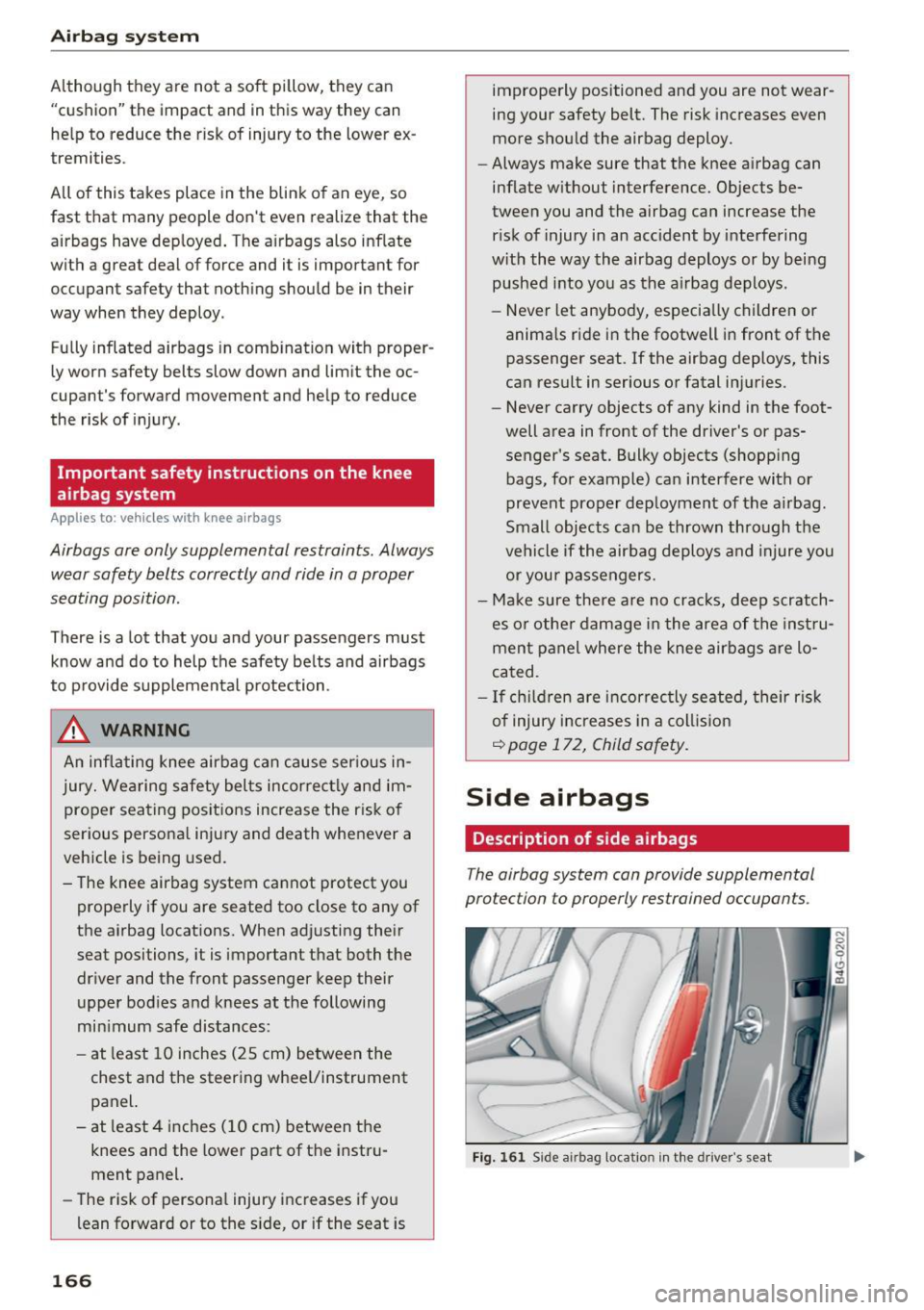
Side airbags
Description of side airbags
The airbag system can provide supplemental
protection to properly restrained occupants .
Fig. 161 S ide a irbag locatio n in th e driver 's seat
Page 198 of 284

Checking and Filling
-Ad Blue is required by law to operate this ve
hicle .
Messages in the instrument cluster display
Applies to: vehicles with selective catalytic reduction
The display indicates if the Ad Blue level is low or
if there is a system malfunction.
AdBlue level low
You will be informed if the Ad Blue in the tank
drops below a certain level.
Please refill AdBlue . Range x mi (km)
This message appears when there is only enough
Ad Blue left to drive the distance indicated in the
driver information system . Fill the AdBlue.
Ad Blue ,0 Refill AdBlue! Cannot start engine
in x mi (x km)! See owner's manual
This message appears when there is only enough
Ad Blue left to drive the distance indicated in the
driver information system. Fill the AdBlue. Other
wise the engine will not start again if you stop it
once the distance indicated has been driven. You
can also check the remaining distance in the on
board computer* .
Refill Ad Blue! No restart! See own-
er's manual
This message appears when the Ad Blue tank is
empty . Fill the Ad Blue . Otherwise you will not be
able to start the engine again once you stop it .
The AdB lue must be refilled when the amount in
the tank has reached the minimum level
c::> page 196, Filling AdBlue.
Incorrect filling/system malfunction
A message appears if the Ad Blue tank was filled
with a fluid other than AdBlue and the system
has detected that the tank was fi lled incorrect ly,
or if there is a system malfunction .
Ad Blue-/' Ad Blue : system fault. No re start in
x mi (x km) See owner's manual
This message appears when it is only possible to
d rive the distance indicated in the driver informa
tion system. Drive to the nearest authorized Aud i
dealer or authorized Aud i Serv ice Facility to have
196
the malfunction corrected . Otherwise the engine
will not start again if you stop it once the dis
tance indicated has been driven.
AdBlue: System fault No restart!
See owner's manual
This message appears if the system has detected
that the tank was fi lled incorrect ly or that there
i s a ma lfunction. Drive immed iate ly to the near
est authorized Audi dealer or authorized Audi
Service Facility to have the ma lfunction co rrect
ed. Otherwise you wi ll not be able to start the en
gine again once you stop it.
Filling AdBlue
Applies to: vehicles with selective cata lytic reduct ion
Fig. 180 R ig ht rea r side of t he ve hicle: removing the Ad B l
ue cap
The Ad Blue tank open ing is located near the die
sel tank opening . Add at least 1.5 gallons (S . 7
lit ers) of Ad Blue . This is the minimum amount re
quired to ensure the system detects the refilling
and to start the eng ine. You can add a maximum
of 4.5 gallons (17 lite rs).
Requirement: the request to add AdBl ue must
appear in the ins trument cluster display .
.,. Switch the ignition off.
.,. Open the tank filler door
c::> page 193.
.,. Tu rn the cap on the filler neck counter-clock
w ise using the wheel wrench from the vehicle
tool kit to remove it
c::> fig. 180.
.. Fill the Ad Blue using a bottle c::> page 197 or a
canister
c::> page 19 7.
Page 200 of 284

Check ing and F illing
is empty or until no mo re fluid flows into the
tank.
~ Remove the canister and close the fi ller tube
c> page 198 , Completing AdBlue refill .
(D Note
Only use refi ll canisters that are approved for
your vehicle. Us ing other systems can cause
Ad Blue to leak.
@ Tips
- An authorized Audi dealer or authorized
Audi repair facility can te ll you which ref ill
can isters are approved for your vehicle.
- A permitted refill canister contains approxi
mately 1.3 ga llons (5 liters) of AdB lue.
Completing AdBlue refill
Applies to: vehicles with selective catalytic reduction
C losi ng the filler neck
~ Turn the cap on the filler neck to the right with
the wheel wrench unt il the cap clicks into place.
This t ightens the cap to the specification o &
in Filling AdBlue on page 197, c> (D in Filling
AdBlue on page 197 .
~ The n press on the left side of the tank doo r un-
ti l it l atches.
After filling
The vehicle must be driven so that the system
recognizes that the Ad Blue was refilled . T his can
take severa l m in utes.
~ If there was no Ad Blue left in the tank and a
range of O mi (0 km) was shown in the d isplay,
switch the ign it ion on for about 30 seconds be
fo re sta rting the engine.
(D Tips
Ad Blue can freeze at very low temperat ures .
If this happens, the system will not detect
that the Ad Blue was refilled a nd it will contin
ue to inform yo u of the low Ad Blue level. The
message turns off as soon as the tank thaws
out again.
198
Catalytic converter
Applies to: vehicles with gasoline engine
It is very important that your emission control
system (catalytic converter) is func tioning prop
erly to ensure that your vehicle is running in an
environmentally sound manner .
~ Always use lead-free gasoline c> page 191, Fuel
supply .
~ Never run the tank down all the way to empty.
~ Never put too much motor o il in your engine
c> page 204, Adding engine oil.
~ Never try to push- o r tow-start your vehicle .
The catalytic converter is an efficient "clean -up "
device built into the exhaust system of the veh i
cle. The catalyt ic converter b urns many of the
po llutants in the exhaust g as befo re they are re
l eased into the atmosphere.
The exclusive use of un leaded fuel is critically im
po rtant fo r the life of the catalytic converte r and
prope r funct io ni ng of the engine.
_&. WARNING
The temperat ure of the exhaus t sys tem is
high, both when driv ing and a fter stopping
the engine.
-
- Never tou ch the exhaust tail pipes once they
have become hot. This cou ld resu lt in burns.
- D o not p ark or operate the vehicle in ar eas
where the hot exhaust system may come in
contact with dry g rass, brush, fuel spi ll or
other mate rial which can ca use a fire.
- Do not apply additiona l undercoating or
rustp roofing on or near the exhaust mani
fold, exha ust pipes, cata lytic conve rter or
heat shields . D uring driving, the substance
used for unde rcoat ing could overheat and
cause a fire .
Cl) Note
-Be aware that just one tank f illing wit h
leaded fu e l w ill already seriously degrade
the performance of the catalytic converter.
- Do not exceed the correct engine oil leve l
c>page204.
Page 213 of 284

a)
a)
.--< N
" N .... 0 a) 0.:,
"'
Wheels
Wheels and Tires
General information
.,.Check your tires regularly for
damage (punctures, cuts, cracks
and bulges). Remove foreign ob
jects from the tire tread.
.,. If driving over curbs or similar
obstacles, drive slowly and ap
proach the curb at an angle.
.,.Have faulty tires or rims re
placed immediately.
"'Protect your tires from oil,
grease and fuel.
.,.M ark tires before removing
them so that the same running
direction can be maintained if
they are reinstalled.
"'Lay tires flat when storing and
store them in a cool, dry location
with as little exposure to light as
possible.
(D Note
-Please note that summer and
winter tires are designed for
the conditions that are typical in those seasons. Audi recom
mends using winter tires dur
ing the winter months. Low
temperatures significantly de crease the elasticity of summ
er tires, which affects traction
Wheels
and braking ability. If summer
tires are used in very cold
temperatures, cracks can form
on the tread bars, resulting in
permanent tire damage that
can cause loud driving noise
and unbalanced tires.
-Burnished, polished or
chromed rims must not be
used in winter driving condi
tions. The surface of the rims
does not have sufficient corro
sion protection for this and
could be permanently dam aged by road salt or similar
substances.
Tire designations
Fig. 190 T ir e designations on the side -
wall Ill>
211
Page 214 of 284

Wheels
(D Tires for passenger vehicles
(if applicable)
P indicates a tire for a passenger
vehicle. T indicates a tire desig
nated for temporary use.
@ Nominal width
Nominal width of the tire be
tween the sidewalls in millime
ters. In general: the larger the
number, the wider the tire.
@ Aspect ratio
Height/width ratio expressed as a
percentage.
@ Tire construction
R indicates a radial tire.
® Rim diameter
Size of the rim diameter in inches.
@ Load index and speed rating
The load index indicates the tire's
load-carrying capacity.
The speed rating indicates the maximum permitted speed
¢ & in
Winter tires on page 22
7.
"EXTRA LOAD", "xl" or "RF" indi
cates that the tire is reinforced or
is an Extra Load tire.
Speed rat- Maximum permitted speed
ing
p
up to 93 mph (150 km/h)
Q up to 99 mph (160 km/h)
212
Speed rat- Maximum permitted speed
Ing
R
up t o 106 mph (170 km/h)
s up to 110 mph (180 km/h)
T up to 1 18 mph (190 km/h)
u up to 124 mph (200 km/h)
H up to 130 mph (210 km/h)
V up to 149 mph (240 km/h)al
z above 149 mph (240 km/h)al
w up to 168 mph (270 km/h)al
y up to 186 mph (300 km/h)al
a) For tires above 149 mph (240 km/h),
tire manufacturers sometimes use the
code "ZR".
(j) US DOT number (TIN) and
manufacture date
The manufacture date is listed on
the tire sidewall (it may only ap
pear on the inner side of the tire):
DOT ... 2216 ...
means, for example, that the tire
was produced in the 22nd week of
the year 2016.
@ Audi Original Tires
Audi Original equipment tires
with the designation "AO" have
been specially matched to your
Audi. When used correctly, these
tires meet the highest standards
for safety and handling. An au
thorized Audi dealer or author
ized Audi Service Facility will be
able to provide you with more in
formation.
Page 215 of 284

a,
a,
..... N r-. N ..... 0 a, OJ ..
® Mud and snow capability
"M/5" or "M+S" indicates the tire
is suitable for driving on mud and
snow. £ indicates a winter tire.
@Composition of the tire cord
and materials
The number of plies indicates the
number of rubberized fabric lay
ers in the tire . In general: the
more layers, the more weight a
tire can carry. Tire manufacturers
must also specify the materials
used in the ti re . These inc lude
stee l, nylon, polyester and other
materials.
@ Maximum permitted load
This number indicates the maxi
mum load in kilograms and
pounds that the tire can carry.
@ Un iform tire quality grade
standards for treadwear,
traction and temperature resistance
Tread wear, traction and temper
ature ranges¢
page 229 .
@ Running direction
The arrows indicate the running
direction of unidirectional tires.
You must always follow the speci
fied running direction
¢page 248 .
~ Maximum permitted
inflation pressure
Wheels
T his number indicates the maxi
mum pressure to which a tire can
be inflated under normal operat
ing conditions .
Glossary of tire and loading
terminology
Accessory weight
means the combined weight (in
excess of those standard items
which may be replaced) of auto matic t ransmission, power steer
ing, power brakes, power win
dows , powe r seats, radio, and
heater, to the extent tha t these
items are avai lab le as factory- in
stalled equipment (whether in
s t alled or not).
Aspect ratio
means the ratio of the height to
the w idth of the tire in percent.
Numbers of 55 or lower indicate a
low sidewall for improved steer
ing response and better overall
handling on dry pavement .
Bead
means the part of the tire that is
made of steel wires, wrapped or
reinfo rced by ply cords and that is
shaped to fit the rim. ...
213
Page 216 of 284

Wheel s
Bead separation
means a breakdown of the bond
between components in the bead .
Cord
means the strands forming the
plies in the tire.
Cold tire inflation pressure
means the tire pressure recom
mended by the vehicle manufac
turer for a tire of a designated
size that has not been driven for more than a couple of miles (kilo
meters) at low speeds in the
three hour period before the tire
pressure is measured or adjusted.
Curb weight
means the weight of a motor ve
hicle with standard equipment in
cluding the maximum capacity of
fuel, oil, and coolant, air condi
tioning and additional weight of
optional equipment.
E x tra load tire
means a tire designed to operate
at higher loads and at higher in
flation pressures than the corre sponding standard tire . Extra load
tires may be identified as "XL",
"xl", "EXTRA LOAD", or "RF" on
the sidewal l.
214
Gross Axle Weight Rating
("GAWR ")
means the load-carrying capacity
of a single axle system, measured
at the tire -ground interfaces .
Gross Vehicle Weight Rating
(" GVWR ")
means the maximum total loaded
weight of the vehicle .
Groove
means the space between two ad
jacent tread ribs .
Load rating (code )
means the maximum load that a
tire is rated to carry for a given in
flation pressure. You may not find
this information on all tires be
cause it is not required by law.
Ma ximum load rating
means the load rating for a tire at
the maximum permissible infla tion pressure for that tire.
Ma ximum loaded vehicle
weight
means the sum of :
(a) Curb weight
(b) Accessory weight
(c) Vehicle capacity weight, and
(d) Production options we ight