belt AUDI A7 2018 User Guide
[x] Cancel search | Manufacturer: AUDI, Model Year: 2018, Model line: A7, Model: AUDI A7 2018Pages: 274, PDF Size: 42.77 MB
Page 132 of 274
Driving sa fety
,.. ALWAYS adjust your speed to road, traffic and
weather conditions.
,.. Take frequent breaks on long trips. Do not drive
for more than two hours at a stretch.
,.. Do NOT drive when you are tired, under pres
sure or whe n you are stressed .
A WARNING
Impaired driv ing safety inc reases the risk of
ser ious persona l inju ry and death whenever a
vehicle is being used.
Correct passenger
seating positions
Proper seating position for the driver
The proper driver sea ting po sition is impor tan t
for safe, relaxed driving .
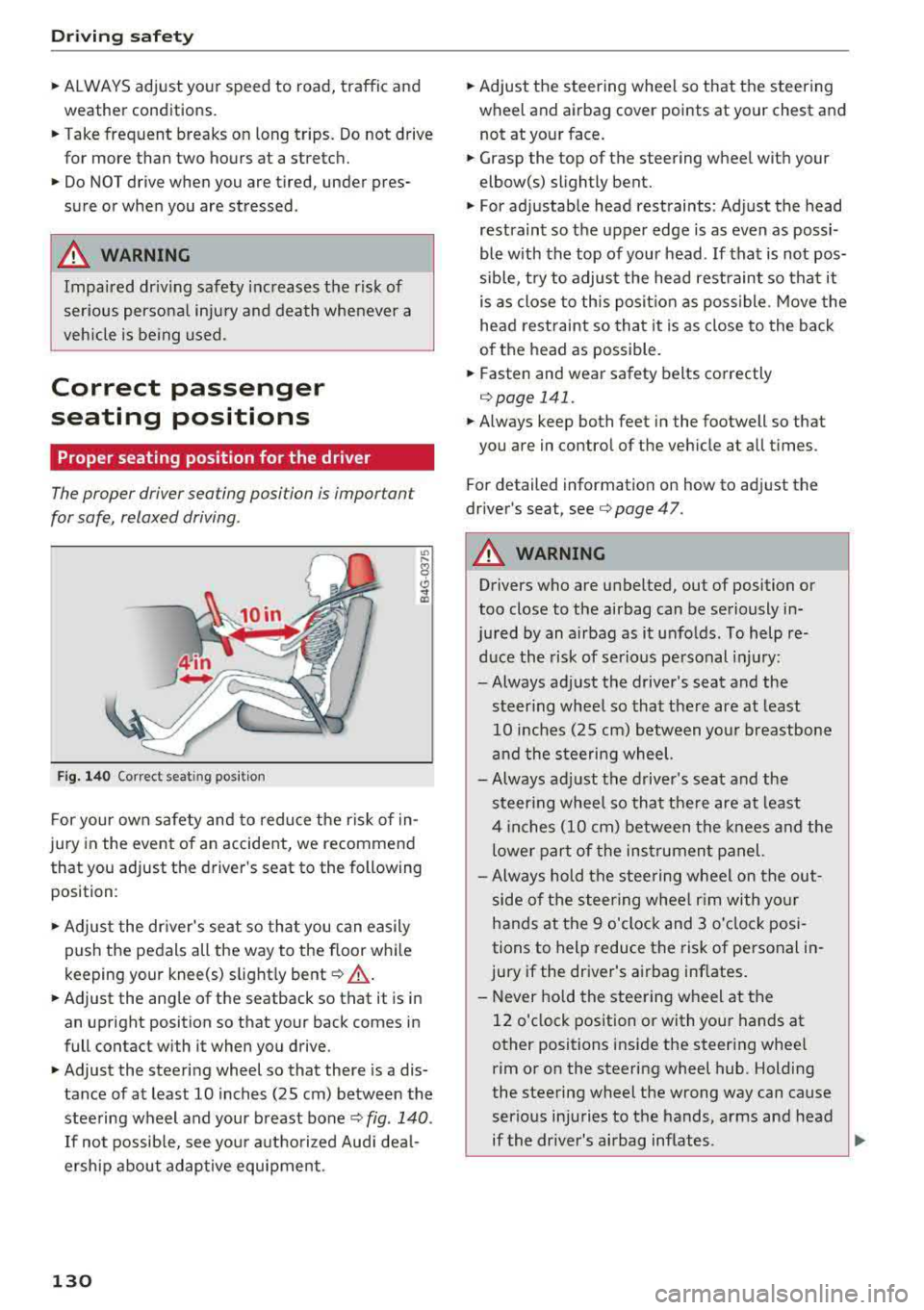
Fig. 14 0 Correc t seat ing posit ion
F or your own safety and to reduce the risk of in
jury in the event of an accident, we recommend
that you adjust the driver 's seat to the following
position :
,.. Adjust the dr iver's seat so tha t you can easily
push the pedals all the way to the floor whi le
keeping your knee(s) s light ly
bent ¢ ,A.
,.. Adjust the angle of the seatback so that it is in
an upright position so that your back comes in
full contact with it when you drive.
,.. Adjust the steering wheel so that there is a dis
tance of at least 10 inches (25 cm ) between the
stee ring wheel and your breast
bone ¢ fig. 140 .
If not possib le, see you r autho rized Aud i dea l
ersh ip about adaptive equipment .
130
,.. Adjust the steering wheel so that the steering
wh eel and airbag cover points at your chest and
not at your face.
,.. Grasp the top of the steering wheel with your
elbow(s) slightly bent.
,.. F or ad justab le head rest raints: Adjust the head
restraint so t he upper edge is as even as possi
ble with the top of your head . If that is not pos
sible, t ry to adjust the head restraint so tha t it
is a s close to this pos it ion as poss ible . M ove the
he ad restraint so tha t it is as close to the back
o f the head as possible.
,.. Fasten and wear safety belts correctly
¢ page 141 .
,.. Always keep both feet in the footwell so that
you are in contro l of the veh icle at all times .
Fo r detail ed information on how to adjust the
dr iver's seat,
see ¢ page 47.
A WARNING
Drivers who are unbelted , out of position or
too close to the airbag can be seriously in-
jured by an airbag as it unfo lds . To help re-
duce the risk of serio us pe rsonal i njury:
-Always adjust the driver's seat and the steer ing whee l so that there are at least
10 inches (25 cm) between you r breastbone
and the steering wheel.
- Always ad just the driver's seat and the
steer ing whee l so that the re are at least
4 inch es (10 cm) between the knees a nd the
lower part of the ins trumen t panel.
-Always hold t he s teering wheel on the out
side of t he steering wheel r im with yo ur
hands at the 9 o'clock and 3 o'clock posi
tions to help reduce the risk of personal in
jury if the dr iver 's airbag inflates.
-Never hold the stee ring wheel at the
12 o'clock position or with you r hands at
other positions inside the steer ing whee l
rim o r on the steering wheel hub. Holding
the steering wheel the wrong way can cause
serious injuries to the hands, arms and head
-
if the driver's airbag inflates . .,_
Page 133 of 274

a co .... N
" N .... 0 00 \,;J '
face decreases the ability of the supplemen
tal driver's airbag to protect you in a colli sion .
- Always sit in an upright position and never
lean against or place any part of your body
too close to the area where the airbags are
located .
- Before driving, always adjust the front seats
properly and make sure that all passengers
are properly restrained .
- For adjustable head restraints : before driv
ing, always also adjust the head restraints
properly .
- Never adjust the seats while the vehicle is moving . Your seat may move unexpectedly
and you could lose control of the vehicle.
- Never drive with the backrest reclined or
tilted far back! The farther the backrests are
tilted back, the greater the risk of injury due
to incorrect positioning of the safety belt
and improper seating position.
- Children must always ride in child seats
~ page 170. Special precautions apply
when installing a child seat on the front
passenger seat
i::> page 146 .
Proper seating position for the front
passenger
The proper front passenger seating position is
important for safe, r elaxed driving.
For your own safety and to reduce the risk of in
jury in the event of an accident, we recommend that you adjust th e seat for the front passenger
to the following position:
.. Adjust the angle of the seatback so that it is in
an upright position and your back comes in full
contact with it wh enever the vehicle is moving.
.. For adjustable head restraints: adjust the head
restraint so the upper edge is as even as possi
ble with the top of your head. If that is not pos
sible , try to adjust the head restraint so that it
is as close to this position as possible
~ page 132. Move the head restraint so that it
is as close to the back of the head as possible.
Driving safety
.. Keep both feet flat on the floor in front of the
front passeng er seat.
.. Fasten and wear safety belts correctly
i::> page 141 .
For detailed information on how to adjust the
front pass enger's s eat, see
i::> pag e 47.
A WARNING
= -
Front seat passengers who are unbelted, out
of position or too close to the airbag can be
seriously injured or killed by the airbag as it
unfolds . To help reduce the risk of serious
personal injury:
- Passengers must always sit in an upright po
sition and never lean against or place any part of their body too close to the area
where the airbags are located.
- Passengers who are unbelted, out of posi
tion or too close to the airbag can be seri
ously injured by an airbag as it unfolds with
g reat force in the blink of an eye.
- Always make sure that there are at least
10 inches (25 cm) between the front pas
senger's breastbone and the instrument panel.
- Always make sure that there are at least
4 inches (10 cm) between the front passen
ger's knees and the lower part of the instru
ment panel.
- Each passenger must always sit on a seat of
their own and properly fasten and wear the
safety belt belonging to that seat .
- Before driving, always adjust the front pas
senger seat properly.
- For adjustable head restraints: before driv
ing, always also adjust the head restraints
properly .
- Always keep your feet on the floor in front
of the seat. Never rest them on the seat, in
strument panel, out of the window, etc. The
airbag system and safety belt will not be
able to protect you properly and can even in
crease the risk of injury in a crash .
- Never drive with the backrest reclined or
tilted far back! The farther the backrests are
tilted back, the greater the risk of injury due
~
131
Page 134 of 274
Driving safety
to incorrect positioning of the safety belt
and improper seating position.
- Children must always ride in child seats
c:> page 170. Special precautions apply
when installing a child seat on the front passenger seat
c:> page 146 .
Proper seating positions for passengers in
rear seats
Rear sea t passengers must si t upright wi th both
feet on the floor consistent with their physical
size and be properly restrained whenever the
ve
hicle is in use.
To reduce the r isk of injury caused by an incorrect
seating position in the event of a sudden braking
maneuver or an accident, yo ur passengers on the
rear bench seat must always observe the follow
i n g:
• For adjustable head restra ints: adjust the head
r estra int so the uppe r edge is as even as poss i
ble with the top of your head. If that is not pos
sible, try to ad just the head restra int so th at it
is as close to this position as possib le
c:> page 132 .
• Keep both feet flat i n the footwell i n front of
the rear seat.
• Fas ten and wear safety belts properly
c:> page 141.
• Make sure that children are always properly re
strained in a ch ild restraint that is approp riate
for their size and age
c::> page 170 .
_& WARNING
Passengers who are imp roperly seated on the
rear seat can be seriously injured in a crash .
- E ach passenger m ust always sit on a seat o f
their own an d properly fas ten and we ar the
safe ty belt belongi ng to that sea t.
- Safe ty belts only offe r m aximum p rotection
when the safety belts are properly posi
tioned on the body and securely latched . By
not sitting upright, a rear seat passenger
in
c reases the risk of personal in ju ry from im
properly positioned safety belts!
132
- For adjustable head restraints: always ad
just the head restraint properly so that it
can give maximum protection.
Proper adjustment of head restraints
App lies to : vehicles with adjustable head restra ints
Correctly adjusted head restraints are an impor
tant part of your vehicle's occupant restraint sys
tem and can help to reduce the risk of injuries in
acciden t situations.
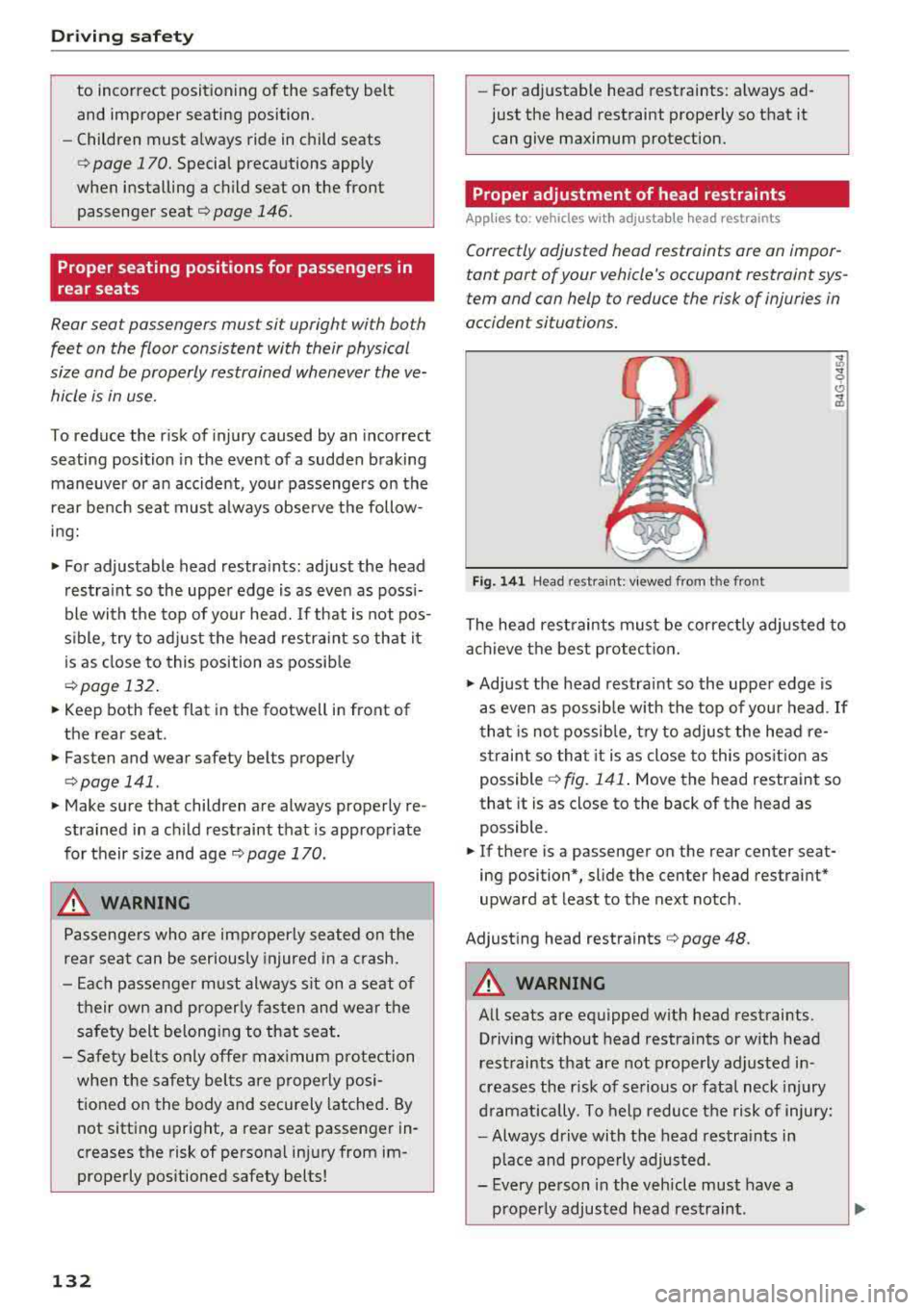
Fig. 141 Head rest ra in t: v iewed from t he front
The head rest raints must be corre ctly adjus ted to
a chieve t he best protec tion .
• Adjust the head rest ra int so the upper edge is
as even as possib le w ith the top of you r head . If
t ha t is no t possib le, try to adjus t the head
re
strai nt so that it is as close to this pos it ion as
possible
c:> fig. 141 . Move the head restraint so
that it is as close to the back of the head as
possible .
• If there is a passenger on the rear center seat
ing position*, slide the center head restraint *
upward at least to the next notch .
Adjust ing head restraints
c:> page 48.
_& WARNING
All seats are equipped w ith head restraints .
Driving w ithout head restraints or w ith head
rest raints that are not prope rly adj usted in
creases the r is k of se rious or fata l neck injury
d ramat ica lly . To help reduce t he risk of injury:
- Always drive with the head restra ints in
place and prope rly adjusted.
- Every pe rson in the vehicle must have a
proper ly adjusted head restraint .
-
Page 135 of 274
a co .... N
" N .... 0 00 \.J '
properly adjusts their head restraint. Adjust
the head restra int so the upper edge is as
even as possible w ith the top of your head .
If that is not possible, try to adjust the head
restra int so that it is as close to th is position
as possib le. Move the head restra in t so that
it is as close to t he b ack of the he ad as pos
sible.
- Never attempt to adjust head restra int
w hil e d riving. If you have dr iven off and
must adjust the dr ive r headrest for any rea
son, first stop the vehicle safely before at
tempting to adjust the head restraint .
- Children must a lways be proper ly restrained
in a chi ld restraint that is appropriate for
their age and size
~ page 170.
Examples of improper seating positions
Th e occupant r estraint syst em con only r educ e
the risk of injury if vehicle occupants ore properly
seated.
I mp roper seating posi tions can cause se rious in
jury or death . Safety belts can only work when
they ar e properly positioned on the body. Im
prope r seating positions reduce the effectiveness
of safe ty belts and w ill even increase the r isk of
injury and death by moving the s afety belt to crit
ical areas of the body . Improper seating posit ions
also increase the risk of ser ious injury and death
when an airbag deploys and strikes an occupant
who is not i n the prope r seat ing pos ition. A d rive r
i s respons ible for the safety of a ll vehicle occu
pants and especia lly fo r children . There fore:
"' Never allow anyone to assume an inco rrect
seat ing pos it ion w hen t he ve hicle is being used
~& -
The follow ing bulletins list only some sample po
sitions that will increase the risk of serious inju ry
and dea th. O ur hope is that these examp les w ill
make you more aware of seat ing pos it ions tha t
are dangerous .
Therefore, wh enever th e vehicle is moving:
- never stand up in the veh icle
- never stand on the seats
Dri ving saf ety
- never kneel on the seats
- neve r ride wit h the seatback recl ined
- neve r lie down on the seats
- neve r lean up against the instrument panel
- never s it on the edge of the seat
- never s it sideways
- never lean out the window
- never put your feet out the window
- neve r put your feet on t he instr ument pane l
- neve r rest your feet on the seat cushion or back
of the seat
- neve r ride in the footwell
- never ride in the cargo area
A WARNING
-
Imp roper seating positions inc rease the risk
of ser ious perso nal in jury and death whenever
a ve hicl e is being u sed .
- Always make sure that all ve hicle occupants
stay in a p roper seating posit ion and a re
p roperly restra ined whe never the veh icle is
be ing used.
Driver's and front
passenger's footwell
Important safety instructions
Applies to: vehicles with knee airbags
A WARNING
= -
A lways make s ure t hat the knee airbag can in
flate w ithout interference. Objects between
yourself and the airbag can increase the risk
of injury in an accide nt by interfering with the
way t he a irbag dep loys or by be ing pushed in
to you as the a irbag dep loys .
- No persons (ch ildren) or animals should ride
in the footwell in front of the passenger
seat . If the a irbag deploys, this can res ult in
ser io us or fatal injur ies.
- N o objects of a ny kind should be ca rr ied in
the footwell a rea in front of the dr ive r's or
p a sse nger's seat. B ulky objects (shopp ing
b ags, for exam ple) can h amper o r preven t
proper dep loymen t of the airbag . Sma ll ob
jects can be thrown thro ugh the vehicle if
133
Page 140 of 274
Safety belts
Safety belts
General information
Always wear safety belts!
Wearing safety belts correctly saves lives!
This chapte r exp lains why safety be lts a re neces
sary, how they work and how to adjust and wear
them correct ly.
~ Read all the information that follows and heed
all of t he instr uctions and WARNINGS.
A WARNING
Not wea ring safety belts or wearing them im
properly inc reases the risk of ser io us personal
inju ry and dea th.
- Safety belts are the s ingle most effective
mea ns ava ila bl e to reduce t he ris k of ser ious
injury and dea th in automob ile acc idents.
Fo r yo ur pro tec tion an d that of your passe n
gers, alw ays co rre ctly wea r sa fe ty be lts
whe n the veh icle is mov ing.
- Pr egnan t wome n, in ju re d, o r physically i m
paired perso ns m us t al so use s afety be lts.
L ik e all ve hicl e o ccupa nts, they are mor e
li ke ly to be serio usly i nju re d if th ey d o no t
wea r safety be lts. The best way to protect a
fetus is to protect the mothe r
-th roughout
the ent ire pregnancy.
Number of seats
Your Aud i has a total of four seating positions:
two in the front and two in the rear. In some
ve hicles, there are f ive seating positions: two in
the front and three i n the rea r. Each sea ting pos i
t ion has a safety belt.
A WARNING
Not wearin g s afety bel ts or weari ng the m im
p ro perly in cr eas es th e risk of ser io us person al
inju ry and dea th.
- N ever strap mo re th an on e person, inclu d
i ng sm all childr en, into an y be lt .
It is espe
ci ally d angerous to pla ce a sa fety bel t over a
c h ild sitting o n you r lap .
138 -
Never let more peop le r ide in the vehicle
than there are safety be lts available.
- Be s ure everyone ridin g in t he vehicle is
properly restrained with a separate safety
be lt or c hild restraint.
~ Safety belt warning light
Your vehicle has a warning system for the driver
and front seat passenger (on USA models only)
to remind you about the importance of buckling
up .
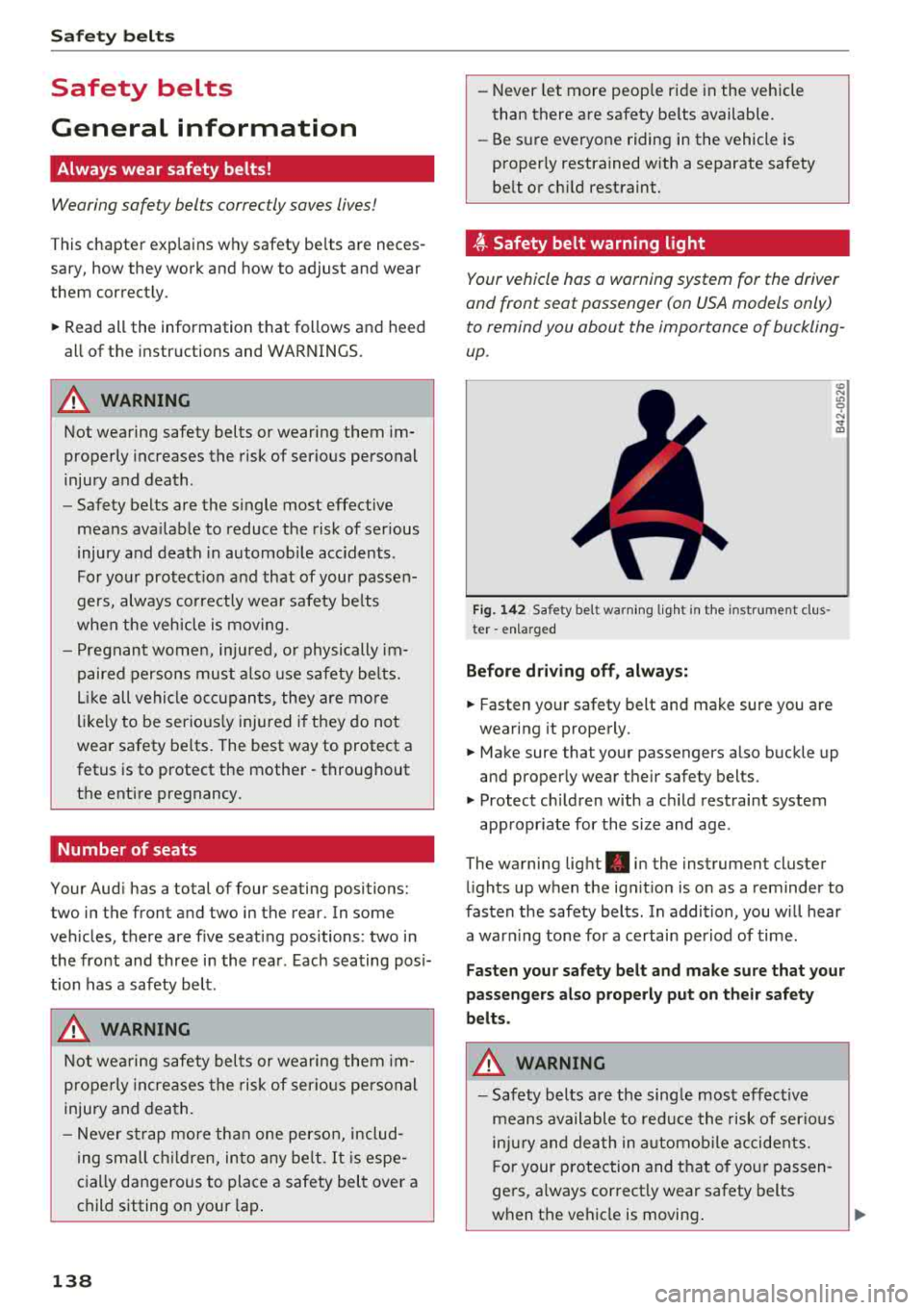
Fig. 142 Safety belt wa rning lig ht in th e inst rume nt clus
ter
-e nl arged
Before driving off , always :
~ Fasten yo ur safety belt an d ma ke sure you are
wearing it prope rly.
and properly wea r the ir safety belts.
~ Protect ch ild ren w ith a c hild restraint system
app ropr iate for the size and age .
The wa rning lig ht . in the inst rument cluste r
li ghts up w hen the ig nition is o n as a rem inder to
fasten the safety bel ts . In addi tion, you w ill hear
a war ning tone for a certain period of time .
Fasten your safety belt and make sure that your
passengers also properly put on their safety
belts.
A WARNING -
- Sa fety belt s are th e sing le mo st effecti ve
means av ail able to reduc e the risk of ser ious
in jur y and de ath in a utom obile accide nts.
Fo r your p rotec tion and t hat o f yo ur p ass en
ge rs, a lways cor rect ly wear safety belts
w hen t he ve hicle is moving .
~
Page 141 of 274
a co ,...,
N
" N ,...,
0 00 <.,;) '
that come on, could lead to personal injury.
Why use safety belts?
Frontal collisions and the law of physics
Frontal crashes create very strong forces for peo
ple riding in vehicles .
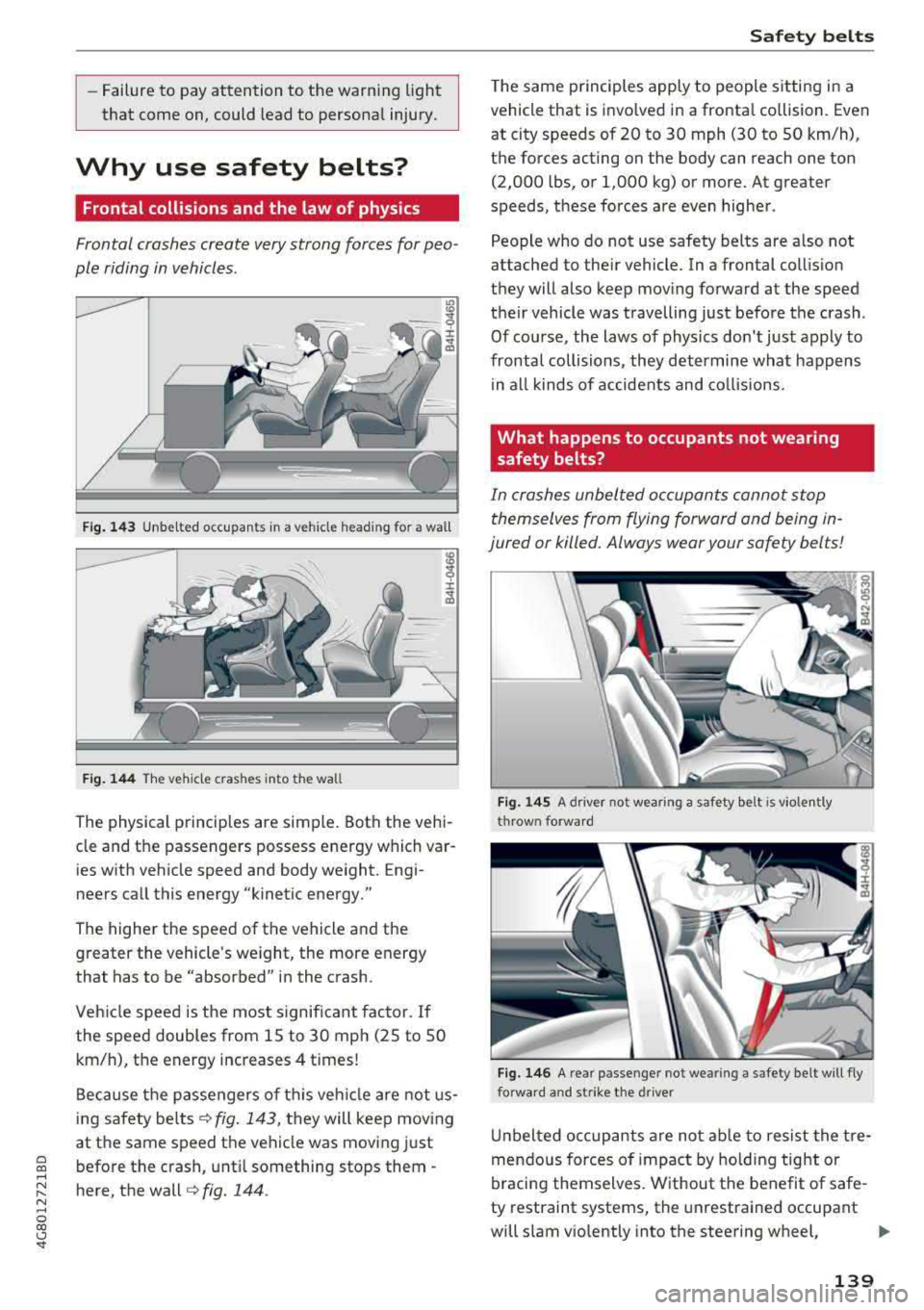
Fig. 143 Unbelted occupants in a vehicle heading for a wall
Fig. 144 The vehicle crashes into the wall
The physical principles are simple. Both the vehi
cle and the passengers possess energy which var ies with vehicle speed and body weight. Engi
neers ca ll this energy "k inetic energy."
The higher the speed of the vehicle and the greater the vehicle's we ight, the more energy
that has to be "absorbed" in the crash.
Veh icle speed is the most significant factor. If
the speed doubles from 15 to 30 mph (25 to 50
km/h), the energy increases 4 t imes!
Because the passengers of this vehicle are not us
ing safety belts¢
fig. 143, they will keep moving
at the same speed the vehicle was moving just
before the crash, until something stops them -
here, the wall¢
fig. 144.
Safety belts
T he same p rinciples apply to people s itting in a
vehicle that is invo lved in a fronta l co llision. Even
at city speeds of 20 to 30 mph (30 to SO km/h),
the forces acting on the body can reach one ton
(2,000 lbs, or 1,000 kg) or more. At greater
speeds, these forces are even higher.
People who do not use safety belts are a lso not
attached to the ir vehicle. In a frontal collis ion
they will also keep moving forward at the speed
their vehicle was travelling just before the crash .
Of course, the laws of physics don't just apply to
frontal collisions, they determine what happens in all kinds of accidents and collisions .
What happens to occupants not wea ring
safety belts?
In crashes unbelted occupants cannot stop
themselves from flying forward and being in
jured or killed. Always wear your safety belts!
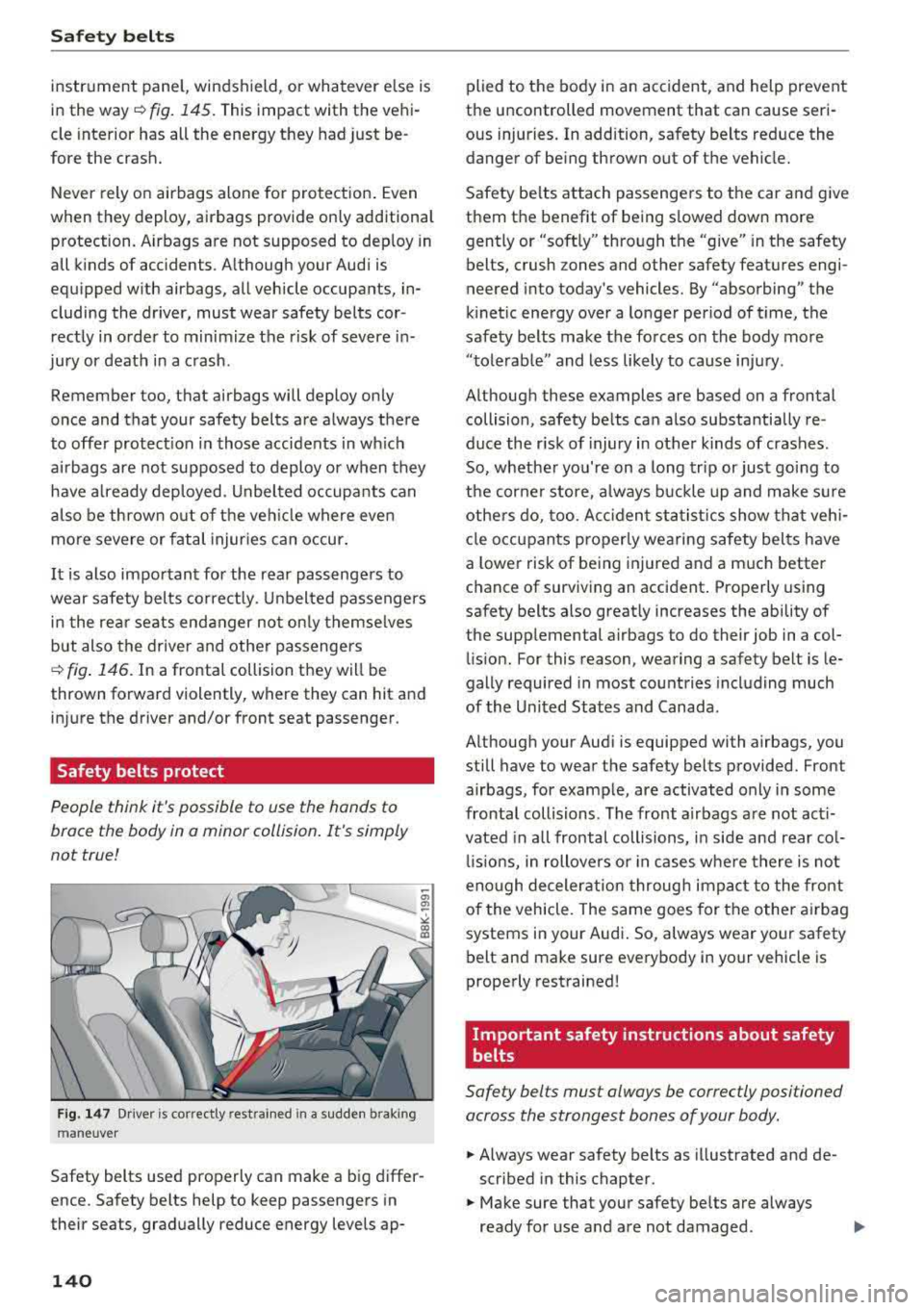
Fig. 14S A driver not wearing a safety belt is violently
thrown forward
Fig . 146 A rear passe nger not wearing a safety belt will fly
forwa rd and strike the driver
Unbelted occupants are not able to resist the tre
mendous forces of impact by holding tight or
bracing themselves . Without the benefit of safe
ty restraint systems, the unrestrained occupant
will slam violently into the steering wheel,
IJI,,-
139
Page 142 of 274
Safe ty belts
instrument panel, windshield, or whatever e lse is
in the way
r:!> fig. 145. This impact with the vehi
cle interior has all the energy they had just be
fore the crash.
Never rely on airbags alone for protection . Even
when they deploy, airbags provide only additiona l
protection. A irbags are not supposed to dep loy in
all kinds of accidents. A lthough your Audi is
equipped w ith airbags, all vehicle occupants, in
cluding the dr iver, must wear safety belts cor
rectly in order to minimize the risk of severe in
jury or death in a crash .
Remember too, that airbags will deploy only
once and that your safety belts are always there
to offer protect ion in those accidents in w hich
airbags are not supposed to deploy or when they
have a lready deployed . Unbel ted occupants can
a lso be thrown o ut of the veh icle where eve n
mo re severe or fatal injur ies can occur .
It is also important for the rear passenge rs to
wear safety belts correctly. Unbel ted passengers
i n t he re ar seats endanger no t on ly themse lves
but also the drive r and other passengers
c::> fig . 146 . In a frontal collision they will be
thrown forward violently, where they can hit and
in jure the driver and/or front seat passenger .
Safety belts protect
People think it's possible to use the hands to
brace the body in a minor collision . It's simply
not true!
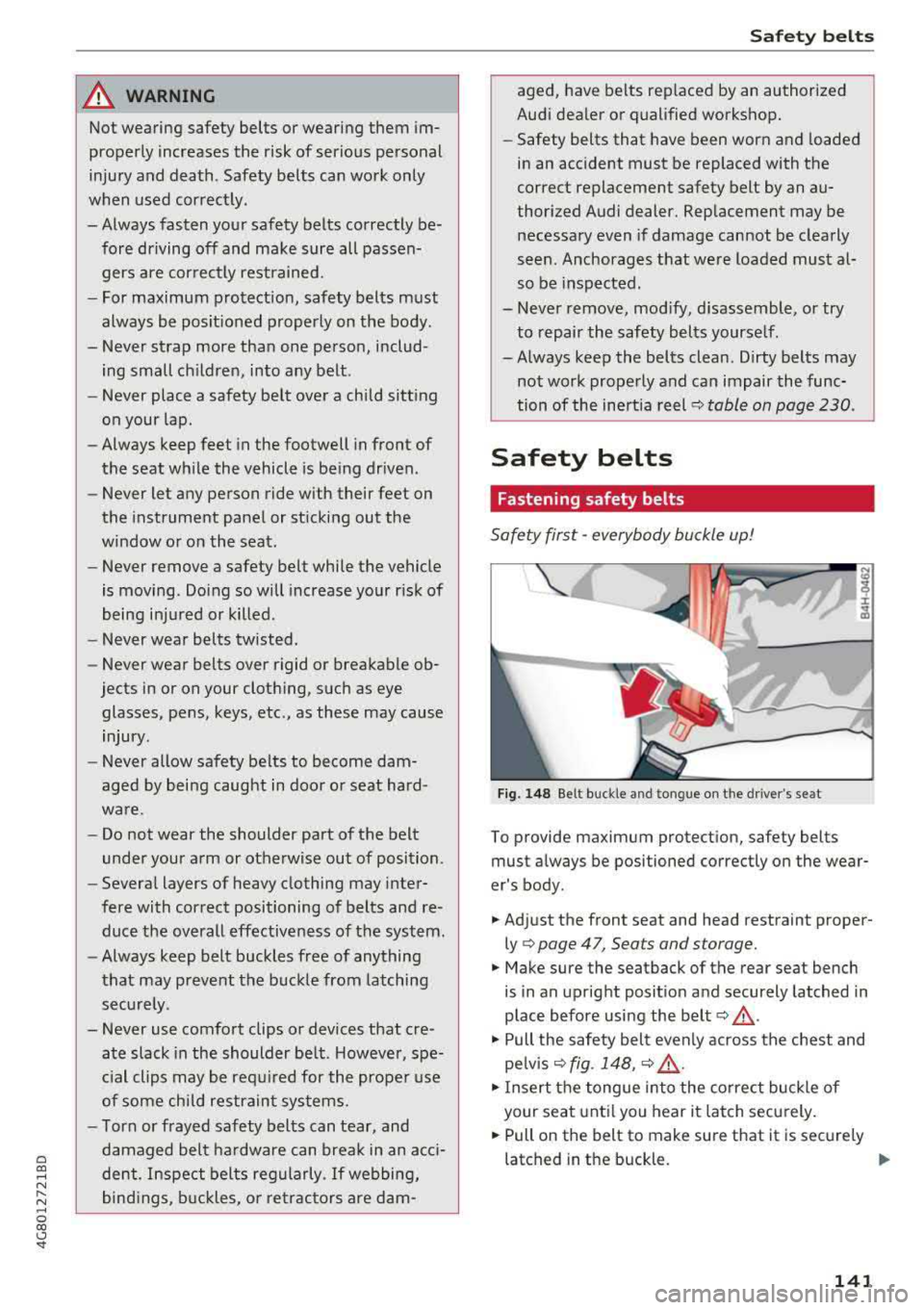
F ig . 14 7 Driver is co rrectly restrai ned in a sudde n brak ing
m aneu ver
Safety belts used properly can make a b ig d iffer
ence. Safety belts help to keep passengers in
their seats, gradually reduce energy levels ap-
140
plied to the body in an accident, and help prevent
the uncontrolled movement that can cause seri
ous injuries. In addition, sa fety belts reduce the
danger of being thrown out of the vehicle.
Safety be lts attach passengers to the car and give
them the benefit of being s lowed down more
gently or "soft ly" through the "give" in the safety
belts, crush zones and other safety features engi
neered into today's vehicles. By "absorbing" the
k inet ic energy over a longer per iod of t ime, the
safety belts make the forces on the body more "tole rab le" and less likely to cause inju ry .
Although these examples are based on a frontal
collision, safety be lts ca n also substantially re
duce the r isk o f injury in ot her kinds of crashes .
So, whethe r you're on a long trip or just going to
the cor ne r store, a lways b uckle up and make s ure
othe rs do, too. Ac ciden t st at istic s show that veh i
cl e occupants prope rly wearing safety bel ts have
a lowe r risk of be ing injured and a m uch better
chance of surviving an acc ident . Properly using
safety be lts also great ly increases the ability of
the supp lemental airbags to do their job in a col
li sion. For this reason , wearing a safety belt is le
gally required in most countries including much
of the United States and Canada.
Although your Aud i is equipped with airbags, you
still have to wear the safety belts provided. Front
airbags, for examp le, are activated only in some
frontal collisions. The front airbags are not act i
vated in a ll frontal collisions, in side and rear co l
li sio ns, in rollovers or in cases whe re there is not
eno ugh decelerat ion throug h impa ct to the front
of the vehicle . The same goes for the other a irbag
systems in your Audi. So, always wear your safety
belt and make sure everybody in your vehicle is
properly rest rained!
Important safety instructions about safety
belts
Safety belts must always be correctly positioned
across the strongest bones of your body .
.,. Always wear safety belts as illustrated and de
scribed in this chapter.
.,. Make sure that your safety be lts are always
ready for use a nd a re not damaged .
Page 143 of 274
a co ,...,
N
" N ,...,
0 00 <.,;) '
Not wearing safety belts or wearing them im
properly increases the risk of serious personal
injury and death . Safety belts can work only
when used correctly.
-Always fasten your safety belts correctly be fore driving off and make sure all passen
gers are cor rectly restrained.
-For maximum protection, safety belts must
always be posit ioned properly on the body .
-Never strap more than one person, includ
ing small ch ildren, into any belt .
-Never place a safety belt over a child sitt ing
on your lap.
- Always keep feet in the footwell in front of
the seat wh ile the vehicle is being driven.
- Never let any person ride w ith their feet on
the instrument panel or st icki ng out the
window or on the seat.
- Never remove a safety belt while the vehicle
is moving . Do ing so will increase your risk of
being injured or k illed.
- Never wear belts twisted.
- Never wear belts over rigid or breakable ob-
jects in or on your clothing, such as eye
glasses, pens, keys, etc ., as these may cause
injury.
- Never allow safety belts to become dam
aged by being caught in door or seat hard
ware.
- Do not wear the shoulder part of the belt
under your arm or otherwise out of position .
- Several layers of heavy clothing may inter
fere with correct positioning of belts and re
duce the overall effectiveness of the system.
- Always keep belt buckles free of anything
that may prevent the buckle from latching
securely .
-Never use comfort clips or devices that cre
ate slack in the shoulder be lt . However, spe
c ial clips may be requ ired for the proper use
of some child restraint systems.
-Torn or frayed safety belts can tear, and
damaged belt hardware can break in an acc i
dent. Inspect belts regularly .
If webbing,
bind ings, buckles, or retractors are dam-
Safety bel ts
aged, have belts rep laced by an authorized
Aud i dea ler or qualified workshop.
- Safety belts that have been worn and loaded
in an accident must be replaced with the
correct replacement safety belt by an au
thor ized Audi dealer. Replacement may be
necessary even if damage cannot be clearly
seen. Anchorages that were loaded must al
so be inspected.
- Never remove, mod ify, d isassemble, or try
to repair the safety belts yourse lf.
-Always keep the belts clean . Dirty belts may
not work properly and can impair the func
tion of the inert ia reel
q table on page 230 .
Safety belts
Fastening safety belts
Safety first -everybody buckle up!
Fig. 148 Be lt buckle and to ngue on t he d river' s se at
To provide maximum protection, safety belts
must always be positioned correctly on the wear
er 's body .
.. Adjust the front seat and head restra int proper
ly
q page 47, Sea ts and storage.
.. Make sure the seatback of the rear seat bench
is in an upright posit ion and securely latched in
p lace before using the belt
q ,&. .
.. Pull the safety belt evenly across the chest and
pe lvis
q fig . 148, q ,&. .
.. Insert the tongue in to the correct buckle of
your seat until you hear it latch securely.
.. Pull on the belt to make sure that it is securely
latched in the buckle.
..,
141
Page 144 of 274
Safe ty belts
Autom ati c s afet y belt retractors
Every safety be lt is equ ipped with an automatic
be lt retractor on the shoulder belt. This feature
locks the belt when the belt is pu lled out fast,
during hard braking and in an accident. The belt may a lso lock when you drive up or down a steep
hill or through a sharp curve. Dur ing normal driv
ing the belt lets you move freely.
Safety belt p ret en sione rs
Safety belts w ith pretensioners he lp to tighten
the safety belt and remove s lack when the pre
tensioners are activated
c;, page 144 . The func
tion of the pretensioner is monitored by a warn
ing light
c;, page 16 .
Convertibl e loc king r etracto r
Every safety belt except the one on the driver
seat is equipped w ith a convertible locking retrac
tor that
must be used when the safety belt is
used to attach a child seat. Be sure to read the
important information about this feature
¢ page 181 .
.&_ WARNING
Improperly pos itioned safety be lts can cause
ser ious injury in an
accident ¢ page 142,
Safety belt position.
- Safety belts offer optimum protection only
when the seatback is upright and belts are
properly positioned on the body.
- Always make sure that the rear seat bac k
rest to which the center rea r safety belt* is
attached is securely latched whenever the
rear center safety belt is being used. If the
backrest is not securely latched, the passen
ger will move forward with the backrest dur
ing sudden braking, in a sudden maneuver
and especially in a crash.
- Never attach the safety belt to the buckle for another seat. Attaching the belt to the
wrong b uckle wi ll reduce safety belt effec
t iveness and can cause serious person-a l in
jury.
- A passenger who is not properly restrained can be seriously in jured by the safety be lt it
self when it
moves from the stronger parts
142
of the body into critical areas like the abdo men.
- Always lock the convertible locking retractor
when you are securing a child seat in the ve
hicle
,=;, page 183.
(D Tips
For information on safety belt pretensioners,
refer to
c;, page 144 .
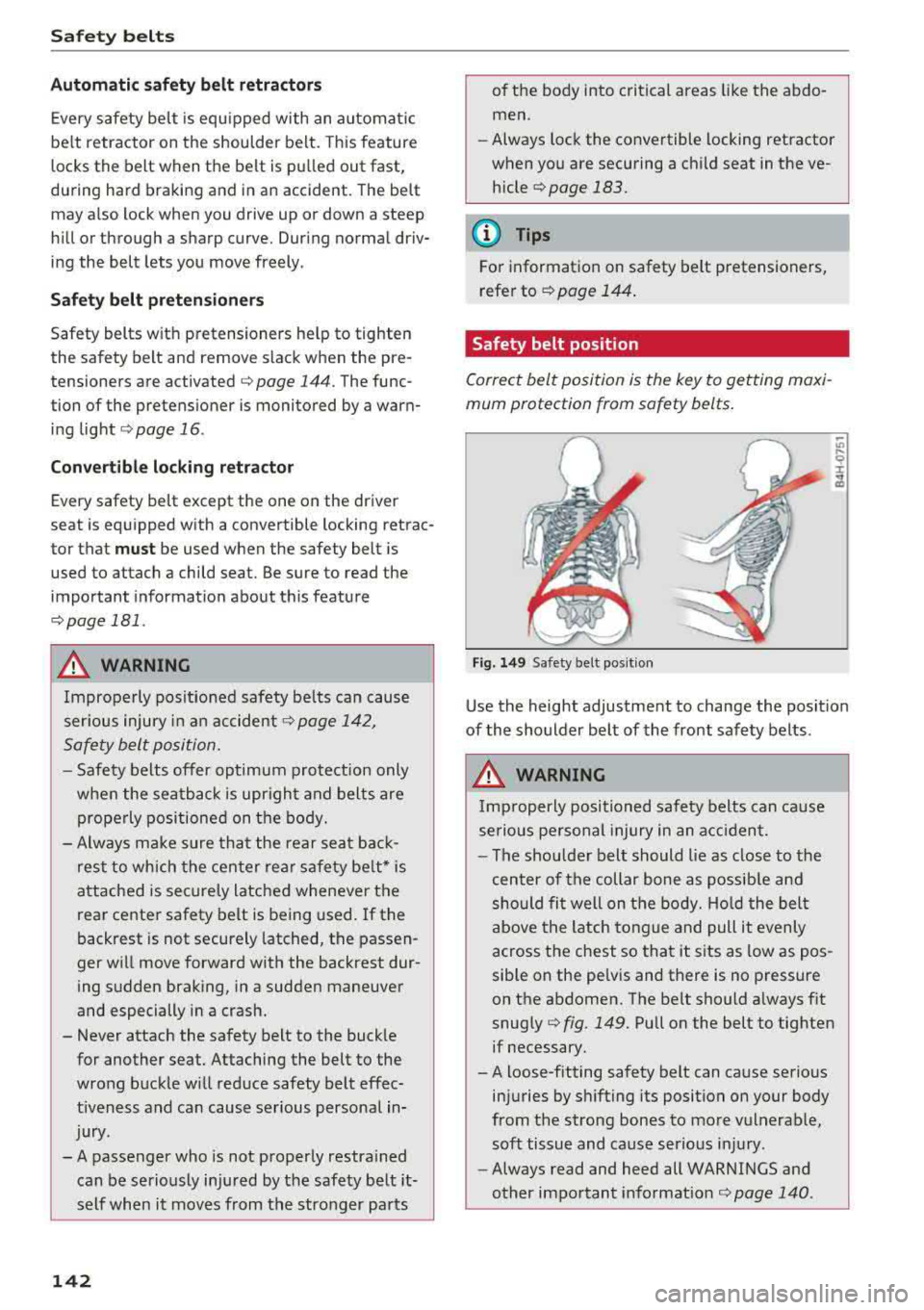
Safety belt position
Correct belt position is the key to getting maxi
mum protection from safety belts .
Fig. 149 Safety belt posit ion
Use the height adjustment to change the posit ion
of the shoulder belt of the front safety belts .
.&_ WARNING
Imp roperly positioned safety belts can cause
serio us pe rsonal injury in an a cc ident.
- The shou lde r belt should lie as close to the
center of the collar bone as possib le and
should fi t well on the body. Ho ld the belt
above the latch to ngue and pull it evenly
across the chest so that it sits as low as pos
sible on the pe lvis and there is no pressure
on the abdomen. The belt should a lways f it
snug ly
c;, fig. 149. Pull on the belt to tighten
if necessary.
- A loose-fitting safety belt can cause serious
injuries by sh ifting its position on your body
from the strong bones to more vulnerable,
soft tissue and cause serious i nju ry .
- Always read and heed all WARNINGS and
other important informat ion
c;, page 140 .
Page 145 of 274
a co ,...,
N
" N ,...,
0 00 <..:l '
restrained
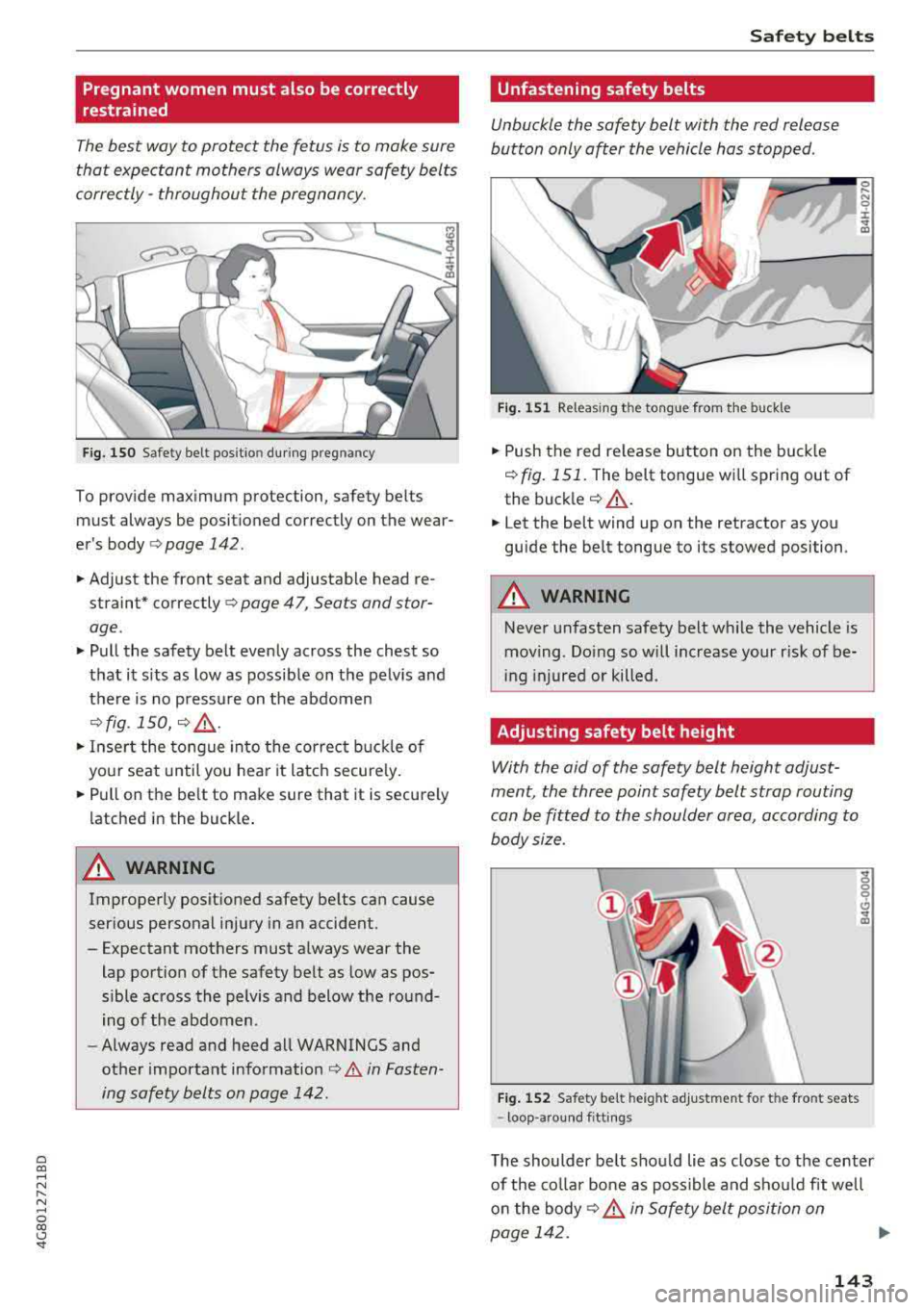
The best way to protect the fetus is to make sure
that expectant mothers always wear safety belts
correctly
-throughout the pregnan cy.
F ig. 150 Safety belt pos itio n during pregnancy
To prov ide max imum protection, safety belts
must always be posit ioned correctly on the wear
er 's body
r=> poge 142.
.,. Adjust the front seat and adjustable head re
straint* correctly ¢
page 47, Seats and stor
age .
.,. Pull the safety belt evenly across the chest so
that it sits as low as poss ib le on the pelv is and
there is no pressure on the ab domen
¢fig. 150, ¢ .(D..
.,. Inse rt the tongue into the cor rec t buckle of
your seat until you hea r it latch secure ly .
.. Pull on the be lt to make sure that it is securely
latched in the buck le .
A WARNING
Improperly posit ioned safety be lts can cause
ser ious personal injury in an accident.
- Expectant mothers must always wear the lap portion of the safety belt as low as pos
sible across the pelvis and below the round
ing of the abdomen.
- Always read a nd heed all WARN INGS and
other important information
c:> .&. in Fasten
ing safety belts on page 142.
Safet y bel ts
Unfastening safety belts
Unbuckle the safety belt with the red release
button only
o~er the vehicle hos stopped.
F ig . 1 51 Releasing th e to ngue from the buckle
.. Push the red re lease button on the buck le
r=> fig . 151. The belt tongue w ill spring out of
the
buck ler=> .(D. .
.. Let the belt wind up on the retractor as you
guide the belt tongue to its stowed position .
A WARNING
Never unfasten safety belt wh ile the vehicle is
moving . Do ing so will increase your r isk of be
i ng injured or killed .
Adjusting safety belt height
With the aid of the safety belt height adjust
ment, the three point safety belt strop routing
con be fitted to the shoulder area, according to
body size.
Fi g. 1 52 Safety belt height adj ust m ent fo r th e fro nt seats
-loop -arou nd fitt ings
0 ..... N 0 :i:
of the co ll ar bo ne as possible and shou ld fit well
o n the body
c:> LD. in Safe ty belt position on
page 142.
..,.
143